Tag Archives: red bay

Friday 7th September 2018 – AND THERE I WAS …

*************** THE IMAGES ***************

There are over 3,000 of them and due to the deficiencies of the equipment they all need a greater or lesser amount of post-work. And so you won’t get to see them for a while.

You’ll need to wait til I return home and get into my studio and start to go through them. And it will be a long wait. But I’ll keep you informed after I return.
***************

… lying on my palliasse wondering whether I ought to heave myself out of my stinking pit.

I’d had a really bad night. For some reason I was very sensitive to the engine noise. It was constantly changing pitch and consequently constantly keeping me awake all through the night and I can’t recall if I ever managed to drop off to sleep.

And as the 06:00 alarm suddenly started to sound, a voice shouted down the loudspeaker system “Polar Bears at 3 o’clock”.

In my half-awakened state I thought to myself that he’s a good few hours late with this announcement, but then it clicked and I grabbed the camera, dashed out of my room, bumped into a lady, she screamed so I dashed back into my room and put on my clothes and then dashed back onto the starboard beam.

At first I thought that it was two polar bears on the ice floe but as events unfolded, I noticed that there were three. A mother and two cubs.

Mum was in position by a seal hole awaiting breakfast, and the two cubs were in their snow-bank den waiting for mum to come back with the grub.

She was totally unperturbed by the passing of the vessel even though it would keep away the seals, but the thing about living in the Arctic is patience. Never mind the “Ohh God, give me patience. And hurry!” – I once heard a delightful story about a group of Inuit who went to the Arctic meadows on Ungava for some hay, found that the grass hadn’t grown enough, so they pitched their tents there and waited.

And this was exactly what mummy was doing, perched by the seal hole. Not pitching her tent waiting for the hay to grow of course, but you know what I mean.

The photos are unfortunately rubbish but then it’s with the Nikon 1’s light-hungry zoom lens in the half-light from a moving ship when I’m not even half-awake. What did you expect? David Bailey?

After taking a score or so of photos, I went back to my room for my medication and other stuff.

And while I was sorting out my laptop, it reminded me of last night’s later events. The bearing on the binnacle was 121°, so we are going in the opposite direction. 0° is North, 90° is East, and so we are heading more-or-less south-east right now, back down Lancaster Sound.

Breakfast was in company of a couple of travellers who seem to have taken a shine to me, and I’ve no idea why because I’m not usually the kind of person whom others like, and we had a really good chat about this and that.

Not about the other though. That’s a rather sore point right now the way that things are. I think that Strawberry Moose is having more luck than me in that respect.

Later I was up on the bridge admiring the pack ice away in the distance to the south, and looking at the beautiful scenery of this corner of Devon Island. I’ve no idea where we are going next, and I’m not convinced that the crew and the captain know either.

Mind you I did manage to speak to a member of the crew about the ship that I keep on seeing. Apparently there’s another ship – the Fram – that’s loitering around the ice edge waiting for a gap to miraculously appear;

We’ve seen several icebergs go drifting past, some of them extremely impressive but none more so than this one with a hole in the middle, like a floating polo mint.It’s apparently called a keyhole iceberg. The hole is caused by some kind of subterranean river in the glacier

And while I was photographing that iceberg I noticed out of the corner of my eye a ship away in the distance. This time, it was no problem in the light to photograph it at distance and to crop it down to see what it was.

It’s indeed a Canadian icebreaker of the kind that would be on stand-by duty around here to watch out for icebergs and also for ships that might risk running headlong into the pack-ice. There are several ships in the channel and also several communities that have not yet received their winter provisions, so with the seas icing up so quickly already, they will be in for a tough time if the icebreakers can’t open up a channel.

We had a couple of discussion session, several of which didn’t interest me very much so I didn’t take part in them, and the one on the story of Franklin’s expeditions and the Erebus and Terror stories, but I didn’t really learn all that much that I didn’t already know.

I did however manage to buttonhole the camera guy and we discussed the camera, the images and my technique.

He had a good look at everything and had a few things to say about it.

Firstly, there’s nothing wrong with my technique except that with it being a lightweight camera, I’m pressing too hard on the switch and making the camera shake at the crucial moment.

Secondly, the images come out the same on his laptop so it’s not a fault of my laptop,

As for the quality of the images, that’s as good it can be. So the fault lies in the camera itself. Not that it’s a bad camera, but simply that it’s not designed to do what I want to do with it and I’m pushing it to the limit of its technical capabilities and even beyond.

It was then lunchtime so I nipped off and had a salad. And to be quite honest I spent more time talking than eating. The yoga assistant is a big fan of 70s rock music so I’ve invited her to come and listen to some of the stuff that I have on my laptop.

It sure beats etchings, doesn’t it?

On a totally different tack, does anyone still remember our trip to Red Bay in Labrador
and the Bernier?

There’s a girl on board ship – one of the staff – called Bernier so I asked her what she knew about the ship. Nothing whatever, she told me, but she did know that there was a very famous Canadian sea captain called Bernier and one of the pages on the Canadian passport depicts him.

Another member of staff told me that Bernier (the captain, not the ship) worked in the High Arctic and it was he who actually claimed Bylot Island – which we will be passing – for Canada in 1906 and he had his crew carve something emblematic on a cliff face.

I’m writing this now because everyone else is outside looking at a bird colony. But as regular readers of this rubbish will recall, the only birds in which I have any interest won’t be found clinging to a rock in the High Arctic.

And this is a fine time for the battery in the camera to start to go flat, and we’re off out in an hour or so. I’ve had to bung it on charge and of course, it’s now that we’re starting to sail through the ice. Good job that I have the phone handy, although what the quality might be like is anyone’s guess.

But it actually worked out, because the sea was so rough at this point that the water in the heated pool was going everywhere except where it was supposed to go, and I was able to take a few videos of it.

The phone didn’t last too long though. There was a huge iceberg away in the distance – more like a large sheet of float actually – and the phone camera will never do justice to that, so I’ve had to go down and fetch the Nikon.

They are still trying to do their best to entertain us seeing as everything that is planned is falling apart. And so we had afternoon tea while we played a kind of game where we had to find out bits and pieces about each other. I sort-of took part in it in a half-hearted way because I’m not really in to being sociable as regular readers of this rubbish will recall.

There’s a National Park at Tay Bay on Bylot Island which is on our route and it’s been decided that we will go for an evening ramble around there.

We needed a briefing from Parks Canada (done vitually) before we could go and, much to my surprise, we were first to leave the boat. I had to get a wiggle on to get changed into my winter gear, and then there was an almighty panic as I couldn’t find my badge.

Nevertheless I did manage to find it and we struggled ashore onto our beach where the perimeter of our walk was guarded by Polar Bear watchers.

Strawberry Moose enjoyed his ride in a zodiac and he made many new friends. Plenty of photo opportunities for him too.

Introducing new species onto an island here is definitely not allowed and there are no moose here. But I shall be wondering what scientists will be thinking when in 1000 years time they are analysing polar bears with antlers or moose in white coats with claws and teeth.

And for me. I had a good walk around to kill the time, which the cynic inside me tells me is the reason for this stop. There were some exciting views of all kinds of things – nothing that I found really interesting though.

There’s a tent ring on the shore but that’s believed to be contemporary and not historical.

As an aside, anything over 50 years old is classed as historical and so that includes a great many of the passengers on board the ship. Me especially. I’m feeling like 150 years old right now with the weight of the world resting on my shoulders.

And there were several icebergs of some beauty. I even saw the sun, such as it was, disappear down behind the mountains and that was fairly spectacular too.

But I do have to say that, much as I enjoyed the pleasant walk, I’ve come here to do much more than this and it’s leaving me somewhat disappointed.

One thing though really stuck in my mind. There’s a young Inuit boy – probably aged about 20 but then again what would I know – on board the ship and I’ve had many a chat with him. He comes from the area and he was pointing out some of the glaciers to me. he was saying that even in his short life the glaciers have receded dramatically and how he was fearing for his grandchildren.

He told me a story about how, even today, he will come over for a large lump of glacier to take home to melt down as water. This ice fell as rain thousands of years ago when there was no pollution in the air and so is as fresh and pure as anything that you might find. It makes the tea taste magnificent, so he said.

It was a wet ride back to the ship, with His Nibs safely inside his plastic bag. And then there was an enormous queue at the boot-washing station as someone apparently decided to do a week’s washing.

A hot shower and a wash of the undies was called for, and then I came down to tea. In a change to my usual habits, I have decided to mingle with different people at mealtimes and chat about different themes seeing as I seem to be stuck in a big rut right now.

And a good chat I had too. We talked about exchanges as students, Switzerland, the Northern Lights and primitive aircraft. All in all, quite an agreeable time and I shall have to do more of this.

It’s quite late now. We didn’t return to the ship from the shore until late and tea was thus even later. I’ll loiter around for a while and then wander off. I doubt that I’ll be around until midnight or later this evening. I need to bring at least some kind of semblance of order into my life.

One thing that has tired me out though is that I had a very emotional, disagreeable and stressful task to do, one which needs to be done and done quickly too before things take a turn in escalating out of hand.

Rather like MacBeth and his “If it were done when ’tis done, then ’twere well it were done quickly”.

This afternoon the opportunity presented itself so I bit the bullet and did it. The sooner I do it, the sooner it’s over.

It didn’t work out how I hoped that it would, but that would have really been clutching at straws. And in any case, it’s all my own fault for not listening to myself and all of my best counsels in the first place. Proverbs 19:21 is what I should have kept in my mind, isn’t it?

It’s not the first time that I’ve ended up in a mess like this. Far from it. Anyone would think that I would be used to it, but not at all. I fall into the trap on every occasion and it never turns out well. I always start off with the best of intentions, it all somehow goes wrong, I always end up saying or doing the wrong thing at the wrong moment and it never ever comes out as I intend it to. In fact, usually exactly the opposite.

I am reminded of Sidney Greenstreet in The Maltese Falcon and “In the heat of the action men are apt to forget where their best interests lie and let their emotions carry them away” and it happens to me all too often.

I really shouldn’t be let out without a keeper. But then, who would want to be responsible for keeping me?

Friday 8th September 2017 – I HAD A …

…disturbed night last night – hardly surprising seeing as I knew that I needed to be up early.

But that didn’t stop me from going on my travels during the night, such as they were.

I was playing in a rock group and to be honest we weren’t much good – but what worked for us was that we were backing a Bruce Forsyth-kind of character who knew how to entertain the crowds and keep them in suspense as long as possible – hiding in the wings until the climax of the musical accompaniment and then sending on the cleaner or someone like that.

But by 05:30 I had made a conscious decision to rouse myself, pack, and eat my breakfast. Especially the last bit, seeing as it was included. Toast, cornflakes (with my own soya milk) orange juice and, eventually, once I had figured out the machine, coffee.

And much to my surprise I had a phone call. WhatsApp clearly works because Ingrid phoned me for a brief chat and it was nice to hear her voice.

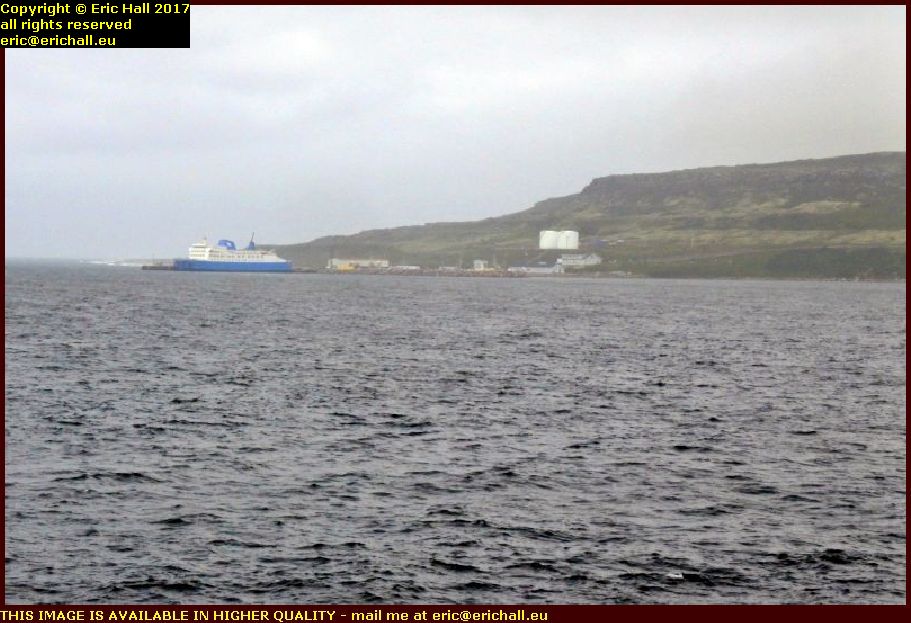
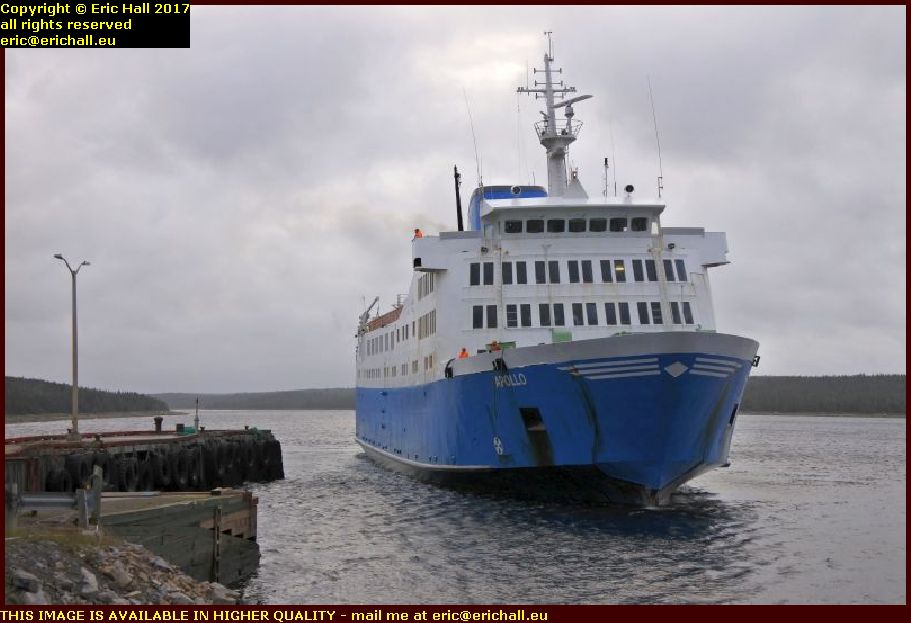
mv apollo st barbe labrador ferry canada september septembre 2017It was only 15 minutes to the ferry terminal and I was second in the queue. So I was soon paid up and down on the quayside.

Apollo came in and, poor thing, she’s looking even sadder an older than she did last time that I was aboard.

47 years old she is now. Surely she can’t go on much longer. But there are no plans to replace her and with the Sir Robert Bond having been sold for scrap, she has to keep going regardless now.

There is, apparently, a type of fish called an “Arctic Char” but I’m imagining a kind of fish dressed in a fur coat that comes round to clean your cabin.

mv apollo st barbe labrador ferry canada september septembre 2017You can still see the signs on the ship written in Finnish and Estonian in the passenger compartment.

This shows you how long it is since Apollo has had a full refit. Even the power sockets are old European 230-volt.

The high winds meant that it was quite a rough crossing – the roughest that I have ever experienced on the Straits of Belle Isle – with the odd crash and bang as we collided with an iceberg or a walrus.

But that doesn’t bother me in the slightest. But there was one guy who was leaning over the rail.
“The trouble with you” I said “is that you have a weak stomach”.
“Rubbish” he retorted. “I’m throwing it as far as everyone else”.

And there’s a young girl on board who is the spitting image of an 11 year old Ginny Weasley starting Hogwarts. I had to look twice to make sure. She and her family were off to “Labby”, which is Labrador City apparently.

blanc sablon quebec canada september septembre 2017I was actually second off the boast when we arrived, which is something of a record.

I made a prominent note of that

But the weather was foul when we arrived. High gusting winds, a typical Labrador mist and it was doing its best to rain down upon us but somehow holding off for the moment.

Not as bad as 2014 but not far off.

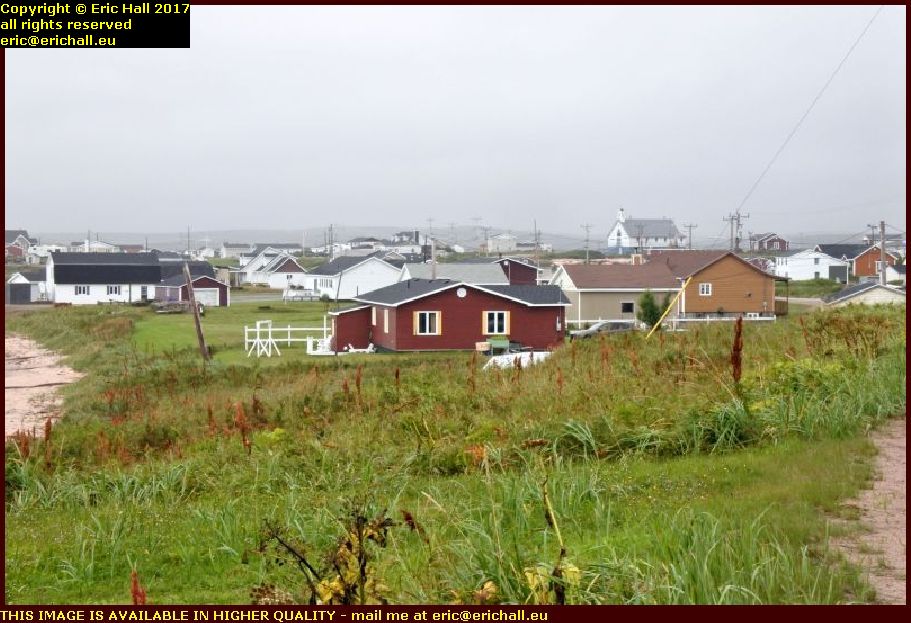
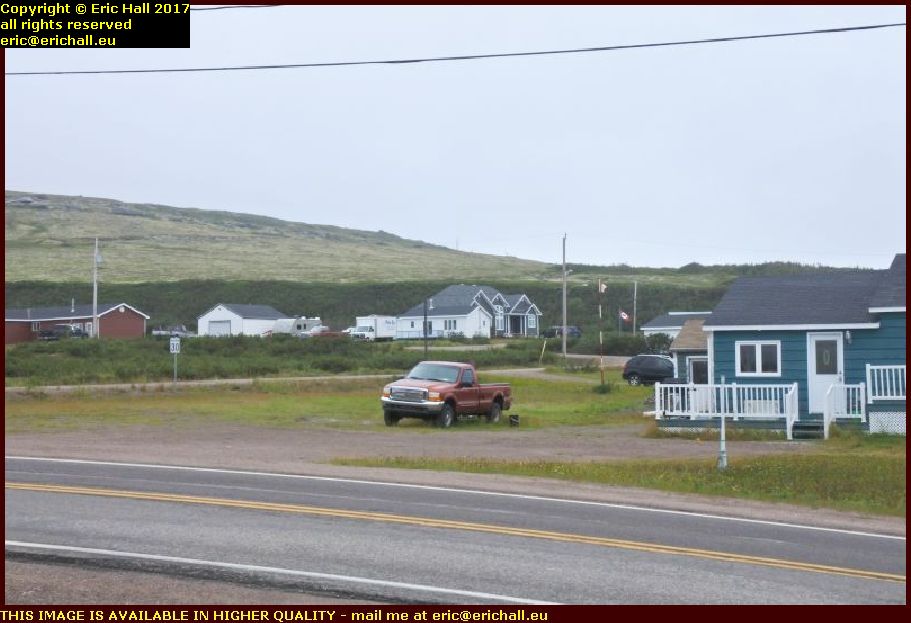
blanc sablon quebec canada september septembre 2017As you know, I’ve been to Blanc Sablon on many occasions, but for some reason I’ve never taken any photos of the town.

Last year I’d made out a list of things to do next time I was here, and photographing the place was high on the list.

And so I parked up Strider and went for a little stroll around the town

newfoundland canada september septembre 2017The area was given its name by Jacques Cartier when he came here on one of his voyages of discovery in the 1530s.

No-one is certain though as to whether it refers to the “Blanc Sablon” which is near his home port of St Malo (just across the bay from where I live) or whether it really dos refer to the white sands that are found here.

And the bay here is another possible site for the elusive “Vinland” of the Norse voyagers.

blanc sablon quebec canada september septembre 2017Regular readersof this rubbis will recall that the area is quite controversial too.

It’s actually in the Province of Quebec but an isoltaed part that is cut off from the rest of the Province, and is known by locals as “the Forgotten Coast”.

They claim that because it’s English-speaking here and so isolated, they are (deliberately) starved of resources, and there is a movement afoot to secede from Quebec and join up with Labrador.

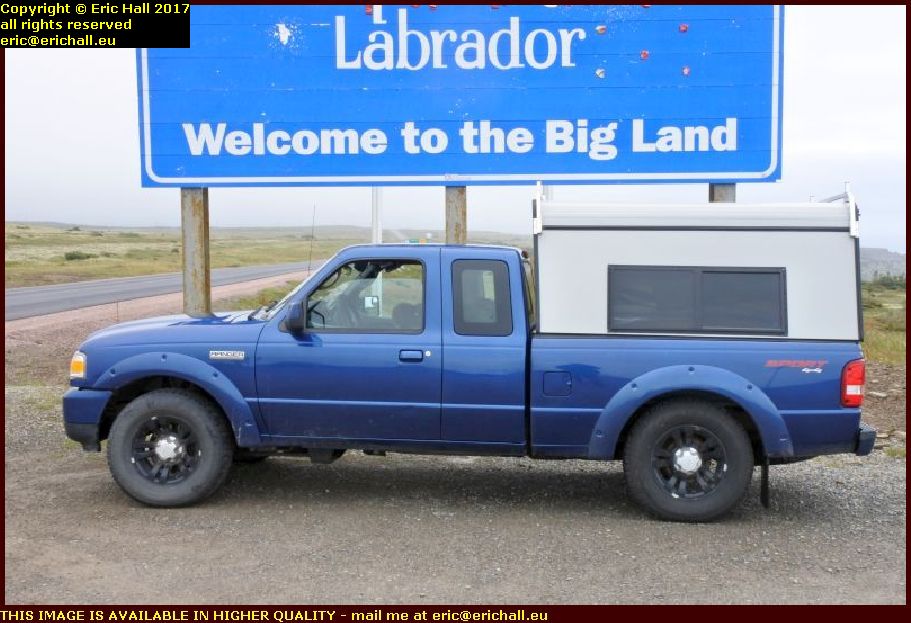
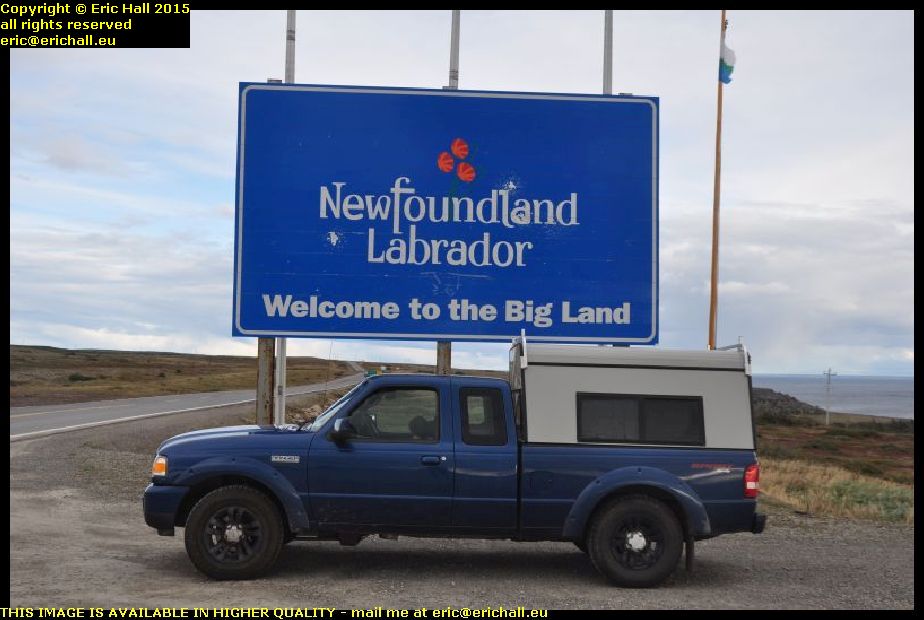
welcome to labrador canada september septembre 2017We have to have the obligatory photograph to say that we have arrived, don’t we?
I joined the queue, because it seems to be an obligatory thing these days to take your photograph here, rather like the place that we visited in Monument Valley in 2002.

Strider is of course very photogenic as you might expect. Strawberry Moose would have gone out too but the weather was atrocious and you wouldn’t put a dog out in this, never mind a moose.

forteau united church labrador canada september septembre 2017Another thing on my “to do” list was to sort out the confusion over the churches in Forteau. And so I went in search of the aforementioned.

There were two that I discovered, and this is the Forteau United Church. I did not, however, discover the Forteau City Church. That must be somewhere else completely.

I must make further enquiries.

coastal footpath labrador canada september septembre 2017Before they started to build the coastal road network in the 1950s, access between the villages was by coastal path.

Nothing had changed here for 200 years since the early settlers and merchants had arrived in the 1740s.

This is the coastal path between Forteau and l’Anse au Clair – the next town to the south. It’s closed these days though because of erosion and landslips.

point amour lighthouse labrador canada september septembre 2017Way over there in the distance across Forteau Bay (thanks to the telephoto lens and a little digital enhancement) is the lighthouse at Point Amour.

We were there, as you may remember, on our travels in October 2010 when we went to inspect the shipwrecks.

There are the remains of two Royal Navy ships out there – the HMS Lily which ran aground in the 1870s and the HMS Raleigh which ran aground in the early 1920s.

Quite a lot of other ships have come to grief there two, including two in one day in 1941.

buckle's point forteau labrador canada september septembre 2017Forteau actualy consists today of two separate villages in the past.

Here is the site of Buckle’s Point. It’s on the South Side of the river and it’s where the Channel Islanders under de Quetteville settled.

Today though, the modern village has settled a little further round the bay to the south.

english point forteau labrador canada september septembre 2017The English settled on the north side of the river andtheir settlement was rather imaginatively called “English Point”.

Today, though, it’s more like the suburbs of Forteau because all of the commercial activity takes place on the south side of the river

Very few people actually stop here and the area is quite often overlooked, just as I am doing right now.

valard landing platform forteau labrador canada september septembre 2017We’ve talked … “at great length” – ed … about the Muskrat Falls and the distribution system that takes the generated current under the Strait of Belle Isle.

When I was looking into it, I noticed that Valard – the company that is doing all of the work – had applied for planning permission to build a quay at the site of their subterranean cable in order to offload their own materials.

And so I went in search of the aforementioned – and although I was locked out of the site, with a little judicious manipulation I was able tohave a butcher’s.

But it doesn’t look big enough to be an alternative landing stage for Apollo if Quebec bans the company from the port at Blanc Sablon.

The Province of Newfoundland and Labrador has a history of grand projects that somehow never seem to come to fruition even though a great deal of money is thrown at them

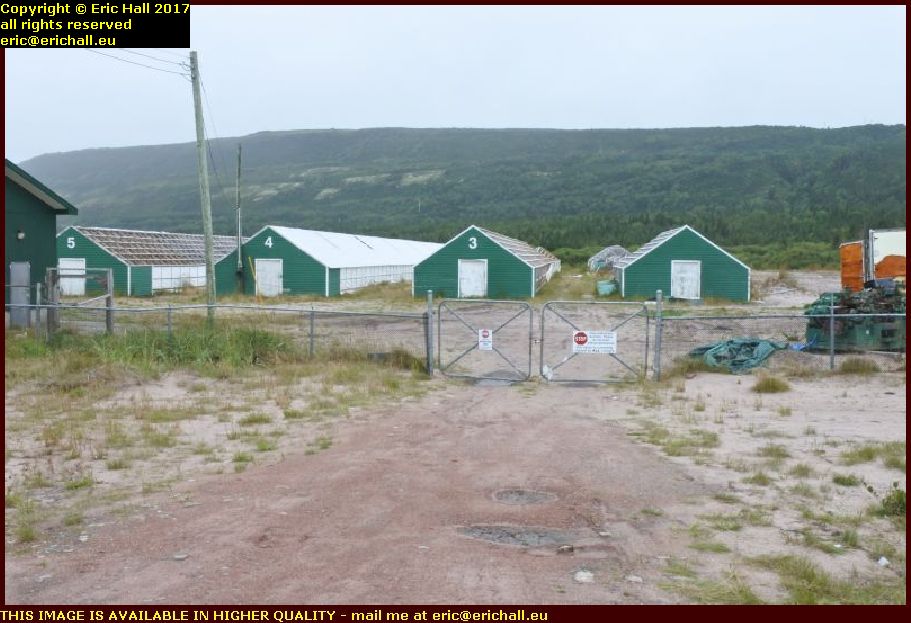
derelict farm capstan island labrador canada september septembre 2017.Here at Capstan Island a great deal of noise was made about a farm and greenhouses that had been installed on the edge of townand it was even listed as a tourism site where people could come to visit.

Today though, it would be a waste of time to visit because it’s all closed down and abandoned. Part of it has collapsed and all of the roofs have gone.

And as a visitor venue – it’s “closed to visits”.

So much for that then;

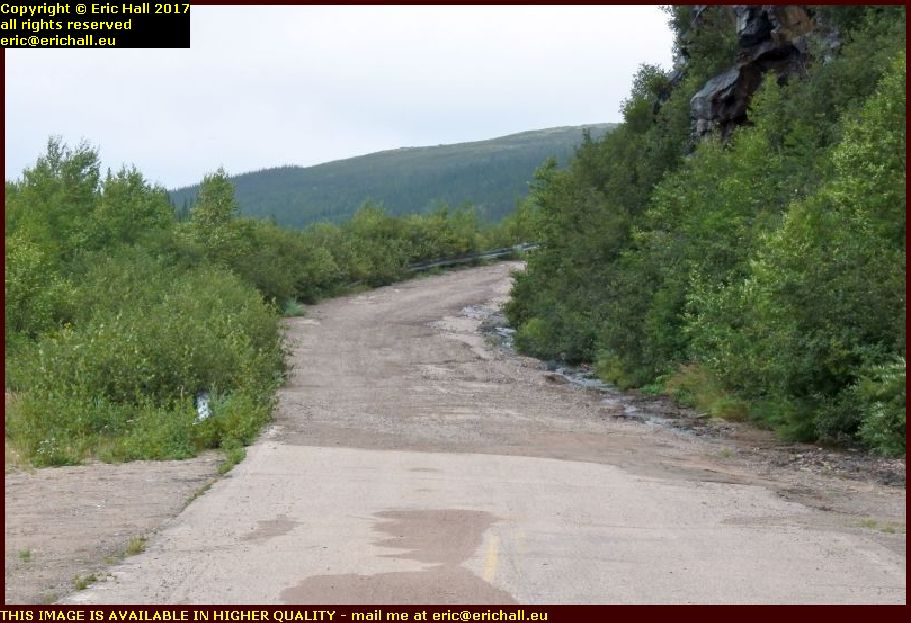
abandoned Pinware River road labrador canada september septembre 2017When I came here in 2010 I told you that a section of the road that followed the Pinware River was one of the most beautiful that I had driven.

In 2014 however, I noticed that they had by-passed the road with a modern highway over the mountains and that this section had been abandoned.

And so I decided that I would do my best to follow the road round today and see how it was doing and to show you what you have missed.

abandoned pinware river road labrador canada september septembre 2017“This Highway is no longer maintained by the Department of Transport. You drive this road at your own risk” said a notice.

And they were right too. Part of the road has been washed out and it was something of a struggle to findmy way around the obstructions.

But this is why I bought Strider, and quite right too. He made short work of this stretch of highway as long as we took it easy.

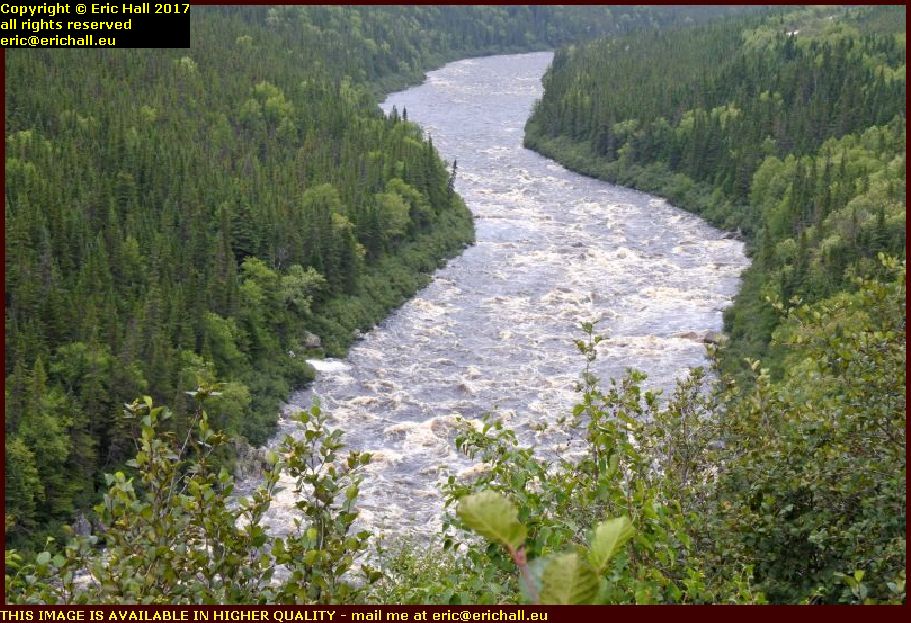
labrador canada september septembre 2017And it was well-worth it too.

After the recent rainstorms the Pinware River was in spate and the famous rapids were really impressive today.

The noise was deafening and so I took a little video of it from closer in. When I find a decent internet connection I’ll upload it.

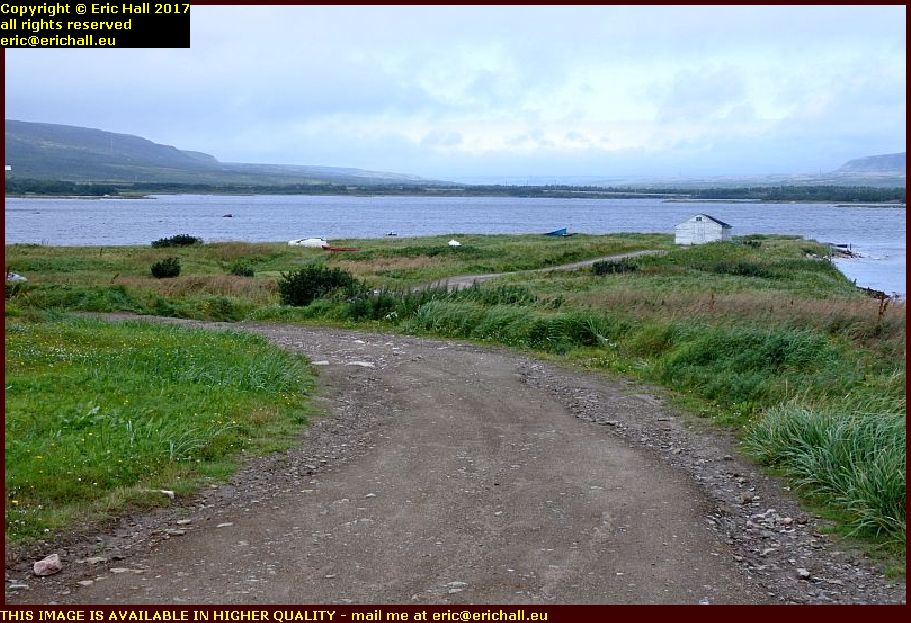
new road county cat pond pinware river labrador canada september septembre 2017I mentioned the new road just now.

Once I rejoined the main road I took a photo of the new route up over the top of the hills.

I remember watching a large artic struggle up there in first gear back in 2014 and remember wondering what was going through the minds of the planners when they re-routed heavy vehicles up there.

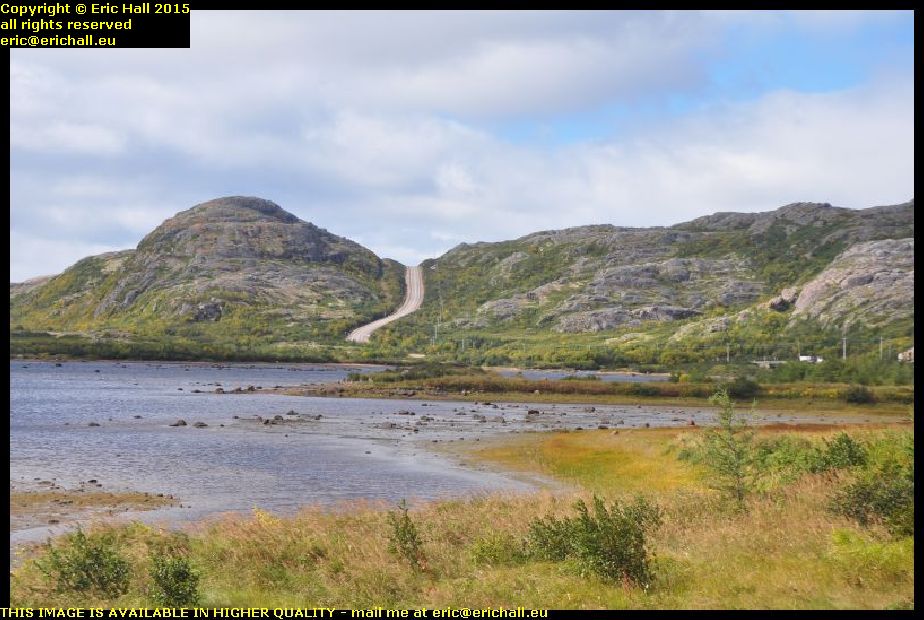
labrador canada september septembre 2017This mountain pass isquite significant because once we pass through it and out the other side, we are at the coast.

Red Bay and its famous 16th-Century Basque whaling station is just the other side.

But for some reason this path always reminds me of somewhere in Scotland and I can’t remember where it is.

mv bernier red bay labrador canada september septembre 2017First thing to do at Red Bay is of course to go and check to see how the MV Bernieris getting on.

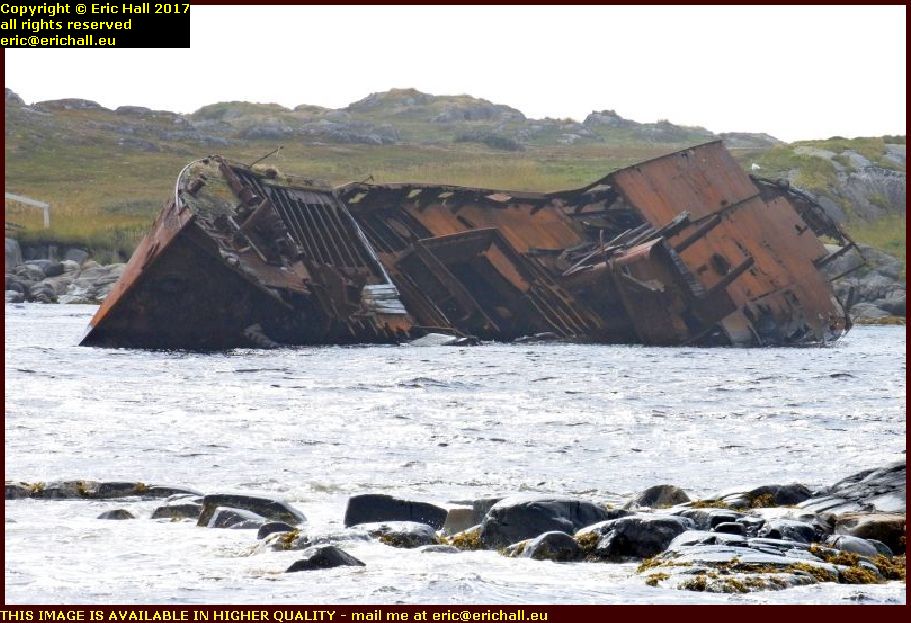
She was delivering coal here one November in the 1930s when she broke free from her moorings during a storm and was driven across the bay onto the rocks of Saddle Island.

And here she sits today, looking sadder and sadder as more and more weather takes its toll.

red bay labrador canada september septembre 2017Regular readers of this rubbish will recall that Red Bay has an exciting claim to fame.

A student was researching the history of Basque whaling in North America when she came across a whole pile of legal documents from the 16th Century relating to a dispute between a whaling captain and his financial backer over the loss of a couple of whaling ships.

The losses were described in such detail that she reckoned that it would be possible to identify the site of the whaling station from aerial photography.

red bay labrador canada september septembre 2017Accordingly, she pored over thousands of photographs and maps, until she came across one covering Red Bay – and then the light went on.

She came over here to do fieldwork and found, in the spot where she reckoned one of the buildings to be, some red roofing tiles of a type unknown in North America but quite common in 16th Century Northern Spain.

She even rediscovered the cemetery where several sailors and other workers had been buried.

red bay labrador canada september septembre 2017But the best was yet to come;

The story told how one of the ships had been gripped by a sudden storm in November, driven across the bay and wrecked on Saddle Island;

This sounded so much like the story of the Bernier that she went and looked where the Bernierhad come to rest. And sure enough – the Bernier was sitting on top of a 16th Century Basque whaling vessel.

red bay labrador canada september septembre 2017All in all, several Basque ships were lost in the Bay and most have been identified.

Furthermore, they even discovered a Basque rowing boat that had sunk at the shore and because of the cold peaty water that was still in a surprisingly good condition.

That has been recovered and is on display in the museum here.

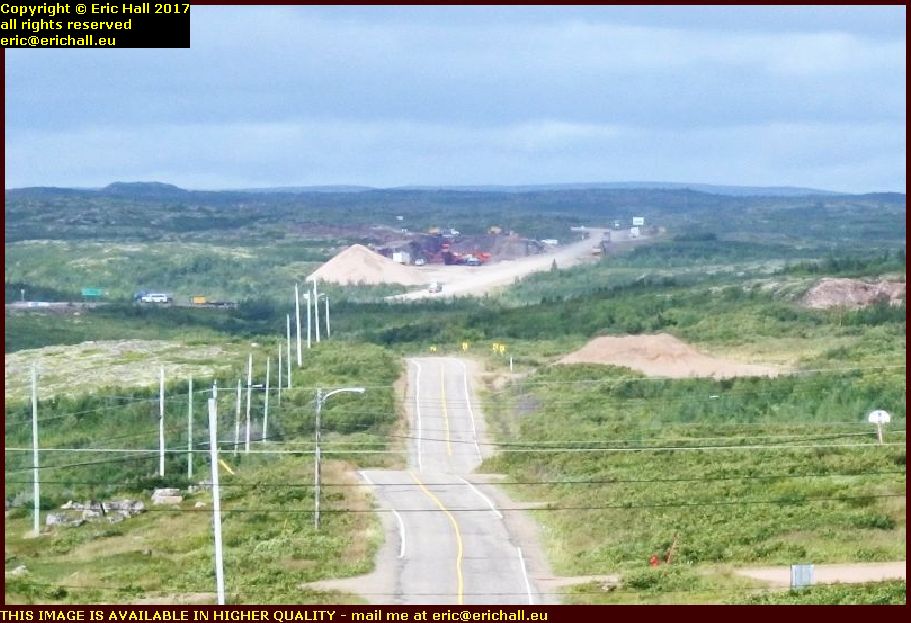
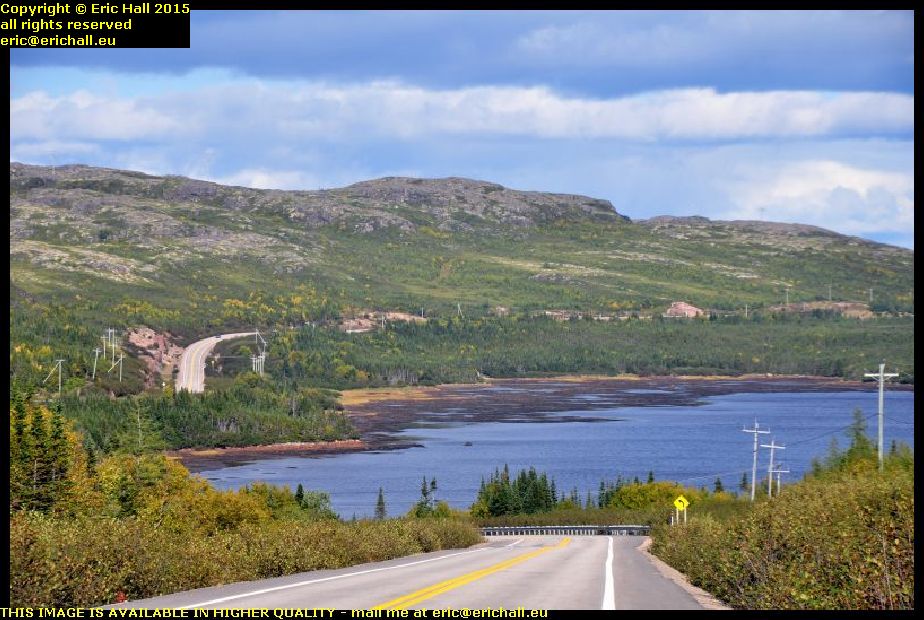
labrador coastal drive road north from Red Bay labrador canada september septembre 2017The road north from Red Bay is in my opinion one of the worst sections of the Trans-Labrador Highway – and that’s saying something.

It wasn’t opened until 1992 – prior to that, access was only by ship – and it looked at one time as if the road had never ever been maintained since the day that it was built.

But it won’t be like that for much longer because they are making headway with the road improvements that they had started in 2014 are well advanced.

labrador coastal drive north canada september septembre 2017And so our drive north is punctuated by sights such as these.

Diggers and graders, and lorry-loads of gravel being brought to the site.

And compactors too. We mustn’t forget tham. When I was on the Trans-Labrador Highway in 2010 I saw a grand total of two. There were two compactors working on this little stretch of highway.

labrador coastal drive canada september septembre 2017But it’s not all like that. There are sections of the Labrador Coastal Drive that bring back many happy memories. So much so that on two occasions I had Strider going sideways.

He’s rear-wheel drive and relatively lightly-loaded and so the rear end hops around everywhere. So hit a bump or a pothole at the wrong angle and off you go, and you have to struggle to regain control.

I bet that the driver of the car coming towards me on one occasion had to stop and change his underwear;

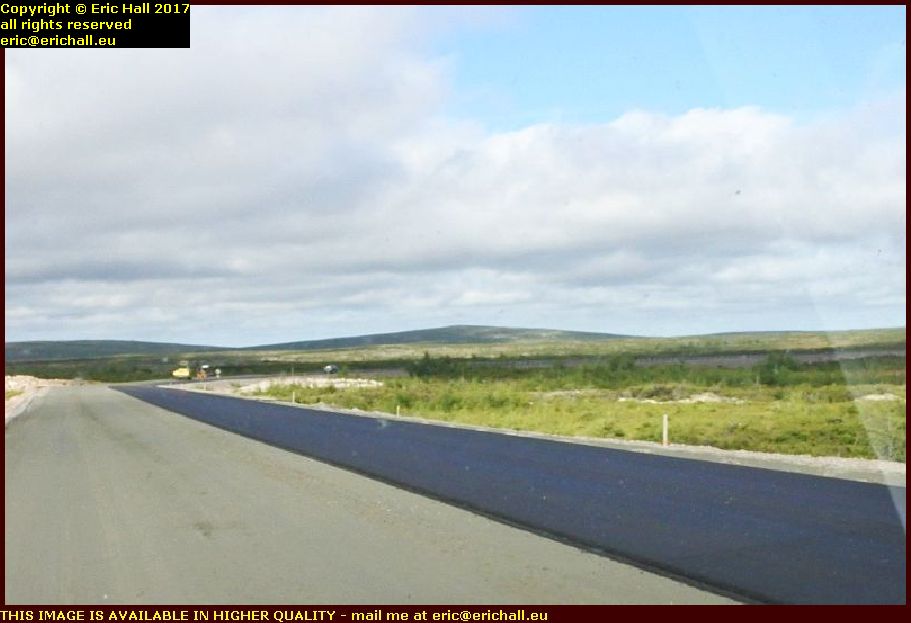
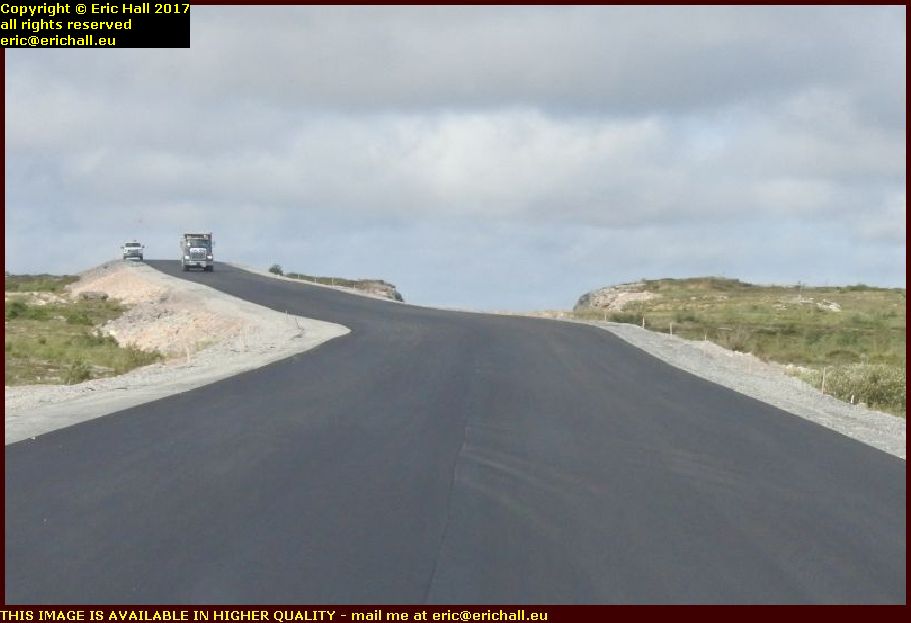
labrador coastal drive asphalt surface canada september septembre 2017But just look at this!

This is why they are carrying out all of the groundwork here. The aim is to asphalt all of the highway from Red Bay to Goose Bay. Such are the “benefits” that the Muskrat Falls and the power of Valard Construction have brought to the Coasts of Labrador.

And before anyone says anything, I do realise that i’m a tourist looking at things from my own perspective. I don’t have to live here in the depths of winter.

labrador coastal drive realignment canada september septembre 2017After acouple of mileswe have the double-tracked asphalt and I can set the cruise control accordingly.

But we can also see that they are realigning the road. Where the road runs through a cutting, it’s often impassible in winter because the snow drifts in and packs tight. It becomes a real engineering job to move it.

Going over the top means that the snow will be loose and blowy, and thus easier to move with a snowplough.

lodge bay labrador coastal drive canada september septembre 2017We don’t stay on the asphalt for long though. We’re soon back in the gravel.

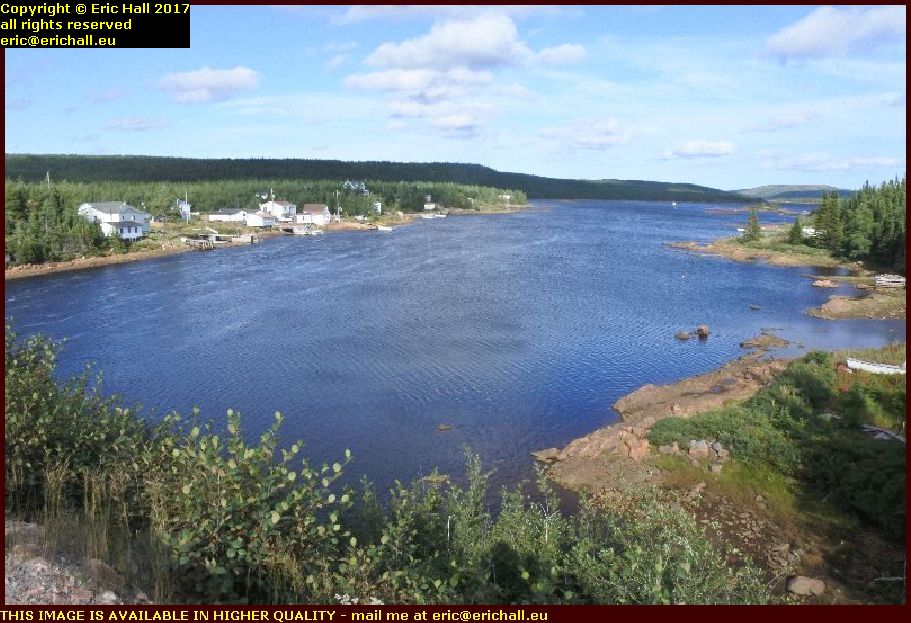
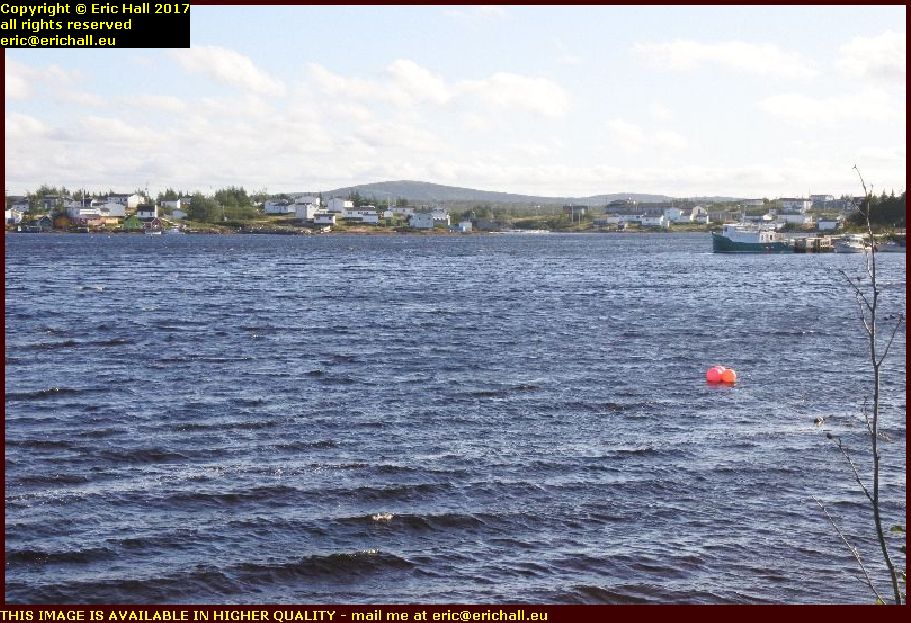
And I’m soon driving over Lodge Bay too. I’ve been past here several times as you know but for some reason or other i’ve never ever stopped to take a photograph of the place.

Not that there’s too much to see of course, because it’s only a small place. In fact, had it not been on the direct route of the Labrador Coastal Drive, it’s likely that it too would have fallen victim to the Province’s resettlement programme.

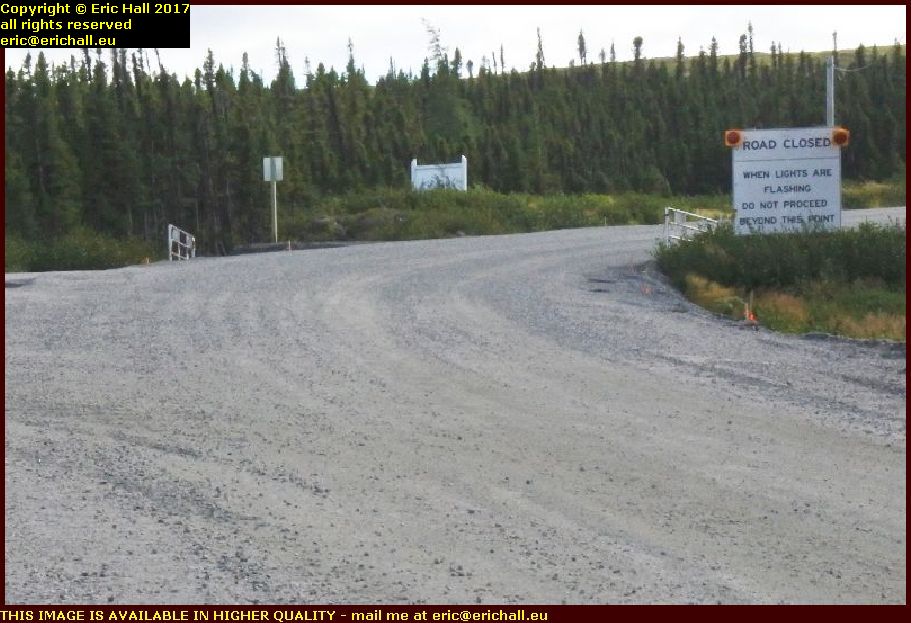
road closed labrador coastal drive lodge bay canada september septembre 2017But this is what you are faced with around here. In severe weather they simply close the road and that’s that.

If you are a traveller and are confronted with the closed gate, you simply park up, build yourself an igloo and go off hunting seal until the Spring.

After all, if you are the kind of person who is in a hurry, you shouldn’t be out around here in Labrador anyway. It’s not for the type of person who has a timetable or an agenda.

mary's harbour labrador coastal drive canada september septembre 2017Another place that was high on my list of places to visit was Mary’s Harbour.

I’d been here before in 2010 but had been sidetracked by the fact that I had forgotten the change of time zone just up the road so I had lost half an hour.

Not a good plan when you have a ferry to catch and plenty of other things to do, so I couldn’t hang around too much.

mary's harbour labrador coastal drive canada september septembre 2017Mary’s Harbour is another one of these “resettlement points” but its history goes back much farther than Joey Smallwood.

Outside just off the coast is the island of Battle Harbour and at one time this was the most important place on the whole of the Labrador coast.

However, almost 90 years ago, like most places in Canada, Battle Harbour was the victim of fire, and almost everything on the island was destroyed.

mary's harbour labrador coastal drive canada september septembre 2017Seeing which way the wind was likely to blow in the future (which comes as quite a surprise to most people) it was decided to abandon the island and settle somewhere else, but on the mainland close by.

Mary’s Harbour seemed like the ideal place to be, seeing as it was close by, had a deep natural harbour that stretched a good way inland and was thus sheltered from the bad weather.

And over the course of time, the inhabitants of many other coastal communities have been resettled here, often quite controversially.

But then, this is not the place to discuss the Resettlement Policy. We’ll be doing enough of that when we arrive in North West River.

Abandoning a good rant before we even start, I make tracks northwards. I’m heading for Port Hope Simpson where I hope to be able to find a bed for the night.

And sure enough, I do. Campbell’s Place is home to home-made bread, home made jams from local ingredients and,like everywhere else in the town, home to the slowest internet connection on the planet.

But there’s a single room at what passes these days for a resonable price, and the bed seems quite comfortable too. First thing is to plug in the slow cooker while I have a shower and wash my undies.

Tea is pasta, mushrooms and vegetable soup, and aren’t I glad that I spent this $14:00 on the slow cooker? Yes, i’ve just seen the prices of the takeaway food.
No internet worth talking about of course, and so I can crack on with the … good grief! … 127 photographs that I took today.

And then a lie down while I listen to the Navy Lark on the radio – and promptly fall asleep. It’s been a long day today.

and I’ve just written a new record of 3027 words too – so there!

Friday 25th September 2015 – WHAT A GOOD NIGHT’S SLEEP!

Having done everything that I needed to do last night, I crawled into my sleeping back and settled down to watch a film. But it wasn’t for long. After about 15 minutes, I switched off the laptop and that was the last thing that I remembered.

I must have had a good nine hours when I didn’t feel a thing. And when I awoke, it was reasonably warm inside the truck cap, there was no condensation at all on the roof and only a few minimal traces on the walls. It seems that this idea of putting the insulation on top of the roof of the truck cap is doing its job. I’m well-impressed with this. But I’ll need some more tape though. If the plastic sacks become torn or damaged, I have plenty to replace them but I’ve run out of tape to hold everything together.

I didn’t stop for breakfast though. There’s a sailing across to Labrador at 10:30 and I want to be on it if possible and so I hit the road.

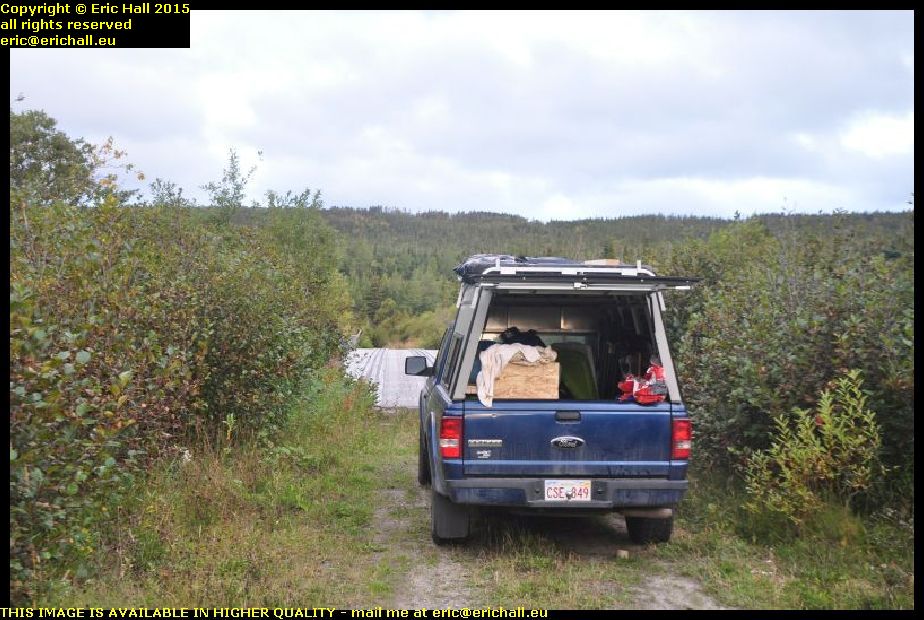
sleeping in strider ford ranger newfoundland canadaBut I did take a minute or two out to take a photo of my spec for last night and Strider with his exterior insulation. You can see just what a good spec this is.

And now, a weird idea is running through my mind that if I could find a plastic sheet that is 6 feet by 4 feet, I could fit that over the top, hold it down with ratchet straps and that would make a very permanent arrangement while I’m on my travels. Something like a corrugated roofing sheet would be ideal for this.

An hour on the road found me at St Barbe and there was an enormous queue waiting for tickets to sail. I was given ticket 16 – which meant that I would be the 16th casual voyager to be added after the reserved places are loaded. And to my surprise, with the senior discount to which I’m now entitled, a 90-minute crossing with Strider costs me all of just $18:58 – eat your hearts out, you European ferry travellers!

mv apollo st barbe newfoundland blanc sablon quebec labrador ferry canadaHaving fuelled up Strider (I keep telling you that out here you need to fuel up when you can) I lined up on the quayside watching the antics of the artics loading up the trailers, and then I was squeezed on board into a little corner of the ship.

And poor Apollo. As she steamed in, I couldn’t help noticing that she’s looking every day now of her almost 50 years and she can’t be long for this world now. The inside is pretty rough too, and I’d have taken a photo of what I meant, except that Bane of Britain here seems to have forgotten to bring his camera with him up into the lounge.

But now, after a heary breakfast of coffee, four rounds of toast and a plate of hash browns, I’m ready for anything. Including a couple of chats that I had had, one with a German guy in an ancient New-Brunswick-registered Dodge Caravan from Woodstock (the Caravan, not the German) with a spare wheel strapped to the top, and another older guy heading out to Goose Bay.

highway 138 lower north shore quebec canadaIn May 2012 I’d done a tour of Quebec Highway 138 from Montreal all the way to the end at Natashquan where the road comes to a shuddering halt in the middle of nowhere.

It’s not actually the end of Highway 138, theoretically at least, because there’s part of the Quebec coast accessible from Blanc Sablon,and the road along there is also called Highway 138. I’d driven down here last year but there was that much fog and rain that we hardly saw a thing

highway 138 lower north shore quebec canadaNo such complaints today though. I was really lucky with the weather and couldn’t have wished for better. I’ve managed to retake all of the photographs that I took last year.

And you can see just how beautiful the road is. It doesn’t quite have the grandeur that the Trans Labrador Highway has, of course … "nothing can quite manage that" – ed … but it was a journey that I wanted to make, just to complete my Highway 138 adenture

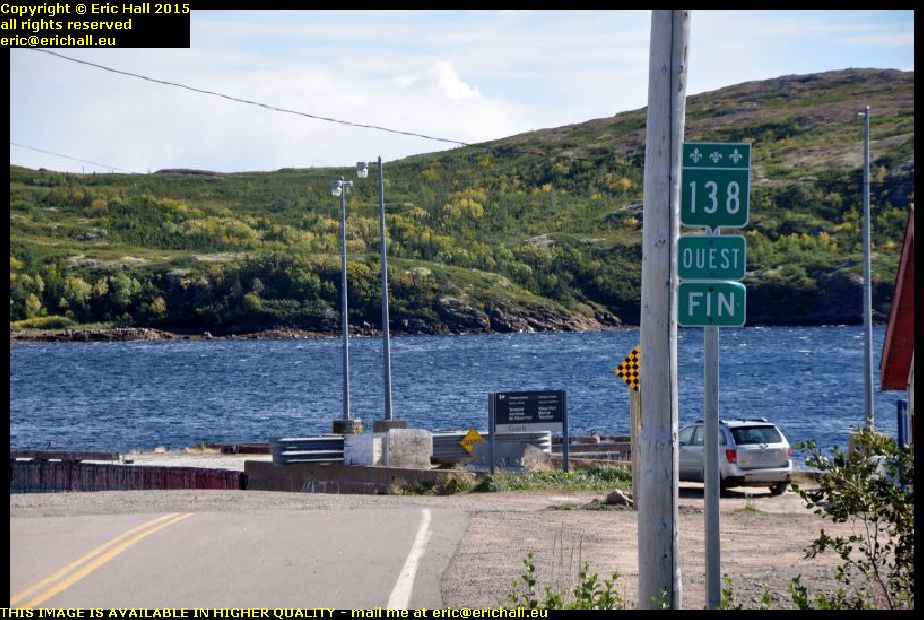
end of highway 138 old fort bay vieux fort lower north shore quebec canadaAnd so we arrive at Vieux Fort, known to the locals as Old Fort Bay because this is an Anglophone area, as I discovered a few years ago.

The Highway terminates at the harbour and here, right in front of us is an old quay. It’s closed off and marked “danger” so it’s clearly unused, but in view of its substantial construction, I wonder if the coastal boat that plies along the Lower North Shore used to call in here before the road through to here was opened.

old fort bay vieux fort lower north shore quebec canadaIt’s not quite the end of the Highway though. If the Highway ever is extended, which won’t be in the lifetime of anyone reading this rubbish, it’ll come round the head of the bay and head west.

At the moment there’s a dirt highway that takes that road, and this eventually brings you down to this beautiful sheltered bay just here. When I arrive, a couple of fishermen … "fisherPERSONS" – ed … were launching a boat and setting off. This really IS the end of the road as far as I can tell, and it was a convenient place for me to stop for lunch.

middle bay lower north shore quebec canadaThere are a few of the villages along the highway too and I took hundreds of photos of them. This is just one of them, Middle Bay.

This is said to be the site of a Basque whaling station back in the 16th Century. There were a couple of dozen along here and the most well-known example, Red Bay in Labrador has been excavated and there’s a museum there. However, I don’t know what, if anything, has been discovered here from that period

strider ford ranger labrador canadaFrom here, I retraced my steps to Blanc Sablon and beyond towards L’Anse Aux Loups in Labrador.

We had to stop though, in order to take a photograph at the border just to prove that Strider was here. This is the border today, of course, but it might not be in the future because the mayor of Blanc Sablon has said that he would like to apply to the Canadian Government to secede from the Province of Quebec and join up with Labrador. Whether the Province of Quebec will agree to releasing some of its prisoners however remains to be seen.

jersey trail anse aux loups labrador canadaThere are many French names just here. Some of them relate to the exploration of Jacques Cartier, others to the French fishing boats that came along here in the 18th Century, but many others relate to inhabitants of the Channel Islands who colonised this area.

The old road along the coast prior to the construction of the new highway is called the Jersey Trail today, and there are all kinds of remnants and relics of the previous inhabitants along here. Excavations have taken place and many artefacts have been uncovered.

anse aux loups labrador canadaThere are a dozen or so villages along here too. I missed out photographing them in 2010 because I was rushing for the ferry (I hadn’t realised that it ran on Newfoundland time, which is 90 minutes ahead of Quebec) and in 2014 I had the weather against me.

But never mind. Today, even though it was now going dark quite rapidly, I still had time to take all of the photos that I wanted to take.

labrador coastal drive deviation county cat pond canadaWhen I was here in 2010, the Labrador Coastal Drive followed the narrow valley of the Pinware River, but I did notice a considerable amount of roadworks in the area round by the County Cat Pond.

This is what they have been doing. The old road goes off to the right, but there’s a new road now going up the hill just there.

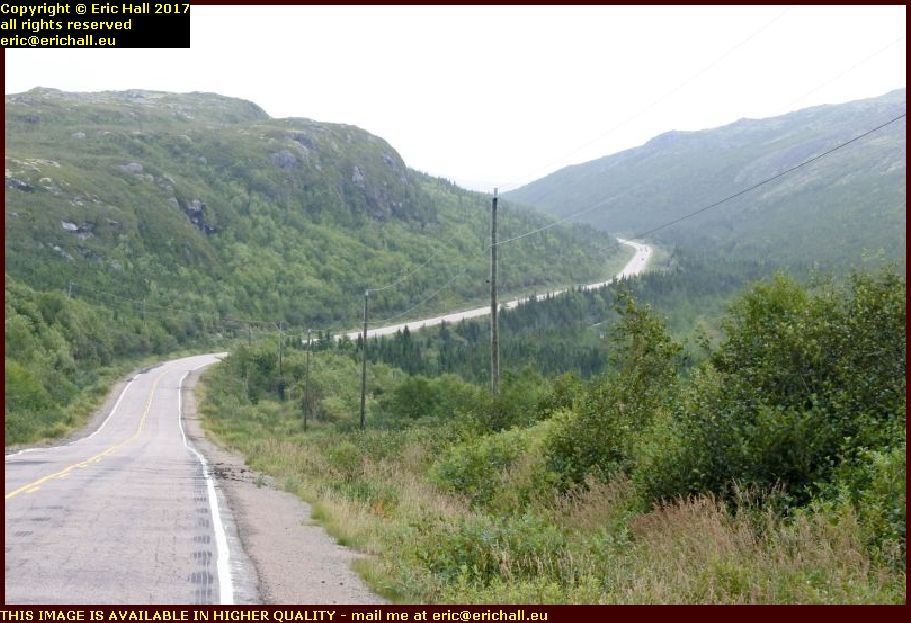
I can’t think why they have done it, though. The route along the Pinware River is beautiful, but this new route is all straight up and straight down. In 2014 I watched a huge lorry struggle up the hill in the rain and I bet he wasn’t amused.

I had planned to stop at a Guest House in Red Bay for a wash and a change of clothes, but there was no-one there when I called, and so I’ll be spending another couple of nights sleeping along the road. I found a very basic rest area and even though it was early, it was freezing cold and so I went to bed. But not before putting the big insulated sunshield across the rear window of the truck cap and wrapping the rest around the head of my bed. I’ve a feeling that I’m going to need it tonight.

Monday 22nd September 2014 – STRANDED AGAIN

I was out like a light last night, long before it went dark even. I must have been tired last night.

dodge overnight stop brador labrador coast lower north shore canada september 2014
And I was awake long before it was light too. This was an excellent place to choose for the night and I was impressed with this. I shall add this to my list of potential specs.

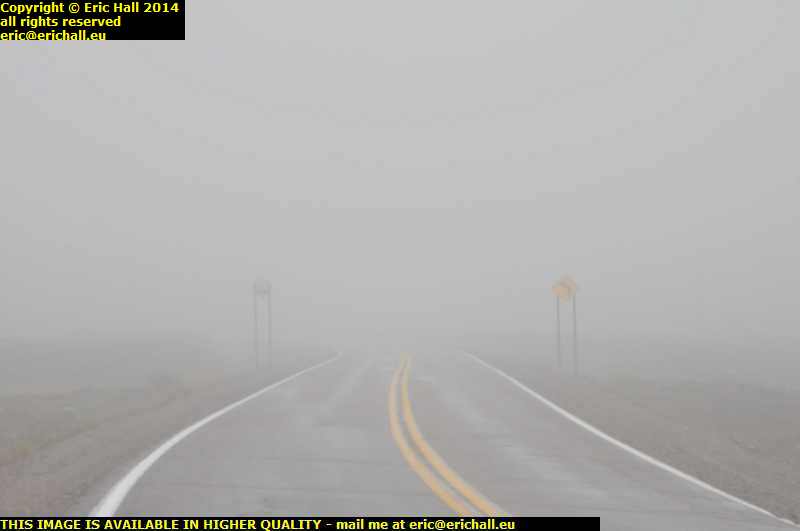
I was rather hoping that the weather would change today, and indeed it has. It’s changed for the worse. The fog is still here but the rain is now coming down like rain that I have never seen. It started at about 02:00 this morning.

Not only that, we have our howling gale back, and that is that.

This makes me decide that I don’t have much future in Labrador right now. If it’s raining like this here, what’s it doing in the interior up on the plateau? I know that snow has been forecast for today and tomorrow up there and if it’s coming down anything like this, we’ll all know about it.

I decide to make my way to the ferry and see about retracing my steps, but after a very long wait, I’m given more bad news. All ferries are cancelled until this hurricane blows itself out. Out there in the Strait it’s gusting at 120mph. Even the ferries to the mainland at Cape Breton Island have stopped running.

dodge entering labrador coast canada september 2014Braving the dreadful rain I pushed on up the road and across the border into Labrador.

The Labrador Tourist Information Board is a little more hopeful though. Snow is forecast for today and tomorrow in the mountains over to Goose Bay but there will be a dramatic improvement in the weather starting on Wednesday with temperatures reaching 16°C.

Giving the matter some considerable thought, I decide to head north this afternoon. I can travel part of the way up the road and stop for the night. If I have a reasonable start I should catch the road over the mountains on Tuesday afternoon when it’s been cleared but if there’s snow still lying about, I’ll just hole up and wait for the thaw.

I can’t think of another solution, but I do have a great amount of faith in the Labrador Highways Department.

But amongst the improvements along the highway since 2010, more of which anon, travellers on the Trans Labrador can now avail themselves, free of charge, of a satellite telephone to keep in touch with someone in case of emergency. Definitely a sign of the times and of progress. So armed with a satellite telephone, I head north.

First thing that I notice are signs telling me “rough road next 7kms”. Obviously the person who thought of this one has never ever been further north than the gate across the highway at Red Bay. This is nothing compared to what I’m going to encounter further along the road.

harbour l'anse au loups labrador coast canada september 2014This is the harbour at L’Anse Au Loups, a photo of which I didn’t take in 2010 when I was on my mega-voyage around the Trans-Labrador Highway
.

At least there’s one good thing about coming round here taking photos in this kind of weather is that you don’t have to worry about where the sun is. You can stand anywhere and you aren’t bothered about the sun streaming into the lens at all.

I saw some kind of monument at the side of the road in 2010 and I didn’t have time to go to check it as I was rushing for my ferry.

war memorial l'anse au loups labrador coast canada september 2014Today though, I did have time for a look around.

It is in fact a war memorial and the plaque on there says something along the lines of “at the going down of the sun etc etc we will remember them” – the old Kipling line. However it seems that they haven’t been remembered because this is an overgrown, neglected and forgotten war memorial that hasn’t seen an ounce of attention since I don’t know when.

And on my way to see the memorial I was thoroughly drenched and soaked to the skin just walking the 50 yards there and back, even wearing a proper heavy-duty rain jacket. The weather here is grotesque.

modern labrador coastal drive county cat pond labrador coast canada september 2014This was what they must have been building in 2010 when I came here to the County Cat Pond and noticed them carrying out all of these road works.

I’m not quite sure why as there was nothing that appeared to be wrong to me about the picturesque little road around the shores of the Pinware River that I can see about 200 feet below me. It wasn’t a difficult stretch of road by any means and I enjoyed driving it.

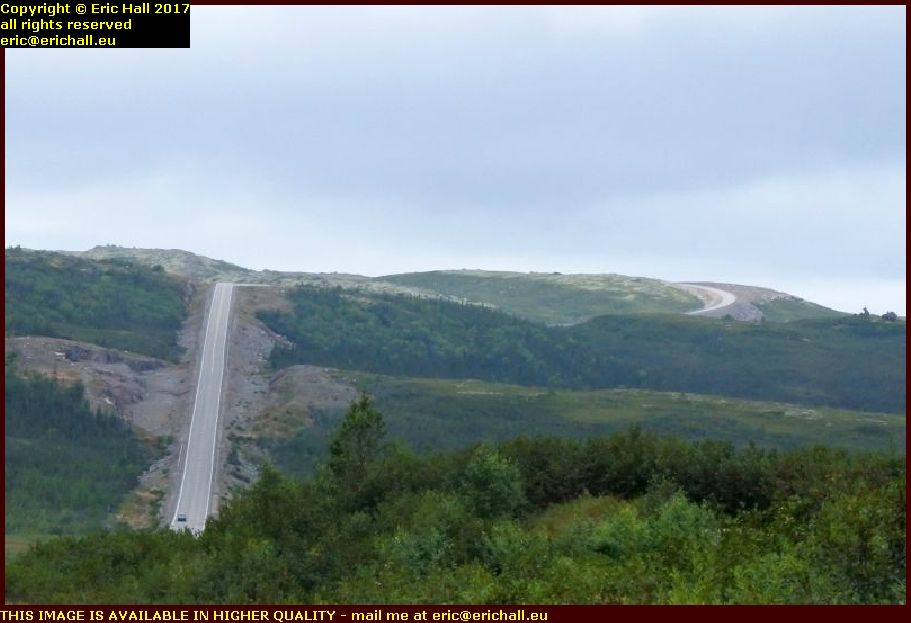
I really don’t see the point of this construction at all. It really makes me wonder what on earth is going on because, beautiful and well-maintained though the surface of the road might be, it’s all up and down and watching a lorry struggle up here with an enormous amount of difficulty can’t have impressed the driver.

I arrived at the Whaling Centre at Red Bay just after 17:00. It has two days when it closes at 17:00 and you can guess what one of them is can’t you? And there’s no UNESCO delegation here today to help me out.

And outside here now the wind is howling. This is a wicked wind that I’m in. That forecasted 120mph wind might not have been an underestimation. What I find totally astonishing is that with this howling wind here blowing like dervishes, we still have all of this fog. It hasn’t moved an inch. Normally, the fog is the first to be blown away in the wind

improvements labrador coast mary's harbour canada september 2014The road however is completely different from how I remember it. Parts of the road are much wider and the surface vastly improved. They seem to be digging up the old road that we know and love and replacing it with the one along which I’m driving.

Talking to one of the road workers here while I was waiting at a stop sign, he tells me that they have been widening this road this summer ready to tarmac the surface. That’s good news for the locals and the tourists although it won’t do much for the environment, bringing so many people here

dreaful road conditions labrador coast canada september 2014However, the road isn’t so good in certain places at the moment, is it? It’ll be interesting to see what it will be like this time next year.

Fuel at Lodge Bay is just 152.9 per litre. That’s not unreasonable for round here and while I’m not exactly desperate for fuel, fuel stations are few and far apart on the Trans Labrador Highway and you should never miss out on an opportunity to fill up the tank.

Now, night is falling and I’ll need to find somewhere to park up ready for the morning.

Sunday 21st September 2014 – WHAT I SAW ON THE LABRADOR COAST

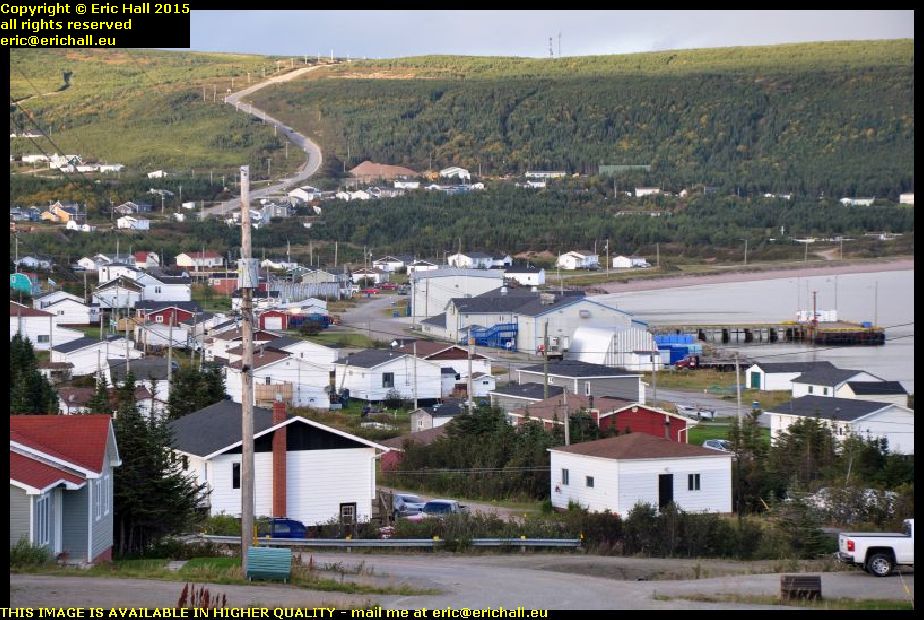
labrador coast lower north shore quebec canada september 2014Not very impressive, is it? In fact, I feel rather cheated after going to all of this trouble to get here in the first place.

However, rolling Newfoundland fogs are a well-known phenomenon in the Gulf of St Lawrence as anyone who remembers my visit to that island in the Gulf of St Lawrence in May 2012 might well remember. And there have been enough marine accidents in the Gulf due to the rolling fog to underline the point, so it’s not really that unexpected.

mv apollo st barbe newfoundland canada september 2014I had a wild night last night anyway, here hemmed in between a couple of vehicles on the quayside in the shadow of the Apollo. It was as if the wind was trying to tear the roof of the Dodge.

I was up too at about 05:50 thanks to the alarm, due to the fact that the shipping company offices open at 06:00. The 08:00 sailing has been cancelled as expected but we had to report back at 09:00 for further news.

At 09:00 we were informed that there would be an unscheduled sailing at 10:30 so we all made our way to the docks where, using a rather large shoehorn, all of the waiting vehicles were squeezed on and off we went.

But the poor Apollo is looking rather worse for wear these days, a lot worse than she did in 2010. A good refit would do her the world of good, or perhaps there’s another redundant cross-channel ferry somewhere that needs a new home. The Apollo could then go to a nice retirement home in the sunshine somewhere in the Aegean, the usual abode of old and tired Ro-Ro ferries.

vieux fort old fort bay labrador coast lower north shore quebec canada september 2014Despite the miserable weather, I made it down to Old Fort, or Vieux Fort as the authorities insist on calling it. This is the far end of Highway 138, and regular readers of this rubbish will recall that we reached the other end of the road
in May 2012.

There’s just this gap of a couple of hundred miles in the road that will never be completed in the lifetime of anyone reading this rubbish.

vieux fort old fort bay labrador coast lower north shore quebec canada september 2014Old Fort was discovered in 1504, officially that is, by Breton whalers who had some kind of whaling plant here similar to the one that we visited in Red Bay in 2010

But I say “officially” because there’s considerable evidence to suggest that places such as this were well-known long before they were officially “discovered”. The whalers and trappers who worked out of these places kept the locations of their enterprises secret so that the competition wouldn’t move in, but with Cabot’s voyage of “discovery” in 1497 (and it’s certain that Cabot knew what he was going to find), there was an impetus for the Breton and Basque whalers and the like to formally “discover” the locations of their enterprises in order to forestall the English.

And with that, I had a slow meander back to the harbour at Brador Bay which will be my location for tonight I reckon. I’m hoping that the weather might improve tomorrow because if we are still having the fog and the rain, I’ll have to postpone my voyage around the Trans-Labrador Highway until next year.


Thursday 6th March 2014 – I’M IN QUILLAN TONIGHT

And in case you are wondering where Quillan might be, it’s back in France again in the Département of the Aude about 50kms from Carcassonne.

But I’m not going to Carcassonne (well, at least, not yet) – I’m going to somewhere quite different, more of which anon

Today, though, I left Andorra nice and early in the bright sunlight and to cheer me up even more, I found a petrol station selling diesel at 111.3 cents per litre, which has to be the cheapest that I can get anywhere in Europe.

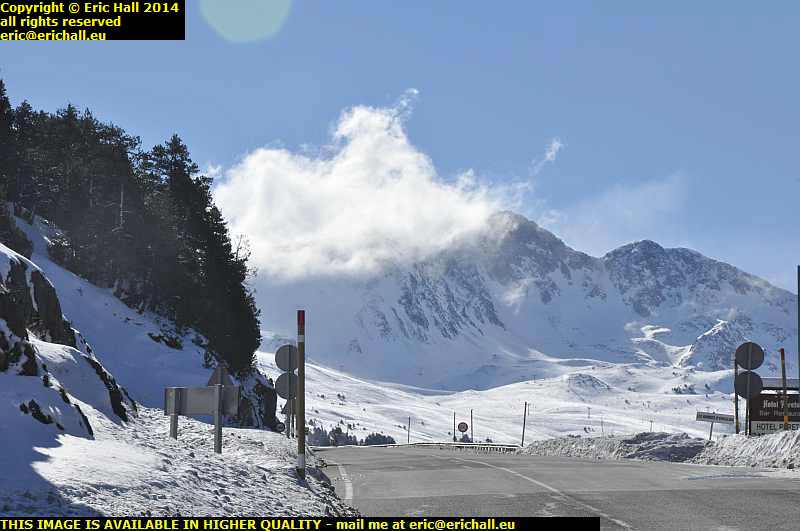
snow blown by wind off the top of the pyrenees andorra
The climb up and out of Andorra was rather fraught though. They were still dealing with the after-effects of the heavy snowfall the other day, and what wasn’t helping matters was that there was a really strong wind up aloft. That’s not a cloud coming over the top of the mountains – that’s the snow being whipped off by the wind.

I was going that way too and the higher the road climbed into the mountains, the worse the road became. But while there weren’t any problems, it was still uncomfortable.

What didn’t help matters was that the snowploughs had not been able to clear the parking areas at the ski resorts. Consequently, all of the holidaymakers simply abandoned (I refuse to use the word “parked”, as “parked” they certainly were not) all over the sides of the roads by the ski lifts regardless of the snowploughs and the moving traffic. It was total chaos in quite a few spots and had I been an Andorran policeman, all of the cars would have been towed away.

Thoughtless was not the word. Pig-ignorant and selfish are far better.


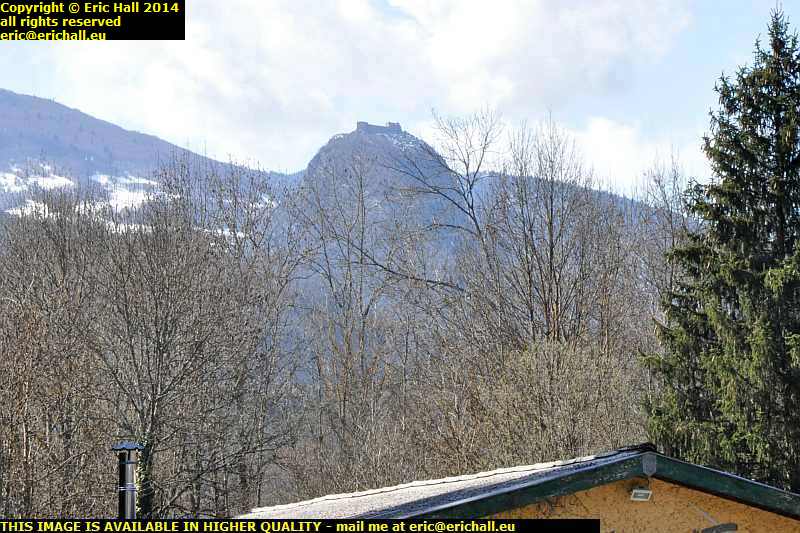
chateau de montségur ariege france
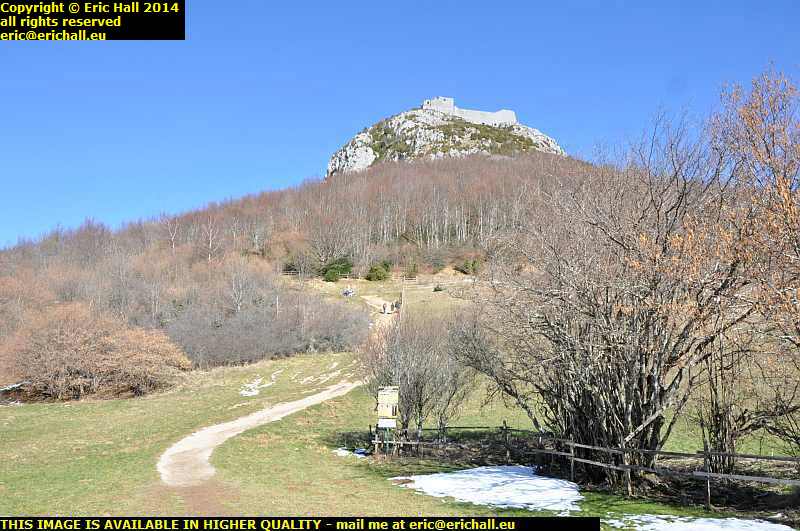
Now, how about this for something? That castle perched up there on that rock in the distance is one of the most enigmatic places in the whole of France and was on the top of the list for me to visit. It’s the reason why I’ve come down here.

It’s the Chateau de Montségur and while it can’t match Béziers for being the place of the greatest massacre of French civilians (well, okay, they weren’t French back in the 13th Century), what happened at Montségur is one of the most mysterious and bewildering events ever to occur in what is now France.


chateau de montségur ariege france monument burning 225 Cathars
Somewhere round about where that monument is (no-one can be exactly sure where the exact spot might have been) on 16th March 1244, approximately 225 Cathars and Cathar sympathisers were put inside a cage and were burnt to death.

And it has to be said that they were quite happy with the idea, to such an extent that about 20 of the victims actually volunteered to go to their doom. One eye-witness report tells of the Cathars singing as the flames were engulfing them.


chateau de montségur ariege franceIn brief … "thank goodness" – ed … Catharism was a religious sect that dissented from the teachings of Rome. Cathars were Christians without a doubt, but nevertheless their manner of worship and their beliefs were considered heretical by the Pope.

Catharism was quite strong in this region and some of the wealthiest landowners were Cathars. Consequently, other local notables didn’t need much encoragement to urge the Pope to declare a Crusade against the Cathars.

Béziers was one of the first Cathar towns to fall and it is said that maybe as many as 20,000 people in the town were burned alive.
It was reported that someone asked “who shall we burn? How do we know which ones are Cathars?”
The reply was quite simple. “Burn them all. God will recognise his own”.


chateau de montségur ariege franceBut as the noose slowly tightened around the Cathar region, the rock of Montségur was fortified and turned into a refuge of the last resort. Little by little, refugees arrived here bringing with them the religious treasures and relics from other Cathar centres that had succumbed. In 1243 there were 500 people living on the rock, all prepared to make a last stand.

Montségur by this time had already withstood several sieges but in May 1243, with opposition elsewhere being almost totally crushed, the whole might of the Crusade laid siege to the rock and slowly but surely, fought their way up the hill.


chateau de montségur ariege franceBy Christmas 1243 it was clear that the garrison could not hold on for much longer and in a daring escape, several of the parfaits, as the Cathar monks and nuns were known, took the entire treasure that had accumulated inside the castle, and disappeared with it to a place of safety. What became of it, no-one ever knew and no trace of it has ever been discovered to this day.

Even more incredibly, one of the escapees managed to return to the castle and he was there on 1st of March 1244 when the castle finally called a truce. The terms of the truce (which was effectively a surrender of course) was that the civilians could leave unmolested, but any parfait (there were said to be about 200 or so in the castle) who failed to renounce his or her vows would be burnt to death.


chateau de montségur ariege franceThe defenders asked for a 15-day truce (why, no-one knows) and this was accorded. And on the eve of the final day, an important ceremony of some nature was held within the castle. Later that evening, a few more parfaits slipped out of the castle, taking with them the final objects of importance that had (presumably) been used at the ceremony. And all of that disappeared too, never to resurface.

Next morning, the garrison surrendered. and it is said, quite astonishingly, that not only did no parfait renounce his or her vows, but another 20 or so claimed to have taken the vows in the meantime and demanded to be burnt – a request which of course was granted.


chateau de montségur ariege franceSo what was the treasure that was taken away at Christmas 1243?
Where was it taken to?
Why did the garrison demand a 15-day truce?
What was so important about the 15th of March that a truce was requested to cover that day?
What was the ceremony that took place on that day?
What were the objects that were used at the ceremony?
Why were they taken away?
Where were they taken to?
Why were so many people so happy to be taken away to their deaths?

There has been endless speculation about all of this and so many books and novels have been written that they could make a stairway up to the castle. But you can see why Montségur is a place of such interest to so many people.


modern village montaillou ariege france
This is another site in the Ariège that is associated with Cathars. It’s the village of Montaillou.

This is not the original site of the village, though. This is a more recent reincarnation. The village that we are interested in is the one that was in existence at the end of the 13th Century and this is about half a mile away from the present site. And unless you know where to look, you won’t find it at all.


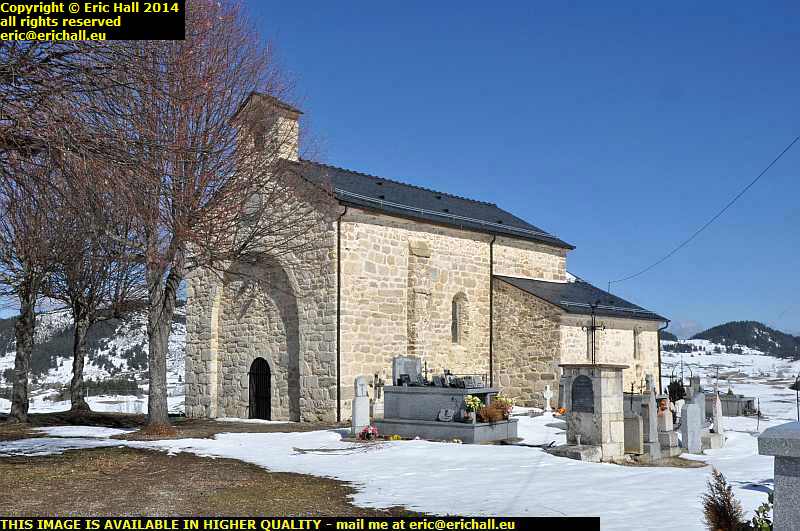
medieval chapel montaillou ariege franceThis chapel sitting down in a field dates from the 11th Century and it was at the foot of the chapel that the original village was situated.

And so to set the scene, the fall of Montségur did not quite spell the end of Catharism in France. It lay dormant for probably 50 years but someone discovered several documents setting out the important tenets of Cathar belief, and he resurrected the religion. Montaillou was one of the most important “new Cathar” villages, so much so that a Papal inquisition descended on the place and arrested all of the inhabitants.

They were fully interrogated and their answers were fully recorded. There were indeed parfaits in the village but many escaped. One by one, though, they were tracked down and burnt to death


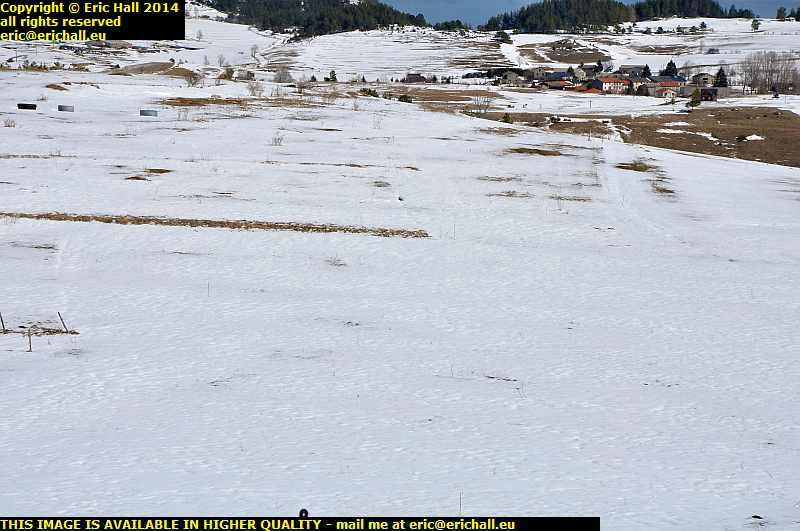
medieval village site montaillou ariege franceSo while you look at the site of the Medieval village and marvel at how clearly the traces of the roads and habitations show up through the snow after 7 centuries of abandonment and agricultural exploitation, let me tell you a little about what is so interesting about the village.

If you remember my visit to Red Bay in Labrador in 2010

you’ll recall how a chance find in a dusty, forgotten archive led to a discovery of the 2nd-most-important historic site in Canada, something similar has happened here.


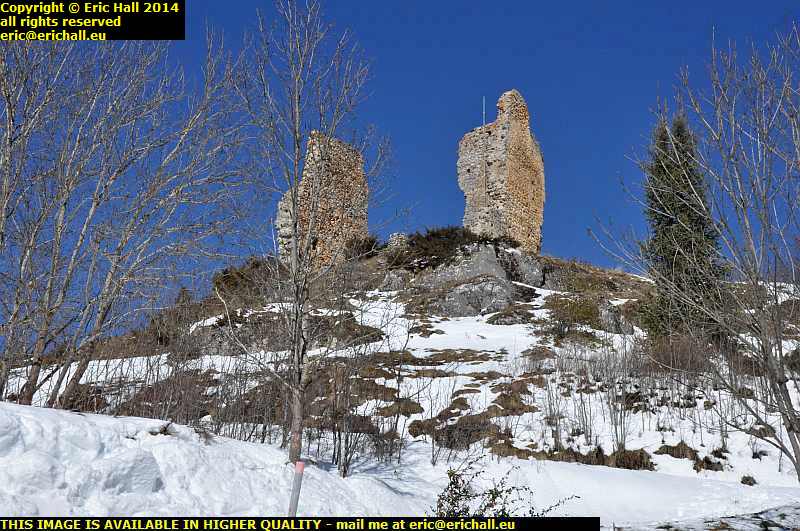
ruined castle chateau montaillou ariege comte de foix franceWhile you look at the ruins of the castle of the Counts of Foix, situated on a hill nearby, I’ll tell you that someone by the name of Emmanuel Leroy Ladurie went a-ferretting in some dusty, forgotten archives of one of the local bishops, and actually discovered the verbatim records of the interviews between the members of the Papal Inquisition and the inhabitants of Montaillou.

He wrote a book (a copy of which is in my possession) to summarise the information gleaned from the interviews and it has become one of the most important references to life in rural France at the end of the 13th Century, adding a great deal to whatever was previously known about the subject.
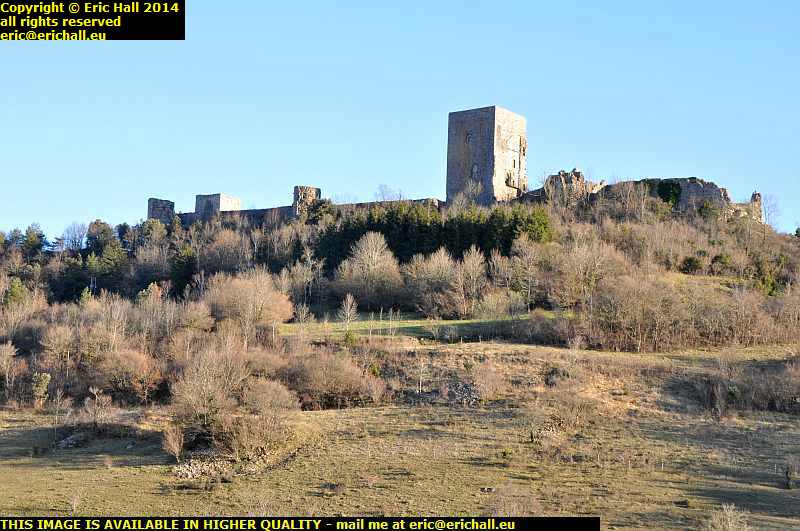

chateau de puivert aude franceWhile we are on the subject of castles, this whole area is teeming with them. Not quite one on every hilltop but pretty much near enough.

This is the Chateau de Puivert and was another Cathar stronghold. It fell to the Crusaders after a siege of just three days in November 1210 and the leader of the crusaders, Simon de Montfort, granted it to one of his marshalls.

As an aside, de Montfort was the father of the Simon de Montfort who opposed Henry III of England during the Barons’ Revolt of 1264-67. It was however Montfort père who was responsible for most of the atrocities committed against the Cathars during the early years of the Crusade.


hanomag kurier diesel montségur ariege franceIt wasn’t all work either. I’ve seen a couple of really interesting motor vehicles today, highlight of which has to be this German Hanomag Kurier light truck.

Apart from the fact that its engine is a diesel, I know nothing else whatever about it. Hanomag stopped making trucks in 1969 and so this gives me some idea of the date. I wouldn’t have put it many years earlier than that. Still, I’d take it home with me tomorrow given half a chance.

Tuesday 1st October 2013 – I’VE BEEN TRAVELLING BACKWARDS TODAY

And that might explain this awfully stiff neck that I have – unless I didn’t swallow the Viagra quickly enough last night.

18th cntury cannon firing real round fort william henry new yorkFirst stop was back to Fort William Henry to watch an artillery demonstration – a real period cannon firing a real cannon ball. Certainly impressive, definitely noisy, and quite successful. Much more successful than Colonel Munro’s artillery that were badly constructed and kep blowing up – there’s a lovely piece of a 32-pound cannon, that they found well-embedded in the soil, on display here at the fort.

And I learnt something new today too, and that was why no cannon was ever raised more than 5° from the horizontal even though that meant a huge loss of range. The answer was that in general it meant very little in loss of range but much more accuracy, which is a strange thing to say. With a high elevation, you need pinpoint accuracy because when the ball lands, it buries itself in the soil. With a low elevation, it skimmed across the surface like a flat stone across the lake, and this could increase the range and also increase the likelihood of hitting something.

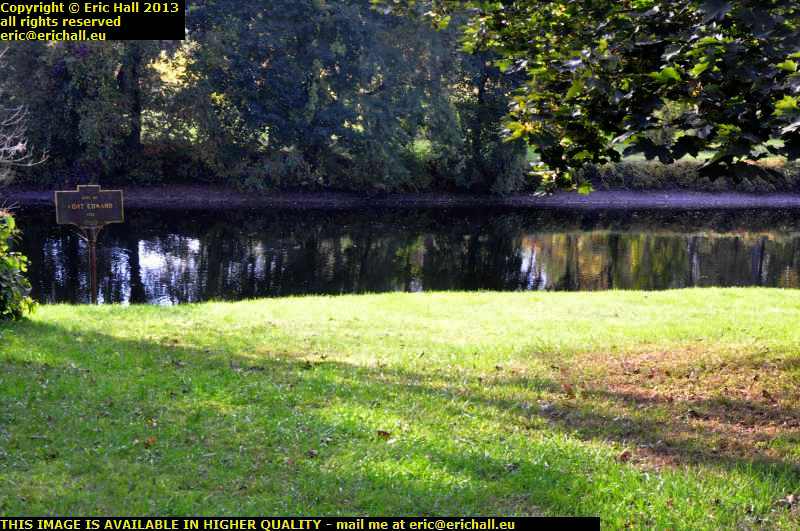
From here I went off to look for Fort Edward, the fort that controlled the frontier around here and to which the survivors of Fort William Henry were fleeing when they were butchered by the Iroquois. I drove past it yesterday, simply for the reason that it isn’t signposted at all from the main road, being on private land. The guy here at Fort William Henry gave me a few pointers and off I went.

fort edward new york usa
And here is the site, in someone’s back garden, although the fort was very much bigger than this of course. It was totally destroyed by the Americans during the Revolutionary War to stop the British from fortifying it, and yet when some of these house-owners were digging down underneath their houses to make cellars, they were churning out all kinds of artefacts, many of which are in a little museum in the town (although, of course, many were simply sold on eBay).

There have been a few archaeological digs and searches on a few of the properties and all kinds of things have been unearthed, all of which is quite exciting. Not as exciting as what was to happen next, though, for we are about to have another Red Bay or Albion experience.

timbers recovered from river hudson fort edward new york
Expressing quite an interest in this kind of thing and, I suppose, being quite knowledgeable, I was engaged in quite a chat with the local museum curator, and after a while he beckoned me into the back room. “Good job I’m wearing my chastity belt” I mused.

However, I don’t know if I’ve mentioned it but I’ve been encountering a lot of dredging along the Hudson just now, and the dredgers were here a short while ago and they encountered something solid just off the banks of the river where the fort was. It turned out that they had hooked a couple of squared-off timbers that have in all probability been part of the fort and were thrown into the river by the retreating Americans. The dark peaty silt on the bottom of the river has preserved them.

Anyway, I’m apparently the first layman to lay my hands upon them, which is something of an honour, I suppose.

thrilling incident of Jane McCrea Fort Edward New York
One of the things that we discuss every now and again is the dramatic change in language over a period of time, and here’s a classic example of this. This describes “one of the most thrilling events in the annals of the American Revolution”, and so today you would be gripping the edges of your seats in eager anticipation.

But back using the contemporary language of the end of the 18th Century your heart would be fluttering as you read the tragic story of young Jane McCrea. She was 17 (according to one account, and as old as 24 in another, and varying ages in between according to more accounts) and she was travelling in the country to visit her fiancé (and so 17 would be a good bet if you ask me) when she was seized by two native Americans working as scouts for the British soldiers.

These Native Americans couldn’t decide amongst themselves which one had captured her first and so was entitled to … errr … do the honours, you might say, and so in an age-old tribal custon, they decided to cut her in two so that each one could have a half.

I can imagine that if such an event were to happen today, poor Jane McCrea would be less than thrilled by the outcome of events.

Fort Ann was the last place to visit today. Known as Fort Schuyler when it was a Dutch possession, there have been 5 forts here at Fort Ann although today not a single vestige remains of any of them.
combined lock 16 17 Champlain Canal Fort Ann New YorkIt is however a strategic place on the route of the Champlain Canal, because, rarely, all three routes of the canal pass within 100 yards of each other here. The first route, known in the vernacular as “Clinton’s Ditch” … "Ditch with a “D” – we aren’t talking about Monica Lewinski" – ed … was modernised and rerouted in the 1850s when new technology permitted wider boats and deeper locks, and the old canal at Fort Ann, just to the right of these locks, was converted into a dry dock for repairs.

On the 1850s canal, new technology meant that they could experiment with “combined locks”, where two locks were immediately adjacent to each other and shared a common central gate. This is combined lock 16 and 17 and the central gate is just behind where the staircase is, the recess for the first gate being seen in the immediate foreground.

From here I stopped at Walmart to do a final food shop for my journey. There I encountered a woman with a face like a wet weekend in Weymouth. “Do you know”, I said, “you look exactly how I feel”.
She burst into laughter, said “well, at least that comment made me smile” and shuffled off down another aisle. Ahh well.

Wednesday 9th March 2011 – The situation here now is …

 that Terry and I have started on the odd jobs. It seems that major tasks for the two of us have finished.

I didn’t paint my doors today for the simple reason that the paint that I bought is nothing like the correct colour and so we decided that just the one coat (that which I put on yesterday) would be enough. And so I spent all morning scrubbing the floor in the cupboard and then mopping it out.

This afternoon I scrubbed the wall at the back of the terrace at the back of the apartment. It’s come up really clean and ready for a nice coat of white stone paint. Just the thing to set off the black tiles that we put on the floor. To finish off the day, I sanded down the doorframe of the front door – outside in the hallway. That will have a coat of gleaming white gloss first thing tomorrow – it’ll be the first thing that prospective purchasers will see so it needs to look good.

Terry was busy too, doing all kinds of things around and about. He’s also hung the curtains in the living room, taken another huge pile of stuff down to the garage, and been moving stuff around in the living room.

Liz though has been extremely busy. She’s been scrubbing the parquet floor in the living room, sanding it down with an electric sander, spreading about some liquid wax that I found in the garage, and then polishing it up with Terry’s electric car polisher. And do you know what? The results are quite impressive. It’s flaming hard work though and she was exhausted afterwards and so to save everyone’s energy I took everyone to the fritkot for tea. The food there is really quite good and I thoroughly recommend it.

In other news, I’ve posted on the internet a trial page of my Trans-Labrador Highway tour from last autumn. It’s the page where I visit Red Bay, the site of the 16th Century Basque whaling station. Have a read of it and let me know what you think as I have a cunning plan involving this page and so it needs to be good.

Friday 15th October 2010 – THIS ALL STARTED AS AN ARGUMENT, YOU KNOW.

strait of belle isle newfoundland labrador canadaSomeone had said something about the first white child born in North America being Virginia Dare in 1587. I replied that that was nonsense as there is evidence in the Norse Sagas to show that at least one child was born to the Viking settlers in Vinland.

The counter argument to that was that Newfoundland is an island – to which led the next and most logical question “and Roanoke Island is what?”.

So then we degenerated into some other discussion that terminated with “well, you can’t see the mainland from Newfoundland”.

The distance across the Straits of Belle Isle is only 18 miles at its narrowest part – less than the English Channel between the UK and France – and so that statement sounded like absolute nonsense and so I was determined to go along and see for myself, and this is how all of this started. I’ve spent 5 years planning for this

mv bernier strait of belle isle labrador newfoundland canada And so here I am at sea level in Red Bay on the southern shore of Labrador and in the distance are the hills of Newfoundland way across the Strait of Belle Isle.

And if you don’t believe me, just click on the image and see for yourself.

The … errrr … ship on the right of the image is the MV Bernier, a collier delivering coal to the bay in 1966 that slipped from its moorings in a November gale and ran aground on the rocks.

basque whaler recovered from water red bay labrador canadaBut I had a most amazing stroke of good fortune at Red Bay.

Red Bay was the site of a Basque whaling station in the 16th Century (and there is strong evidence to suggest that it was operational long before then – maybe even before Columbus sailed the Atlantic). Not only are there the ruins of a whale-oil distillery, but 4 sunken galleons and several small whalers, one of which has been recovered and put on display

wreck mv bernier cemetery basque whaler graves red bay labrador canadaThey also rediscovered a cemetery containing the graves of basque whalers who had lost their lives jn the 16th Century, and this can be seen to the left of the Bernier.

Of course it is all closed up at this time of year but the Canadian Government has submitted it as a potential UNESCO World Heritage site and today there were some visitors from this being shown around. Of course, Yours Truly blagged his way onto the guided tour and was given the full VIP treatment.

It was truly remarkable

mary's harbour labrador canadaI forgot to take a photo of my hotel last night but this is the town in which is is situated – Mary’s Harbour.

This is a “new” town, being officially founded in the 1930s. Prior to that, everyone lived on an island called Battle Harbour but the settlement burnt down in 1930, so it was decided to create a new community for the inhabitants here on the mainland.

From here, it was to my startling discoveries at Red Bay.

point amour lighthouse strait of belle isle labrador newfoundland canadaAnd that wasn’t all either. Down the road at Point Amour is Canada’s second highest lighthouse.

It was of course closed when I got there but a lady was loading up her car and so she took some time out to explain things to me. She even told me where to go to see the remains of two ships stranded on the coast just down here.

shipwreck hms raleigh point amour strait of belle isle lighthouse labrador canadaSo off I went for a wander along the coast to see for myself.

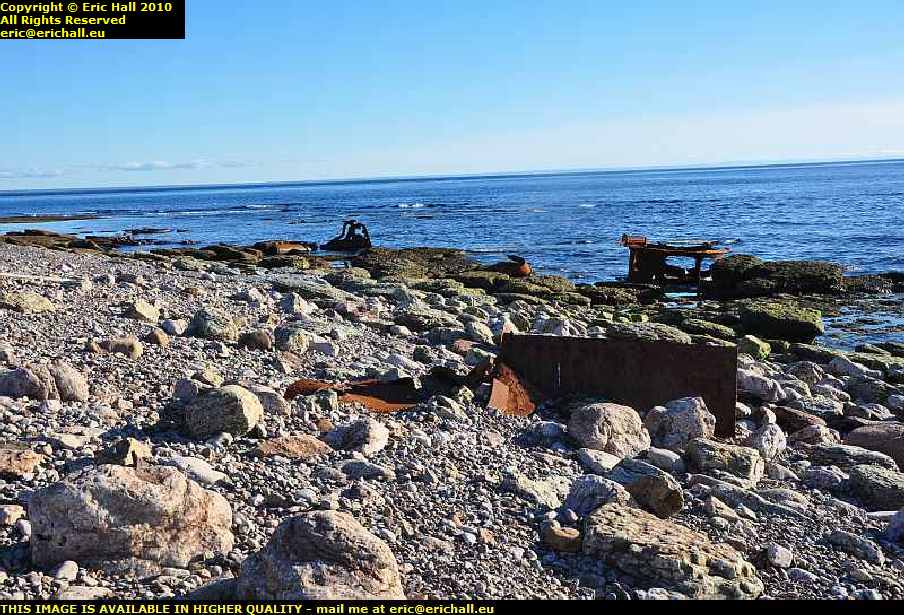
These are probably bits of HMS Raleigh, a British light cruiser that ran aground here in 1922, having swerved to avoid an iceberg in the Strait of Belle Isle. It was so well aground that it was impossible to move it and so they decided to dynamite it.

shipwreck hms raleigh point amour strait of belle isle lighthouse labrador canadaThey calculated precisely the amount of explosive that they needed to split the ship into manageable portions, but totally forgot to take into account the quantity of ammunition that remained on board.

Consequently, huge portions of the ship were hurled many hundreds of yards inland where they remain to this day.

But some of the remains that you see relate to HMS Lily, a British man-o-war that had gone aground 50 years earlier. However the remains are so mixed up due to the explosion that it’s hard to tell which is which.

mv apollo newfoundland labrador ferry strait of belle isle blanc sablon st barbe canadaSo that was my day really – and what a day it was.

And coming into Blanc Sablon there was a ferry moored in the harbour with steam up. Further enquiries revealed that it was the MV Apollo – the Newfoundland ferry, and it was leaving in half an hour so I had to get a move on if I wanted to catch it.

And so here I am in St Anthony, Newfoundland just 20 minutes away from L’Anse au Meadows and the Viking remains. Yes, I had a quick thrash through the dark right the way up Newfoundland to get here.

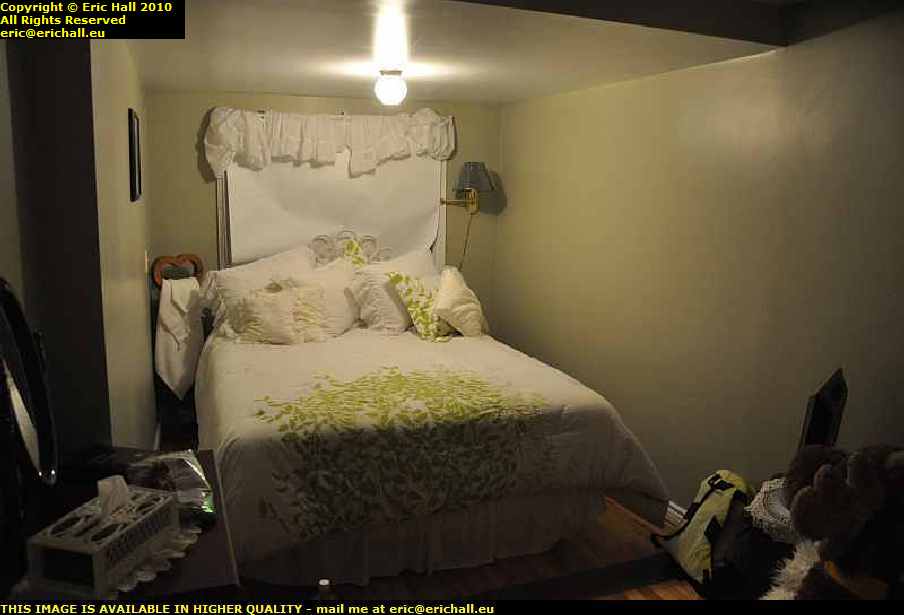
bed and breakfast st anthony newfoundland canadaBut what a cheesy place this B&B is – it’s furnished in the worst possible taste – all chintz and lace and nothing practical and all gone to ridiculous extremes.

It’s like something out of a bad 1920s novel and I can’t think what must have gone through the minds of the people who fitted this out. There are 7 pillows on the bed, for heaven’s sake, all laid out with military precision. One look at this place and the phrase “obsessive behaviour” sprang straight away to mind.

Still I’ll be gone tomorrow, I hope.

But that’s not definitive. There are some ominous rumblings in the distance. It seems that the ferry to Sydney, Cape Breton, may well have broken down. And the only other way off the island is back the way I came, and then to retrace my steps all the way over the Trans-Labrador Highway. And the weather has broken!

The road from Blanc-Sablon to some weirdly-named town beginning with N … "Natashquan" – ed … has not yet been built so I can’t get round to Sept Iles and then Baie-Comeau that way.

One other possibility is to have Casey shipped in a container by sea freight to wherever it is that Highway 138 begins – and when they told me how much that might cost (STARTING AT $400 – heaven alone knows what price it will finish at) I nearly fell through the floor.

But on reflection, if you think about it – the hotel at Labrador City, the one at Goose Bay, the one at Cartwright and the one at Mary’s Harbour came to almost twice that – and then there was the fuel and so on.

I shall have to look carefully into this. There’s a freighter leaving for there from Blanc Sablon next Friday.