Tag Archives: fort william henry

Thursday 3rd October 2013 – STRAWBERRY MOOSE …

strawberry moose mount defiance fort ticonderoga lake champlain new york usamans … "persons!" – ed … a British 12-pounder gun that was dragged to the top of Mount Defiance by a troop of General Burgoyne’s artillery with the aim … "ohh, well done!" – ed … of threatening the American rebels in the fort way below on the promontory on Lake Champlain.

It just goes to show you the power that modern artillery posed back in the early modern era because I doubt very much whether any cannon in the British artillery train, and certainly not a 12-pounder, would have had the effective (or even the absolute) range to do anything like any serious damage to the fort.

Don’t forget that these forts are not like early medieval castles, built of stone walls, where a few 14th- and 15th Century cannon balls could send them crashing down. These fortresses might be faced outside and inside with stone (or even wood) but in between the facings was often as much as 24 feet of earth or sand and any cannon ball, explosive or otherwise, would be merely smothered. At Fort William Henry they were firing point-blank (like 150 yards) with all the artillery that Moncalm had and the only reason that the fort’s north-western bastion collapsed was because a lit howitzer shell from outside landed in an opened box of fused shells on the parapet. And even that wasn’t enough to breach the walls – it simply showed Munro that the writing was on the walls.

artillery crew strawberry moose mount defiance fort ticonderoga lake champlain new york usaOf course Strawberry Moose was not alone up here. He recruited a very keen and willing artillery crew from amongst the local residents out for an early morning hike, and they were only too ready to help him in his exploits with his weapon.

With one volunteer being worth ten men, it was certainly enough to put the wind up the American rebels down in the fort below and they soon fled across the lake into Vermont. But seriously, I cannot imagine whatever was going through the mind of the commander of the fort that he didn’t put a detachment of his men up here to stop the British from taking the position and threatening the fort. Overconfidence?

rogers rock new york state campground lake george USAI did promise you all yesterday that I would show you a photo of my camp site from last night, and you won’t be disappointed, because I wasn’t. This is Rogers Rock campsite on the very northern edge of Lake George and it is one of the most spectacular places in which I’ve slept (strangely enough, of my “top 10”, every one of them is in North America).

As for Rogers, he was someone who became totally disillusioned with the British tactics of marching in fours, dressed in bright red uniforms, through the forests around here. He recruited a band of volunteers, called them “Rogers’ Rangers”, and dressed them in greens and browns. Then he sent them crawling through the forest to wreak havoc and destruction amongst the French military, their native Algonquin allies, and the Frech settlers who had settled around the head of Lake George in defiance of the treaty of Utrecht of 1713.

From there I drove on across the pass and the old portage to Crown Point, where Lake Champlain narrows to about half a mile. Crown Point actually faces north rather than south and so once the French had abandoned Fort Carillon (as Fort Ticonderoga was known) in order to defend Montreal after the fall of Quebec and the loss of Montcalm’s army in 1759, the British dashed here to where the French formerly had a trading post (Fort St Frederic) to take possession.

crown point fort amherst lake champlain new york usaHere, they started to build what would have been the largest fortress in the whole of North America and in a rush that would have put modern builders to shame, they were well on the way to completing it when the dramatic collapse of French military resistance in North America in 1760 meant that the fort was no longer necessary. After all, who could have foreseen the American Revolution?

The fort was built much more substantially than this, but a chimney fire in one of the barracks went out of control and set alight the armoury, wherein was stored most of the British munitions, including a couple of tons of gunpowder. The subsequent explosion atomised the armoury and set everything else alight, including the timber cross-bracing within the earthen walls and so there was a subterranean fire that went on for weeks until everything was consumed.

champlain bridge lake champlain new york vermont usaThere’s a bridge here too – the Champlain Bridge, that crosses the lake into Vermont (I was in Vermont when I took this photo). Pretty though this bridge might be, it’s not a patch on the one that used to be here. That was a graceful steel lattice-girder bridge that was totally innovative in the 1920s when it as built, but the techniques used went on to be standard bridge-building practice until the advent of (yeeuucchhh) concrete bridges.

Accordingly it was classed as a National Monument in 2009 and a team of experts was sent to examine the bridge and make an inventory. What they found so horrified them that the bridge was immediately closed and demolished, for it seems that in the confusion about who actually owned the bridge, there had never been an inspection or even five minutes of maintenance of the structure since the day that it was built.

So tomorrow, I’ll show you this evening’s camp site and you can see what you think of that.

Tuesday 1st October 2013 – I’VE BEEN TRAVELLING BACKWARDS TODAY

And that might explain this awfully stiff neck that I have – unless I didn’t swallow the Viagra quickly enough last night.

18th cntury cannon firing real round fort william henry new yorkFirst stop was back to Fort William Henry to watch an artillery demonstration – a real period cannon firing a real cannon ball. Certainly impressive, definitely noisy, and quite successful. Much more successful than Colonel Munro’s artillery that were badly constructed and kep blowing up – there’s a lovely piece of a 32-pound cannon, that they found well-embedded in the soil, on display here at the fort.

And I learnt something new today too, and that was why no cannon was ever raised more than 5° from the horizontal even though that meant a huge loss of range. The answer was that in general it meant very little in loss of range but much more accuracy, which is a strange thing to say. With a high elevation, you need pinpoint accuracy because when the ball lands, it buries itself in the soil. With a low elevation, it skimmed across the surface like a flat stone across the lake, and this could increase the range and also increase the likelihood of hitting something.

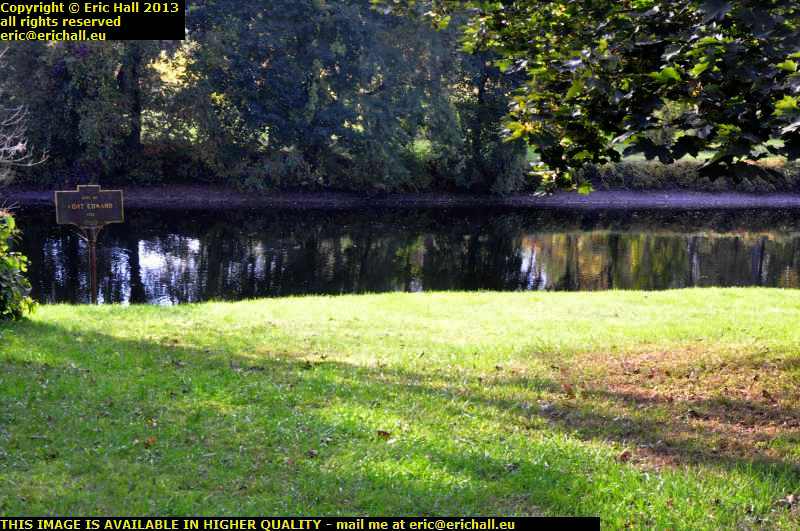
From here I went off to look for Fort Edward, the fort that controlled the frontier around here and to which the survivors of Fort William Henry were fleeing when they were butchered by the Iroquois. I drove past it yesterday, simply for the reason that it isn’t signposted at all from the main road, being on private land. The guy here at Fort William Henry gave me a few pointers and off I went.

fort edward new york usa
And here is the site, in someone’s back garden, although the fort was very much bigger than this of course. It was totally destroyed by the Americans during the Revolutionary War to stop the British from fortifying it, and yet when some of these house-owners were digging down underneath their houses to make cellars, they were churning out all kinds of artefacts, many of which are in a little museum in the town (although, of course, many were simply sold on eBay).

There have been a few archaeological digs and searches on a few of the properties and all kinds of things have been unearthed, all of which is quite exciting. Not as exciting as what was to happen next, though, for we are about to have another Red Bay or Albion experience.

timbers recovered from river hudson fort edward new york
Expressing quite an interest in this kind of thing and, I suppose, being quite knowledgeable, I was engaged in quite a chat with the local museum curator, and after a while he beckoned me into the back room. “Good job I’m wearing my chastity belt” I mused.

However, I don’t know if I’ve mentioned it but I’ve been encountering a lot of dredging along the Hudson just now, and the dredgers were here a short while ago and they encountered something solid just off the banks of the river where the fort was. It turned out that they had hooked a couple of squared-off timbers that have in all probability been part of the fort and were thrown into the river by the retreating Americans. The dark peaty silt on the bottom of the river has preserved them.

Anyway, I’m apparently the first layman to lay my hands upon them, which is something of an honour, I suppose.

thrilling incident of Jane McCrea Fort Edward New York
One of the things that we discuss every now and again is the dramatic change in language over a period of time, and here’s a classic example of this. This describes “one of the most thrilling events in the annals of the American Revolution”, and so today you would be gripping the edges of your seats in eager anticipation.

But back using the contemporary language of the end of the 18th Century your heart would be fluttering as you read the tragic story of young Jane McCrea. She was 17 (according to one account, and as old as 24 in another, and varying ages in between according to more accounts) and she was travelling in the country to visit her fiancé (and so 17 would be a good bet if you ask me) when she was seized by two native Americans working as scouts for the British soldiers.

These Native Americans couldn’t decide amongst themselves which one had captured her first and so was entitled to … errr … do the honours, you might say, and so in an age-old tribal custon, they decided to cut her in two so that each one could have a half.

I can imagine that if such an event were to happen today, poor Jane McCrea would be less than thrilled by the outcome of events.

Fort Ann was the last place to visit today. Known as Fort Schuyler when it was a Dutch possession, there have been 5 forts here at Fort Ann although today not a single vestige remains of any of them.
combined lock 16 17 Champlain Canal Fort Ann New YorkIt is however a strategic place on the route of the Champlain Canal, because, rarely, all three routes of the canal pass within 100 yards of each other here. The first route, known in the vernacular as “Clinton’s Ditch” … "Ditch with a “D” – we aren’t talking about Monica Lewinski" – ed … was modernised and rerouted in the 1850s when new technology permitted wider boats and deeper locks, and the old canal at Fort Ann, just to the right of these locks, was converted into a dry dock for repairs.

On the 1850s canal, new technology meant that they could experiment with “combined locks”, where two locks were immediately adjacent to each other and shared a common central gate. This is combined lock 16 and 17 and the central gate is just behind where the staircase is, the recess for the first gate being seen in the immediate foreground.

From here I stopped at Walmart to do a final food shop for my journey. There I encountered a woman with a face like a wet weekend in Weymouth. “Do you know”, I said, “you look exactly how I feel”.
She burst into laughter, said “well, at least that comment made me smile” and shuffled off down another aisle. Ahh well.

Monday 30th September 2013 – THE FRENCH ARE COMING! THE FRENCH ARE COMING!

strawberry moose fort william henry lake george new yorkAnd even if it is General Montcalm and his Abenakis allies about to wreak havoc on the British soldiers and massacre their prisoners on the plain in front of the fort, there’s no need to worry because as well as Hawkeye and Chingachcook, Strawberry Moose is there ready to repel all boarders – and a few … "you said that yesterday" – ed .

Where I am is at the infamous Fort William Henry, another one of those humiliating episodes in British Military History in North America where, due to an insufficient lookout and picket, Lt-Col Munro allowed the fort to be enircled by Montcalm’s French troops and Iroquois allies and whose superior artillery (which should never have been allowed to land if the look-out had been up to much) battered the fort into submission.

Although the story of the subsequent massacre of the captive women and children was grossly exaggerated by Fenimore Cooper in The Last of the Mohicans, there was certainly a considerable slaughter here outside the fort as the Iroquois, drunk on the rum looted from the fort and having been denied any say in the peace process thus feeling cheated of their right to obtain scalps and other booty from the occupants of the fort, were determined to seek redress.

So this morning after my relaxing stay at the camp site at Schaghticoke last night, I hit the road.

soil polluted by PCBs schuylerville new yorkFirst stop was at Schuylerville, the old “Saratoga” and a pretty place it is too. But this sign isn’t so pretty. The ground is so polluted by PCBs that it’s against the law to dig in the soil – no use trying to grow potatoes and the like here, even if not a couple of hundred yards from where I’m standing there are corn fields and all kinds of things.

But tha corn is not of course intended for human consumption – it’s for animal feed (and humans will then eat the animals)and so that’s ok. But it’s frightening all the same, what’s happening to the world’s food supplies.

lock 12 old champlain canal hudson valley new yorkYesterday I showed you a photo of a lock on the Champlain Canal. Before the modernisation of the Hudson navigation, there was an “Old Champlain Canal” that was on a much smaller scale. I’ve been following that today too, and I reckoned that I would show you a photo of a lock on here. This is in fact Lock 12 and it’s a little different, isn’t it?

Still, for a canal that was built in 1832 the masonry is in surprisingly good condition although the amount of neglect of the canal and the amount of route that has been lost means that it will never be opened again, which is a shame.

A little further up the road is a town called Glen Falls and while there is nothing to see here (the falls have, like many on the Hudson, been oveebuilt with barrages for hydro-electric power) it has its own excitement. On Lap Three of the circuit of trying to find my way out of the town , I noticed a place called “Mailing Made Easy” – a kind-of boutique which guarantees to find the cheapest method of mailing parcels. Too good an opportunity to miss and so I took the Roland amp that I had bought. They told me the price and, picking myself up off the floor, I packed it because $35:02 was too good a price to miss out on.

And it’s not going on a snail’s back either – delivery 2/3 weeks they say, which may well be before I get home and certainly before I get back from my next stint in Brussels. And so, Liz and Terry, if you read this before I get in touch with you, I’m sorry that I didn’t ask you if you will take in a parcel for me, but I had to make an on-the-spot executive decision, and with it being an executive decision, if it is the wrong decision, then you can execute me when I return home.