And that might explain this awfully stiff neck that I have – unless I didn’t swallow the Viagra quickly enough last night.
 First stop was back to Fort William Henry to watch an artillery demonstration – a real period cannon firing a real cannon ball. Certainly impressive, definitely noisy, and quite successful. Much more successful than Colonel Munro’s artillery that were badly constructed and kep blowing up – there’s a lovely piece of a 32-pound cannon, that they found well-embedded in the soil, on display here at the fort.
And I learnt something new today too, and that was why no cannon was ever raised more than 5° from the horizontal even though that meant a huge loss of range. The answer was that in general it meant very little in loss of range but much more accuracy, which is a strange thing to say. With a high elevation, you need pinpoint accuracy because when the ball lands, it buries itself in the soil. With a low elevation, it skimmed across the surface like a flat stone across the lake, and this could increase the range and also increase the likelihood of hitting something.
From here I went off to look for Fort Edward, the fort that controlled the frontier around here and to which the survivors of Fort William Henry were fleeing when they were butchered by the Iroquois. I drove past it yesterday, simply for the reason that it isn’t signposted at all from the main road, being on private land. The guy here at Fort William Henry gave me a few pointers and off I went.
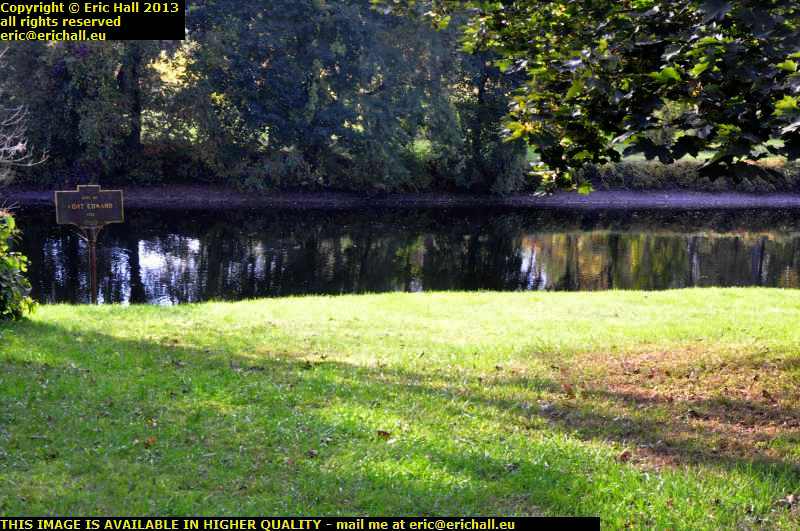
And here is the site, in someone’s back garden, although the fort was very much bigger than this of course. It was totally destroyed by the Americans during the Revolutionary War to stop the British from fortifying it, and yet when some of these house-owners were digging down underneath their houses to make cellars, they were churning out all kinds of artefacts, many of which are in a little museum in the town (although, of course, many were simply sold on eBay).
There have been a few archaeological digs and searches on a few of the properties and all kinds of things have been unearthed, all of which is quite exciting. Not as exciting as what was to happen next, though, for we are about to have another Red Bay or Albion experience.

Expressing quite an interest in this kind of thing and, I suppose, being quite knowledgeable, I was engaged in quite a chat with the local museum curator, and after a while he beckoned me into the back room. “Good job I’m wearing my chastity belt” I mused.
However, I don’t know if I’ve mentioned it but I’ve been encountering a lot of dredging along the Hudson just now, and the dredgers were here a short while ago and they encountered something solid just off the banks of the river where the fort was. It turned out that they had hooked a couple of squared-off timbers that have in all probability been part of the fort and were thrown into the river by the retreating Americans. The dark peaty silt on the bottom of the river has preserved them.
Anyway, I’m apparently the first layman to lay my hands upon them, which is something of an honour, I suppose.

One of the things that we discuss every now and again is the dramatic change in language over a period of time, and here’s a classic example of this. This describes “one of the most thrilling events in the annals of the American Revolution”, and so today you would be gripping the edges of your seats in eager anticipation.
But back using the contemporary language of the end of the 18th Century your heart would be fluttering as you read the tragic story of young Jane McCrea. She was 17 (according to one account, and as old as 24 in another, and varying ages in between according to more accounts) and she was travelling in the country to visit her fiancé (and so 17 would be a good bet if you ask me) when she was seized by two native Americans working as scouts for the British soldiers.
These Native Americans couldn’t decide amongst themselves which one had captured her first and so was entitled to … errr … do the honours, you might say, and so in an age-old tribal custon, they decided to cut her in two so that each one could have a half.
I can imagine that if such an event were to happen today, poor Jane McCrea would be less than thrilled by the outcome of events.
Fort Ann was the last place to visit today. Known as Fort Schuyler when it was a Dutch possession, there have been 5 forts here at Fort Ann although today not a single vestige remains of any of them.
 It is however a strategic place on the route of the Champlain Canal, because, rarely, all three routes of the canal pass within 100 yards of each other here. The first route, known in the vernacular as “Clinton’s Ditch” … "Ditch with a “D” – we aren’t talking about Monica Lewinski" – ed … was modernised and rerouted in the 1850s when new technology permitted wider boats and deeper locks, and the old canal at Fort Ann, just to the right of these locks, was converted into a dry dock for repairs.
On the 1850s canal, new technology meant that they could experiment with “combined locks”, where two locks were immediately adjacent to each other and shared a common central gate. This is combined lock 16 and 17 and the central gate is just behind where the staircase is, the recess for the first gate being seen in the immediate foreground.
From here I stopped at Walmart to do a final food shop for my journey. There I encountered a woman with a face like a wet weekend in Weymouth. “Do you know”, I said, “you look exactly how I feel”.
She burst into laughter, said “well, at least that comment made me smile” and shuffled off down another aisle. Ahh well.


 , there was certainly a considerable slaughter here outside the fort as the Iroquois, drunk on the rum looted from the fort and having been denied any say in the peace process thus feeling cheated of their right to obtain scalps and other booty from the occupants of the fort, were determined to seek redress.
