Tag Archives: albion

Tuesday 1st October 2013 – I’VE BEEN TRAVELLING BACKWARDS TODAY

And that might explain this awfully stiff neck that I have – unless I didn’t swallow the Viagra quickly enough last night.

18th cntury cannon firing real round fort william henry new yorkFirst stop was back to Fort William Henry to watch an artillery demonstration – a real period cannon firing a real cannon ball. Certainly impressive, definitely noisy, and quite successful. Much more successful than Colonel Munro’s artillery that were badly constructed and kep blowing up – there’s a lovely piece of a 32-pound cannon, that they found well-embedded in the soil, on display here at the fort.

And I learnt something new today too, and that was why no cannon was ever raised more than 5° from the horizontal even though that meant a huge loss of range. The answer was that in general it meant very little in loss of range but much more accuracy, which is a strange thing to say. With a high elevation, you need pinpoint accuracy because when the ball lands, it buries itself in the soil. With a low elevation, it skimmed across the surface like a flat stone across the lake, and this could increase the range and also increase the likelihood of hitting something.

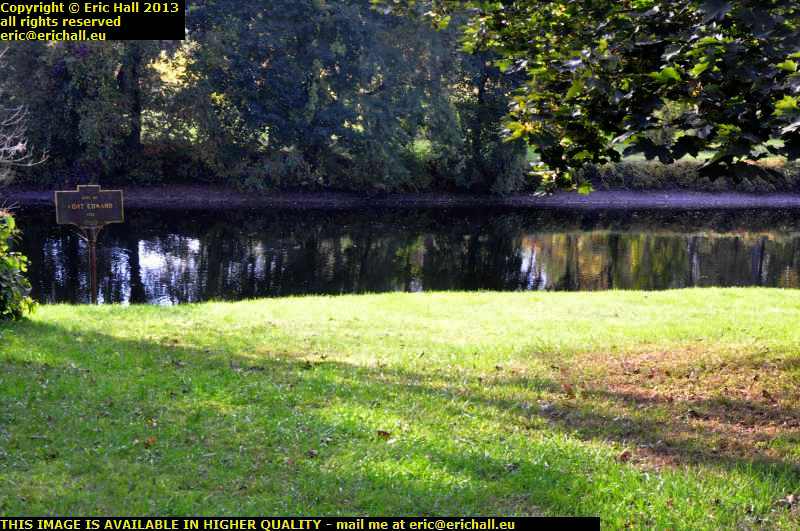
From here I went off to look for Fort Edward, the fort that controlled the frontier around here and to which the survivors of Fort William Henry were fleeing when they were butchered by the Iroquois. I drove past it yesterday, simply for the reason that it isn’t signposted at all from the main road, being on private land. The guy here at Fort William Henry gave me a few pointers and off I went.
fort edward new york usa
And here is the site, in someone’s back garden, although the fort was very much bigger than this of course. It was totally destroyed by the Americans during the Revolutionary War to stop the British from fortifying it, and yet when some of these house-owners were digging down underneath their houses to make cellars, they were churning out all kinds of artefacts, many of which are in a little museum in the town (although, of course, many were simply sold on eBay).

There have been a few archaeological digs and searches on a few of the properties and all kinds of things have been unearthed, all of which is quite exciting. Not as exciting as what was to happen next, though, for we are about to have another Red Bay or Albion experience.

timbers recovered from river hudson fort edward new york
Expressing quite an interest in this kind of thing and, I suppose, being quite knowledgeable, I was engaged in quite a chat with the local museum curator, and after a while he beckoned me into the back room. “Good job I’m wearing my chastity belt” I mused.

However, I don’t know if I’ve mentioned it but I’ve been encountering a lot of dredging along the Hudson just now, and the dredgers were here a short while ago and they encountered something solid just off the banks of the river where the fort was. It turned out that they had hooked a couple of squared-off timbers that have in all probability been part of the fort and were thrown into the river by the retreating Americans. The dark peaty silt on the bottom of the river has preserved them.

Anyway, I’m apparently the first layman to lay my hands upon them, which is something of an honour, I suppose.

thrilling incident of Jane McCrea Fort Edward New York
One of the things that we discuss every now and again is the dramatic change in language over a period of time, and here’s a classic example of this. This describes “one of the most thrilling events in the annals of the American Revolution”, and so today you would be gripping the edges of your seats in eager anticipation.

But back using the contemporary language of the end of the 18th Century your heart would be fluttering as you read the tragic story of young Jane McCrea. She was 17 (according to one account, and as old as 24 in another, and varying ages in between according to more accounts) and she was travelling in the country to visit her fiancé (and so 17 would be a good bet if you ask me) when she was seized by two native Americans working as scouts for the British soldiers.

These Native Americans couldn’t decide amongst themselves which one had captured her first and so was entitled to … errr … do the honours, you might say, and so in an age-old tribal custon, they decided to cut her in two so that each one could have a half.

I can imagine that if such an event were to happen today, poor Jane McCrea would be less than thrilled by the outcome of events.

Fort Ann was the last place to visit today. Known as Fort Schuyler when it was a Dutch possession, there have been 5 forts here at Fort Ann although today not a single vestige remains of any of them.
combined lock 16 17 Champlain Canal Fort Ann New YorkIt is however a strategic place on the route of the Champlain Canal, because, rarely, all three routes of the canal pass within 100 yards of each other here. The first route, known in the vernacular as “Clinton’s Ditch” … "Ditch with a “D” – we aren’t talking about Monica Lewinski" – ed … was modernised and rerouted in the 1850s when new technology permitted wider boats and deeper locks, and the old canal at Fort Ann, just to the right of these locks, was converted into a dry dock for repairs.

On the 1850s canal, new technology meant that they could experiment with “combined locks”, where two locks were immediately adjacent to each other and shared a common central gate. This is combined lock 16 and 17 and the central gate is just behind where the staircase is, the recess for the first gate being seen in the immediate foreground.

From here I stopped at Walmart to do a final food shop for my journey. There I encountered a woman with a face like a wet weekend in Weymouth. “Do you know”, I said, “you look exactly how I feel”.
She burst into laughter, said “well, at least that comment made me smile” and shuffled off down another aisle. Ahh well.

Monday 22nd August 2011 – It was 09:30 …

… this morning when I was burned out of bed by the heat. It’s quite astonishing just now, all of this. It was only a week or so ago that I was complaining about the cold weather.

Anyway, I’ve finished the web pages for the Nova Scotia Museum of Industry and they are on line. And well-worth a read too because I managed to blag my way in to see the world’s most controversial railway engine. But that’s all the web site stuff that I’m doing now until I go back next week – is it really only a week away?

The web pages took me nicely to lunch and I actually managed to find a decent tomato in the megacloche. How nice that was as well. Afterwards I was back up the ladder again. It’s now right into the apex of the roof – I can see over the roof line – and sfter today’s exertions there’s not all that much more to do up there. I’m out tomorrow afternoon so I’ll finish it off on Wednesday.

A short while after working in the garden I went for my solar shower. And a max temperature of an astonishing 60.5°:C was recorded. But don’t get carried away by that – I forgot to fill it yesterday and so the temperature sender was reading the air temperature. 41°C was much more like it.

Tonmorrow I have to go to the mairie at Pionsat for some stuff for Radio Anglais. And then, I have to pick up another oil tank. This will be the “before” for the used cooking oil. I’ll also make up the leads for the batteries over in Canada.

Monday 25th October 2010 – I’M IN A BAD MOOD AGAIN.

Yes – I went into Truro today.

Now if Truro were ever famous for just one thing it would be the Teachers’ Training College. If you have been following my journey you will know that Nova Scotia is a province of mainly small villages in isolated situations and until the road-building process that started in 1918 and is still not yet finished these villages had no connection to any other.

But if you can’t bring the children to education the province realised that it needed to bring education to the children and in 1876 it created a small College in Truro to train teachers to educate children in the wilderness.

These teachers, once they had qualified, were sent to these isolated villages, lodging with parents and teaching children in empty fishing sheds and generally integrating into the village to which they had been sent. And this programme continued until 1960.

The college itself is a magnificent building crowned with a copper dome and spire, and features as the centrepiece of the Truro Heritage poster. And when I came here in 2003 I had a quick look for the building but couldn’t find it.

However today, with more time on my hands, I wandered around until I found it. And I had to find it too, because the people whom I asked, including the lady in the Tourist Office, knew nothing about it.

teacher training college truro nova scotia canadaSo here’s the building – the most significant in Truro and probably the most influential in Nova Scotia.

And the reason I couldn’t find it is that there is a huge concrete bunker – a public library – right in front of the building, built on the lawn, and a huge modern building – the police station – built in the old courtyard (this photo was taken around the back).

teacher training college truro nova scotia canadaAnd of course the copper dome and spire have gone – sold for scrap, I shouldn’t wonder.

The building has been abandoned for probably 30 years and there’s a notice on the wall – “The Truro City Council is actively seeking new opportunities for this building”. So how about using the money spent on the new police station to refurbish the building and moving the police into here? Or demolishing the library and ……

But I’m not going to go on and on about this because I’ll get more and more depressed. My opinions about Canadian preservation efforts is starting to sink to the same depths as those of the USA. Or of France. Or of the UK. People no longer have any pride in their heritage.

So to cheer myself up I went in search of what may well be the oldest intact steam railway locomotive in the world.

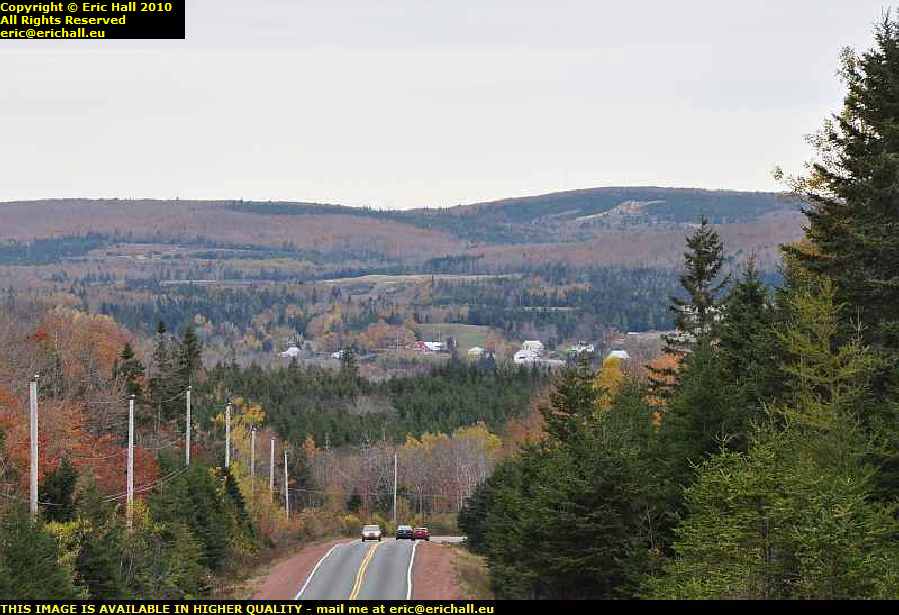
highway 311 cobequid hills nova scotia canadaMy route north out of Truro took me along Highway 311 and Highway 326 took me over the watershed between south-western Nova Scotia and north-eastern Nova Scotia and I encountered some views that were truly beautiful.

However, it also took me into a load of traffic as you can see and I’m not at all used to this. Still, you can’t have everything, I suppose.

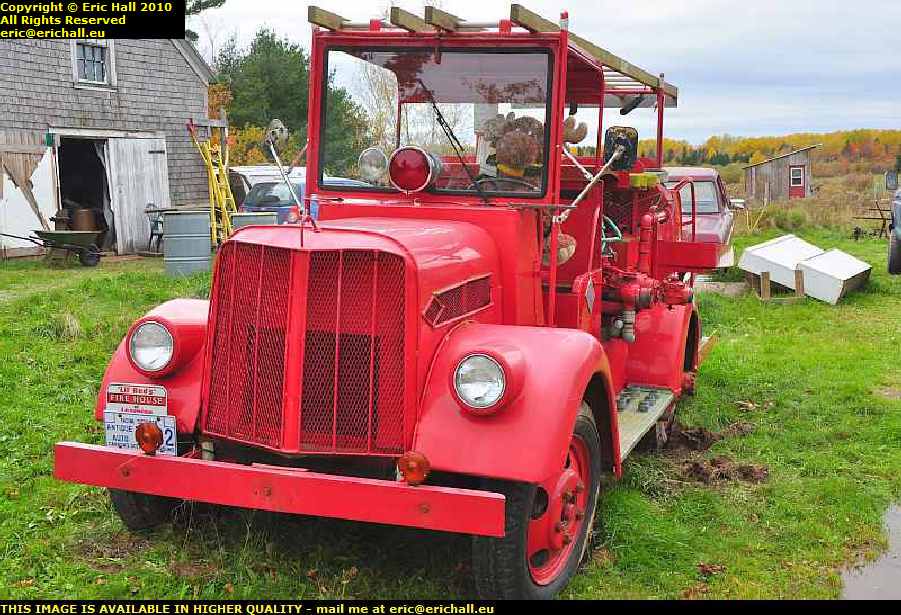
1930s ford 2 ton chassis V8 flathead fire engineYou can’t have this either, because the owner has no interest whatever in parting with it, although Strawberry Moose has a good go at driving it.

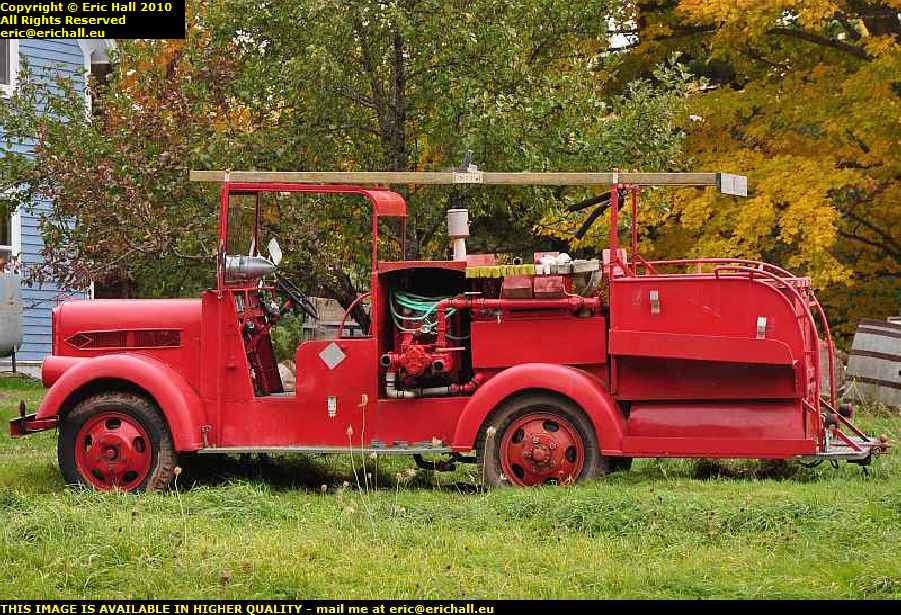
It’s basically a standard 1930s Ford 2-ton chassis with twin rear wheels, a single-wheel front and a Ford V8 flathead (sidevalve) engine and formerly belonged to a small paper mill out on the coast in British Columbia, a mill that was isolated from the main road network.

1930s ford 2 ton chassis V8 flathead fire engineThey built it themselves after a fire in the mill during the 1940s had caused considerable damage because they had no means of extinguishing it.

And the next fire, in 1994, he fire engine had been out of use for so long that it wouldn’t start and so the mill burnt down again. Consequently they junked it and the present owner rescued it and, having fixed it, drove it back here.

At least, that cheered me up considerably.

albion samson nova scotia museum of industry stellarton new glasgow canadaI eventually tracked down my steam locomotive, thanks to the owner of the fire engine who put me right.

A group of engineers have liberated it from its depressing situation on a plinth outside in all kinds of weather and, having restored it to something resembling working order, it’s now in the Nova Scotia Museum of Industry and I was lucky enough to be allowed in to see it.

The locomotive is called Albion and came to Nova Scotia from Newcastle upon Tyne in 1854.

For a long time it was considered that 1854 was the date of manufacture, but I would find this hard to believe without convincing evidence. If you compare this design with any other design of 1854 and the evolution has been considerable.

I’m not going to go into a long discussion here because I have expounded at considerable length elsewhere, where you can read at great length exactly what I think about this locomotive.

What is comforting about this is that the people who, while they might not know exactly what it is that they have, are fully aware of the fact that they are in possession of something that is truly special and they have gone to considerable lengths to take care of it. That can only be commended.

And that cheered me up considerably too

main street new glasgow nova scotia canadaHaving been bundled out of the museum with indecent haste because it was closing time, I wandered off to have a look at New Glasgow.

This was another town with quite an impressive past, growing rich on all of the industry and coal mining that took place in the vicinity, but now all of this is long-gone and the town is a shadow of its former self.

There were houses on sale here for as little as $26,000 which, for a European such as myself, is an astonishing price. You couldn’t buy a garage for that in the UK, never mind a house.  

new theatre old shipyard new glasgow nova scotia canadaThat down there is a new theatre, so if you did come here to live, there would be something to entertain you.

But on the site of the theatre and its car park, between 1821 and 1918, there were 5 shipyards and a total of 210 sailing ships were built there. The largest was one of 1400 tons, would you believe.

The ships were built by local men using local materials and from here they went out to sail the world. You would never believe that now.

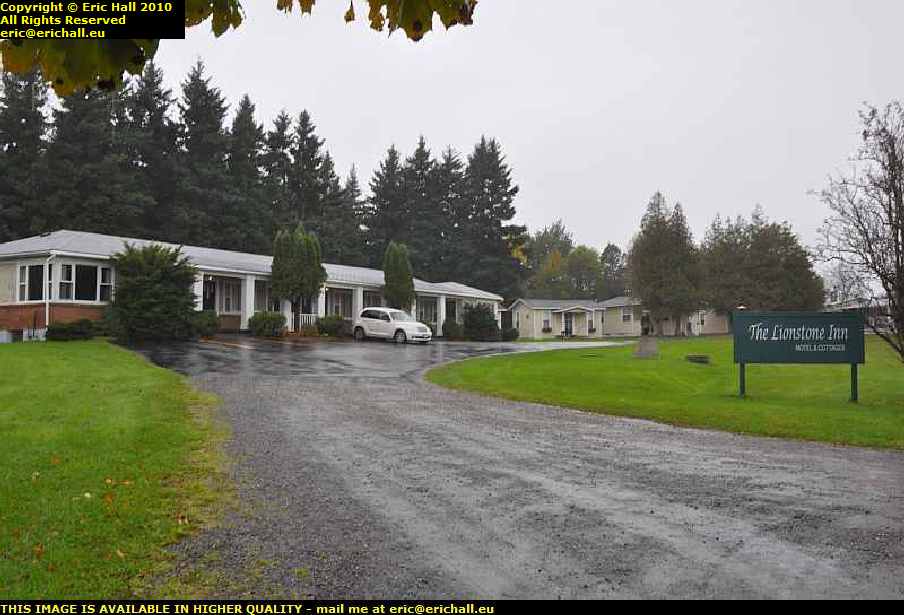
lionstone motel pictou nova scotia canadaYou’ve all seen this before. This is the Lionstone Motel up the road in Pictou and I stayed here in 2003.

Time was marching on and I didn’t have time to look for another motel (I believe in spreading my largesse about) so I came back here. No reason why not, after all, I was quite comfortable here last time.

bowater paper mill new glasgow nova scotia canadaThe restaurant that had served me a decent meal last time had closed down, so I bought some chips and went to look at the Bowater paper mill – one can’t escape the smell of wet paper around here.

With a better camera, this photo worked much better than the one that I took in 2003.

So having accomplished that task, I went to heat up some beans in my slow cooker. Pour them over my chips and I’ll have a meal fit for a king.

Sunday 24th October 2010 – I ALMOST FORGOT TO BLOG AGAIN …

“shame” – ed … but I remembered just in time.

berry's motel truro nova scotia canadaSo here in the comfort and privacy of a cheap ($60) but comfortable motel in Truro where I smuggled in my slow cooker and coffee machine, I can bring things up to date.

And I’m whacked. I’ve been on my feet from 9:30 until 17:00 and I’ve tramped everywhere all around Halifax and Dartmouth and the only time that I sat down was on the ferry across the Strait between the two cities.

And I’m still in love with the city

Today I tramped around the two towns and saw much more than I have ever seen before, and the more I see of the place the more I like it. I could really settle in a place such as this. Mind you, the weather has been astonishingly good – probably the best day since I’ve been in Canada and I deserve it too – the two other times I’ve been here, they have both been in snowstorms.

And if you are wandering why there are no photos, the answer is that they have all been moved. In the intervening time, I’ve completely written up my notes about my visit to Halifax and you can read them at your leisure.

I finished my visit on a poignant note – to track down the site of the legendary Pier 6. Back in 1917 the convoys to the battlefields of France assembled here. And the harbour was a busy place so a one-way system was operated similar to what is operated in the English Channel today. And as a small convoy was leaving port a ship came steaming in down the wrong channel. A collision was inevitable and sparks from the grating metal set fire to the errant ship.

Because the ship was not flying the special red pennant that it was supposed to fly, no-one knew that it was an ammunition ship, loaded with over 5,000 tons of explosive. And the crew, instead of opening the sea cocks to sink the ship as they are obliged to do when an ammunition ship catches fire – they simply abandoned ship, which then slowly drifted into the harbour, blazing away furiously.

memorial halifax explosion 1917 disaster mont blanc imo nova scotia canadaPuzzled by this bizarre behaviour, crowds of people flocked to the shoreline to see the spectacle, and as the ship collided with pier 6, it exploded.

2,000 people were killed and many many thousands were injured in what is the largest non-nuclear explosion the world has ever seen. A primary school behind the pier was obliterated and no-one there survived, and they picked up bits of Halifax from gardens 60 miles away.

site of halifax explosion 1917 disaster mont blanc imo nova scotia canadaSo armed with a little information and a couple of useful pointers I managed to track down the site. It’s now covered by the Halifax Shipbuilding Yard so there isn’t anything to see (mind you, after an explosion of that magnitide there wouldn’t be anything to see anyway) but it was something I had to do.

And tomorrow I’m going for my third attempt to take a photo of Amherst and also to look for the oldest steam locomotive in Canada.