Tag Archives: aude

Tuesday 11th March 2014 – I’M BACK HOME NOW.

Pulled in at 21:10 tonight after a long drive back from the Pyrenees.

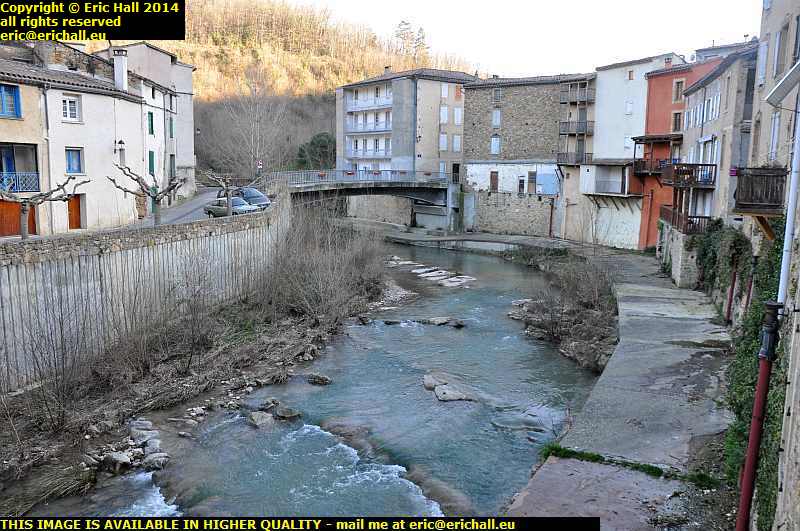
chambre d'hote au coeur de rennes les bains aude franceI can’t leave Rennes les Bains though without showing you my digs for thr last few days. That’s it over there in the background, the building there with the red shutters. And my very comfortable room was the one wiht the open window.

I told the owner that I might be back later on and he gave me a card. “Give us a ring to let us know”.
Absolutely – and then they will have time to arrange a quick holiday, or to close for redecoration or the like.


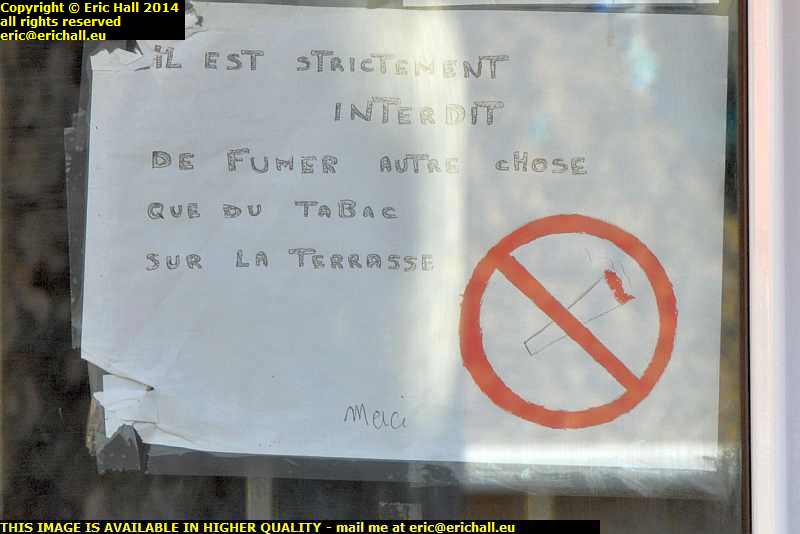
cafe no smoking sign rennes les bains france
But this photo will give you an idea of what Rennes les Bains is really like.
“The smoking of anything other than tobacco is strictly prohibited on the terrace”.

Rennes-les-Bains is one of these places that, for no reason at all (because house prices are not cheap like the Combrailles) seems to have attracted a huge “New-Age” community. It would do my head in after a while if I had to live here.


I followed the Lady Who Lives In The Sat-Nav as far as Castres and then followed the signs to Albi. And then I turned off the recommended route as I wanted to make a deviation.
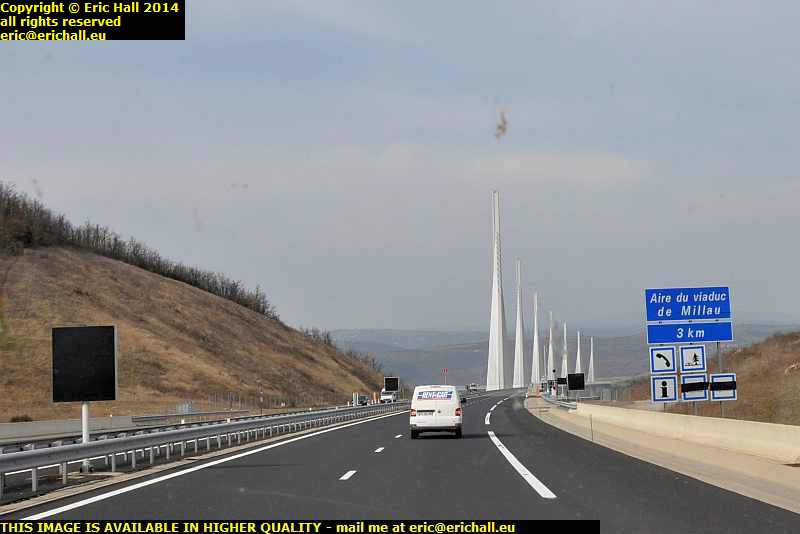
viaduc de millau viaduct aveyron franceEver since 2004 when it opened, I’ve been trying to get to the Millau Viaduct and I’ve never actually managed it. Something has always cropped up.

But today in Albi I picked up the signs and even though this meant a late return home, well, here I am. Driving across the aforementioned.

And doesn’t Strawberry Moose take a good photo?


river tarn millau aveyron franceAnyone who knows the southern slopes of the Massif Centrale will know of Millau. There’s a major Route Nationale that runs from Bordeaux and the Biscay coast over the Lyon and Switzerland along the valley of the River Tarn, and there’s a major Route Nationale that runs north-south over the mountains between Paris and the Western Mediterranean coast of south-west France and Nothern Spain.

These two roads collide at a little roundabout in Millau and it is no joke to say that people have sat here without moving a wheel for five hours as the traffic snarls itself up well and truly.

The first time I came here I didn’t know about this. I gave up and went for a coffee. Ever since then, I’ve come at night.


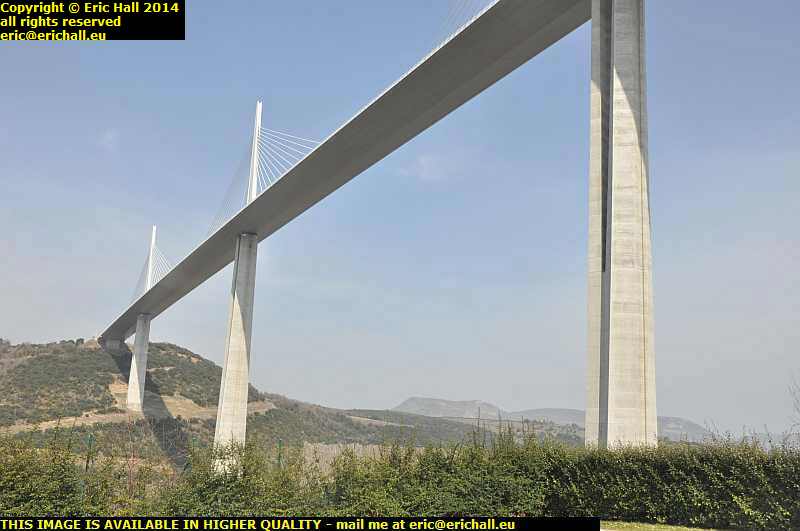
viaduc de millau viaduct aveyron franceAll that changed in 2004.

Plans had been proposed on several occasions for a way of dealing with the traffic but ultimately they bit the bullet and set to work to build what at the time was the tallest road bridge in the world. Opened in December 2004, it turned Millau into something of a tranquil backwater, much to the relief of the residents.


viaduc de millau viaduct franceIt’s a magnificent structure, a maximum height of 343 metres above ground at its highest point, and one of the pillars, at a height of 245 metres, is the tallest pillar in the world.

And, incredible as it might seem, once it opened there was an outcry from certain local businesses that their takings had dropped since the building of the viaduct.

There’s no pleasing some people.


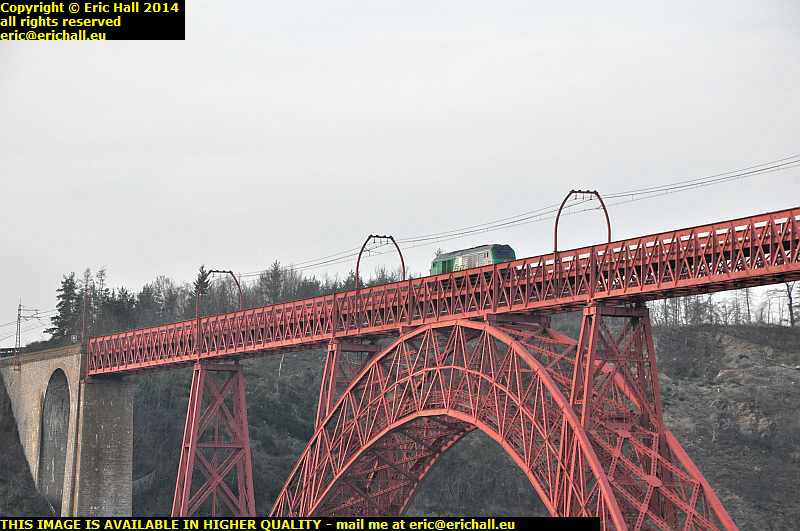
viaduc de garabit Ruynes-en-Margeride cantal franceTravelling north on the A75, I stopped off to visit another iconic viaduct along the way. This time, it’s a railway viaduct, the magnificent Viaduc de Garabit, situated in Ruynes-en-Margeride in the Cantal.

And there’s not another viaduct in the world like this. It is magnificent.


viaduc de garabit Ruynes-en-Margeride cantal franceEverywhere you go in this country, you only have to look at ametal structure and someone will tell you that Gustave Eiffel (he of the Tower fame) built it.

In this case they would be right for once – at least, in the general scheme of things. Inspired by the engineer Leon Boyer, it was Eiffel’s company that built it and it took four years, from 1880 to 1884 although, rather perversely, the viaduct was finished before the railway line.


railway locomotive viaduc de garabit Ruynes-en-Margeride cantal franceIt is still open for traffic too, which is quite astonishing seeing how much of France’s railway heritage has closed down, and even this was closed for a short spell a couple of years ago.

I had quite a chat with an old woman who told me that her grandfather had helped build it as a boy. She reckoned that in 5 years time the trains will have gone from here “just 3 or 4 passengers on each train – 50 years ago we had 3 or 4 hundred”. Now, there are just two passenger trains and one goods train each day in each direction.


viaduc de garabit Ruynes-en-Margeride cantal franceIt will be a shame if it does close down though. While you digest the view from the aforementioned lady’s back garden (with grateful thanks), I can tell you that it’s 122 metres above the base of the river and is almost 565 metres long.

And in case you are wondering (which I’m sure that you are), there are 678,768 rivets in the construction.

Since 1965 it’s a Monument Historique.


river truyere barrage de grandval Ruynes-en-Margeride cantal franceThat’s not all though. The valley underneath, that of the River Truyère, was dammed by the Barrage de Grandval in 1959, for hydro-electric purposes.

But someone has pulled out the plug as you can see, much to the dismay of the boat owners and the guy who owns the water sports concession.

Not for me though. We can see the original road beidge that was drowned as the valley was flooded. I bet it’s not every day that this has seen the light.

Monday 10th March 2014 – THIS HAS ALWAYS BEEN THE MOST FAMOUS …

aerial view of rennes le chateau from chateau de le bezu aude france… view of Rennes-le-Chateau. It features in almost every book and article written about the place, and many people, including Yours Truly, have always thought that it was an aerial photograph.

But not any longer, because I can now tell you exactly how it was done and being airborne plays absolutely no part whatever in the procedure


rennes les bains cardou chateau de le bezu aude france
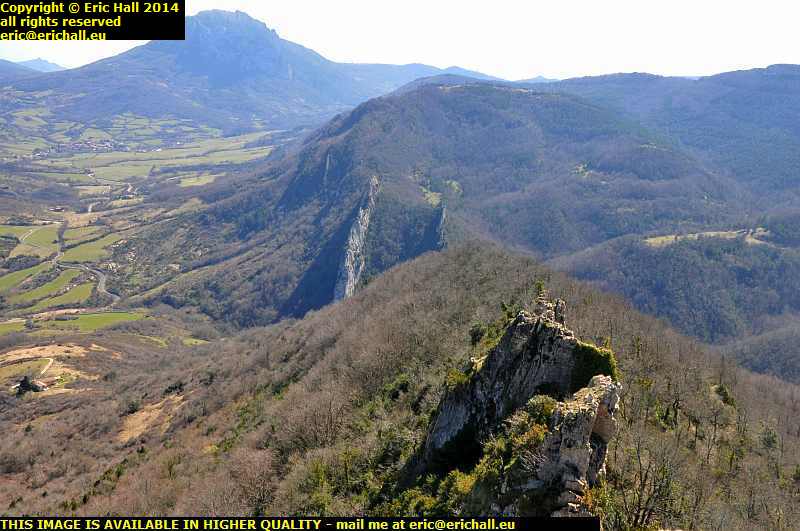
Probably about 7 or 8 miles from here as the crow flies (those buildings at the bottom centre of the shot, just below Cardou, are the Thermal Spa buildings here at Rennes les Bains) but a heck of a lot further away by road, that’s for sure, is a very high rocky crag.

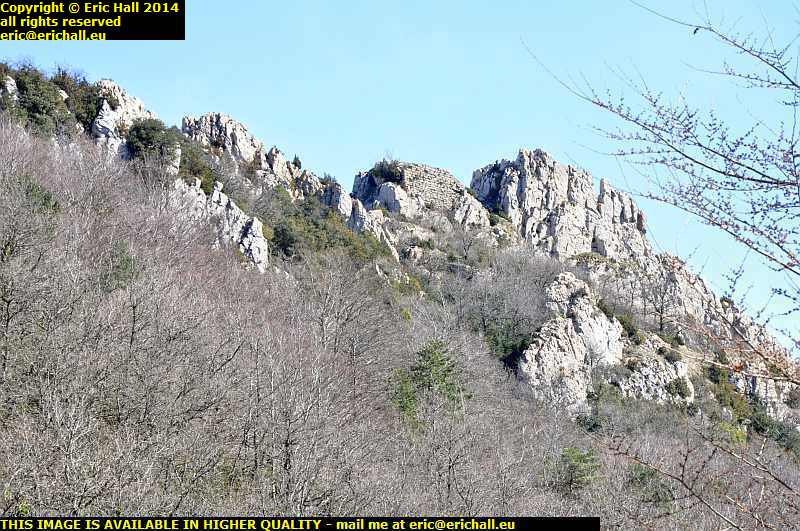
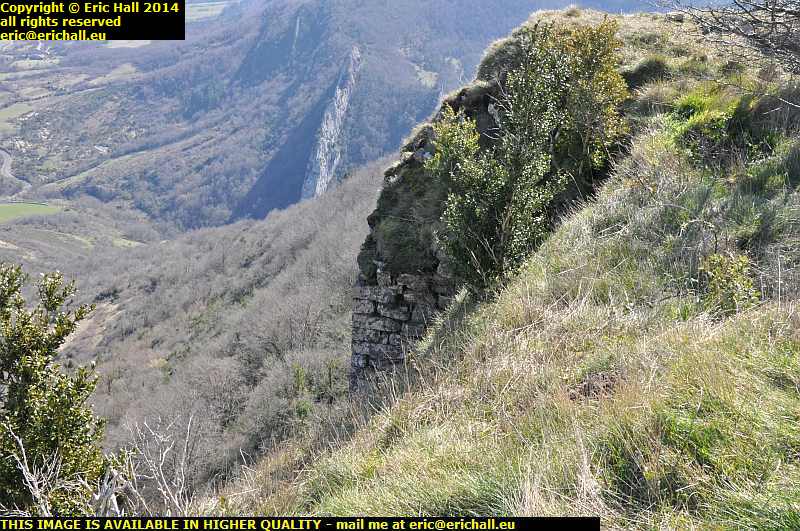
On this crag are situated the ruins of the Chateau de Le Bezu, and it is from right up here on the top, overlooking the sheer drop of several hundred metres, that the photograph of Rennes-le-Chateau has been taken.


cart tracks to chateau de le bezu aude france
But before you begin to set off here in droves, let me give you a couple of words of warning. There is not one single signpost to the Chateau from anywhere. There is no approved rounte and no marked pathway.

Even the Lady Who Lives In The Satnav tells me that there’s no road that goes anywhere near it. I found my way by tapping in the co-ordinates of Longitude and Latitude and following a series of cart tracks by trial end error until I could go no further.


stonework ruins amongst the limestone outcrops chateau de le bezu aude franceHere, I was able just about to make out some stone blocks interwoven between the limestone outcrops (good job I had some binoculars) and so I reckoned that I could well be onto something here.

While I was reflecting over how I was going to reach the top I was joined by another van-driver. I fell in with him and we immediately started talking solar panels as his van was fitted out exactly as Caliburn, even down to the solar panel on the roof and the control boxes.


strange man with peugeot boxer and solar panel chateau de le bezu aude franceHe’s a local yokel (and a very vocal local yokel too) and he’s been up here beffore and so knows the way. And very kindly, he offered to accompany me to the top so that I wouldn’t lose myself in the shrubbery.

Fortune really does smile on the brave!


chateau de le bezu aude franceNow, I’m not going to tell you anything much about the Chateau as this is yet another place that has been the subect of so much nonsense. I’ve even seen two completely different and contradictory “official histories” of the chateau.

You can do your own research from that point of view, and good luck to you too.


Let me just tell you this, though.
pyrenees chateau de le bezu aude franceThere is a best-selling “conspiracy theory” book that speaks about the Castle in great detail, and the authors express total bewilderment as to why a castle should be built here on this site when there were several others doing the same job in the immediate vicinity.

Anyway, I have an answer to that too


peak of mount bugarach chateau de le bezu aude franceWhile you look at the peak of Mount Bugarach, where the world was supposed to end in 2012 if you remember correctly, you’ll notice to the extreme left another peak in the far distance.

Just beyond that peak is the Mediterranean and the port of Narbonne, and Narbonne has until very modern times been the leading port of Southern France and Northern Spain (remember until the late 15th Century the Muslems were in possession of much of the Spanish coast).

I counted three mountain passes coming this way from Narbonne, one heading off to the interior and two heading south towards the Pyrenees and Spain. Just think of all the trade goods that would be coming by these passes into this area for onward passage avoiding the Moorish galleys, and what would be the value of these goods?

Any nobleman bent on increasing his wealth (and many of these noblemen were as bent as they come) would stick a castle right on this promontory so that he could intercept the pack trains coming through the passes and demand his toll.

And the reason why the castle wasn’t immediately destroyed once it had been captured during the many times that it changed hands was because the new owner wanted it intact for exactly that purpose.


grave abbe henri boudet axat aude franceI went to Axat later to find the grave of the enigmatic Abbé Henri Boudet, one of Saunière’s closest confidants.

Here it is, and this is another so-called riddle for which there is a simple explanation.

So with him being priest at Rennes les Bains and with his mother and sister being buried there, how come he wasn’t?

The answer to that is that his mother and sister predeceased him and so he was alone. And we saw yesterday that e relinquished his living in 1914 and here on the grave, it has him dying in (March) 1915. It seems, from what I have been able to find out, that he was dying of cancer and it was probably that which caused him to abandon his post. Of course, he had no-one to care for him there but at Axat, his brother’s widowed wife was still alive and quite young too, so it is very likely that he moved to Axat so that she might care for him.

And so he died at Axat (it says that on the flat headstone) and having seen the road between Axat and Rennes-les-Bains today (and it’s more than double the 15kms that a modern best-selling author tells us) and what it is like to travel along it in certain places, I shudder to think of what it might have been like 100 years ago. No wonder they left him here at Axat.


calvaire statue of Jesus antugnac franceJust a couple more things to do.

We are told that there is a statue of Jesus on a mountain top near Antugnac gazing over to his burial place at Cardou. No co-ordinates were given for this statue so it took some locating but eventually I discovered it.

Today though, he’s looking over at a brand-new villa because they have built a housing estate around him. And he couldn’t have seen Cardou anyway as there is an outlying ridge in the way that just about obscures the perspective.

A lot has been made about the two figure eights in the date on the cross – how they are formed of two small, letter ‘o’s. Clearly the propagators of this particular theory have never seen the Visigoth column in the Church of Mary Magdelene at Rennes le Chateau that we saw the other day. On there, the figure eight in the “Mission 1891” is exactly the same and they made no theory about that. It is in fact standard mason practice and you see it everywhere. It’s just that some masons are better than others.

As an aside – who says that the statue is of Jesus anyway? There’s no identification at all on the statue.


berenger sauniere church antugnac aude france
Sauniere was for a while the priest of Antugnac and so I went for a quick look at the church there.

Not much to see as it has escaped the enlargement processes so common elsewhere, but you can see at least three different styles of stonework in its construction, two of them being quite low down. The earliest stonework looks quite primitive but I wouldn’t like to hazard a date or period.


cross overlooking montazels rennes le chateau aude france
Still five minutes before dark, so a quick nip up to Montazels which was where Sauniere was born.

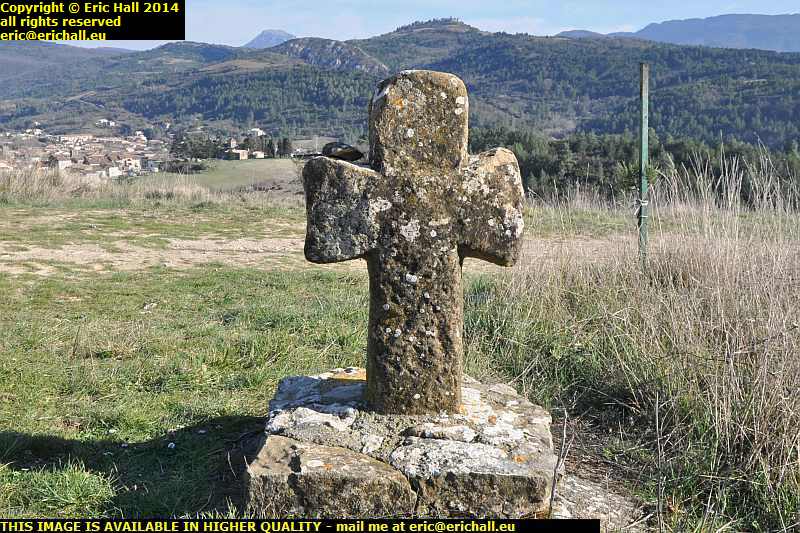
But here’s another conspiracy theory that everuone else has missed. High on the hills overlooking the town is an old weather-worn cross. And that is lined up absolutely and plumb-perpendicularly (I’m glad that I brought my home-made groma with me – that course in Roman surveying was magnificent) with Rennes-le-Chateau.

So what’s the reason for this please. Answers on a postcard to …

vegetarian pizza couiza aude france
And I also found the world’s most astonishing vegetarian pizza while I was passing through Couiza. What can I say?

And we had another sales enquiry today. It’s all happening, isn’t it? Signwriting Caliburn pays dividends in spades.

Sunday 9th March 2014 – WHAT A BEAUTIFUL DAY …

… and I’ve been taking full advantage of it. Not least in the Thermal Spa. And today’s verdict?

The Mudbath – same as yesterday (the mud had worn off during the night)
The Circular Shower – can’t see what this did that three friends with hosepipes couldn’t do (I, of course, don’t have three friends)
The Penetrating Shower – I was worried about this and when she said “lie face-down on the bed”, that did nothing to allay my fears. However it’s a horizontal bar of five or six very fine but high-pressure shower heads all aimed at your back.
In the jacuzzi, a rather large woman jumped in and landed right on my foot.
“I’m so sorry – was that your foot?”
“Yes it was” I replied “but don’t worry – I still have one left”.
I finished it off with a massage today. I was hoping for a young blond nymphette – I ended up with a retired former Soviet discus-thrower.
“I’ll massage your clavicles, shall I?”
“Not while I have my strength you won’t”.

chateau of arques rennes les bains aude france
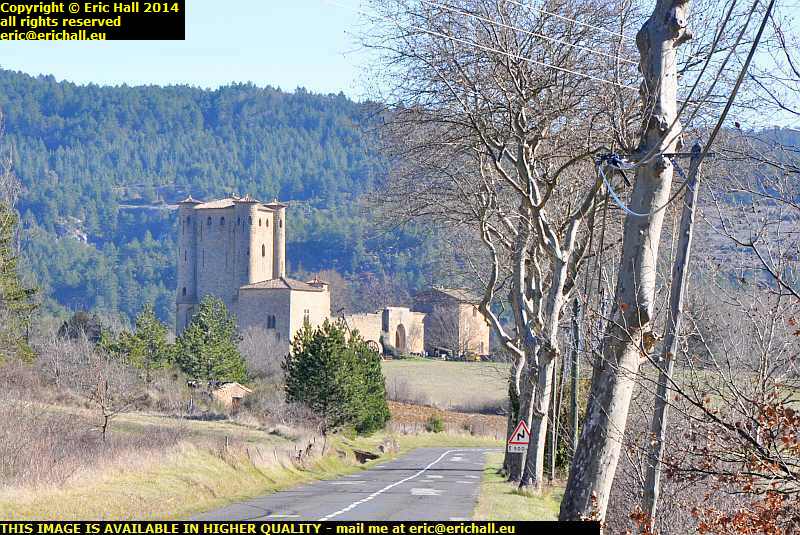
Apart from that, I’ve been out and about again. This is the Chateau of Arques, about 15kms awy from here.

It dates from the aftermath of the Crusade against the Cathars and is said to control an important route used by transhumance farmers as they pass up and down to and from the higher slopes, but looking at its position here and how easily it is overlooked, it’s good that the transhumance farmers didn’t possess any cannon. A few bits of ordnance on the surrounding hills and the castle wouldn’t last long.

As it happens, it was a ruin up until about 120 or so years ago but has since had quite a decent renovation.


cardou chateau de blanchefort valley river salz peyrolles rennes les bains aude franceFrom there I went up to the village of Peyrolles. This is another place that features in all of these stories but there was nothing of interest to me.

That is except a plot of land (that wasn’t for sale, unfortunately) that had one of the best views that I have seen for a while – right up the Vallée du Salz past Cardou (on the left) and the ruins of the Chateau de Blanchefort (on the right) almost all the way to Rennes-les-Bains.


serres packhorse bridge old road rennes les bains aude franceThe modern road to Rennes-les-Bains is not the original road by any means, as I mentioned the other day.

The original road runs from Serres and goes over the river by this absolutely magnificent packhorse bridge, passing right by the foot of Cardou and then through the village of Montferrand to its final destination.


old road serres rennes les bains cardou aude franceNow, does this road remind you of anything? It ought to do, because you have seen something similar before.

Do you remember when I wrote my magnum opus about Riccarton Junction back in 2007/2008? We found the road that went down there too and there were not half some striking similarities. It made me feel quite at home, I tell you


cardou rennes les bains aude franceBut as for Cardou itself, it’s a magnificent, awe-inspiring mountain and you can see why it’s featured so much in the folklore of many of these legends.

Despite the fact that there are dozens of other mountains around, one or two of which are higher that Cardou, it’s nevertheless the dominant feature all the way around here – see it from miles around.


tomb of god jesus rock fall scree cardou rennes les bains aude franceBut one or two of the legends of Cardou are not quite so wholesome and healthy. At least two writers have insisted that Jesus is buried somewhere up there in a tunnel and that the rockfall that you see there was engineered to cover the traces of the excavation.

Mind you, neither of these two authors explained in any kind of detail how this rockfall was engineered in the days before controlled explosive. The usual historical way of doing this, by piling the rock on a large wooden platform and then burning the platform, would not have been sufficient to have produced this fall.

But no matter what method they chose, it must surely have been an interesting experience for the watchers at the foot of Cardou.


nicolas poussin bergers d'arcadie les pontils serres arques rennes les bains aude franceNow if any place is ever likely to push Rennes-le-Chateau off the top of the pile of places about which more rubbish has been talked than anywhere else on the planet, then it has to be this place.

This is a lieu-dit (or hamlet called) Les Pontils on the road between Serres and Arques and it has a quite eerie claim to fame.


nicolas poussin bergers d'arcadie les pontils serres arques rennes les bains aude franceIt may not look like much but on that flat platform over there was until 1988 a tomb that has been said by so many people to be the inspiration behind the painting Les Bergers d’Arcadie – “The Shepherds of Arcadia” – by Nicolas Poussin.

If this is so, then it’s a magnificent feat by Poussin seeing as how he painted his oeuvre in the 1630s, and yet all of the evidence available places the building of the tomb to … errr … 1903.

Someone did reply that there was an earlier, identical tomb here that was destroyed on royal orders later in the 17th Century but that begs the questions “how did they know that it was identical?” and “how did they know that this was the spot?” We’re dealing with a period before photography and GPS recording. And no-one as far as I am aware, has produced any kind of evidence to support this story of a royal order.

It’s connected with a phrase “Et In Arcadia Ego” which may people claim is bad Latin (there’s no verb) and hides an anagram or a coded message, but Latin is one of those languages where there is no pronoun (the verb is declined in order to reflect the doer of the action) but Ego is a pronoun and is used for emphasis or else in certain cases when there is no verb. And in that case it is put at the end of the sentence so the phrase would be something like “And I, in Arcadia”. That’s perfectly acceptable to say that in English and the construction is also good Latin.


grave family gelis cemetery rennes les bains aude franceBut if you want a real mystery, one that no-one has picked up, go to the cemetery in Rennes les Bains. We have four main actors in this conspiracy – Saunière of course, his two friends Boudet and Gélis, and his servant girl Denarnaud.

And what do they all have in common? The answer to that is that each one of their families has a tomb in the cemetery at Rennes-les-Bains, although not one of the actors is buried in it.

You could make up a decent conspiracy theory about this too.


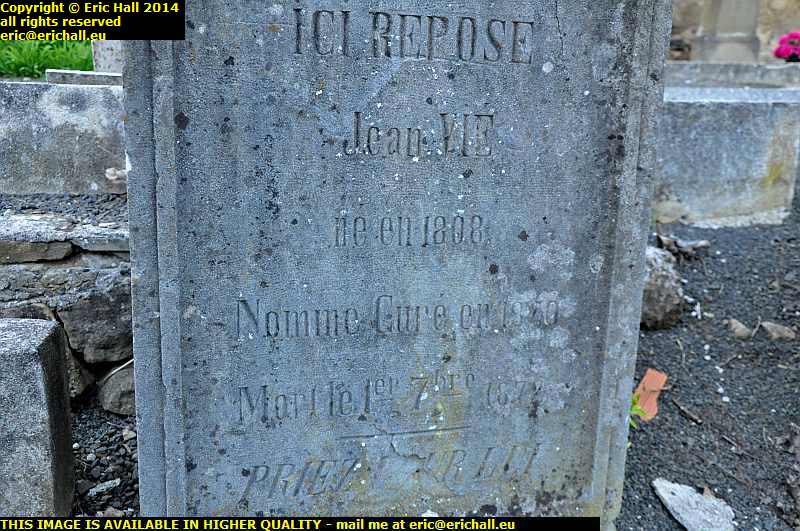
grave jean vie cemetery rennes les bains aude franceBut that’s not all that’s exciting in the cemetery either. What about this?

This is a grave belonging to someone called Jean Vié and I bet he’s glad that he’s here because he must have been called some rotten names at school. His name is a phonetic expression of the pronunciation of the name of the month – janvier – January.

Not only that, the way that the date is expressed – 7 bre – is quite common masons’ shorthand for the month of September, but couple that with the emphasis of the date 1 (as in first), you could make up a date of 17 January – and that was a day upon which a lot of things happened during this mystery.

That would make a good conspiracy theory too – totally overlooked by everyone so far.


plaque commemorative abbe boudet church rennes les bains aude franceOur January man is said to be the predecessor to the Abbé Boudet and it is also said that Boudet officiated over his interment – which if he did, his appointment to the church here must have been extremely rapid.

And one thing that should be mentioned is that the January man is buried in the plot right next door to Boudet’s family plot.

Coincidence or what?


Saturday 8th March 2014 – I HAVE DECIDED …

rennes les bains aude france… thatI’ll be staying on in Rennes-les-Bains for a few days. And for several reasons too.
Firstly – There’s so much going on here and in the area
Secondly – I’ve found a cosy little B&B where I’m having good value for money
Thirdly – I don’t have to be home until Tuesday night (and not necessarily then either)

So all in all, it seems like a good plan, even though the town has seen much better days than these days, as you can probably imagine.


This morning, first stop was to see what remained of the Chateau de Blanchefort. These (such as they are) are perched on a mountain top right opposite the legendary Cardou, the mountain that has figured in so much of the conversation around here.

chateau de blanchefort rennes les bains aude franceBut getting there is by no means easy. Not as exhausting as the climb up to Montségur the other day, but there is just so much of it and the path is in a terrible condition.

Immersed in mud, and the bridges, such as they are, are like this. It’s another one of these walks that is not for the faint-hearted.


ruins chateau de blanchefort rennes les bains aude franceThe castle was the former home of Bertrand de Blanchefort. He was 4th Grand Master of the Knights Templar, whose period of office was from 1153 to 1170, and this is just about all that I could find of the remains of his castle.

I’ve found nothing that gives me much help about the history of the place, but I imagine that with it being a Templar stronghold, the suppression of that order in the early 14th Century led to its downfall.


dressed stones chateau de blanchefort rennes les bains aude franceIt’s not quite all that remains of the castle. I had a good rummage around and found quite a few stones, such as these examples, that have clearly been “dressed”.

I can’t think what else stones such as these might have been used for, if not for part of the interior of the castle. You won’t find stones like these in a goatherd’s hut, unless he’s pinched them from a ruined castle of course.


river salz valley chateau de blanchefort rennes les bains aude franceRight down there at the bottom of the valley, out of the shot unfortunately, is the River Salz and it’s from there (or thereabouts) that I’ve walked.

You can see now why it was that it took me so long to reach here, regardless of the state of the path and the bridhes (such as they are).

Across the river valley on the far bank is a loggers’ road, and that particular road has featured in some of the stories too.


pech de cardou chateau de blanchefort rennes les bains aude franceThis is a close-up of the famous “Cardou” mountain.

Apparently Jesus is buried in the side of the mountain somewhere. Or was it the Holy Grail? Or perhaps the Ark of the Covenant? I forget now, or maybe I’m becoming confused. But a good number of these tens of thousands of books consider Cardou as playing an important role in whatever mystery there might be in this area.


rennes le chateau de blanchefort rennes les bains aude franceBut leaving all of the conjecture aside, let’s sit for a while right at the top and admire the view.

In case you are wondering about the town over there on that crest, that is of course the famous Rennes-le-Chateau where we were yesterday morning – the place where Bérenger Sauniere made his discoveries that transformed this area from an isolated, abandoned rural backwater into a trendy esoteric tourist venue.


coustaussa chateau de blanchefort rennes les bains aude franceThat down there is Coustaussa where we went yesterday afternoon to see the ruins of the castle and also the grave of the Abbé Antoine Gélis who was murdered at the vicarage and whose murder was never solved (no Miss Marple in France of course – she would never have missed out on a Murder at the Vicarage in the UK)

I showed you yesterday a photo of how the Chateau of Coustaussa dominated the valley of the Salz River – so just look at how the Chateau de Blanchefort dominates the Chateau of Coustaussa


This afternoon, it was Open Day at the Spa. Three “goes” for just €18:00 – makes a mockery of the €50-odd for a shower at Neris-les Bains.

I wasn’t going to miss out on that, and so here’s my report of the afternoon’s visit –
The therapeutic shower – like being stuck up against a wall by someone armed with a Kärcher
The aerobath – last time I had an experience like this was when mum put all five of us kids in the bath together after we had had baked beans on toast for tea.
The mudbath – nice, hot and gooey. Has done wonders for my skin and according to my landlady here at my little B&B makes me look 10 years younger – as long as I don’t have a shower and wash it off!

I followed that with an hour in the sauna and jacuzzi for just €3:00 and after all of today’s activities I feel like a new man. Yes, I’m fed up of the old one.

Tea was interesting. No restaurant here in the town and so, remembering that I had the camping gear (not that I intend to do any camping) in the back of Caliburn, I went and cooked some pasta and tinned ratatouille.

I’m totally whacked too and so I’m going to have what remains of an early night.

Friday 7th March 2014 – THERE’S BEEN MORE RUBBISH …

… written about this place than anywhere else on the planet. And I shall be contributing my fair share too … "groan" – ed.

rennes le chateau aude france bérenger saunière tomb of godYes, you’ve guessed it. I’m in Rennes-le-Chateau and what am I doing here? Looking for the Holy Grail? Looking for the Children of Jesus? Looking for the tomb of Mary Magdalene? Looking for the lost Cathar treasure?

Or have I simply come for a nosy around to see what all the fuss has been about since an elderly housekeeper strung along a dazzling urbanite with promises of vast wealth and fortune in oder to ensure that she would be well-cared for in the twilight of her life?
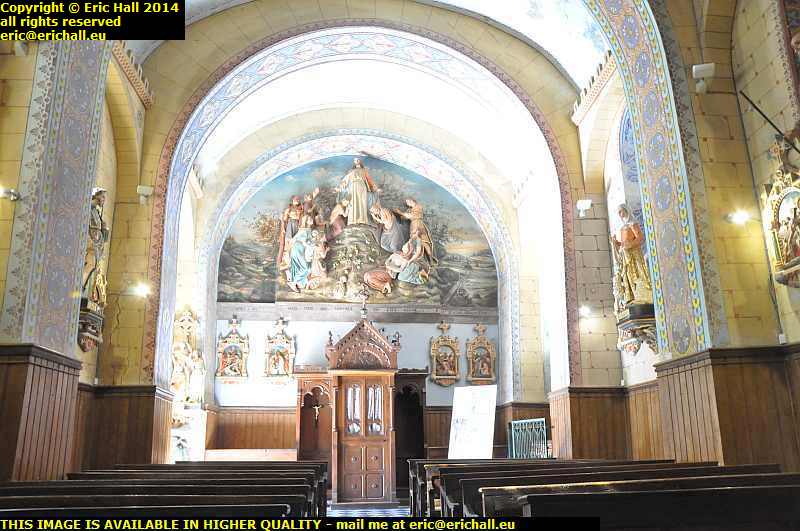

interior of church st mary magdalene rennes le chateau aude france bérenger saunière tomb of godThis is the interior of the church of St Mary Magdalene at Rennes-le-Chateau and although it looks quite beautiful today (which it doesn’t, as it happens – it is badly in need of attention which is totally astonishing considering how much money comes here these days), it wasn’t anything like this 130 years ago.

When a new priest, Bérenger Saunière, was appointed to the parish, he was horrified at the state of the place. It had been abandoned during the French Revolution almost 100 years earlier and although there had been a religious revival, the fervour had not reached Rennes-le-Chateau and the building was on the point of collapse.
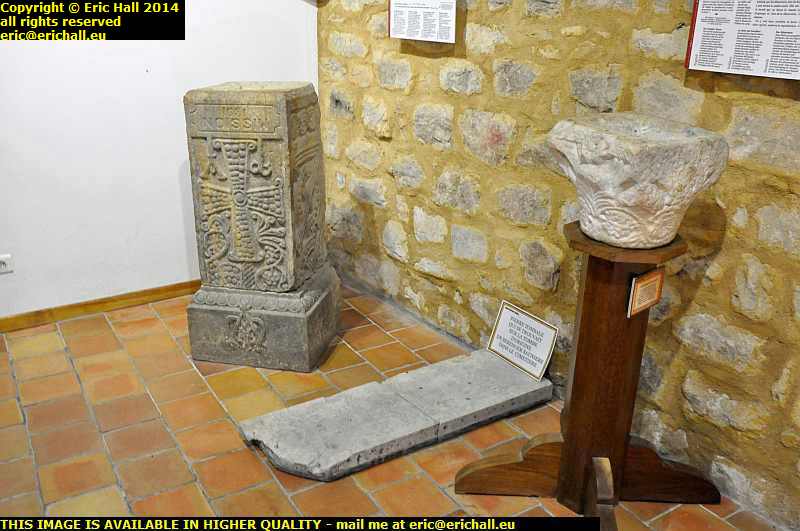

hollow column altar support rennes le chateau aude france bérenger saunière tomb of godHe borrowed a little money and made a start on some urgent renovations. But when he turned his attention to the altar, he found that one of the pillars was partly hollow and some parchments had been stuffed into it.

Hollow pillars are nothing new in churches. If you’ve been following my adventures over the last few years you will know from my frequent visits to Auvergnat churches with Marianne that it’s quite customary to have something similar in a church, and it’s where the sacred relics are kept.

And, as you know because I’ve told you this before, there was an inventory of relics carried out in all French churches in the mid-19th century. This church was no exception, and in the diocesan registers there is the report of the visit, and …
Bishop’s investigator “are there any relics in the church?”
Saunière’s predecessor “more than likely”.
It’s curious, to say the least, that Saunière’s predecessor could not give a definitive answer, especially when it’s something that falls within his responsibility.

As for the parchments, there is no dispute whatever that they were found. As to their content however, you’ll have to make up your own mind about that because every person tells a different story.

One thing that should maybe be mentioned however is that the pre-Revolutionary priest of the parish, the Abbé Bigou, was the confessor to several notable families in the area. Believing that the Revolutionaries would pillage absolutely everything that they could find, Bigou’s secret hiding place- the hollowed column used as an altar support – would make a safe cache for anything important.

And Bidou? He fled the Revolution and died in exile, never returning to Rennes-le-Chateau.

So Saunière found some parchments in a hollowed-out column. The next thing of note to happen is that some time later there’s a little enigmatic note in his diary – “ohh, by the way, I found a tomb today”. And then absolute silence.

He’s next in the graveyard attached to the church, frantically digging away to such a degree that the mayor of the commune makes a formal complaint to the Bishop. And then Saunière starts to spend money like water – tens of thousands of pounds.


villa bethania rennes le chateau aude france bérenger saunière tomb of god
He rebuilds the church and the presbytery, he refurbishes the village’s water supply, he builds a new road, and then he buys some land and builds himself a sumptious villa with outhouses and a magnificent tower that serves as a library.

He’s then investigated by his bishop – where did the money come from?

The conclusion is that he’s been selling masses. And there’s no doubt that he did. But just how many would he have to have sold in order to have amassed so much money? It’s unthinkable. He’s suspended from office but he carries on as before, taking no notice. Even though there’s a newspaper “advertisement” from the bishop advising his parishioners that he has been relieved of his functions, no-one takes any notice at all. He dies and takes his secret with him to the grave.

Only his faithful housekeeper is aware of the situation. Once she let slip that “the people around here are walking on gold but they just don’t realise it”. She sells the villa to an urbanite from the coast but remains in occupation promising the purchaser that she will make him rich beyond his wildest dreams. But she too takes her secret with her to the grave and that is that.

So where does this leave us?

I’m not going to waste anyone’s time with conjecture. There’s enough rubbish been written already about all of this.

magnificent defensive site rennes le chateau aude france bérenger saunière tomb of god
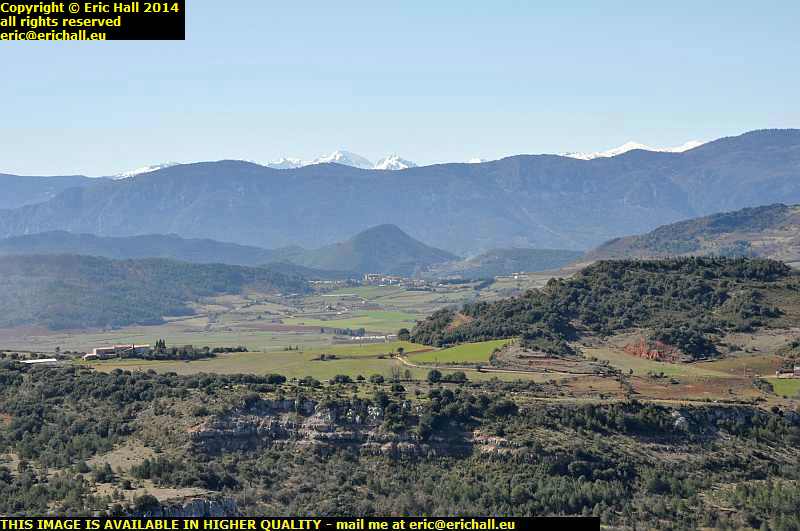
But firstly, one look at this site will tell you that this is the most magnificent defensive situation one could ever imagine, and the view from here commands absolutely everything. Nothing can move within a 20-mile radius without being observed from here.

If I were a neo-historical figure looking for a place to build a palace and a town for my followers, I would choose nowhere else but this. And there is evidence of occupation going back thousands of years – Stone Age, Iron Age, Gallo-Roman – you name it.

But the Visigoths came to this area in the 5th Century and set up a Kingdom. Their capital city was called Rhedae and from what we know, the site of Rennes-le-Chateau corresponds in every detail with the contemporary description of Rhedae.
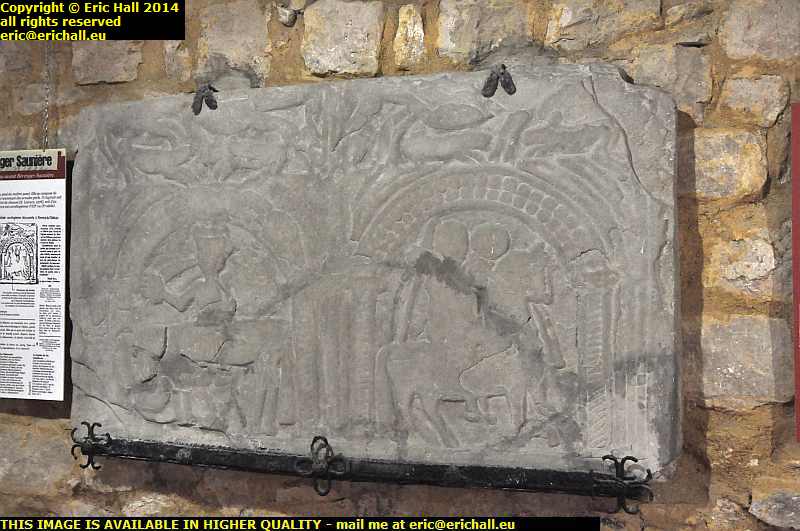

visigoth carving rennes le chateau aude france bérenger saunière tomb of godTons of Visigoth artefacts have been discovered in the area and the church itself contains much evidence of Visigoth stonework, sculpturez and artefacts, such as this magnificent carving that Saunière discovered, face-down on the floor and being used as a flagstone.

There is therefore little doubt that the modern-day Rennes-le-Chateau is the historical Rhedae


rennes le chateau aude france bérenger saunière tomb of godIn fact, on my mega-ramble around the site this morning I counted three and perhaps 4 concentric rings of defences around the site, and there is no evidence to suggest that anything much of this relates to a more modern period.

So whoever was fortifying this site really meant it

rennes le chateau aude france bérenger saunière tomb of god
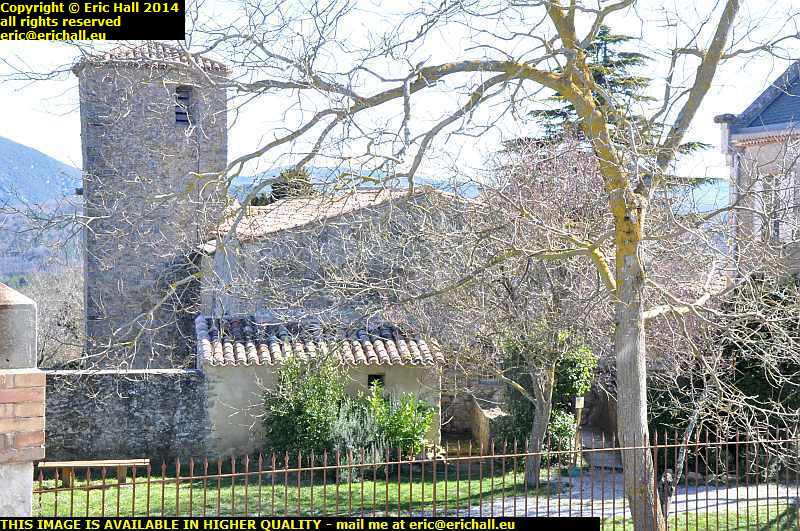
Now if you remember from our discussions a few years ago, it’s perfectly normal for there to be a small chapel included in a castle or chateau once the Lord has converted to Christianlty and, as I have said, there’s certainly a Visigoth presence in the church here.

But as Christianity gained in influence and barbarity slowly died out (not that you would ever notice it) the church would take over more of the site and the castle or chateau would be reduced in size.


chateau hautpoul blanchefort rennes le chateau aude france bérenger saunière tomb of godThis is the current chateau, right next to the church. But from what I can see at a distant glance, there is nothing particularly Visigoth about this – although I have been told subsequently that part of the foundations is believed to be of Visigoth origin.

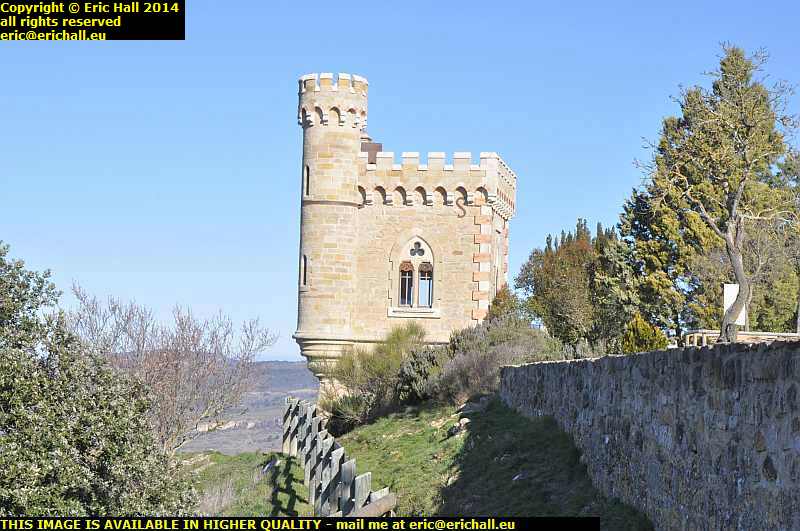
And in any case, this is not where I would have my chateau. Mine would be on the highest corner of the walls with the best view – right in fact where Saunière build his tower-library.

Anyway, to continue onwards. Saunière says that he found a tomb. What evidence is there that there was a tomb here? Plenty, as it happens.

In several cases, there are entries in the parish registers of people being “buried in the tomb of the Lords” – the last one being in the 1730s. And it’s only after that date that the Lords (and Ladies) were buried ordinarily in the cemetery.

There have been three inspections of the church using SONAR – a device that measures reflected echoes from the ground – and they have each given a similar result – that at a depth of 5 metres or so under the church there is a reading that corresponds with what one would expect to see if there were a cavern below.

No entrance to this cavern was found, though, and the easiest way to hide an entrance into a cavern (from the outside, anyway) would be to use it as a grave and bury a body in it, and then fill it over. And maybe this was why Saunière was digging frantically in the graveyard. Perhaps the parchments had given him a clue to whose grave it was that led into the cavern.

As an aside – following what have been described as “a few deplorable incidents” (of which we can all hazard a guess) the cemetery is locked and access is only granted to relatives of the inhabitants of the cemetery. I wish that I had known this back in May 2013

library tower rennes le chateau aude france bérenger saunière tomb of god
But this is no place for speculation. There’s enough of that about already. And some of the speculation would appear to be manifestly false. Saunière was not always “rolling in money” – even after having discovered whatever it was that he discovered, he had times when there was so little about that the work on his beloved Villa Bethania came to a sudden halt. If he really were blackmailing someone about a guilty secret, he would simply go back for more cash. Or if it were a regular flow of money that he was receiving, he would have planned his work more carefully.

Some say that, being an unltra-Royalist (which he certainly appeared to be), the French monarchist parties were paying him handsomely to propagate their cause. But with a parish of just a few hundred souls, their vote wouldn’t have been worth very much.

And much of the rumour and supposition that circulated following a “disclosure” by someone in Paris in the 1970s and 1980s is now considered by most authorities to be based on a forgery.
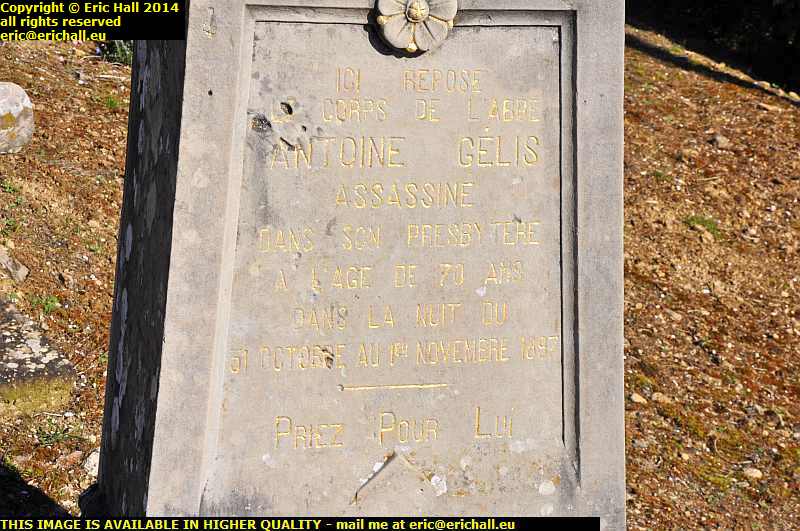

grave father antoine gelis murdered coustaussa rennes le chateau aude france bérenger saunière tomb of god
Nevertheless, he did receive money – and plenty of it – from somewhere. And one of his confidants, a priest by the name of Father Gélis from the neighbouring village of Coustaussa, was brutally murdered one night while all of this was going on.

Even today, the locals at Coustaussa (and I found some pretty vocal local yokels who told be everything I want to know) consider that Gélis’ neohew did the deed and did it for the money that Gélis was supposed to have been handling on behalf of Saunière (although the local police dismissed the nephew as a suspect and went to great pains to state that the money remained untouched.

And so you pay your money and you take your choice.

If you want to find out more about the mystery of Rennes-le-Chateau, then there are enough books written on the subject to rebuild completely every single one of the three and maybe four concentric rings of denfensive walls around the village of Rennes-le Chateau. Don’t just read one of them though otherwise you will end up with a very skewed viewpoint and – perish the thought – you might even start to believe that author’s particular slant on all of this.

There are ten thousand books, ten thousand authors, and ten thousand different opinions about the mystery of Rennes-le Chateau.


chateau de coustaussa valley de sals rennes le chateau aude france bérenger saunière tomb of god
While I was in Coustaussa checking the grave of Father Antoine Gélis (and believe me, there is nothing in the world more sad than an abandoned cemetery), I went for prowl around the ruined castle.

It was built on an eminence at the foot of Rennes-le-Chateau with the aim of controlling the valley of the River Salz, which as you can see, it does in spades.
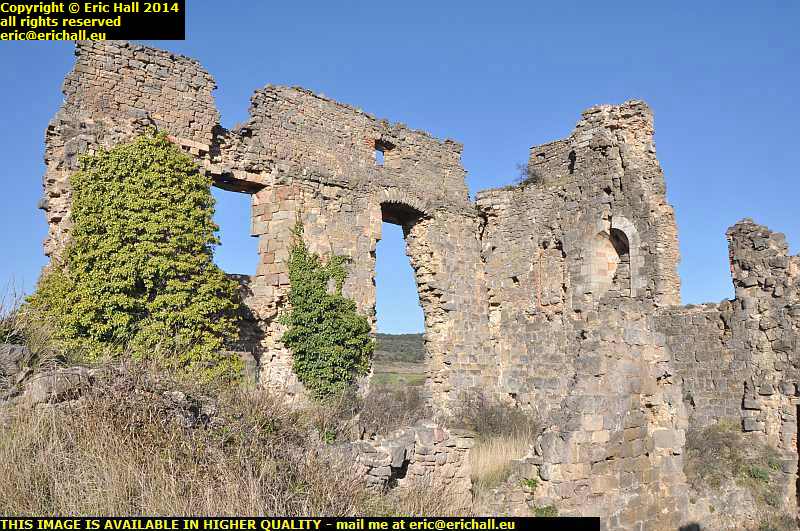

rennes le chateau de coustaussa aude france bérenger saunière tomb of god
It dates from the 11th and 12th centuries, times of much turbulance in this frontier province, and fell to the Crusading forces in 1210. Nevertheless, it was the scene of a small rebellion, which didn’t last long, but the reprisals were, well, severe, as you might expect whenever Simon de Montfort was about.

This led to the first round of demolition


rennes le chateau de coustaussa aude france bérenger saunière tomb of god
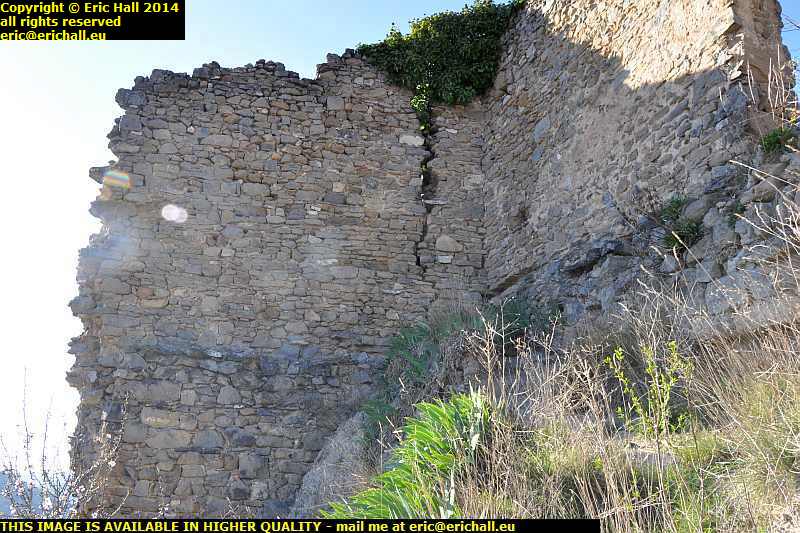
It was re-established as some kind of manor house in the 16th Century but the Revolution put paid to that. It was sold into private hands and the new owner treated it as a quarry, selling off all of the stones to the locals in the neighbourhood for their various building projects.

That really marked the end of the Chateau as we know it.

rennes le chateau aude france bérenger saunière tomb of god
It’s still in private hads today and one is supposed to ask the owner for permission to visit the castle (which is not for the faint-hearted as it really isn’t very secure)

I duly presented myself at the relevant address, only to discover that it has been a long time since the owner has taken the trouble to visit his own premises, and so I took it upon myself to enter. I wasn’t going to let a ruin like this pass me by.


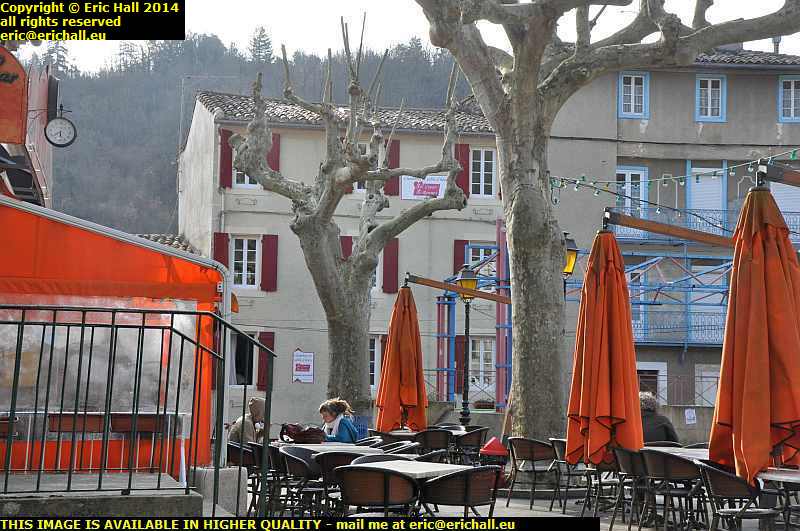
So now having given Caliburn a good wash (because, believe me, he needed it after the snows and salty roads of Andorra) I’m now in the pretty-derelict spa town of Rennes-les-Bains. A couple of things I need to do here.
Thursday 6th March 2014 – I’M IN QUILLAN TONIGHT

And in case you are wondering where Quillan might be, it’s back in France again in the Département of the Aude about 50kms from Carcassonne.

But I’m not going to Carcassonne (well, at least, not yet) – I’m going to somewhere quite different, more of which anon

Today, though, I left Andorra nice and early in the bright sunlight and to cheer me up even more, I found a petrol station selling diesel at 111.3 cents per litre, which has to be the cheapest that I can get anywhere in Europe.

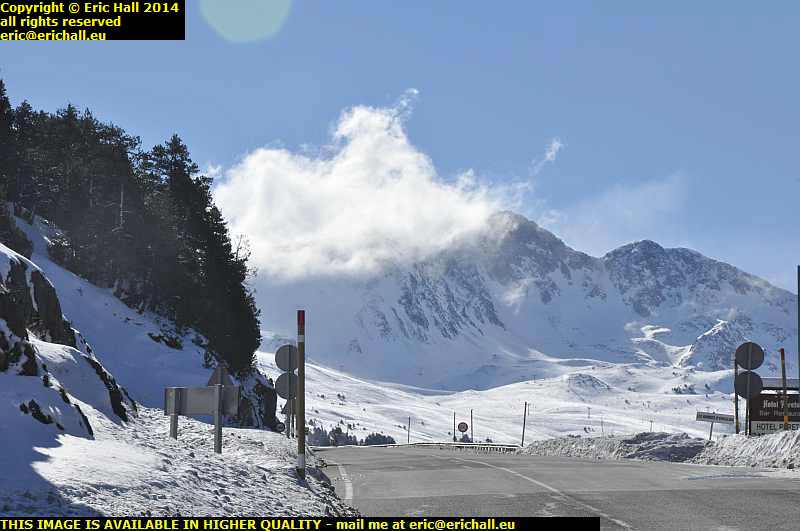
snow blown by wind off the top of the pyrenees andorra
The climb up and out of Andorra was rather fraught though. They were still dealing with the after-effects of the heavy snowfall the other day, and what wasn’t helping matters was that there was a really strong wind up aloft. That’s not a cloud coming over the top of the mountains – that’s the snow being whipped off by the wind.

I was going that way too and the higher the road climbed into the mountains, the worse the road became. But while there weren’t any problems, it was still uncomfortable.

What didn’t help matters was that the snowploughs had not been able to clear the parking areas at the ski resorts. Consequently, all of the holidaymakers simply abandoned (I refuse to use the word “parked”, as “parked” they certainly were not) all over the sides of the roads by the ski lifts regardless of the snowploughs and the moving traffic. It was total chaos in quite a few spots and had I been an Andorran policeman, all of the cars would have been towed away.

Thoughtless was not the word. Pig-ignorant and selfish are far better.


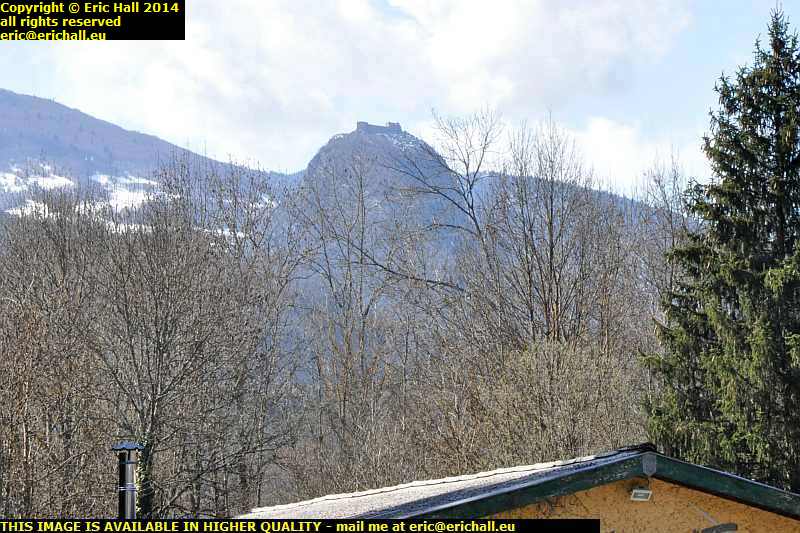
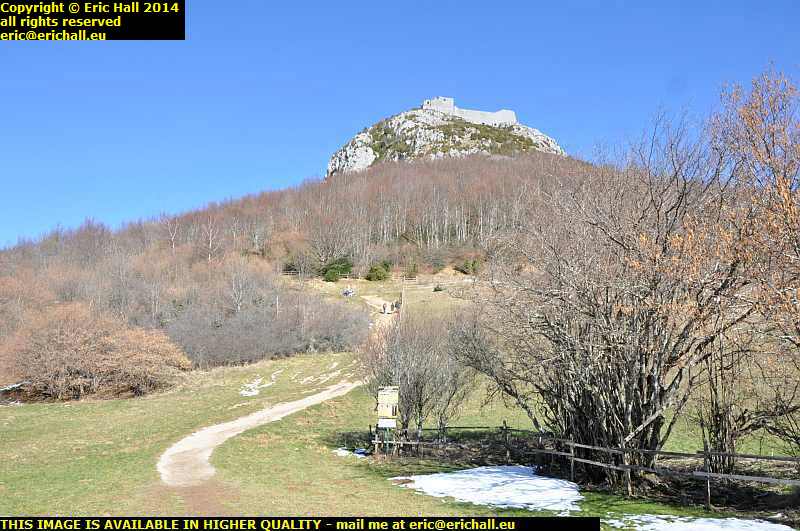
chateau de montségur ariege france
Now, how about this for something? That castle perched up there on that rock in the distance is one of the most enigmatic places in the whole of France and was on the top of the list for me to visit. It’s the reason why I’ve come down here.

It’s the Chateau de Montségur and while it can’t match Béziers for being the place of the greatest massacre of French civilians (well, okay, they weren’t French back in the 13th Century), what happened at Montségur is one of the most mysterious and bewildering events ever to occur in what is now France.


chateau de montségur ariege france monument burning 225 Cathars
Somewhere round about where that monument is (no-one can be exactly sure where the exact spot might have been) on 16th March 1244, approximately 225 Cathars and Cathar sympathisers were put inside a cage and were burnt to death.

And it has to be said that they were quite happy with the idea, to such an extent that about 20 of the victims actually volunteered to go to their doom. One eye-witness report tells of the Cathars singing as the flames were engulfing them.


chateau de montségur ariege franceIn brief … "thank goodness" – ed … Catharism was a religious sect that dissented from the teachings of Rome. Cathars were Christians without a doubt, but nevertheless their manner of worship and their beliefs were considered heretical by the Pope.

Catharism was quite strong in this region and some of the wealthiest landowners were Cathars. Consequently, other local notables didn’t need much encoragement to urge the Pope to declare a Crusade against the Cathars.

Béziers was one of the first Cathar towns to fall and it is said that maybe as many as 20,000 people in the town were burned alive.
It was reported that someone asked “who shall we burn? How do we know which ones are Cathars?”
The reply was quite simple. “Burn them all. God will recognise his own”.


chateau de montségur ariege franceBut as the noose slowly tightened around the Cathar region, the rock of Montségur was fortified and turned into a refuge of the last resort. Little by little, refugees arrived here bringing with them the religious treasures and relics from other Cathar centres that had succumbed. In 1243 there were 500 people living on the rock, all prepared to make a last stand.

Montségur by this time had already withstood several sieges but in May 1243, with opposition elsewhere being almost totally crushed, the whole might of the Crusade laid siege to the rock and slowly but surely, fought their way up the hill.


chateau de montségur ariege franceBy Christmas 1243 it was clear that the garrison could not hold on for much longer and in a daring escape, several of the parfaits, as the Cathar monks and nuns were known, took the entire treasure that had accumulated inside the castle, and disappeared with it to a place of safety. What became of it, no-one ever knew and no trace of it has ever been discovered to this day.

Even more incredibly, one of the escapees managed to return to the castle and he was there on 1st of March 1244 when the castle finally called a truce. The terms of the truce (which was effectively a surrender of course) was that the civilians could leave unmolested, but any parfait (there were said to be about 200 or so in the castle) who failed to renounce his or her vows would be burnt to death.


chateau de montségur ariege franceThe defenders asked for a 15-day truce (why, no-one knows) and this was accorded. And on the eve of the final day, an important ceremony of some nature was held within the castle. Later that evening, a few more parfaits slipped out of the castle, taking with them the final objects of importance that had (presumably) been used at the ceremony. And all of that disappeared too, never to resurface.

Next morning, the garrison surrendered. and it is said, quite astonishingly, that not only did no parfait renounce his or her vows, but another 20 or so claimed to have taken the vows in the meantime and demanded to be burnt – a request which of course was granted.


chateau de montségur ariege franceSo what was the treasure that was taken away at Christmas 1243?
Where was it taken to?
Why did the garrison demand a 15-day truce?
What was so important about the 15th of March that a truce was requested to cover that day?
What was the ceremony that took place on that day?
What were the objects that were used at the ceremony?
Why were they taken away?
Where were they taken to?
Why were so many people so happy to be taken away to their deaths?

There has been endless speculation about all of this and so many books and novels have been written that they could make a stairway up to the castle. But you can see why Montségur is a place of such interest to so many people.


modern village montaillou ariege france
This is another site in the Ariège that is associated with Cathars. It’s the village of Montaillou.

This is not the original site of the village, though. This is a more recent reincarnation. The village that we are interested in is the one that was in existence at the end of the 13th Century and this is about half a mile away from the present site. And unless you know where to look, you won’t find it at all.


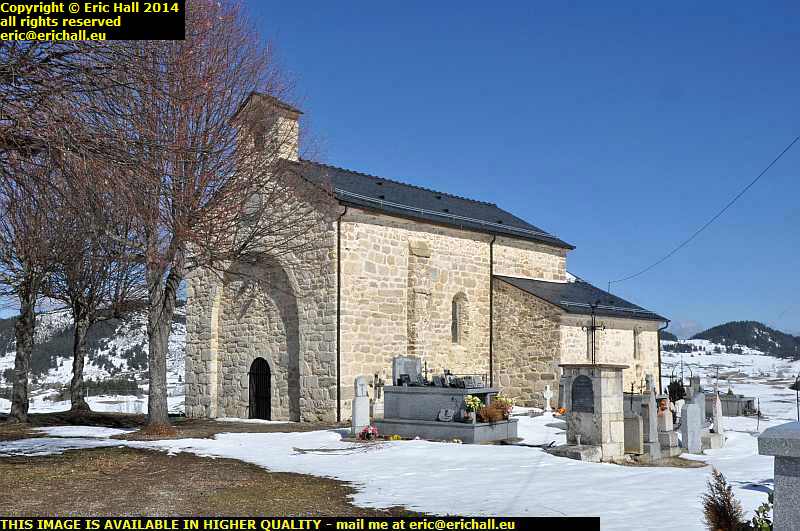
medieval chapel montaillou ariege franceThis chapel sitting down in a field dates from the 11th Century and it was at the foot of the chapel that the original village was situated.

And so to set the scene, the fall of Montségur did not quite spell the end of Catharism in France. It lay dormant for probably 50 years but someone discovered several documents setting out the important tenets of Cathar belief, and he resurrected the religion. Montaillou was one of the most important “new Cathar” villages, so much so that a Papal inquisition descended on the place and arrested all of the inhabitants.

They were fully interrogated and their answers were fully recorded. There were indeed parfaits in the village but many escaped. One by one, though, they were tracked down and burnt to death


medieval village site montaillou ariege franceSo while you look at the site of the Medieval village and marvel at how clearly the traces of the roads and habitations show up through the snow after 7 centuries of abandonment and agricultural exploitation, let me tell you a little about what is so interesting about the village.

If you remember my visit to Red Bay in Labrador in 2010

you’ll recall how a chance find in a dusty, forgotten archive led to a discovery of the 2nd-most-important historic site in Canada, something similar has happened here.


ruined castle chateau montaillou ariege comte de foix franceWhile you look at the ruins of the castle of the Counts of Foix, situated on a hill nearby, I’ll tell you that someone by the name of Emmanuel Leroy Ladurie went a-ferretting in some dusty, forgotten archives of one of the local bishops, and actually discovered the verbatim records of the interviews between the members of the Papal Inquisition and the inhabitants of Montaillou.

He wrote a book (a copy of which is in my possession) to summarise the information gleaned from the interviews and it has become one of the most important references to life in rural France at the end of the 13th Century, adding a great deal to whatever was previously known about the subject.
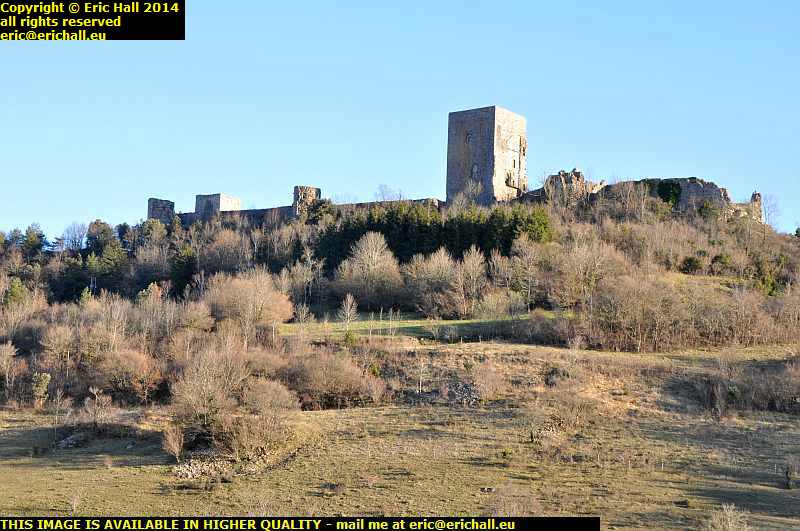

chateau de puivert aude franceWhile we are on the subject of castles, this whole area is teeming with them. Not quite one on every hilltop but pretty much near enough.

This is the Chateau de Puivert and was another Cathar stronghold. It fell to the Crusaders after a siege of just three days in November 1210 and the leader of the crusaders, Simon de Montfort, granted it to one of his marshalls.

As an aside, de Montfort was the father of the Simon de Montfort who opposed Henry III of England during the Barons’ Revolt of 1264-67. It was however Montfort père who was responsible for most of the atrocities committed against the Cathars during the early years of the Crusade.


hanomag kurier diesel montségur ariege franceIt wasn’t all work either. I’ve seen a couple of really interesting motor vehicles today, highlight of which has to be this German Hanomag Kurier light truck.

Apart from the fact that its engine is a diesel, I know nothing else whatever about it. Hanomag stopped making trucks in 1969 and so this gives me some idea of the date. I wouldn’t have put it many years earlier than that. Still, I’d take it home with me tomorrow given half a chance.