… something of a rather sad day. Nothing to do with anything that I have done, I hasten to add, but from a historical perspective – more of which anon
First off though, taking my bag off the bed, I noticed a rather large brown stain on the quilt. Somehow my bottle of gravy browning has leaked. So I had to scrub the quilt cover with soap to stop the stain fixing into the cover
Secondly, I still can’t make the internet work here. So having learnt the technique of USB tethering last night, I used it again, It’s not very satisfactory but at least it works.
That is, well enough to type up the notes off the dictaphone. There were some weird goings-on last night but unfortunately I can only remember a bit of it. There was a housing estate like Park Estate in Shavington and a house on there was all overgrown and filthy, full of weeds and the house was all infested with cobwebs. I was with a young guy. I don’t remember too much about how it started off but I remember that eventually we were driving around Park Estate together. We went to this house as we had to pick something up and this involved getting a third guy to go with us. There was a woman there and a guy – it might have been my friend from Stoke on Trent. In the meantime there was some discussion about someone else. As we were driving around this estate he said that he was the guy who did something or other. This young guy pointed out a building and said “that’s where that guy committed suicide 3 years ago. He gassed himself”. I could vaguely remember that so he said “yes, he had a washing machine that was for sale”. I was really interested. When I looked on my Social Network pages I found that he was born in Pwllheli. That was really interesting to me and I was very disappointed to find out that he had died. We got to this house and got a few things together. This living room was so untidy and no-one seemed to be bothered at all. Filthy, untidy, cobwebby. In the end to close the door it was just a case of pulling the curtains and kick a load of stuff out of the way. This woman was sitting there doing something said “yes, that’s fine”. We had to go outside then and get in my van ready to go but the other guy then started to move some sand and gravel and ash around. It was a case of getting a barrow-load of stuff, tipping it through a sieve and the stuff that passed through the sieve, throwing it away somewhere. All these long grass and weeds so he was doing that. At one stage he was pushing a load and went to tip it up and the barrow just folded up under the weight. He was cursing this and I thought to myself “now that they have messed up the wheelbarrow we might actually stand a chance of going”
Another thing that I mentioned on the dictaphone that I head when I transcribed my notes was “don’t forget to add that someone else’s flaming alarm awoke me at blasted 05:10 this morning”.
Having had a shower I went downstairs, made my excuses to the receptionist and then loaded up Caliburn. Reversing into the busy street was … errr … interesting, but eventually we set off and in the blistering heat, headed south.
 After a drive of several hours in the sunshine, I finally came to my first port of call.
My route took me round the city of Limoges on the ring road out westwards on the N141 toward Angouleme to reach what is probably the saddest place in Western Europe where the nadir of man’s inhumanity to man in the horrors of war was reached.
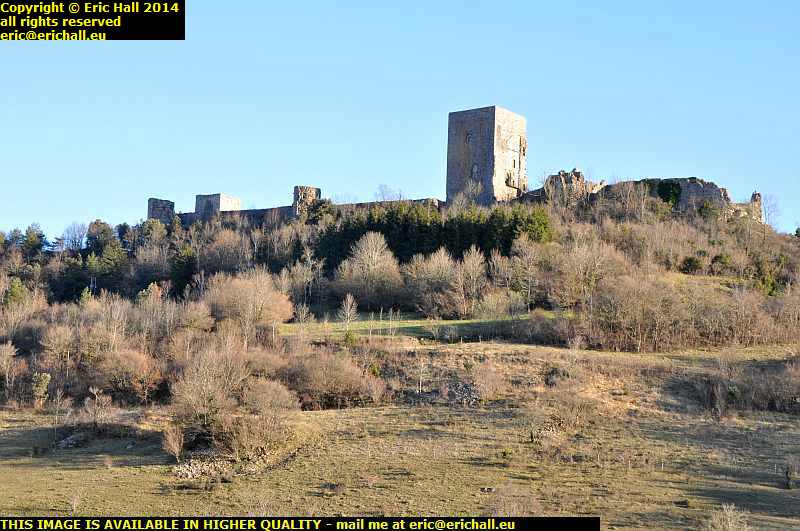
And if the burnt-out building on the hill over there in the previous photo hasn’t given you a clue as to where I am, then read on.
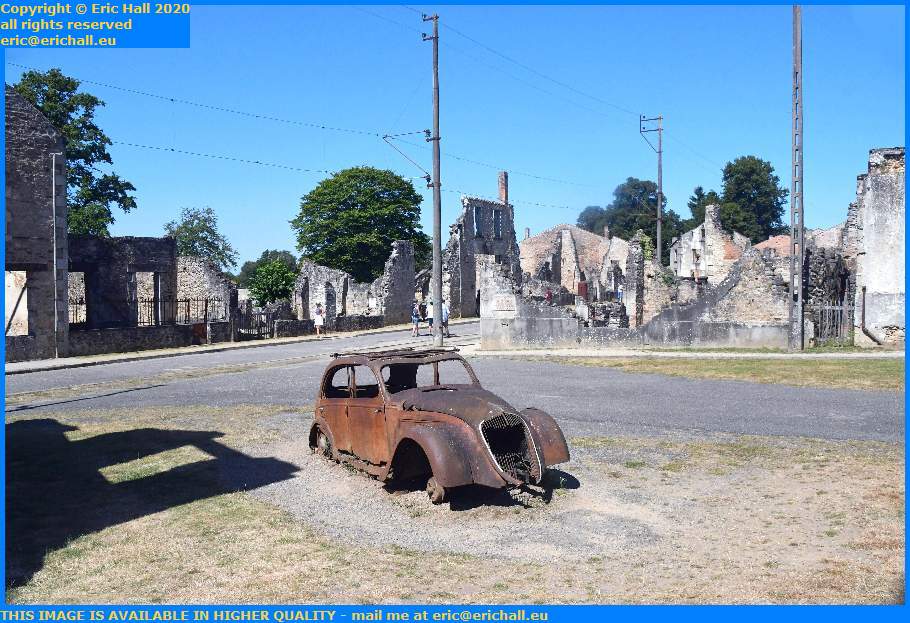 This is the photo that everyone has seen and which comes to everyone’s mind when the subject of Oradour sur Glane comes to the fore.
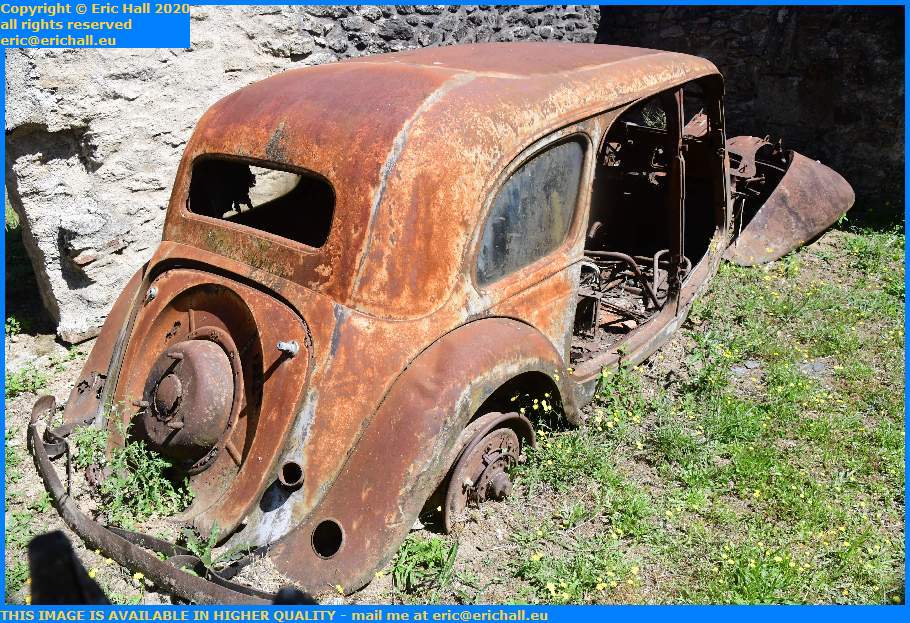
The burnt-out shell of the old Peugeot 202 in the town square has featured in just about every article or every story that has ever been written about that tragedy that took place here on the 10th of June 1944 as a company of the Das Reich 2nd Panzer Division of the SS passed by on its way to the Normandy beaches.
And after they left the village, only 6 people who had encountered the Germans remained alive and all were seriously wounded.
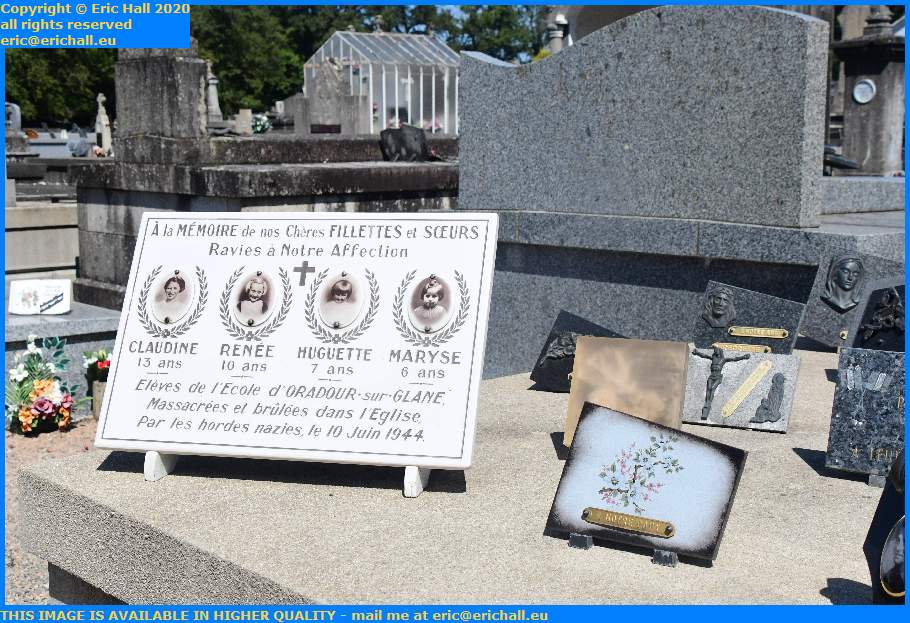 The scale of the massacre can be gauged by plaques such as this that cover the cemetery.
Of the women and children rounded up by the SS, only one woman survived to tell the tale. All of the others regardless of age, from the smallest baby to the oldest grandmother, were brutally killed, in many cases by being burnt alive, in the village church by the soldiers.
No-one knows the exact number because the village was home to dozens of refugees who had been bombed out from elsewhere and who were not recorded on the census held by the authorities, but the best estimate is that 349 women and children lost their lives either in the church or while attempting to escape from the inferno.
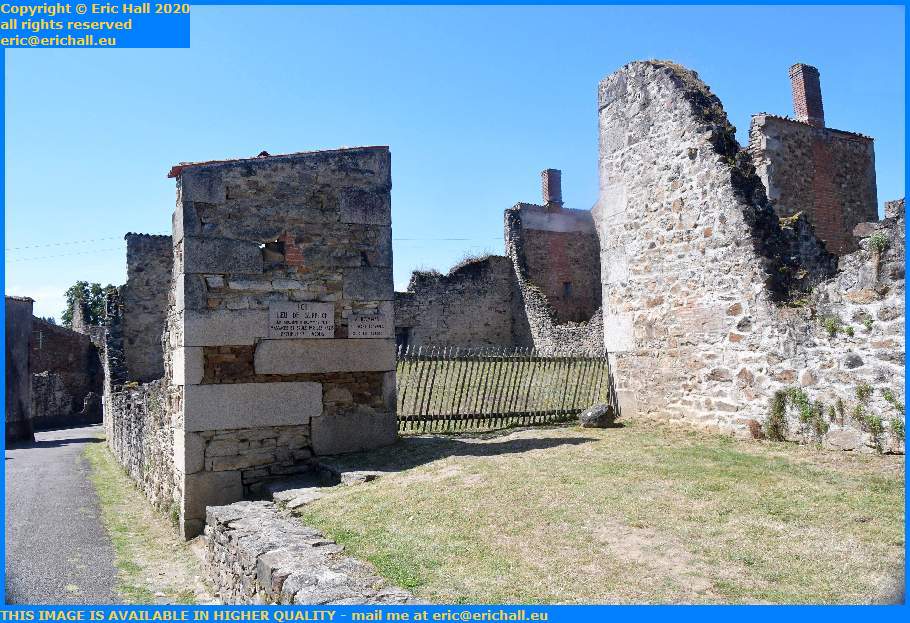 The fate of the men was no better.
In places like this, the men who had been rounded up were shot – in the legs according to one of the 5 who survived – so that they would be disabled. Then wood and so on was piled up on top of the injured men and set alight so that they burned to death.
In this barn, the Grange Laudy or “Laudy’s Barn”, one of 6 places of execution, 62 men were herded. 6 of them made a run for the door when the fire was at its height and 5 managed to escape completely despite their wounds, the 6th being shot down and killed.
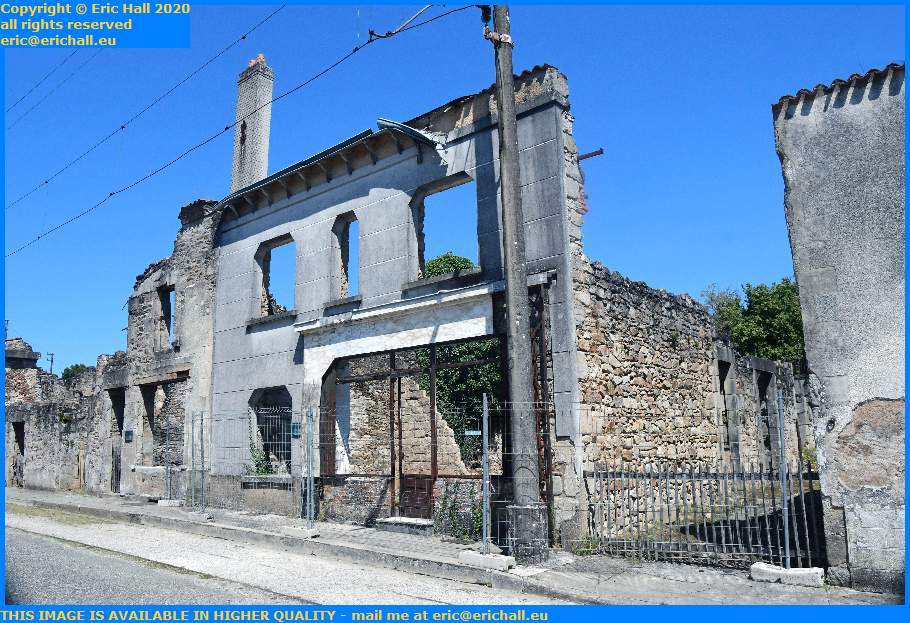
In total, approximately 643 unarmed civilians were brutally slaughtered, and the village was burned down around them. Everything that could burn was destroyed.
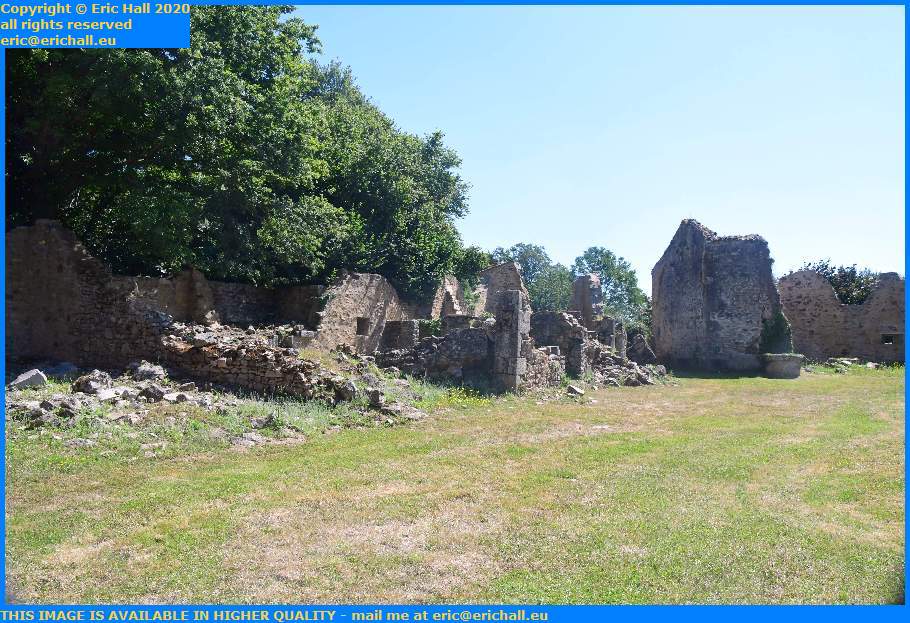
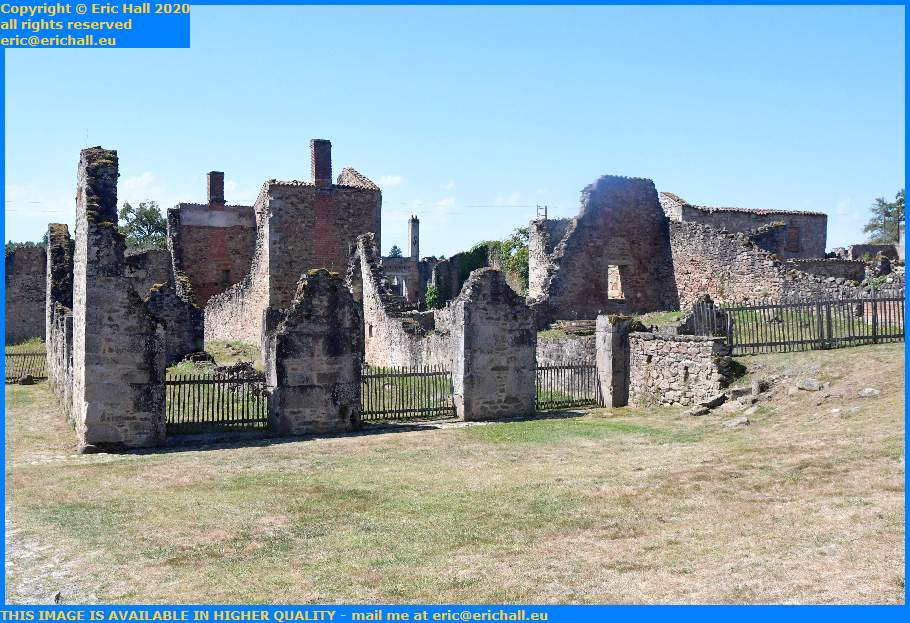
So while I post the remainder of the photos that I took, which in most cases have little bearing on the text that accompanies them, I’ll tell you a story.
Each photo is captioned individually by the way with as much information as I have found to date. Click on the photo to see it. If you have anything to add, please use the link to the contact form bottom-right.
And so, the history of the village of Oradour sur Glane is somewhat complicated because, as you might expect in a tragedy such as this, quite a few romantic notions have been allowed to creep into the story and which may or may not have some foundation in fact, and I’ll do my best to avoid perpetuating any myth.
 But let’s start at the very beginning.
The name of the village, Oradour, is said to come from that Latin oratorium, which suggests that during the Gallo-Roman period … “you must NEVER say simply ROMAN in France” – ed … there was some form of place for prayer here.
Its first mention in print was in 1264 when it appears in the Chronique de Maleu, where it is stated that Oratorio supra Glanant belongs to the canons of the Abbey of St Junien.
As is usual with these places it passes into the hands of nobles and then by a variety of marriages and inheritances it changes hands quite rapidly until the French Revolution which swept all of the nobility away.
It’s often been said that by the time of the outbreak of the Second World War it was a sleepy little village in the countryside, but I’m wondering just how much of that is simply poetic licence.
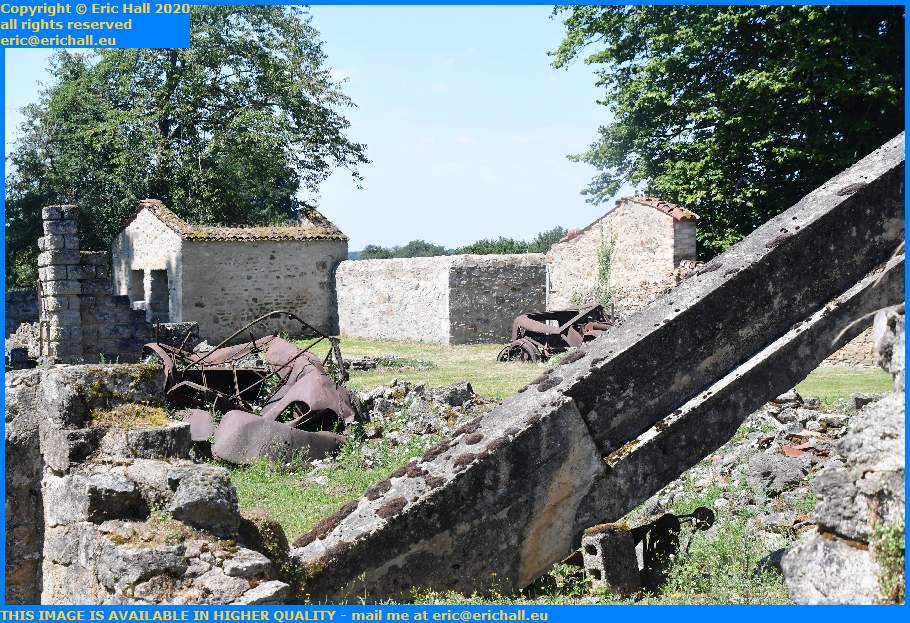
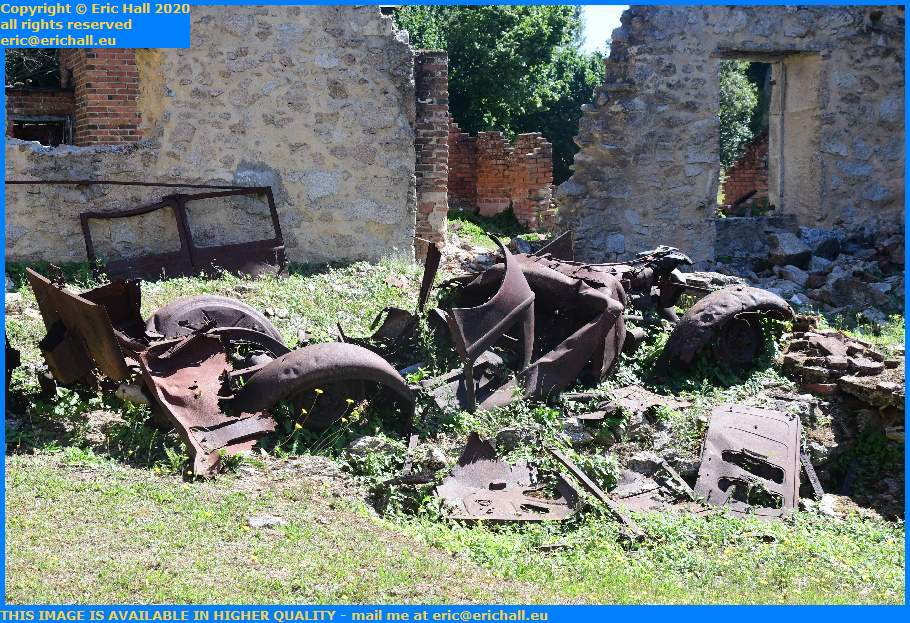
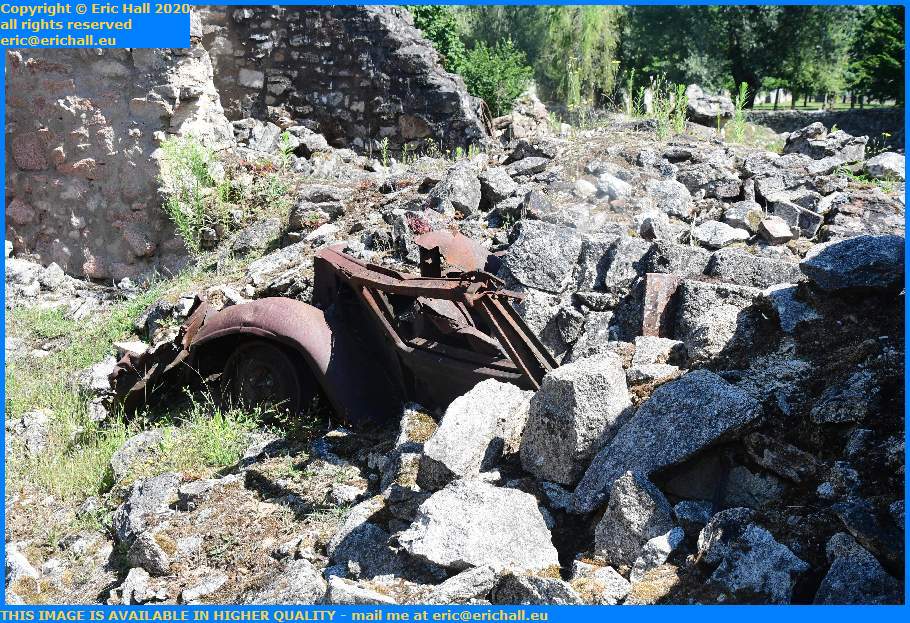
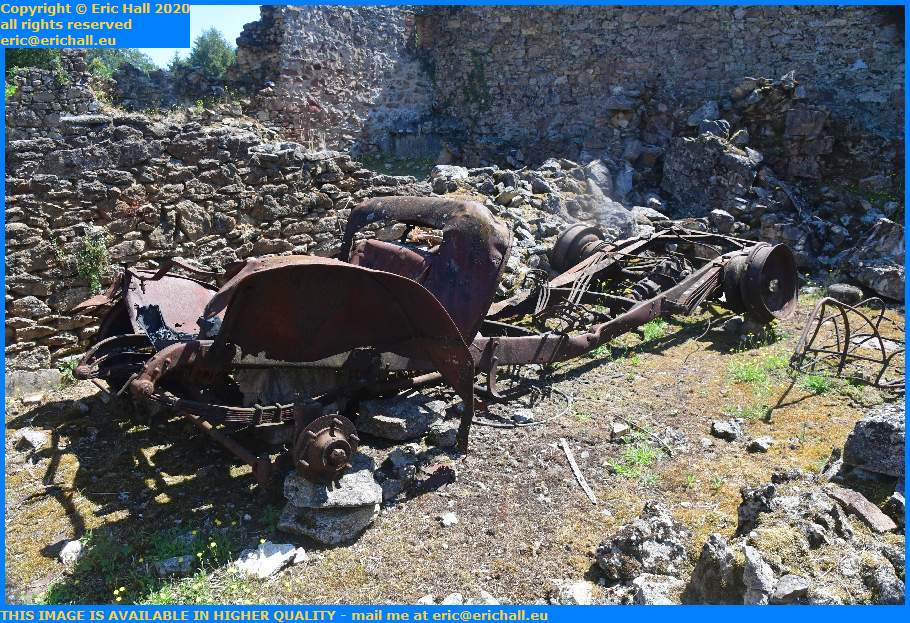
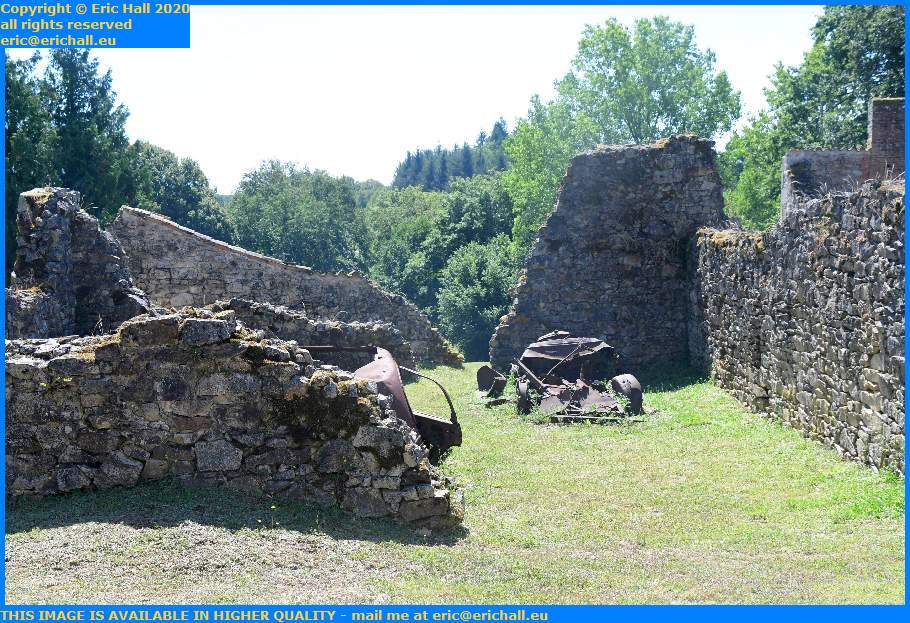
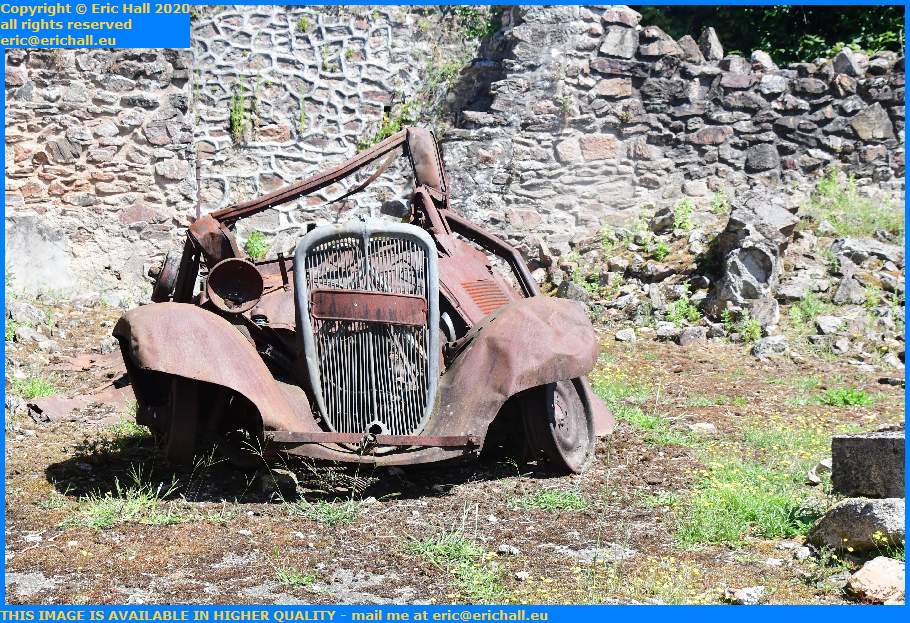
 If you have a look in many of the barns and garages of the town, like this one here, there are the remains of burnt-out vehicles everywhere.
As far as I could see, I counted 32 of them that were plainly visible and it’s almost inevitable that there were others that I wasn’t able to see. There were other vehicles, such as the draper’s van, that were known to have been driven away by the German troops when they left.
No village with that many vehicles is going to be sleepy by the standards of 1930s rural France, surely?
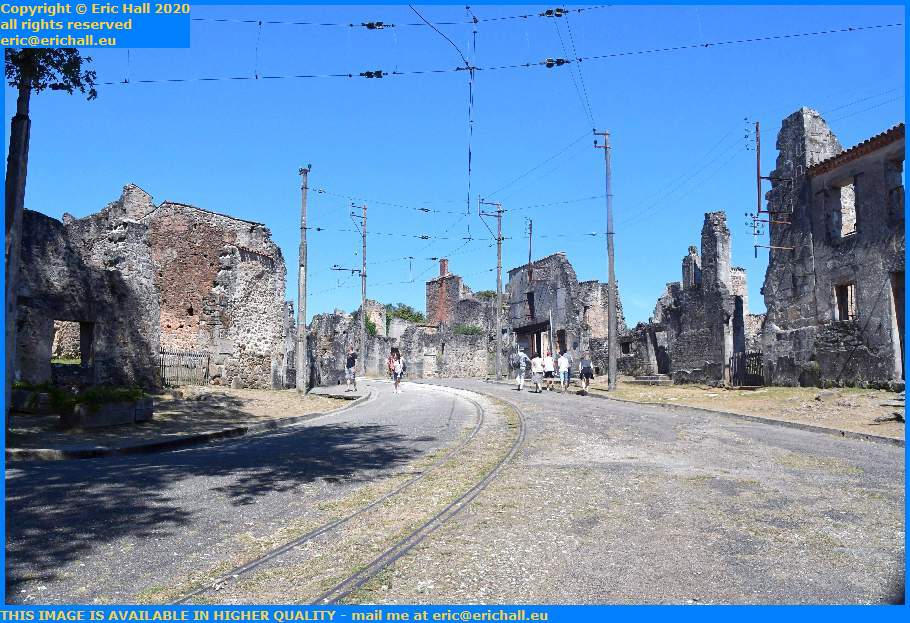
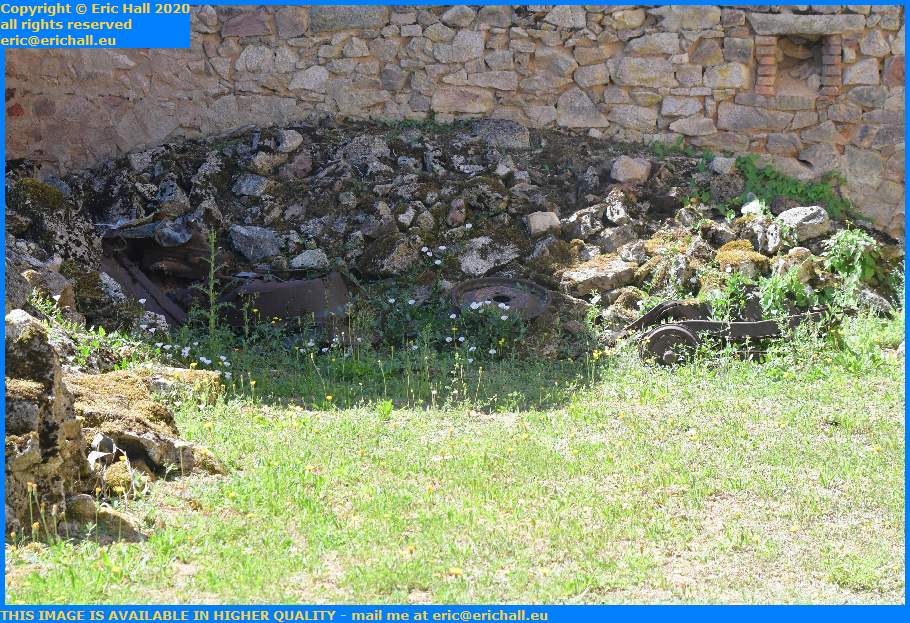
 Furthermore, there was electricity in the village, and even an electric tramway that connected the village to Limoges and you can see the remains of the line in this photo.
It’s quite true to say that there was a network of “tacot” – the narrow-gauge lightweight tramways that honeycombed their way all across rural France, but for the most part they were shoestring operations rather like the railways of Colonel Stephens in the UK, staggering on under a burden of financial uncertainty and barely surviving into the 1950s.
An electric tramway shows a degree of investment that would never ordinarily be seen in a “tacot” network. It seems that the population of the village must have been wealthy enough to have been considered a worthwhile target for the railway company under these circumstances.
 During World War II 168 men from the village were conscripted into the French Army and at the cease-fire 113 of them returned to the village. The rest were either prisoners, displaced or lost.
That was basically the village’s only connection with a War that had largely passed them by, other than of course the arrival of different groups of refugees who came to the area.
The villagers were never really bothered by the pressures of occupation, being content at first with life under the Vichy regime.
Gradually as the war wore on they became more and more disillusioned. The general opinion drifted towards a yearning for liberation and an Allied victory and several people joined the Resistance.
Several more people assisted with the “rat lines” of exfiltrating evading Allied soldiers and airmen.
 The Normandy landings were greeted with a great deal of relief and people began to look for the day that they could return to peacetime normality.
But this is when Das Reich entered the scene.
On the Eastern Front the 2nd Waffen SS Division Das Reich had been through the mill and at the 4th Battle of Kharkov in April 1944 it had been very badly mauled and had been withdrawn from the fighting.
It had been sent to south-west France, the area around Montauban, to rest and be reconstructed with new recruits.
 The D-Day Landings had caught it in a state of unreadiness but nevertheless it was ordered North to confront the Allies.
What should have been a fairly pleasant journey northwards was fraught with problems as the resistance left no stone unturned in their efforts to delay the troops. Destruction of bridges, dynamiting the railway, ambushes in country lanes were the norm.
On the Eastern Front, no quarter was ever asked for or given and a decree of 3rd February 1944 signed by Hitler had made it clear that extreme action against the civilian population in the face of terrorist action was appropriate.
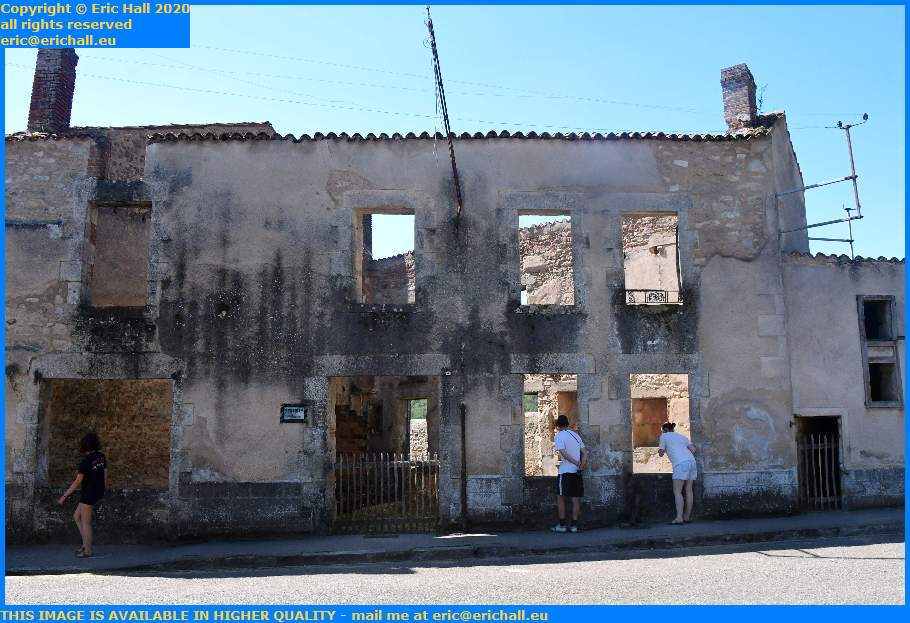 Das Reich brought with them to the Western Front this behaviour and as their route north was littered with Resistance attacked, it was also littered with atrocities committed by Das Reich against the civilian population in revenge.
Regular readers of this rubbish will recall that WE VISITED TULLE in 2014 where Das Reich had hanged 99 civilians from lamp-posts, but the worst is yet to come.
The reason why Oradour-sur-Glane was chosen to be the site of the worst massacre of civilians in Western Europe in modern times has never been satisfactorily explained.
 A German officer, a certain Lieutenant Gerlach, had been carried away by the Resistance. Legend has it that the Germans suspected the village as being the home of the Resistants concerned, but this has never been established with any certainly.
It was however a day when there was to be a medical inspection of the inhabitants so everyone from the village and the surrounding neighbourhood would be in the vicinity of the schools where the inspections were to take place.
But whatever the reason, Sturmbannfuhrer Adolf Deikmann had received instructions to create “an event of the greatest possible terror” to quieten the resistance activity in the area.
 At some time between 13:30 and 13:45 the village is surrounded by a force of about 150 German soldiers.
And when I say “German” I have to be very careful because there were without any doubt several soldiers of Das Reich were Alsatian – from the French province of Alsace that was forcibly incorporated into Germany.
A German officer present, Heinz Barth, is quoted by the French author Jean-Jacques Fouché as saying “now we’ll see what the Alsatians are capable of”.
 One has to be very careful not to make or imply any kind of suggestion that the Alsatian troops in Das Reich took part willingly in the massacre.
The merest hint or suggestion brings down the wrath of at least one Alsatian ex-combatants’ association onto the heads of the author.
It’s not been unknown for these Associations to trawl the literary world for such allegations and to haul authors and historians before the Courts on charges of slander and libel. And while these cases are generally dismissed, it’s still quite an expensive and time-consuming process.
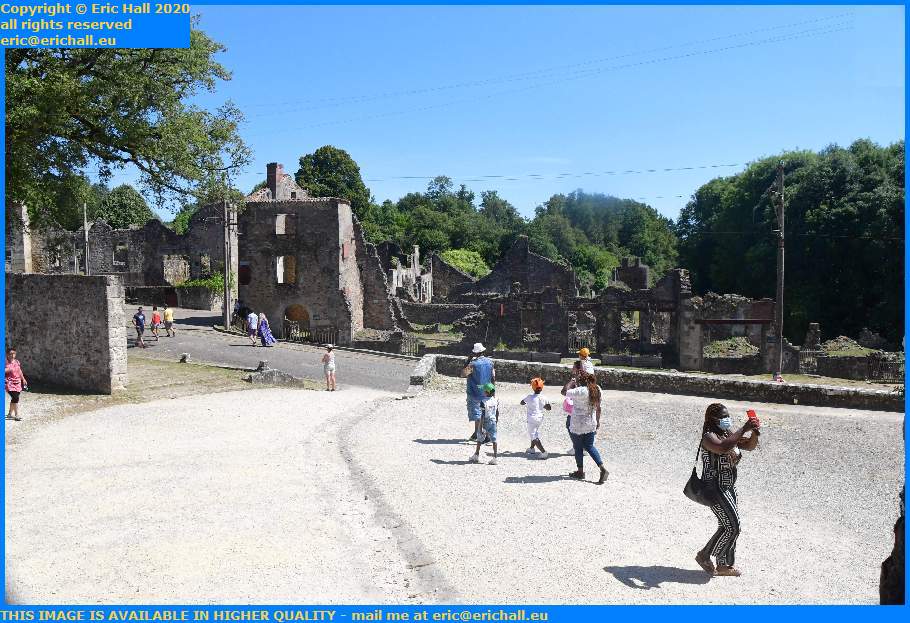
 Where we are standing is in the Champ de Foire, the marketplace of the village, with the burnt-out Peugeot 202 down at the far end.
The German troops advanced into town from all directions herding the civilians into the marketplace. By 14:45 there were almost 250 people there
Other troops were out in the neighbourhood rounding up the agricultural workers labouring in the fields while more soldiers made a systematic search of the houses for anyone hiding or attempting to escape and discovered something like 150 people hiding.
 There is good evidence to suggest that some of the women and girls found hiding were sujected to sexual violence by the soldiers and several were shot dead or beaten to death on the spot.
And at this moment, to add to the confusion, a tram from Limoges pulled up in the town. One of the people on board leapt down as if to make good his escape but was immediately shot down on the spot and his body thrown in the river.
As for the two member of the crew on board, their papers were checked by an officer and ordered to return with their tram to Limoges.
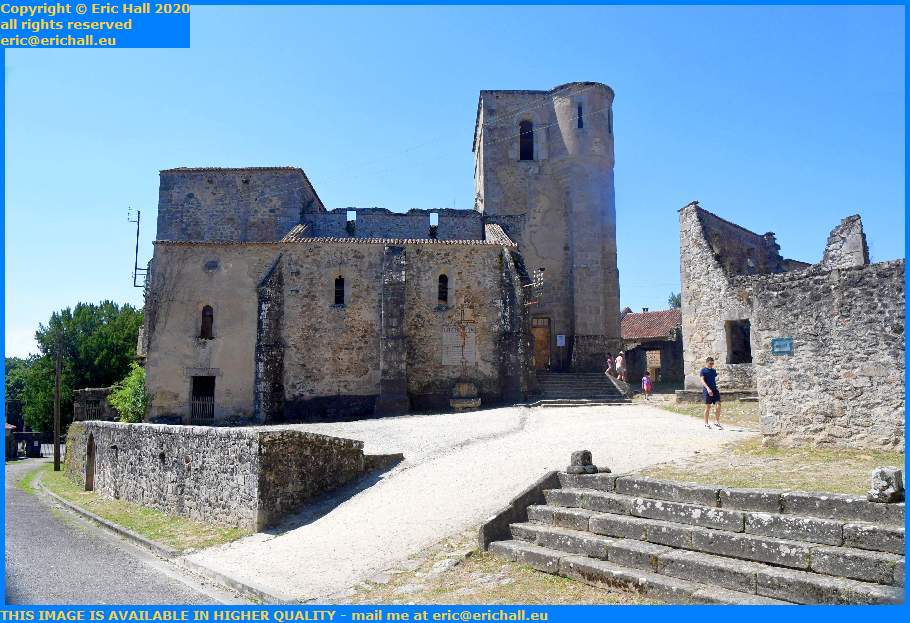 By 15:00, with as many as possible of the village now assembled in the Champ de Foire, the women and children, believed to be 350 in total, were led off to the Eglise St Martin, St Martin’s Church.
Boys over the age of 14 remained in the marketplace with the men.
As to what happened that afternoon in the church, there was only one survivor, Marguerite Rouffanche. She was questioned on several occasions and swore a deposition on 13th June 1944 before the Prefect of Limoges, according to a report prepared for the French Government 2 days later. Her story never varied from one moment to the next
 The women and children were herded into the church and once they were inside the Germans place some kind of large container in there.
This container had cords trailing from it and the Germans lit these cords. As a result there was a loud, enormous explosion and a huge thick wave of black suffocating smoke.
According to subsequent testimony, the aim was to bring down the roof of the church onto the people inside but the explosive charge was insufficient so the Germans threw hand grenades and fired bursts of machine gun fire through the door and windows in an orgy of slaughter.
 Once the Germans were convinced that there was no-one left alive in the church they heaped a pile of straw inside and set the church alight.
However there were a great many people still alive in the church. Several people who had taken shelter behind the altar attempted to escape from under cover of the smoke. There was a broken window behind the altar near to which they found a step ladder that was used when the curé had to light the candles.
A crying baby held by one of the escapees alerted the Germans who machine-gunned them all down. Marguerite Rouffanche, badly injured, managed to haul herself into the shelter of a nearby garden. She was the only survivor from the church. Everyone else was killed.
 As for the 180 or so men and boys, they were kept waiting here in the Champ de Foire while the Germans searched the houses for any arms and ammunition.
The “official reason” that the Germans had visited the village, according to the survivors, was that the Germans suspected that there was an arms dump in the village. This was what they had all been told while they were waiting in the Champ de Foire
The Germans found nothing of any particular significance, so the next stage was that round about 16:00 the men were led off in groups of about 30 to various locations.
 Amongst the places to which they were taken were
- The Grange Laudy
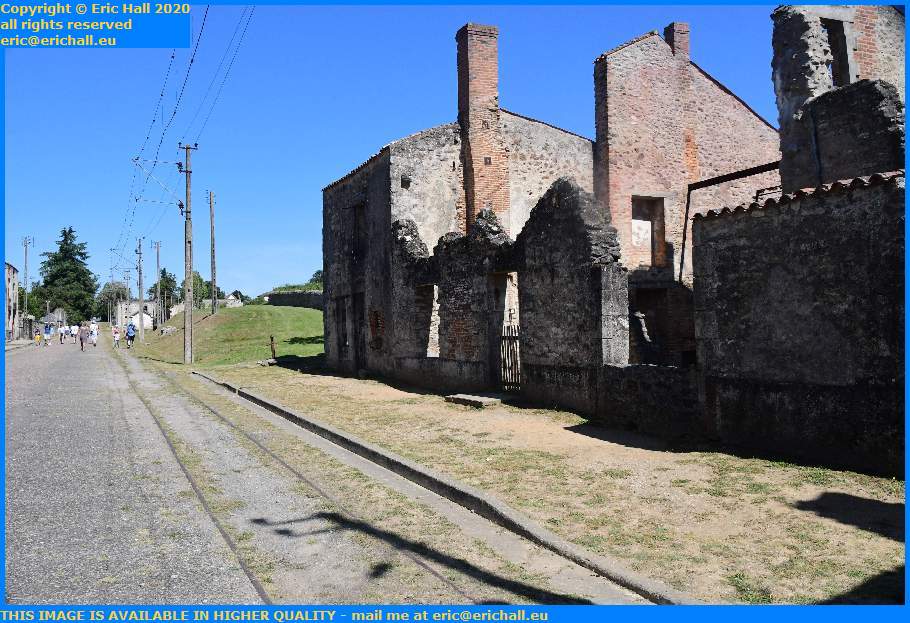
- The Forge Beaulieu (here on the right of this photo
- The Chai Denis
- The Garage Desourteaux
- The Grange Milord
- The Grange Bouchoute
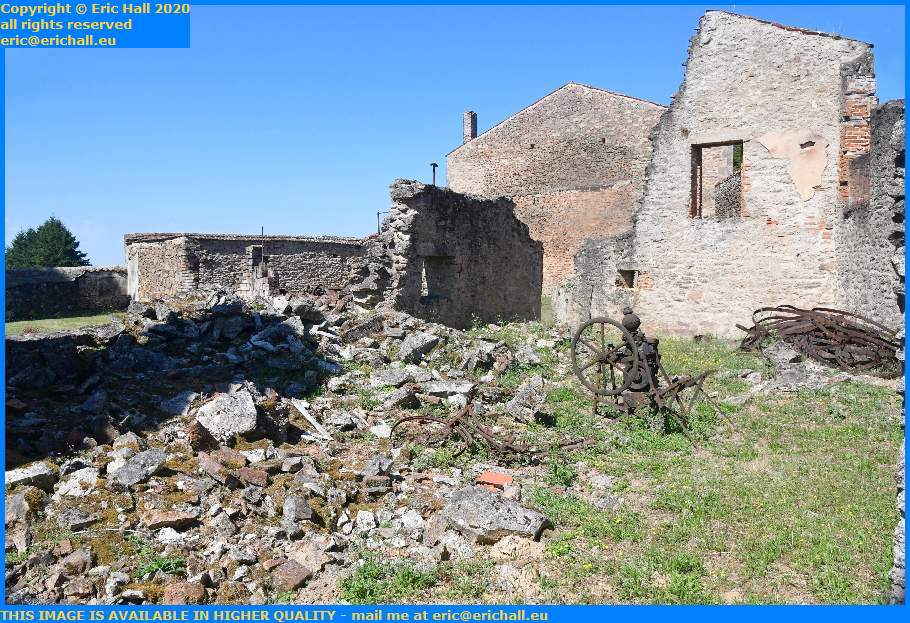 According to the 5 survivors, after a long wait, the Germans opened fire on the men and boys, first of all aiming for the legs to cripple them.
And while they were still alive, they were covered with straw and other flammable material which was then set alight so that they were burnt to death.
At the Grange Laudy, 6 wounded men made a break for it under cover of the smoke. One was gunned down but the others made good their escape.
 Having murdered all of the villagers that they could find, the Germans then turned their attention to the buildings.
The buildings were looted of anything of value and then set alight. During this operation many more civilians were discovered hiding and either pulled out by the Germans or attempted to flee the flames.
These were shot down in cold blood, and it was discovered subsequently that the bodies of some women and girls were in positions that suggested sexual violence.
Round about 18:00 an engineer from the tramway turned up to find out what was going on. He was met by a mass of flames. He was also met by a German patrol who checked his identity and then told him to clear off and think himself lucky.
Also round about this time a tram from Limoges turned up, and a further one arrived two hours later. They too were searched, the identity of the passengers and crew were checked and they were all turned back.
Several other people attempted to reach the village from across the fields but met German patrols and were turned away.
 Later on that evening most of the troops departed, taking away a great deal of the booty and leaving a detachment of soldiers secured in one of the shops to guard the village.
The discovery later on of several hundreds of empty bottles of wine and champagne in the building tells its own story of what went on during this night and it’s possible that the deaths of some of the girls and women occurred during this period.
Over the following two days the main body of troops returned and did what they could to clear away the human remains and render impossible any identification of the deceased, just as they would do on the Eastern Front.
All that they could find were buried in a hastily-dug pit behind the church.
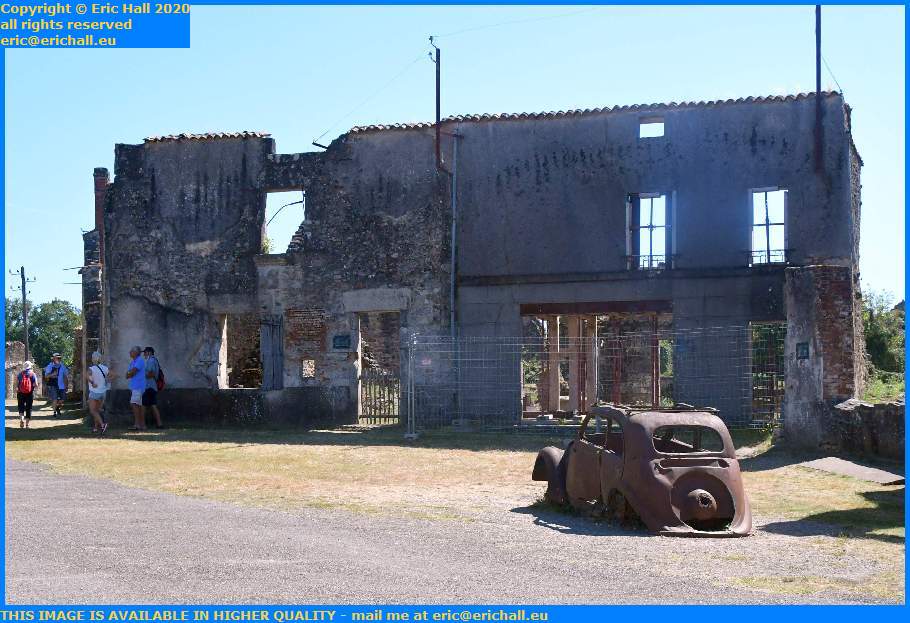 During these two days a cordon of troops around the village tried to keep the civilians away.
However, some people, including the sous-préfet of the region, managed to infiltrate themselves into the village to see the situation.
What they saw rendered them speechless and their subsequent report need not be repeated, save one remark from the sous-préfet that the village was beyond help.
If you remember our railway engineer who was met by a mass of flames, it’s hardly a surprise.
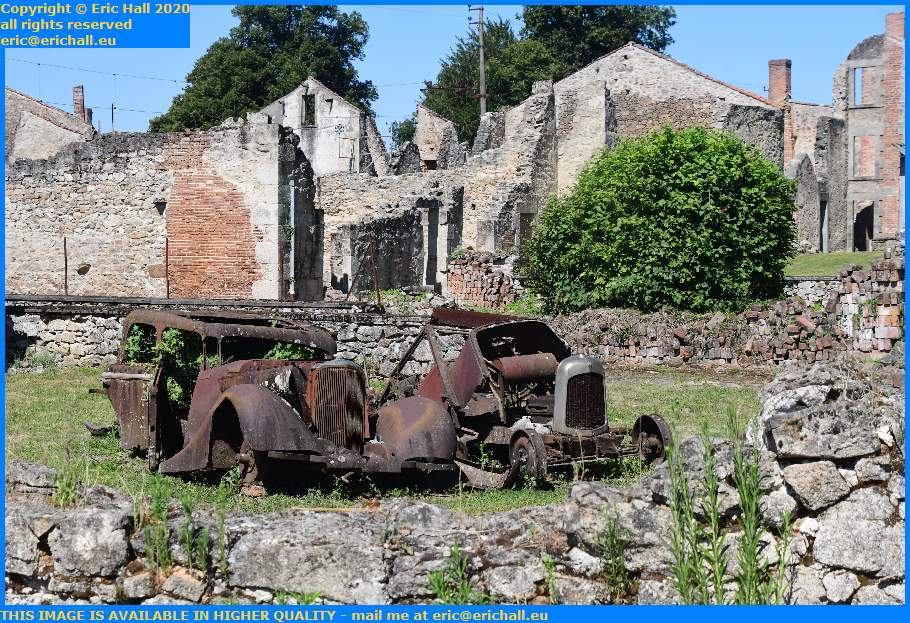 Including the 5 men and one woman who escaped directly from the slaughter, it’s reckoned that in total about 30 people actually present in the village at the time survived.
One 8 year old boy waiting for his medical inspection saw the Germans arrive and ran away into the woods just before the cordon closed. Everyone else in his family was killed.
Two men took shelter in the drains and hid there until it was safe to leave, and then they sneaked off into the woods.
 Of those hiding in the houses, some managed to hold out amongst the flames until dark and then likewise sneak out into the woods.
One youth with a broken leg in plaster and who had been unable to attend the medical inspection nevertheless managed to make his way into the woods under cover of darkness.
Another dozen or so passengers from the tram that arrived in the evening also managed to slip away into the woods.
Everyone has his or her own story to tell about their own drama on that day in June.
 On 13th June, the Préfèt of the département and Monseigneur Louis Paul Rastouil, the Bishop of Limoges, visited the village and made a report of the incident to the French authorities in Vichy.
It’s in this report that the first suggestion is made that the Germans were retaliating for the kidnap of one of their officers, although the Préfèt added that the village was one of the calmest and hard-working in his area.
On the 14th of June the Bishop sent a strongly-worded protest to the German General in charge of the area, and 2 days later held a mass to mark the event. Several other masses were said and a ceremony was held in the Cathedral on 21st June despite the best efforts of the Vichy police to disrupt it.
 By now, the Pope had come to learn of the event and his ambassador sent a strongly-worded rebuke to Marshall Petain, President of the Vichy Republic.
Petain in his turn summoned the German Ambassador to him and in a most untypical outburst told him inter alia ‘you’ve burnt our villages, massacred our children, profaned our churches and heaped shame upon your country. You are nothing but a bunch of savages”.
And I have often wondered about the German Ambassador’s response to that. It must have been very interesting, but history does not record it.
 Petain didn’t stop there either.
He wrote to the German Chief of Staff and told him that even if bands of people, often inspired by foreign terrorists, are causing problems for the Germans, the depth and ferocity of the German response has gone beyond all bounds of all reason and threatens to undermine any hope of reconciliation between France and Germany.
The German Ambassador refused to transmit the letter so, not to be outdone, Petain caused a copy to be given to a General in Hitler’s entourage with a copy to the Pope.
 The village was never rebuilt. It was decided in January 1945 to treat it as a War Memorial and a new village was built several hundred metres away.
Meanwhile, the French authorities continued to make their investigations into the Massacre. A Court of Enquiry in Limoges set to work immediately and shortly later a German soldier who had been present at Oradour sur Glane fell into their hands.
He was tried and on 12th March 1946 sentenced to death for his role in the massacre. However the sentence was overturned due to the fact that at the time he had been a minor.
 It took 8 years for sufficient evidence to be amassed in order that some soldiers alleged to be present could be identified, and then some French laws needed be changed so that they could be brought to trial.
One notable absentee at the Court hearings at Bordeaux was the German officer commanding Das Reich, Heinz Lammerding. He was traced to the British Zone of Occupied Germany but inexplicably, the British refused to allow him to be extradited. He had been apparently tried for other war crimes and served a sentence, and so was deemed by the British to be purged.
The French were not amused, as one might expect. He was sentenced to death in absentia and there was even talk of sending in a commando squad to kidnap him. That came to nothing and he died peacefully in 1971.
 Amongst the defendants were 14 French soldiers from the Alsace.
That there were soldiers from the Alsace present at Oradour sur Glane has never been in dispute – the soldier who translated the orders from German to French in the Champ de Foire was unquestionably from the Alsace.
They all claimed that the Laws of Military Justice passed by the French did not apply to them as they were French, and in any case most had been conscripted into the Division.
The French response was to charge with treason the one, Georges René Boss, who admitted volunteering. He was found guilty and condemned to death. The others received various terms of imprisonment.
 The story doesn’t end here though – not by a long way.
There was a huge outcry in Alsace against the sentences and all kinds of turbulent events took place. In the end, the French Government voted a Law of Amnesty – a decision described by some as “shameful”. One author has suggested that the French Government preferred to placate a wealthy, industrialised region of France rather than a “poor rural community that posed no threat whatever to national unity”.
The 13 conscripts from Alsace were released and the one sentenced to death along with another Prisoner who had received a capital sentence were reprieved.
 As you might expect, in the Limousin there was uproar as the prisoners were released.
Many people who lived in the area and who had been awarded honours and medals by the French Government returned them in disgust.
Even a bronze plaque that the French Government had presented to the town in commemoration of the atrocity was returned. In its place the villagers erected a plaque listing the names of all of the Parliamentarians who had voted in favour of the amnesty, along with another plaque listing the names of all of the convicted men who had been liberated.
Even some towns that had been honoured for their wartime rôle by the French Government returned their honours.
 The French Government had erected a “Crypt of The Martyrs” to house the ashes, but the citizens refused to allow the ashes to be transferred.
As well as that, they refused to allow the Government to sent any representative to any of the ceremonies that took place in the village to honour the dead.
As the mayor of the new town said at the time, “to our feeling of great sorrow and our struggle for survival has been added a feeling of injustice, abandonment and even of some revulsion”.
 In 1981 in East Germany, the authorities arrested an old man who turned out to be one of the Company Commanders known to have been present at Oradour sur Glane, living in the East under a false name.
He was tried in East Berlin for various war crimes including that of Oradour sur Glane, during which three of the survivors gave evidence against him. He was found guilty and sentenced to life imprisonment, but was released in 1997.
It must have been an embarrassment to the French and British Governments that it was the East Germans who were most interested in pursuing the events of Oradour sur Glane.
 And as subsequent events unfolded, the interest of the East German Justice system in the events here must have proved even more embarrassing to the West.
In October 2010 whilst searching through documents formerly held by the Stasi, the East German Secret Police, a researcher discovered a document that showed that the Stasi had conducted an enquiry into the massacre.
This document contained a great deal of incriminating evidence previously unknown to the French authorities. Furthermore, it identified many of the participants, of whom 6 were found by the German authorities to be still alive and living in what was West Germany.
 In an enquiry undertaken by the German police, two of them denied being present at the time and the other four, aged 85 and 86, could not remember or were in no medical condition to be questioned.
As a result, in January 2013 several representatives of the German Justice system from Dortmund visited Oradour sur Glane in the hope of finding additional supporting evidence.
In January 2014, a former soldier, Werner Christukat was tried in Germany but found Not Guilty due to lack of evidence, a decision that was upheld on appeal. Although it was held that he was present at the time, there was apparently insufficient proof to suggest that he took an active role.
 In my opinion, not having access to the full facts of the case, this is a most extraordinary decision considering the verdict that was presented against John Demjanjuk a couple of years earlier.
In Demjanjuk’s case, a legal precedent was set that mere presence at an act of war crimes was sufficient for someone to be found guilty of being an accessory, a principle that was subsequently successfully applied against several other people who had served the German cause during the War.
Suspects are still being PULLED OUT OF THE UNDERGROWTH AND CHARGED in accordance with the Demjanjuk decision even today, and so I am curious to see why it did not apply in the case of Christukat.
Despite “the continuing enquiries”, which are being carried out by the German Government due to the “Demjanjuk decision”, it is doubtful if any other person will ever be brought to justice.
 Even today, the body that represents the soldiers from Alsace is active in this field.
When he learnt that German Prosecutors were on French soil searching for evidence, a spokesman from the Association des Déserteurs, Évadés et Incorporés de Force (ADEIF) “wouldn’t it be better for someone in High Authority (in Germany) to have come and given a public apology to those people from Alsace who were incorporated by force” into the German Army?
As you can understand, anyone writing about the massacre needs to tread carefully. Any criticism of the involvement of soldiers from Alsace in the massacre even more than three quarters of a century after the event is met with a full barrage of everything that the defenders of their role can muster.
 And it isn’t only the ADEIF that is on the warpath.
Revisionist history is all the rage these days as people, taking advantage of the death of eyewitnesses, now attempt to view the events through eyes of different colours and either deny their part in the massacre or shift the blame onto others.
These will inevitably be laid to rest eventually when the public records of the trial at Bordeaux in 1953 and the investigation by the Prefet of the département of Haute Vienne become available to the public and I for one can’t wait for that to happen, but these days people have a tendency to believe whatever suits their own opinion rather than be swayed by hard evidence.
 But retournons à nos moutons as they say around here.
The Association Nationale des Familles des Martyrs organised the building of their own Memorial to the Martyrs which contains the ashes of those who died at Oradour sur Glane.
But I wasn’t very happy about them being visible to public gaze, I have to say. There’s a glass panel in the monument through which you can see bones and ashes. For me, that was in rather bad taste.
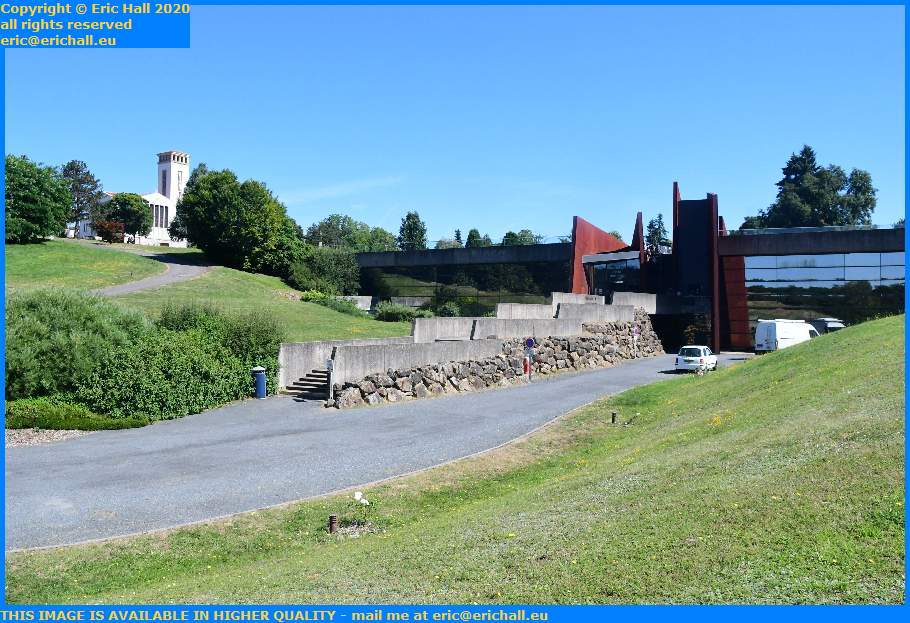 As a result of a project going back to the late 1980s, on 16th July 1999 a Visitor Centre was opened at the village, complete with Ye Olde Gifte Shoppe, which was something else that I thought to be in pretty bad taste. It’s all completely different from when I came here the first time and when I brought Nerina here in 1991
It was opened by none other than the President of the Republic, Jacques Chirac accompanied by Catherine Trautmann, the French Minister for Culture. By now, the politicians from the Government were being allowed into the village by the population.
Francois Mitterand, who had voted in favour of the Amnesty in 1953 went there on 10th June 1994 but according to the local Press, all the inhabitants closed their window blinds in protest.
Unfortunately, since then the Centre has become the target for neo-Fascist revisionists who have been spraying the notices with graffiti saying such things as “Liars” and “Reynouard (a far-right Revisionist who has a whole list of convictions for Nazi apologia) is right” and things like that.
Several other French presidents have been to the village subsequently, and one significant visitor here, on 4th September 2013, was Joachim Gauck, President of Germany who came with the French President Francois Hollande. During this visit, Gauck gave a speech of apology and reconciliation.
One person who never, apparently came to Oradour sur Glane was Nicolas Sarkozy. He did however go to Colmar in the Alsace where, on 8th May 2010 where he publicly declared that the soldiers of Alsace recruited by the Germans were “not traitors but, on the contrary, victims of a real war crime”, something that went down like a lead balloon with the citizens of the Limousin.
In fact, this action of Sarkozy made me wonder whether the appearance of Hollande, Sarkozy’s opponent in the Presidential election of 2012, at Oradour sur Glane in 2013 might have been more of an opportunist nose-cocking at Sarkozy and a vote-winning exercise rather than any kind of personal sentiment, but sometimes I’m far too cynical for my own good.
But then again, Emmanuel Macron came to Oradour-sur-Glane in between the first and second round of elections for President in 2017, so I’ll let you make up your own mind.
And while you do that, I’m off to my next port of call. And I’ll leave you with one final thought about the events of Oradour sur Glane that has been missed by, as far as I can see, every commentator on the events.
And that is that the events here delayed Das Reich‘s journey to the Normandy battleground by three days and how might the course of the war have been different had they not been held up here? And how many lives were saved elsewhere because of the delay?
Even if nothing else, the events of Oradour sur Glane fulfilled one purpose that benefited the Allied cause.
So picking up a baguette and fuelling up Caliburn as I passed through the new village, I carried on south (stopping for lunch on the way).
 Next stop for this afternoon is the town of Chalus and its early medieval tower.
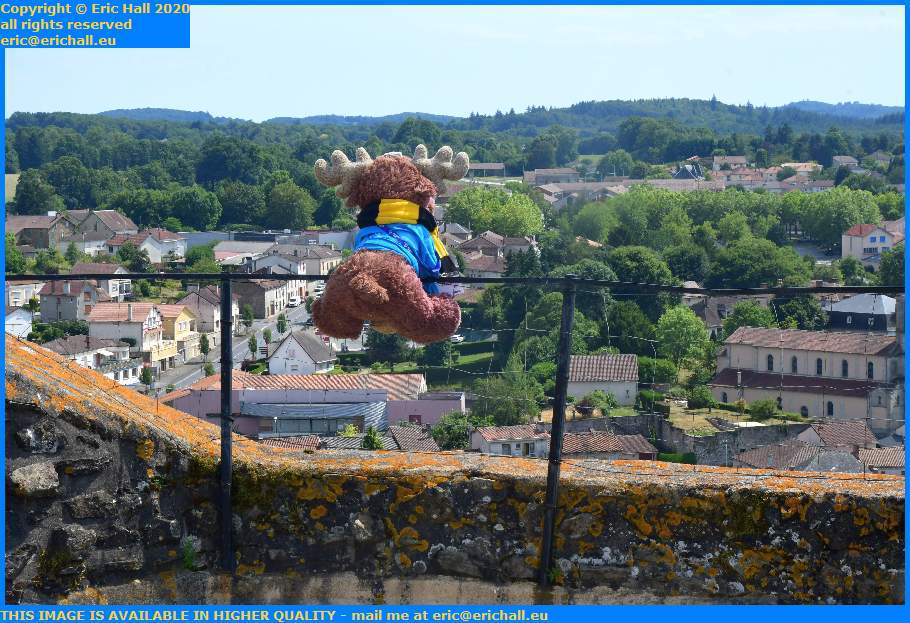
While Strawberry Moose works out how he’s going to take the keep by storm, I’ll mention something about our interest in this place.
Yesterday, as regular readers of this rubbish will recall, we visited Chateau Gaillard, the castle of Richard the Lionheart, and we talked about the siege of the castle by King Philip after the death of Richard.
 This castle would have been a much more important place than it would appear today.
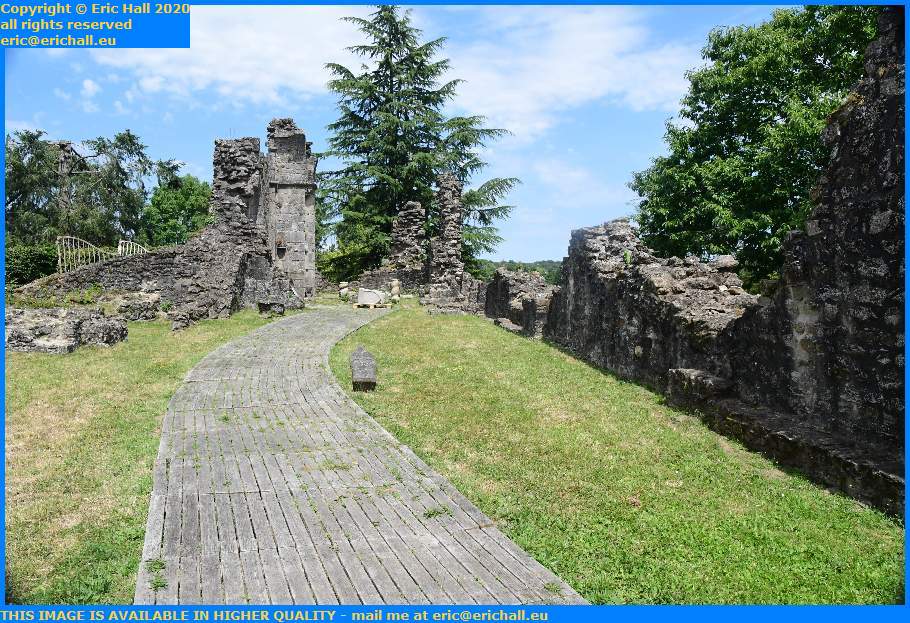
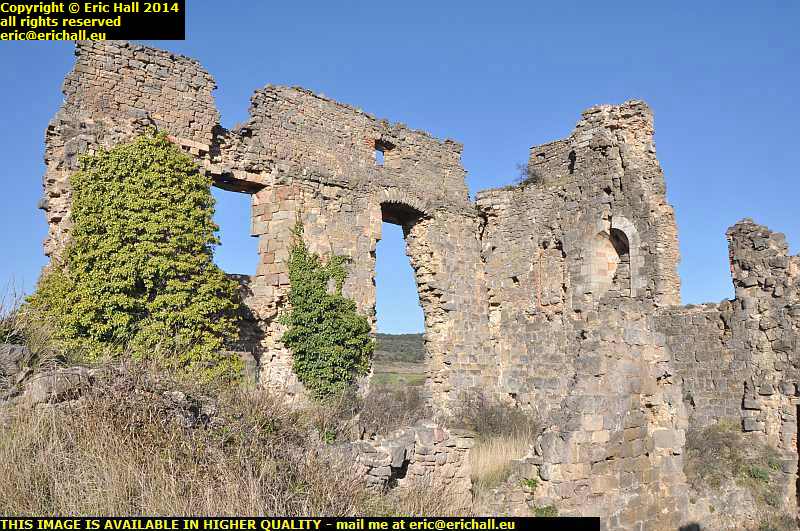
There may not be much remaining of the fortifications here today but there are the remains of several stone walls such as these remains here . These might either be the remains of buildings or of walls, although the curved end is more suggestive of a former building in this particular case..
And the big pile of stones in the bacckground, I wonder where they came from and of what they were part.
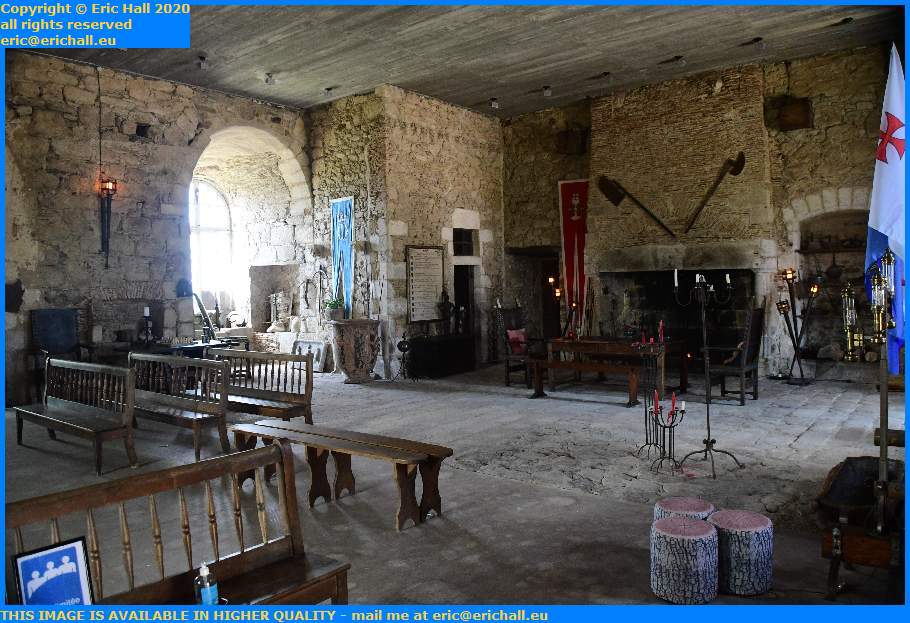 But what we are looking at here, in the Great Hall of the Manor House to which the tower belongs, is said by some to be the spot where King Richard died in 1199.
It’s certainly true that he was carried to somewhere round about here, but there are several candidates for the place of his death. Some sources suggest that he even lived for 6 days after being wounded.
The castle is situated today in the département of the Haute-Vienne in the Limousin, but previously, back in antiquity it was quite close to the border between the Périgord, which was not then part of France and the domaine of Counts of Limoges.
This border took on a totally new significance in 1137 when Duke William X died without a male heir, and his lands passed to his daughter Eleanor. She was immediately married off to King Louis VII but the marriage was not a success.
 The couple divorced in 1152 and just as quickly as her first marriage, she married Henry, Duke of Normandy.
Henry’s grandfather had been Henry I, King of England and after the death of Henry I there had been the disputes over the throne of England between the late King’s daughter Matilda (The Duke of Normandy’s mother) and Stephen, nephew of the late King.
With no direct male heir to the English throne (Henry I’s son had been lost in the “White Ship” disaster of 1120), Stephen invoked the right of male progeniture and claimed the throne. This had led to Civil War in England
 Henry had been campaigning against Stephen on behalf of his mother and the matter of succession was resolved in 1154 when Stephen died. Henry simply took over the crown by right of occupation, having no faith whatever in whatever promise Stephen had made.
This sent shock waves throughout the whole of the border area between Périgord – by now part of the region of the Aquitaine – and that area ruled by the Counts of Limoges.
Rather than being a boundary between two rulers of more-or-less equal stature, it was now an international boundary. Consequently a whole line of fortifications was either built or rebuilt by the Count of Limoges to secure his frontier.
 There was already an important road between the religious centre of Bourges and the port of Bordeaux in the Aquitaine. This passed by the town of Chalus and so the rocky outcrop was considered to be a logical place to build some kind of fortification that would protect the road.
Due to its strategic position it was subject to attack on many occasions, even once prior to the issues with Richard, but it is with Richard that we are particularly interested.
And for this, we need to turn our attention to the Third Crusade to Palestine.
While the object of the Crusade was the recapture of territory lost to Saladin after the disastrous Battle of Hattin, the Pope took the initiative to persuade Henry II of England and Philip of France to forget their disputes, take the cross and accompany the crusaders.
However Henry died before he could set out and his son Richard set out in his place.
 The Crusade was only partially successful and in 1192 Richard left Palestine to return to England. On his way home he was kidnapped by Leopold of Austria who had a personal grievance against him, and passed to the Holy Roman Emperor who held him to ransom. On payment of the ransom by the English, he was released.
While he had been imprisoned there had been several revolts against him, most notably by his brother John but also by the Counts of Limoges, and these continued.
During the rebellion of the latter a mercenary named Mercadier and his forces had attacked the castle on behalf of King Rechard.
The 38 local people present, men, women and children, fled to the tower and barricaded themselves in.
 Mercadier began work on undermining the walls of the tower. And that would not have been easy because the walls are 3 metres thick, so I’m told.
Anyway, after 4 days of work, Richard came by to see how the attack was progressing.
While he was inspecting the works he was shot just underneath the neck by a bolt fired from a crossbow from the top of the tower roughly where Strawberry Moose is standing, and died of this wounds when gangrene set in.
And that unfortunately is that as far as Richard the Lionheart is concerned.
 So now that we have set the scene, let’s go off on our guided tour of the premises.
The first thing that needs to be said is that while the tower here is original, the building probably isn’t. It dates from the enlargements of the 13th Century and I’ve seen a reference to reconstruction du logis du chateau en haut – “reconstruction of the lodgement of the upper chateau” – of 1280.
If that’s the case, this would be the garrison of the castle, where the defenders of the castle would lodge.
 There’s a doorway in the wall of the building that leads into the tower.
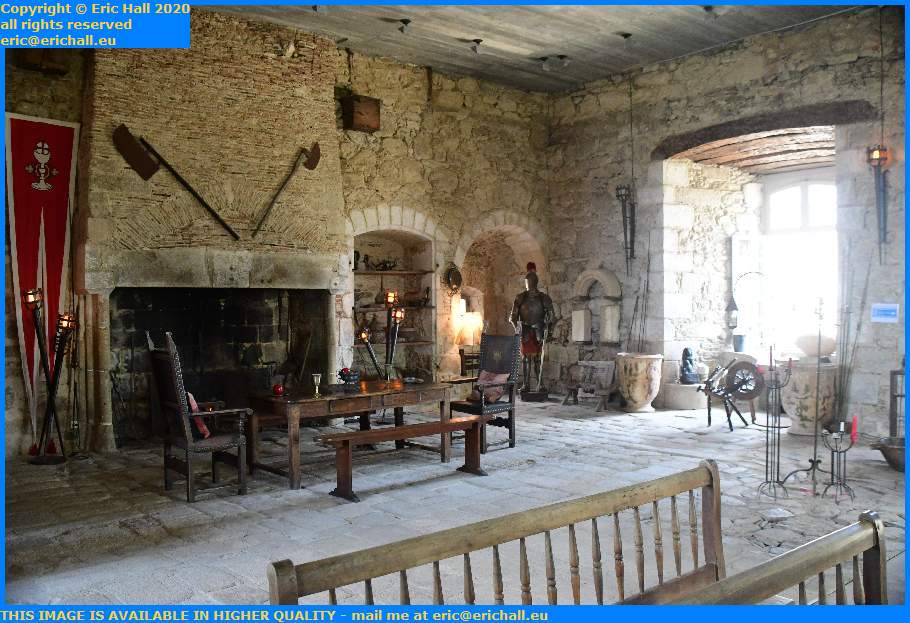
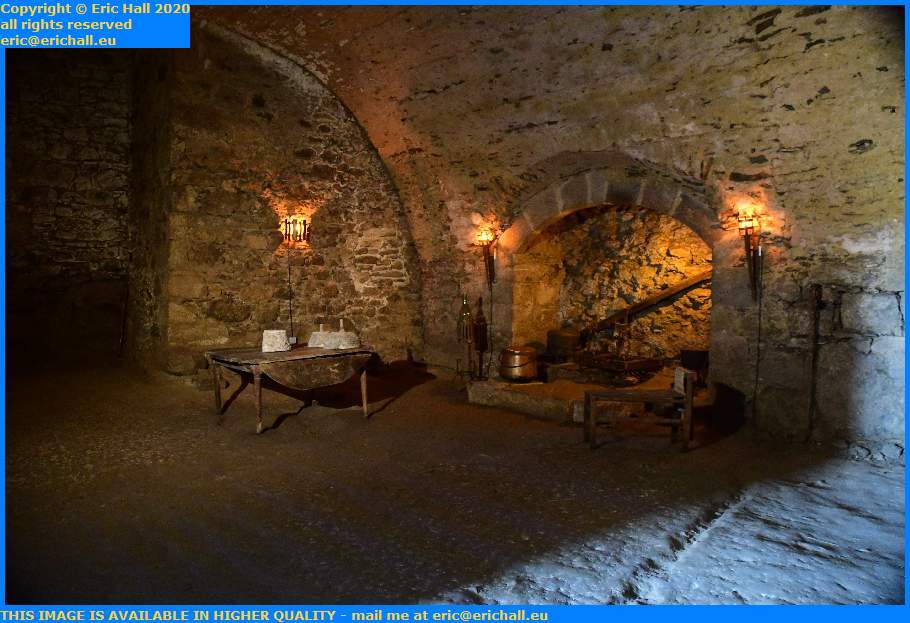
And from here we have a choice of two directions – upwards and downwards. We are going downstairs into the basement of the tower, complete with a lovely vaulted ceiling and beautiful arched fireplace.
Back in the 12th Century it would probably have been lit by tallow candles, presumably on a round chandelier that would be raised up or lowered down from the ceiling, rather than the reproduction medieval flares on the wall either side of the chimney.
 There are two rooms underneath the tower.
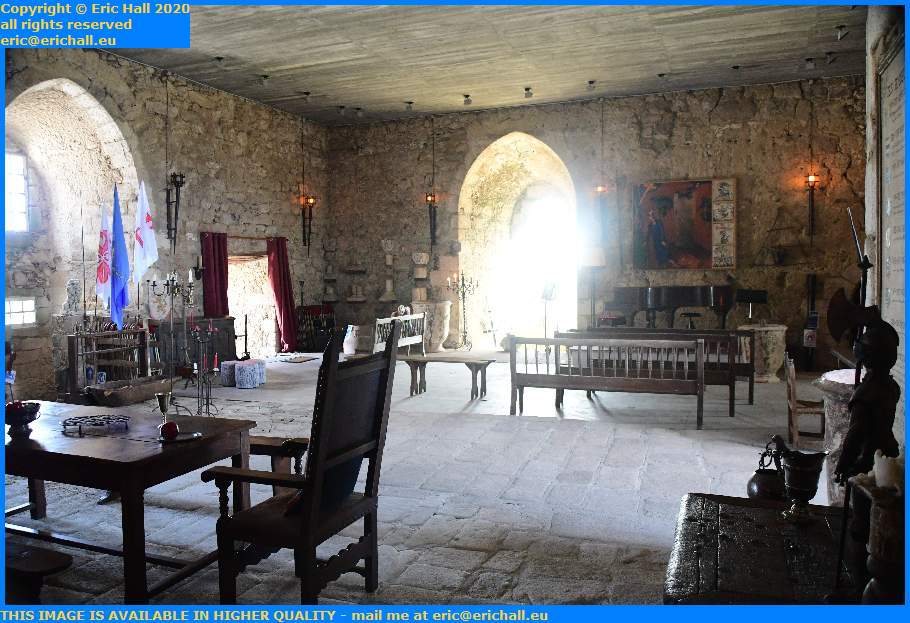
We’re in the second room here. The entrance through which we walked from the first room is behind the pillar, under observation from Strawberry Moose who is presumably watching for English soldiers and mercenaries from the Perigord.
We’ve seen a few items of furniture around – in the previous photo and in this room. I’ve no idea if they are contemporary or reproduction but there certainly wouldn’t have been all that much furniture in a medieval building such as this. The occupants wouldn’t have been as wealthy or had as many possessions as is often depicted in Hollywood epics.
 Back in the first room again you can see an example of the type of chandelier that I mentioned, although I doubt if it would have been as elaborate as this one.
Over to the left are the stairs down which we descended, and on the right is a doorway that leads out into the moat. For obvious defensive reasons, it’s doubtful that the doorway is contemporary with the construction of the tower and is more likely to be a comparatively modern alteration.
But I’m not going outside right now, I’m going back up the stairs, and right to the top too.
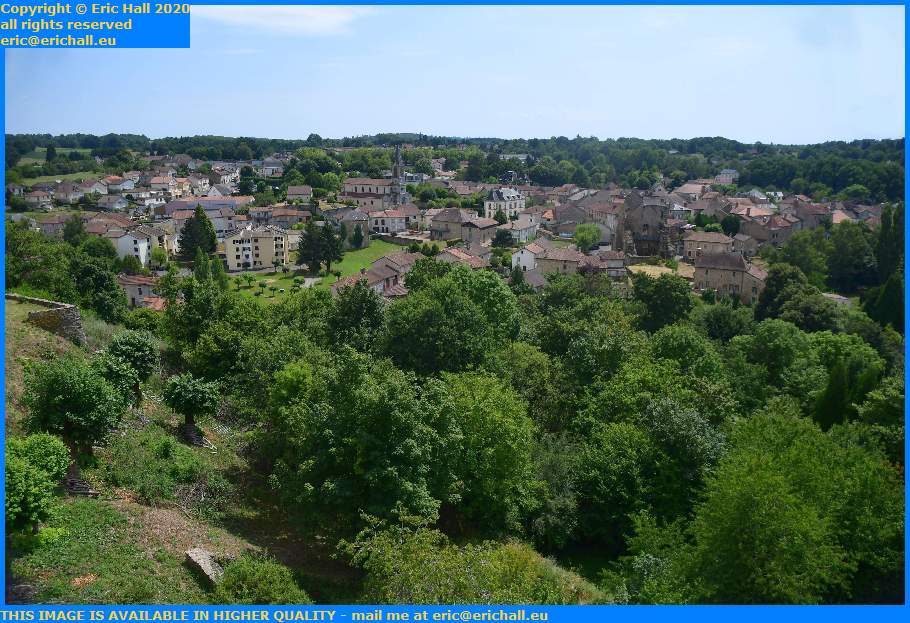
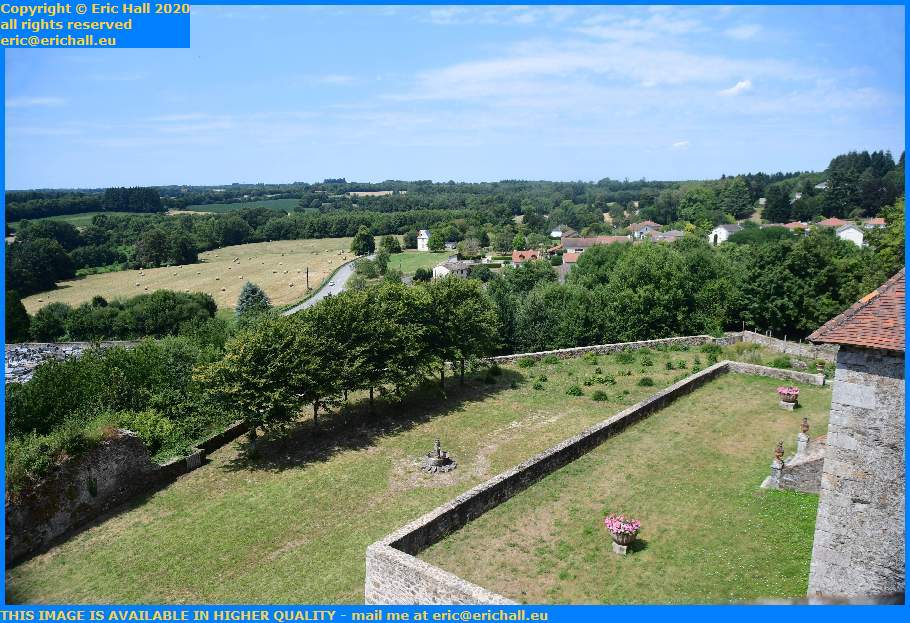
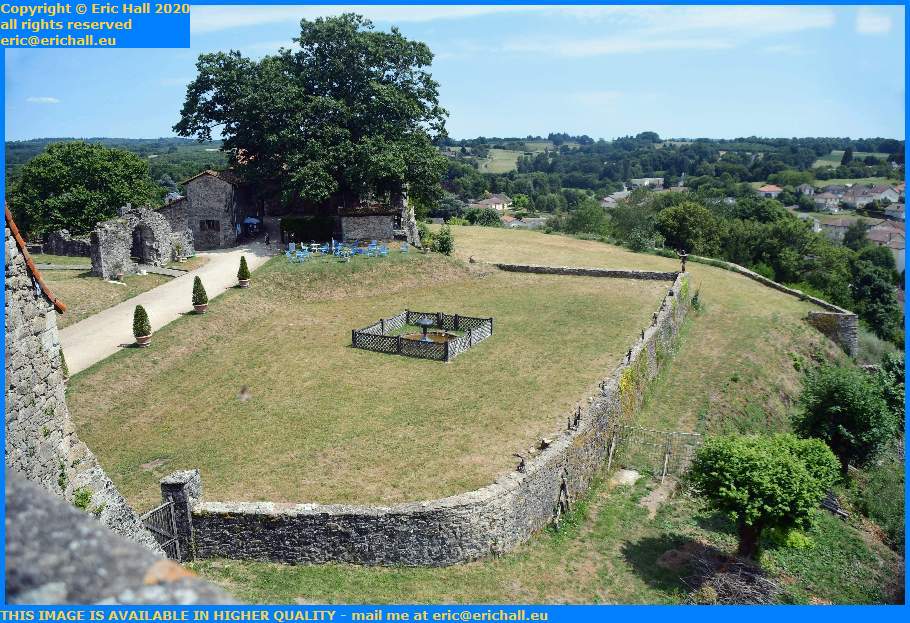 And here I am, right up on the top of the tower and you can see the excellent view from up here.
Although it might not look like it from down below, it was in fact a real fortified castle and in this photo you can see part of the old walls of the place over there on the right with the remains of a little angled tower. I imagine that the walls continued round to the left of the line of trees covering that bank just there.
Even from this height you can see how the tower of the castle commands the view of the approaches to the butte. The main road that it covers is the one in the upper centre of the image heading slightly off to the right.
But now having had a good look, I’m going back downstairs and out through the door that we saw earlier.
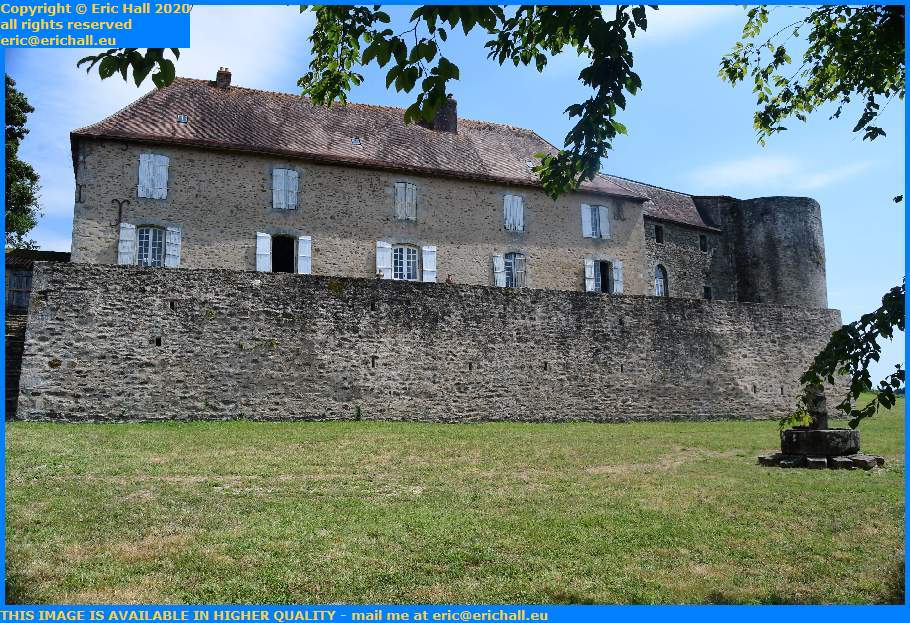 Having passed through the doorway in the tower into what I reckon may well have been the old moat, we can see the difference here between the old, original buildings and the more modern construction.
There was a part of the chateau built in the Seventeenth Century by the Bourbon-Busset family who had been the owners since 1530, and in the absence of any other information and of any other suitable candidate, I would suggest that the Hall on the left of this photo might be the more modern part.
As an aside, the Bourbon-Busset family is an illegitimate branch of the Royal House of France, the illegitimacy being due to the fact that Louis de Bourbon, cousin of King Charles VII, married without royal consent and later kept the marriage secret in order that he could become Bishop of Liege.
 And so Strawberry Moose and I climbed to the top of the main tower to see the view, which you have already seen in a few earlier photos.
And climbing to the top of the tower isn’t easy, although it’s easier than it might have been because there is one floor missing from how it was originally. That was somehow lost in the renovations of the 1960s although this might be the damage that was referred to when in 1870 there was “a fall of stones” at the chateau.
But the first obstacle that you have to overcome is the actual entry into the tower because it’s not as straightforward as it might be. The door is about 30 feet above ground and you need to climb up a rather steep ramp to enter.
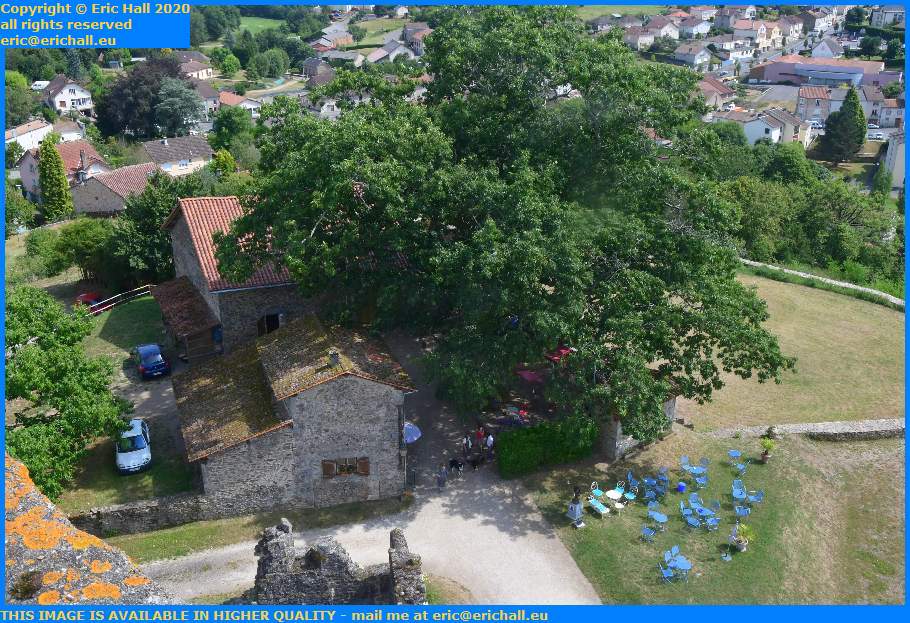 And although it might not have been as easy as that 900 years ago, I have actually seen an old drawing of the tower that seems to suggest that there was some kind of building at the side.
It’s quite possible that if this was the case, there may well have been a stone staircase inside that went up to the main door.
Once inside, it continues to be something rather challenging to reach the top.
 In certain places the original circular staircase around the inside of the outside wall. In other places the staircase is no longer there and there is some kind of ad hoc ladder arrangement to reach the floor above. It’s not for the faint-hearted.
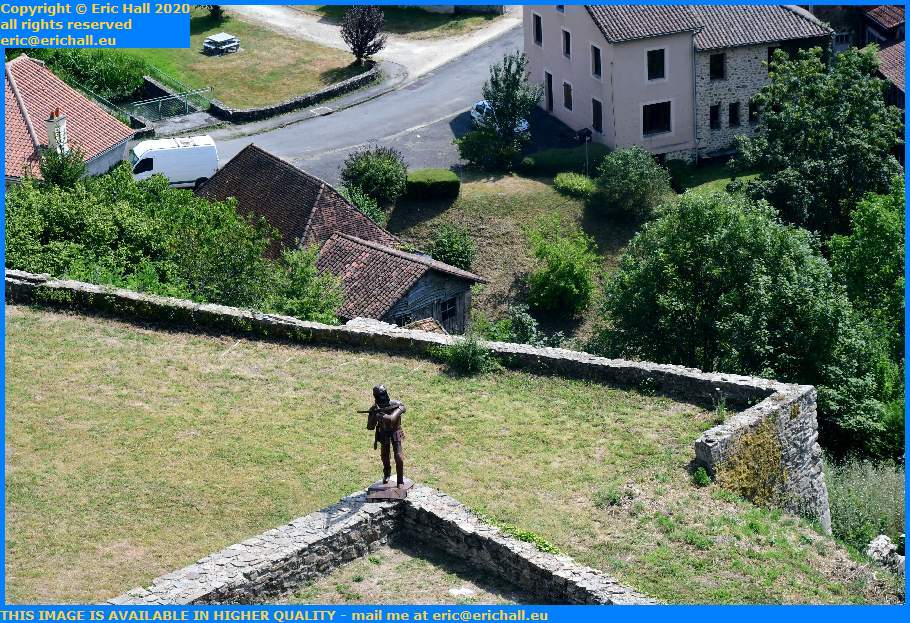
But once you do actually make it to the top, it’s well worth it because of the view. And not just of the view of the surrounding countryside either, but also because of the decorations in the garden. Like this crossbowman, for example.
The significance of this escapes me right now. But I did wonder whether it was on that spot that King Richard met his end.
 Flying from the top of the tower is this rather beautiful flag.
Unfortunately I’ve not been able to identify it – it doesn’t belong to anyone who might have had any claim over the castle so it looks as if I’ll have to leave this for a while until chance plays its hand and I spot it somewhere else where there’s a legend.
But of course, there’s always my very knowledgeable readership. It might be that one of you lot might know. if so, please contact me using the contact link bottom-right.
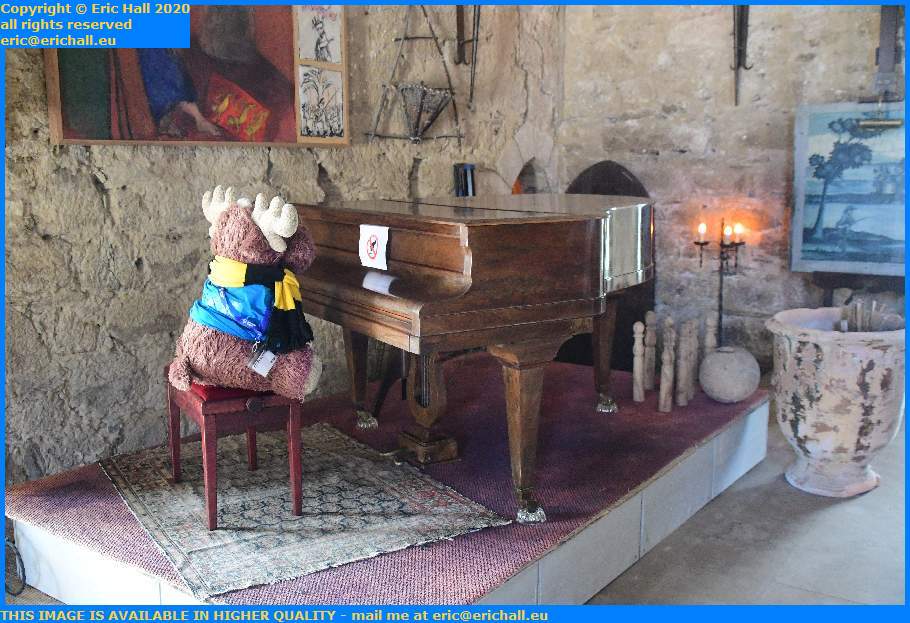 So while STRAWBERRY MOOSE entertains us with selections from the classics, I’ll tell you a little more about the subsequent history of the castle.
After a siege by soldiers from the Perigord in 1265 in which the defending captain was killed, a fine levied on the attackers enabled the chateau to be repaired. It passed to King Philip in 1306 and in 1317 he gave it to one of his advisers, Henri de Sully.
As a result of various marriages it passed through several families, including the Bourbon-Bussets whom we mentioned earlier, and also the Borgia family of Italy, the family of Cesare and Lucrezia.
During the Wars of Religion it was attacked twice, in 1569 and again in 1591 during which attack it came under artillery fire.
 As usual in a medieval fortified place, there would be a chapel or church. And the Chateau de Chalus is no exception.
What we have here is the Eglise Notre Dame – the Church of Our Lady of High Chalus. Building commenced in the 11th Century and in 1095 Gerald, Abbott of the Monastery of St Augustin of Limoges took up possession. It later became the parish church and was expanded in the 15th Century.
 Subsequently a new church, the Eglise Notre-Dame de l’Assomption was built in the village and the one here became disaffected. It gradually slipped into decay and began to fall down. A visitor who passed by in 1888 noted that there was much more of it still standing back then than there is today.
But on a happier note, what remains of the church was added to the List Of Historic Monuments on 25th March 1981
Interestingly, the entrails of Richard the Lionheart are said to be buried somewhere within the precincts of the church, although I couldn’t find out exactly where they might be.
Having left the scene, a long drive brought Strawberry Moose, Caliburn and me as far as Gueret where, due to the heat and general fatigue, we abandoned our efforts to continue.
A brief shopping excursion to LeClerc and then I installed myself in a Premier Class hotel cross the road where I had a shower to cool myself down, and washed my clothes. Internet once more very patchy so the USB-tethering came ito the fore.
Having made myself a dish of pasta and vegetables in the slow cooker, I lay on the bed and crashed out completely.
That was that.
All translations in the text from French and German have been done by me.



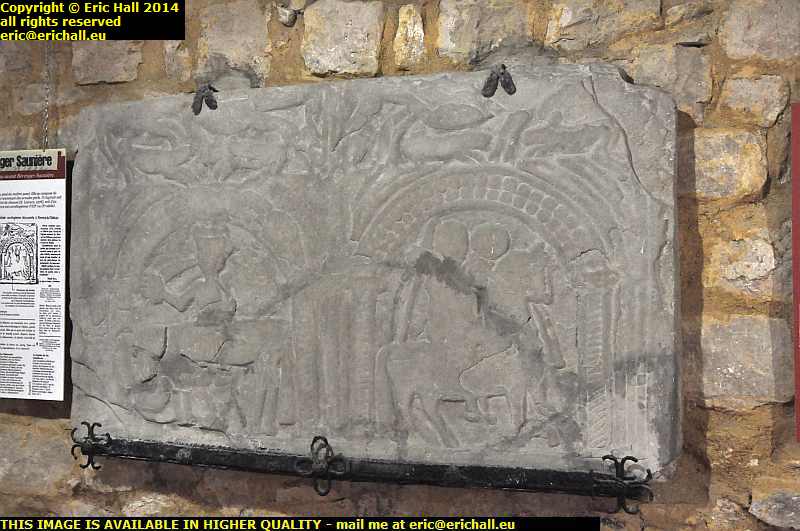







 (a copy of which is in my possession) to summarise the information gleaned from the interviews and it has become one of the most important references to life in rural France at the end of the 13th Century, adding a great deal to whatever was previously known about the subject.