Tag Archives: church

Tuesday 20th August 2019 – YET ANOTHER …

… bad night.

Not at all helped by the fact that I had to get up and go hopping around the cabin for 10 minutes to try to overcome a really bad attack of cramp in both ankles. No idea why that might be. maybe it’s because I don’t have enough salt, and watching one of the staff sprinkle salt all over his chocolate ice cream this evening and tell us all just how wonderful it is, then maybe I ought to try it too – except that I don’t eat ice cream of course..

With no rush for the morning, I was in no rush either and I was comfortably beaten by the three alarms. But it’s been weeks since I’ve had a proper Sunday lie-in and a real day of rest so I reckoned that I deserved it.

We’re now in the fjord at Ilulissat, famous for its icebergs. And there are plenty in here too. They are all ground out on the terminal moraine that’s at the entrance to the fjord and it’s only when they melt a little, when there’s a really high tide or when there’s enough force in the congestion behind them that they can pass over into the sea.

They move something like a maximum of 35 metres per day but that’s not a daily total. It’s a daily average over a period of several weeks. Sometimes they won’t move at all for days.

We went out in the zodiacs to look at the icebergs but ended up whale-watching instead as a pod of fin whales and then a pod of hump-backs decided to strut their stuff right by where we were sailing. It all gave quite a surprise to the fishermen who were hauling in their long lines with halibut.

After lunch we went to town – literally. I’ve been here before but I still like the place so Strawberry Moose and I had a nice long walk out down the boardwalk to look at the ice congestion in the fjord. It really is so spectacular.

And much to my surprise I could remember the short-cut back home again.

There’s a museum in town – the birthplace of Knud Rasmussen, who probably just about beats Vilhjalmur Stefansson to the title of “Last of the Famous Polar Explorers”, so I went in there to have a look around. It was extremely interesting to me, and His Nibs found a couple of photo opportunities there.

There is an old church in the town too so on the way back to the ship I took myself over there to see it. It looked quite interesting too but it was locked up so it wasn’t possible for me to go in to inspect it.

While we’d been down at the boardwalk another cruise ship had come in. It was the MSC Orchestra with a capacity of 3200 passengers.

Watching them try to unload with a series of lighters and tenders was amusing – the weight of 240 passengers at a time on the jetty was causing it to sink below the waterline and they were wetting their shoes. They had gazebos to protect the poor dears from the sun (in the High Arctic!), all of that, and an endless procession of guides.

But 3200 visitors in a town of about 4500 is impossible, and the situation at the boardwalk must have been ridiculous.

On arriving back on board The Good Ship Ve … errr … Ocean Endeavour I had a good shower and clothes wash, and then carried on the photos while we had the debriefing. And I fell asleep too.

After tea I went up to the top deck lounge and carried on with the photos until fatigue brought me back down again. I’ve now reached 19080553 from the late afternoon of 8th August. Still tons to get through but I’ll just have to keep on trucking, won’t I.

But not tonight. I’m off to bed.

Sunday 21st July 2019 – SO THAT’S ANOTHER …

… place crossed off my bucket list. And it’s been a long time coming too. But today I finally made it to Brattahlid, the home of Eric the Red and his son “lucky” Lief Ericson

But putting things into the correct order, I didn’t have my decent sleep last night unfortunately.

As seems to be par for the course these days I awoke at 04:05 for a trip down the corridor and again at about 05:55. However it was once more a struggle to leave the bed.

Outside, the weather is cloudy and misty with a lot of dampness in the air, almost raining. But then of course this is the south-west coast of Greenland. What was I expecting?

Breakfast was another early start today and I had once more to do without my medication seeing as we were leaving the ship almost immediately. A quite pleasant ride took us to the landing stage of a small modern settlement called Qassiarsuk which was all sleepy and closed up, seeing as it was some kind of unearthly hour on a Sunday morning.

We walked past a farm – one of the earliest modern sheep farms in Greenland, founded in 1924 – and then out into the countryside to a pleasant bowl in the hillside. The first thing that we encountered, opposite the modern church, was a small turf outline which, having been excavated in the past, was revealed to be a very small church dating back approximately 1000 years.

And that was quite an interesting find.

It is well-known that whilst Eric the Red did not embrace Christianity, his wife Thjodhild did. And there is a record of her insisting on having her own church built – the Þjóðhildarkirkja or Thjodhildarkirkja – at Brattahlid. The dimensions of this church, its timescale and the site of this turf outline as described in the sagas corresponds with what we know about her church.

A little further on are some quite substantial remains of a rather large stone church. Not as complete as the church at Hvalsey but substantial nevertheless. And it’s a big place too, as you might expect from Brattahlid, because this was one of the most important communities in Norse Greenland.

Close by are the remains and sites of several large stone buildings that were presumably storage rooms of some nature and also some smaller stone walls that might have been sheep folds.

There were also the foundations of a substantial stone dwelling house which are such that would appear to relate to a very important personage. As there wouldn’t be more than one such person in any community, this is believed to be the likely site of the homestead of Eric the Red.

All together, there are over 30 Norse sites in the immediate vicinity but many of them have been disturbed by more modern buildings or by agriculture. The ones by the church are the most clearly defined and complete.

Eric the Red took a couple of years to cruise along the Greenland coast to find the best possible place for his settlement and indeed his own home. The richness of the area here and the number of Norse sites are a testament to the wisdom of his choice.

As well as the Norse remains there are the remains of several Inuit beehive houses, and also a more modern reconstruction which looks as if it is about to suffer the fate of its predecessors.

Farther on still are a reconstruction of Thjodhild’s church as well as a modern reconstruction of a Norse longhouse. In the immediate vicinity was another outline in the soil that corresponds with the size and shape of yet another longhouse.

We had a good prowl around the site, finding several good viewpoints from which to take photographs, and I climbed right up to the hill overlooking the fjord where they erected in more modern times a statue of Lief Ericson. From here the view was even more impressive and we could clearly see several layers of raised beaches, showing just how much isostatic rebounding there has been.

Of course, I was not alone on my travels. I was accompanied by Strawberry Moose, complete with Viking helmet, who had several photo opportunities.

Interestingly, in the distance I could two barns or storehouses that belonged to the farm of 1924. These, as well as the base of the house of the farmer, were made of local dressed stone. There is no record of any stonemason being in the area at this time, so it might be that these stones were pillaged from the Norse site in the days when conservation was of little importance.

Back on the ship we had lunch, and then I went down to my room where I crashed out for an hour or so.

This afternoon we were all on the aft deck in the glorious sunshine, watching the world, the scenery, the fjords and the icebergs go by, until about 17:00 when it became too cold.

And that reminds me of something. I’ve learnt a new way of describing distance. In Europe, we would say that someone lived, say, 2 miles away. In North America, you would say, say, 2 hours away. But Tupaarnaq, our Greenlander guide told us that her uncle lived “two fjords away”. I shall have to remember that one.

After tea, our host Dave Newland performed a few songs off his latest album. He’s actually a folk singer and his songs are all about the High Arctic. It made me quite nostalgic.

But now it’s bed time. There’s yet another early start in the morning and I can’t afford to hang about any longer if I want a decent night’s sleep.

It goes without saying that I’m really happy that I made it to Hvalsey yesterday and to Brattahlid today, but just 10 miles across the bay is the Norse settlement of Gardar – the site of the cathedral and centre of Christianity in the Norse settlements in Greenland. And we didn’t have the time to go there.

I shall just have to come back!

Saturday 20th July 2019 – HVALSEY!!!!

Today was a really exciting day in which a great deal was accomplished. Another one of my lifetime destinations has been reached.

But it wasn’t quite like that at the start. I awoke, just for a change, at 05:00 and couldn’t go back off to sleep. But that’s not to say that I was up and about very lively. I did manage to beat the third alarm but only just, and staggered into an early breakfast looking something like the Death of Nelson. I’m not feeling myself these days which is just as well, because it’s a disgusting habit.

After breakfast I went back to my room and relaxed for a very short while before we were called to the boats, and then we set off for Hvalso.

Hvalso is better-known by its Norse name – Hvalsey – and is internationally famous as having probably the best-preserved Norse ruins in North America. It’s long-been my ambition to come here and this is probably one of the main reasons why I’m here on this voyage.

There are the remains of a magnificent stone house with all of the outbuildings and other offices. No-one can really tell the date of when it was first constructed but it was expanded over a period of several centuries culminating in some work as late as the very early 15th Century, towards the very end of the Norse settlement in Greenland.

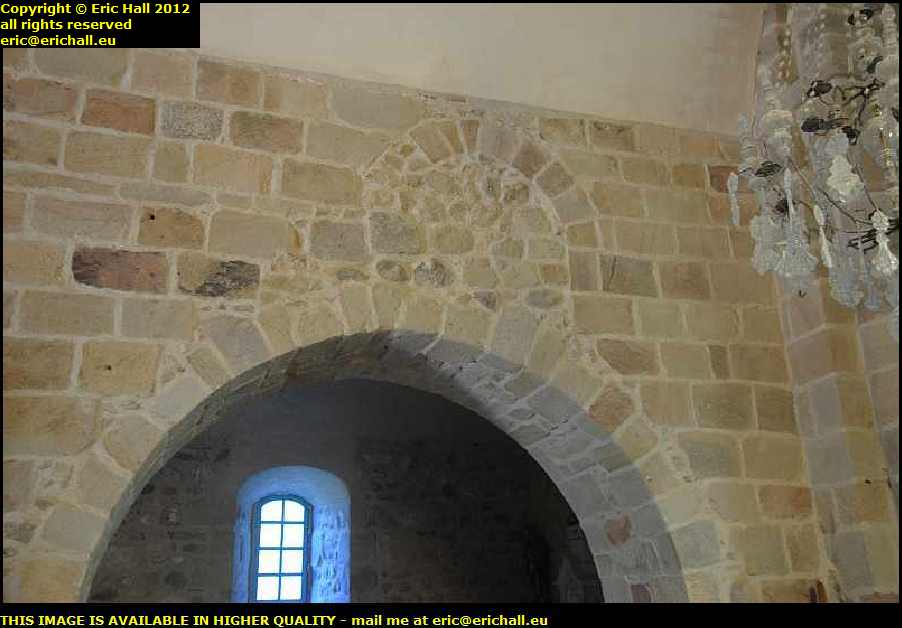
Not only that, there are the remains of a magnificent Norse church from maybe the 13th Century and which are quite intact considering that it has been abandoned for 6 centuries or so. Highlight of the church though is an incredible arched window of a type that I have never seen before in Norse architecture. I had no idea that they knew the principle of arches and keystones. And what is more, it is still intact and that is even more of a surprise.

Another claim to fame is that the last written event in Norse Greenland took place here. The Norse here were never very into writing so written records are … errr … scant. But in 1408 here is a record of a wedding that took place in the church between a local girl and an Icelandic man. And after that, there is no written word that ever came out of Greenland until the 18th Century and a new breed of settlers.

The fate of the Norse is unknown and any suggestion is mere speculation. However we can rule out that they returned to Iceland or Norway despite what some people suggest. While it’s certainly true that some did – the husband at the wedding was recorded as being in Iceland a couple of years later – they would not have sent out search parties to Greenland during the next few centuries to look for any Norse survivors had they all returned to Iceland or Norway.

And suggestions that they returned because of land inheritances in the rest of Norse Europe becoming more available after the Black Death is quite clearly absurd when you consider that the Black Death took place 70 years (or three generations) previously.

And even if that were the case, it’s by no means certain that every last man or woman would leave. We’ve seen for ourselves that when the Inuit at Grise Fiord were offered the chance to return to their homeland after just 20 or so years and leave the desperately inhospitable environment of Ellesmere island, a great many of them chose to cling on.

The church here at Hvalsey was built on the site of an earlier, smaller church and one of the walls was built over part of the old graveyard. Consequently as the bodies rotted away and the graves caved in, the wall on that side sagged dangerously but has now been stabilised.

While I was there I took the opportunity to go for a wander around with the geologist. I’d been attracted to the fact that in the walls of the church were several blocks of pink granite, quite unlike the main stone in the area, that has been so well-cut that there was not a single tool mark upon them. The general opinion, from our archaeologist that they had been cut by hand seemed most unlikely to me.

However, we soon found what we had been looking for. Not too far away, a bed of granite had at some time infiltrated the metamorphic rock and at one point there was a twin-fault line that passed right through it. The granite had been cleaved by Nature on both sides to absolute perfection and there was clear evidence that some of this rock had been removed.

So that answered my question far more easily than I had imagined. My opinion of this archaeologist is going downhill quite rapidly, as regular readers of this rubbish will recall.

We also had a kind-of stone corral for horses, several foundations that looked as if they might have base of medieval tithe-barns and warehouses, and a load of stone walls, clearly man-made but using some of the heaviest stones that you could imagine.

There was also something that looked very much like an Inuit grave or cache but this was disputed, and Nature had provided the site with all kinds of wild herbs that would have been a boon to any Norse chef.

One thing that Yours Truly uncovered that had been missed by the excavators of the site was some writing chiseled into the lintel over the doorway into the church. Anyone who knows anything about European architecture of the middle period of the Second Millennium will know that builders had a habit of carving the date into the lintel. That was what I had been looking for.

But as for what the writing might be, It seemed to be something like …CLL … and the rest was covered in a heavy growth of lichen that was clearly the original growth. Obviously it’s against the Law to scrape away any of the lichen so I shall have to leave that to the experts. But it doesn’t seem to suggest any kind of Roman numeral that I might be able to identify

While all of this was going on, we were overflown by an eagle. And there was a fisherman out there catching the cod that were leaping about all over the place. It was all quite lively. What wasn’t lively though was the farm further down the valley. Greenland has 37 farms, of which 35 are working. However this one is one of the two that isn’t. It ceased operation in 2006 when the owner retired and it was bought by people who use it just as a weekend retreat.

Back on the ship and lunch, by which time we had sailed to the town of Qaqortoq. This is the largest town in south Greenland, with about 3,000 inhabitants and our stop for this afternoon.

A guide took us around the town on a guided tour and showed us the sights. We were walking around for about 90 minutes and saw plenty of things, but nothing that I would call “startling”, except for the only public fountain in Greenland.

Somewhere round by the river we fell in with a couple of little girls aged about 7 or 8 or something. They were proudly displaying a bottle in which were several tiny little fish about an inch or so long. Obviously following in the Inuit traditions There were some young teenage boys leaping off a high cliff into a freezing cold lake. Rather them than me.

We finished up in the modern church, built in 1973, and had a tour around the local supermarket to see the prices in there. Not quite as outrageous as I was expecting compared to Northern Greenland.

The museums were interesting, especially the Norse museum where there were remarks that seem to confirm some of my ideas, and then we went for a coffee at the local hotel.

A little later, I took Strawberry Moose for a walk around the town and for a few photo opportunities, which he enjoyed immensely.

Tea tonight was a vegetable biryani which was probably among the best that I have ever eaten. It was totally delicious although I would have liked it to be more spicy, as you might expect. I can’t be doing with this North American idea of spicy food.

In the evening, while everyone was watching a film, I was typing my notes when Ben the Chef came over for a chat. A huge mountain of a man he was born in Brisbane but came to the UK when he was 3 and lived in Liphook and then in Wiltshire. We chatted about quite a few things for quite some time.

He told me that one day soon we are to have a banquet of local delicacies. He had been ashore today and bought a load of whale meat and things like that for us to try. And when I say “us”, I don’t mean that I will be participating. It all sounds pretty revolting to me and anyway I’m a vegan, as regular readers of this rubbish will recall.

So I’m now off to bed. No chance of an early night with so much going on, but I’d be happy if I could just sleep through until when the alarm goes off. One of these days I might just manage it, but I’m not holding my breath.

Sunday 14th July 2019 – THIS MORNING …

… we walked all the way from the harbour at Reykjavik right the way through the city and out the other side, and up the hill to the big new modern church that towers above the place.

When we eventually arrived there we were greeted by a burly man standing cross-armed blocking the doorway, with the air of “none shall pass” as in Monty Python and the Holy Grail
“Why not?” asked Our Hero
“Because there’s a Mass going on. And you won’t understand it either because it’s in Icelandic so come back in an hour!”

Yes, it’s Sunday of course and I had completely forgotten.

Last night I had had a terrible night’s (lack of) sleep, probably one of the worst that I have had for quite a while. In fact so much so that I found myself on one occasion dictating the same dream twice. I’m clearly losing my marbles – not that I had too many in the first place.

Despite all of my exertions I did actually make it up (just) before the first alarm and staggered once more out on deck to take a couple of photos of Reykjavik in the rain. because the weather has now broken.

We had an early breakfast and then because we aren’t amongst the hordes saying goodbye to the ship today we had an hour or so free time. I spent my hour or so in the horizontal position on the bed and enjoyed every minute of what I remembered about it. Which wasn’t much.

At 09:00 we went out across the road to the café in the Flea Market where we were assured of a good wi-fi connection. And a good wi-fi connection it was too and we spent quite some time checking up on things, including the latest chaos in the UK.

Later, Rosemary wanted to go shopping for some presents for her friends so we headed off into town, looking at a few shops on the way, in one of which she bought a few winter woollies. After all, Iceland is the place to come for those.

There was the church of course, as I mentioned earlier, and then a walk down to the waterfront and back along the shore to the ship for lunch.

Grabbing Strawberry Moose we made our way back into town after lunch. We had had to wait for a while to give the rainstorm time to die down, so we didn’t have as much time as we would have liked.

The flea market was now open so we had a look around, and Rosemary tried some dried cod. A few more shops and a few more presents, and a couple of photo opportunities for His Nibs.

By now the rain was coming down in torrents so we fled back to the ship. All of our new co-voyagers were waiting to board but we didn’t hang about. We just charged through them and up the gangway onto The Good Ship Ve … errr … Ocean Endeavour.

First thing that I did was to dive into the shower, taking a handful of clothes in with me. I needed a good scrub up and I have to keep on top of the laundry for I have a long way to go.

And then we had all of the briefings that I have sat through on innumerable occasions followed by the mandatory lifeboat drill. And in the time that it took to organise the drill we would have all disappeared beneath the waves a good while ago had we really been in trouble.

For tea we made the acquaintance of a couple from Edinburgh in Scotland on their first voyage. The husband had visited Greenland many years ago so he’s in for a bit of a shock when he gets back there.

After tea we had a tea and a chat, but it’s an early start tomorrow so we decided to retire early.

And I can’t say that I’m sorry. The pace is now going to heat up considerably.

Saturday 3rd December 2016 – AND IF YOU THINK …

… that the last couple of nights were bad, you ain’t seen nuffink yet. Because there I was, it was 06:30, and I was still wide-awake. I just couldn’t drop off at all, and I’ve no idea why.

But I must have done shortly after that. And I heard the alarm go off at 07:00, and the next one at 07:15, but that was nothing like enough to make me leave my bed. Instead, I breakfasted at something like … errr … 10:30.

vegan cooking van leuven market belgium october octobre 2016I was up in town a little later to buy some stuff for my butties. And here I had a big surprise.

There was a new van on there and it seemed to be advertising home bakery products, including bio, lactose-free, gluten-free and vegan products.

I had quite a chat with the owner and he pointed out to me the products that he had which were vegan. There were two varieties of cake that you buy by the slice and some biscuits too. That was so exciting.

He’s here every Saturday so I shall be frequenting him when I come back.

After lunch, I had a shower and a clean up ready for Alison coming round. We went down the road to the café for a coffee and a good chat about this and that, all that’s happened to us for the last couple of weeks.

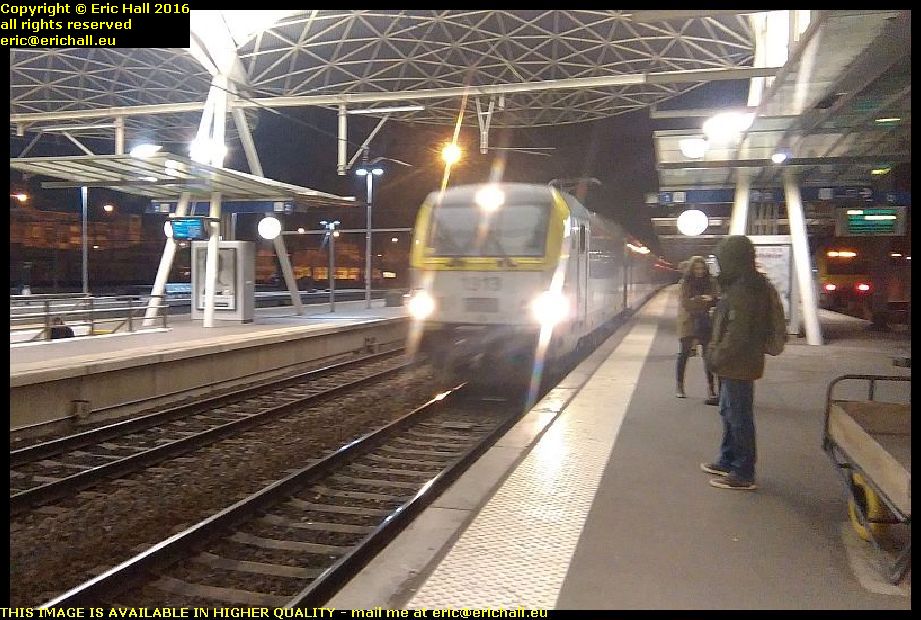
train railway station leuven belgium october octobre 2016Alison ran me down to the railway station afterwards where I bought my ticket.

OH Leuven are playing away tonight against AFC Tubize. Tubize is a town that I have never visted and of course I’ve certainly never seen the football club play. Apart from that, as I said to Alison, I ought to get out more often and connect with the real word every now and again, and going to the football is one way of doing it.

The ground is a good 20 minute stroll south of the railway station and, would you believe it, there’s no fritkot between the town centre and the ground that I could see. That meant that I had to do without my tea. But isn’t that astonishing?

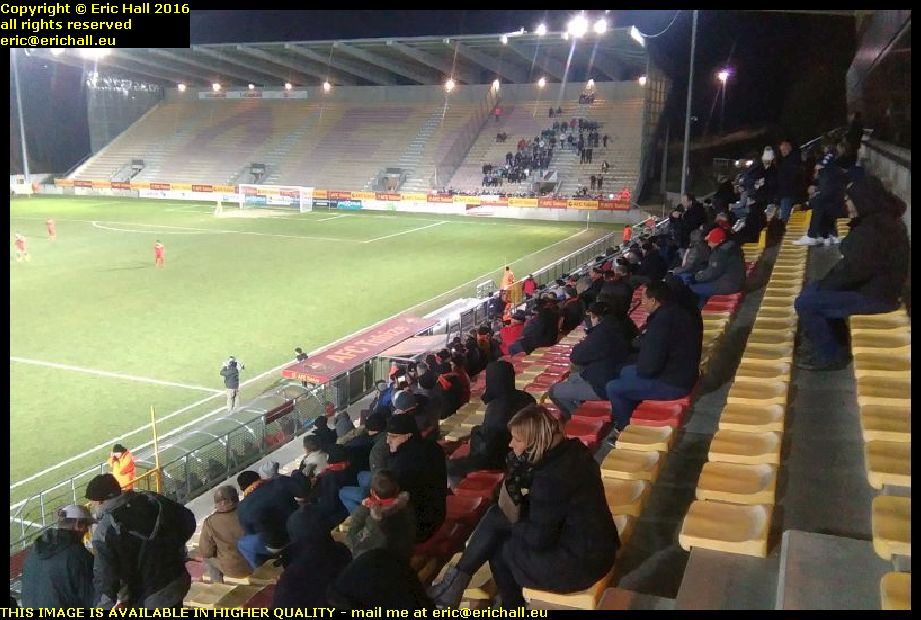
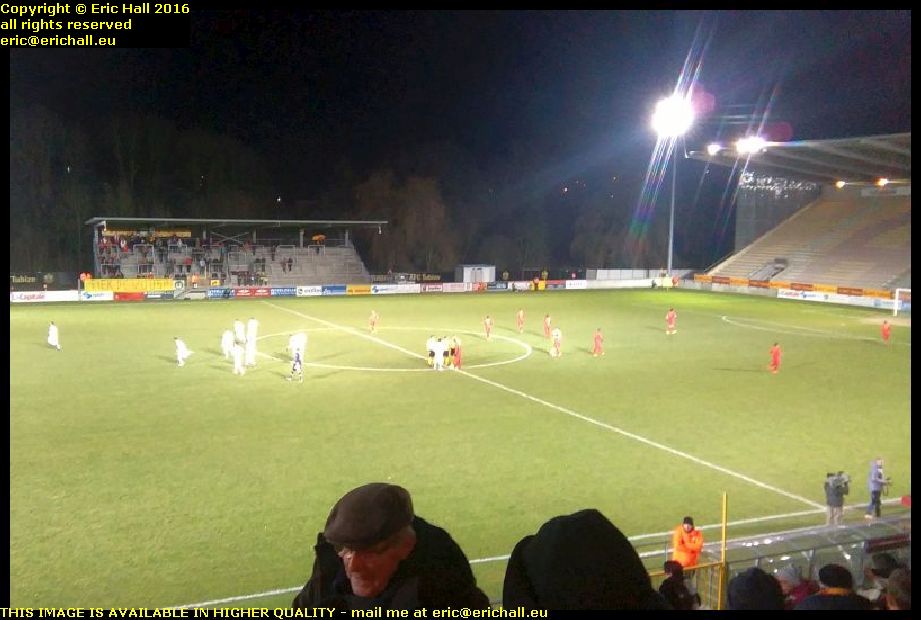
stade leburton afc tubize belgium october octobre 2016The ground is a modern two-sided wonder with a couple of concrete stands with basic seat forms put on there. Underneath the stand where I’m sitting is a long hall with a pie hut inside and the players’ changing rooms and the like. It’s all very basic.

It cst me €15 for a seat which wasn’t so bad, but actually finding my place was something else. The security guards clearly didn’t know the stadium all that well and I was sent from pillar to post before I found the correct entrance.

stade leburton afc tubize belgium october octobre 2016I suppose that a good number of other people had difficulty finding the ground too, because I don’t think that I’ve ever seen such an empty stadium at this level of football. At a rough estimate of what I could see, there can’t have been 1500 people in the ground for this match. 100 away supporters if they were lucky.

The Kop for the home fans is a little standing area on the far side -capacity about 500 I suppose and maybe 120 people in it. They made a bit of noise I suppose, but it wasn’t anything to be worked up about.

stade leburton afc tubize belgium october octobre 2016There’s another small stand behind the goal, out of shot to the left. That maybe has room for 700 people I suppose but it was empty and closed off.

It’s not quite a one-sided wonder that you might find in Scottish lower-league football but it’s not far off. One of those places where they set out with the best intentions and then ran out of money.

As for the match itself, the first half was pretty uneventful. Both sides had their chances, including a shot from an AFC Tubize player that hit the post, rolled along the goal-line and back into play, with Gillekens in the Leuven goal totally flat-footed.

But there were a few strange decisions out there. The OH Leuven n°10 was being kicked, pushed, dragged and swatted off the ball by the defenders and never a foul was awarded despite how much protesting he did; It totally astonished me.

And when he was booked for complaining too much, I really did feel for him.

At half-time, I went down for a hot drink. I dunno what they flavoured my hot water with, but at €2:00 it was flaming expensive

The second half was a little more lively at first, and OH Leuven took the lead. They have a centre-forward called Casagolda who somehow has always flattered to deceive. But today, he had a really good game, living up to his promise. as a Tubize player dallied on the ball à la Pionsat defence, ha was harried out of it and Casagolda whacked it into the net.

The game them came alive and we had about 25 minutes of exciting football and it was a shame that the match couldn’t have been played like this all the time.

OH Leuven scored a second with about 15 minutes to go, and they hit the bar and had another cleared off the line too. As it finished, they thoroughly deserved the victory.

I walked back into town looking for a fritkot. I photo-bombed a group photo and so was invited to be formally included in it, which was good fun, and then carried on my search.

eglise st gertrude church tubize belgium october octobre 2016I walked past the really beautiful Church of St Gertrude and eventually came across a fritkot on the way out of town. a big bag of chips and garlic sauce was beautiful and as I sauntered back to the railway station I noticed that if I had come out of the station building via the second door, I would have been right by a fritkot.

GRRRRR!

The train brought me to Brussels-Midi and then we had more excitement as our train to Leuven via the Airport arrived at the wrong platform and we all had to run for it.

By 0045, freezing cold, I was back in my little room in my hostel. I’d had a lovely day out with good company, and now I’ll have a good night’s sleep ready for my trip tomorrow.

Tuesday October 8th 2013 – HAPPY SILVER WEDDING ANNIVERSARY.

Yes, it’s my silver wedding anniversary today – 25 years of marriage. And the fact that I haven’t seen my wife since 1994 doesn’t change a thing – it’s still the silver wedding anniversary and so happy anniversary to me, and to you too. And this of course does remind me – not so long ago someone, who really wasn’t au fait with the situation really did ask me if I talked to Nerina while I was making love. My reply was that it all depended upon whether or not I could reach the telephone.

So how did I celebrate it, you may well ask. Not like Alan Shearer who, all those years ago, celebrated winning the Cup Final by going home and creosoting the shed, I woke up at 02:00 exactly after crashing out last night. 02:00 in Greece is exactly the same time as 00:00 in the UK and that must be the purest of pure coincidences.

Being unable to go back to sleep, I did some work on the computer, worked on one of the Rock Music programmes that I do for Radio Anglais, and then emptied all of my bags and suitcases and weeded out the tubbish. And found, to my dismay, that while I had brought back my winter coat as well as my winter fleece, having resolved to leave one of them behind in Montreal, I’ve also somehow managed to leave behind all of my clothes. All I have is what I’m wearing plus the clothes that I was wearing up until I had my shower at Crown Point the other evening. That called for a clothes-washing session under the shower at 05:00, which wouldn’t have been so bad had I remembered to bring back the washing soap.

I’ve also managed to forget to bring back all of the SD cards for the computer, which is annoying to say the least. I can’t even think where they might be because I did sort through the boxes before I put them away in my storage unit, and they didn’t come to light there. So I dunno.

sunrise agkistri Saronic Gulf, upon which Piraeus is situated greeceTrixi had us all outside to watch the sunrise over Aegina and then we started the yoga. Trixi teaches Dru Yoga, not that I know anything about it, but I was surprised that some of the relaxation and de-stressing techniques that I have been using for years are mirrored in Yoga (which is probably why they work) and so I wasn’t actually far behind the rest of the group.

That took us up to 09:00 and breakfast, and then following a relaxation, we had our singing sessions from 11:30 until 13:00. I don’t care what anyone else says – I still sing like a vache espagnole and I always will, but it’s why I’m here and it’s why I’ve paid for this course so I ought to have my money’s worth.

church agkistri Saronic Gulf, upon which Piraeus is situated greeceWhile everyone else was at lunch I went for a walk around the little town to look at the scenery and the buildings. I found a bakery and bought a small loaf, and also a tomato from over the road in the greengrocer’s. Sitting on the beach and eating the bread and tomato was a good way to enjoy the sun.

Back at our lodgings everyone else was in the water swimming but I’m having to forego that pleasure. The sea bed at the shore shore is full of sea urchins this time of year and with not having any footwear for the water, it would be extremely painful to step on an urchin.

Another Yoga session was from 17:30 until 19:00, followed by dinner. And I’m being looked after really well by the chef (also called Eric). Trixi and I and one or two others sat up until all hours in the evening chatting about old times. After all, I first met Trixi … errrr … 48 years ago when she had this gorgeous long hair way down past her waist and until a chance meeting last November, I hadn’t seen her since 1972.

Sunday 23rd September 2013 – AFTER THE DEBACLE …

… that was yesterday, and being still awake at 05:30, it’s no surprise whatever that I had something of a late start this morning.

And the … errr …. 11:30 start meant that the day was over before it had really begun.

I had to be at Marianne’s at 13:00 to set up the stage for this show that started at 16:00. so there was no time to do anything else.

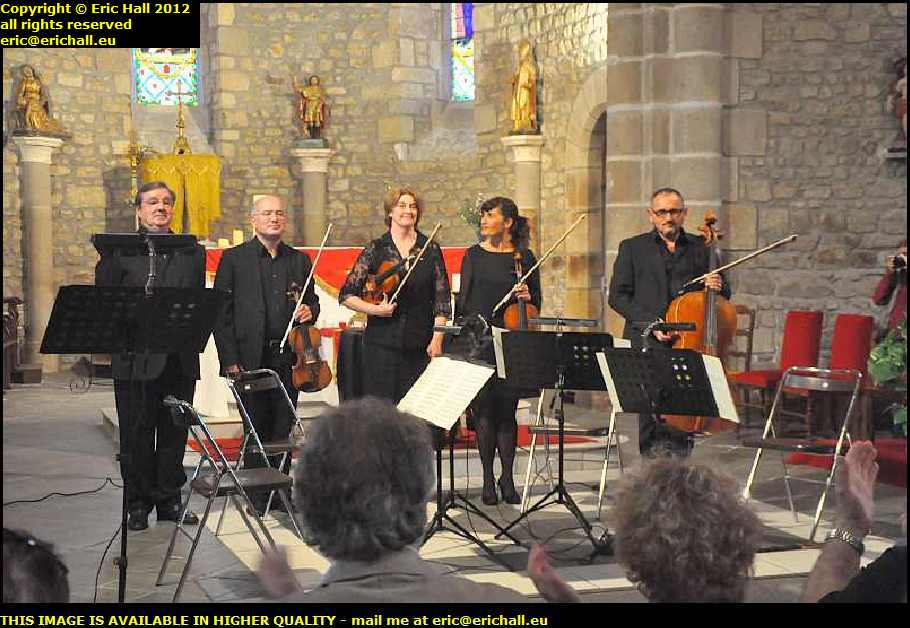
Die sieben letzten Worte unseres Erlösers am Kreuze haydn concert church of st bravy pionsat puy de dome franceSetting up of the equipment didn’t take all that long and after the sound check we settled back to listen the music.

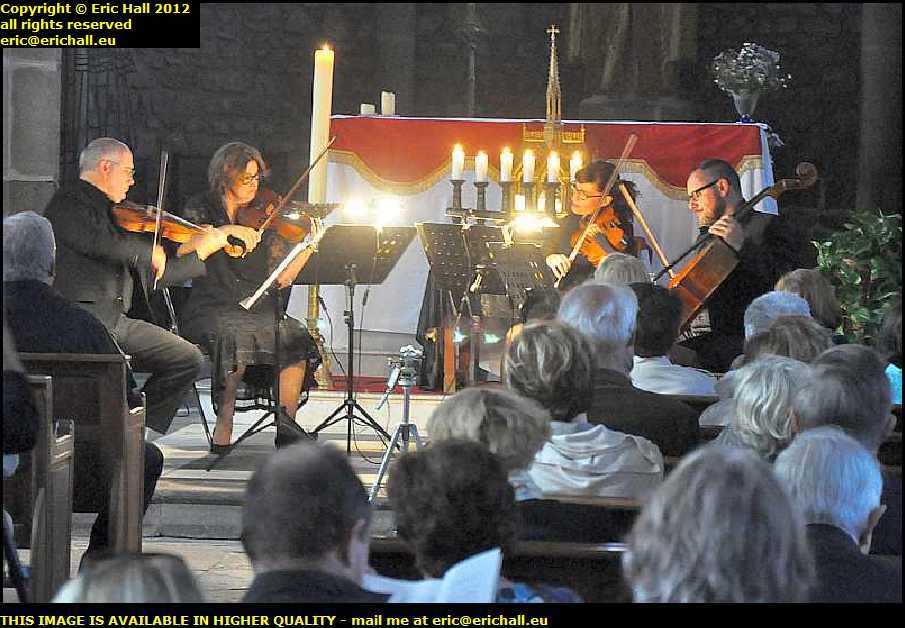
We were being treated to a concert of Haydn’s Die sieben letzten Worte unseres Erlösers am Kreuze – “The_Seven_Last_Words_of_Christ” – with three violins and a ‘cello.

As you know, it’s not my type of music but even I can recognise quality when I hear it.

Die sieben letzten Worte unseres Erlösers am Kreuze haydn concert church of st bravy pionsat puy de dome franceI would rather have a different kind of music as you know, but as I have said before … "and on many occasions too" – ed … around here, you have to take whatever entertainment that is offered, wherever, and whenever you can find it.

The musicians were extremely professional and very well-rehearsed. They certainly gave the music a good haydn. The packed crowd in the church certainly appreciated the performance too.

It all made for an extremely enjoyable afternoon, I have to say

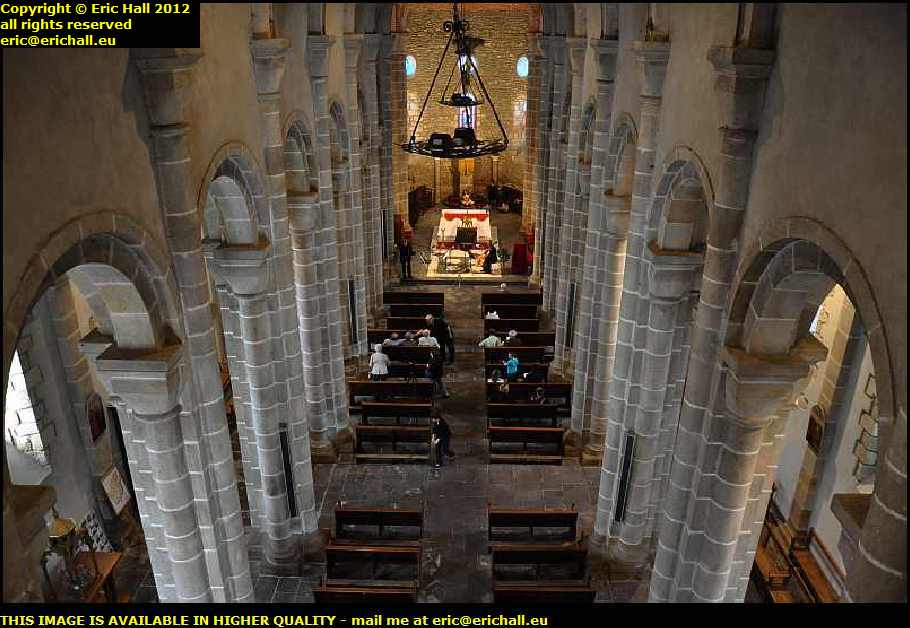
Die sieben letzten Worte unseres Erlösers am Kreuze haydn concert church of st bravy pionsat puy de dome franceWith having set up the sound quite quickly, it gave me a god opportunity to have a look around the church.

Of course I’ve been here before, but I’ve never had much of an opportunity to go for a good prowl around.

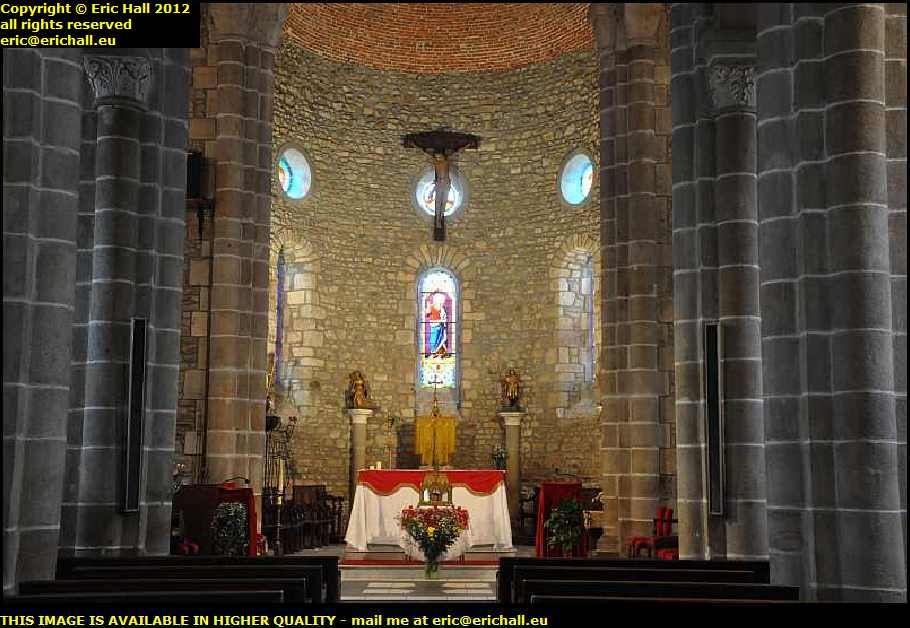
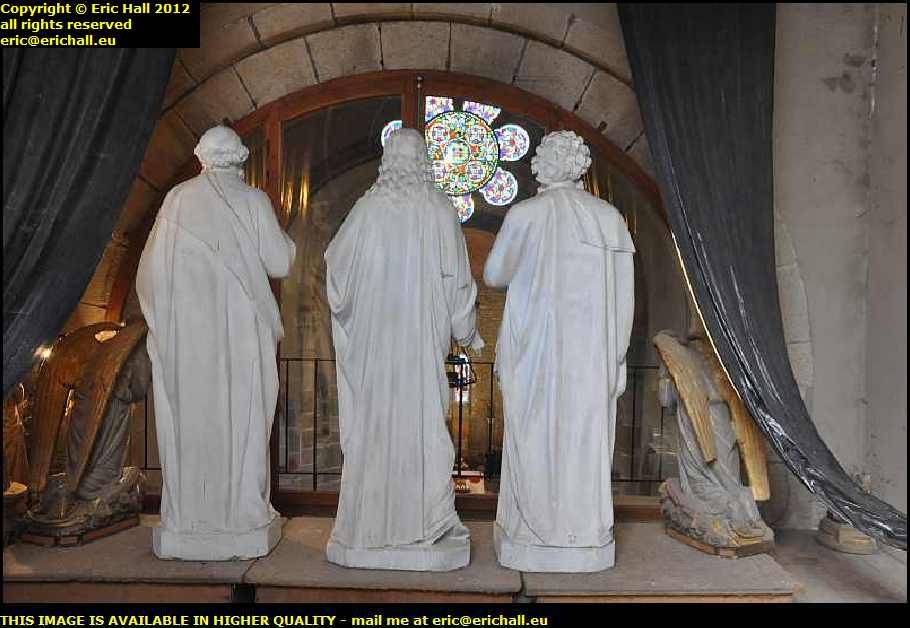
And I’m glad that I did, because for a modern church (built in 1888 which is new for around here), it is surprisingly interesting and there’s a lot to see.

Die sieben letzten Worte unseres Erlösers am Kreuze haydn concert church of st bravy pionsat puy de dome franceThe thing that you’ll notice about this church is that it is not aligned in the more-traditional east-west direction. And there’s a reason for this.

This isn’t the original site of the church – that can be found across the square near where the steps down to the old market place are.

The church that was there was disaffected, like all churches were, during the French Revolution. It was used as a store for saltpetre.

Die sieben letzten Worte unseres Erlösers am Kreuze haydn concert church of st bravy pionsat puy de dome franceSaltpetre is however extremely corrosive and during a survey of the structural stability of the church some years later, they discovered that the saltpetre had eaten away all of the structure of the church and it was totally unsafe.

Not only had the church to be demolished immediately, they couldn’t rebuilt on the same site. The site where the church might be found today was the only empty plot of land in the centre of the town, and so they had to build the church around the plot, not the other way around.

Die sieben letzten Worte unseres Erlösers am Kreuze haydn concert church of st bravy pionsat puy de dome franceEven more interesting was the fact that it was the feast of St Bravy

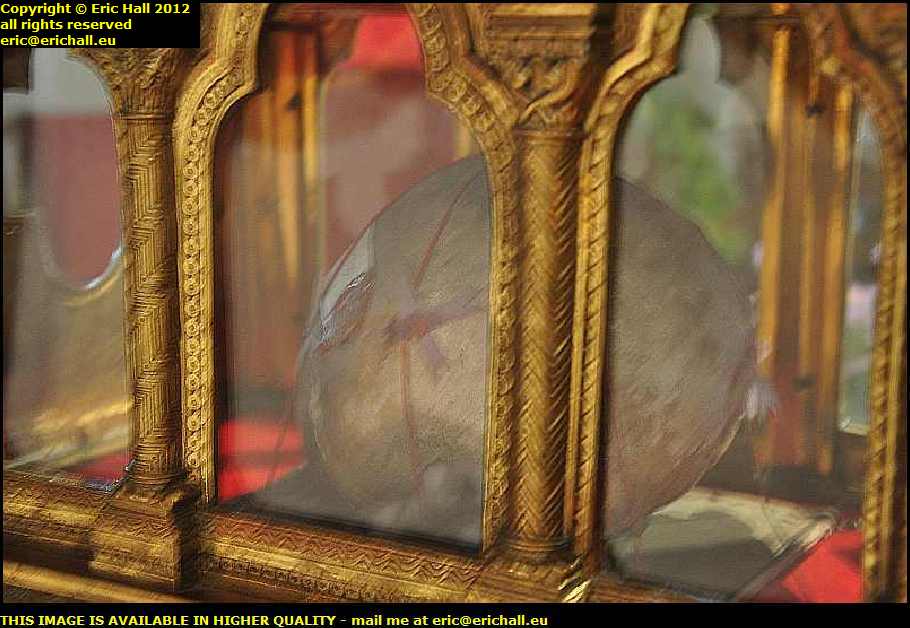
He was an abbott on the 8th Century and is the patron saint of the church. And with it being his feast day, his skull, one of the relics of the church, was actually on display for all to see.

This led to one of these fascinating conversations that only ever happen once in a lifetime
Marianne – “it’s a very small skull, don’t you think?”
Our hero – “it’s probably the skull of St Bravy when he was a small child”.

Radio rehearsing came next with Liz, and a lovely stuffed courgette meal later, back here to carry on working.

Printing out the notes for tomorrow produced nothing at all and as I’m too tired right now to do anything about it, I changed the font colour to blue and now I have blue notes. I’ll have to look at this black ink cartridge when I feel more like it.

Right now I need to sort out some music for our radio programmes tomorrow if I can manage to stay awake, and then I’ll be off to bed.

I just hope that I remember to wake up.

Friday 10th August 2012 – I DIDN’T DO …

… anything like as much as I wanted to do today, which was something of a disappointment.

We started off on the wrong foot when I telephoned Nikon to see how they were progressing with the repairs to the Nikon D5000. Seems that they didn’t receive the authority to do the work, so they say, despite my having posting it off a month ago.

So I now have to do all of that again.

GRRRRRRRRR!

So after a couple of hours on the computer I went outside to start to cut the wood to make the window frames but although I managed to cut all of the pieces, that was about that for the phone rang.

Marianne was in need of a lift to St Hilaire to plan her walk for 10 days time.

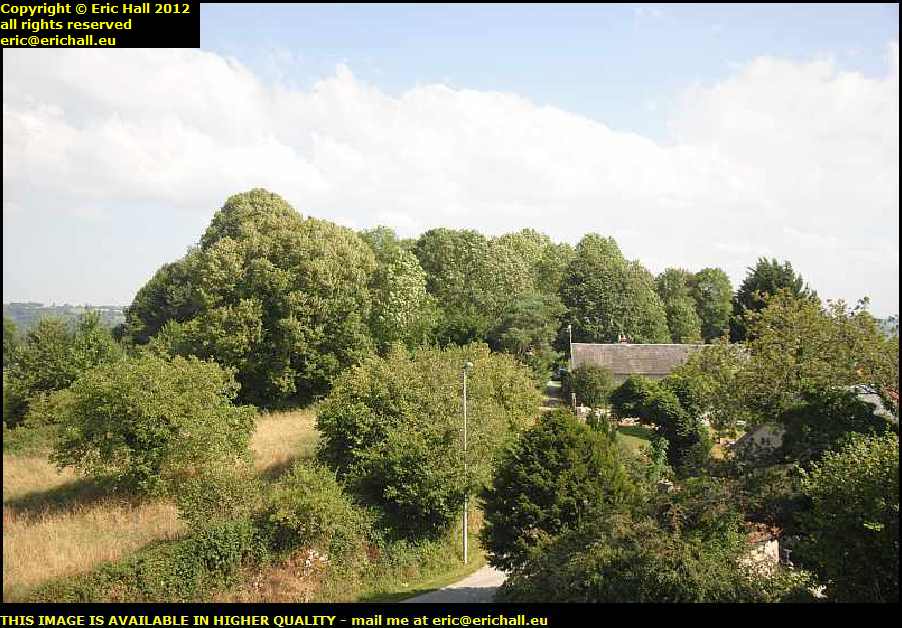
st hilaire puy de dome france St Hilaire is another village a little like Chateau-sur-Cher in that the church is situated on a mound on a promontory with an excellent view of the surrounding area.

And while the history of Chateau-sur-Cher is quite well-known, almost nothing is known of the history of St Hilaire.

Nevertheless, the mound and the strategic position are very suggestive of a Dark-Age fortress of some kind.

It’s a well-known phenomenon in many similar villages that the church on the mound started off as a tiny chapel somewhere within the fortress and the church expanded as the fortress declined.

Marianne didn’t have much information on the village but we went for a good prowl around.

st hilaire puy de dome franceIn the end, we had come up with tons of interesting stuff that we had discovered, as well as having a few interesting chats with the locals.

One of the aforementioned was not in the least pleased to see a couple of people wandering around looking at his house, and he freely gave vent to his displeasure.

However, not all of the locals were so ungracious.

At another house we were invited in for a drink and we had a guided tour of the old lady’s biscuit tin with all the photos, press cuttings and the like, including a newspaper from 1921 with the obituary of her grandfather.

He had a considerable claim to fame, being one of just seven survivors of the legendary Charge de Reichshoffen in 1870.

And so going from knowing very little to knowing quite a lot was the work of just an hour and a half.

paris orleans railway montlucon gouttieres st fargeol railway station allier franceOur day wasn’t over yet.

Regular readers of this rubbish will recall that I have been talking … "quite considerably" – ed … about the ephemeral Montlucon-Pionsat-Gouttières railway line.

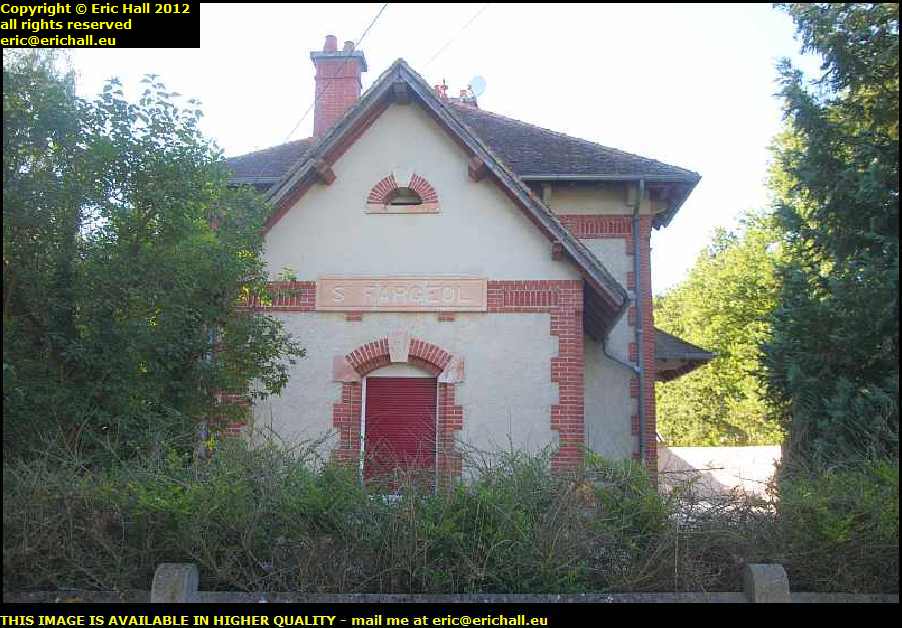
A few weeks ago on one of my ramblings I’d stumbled across the St Fargeol railway station and as Marianne didn’t know where it was, we went the long way round on the way home in order to visit it.

paris orleans railway montlucon gouttieres st fargeol railway station allier franceI’m not sure why they called it “St Fargeol” because the station is so far away from the village – a good couple of kilometres if you ask me.

That kind of thing wasn’t important in the 1850s and 1860s because there was no other choice – if you wanted to travel, rail was the only sensible option and so you had no option other than to walk – or catch a hay-ride – to the nearest railway station wherever it might be.

But by the time that this line was opened in the 1930s, road transport was well in the ascendency and the death-knell was already sounding for many rural railway lines.

paris orleans railway montlucon gouttieres st fargeol railway station allier franceNot even railway lines and railway stations in built-up urban areas could withstand the pressure from other forms of road-based passenger transport.

These little rural railway lines stood no chance whatever and were soon all swept away. The tacots – the little narrow-gauge railway lines that infested the French rural countryside – disappeared in the blinklng of an eye and the rural branch-lines quickly followed.

All you can see now – if you look long and hard – are the indentations in the soil where the railway used to pass.

So abandoning another good rant … "for the moment " – ed … tomorrow is Saturday and I’ll be off to Commentry shopping, I hope.

But I’m going to have to do better than this for working if I’m going to treat myself to the little autumn break that I promised myself a little later on this year.

Wednesday 1st AUGUST 2012 – I’VE BROKEN …

hole between house and lean-to les guis virlet puy de dome france… through the wall between the house and the lean-to.

It’s not properly through, yet and to be honest I don’t think that it will ever be, because one of the down-sides drilling from both sides of the wall is that the two holes never mate up and mine is about 5mm out.

This morning I was working on the website but for one reason or another I couldn’t concentrate. Add to that the fact that we had so much solar energy this morning, and so I decided to go out and run the huge drill for half an hour or so

That used up some of the surplus electrical energy while I was doing it (only 82 amps made it into the home-made 12-volt immersion heater that I use as a dump load for the surplus energy I capture) and it broke through.

I need to tidy the hole up now, which will take a while, run a tube through the hole, and pass 6 wires through the tube – 230 volt mains, 12 volt DC power and 12-volt DC light, and then the world will be my lobster in the lean-to.

One of the benefits of having power in the lean-to is that I can tile the floor, make a kind-of work area and then install the big washing machine.

I’d love to see how that works and how much current that it uses, bearing in mind that I’ll be running it off the hot-fill from the dump-load with the machine on a low temperature setting and on the economy wash low-water programme. 

collapsed lean to rebuilding stone wall les guis virlet puy de dome franceTalking of the lean-to, I spend a few hours on the wall too and it seems that I’m advancing rapidly.

While I was scavenging around for stones in the house, I came across a pile of smashed-up lightweight brick, plaster and the like from when I knocked a wall down and so I’m shovelling that up and using it as infill.

Apart from the fact that it is of course quite light, it’s slowly emptying the house and that can only be a good thing, killing two birds with one stone.

roche d'agoux puy de dome franceFor our Wednesday walk this afternoon, we went to Roche d’Agoux, a small village right out in the wilderness on the edge of the world.

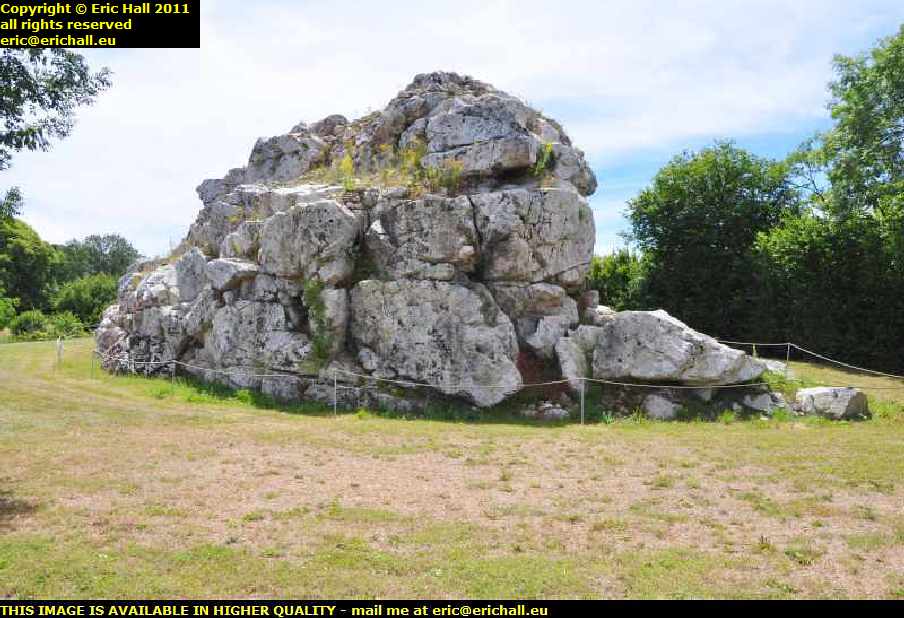
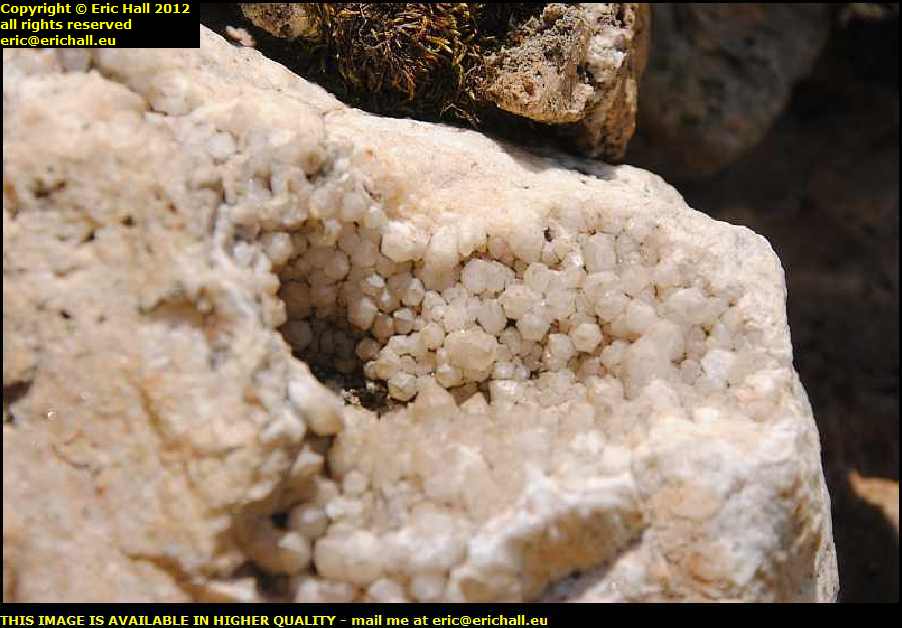
Roche d’Agoux has a couple of claims to fame, not the least of which is this really impressive outcrop of milky quartzite. There’s a whole seam of this stuff that runs diagonally through the whole of the north-west of the Combrailles, making the odd spectacular appearance here and there, and spectacular is certainly the word.

roche d'agoux puy de dome franceThe photo of the Roche is quite well-known – it’s a typical touristy thing of course – but what isn’t so well-known is the quartz. And so I’ll show you a close-up photo of that, and you can see what I mean by “milky quartz”.

Incidentally, it’s from this rocky outcrop where the Roche in the name comes from and it is, incidentally the same root for the word that is used for the area of the Staffordshire Moorlands in the UK the Roaches – that place where the wallabies hang out

roche d'agoux puy de dome franceWhen you look around here today at the sleepy little village of … errr … 91 people (a far cry from the heady days of the 1840s when 450 people were living here) it’s hard to remember that at one time, this was quite probably the most important town of the region.

You look at towns like Marcillat en Combraille, for example. A big, bustling village today yet it didn’t receive its charter for a market until 1258 – and that charter was granted by none other than a certain nobleman called Guillaume de la Roche d’Agoux.

He was certainly the most important nobleman in the area at the time and he did have his castle here in Roche d’Agoux.

castle chateau fort roche d'agoux puy de dome franceMany people will tell you that the Roche d’Agoux is actually the ruins of his castle, or chateau-fort, but that isn’t so.

That was something that was mentioned in a guide book of the region of the 1880s and which has lingered on in current folklore.

In fact, that’s the site of his castle over there on that mound. However, it was dismantled in the early 15th Century and that date is interesting.

castle chateau fort roche d'agoux puy de dome franceIt’s quite early for this to have happened – long before Cardinal Richelieu’s edicts of the 1620s against the nobility that led to the dismantling of most of the castles in this area – and nothing has come to light which might suggest a reason for this.

However, certainly a few years ago there were some quite substantial remains to be seen, but no-one knows the present position today, because the current owner does not welcome visitors.

I spoke … "at great length" – edlast time that we were here about the magnificent church.

church roche d'agoux puy de dome franceLike every church almost everywhere in Medieval Europe, the rapid expansion of the population in that period led to the rapid expansion of the church, and having a crafty nose around, I came across some really good evidence of this.

Up there we can see the remains of a window that has long-since been filled it. It’s very reasonable to assume that this wall was thus an outside wall of the building and the light was lost when the annexe was built on behind it

So I dropped Marianne off at Pionsat and went back home to carry on working for a while.

No point in wasting the day.

Wednesday 27th June 2012 – 28 DEGREES CELSIUS …

… it was this evening at 19:15. So you can see what the weather has been like all day.

After having several days of mediocre weather, cool, wet and windy, too. So you can tell that there was something afoot.

chateau sur cher puy de dome franceAs indeed there was. We had another one of our walks. Bound to be a heatwave (or a torrential downpour) today.

You may remember from a couple of weeks ago that Marianne and I went off to do a recce of Chateau-sur-Cher. In her capacity as approved tourist guide for the area she is doing a programme of walks around rhe various villages.

It’s the kind of thing that interests me deeply as you know, so I’ve gone along as Minder. And here we are today in Chateau-sur-Cher

church chateau sur cher river cher allier creuse puy de dome franceI have said, on many occasions and at great length too, that here in rural France, the situation of many old churches gives reason to believe that they are sited on old historic fortress sites.

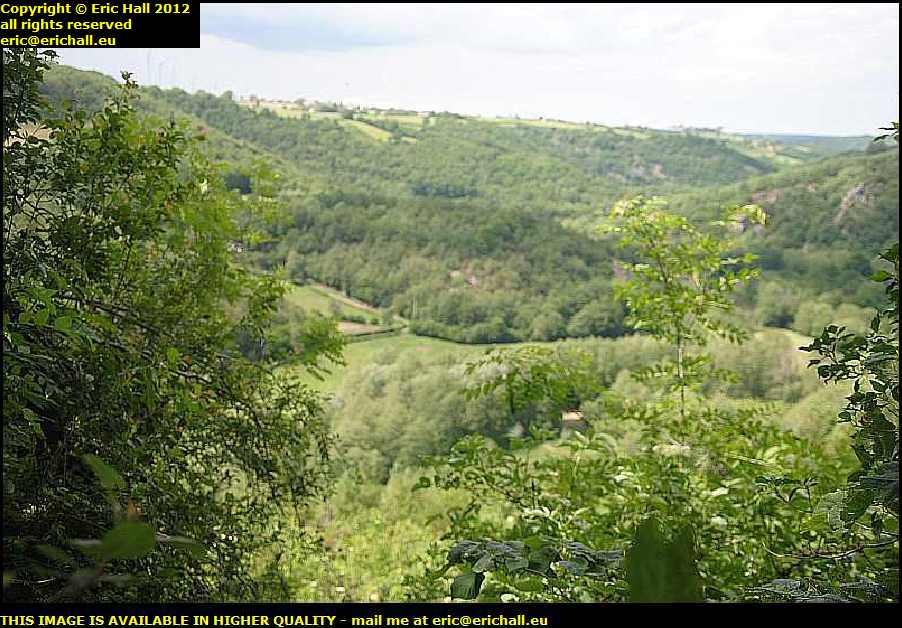
The mounds and the sometimes stunning defensive positions of the buildings underlines this – for example, look at the view that you have from the site where the church at Chateau-sur-Cher is situated.

Any nobleman bent on maintaining his power in the region (and many were as bent as they come) would have had a fortress up here in a flash as soon as he were to see the excellent position

church chateau sur cher river cher allier creuse puy de dome franceAnything passing on the road down there would be under his immediate surveillance and he would soon pounce in a twinkling of an eye to launch an attack or to exact a toll.

The valley in the middle is the River Cher, to the left is the département of the Creuse and to the right is the département of the Allier. We ourselves ae in the département of the Puy-de-Dôme.

In the days before the unification of France, these were all independent Provinces and with the only bridge over the River Cher for miles being situated just down there at the foot of the hill, he would be in a magnificent position to control the trade, and his fortress would have been pretty-much impregnible to a surprise attack from another province

church chateau sur cher puy de dome franceHow this would have all come to pass would have been that the nobleman back in the days prior to the arrival of the Romans would have stuck his oppidum up here straight away.

Christianity slowly came to the area and when it took hold, he would have himself been amongst the first to be converted, and he would have provided a little place somewhere in his oppidum for worship to be held.

During the passage of time as the region settled into more peaceful ways (remember we are long before the period of the 100 Years War which devastated this region) the need for a fort grew less and the population expanded.

church chateau sur cher puy de dome franceHence the need for a bigger church, and much less need for a fort. And in the end, the fort would fall into decay.

And that’s exactly what has happened here in Chateau-sur-Cher because during some archaeological excavations in the past, they did actually find some evidence to suggest this was indeed a fortified oppidum occupied by the Gauls.

chateau sur cher puy de dome franceBut the key to the village was the fort. And why the fort was there was because of the key position that the promontory held – over looking the only practical crossing of the River Cher for many miles either upstream or downstream.

A packhorse train of goods or a herd of cattle crossing over the bridge from the Creuse into the Allier or the Puy-de-Dôme and our noble could swoop on it like a hawk and exact an appropriate amount of tribute.

chateau sur cher puy de dome franceThat estaminet there would have been an exciting lively place 150 years ago in the days of pack horses, drovers and horse-drawn waggons, everyone stopping for refreshment after a long arduous travel through the mountains

Today though, the estaminet is long-since closed and the village is pretty-much abandoned. From a heyday of well-over 700 people living here 150 years ago, the number of inhabitants now totals a miserable 78.

The sites of many abandoned buildings that have crumbled away into nothing are quite evident, and many other buildings are lying abandoned, likewise to suffer a similar fate.

The exodus to the urban regions of France from little communities like this is tragic. As you know, on my own property I have the remains of half a dozen houses.

machinery moulin de chambon chateau sur cher puy de dome franceWe ended up going for a walk along the bank of the river heading northwards, because there was something important to see here, at least from my point of view.

There’s a mill – the Moulin de Chambon – down here and although it’s long-since ceased to function and its machinery is all dismantled today, it’s nevertheless quite an interesting place to be

moulin de chambon chateau sur cher puy de dome franceInteresting for several reasons too.

  • the water arrives via a system of weirs and locks, rather than the more usual millrace.
  • it’s a hybrid mill, in that the water powers a system of pulleys and that other machinery – not just a corn-grinding wheel – was operated here. There was even talk of a sawmill in one of the sheds.
  • it’s an undershot wheel ie where the water passes underneath, not an overshot wheel where the water passes over the top

. It’s such a shame that I couldn’t have a better view of it.

moulin de chambon river cher chateau sur cher puy de dome franceIt was a shame that there were so few of us out for our walk today. It was a really beautiful afternoon and this was, from my own point of view, probably the most interesting walk that we have undertaken since we started doing them.

We were ready for a drink after all of this and so Marianne and I headed back to Pionsat and refreshment. Nothing of course available here.

And this was when I noticed the temperature.

I nipped back home quickly where the water in the solar shower was still 36°C, and had a nice warm shower. I needed it too.

This evening, while watching one of the most boring football matches that I have ever seen, I sorted out a pile of paperwork. That’s not like me. I must be feeling the heat.

You’re probably thinking “what an exciting day” but I’ve not told you the half of it yet.

This morning I was up and about long before the alarm went off. Before 08:00 in fact, and that’s not something that happens every day.

I worked for a few hours on my web pages and then went outside for some more tidying up and throwing of stuff down at the dechetterie. That’s all gone now and I can move about comfortably in the barn where the Ebro is.

And it’s been a few years since I’ve been able to do that.

>Tomorrow I need to measure up for the stuff that I need for the next stage of renovations, and to do some washing if the weather stays fine.

I’m also planning some more shelves in the barn now that I have the space to stick them up.

Watch this space.

Sunday 3rd July 2011 – Remember yesterday …

rainwater harvesting home made water filter les guis virlet puy de dome france… when I said that today I would be working on the guttering and the water filter system? Well in fact that was what I did this afternoon and you can see the results just here in the photo. We now have full-sized guttering and a full-sized downpipe with a decent-sized sump that is angled down to where the drain is.

The tube down to the settling pipe is 80mm like the rest of the guttering, and from there on, nothing else has changed.

I’ve been trying to fit a covering over the top but I can’t get it to fasten down. In the end I’ll be having to resort to cable ties I reckon. Now where did I put my cable ties then?

I also said that I would be doing some bread baking, but the less said about that the better. Apart from dropping some of my mix on the floor, I ended up with a couple of soggy lumps of I’m not quite sure what – and that after spending I don’t know how long looking for a third shelf for the oven. I reckon that the “best before” date of April 2010 might have something to do with this, and so I’ll have another go with some fresh stuff and see what happens. But I really need a decent flat tray for the oven.

fete touristique roche d'agoux puy de dome franceMarianne the local journalist from the newspaper La Montagne rang me up this morning to invite me to Roche D’Agoux for her presentation at the tourism morning. She drove in her car and I went as passenger.

This was not really such a sound move as I get bored with this kind of thing after about half an hour. I’m not really much of a socialite as you all know and 2 hours and more is more than enough for me.

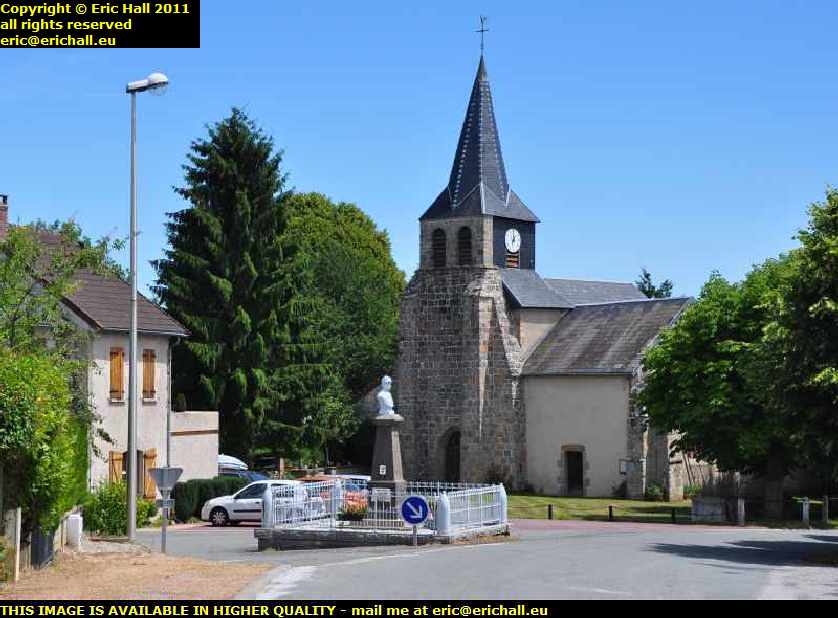
eglise village church roche d'agoux puy de dome franceAnd so after a while I slipped away and went for a little walk around the village. Only a little walk of course because there isn’t too much of a village to see.It’s only a small place.

Centre of every village in France is the church, and generally speaking, they are well-worth seeing. The one here at Roche d’Agoux is no exception and is, for a change, in an exceptionally-good state of preservation for such a small village.

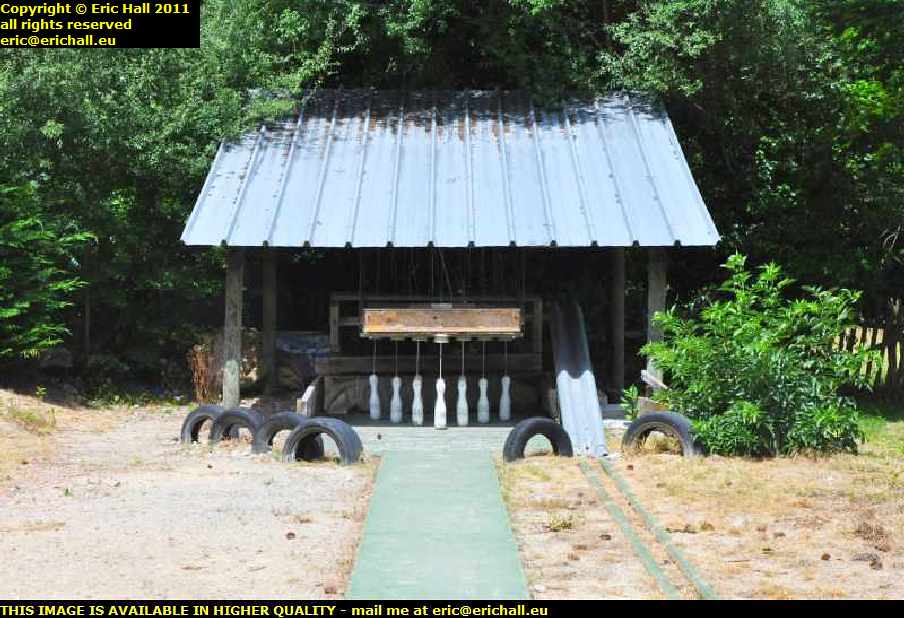
jeux de quilles ten pin bowling alley roche d'agoux puy de dome franceOne thing for which Roche d’Agoux is famous (because it has several claims to fame which we shall discuss in early course) is that it has a public 10-pin bowling alley – a jeux de quilles in the open air.

It actually works too, so I was told later, and I would have loved to have had a go. But I think that you have to bring your own bowling balls. But anyway, it’s not what you would expect to find in a village like this.

Back at the tourism exhibition, I discovered that the organisers were the people who organise the vintage fete at St Maurice pres Pionsat where they have all of the old cars. I had a good chat with one of the organisers about the Minerva – so much so that I’ve been invited to exhibit it there on August 14th. I need to get a move on and get it running.

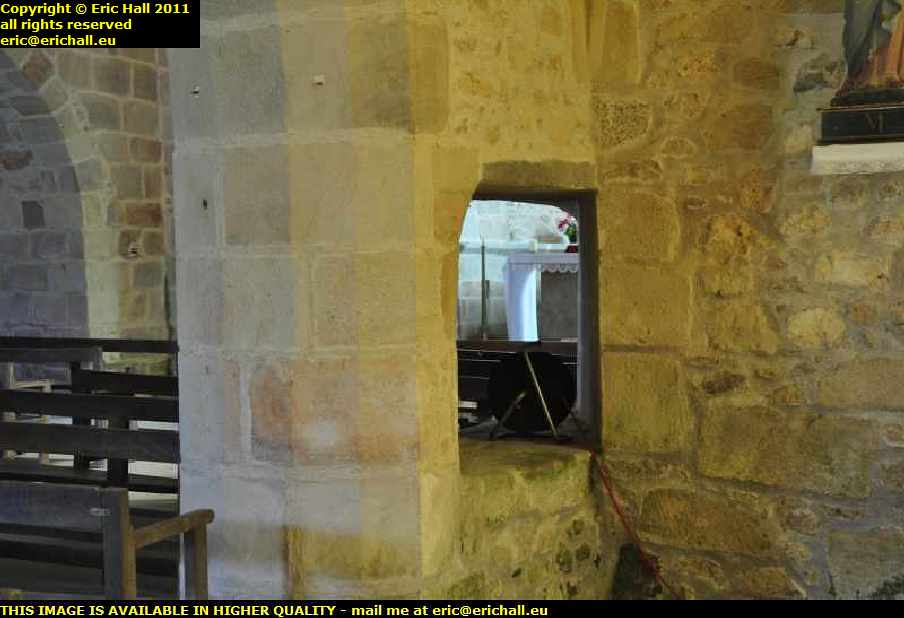
leper window church roche d'agoux puy de dome franceWhen the do was over, I told Marianne about my little wander around the village and the visit to the church. She told me that the church is quite famous – one of the several things for which Roche d’Agoux is famous – and that we should visit the inside of it.

She went off on a voyage somewhere and came back brandishing the keys to the front door. She knew who held them and had gone off for a little negotiation on my behalf

leper window church roche d'agoux puy de dome franceIn the immediate vicinity of Roche d’Agoux in the Middle Ages was a very large leper colony and they were isolated from the general community, as you might have expected in those days.

However, the lepers were obliged to attend Mass just the same as everyone else and so special provisions were made for them in the church. They had their own alcove away from the mainstream congregation and could witness the mass through a special leper window

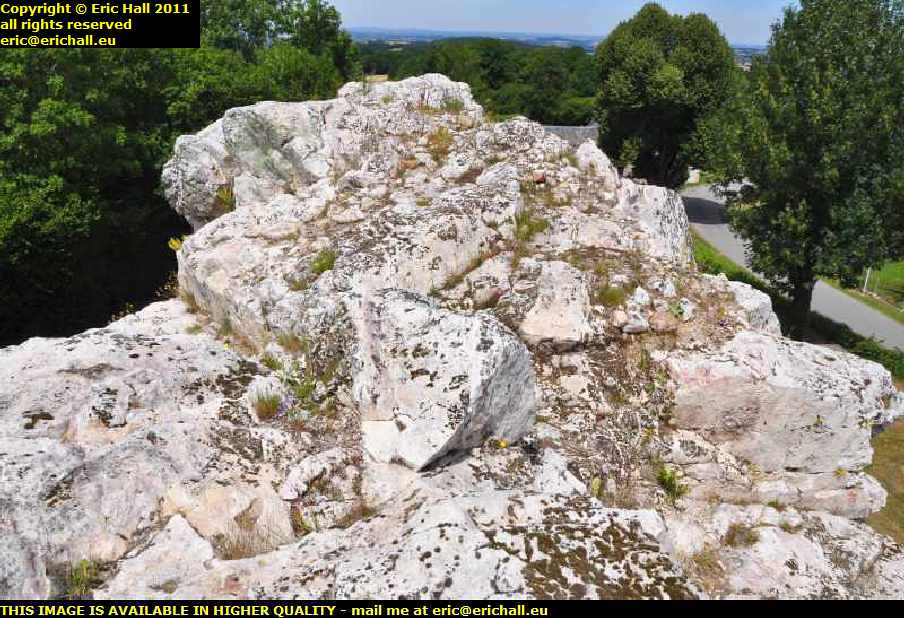
roche d'agoux puy de dome franceAnother claim to fame for Roche d’Agoux is that the village is built on an bed of quartz that runs for maybe 20 kilometres across the north-western Combrailles.

The village takes its name from one of the most important outcrops of this bed, It is full of quartz and semi-precious stones and has been exploited for its precious stones in the past as well as having been quarried for building material.

roche d'agoux puy de dome franceNow, it’s a viewpoint for the village and the surrounding area. There are steps around the side and you can climb up to the top for a look.

It’s often been said that the rock that we have just seen is part of a Medieval castle that was situated here in the village but that’s not correct. This was something that was written in a guide book in the 1880s and has simply been copied out liberally without anyone having actually come here to visit the site.

chateau de Guillaume de Rochedagoux roche d'agoux puy de dome franceThere was indeed a medieval castle chateau fort here in Roche d’Agoux, but that was over there on that eminence – the small hill over there about a quarter of a mile away from the rock.

Unfortunately we cannot go to visit it as it’s on private property and the owner doesn’t encourage tourists which is a shame. But apparently there are quite a few remains that can be seen, according to someone who went there many years ago.

town walls roche d'agoux puy de dome franceThere are some ruins visible here and it doesn’t take much imagination for them to be pictured as remains of the castle or even remains of a wall around the village, but that is pure speculation.

But anyway, all of this area was the fiefdom of Guillaume de Rochedagoux in the mid-13th Century. He was famous for having gone on one of the Crusades to the Holy Land. He passed through the land of the Armenians (you have to remember that back in those days the territory of Armenia was much bigger than it is in modern times), noticed the skilled weavers there, and brought some of them back.

This accounts for the history that this region had as a flax-weaving area in the past, and accounts for names of places in the area (for example the Moulin des Armenièns) and the surname Desarmenièn that you encounter around here.

Anyway the hospitality had been freely flowing at the fete de tourisme, so much so that I had to drive back.

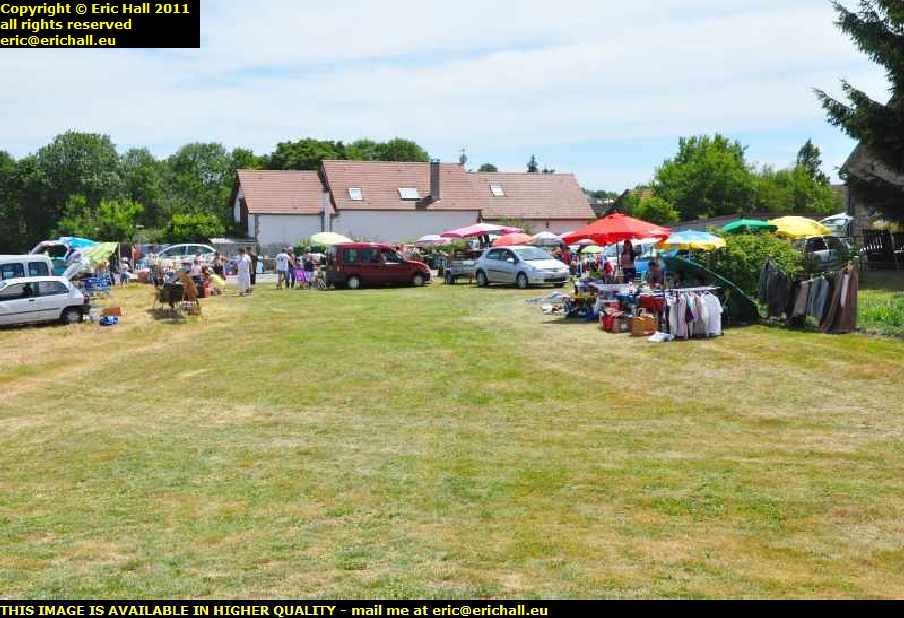
brocante arpheuilles st priest allier franceAnd I still had time, after playing for a while with the rainfall harvesting equipment to go off to Arpheuilles St Priest and the brocante that they were having today.

There weren’t many stalls there – despite the glorious weather – by the time that I arrived and I wasn’t able to go mad. but “spend, spend, spend” it was indeed and I was out by as much as €4:00 by the time that I left.

But the brocante was not my only reason for going to Arpheuilles St Priest. We’ve talked … "at great length" – ed … about the tacot or ligne economique, the narrow-gauge line that meandered through this area of the Allier between Marcillat en Combraille.

ligne economique gare de chemin de fer arpheuilles st pierre allier franceIt actually passed through (and that’s a rare thing – that the tacot actually passed through anywhere) Arpheuilles St Priest and so I reckoned that I would go and see if I can find any trace of the line.

And having waded through a couple of hedges and a pile of weeds (and someone’s nicely-mown lawn) this is, what I reckon might have been the track-bed of the line. It’s very much like the width that an abandoned railway line might be and it’s heading in the general direction of Commentry

ligne economique gare de chemin de fer arpheuilles st pierre allier franceAnd now that I know what a tacot railway station looks like, having identified the one at Marcillat en Combraille the other day, I could go off and look for a building that corresponds.

And here we are – following my track-bed backwards across the road I ended up peering through the trees at this building, and this is what my money is on. This looks like a tacot railway station to me if ever I saw one.

So wasn’t this a busy day then? It kept me well out of mischief and I learnt a lot too.
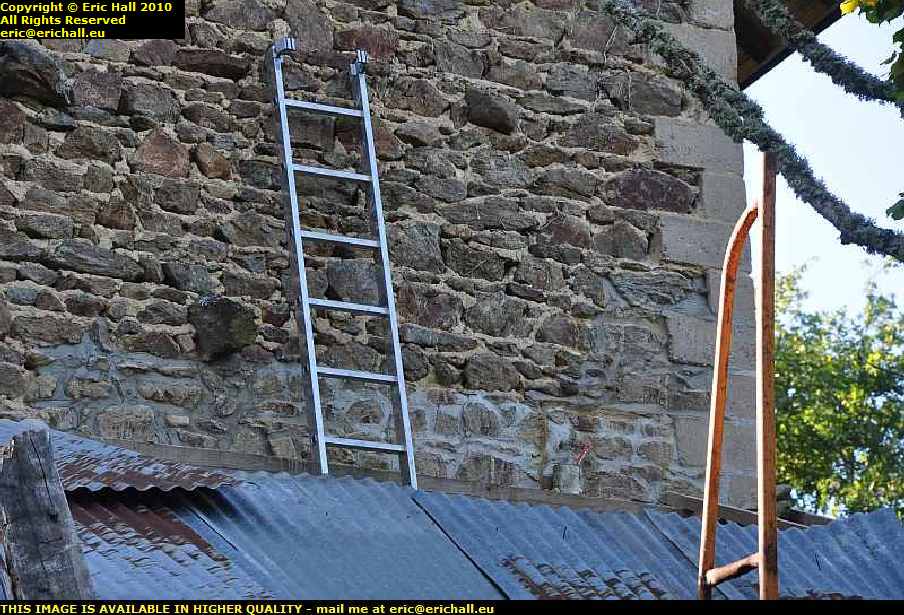
And so have you now.

Tuesday 31st August 2010 – I’ve been out and about …

… for part of the day today.

village church eglise de virlet puy de dome franceOne of the places that I visited today was Virlet, the village that is my postal address. And while I was there I went to take a few photographs.

Now that my website is practically up-to-date I’ve started on doing some new stuff and one of the things I’m working on is a page about the village. There’s nothing at all in English about it.

village church eglise de virlet puy de dome franceWhile I was there for the brocante I took a few pics but I really wanted one of the church. There has never been a decent one because it’s surrounded by clutter – a stone wall, trees, the village hall etc.

So I had this idea of driving right across to the other side of the valley, using the 105mm (3x) zoom, doing a nice long-hop (it’s over a mile away across there) and then cropping the church out of the photo.

And do you know, it’s come out rather well. It really is the only position where you can see it to its best advantage , and in fact I’ve never seen a photo of the church taken from this position. I’m well-pleased with this.

So why was I in Virlet today?

Two reasons really. Firstly to obtain an attestation that I am a resident in the area and secondly to have a copy of the list that gives the names and addresses of doctors who are authorised to give medical examinations for commercial driving licences. If I’m changing my driving licence for a new one I may as well change my truck and bus (and taxi) licences too while I’m at it. You never know what might happen.

But of course, as you would expect, it wasn’t all plain sailing. The mayor’s secretary is away today and he doesn’t have a clue what to do. So I’ll have to go back on Thursday. You’ve never ever seen anything like this place for chaos. But at least the guy at the Driving Licence centre answered his phone this morning and he was even helpful. I don’t have much time to apply for this licence so I need to put my skates on. I’ll go down to Clermont Ferrand on Thursday when I have my attestation.

pointing stone wall les guis virlet puy de dome franceSo this afternoon I carried on with the pointing and it doesn’t half take ages to do. You can see just how far I’ve done today – the grey-mortared bit at the lower edge of the wall. That’s about one-sixteenth of the wall done.  At this rate it will take for ever but I’ll keep on plugging away at it as long as the weather lets me.

And that might not be for long – last night the temperature fell to 7.2°C, the lowest so far. I ahve all the windows closed up here and I’m wearing a jacket – in August.

And in other news, Terry and I are now the owners of an Ifor Williams 2.5-tonne trailer. Fed-up of messing about with old trailers that won’t even carry a set of scaffolding when they are working properly, we have bitten the bullet and paid up. It’ll move the scaffolding and Terry’s tractor quite nicely, help me fetch all my cars down here, and we can hire it out as well to make a little bit on the side, like we do with the scaffolding.