Tag Archives: norse remains

Tuesday 14th April 2020 – WHAT A REALLY NICE …

… gesture.

One of my neighbours knocked on my door earlier.
“I haven’t seen you about for a good few days. I was wondering if you were Ok. Do you need anything?”

That’s what I call Solidarity. It’s what the world has been missing for the last 50 years. Let’s hope that if we learn anything from this world-wide dêbacle, it’ll be that Solidarity is a very important concept and that there’s always a place for it.

Not like – was it Ron Atkinson? – who said “there’s always a place for the Press. They just haven’t dug it yet”.

Even more surprisingly, I arose from my stinking pit as the first alarm went off at 06:00. I bet that you weren’t expecting that – I know that I wasn’t!

But the secret to that was that I had forgotten to put the ‘phone under my pillow and it was on the chair, making enough noise to awaken the dead. Rather like Peel’s “View Hulloo” I suppose.

Actually, I was already awake. I had awoken bang on the spot of 05:58 and I know that for a fact because I looked at the time on my fitbit.

So what all of that was about this morning, I really have no idea.

After the meds it was the dictaphone. I was with my father at a house and Claude had thrown away an old cooker but the cooking panel was better than the one in my house so I took the cooking panel out of the cooker and put it in the kitchen. It worked for a couple of days and then packed up, so we repaired it and it worked for another couple of days and then it packed up again, right in the middle of doing something, making a cup of tea I think. Of course it was a Saturday afternoon, wasn’t it? No chance of getting to the shops to replace it. And Bank Holiday Monday, so we were stuck. I had to get the old one out to put back in to last until the shops reopened. We were talking about it and I was thinking “yes, God, Claude never gave anything good away so that explains that. At the same time I had to take it out and dump it in my garden along with all of the other rubbish that was in there. It was really looking bad, my place and my father said that I ought to take some stuff down to the tip. I said that I would do as soon as the van’s empty but it’s full right now. He said “why don’t you take my van? Take some stuff in my van?”. I was surprised that he would let me because he was never really one for letting people take his vehicles. He started to remember the time that I’d borrowed his van in 1974 and I had a parking ticket, all that kind of thing. I was thinking “God, that’s 40-odd years ago and he’s still remembering that and still talking about it”.

After breakfast I started on the file digitalising again. And what a miserable session that was this morning. It took me ages to find four albums for which I could find everything that I needed. There were several where there were only two tracks, or three tracks or, in one case, nothing at all available and that was depressing.

Some of the stuff is pretty rare, I know, but I was expecting to do better than this. Like I’ve said before … “many, many times ” – ed … that fire at Universal Studios must have been devastating. I’m going to have my work cut out to deal with all of this stuff that I can’t find anywhere else, and I’ll certainly be doing the music industry a great favour when I’ve digitalised it all.

Despite the good start to the day that I had had, all of this nonsense took me almost up to lunchtime. What was even worse was that because of all of the issues I didn’t manage to do too many photos. I’m still inspecting the old Norse village at Gàsir just up the road from Akureyri. I’ll never be finished at this rate.

Nevertheless I cracked on and by the time I knocked off this evening (a somewhat later 18:15) I’d finished writing all of the notes for all of the radio projects as far as I could. That will be dictated tomorrow and I can crack on with editing it – I hope.

Tea was a falafel with steamed veg in a cheese sauce and it’s difficult to make a vegan cheese sauce when you’ve run out of the correct type of vegan cheese that you need.

No pudding tonight – simply because I made too much veg and I have to be careful what I eat.
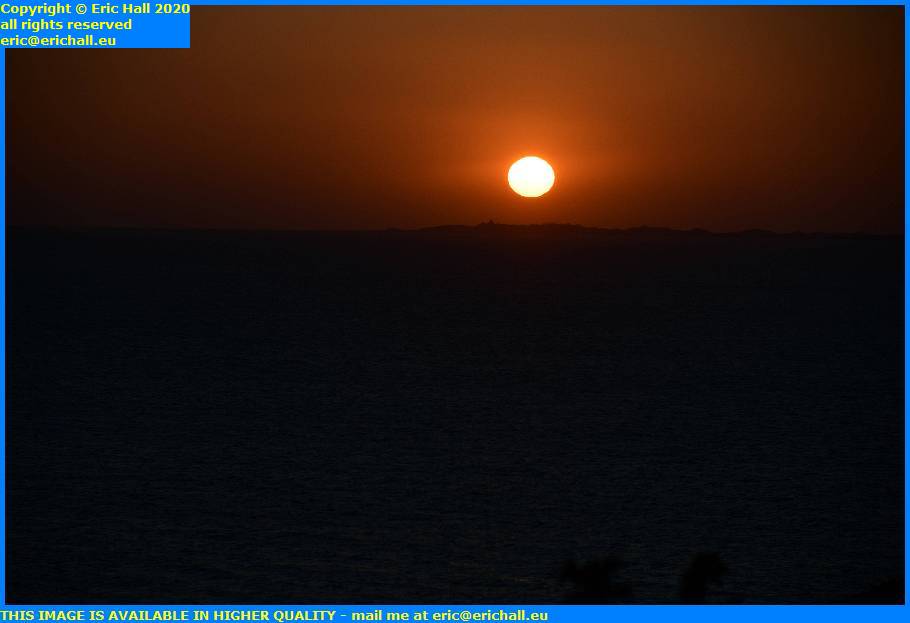
sunset ile de chausey granville manche normandy france eric hallWhen I’d finished the washing-up I went out for my evening run.

And with all of the vegetables that I had eaten, it was quite a struggle to run all the way up to the top of the hill and I was exhausted. Mind you, it was well worth it because there was a really beautiful evening sun.

There were quite a few people out there enjoying it. And no surprise either because it was slightly warmer tonight than it was yesterday evening.
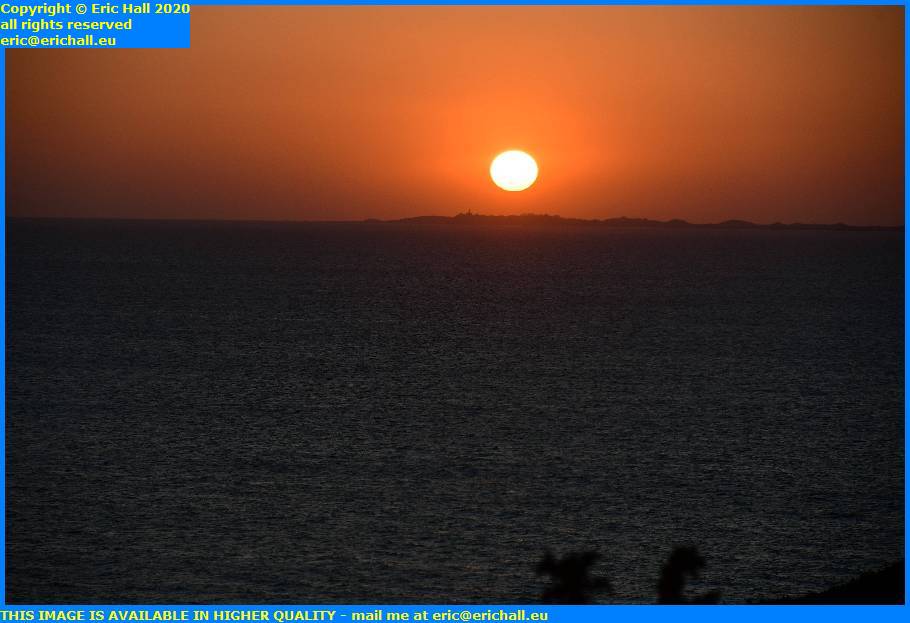
sunset ile de chausey granville manche normandy france eric hallThe sun was going down quite nicely over the Ile de Chausey so I took another photo of it.

To try something different, I had a play around with the camera settings but it still didn’t give me the image that I wanted, which was a shame. It’s a bit of a disappointment really.

So on that note I exchanged pleasantries with another sun-watcher (from an appropriate social distance of course) and carried on with my run around the corner and along the cliff top.
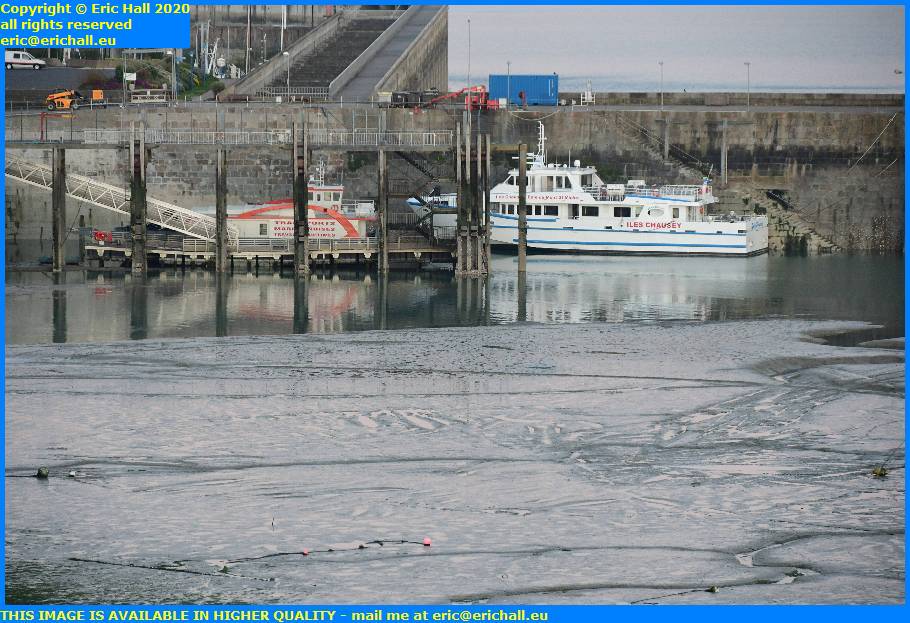
chausiais joly france ferry terminal port de granville harbour manche normandy france eric hallStill the same four boats in the chantier navale so I had a look over at the ferry terminal.

Not that the ferry terminal will be doing much, but one of the Joly France boats – the older one, I think – and Chausiais are moored up there. Apparently, in answer to a question that I had posed a few days ago, there’s a freight service twice a week over to the Ile de Chausey.

No-one has said anything about passengers though, so I don’t know how they are moving about, if they are moving about at all, that is.

So I pushed on with my running. And while it was agonising tonight, I managed to complete all of my five runs.

One thing that I have noticed though, is that while I’m not pushing on the distances very much, my recovery time between each run (because I have to pause for breath) is reducing little by little.

And even when I don’t feel up to running, I find that I can still push on regardless and as long as it’s on the flat or downhill I can do it.
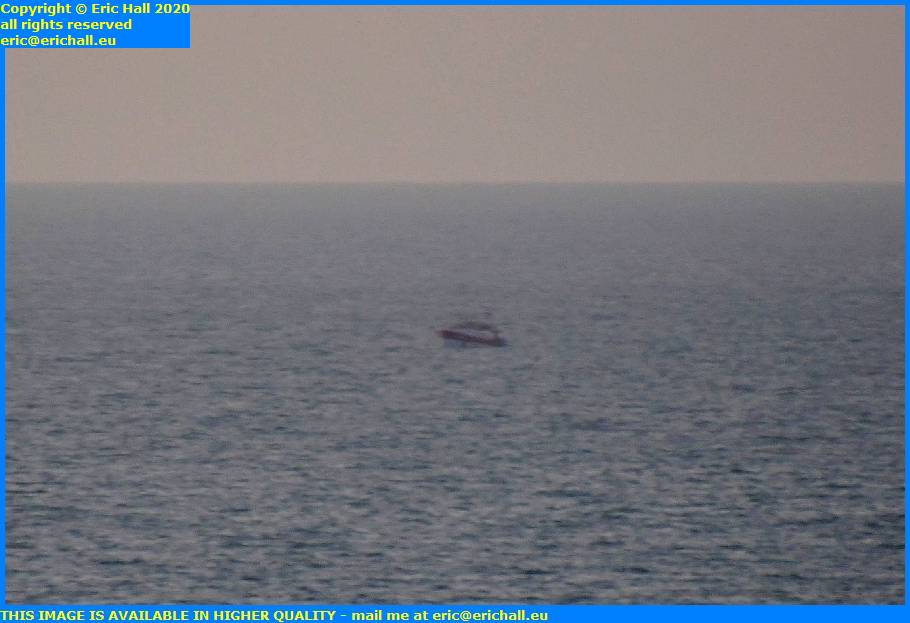
trawler english channel granville manche normandy france eric hallJust for a change, I thought that tonight I hadn’t seen a fishing boat out there and that they weren’t being allowed out.

However I did notice something moving right out to sea near the horizon so I took a speculative photo in order to blow it up (the photo, not the object) when I return home.

Sure enough, it’s one of the big fishing boats right out in the English Channel. So they are still going.

Anyway with a bit of luck I might be in bed before midnight. I’ve had a long day today and I haven’t even crashed out. That must be something of a record.

I wonder if I can keep it up.

Wednesday 24th July 2019 – OUR LAST …

… complete day on board ship – for now anyway – and what an interesting day it has been.

The day started off with, probably for the first time for quite a while, some uninterrupted sleep. And although I awoke at about 05:20 or thereabouts, uninterrupted it was. And for the first time for quite a while, I actually felt almost-human when i awoke.

It was a much better start to the day.

Outside, there were things to see too and that made it so much better. Much better than being totally shrouded in fog and mist

We’re sailing down a fjord, the name of which I forgot to note, somewhere round near the settlement of Qeqqata. And I made a discovery too, and I was lucky enough to photograph it.

It might well be a haphazard pile of stones but from the angle from which I took the image, it looked just like a ruined stone house (and I’ve seen a few of those – even lived in one too – in my time). It was on a spit of land sticking out at the junction of two fjords, in exactly the spot where one might expect an early settler, even of the Norse era, to erect a dwelling.

I showed it to the on-board archaeologists, and they seemed to think that it was something man-made. And who am I to dispute that? After all, we are somewhere in the vicinity of the limits of where the Western Settlement of the Norse might have been.

After breakfast I edited some photos for a while and then later on we had a talk on geology. And shame as it is to admit it, I dozed off in the middle of the discussion. I don’t know why, because up to that point I had been feeling quite good.

Once the talk was over we donned our wet-weather winter gear and clambered aboard our zodiacs for a final cruise. Past various nesting colonies of kittiwakes and guillemots up to the head of the fjord where a glacier was busy calving off into the water.

Strawberry Moose came along too and he went for a short kayak trip with Genevieve. He has more luck with the girls than I do.

But my luck held out today, just for a change.

My camera was in the right place at the right time with the right settings just as a huge pile of ice calved off the glacier. It made the most enormous splash although by the time the tsunami reached us it was pretty miserable.

By now the old Danish guy was feeling the cold so we headed off back to the ship. And that turned out to be lucky too because we caught sight of a young bearded seal sunning itself on an ice-floe. Baldur called up the other zodiacs to come to see it, and so it chose that moment to slide off the iceberg into the water.

But not before I took a photo of it. And what a stunning photo it was too and I’m well-pleased with that one. It’s definitely one for the family album.

Lunch was a barbecue on the rear deck and then we had all of the usual housekeeping stuff and instructions for our disembarkation tomorrow morning. That was followed by a packing session as we need to vacate the premises, and I can’t find the hood for my camera lens. And that’s a disappointment and no mistake.

There was another photography session dinner this evening and we had quite a discussion, which was punctuated by the ship making a severe U-turn as if it had missed the turning into our fjord.

And as Rosemary and I were leaving we were accosted by one of the Québecois women who wanted a chat. An elderly woman who is travelling alone and by the looks of things hasn’t made any friendships. We all had quite a chat in French.

On the deck, the views were spectacular as we entered the fjord and I took quite a few photos before the cold wind from the interior drove me inside. I wrote my notes, has a chat and that was that. I’m off to finish packing and then to bed ready for an early start in the morning.

It looks as if it’s all over for another trip.

Tuesday 23rd July 2019 – I REALLY DON’T …

… know what is happening these days but I had a night that was almost the same as the previous few nights. Awake at about 03:10 or thereabouts, and again at 05:15 and not being able to go off back to sleep. I’m getting rather fed up of this.

With the alarms going off it was still a struggle to haul myself out of bed and I didn’t beat the third alarm by very much.

Up on deck to see what was going on. And the short answer was “nothing”. The whole world was shrouded in a thick mist and I couldn’t see a thing.

Instead, I went back to my cabin and had a nice hot shower to freshen myself up and to wash another load of clothes ready for departure. So, nice and warm and damp, I slipped under the covers for five minutes and the next thing that I remember, it was 07:55 – 5 minutes to breakfast.

After breakfast, I managed to track down John Blyth. he had given us yesterday a talk on the charts of the High Arctic and had said that he had the charts on *.pdf. So I slipped him an USB key.

There was a talk this morning on wild flowers of Greenland, followed by a charity auction. I was present in body but not necessarily in spirit as I attacked the photos. In effect, Jessie has asked to see my top 15 from this trip so I went through and sorted some out while everything was happening. I’ve ended up with about 30 which is rather more than she wanted but that can’t be helped.

By this time we had arrived in Nuuk, the capital of Greenland. The most northerly capital city in the world.

Lunch was early today – 11:30 – so we had to be quick. And then we were called down to the bus that was to take us into the town centre. We were actually tied up at the quayside today for once so no need for the zodiacs

A delightful Inuit girl called Evie (which is a shortened form of her real name which, like most Inuit names has about 100 characters) took us on a walk around the cultural centre, the old town and finally to the museum.

And I learnt something that I didn’t know, in that films in the cinema in Nuuk, they are shown in “version originale” with subtitles in Danish. Not in Greenlandic because apparently there wouldn’t be enough room on the screen for the characters and it would take too long to read them.

Which reminds me of the old chestnut about why there are so many babies born in Greenland. The answer is that the Greenlandic word for “no” is so long that by the time the girl has finished saying it, it’s already too late for the guy.

The museum was interesting. Apart from the usual stuff that you would expect to see, there was an exhibition featuring the Norse in Greenland. That was quite exciting for me at least, so I made a beeline thereto. And remind me to find out more about the “farm in the sands” that has recently been discovered at Nipaatsoq.

By now Rosemary had joined me so we wandered off for a coffee where we learnt the dreadful news from the UK. It beats me just how so many people can be so stupid and irresponsible.and so keen to bring down chaos and disorder upon themselves.

We went off shopping and Rosemary bought a few souvenirs for herself and her friends and then we just about had enough time to catch the last bus back to the ship.

Tea was taken in the company of a Francophone Canadian couple and by a German guy from an adjoining table who insisted on joining in our conversation. But at least this Canadian couple was delightfully normal which makes a change.

Now, there’s a chocolate party going on in the back of one of the lounges so I’m comfortably esconced in the library typing my note. But as I see the mountain of uneaten delicacies making their way back to the kitchen, I’m appalled at the waste of food when there are so many starving people all around the world.

And in other news, I saw one of the young waiters, a tall thin guy from the Maldives, dressed in civvies and making his way off the ship. He told me that he was going home. Later on I asked one of the friendly waitresses about it. She confirmed that he was leaving, and when I asked why, she made a very non-committal gesture. Whatever reason there is for his leaving the ship, the staff is not allowed to talk about it.

It’s still early so I’m going to edit a few more photos before I go to bed. Our last complete day tomorrow and hasn’t it gone so quickly?

Monday 22nd July 2019 – IT WAS SOMETHING …

… of an easier day for me today, although you might not think so.

Being awake at 03:05 this time (just for a change) and then again a short while before the alarms went off, I did finally manage to fall out of bed and totter straight down into breakfast for 06:30.

Once breakfast was over we had to dash back to our rooms to don our winter clothing because we were off for a very long zodiac trip. And we needed our clothing too because it was to be a very long trip in the cold and wind.

We’ve anchored in Arsuk Fjord and almost at the head of it is a really impressive waterfall. It’s not the highest in Greenland (we have already seen that) and not by a long way either, but the volume of water that pours over it is phenomenal.

On the way there we kept a look-out for wildlife, although our first “sighting” was of a cabin on shore. It looked as if it had been abandoned for a considerable period of time and was in a poor state of repair, but it would make a very nice home for someone who craved solitude. Going to the shops would be an issue, though.

A little farther on, someone on our boat spotted an arctic fox. We all craned our necks and one or two people managed to catch a fleeting glimpse. I wasn’t so lucky unfortunately. But then, someone later explained that an arctic fox was only the same size as a domesticated cat so I don’t feel so bad about not seeing it.

Much more luck later on. Someone called from another zodiac that they had seen a musk-ox on shore, so we all headed that way. After a good deal of searching and scanning, I finally saw it. And it put on quite a performance for us too, gambolling about in a clearing amid the rocks.

But it was strange to see a musk-ox on its own. They are herd animals. And so the consensus thinking was that although it didn’t look much like it, it was possibly a male adolescent that had been ejected from the herd by the dominant male and had yet to establish its own harem

The waterfall was impressive. It was really powerful and the amount of water cascading down from it was enormous. It’s all melt-water off the Greenland ice-cap so it gives you some idea of what’s going on in the interior of Greenland and how badly climate change is affecting the place.

Some of the zodiacs went quite close to the fall, but our driver was somewhat nervous by the looks of things and wasn’t too keen to go too close.

On the way back we were waylaid by another zodiac. Our driver is apparently the expedition’s ornithologist and the others had seen some birds that needed to be identified.

Not that this kind of thing would interest me. As I have said before, there may be several interesting species of bird in a Greenland fjord but not a single one of any type that I would be interested in watching.

They had repositioned The Good Ship Ve … errr Ocean Endeavour while we had been away and so it was a long – and I do mean long – ride back to where we were supposed to go. In fact all the way up to the end of the fjord, past the Danish navy’s naval base at Kangilinnguit and then along another arm, following the only road in Greenland that connects two communities together.

The reason for the naval base is that not too far away (although it seems like miles when you are in a cold and wet zodiac in a freezing fog) was the world’s only cryolite quarry, in the abandoned town of Ivittuut.

While looking for silver (which they found, but not in sufficient quantities to make it worthwhile) at the end of the 18th Century they stumbled across an outcrop of cryolite. At first is was used as an additive to salt (the Pennsylvania Salt Company was the chief purchaser) and pottery but later they discovered that added to bauxite, it reduced considerably the energy needed to smelt aluminium.

The Danes worked it for a while and then the Americans took over, but when Denmark was occupied by the Nazis there was a fear that the mine would fall into their hands. Thus a Canadian and later an American detachment of troops was sent in to protect it. The naval base was built to repel any possibility of a German raider or invasion party.

The mine was exhausted and abandoned in 1984, and cryolite became the first of the earth’s minerals to be commercially exhausted. But by then scientists had succeeded in making it in a laboratory.

The whole place looks as if it’s abandoned now and it’s really sad, with all of the equipment lying around. Even a half-dismantled Bedford lorry, a 6-cylinder diesel of the 1970s is just lying there.

I had a good explore around and found the cemetery, full of graves of workmen who must have died in mining accidents (this must have been a dangerous place to work) as well as the graves of a couple of young children. There were also several plaques relating to people lost in shipwrecks in the vicinity.

We did find several examples of habitation though. Two or three houses looked as if they were still occupied, there was a garden growing potatoes and lettuce and there was an array of solar panels. These seemed to be powering the equipment in a Seismology reading station carved into the side of one of the rocks.

By the way, as a matter of interest, this is not the first time that the town had been abandoned. Although it is very well-known that the Norse had an Eastern Settlement (Brattahlid and its environs) and a Western Settlement (near Nuuk) here in Greenland, there was also a much less well-known Middle Settlement too, of about 20 homesteads. Some excavations on the site of Ivittuut have revealed Norse ruins that would correspond with what is known about part of the site of the Middle Settlement.

Back on board ship it was lunchtime and I was good and ready for it. And much to our surprise there was free time – the first of the trip – afterwards. I went down to my cabin intending to do all sorts of things but ended up under the covers for well over two hours. And I wasn’t sorry either.

Later there was an exhibition of Admiralty charts of the High Arctic and, even better, the guy presenting the exhibition had them in *.pdf format and offered to copy them to anyone who wanted them. Ever since then, I’ve been armed with a memory stick for the next time that I bump into him.

Tea tonight was in the company of several other people. I always enjoy people-watching and there was plenty to see tonight that caught my interest.

But now I might go for an early night. There’s a lie in (of sorts) tomorrow so there’s no urgency but it will still be nice to take advantage of whatever is available to help me catch up with my sleep.

Sunday 21st July 2019 – SO THAT’S ANOTHER …

… place crossed off my bucket list. And it’s been a long time coming too. But today I finally made it to Brattahlid, the home of Eric the Red and his son “lucky” Lief Ericson

But putting things into the correct order, I didn’t have my decent sleep last night unfortunately.

As seems to be par for the course these days I awoke at 04:05 for a trip down the corridor and again at about 05:55. However it was once more a struggle to leave the bed.

Outside, the weather is cloudy and misty with a lot of dampness in the air, almost raining. But then of course this is the south-west coast of Greenland. What was I expecting?

Breakfast was another early start today and I had once more to do without my medication seeing as we were leaving the ship almost immediately. A quite pleasant ride took us to the landing stage of a small modern settlement called Qassiarsuk which was all sleepy and closed up, seeing as it was some kind of unearthly hour on a Sunday morning.

We walked past a farm – one of the earliest modern sheep farms in Greenland, founded in 1924 – and then out into the countryside to a pleasant bowl in the hillside. The first thing that we encountered, opposite the modern church, was a small turf outline which, having been excavated in the past, was revealed to be a very small church dating back approximately 1000 years.

And that was quite an interesting find.

It is well-known that whilst Eric the Red did not embrace Christianity, his wife Thjodhild did. And there is a record of her insisting on having her own church built – the Þjóðhildarkirkja or Thjodhildarkirkja – at Brattahlid. The dimensions of this church, its timescale and the site of this turf outline as described in the sagas corresponds with what we know about her church.

A little further on are some quite substantial remains of a rather large stone church. Not as complete as the church at Hvalsey but substantial nevertheless. And it’s a big place too, as you might expect from Brattahlid, because this was one of the most important communities in Norse Greenland.

Close by are the remains and sites of several large stone buildings that were presumably storage rooms of some nature and also some smaller stone walls that might have been sheep folds.

There were also the foundations of a substantial stone dwelling house which are such that would appear to relate to a very important personage. As there wouldn’t be more than one such person in any community, this is believed to be the likely site of the homestead of Eric the Red.

All together, there are over 30 Norse sites in the immediate vicinity but many of them have been disturbed by more modern buildings or by agriculture. The ones by the church are the most clearly defined and complete.

Eric the Red took a couple of years to cruise along the Greenland coast to find the best possible place for his settlement and indeed his own home. The richness of the area here and the number of Norse sites are a testament to the wisdom of his choice.

As well as the Norse remains there are the remains of several Inuit beehive houses, and also a more modern reconstruction which looks as if it is about to suffer the fate of its predecessors.

Farther on still are a reconstruction of Thjodhild’s church as well as a modern reconstruction of a Norse longhouse. In the immediate vicinity was another outline in the soil that corresponds with the size and shape of yet another longhouse.

We had a good prowl around the site, finding several good viewpoints from which to take photographs, and I climbed right up to the hill overlooking the fjord where they erected in more modern times a statue of Lief Ericson. From here the view was even more impressive and we could clearly see several layers of raised beaches, showing just how much isostatic rebounding there has been.

Of course, I was not alone on my travels. I was accompanied by Strawberry Moose, complete with Viking helmet, who had several photo opportunities.

Interestingly, in the distance I could two barns or storehouses that belonged to the farm of 1924. These, as well as the base of the house of the farmer, were made of local dressed stone. There is no record of any stonemason being in the area at this time, so it might be that these stones were pillaged from the Norse site in the days when conservation was of little importance.

Back on the ship we had lunch, and then I went down to my room where I crashed out for an hour or so.

This afternoon we were all on the aft deck in the glorious sunshine, watching the world, the scenery, the fjords and the icebergs go by, until about 17:00 when it became too cold.

And that reminds me of something. I’ve learnt a new way of describing distance. In Europe, we would say that someone lived, say, 2 miles away. In North America, you would say, say, 2 hours away. But Tupaarnaq, our Greenlander guide told us that her uncle lived “two fjords away”. I shall have to remember that one.

After tea, our host Dave Newland performed a few songs off his latest album. He’s actually a folk singer and his songs are all about the High Arctic. It made me quite nostalgic.

But now it’s bed time. There’s yet another early start in the morning and I can’t afford to hang about any longer if I want a decent night’s sleep.

It goes without saying that I’m really happy that I made it to Hvalsey yesterday and to Brattahlid today, but just 10 miles across the bay is the Norse settlement of Gardar – the site of the cathedral and centre of Christianity in the Norse settlements in Greenland. And we didn’t have the time to go there.

I shall just have to come back!

Saturday 20th July 2019 – HVALSEY!!!!

Today was a really exciting day in which a great deal was accomplished. Another one of my lifetime destinations has been reached.

But it wasn’t quite like that at the start. I awoke, just for a change, at 05:00 and couldn’t go back off to sleep. But that’s not to say that I was up and about very lively. I did manage to beat the third alarm but only just, and staggered into an early breakfast looking something like the Death of Nelson. I’m not feeling myself these days which is just as well, because it’s a disgusting habit.

After breakfast I went back to my room and relaxed for a very short while before we were called to the boats, and then we set off for Hvalso.

Hvalso is better-known by its Norse name – Hvalsey – and is internationally famous as having probably the best-preserved Norse ruins in North America. It’s long-been my ambition to come here and this is probably one of the main reasons why I’m here on this voyage.

There are the remains of a magnificent stone house with all of the outbuildings and other offices. No-one can really tell the date of when it was first constructed but it was expanded over a period of several centuries culminating in some work as late as the very early 15th Century, towards the very end of the Norse settlement in Greenland.

Not only that, there are the remains of a magnificent Norse church from maybe the 13th Century and which are quite intact considering that it has been abandoned for 6 centuries or so. Highlight of the church though is an incredible arched window of a type that I have never seen before in Norse architecture. I had no idea that they knew the principle of arches and keystones. And what is more, it is still intact and that is even more of a surprise.

Another claim to fame is that the last written event in Norse Greenland took place here. The Norse here were never very into writing so written records are … errr … scant. But in 1408 here is a record of a wedding that took place in the church between a local girl and an Icelandic man. And after that, there is no written word that ever came out of Greenland until the 18th Century and a new breed of settlers.

The fate of the Norse is unknown and any suggestion is mere speculation. However we can rule out that they returned to Iceland or Norway despite what some people suggest. While it’s certainly true that some did – the husband at the wedding was recorded as being in Iceland a couple of years later – they would not have sent out search parties to Greenland during the next few centuries to look for any Norse survivors had they all returned to Iceland or Norway.

And suggestions that they returned because of land inheritances in the rest of Norse Europe becoming more available after the Black Death is quite clearly absurd when you consider that the Black Death took place 70 years (or three generations) previously.

And even if that were the case, it’s by no means certain that every last man or woman would leave. We’ve seen for ourselves that when the Inuit at Grise Fiord were offered the chance to return to their homeland after just 20 or so years and leave the desperately inhospitable environment of Ellesmere island, a great many of them chose to cling on.

The church here at Hvalsey was built on the site of an earlier, smaller church and one of the walls was built over part of the old graveyard. Consequently as the bodies rotted away and the graves caved in, the wall on that side sagged dangerously but has now been stabilised.

While I was there I took the opportunity to go for a wander around with the geologist. I’d been attracted to the fact that in the walls of the church were several blocks of pink granite, quite unlike the main stone in the area, that has been so well-cut that there was not a single tool mark upon them. The general opinion, from our archaeologist that they had been cut by hand seemed most unlikely to me.

However, we soon found what we had been looking for. Not too far away, a bed of granite had at some time infiltrated the metamorphic rock and at one point there was a twin-fault line that passed right through it. The granite had been cleaved by Nature on both sides to absolute perfection and there was clear evidence that some of this rock had been removed.

So that answered my question far more easily than I had imagined. My opinion of this archaeologist is going downhill quite rapidly, as regular readers of this rubbish will recall.

We also had a kind-of stone corral for horses, several foundations that looked as if they might have base of medieval tithe-barns and warehouses, and a load of stone walls, clearly man-made but using some of the heaviest stones that you could imagine.

There was also something that looked very much like an Inuit grave or cache but this was disputed, and Nature had provided the site with all kinds of wild herbs that would have been a boon to any Norse chef.

One thing that Yours Truly uncovered that had been missed by the excavators of the site was some writing chiseled into the lintel over the doorway into the church. Anyone who knows anything about European architecture of the middle period of the Second Millennium will know that builders had a habit of carving the date into the lintel. That was what I had been looking for.

But as for what the writing might be, It seemed to be something like …CLL … and the rest was covered in a heavy growth of lichen that was clearly the original growth. Obviously it’s against the Law to scrape away any of the lichen so I shall have to leave that to the experts. But it doesn’t seem to suggest any kind of Roman numeral that I might be able to identify

While all of this was going on, we were overflown by an eagle. And there was a fisherman out there catching the cod that were leaping about all over the place. It was all quite lively. What wasn’t lively though was the farm further down the valley. Greenland has 37 farms, of which 35 are working. However this one is one of the two that isn’t. It ceased operation in 2006 when the owner retired and it was bought by people who use it just as a weekend retreat.

Back on the ship and lunch, by which time we had sailed to the town of Qaqortoq. This is the largest town in south Greenland, with about 3,000 inhabitants and our stop for this afternoon.

A guide took us around the town on a guided tour and showed us the sights. We were walking around for about 90 minutes and saw plenty of things, but nothing that I would call “startling”, except for the only public fountain in Greenland.

Somewhere round by the river we fell in with a couple of little girls aged about 7 or 8 or something. They were proudly displaying a bottle in which were several tiny little fish about an inch or so long. Obviously following in the Inuit traditions There were some young teenage boys leaping off a high cliff into a freezing cold lake. Rather them than me.

We finished up in the modern church, built in 1973, and had a tour around the local supermarket to see the prices in there. Not quite as outrageous as I was expecting compared to Northern Greenland.

The museums were interesting, especially the Norse museum where there were remarks that seem to confirm some of my ideas, and then we went for a coffee at the local hotel.

A little later, I took Strawberry Moose for a walk around the town and for a few photo opportunities, which he enjoyed immensely.

Tea tonight was a vegetable biryani which was probably among the best that I have ever eaten. It was totally delicious although I would have liked it to be more spicy, as you might expect. I can’t be doing with this North American idea of spicy food.

In the evening, while everyone was watching a film, I was typing my notes when Ben the Chef came over for a chat. A huge mountain of a man he was born in Brisbane but came to the UK when he was 3 and lived in Liphook and then in Wiltshire. We chatted about quite a few things for quite some time.

He told me that one day soon we are to have a banquet of local delicacies. He had been ashore today and bought a load of whale meat and things like that for us to try. And when I say “us”, I don’t mean that I will be participating. It all sounds pretty revolting to me and anyway I’m a vegan, as regular readers of this rubbish will recall.

So I’m now off to bed. No chance of an early night with so much going on, but I’d be happy if I could just sleep through until when the alarm goes off. One of these days I might just manage it, but I’m not holding my breath.

Friday 19th July 2019 – HAVING SAID …

… last night that I was looking forward to a decent night’s sleep, then once more I found myself being quite disappointed; I was so determined that I didn’t even attempt to watch a film when I went to bed, but even that didn’t help.

In something that is becoming rather too much of a regular occurrence these days, I was awake at 04:00 and needed a trip down the corridor. Back to sleep but I awoke once more at about 05:55. And that’s not the same as saying that I was ready to leave the bed. I did manage to beat the third alarm call – but only just.

After the medication I went up on deck to see what was happening, but I needn’t have bothered. Back in the open sea again and we are shrouded in fog and mist. There are a couple of offshore rocks and islands appearing through the gloom but that’s the best that I can do. I came back downstairs to my cabin in disgust.

Once breakfast was over, it was time to prepare ourselves for our little trip out. We are anchored offshore at the island of Uunartoq Qeqertaq.That’s Greenlandic for “hot place” so as you may expect, there is a hot tub here and many of our fellow passengers wanted a dip.

It’s an exciting place to be too, because it’s one of the world’s most recently discovered islands – dating from September 2005.

And if you are scratching your head wondering about that, let me explain. Until that date, it was “attached” to the mainland by a large ice-sheet and no-one knew for sure what was under the ice. But climate change is so rapid in this part of the world and the effects so devastating that the ice sheet finally receded at that date and we could see that underneath it was nothing but the sea.

What was much more interesting from my point of view was the fact that there was formerly an Inuit village here with many well-defined sod huts and several other features too.

Everyone shot off on the zodiacs to the shore and split up into several parties in order to go our separate ways. Those of us who were interested in archaeology headed off across the island towards the site.

We hadn’t gone far before we came to a grinding halt. There were several clearly-defined rows of pebbles all across the mountainside. These are quite clearly raised beaches and it shows just how depressed the island was under the weight of the ice-cap during the ice age, and how much isostatic rebound there has been.

It was quite noticeable that the Inuit settlement was entirely below the lowest line of raised beach, which shows that the latest major rebound must have been at least more than 600 years ago. It wasn’t until probably well into the 15th Century that the Inuit reached this far south.

There was however quite a cliff – probably about 20 feet – down from the settlements to the beach, and that’s quite possibly an indication that isostatic rebound is still taking place. Regular readers of this rubbish will recall that in Labrador a couple of years ago we saw evidence of rebound that has taken place within the last 70 years.

As for the site itself, our attention was drawn first of all to a row of single-family sod houses right on the cliff edge. These are unfortunately eroding away as the cliff face crumbles underneath them.

Set farther back was a row of multi-family sod houses, some with a clearly-defined dividing wall and one that even had two entrances. The stone lintels for that one were still present and almost in place.

What was surprising though was that even though we are in the tundra, each site was surrounded by a complete mass of wild flowers that resembled buttercups. All of the sod walls, part of the interiors and areas that were probably refuse pits were covered in them.

This is an indication of how much refuse each of these houses had accumulated during its occupancy and how fertile the soil must be at those spots. The thick and high sod walls would also help to contribute to this too.

There were plenty of other signs of occupancy too. We saw a variety of stone food caches in various states of repair, and several tent rings from Inuit summer camps in this location.

A square low wall only one stone high was there too. speculation was that this was the base of a more modern timber building of some description. There were several such wooden cabins on the island.

What must have been the most interesting find was the presence of several Inuit graves – low stone walls covered with slabs. Most had fallen down but one was still intact and we could see that there were human remains inside that one.

Someone else saw what he reckoned was the remains of a Norse longhouse but when we all went off to look, he could not find it again.

By now it was time to return to the ship so we had to abandon our exploration, which meant that I didn’t have time to visit the more modern graveyard. I would be interested to see what that was all about and who might be in it.

After lunch we had a series of lectures. Our Greenland guide gave us a discussion on farming in Greenland, after which there was a lecture on pre-historical archaeology in the High Arctic which was interesting.

There was then a 15-minute break before a concert given by our musicians Charlie and Nive. I went down to my room where I fell asleep, only to wake myself up by snoring too loudly.

The concert was short but very interesting and I had quite a talk with Nive afterwards She actually came from Uummannaq she was able to identify the girl who had posed for me there last year.

Tea was rather catastrophic. There must have been a problem in the kitchen because the food took an age to come to the table. Almost as if half of the kitchen was out of action. And they kept trying to serve me things that I couldn’t eat. Something of a disaster that all was.

And I had an argument with a fellow passenger – all about the Norse. He had been listening to far too much of the lectures given by our historian and to far too much of the newspaper speculation of 70 years ago. But things have changed dramatically with the discovery of new material and the application of new techniques. What was the current way of thinking back then is no longer appropriate.

Bu now the lights in the public rooms are being turned out. Someone is obviously hinting that it’s time for me to go. And while I’ve been loitering around here ,the ship, having gone up a fjord, reversed back down and has now turned round about 45° to starboard. She’s switched the engines onto tick-over and dropped anchor so it looks as if we are here for the night.

So I’ll go to bed. Tomorrow we will be landing at one of the destinations that is at the top of my wish list. That is, if the weather lets us.

Thursday 11th July 2019 – WE’VE HAD …

… a really busy day today. And I do mean busy.

Last night I had a very mixed night – I went to bed early, fell asleep watching a film, managed to awaken in time to switch everything off and go back to sleep.

Nevertheless i was awake enough at about 04:00 and again at 05:50 but hardly in any mood to leave the bed except for the usual reasons that any man of my age will know.

Once the alarms all went off (I found my phone last night under a couple of pieces of paper as I was tidying up) I had a struggle to leave my stinking pit, but once on deck I found that we were pulling in to the port of Seydisfjordur.

And we weren’t alone either, for there was a big car ferry, the MS Norrona, moored alongside. This is the ferry that goes to the Faroe Islands and Denmark and how I would have liked to have gone for a ride on that in order to come across the North Sea.

Mind you, I would have had a few logistics problems as it’s a once-a-week only sailing. And then I would have to get to Reykjavik. But there were hordes of cars of all kinds of European countries lined up ready to board, and streams of ditto disembarking all over the place. There were even several British vehicles.

After Breakfast I came back to my room where I … errr … had a little rest and almost missed my call at 08:40.

Jessie led us on a photography hike to the waterfall where we climbed up to the top of the path and took a pile of photos. The day had started off cold but by the time that I was on top I had divested myself of almost everything.

Back into town afterwards, where on the way I stumbled across an ancient Scandinavian vehicle. No idea what it is so I shall have to do some research. But while I was doing that, the ferry loaded up and sailed out. “Gone and never called me mother” as they might have said in “East Lynne”.

We photographed the Rainbow Walk and a few other places in the town centre and then off to the church.

On the way back to the ship I came across the local scrapyard where I spent a very pleasant half hour poking around the ruins and relics. Nothing all that exciting or old unfortunately. But while I was continuing on to the ship, another cruise ship pulled in and tied up to where the ferry had been.

One mug of tea later we were back on shore. Rosemary had missed the church so I took her there, only to find that it had closed for lunch. So we went for a walk and a visit to a couple of arty places. But by now the wind had increased and it was going bitterly cold. A hanging cloud was rolling up the fjord making things worse.

Back yet again at the ship and I fetched my packed lunch as we were off on the bus.

First stop was at an archaeological site at Thorunnarstadir where an old Norse church had been discovered. We had a good look around it. They had come across and excavated a graveyard there, of which half of the bodies had been interred in the foetal position indicating a pagan burial, but others in the more usual Christian style. Iceland was Christianised at 1000AD so the church and the Christian burials would date from some time round about then.

But it’s interesting to speculate about what might have been on the site prior to the church that led to it being chosen as a site for pagan burials. There was a Norse village here that has yet to be properly investigated, and interestingly, a modern village had sprung up in the immediate vicinity but had been abandoned comparatively recently, in the last 50 or so years.

While they were excavating the church they unearthed some relics and these are now in the museum at Rejkjavik.

On we went to the Skalanes nature reserve at the edge of the fjord. We were given a discussion on lupins, how they were planted to anchor and fertilise the soil but how they have gone on the rampage and found to be most pervasive – the country is covered in them. There were plenty of rhubarb and angelica growing here in the neighbourhood.

Dodging the terns, we went to a cliff site to see the nesting birds but I was more interested in the geological formations. And a gyrfalcon put in an appearance but unfortunately I wasn’t quick enough with the camera.

There was a pile of feathers lying around and it was explained to us that a short while ago a Skua had caught a fulmar, drowned it to kill it, and then dragged the carcass onshore for a feast. This had all taken place in front of a crowd of onlookers.

The road out there was narrow and treacherous and involved driving through several rough, rocky fords where there were several impressive waterfalls. It was a good job that we had a 4 wheel drive bus.

Tea was a barbecue and I almost missed it, having a shower and a clothes wash, followed by yet another relax.

We had a chat afterwards, including a young American boy, and now I’m off for an early night. I need it too. There won’t be any photography tonight because we are now encased in an overwhelmingly thick fog.

Tuesday 9th July 2019 – HAVING SAID ..

… that I was planning on an early night last night, I wandered back to my cabin and began to watch a film. However, I never even made it past the credits, so tired was I

And it will be the same tonight because I feel totally wasted. It has been a really hectic day.

Something of a struggle to tear myself out of my stinking pit at the sound of the alarm. However I did make it to breakfast at the appropriate time, but it would be wrong to say that I was the life and soul of the party.

During the night we had sailed down the Eyjafjördur fjord and moored at the quayside in the town of Akureyri, the “Capital of the North”, just as Tintin did in the Aurora in The Shooting Star.

First item on the agenda was a trip out to some archaeological ruins but as our bus wasn’t until 09:15, I had time to chill out for a while before leaving. At least, that was the plan, except that my reverie was interrupted by the cleaner bursting in to clean my room.

But I made it onto the quayside in time and much to my surprise the driver was from Wolverhampton. Married to an Icelandic girl whom he had met in London, she wanted to return home so he came too. And just like us, he has no intention of ever returning.

We also learnt a few Icelandic definitions today. A tree is a tree, a wood is two trees standing close together and a forest is three trees ditto.

This morning’s destination was Gasir, an abandoned Norse village about 11 kms away. And when I say “Norse” I don’t really mean it because although it’s from the late Norse period, it’s actually a settlement just occupied seasonally by merchants trading with the area.

We don’t know for sure who these traders were but the discovery of German goods from the pre-Hanseatic days and alse English trade goods is very significant.

There were the remains of a church here and these were quite visible following some excavation, even down to the churchyard wall. Plenty of foundations of booths too, many of which have never been excavated. It was quite a big, busy place during the trading season.

So why was it abandoned? The answer is that you can see from the photo the spread of alluvial silt that has accumulated. Most boats anchored in the river to the side of the settlement but round by the 15th Century the accumulation of silt made this impossible.

It’s very tempting to consider the influence of the mini-Ice Age of this period that put an end to the Medieval Warm period, and look for a change in the weather, the tides and the currents causing the build-up of silt.

But one thing is quite clear. The archaeological investigations of the area so far carried out have turned up absolutely nothing of any size whatever. Trinkets that were easily lost or discarded and broken objects, but nothing of anything that would be classed as a large object. There was no wood discovered of any importance.

This points to what would be described as an “orderly evacuation” of the site where everything possible would be taken away for re-use, rather than a panic-stricken flight such as you might have when invaders arrive and the inhabitants take only what they could carry, or an evacuation following a fire.

Something else I learnt about Iceland this morning too. There are horses everywhere, thousands of them, and we asked their purpose. And the reply can only be given with an Icelandic accent, which is impossible to do in a text format, so you’ll have to do the best you can.

“Ven the horssiss is born they go out into the fields and learn to become ponies. Zen ven they get to four years we go to ride them. And of they bite and kick too much ve make zem into sausages”

So now you know.

On the way back I sat next to our Norse expert, hoping to pick his brains. However he must have had a hard day too because he dozed off and slept all the way back to the ship. So much for that!

After lunch we decided to have a little rest for a few minutes before setting off on our travels. We would meet again at 14:00. I remember seeing 13:50, but the next thing that I remember was that it was 14:10. I needed to put my skates on.

I ended up heading off on my own. Right out of the city to the Air Museum, the Motorcycle Museum and the Museum of Industry. But my admission pass didn’t cover them after all of that, so I headed back to town, stopping off at a few civic museums on the way.

One of them had an exhibition of maps and one of the comments startled me. It went something like “improvement in ships and navigation techniques in the 15th and 16th centuries meant that mariners could visit the New World” or something along those lines, completely forgetting that the Norse had been visiting the New World for 500 years prior to Cabot and Columbus.

Nothing else of any great interest although my admission pass covered them, but we did discover a Toy Museum. Several toys such as pedal cars and kiddies’ tricycles parked outside and Strawberry Moose enjoyed them immensely.

Further along on my route back I came across an ice-cream parlour that sold – would you believe – vegan ice cream, so I stocked up with a large coconut ice cream, that cost me almost €5:00.

Across the road was a signpost pointing up a steep path to the Botanical Gardens, so I staggered my way up there. And “stagger” was the word because it was long and steep.

But well worth the climb because not only was it beautiful, blue poppies and black tulips included, but the smell was delicious. I sat there for a good half-hour to soak it all up, and regular readers of this rubbish will recall that this isn’t like me at all. As I have said before, and on many occasions too, the only time that I would ever be likely to take a photograph of a flower would be if an old car were parked upon it.

Back down into town where I was nearly squidged by a couple of cars, I discovered that many restaurants are selling vegan options. No danger of me having difficulties about eating out – except the price of course because things are horrendous here.

After tea I had a nice hot shower which helped me to relax after my efforts. I washed my clothes too – I need to keep up-to-date with my washing as I don’t have much stuff. Then I girded up my loins. It’s going to be another very long day so I need to be on really good form. I remember the rush around that we had last year and if anything it’s intensified.

Still, no peace for the wicked.

There was another beautiful sunset so I stayed on deck and watched it as the pilot helped us navigate our way out of port and then came back down to go to bed. I need a good sleep ready for tomorrow.

Thursday 12th January 2017 – I’M STILL STRUGGLING …

… with these perishing sleep issues.

An early night, a film on the laptop and there I was, gone. Only to wake up a short while later and take an absolute age to go back to sleep again.

But I was on my travels too during the night. My niece Rachel was in Canada trying to work out some connections with associated companies and was phoning around. She asked me to help out too, and one of them that I called was a taxi company in … errr … Detroit, about 1,000 miles away. And when I did phone them up, the girl who answered the ‘phone had the air of being totally gormless, and I couldn’t understand why Rachel would – firstly – want to associate her business with a business so far away and – secondly – why she would want her business to be associated with a firm that was so clueless.

Alone again at breakfast, and then back down here to carry on with my research. I’ve been wading through this report from these Finnish geologists and found some more exciting stuff that might change a few of my – and other peoples’ – perceptions.

And that is that the Moravian missionaries in the north of Labrador kept very detailed records of day-to-day life in their mission stations for a period of more than 150 years. And you’ll see where this is leading.

In my writings, I’ve commented on several occasions about how certain places, such as the Norse landing sites, don’t look like the kind of places that I would choose for landing. But my opinions might have to change.

Labrador and Newfoundland were, in the Ice Age, covered with ice to a depth of at least 4,000 feet and that has an enormous weight. Since the end of the Ice Age and the melting of a lot of the ice, the land has slowly been rising. Obviously the weight of the ice had compressed the earth, the soil and the rock, and now the pressure is off the land, it’s springing slowly back into shape.

The Moravians kept records for this at some of their stations, and a change of level of a rise of 15 feet was recorded at one station “in one generation”. Extrapolate that out over 1,000 years and you are going to have a totally different shape of coastline, and the raised beaches that you see all along the coast of Labrador and Newfoundland give ample testimony for that.

Looking at the coastline today may give you a totally different idea of what the land might have been like in recent history.

At lunchtime I went out for my baguette and then at some point in the proceedings I crashed out for half an hour or so. A brief exchange of pleasantries with my djervushka and then the second half of my mega-meal which was just as delicious as last night.

I’ll try again to have a decent sleep and tomorrow I have work to do. I need to go to Caliburn for the washing soap, and then to the launderette to wash my clothes. I’m running out.

But winter is on its way. Snow is forecast for the next few days and the temperature is threatening to drop.

Minus 9°C might not be cold in Canadian, or even Auvergnat terms, but it’s cold enough for here.

Wednesday 11th January 2017 – WHAT A BAD NIGHT!

Just as I said, I was in bed early last night, and was soon asleep. But then I awoke at about 00:45 when a noise on the radio awoke me, so I switched off the laptop and went back to sleep.

And then it all happened.

All I can say is that I must have had a nightmare, because I had one of those dreams that was extremely disturbing and which made me sit bolt upright. and it wasn’t just the fact of the dream either but the person who was the central character and all of the people who surrounded her. It was such a graphic, disturbing dream that I couldn’t go back to sleep and ended up typing it up on the laptop to make sure that I didn’t forget it.

But I must have gone back to sleep because the alarm awoke me at 07:00, and for some reason we had a most astonishing cacophony from the church bells and I’m not quite sure why. But never mind anyone else in the building, it probably would have awoken the dead too.

At breakfast I was on my own, and then I came back down here to carry on with my research. I started to read the report of that Finnish expedition to Labrador. And it’s come up with a couple of interesting facts.

  1. There’s a lengthy discussion of the Churchill Falls and the Bowdoin Canyon into which the Falls descends. A huge pile of statistics that will be of great interest when I start to write about my trip out in the Wilderness of Labrador to visit the Falls
  2. Even more interestingly, you need to remember that this is the period 1937-1939, long before the discovery of the Norse remains at L’Anse aux Meadows on Newfoundland. And yet there’s a map in the preface of this expedition’s report where they discuss the Norse settlement of Newfoundland, and as far as the small scale of the map can isolate, the expedition places Vinland in round about the same area that Helge Ingstad discovered the Norse remains (although Ingstad hesitates to identify them as “Vinland” and as you already know, I don’t think that it corresponds at all with the description given in the Norse Sagas). It’s a little-known fact that L’Anse aux Meadows was identified in 1914 as the location of “Vinland” by an insurance agent and amateur historian called William A Munn in his book “Wineland voyages;: Location of Helluland, Markland, and Vinland”, but Munn isn’t listed as a source by the Expedition, and so I’m now more intrigued than ever before about the source of this Expedition’s information about the location

Just before lunch I went out to the supermarket on the corner for a baguette and came back with a black plastic box as well – another one in the waste bin and I now have a dozen of them ready for packing, whenever that might be.
And I also had a major crash-out this afternoon too, but that’s hardly a surprise.

Tea was delicious – potatoes, carrots, broccoli, gravy and a vegan Linda McCartney pie. That was the best meal that I’ve had for quite a while. And my djervushka from the Ukraine was there too. I have to make the most of my time with her because she’s leaving on Friday, having found a studio for herself. I wonder if she needs a flatmate?

And there are more new people here too – but I’ve not had the pleasure of their company as yet.

Tonight I’m looking forward to my bed. As well as having a shower and a shave, I have a clean bedroom and fresh bedding. I’m all set up for a good night’s sleep but whether or not I’ll have one is another thing.

Who – or what – is going to interrupt me tonight then?

Saturday 16th October 2010 – WE MADE IT TO L’ANSE AUX MEADOWS TODAY

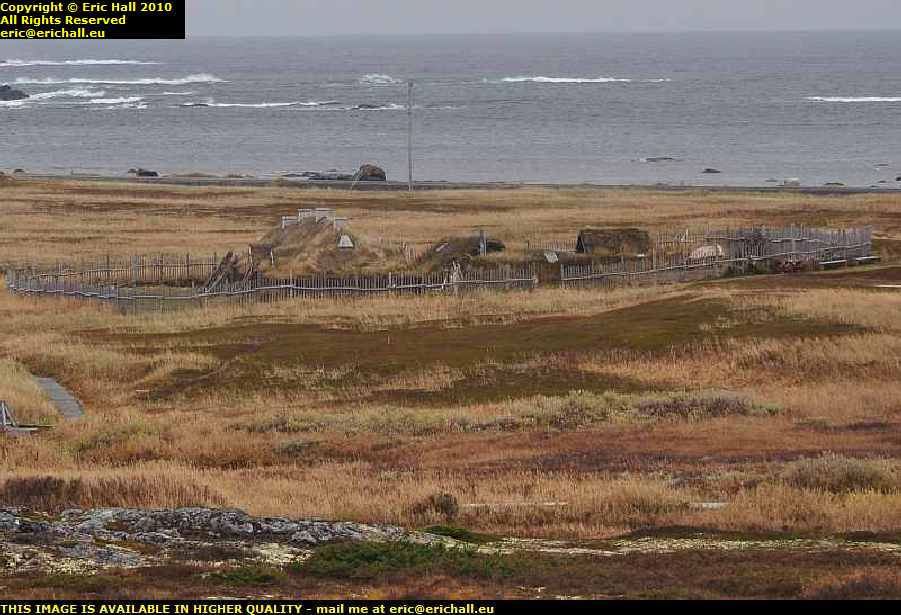
l'anse aux meadows viking settlement norse newfoundland canadaThe view is spectacular and you can understand why the Norse chose this particular site.

There are two crescent-moon shaped bays, both well-sheltered, next to each other surrounded by cliffs to the prevailing northern side, and a low bank behind to stop the easterly winds. The boats could be brought right up to the village when weather conditions were right but a sandbank has intervened these days.

l'anse aux meadows viking settlement norse newfoundland canadaUnfortunately, the place was all closed up and locked, but having driven all of this way to get here, I was not going to be thwarted.

A visitor centre with a low roof miles from anywhere where there isn’t anyone about is not going to be a barrier to anyone who is sufficiently determined, and 10 minutes later we were in the park.

ruins viking norse remains l'anse aux meadows newfoundland canadaIt’s a little confusing at first – they have built some replicas of the Viking buildings, but these are some way from the remains of the original Viking ruins.

The remains of the original buildings are surprisingly open. They are not fenced off at all to anyone so you can wander around them.

bog iron l'anse aux meadows viking settlement norse newfoundland canadaThere are all kinds of traces of bog iron too just floating on the surface of the bog. The Norse travellers would have found this very useful to repair their ships.

But after that I had to clear off smartish-like because the heavens opened and I was soaked to the skin just walking back to the car. And I don’t have long here and I have a lot to do.

You may not think it but Newfoundland is huge, much bigger than it looks on a map and I have to travel from here, at the extreme north-east, down to the Marconi station at the extreme south-west, and its over 1300 kms, would you believe.

deer lake motel newfoundland canadaAnd so in a kind of minimalist mode I’ve made it this evening to Deer Lake where I can pick up the Trans-Canada Highway eastward.

The motel isn’t as cheap (by a long way) as I’d been hoping, but around here there are not so many choices. There was a cheap bed-and-breakfast but no-one answered when I knocked on the door. It made me wish that I had bought a mobile phone as well as a Sat-Nav.

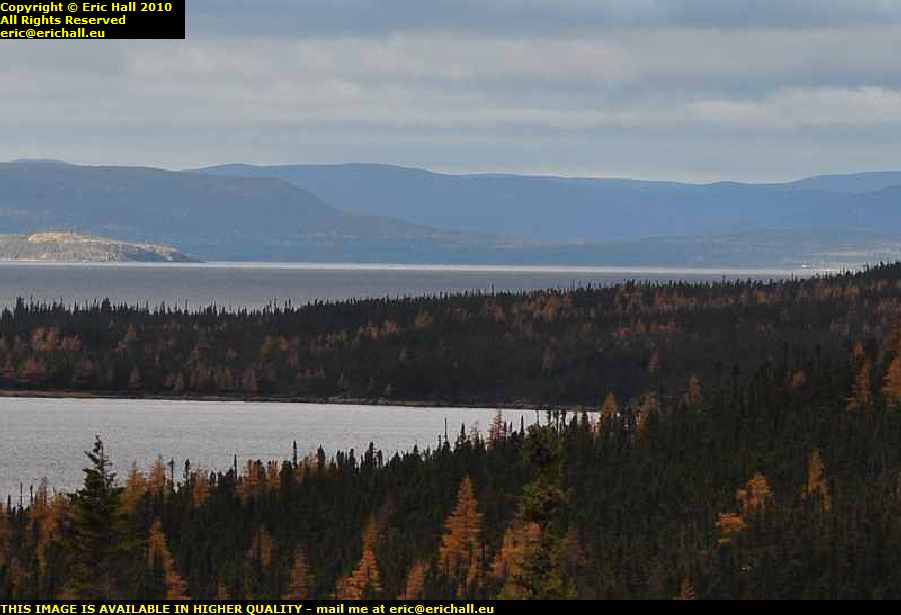
beautiful scenery north west newfoundland canadaThe drive along the Viking Trail down from l’Anse aux Meadows to here was almost 500 kms, you know and we went through some wonderful scenery, because Northern Newfoundland really is beautiful.

There are some really nice mountains and massifs and had the weather been better and had I had more time, I could have taken hundreds of photos along here but I was in a rush.

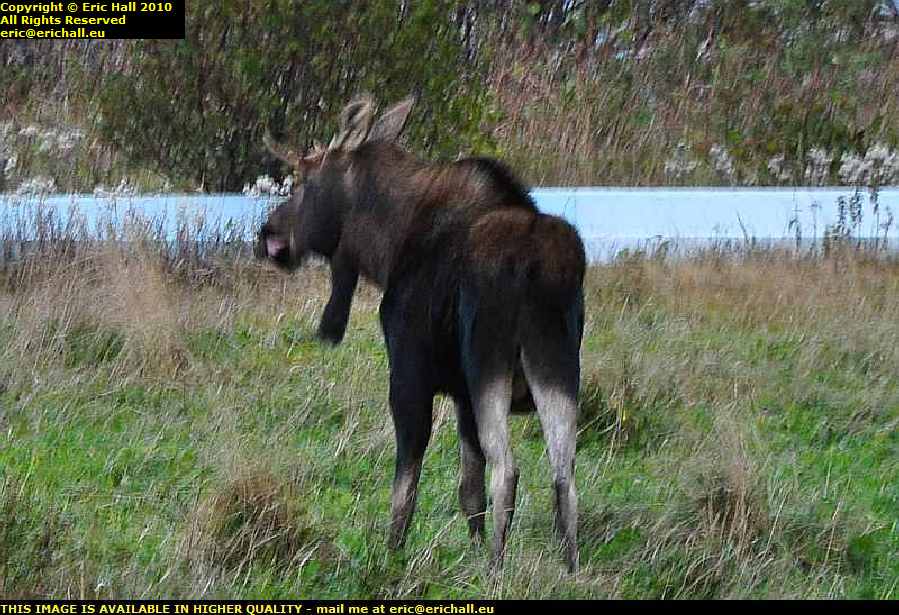
moose newfoundland canadaWe also saw some of Strawberry Moose‘s cousins. One was quite a good clear shot which came out blurred due to the darkness that was surrounding me.

As for the second – there were about 3 vehicles in a line – I was the middle one – and in the darkness and we were travelling at speed, suddenly the front car slammed on his brakes and screeched to a stop, and we saw four long legs in the headlight beam disappear into the forest. He had just had a close encounter with a moose. It was noticeable that for the remaining 30 kms to Deer Lake his speed dropped from over 100 kph down to about 70 kph.

Tomorrow I’m back on the highway and I want to do all of it to Saint Johns in one go. If I can find somewhere cheap to stay I’ll do 2 nights there, visit Cape Race and the Transatlantic Air Museum, and then head back to the south-western corner (Newfoundland is like a big triangle) to my ferry Thursday night.

Thursday 14th October 2010 – WELL, STRAWBERRY MOOSE HAD A GOOD DAY TODAY.

strawberry moose family labrador coastal drive canadaOn the road between Port Hope Simpson and Mary’s Harbour we encountered some more of his cousins. This time it was mother and daughter.

And a short while later we encountered another juvenile. So he’s having fun anyway, meeting up with all of his family and he’s ever so excited about it all. Good old Strawberry Moose

wunderstrand norse viking visit site cartwright labrador canadaAs for me, I’ve done nothing like as much as I hoped. But then again, I’ve been distracted. For a start I couldn’t get out to see the Wunderstrand.

Although it’s just across the bay from Cartwright, it’s actually a 10-mile walk followed by a 10-minute kayak journey (you need to carry your kayak the 10 miles, by the way), or else it’s half an hour across the bay in a kayak (in a howling wind across freezing cold water) and of course regular readers of these columns know that you couldn’t get warm again. You know that it’s against the law to light a fire in a canoe – you cannot have your kayak and heat it.

wunderstrand norse viking visit site cartwright labrador canadaThere is however a certain spot to which you can drive and with a long telephoto lens and a little judicious crop and sharpen, you can make out the beach right away in the distance and see just how beautiful it all is.

Of course a photo isn’t the same as actually walking in the footsteps of Eirik the Red at the climax of his magnificent epic voyage to Vinland, but I suppose that it’s the best that I can do

pinsent's arm labrador canadaAnyway, back on the Labrador Coastal Drive (as this bit of the Trans-Labrador Highway is called) the next stop was the most delightfully-named Pinsent’s Arm, a small fishing village on the coast in a sheltered bay off the Atlantic. I always thought that the name was quite romantic.

I had to ask directions when I got to Charlottetown. I hailed a passing native (who picked up a handful of gravel and hailed me back)
“Excuse me – can you tell me where I can find Pinsent’s Arm?”
“Why yes alrighty” she burred (I just love the way they talk in Labrador). “It’s over there in that bucket”.

fishing boat pinsent's arm labrador canadaPinsent’s Arm has a population of 64 and they were all on the quayside waiting for me to arrive.

One of the fishing smacks that operates out of here had just put in to port.
“What do you catch here now that the cod has finished? Shrimp like out of Cartwright?” I enquired.
“Why no” he replied. “We get them thar whelks and scallops”.
But if they were whelks and scallops in those baskets they were unloading then I’m going to have my eyes tested as soon as I get back to Europe.

atlantic ocean pinsent's arm labrador canadaThe natives, obviously wishing to see the back of me, pointed out to me the way through the rubbish dump and local tip to the point where you can see the Atlantic through the cove.

This is quite impressive, and would have been even nicer had I been more lucky with the weather. But it could have been worse – it could have been snowing.

iceberg alley st lewis labrador canadaI also went off down Iceberg Alley for a visit to St Lewis – the farthest easternmost settlement on the mainland American continent.

And if ever I have the luck to be able to choose a place out here to settle it would be here. St Lewis is easily the prettiest place that I have ever visited on the North American continent.

It was settled in the earliest days of white exploration and then forgotten.

iceberg alley st lewis labrador canadaAnd when it was “rediscovered” in the 19th Century, the person who discovered it (I can’t remember his name just now) remarked on the “industry and divinity” of the inhabitants. I suppose that a couple of hundred years of isolation had had its advantages for the inhabitants.

But all of that changed after World War II

pinetree radar station st lewis labrador canadaIts more modern claim to fame, as everyone will tell you, is that it was a station on the DEW line – the Distant Early Warning radar system installed by the Americans on Canadian soil to track and then shoot down the atomically-armed Russian bombers so that the nuclear fallout would be in Canada and not in the USA.

But of course it wasn’t on the DEW line, despite how romantic the legend sounds, as you can tell from the antennae. It was actually a site on Pinetree – the forerunner of the DEW line but which operated on a much shorter-reach traditional radar system and with all the defects of a traditional system.

Once the Russians mastered the art of low-flying, Pinetree’s days were numbered.

alexis river port hope simpson labrador coastal drive canadaBut it’s unfair to single out places like St Lewis and Pinsent’s Arm for their beauty. The whole of this road – the Labrador Coastal Drive – is full of spectacular scenery.

This is, I think, Alexis River near Port Hope Simpson and if there is a more beautiful place to stop and eat my midday butty, I would really love to see it. In fact, the nice lay-by here would be an ideal place to stay for the night, if only I had a camper.

And after that, with me not being halfway around where I wanted to go, and having found some playmates for His Nibs, I’ve had to lay up for the night in Mary’s Harbour (spelt correctly – this is Canada not the USA).

Wednesday 13th October 2010 – I’VE SEEN A BEAR!

eagle plateau black bear trans labrador highway canadaYes, I really have!

Rupert sauntered across the road about 150 metres in front of me and then stopped by the side of the road waiting for me to ensure his immortality by recording his features in the camera.

But I’m ever so impressed by all of this, I really am. I think that all of the wildlife have been briefed to expect the arrival of the legendary Strawberry Moose and they are lying in wait.

united states air base happy valley goose bay labrador canadaSo this morning having left my extortionate and over-priced motel (but then again everything is extortionate and over-priced out here and when you work out the logistics of bringing the stuff up here it’s hardly any surprise – you just need to be prepared for the shock) I had a wander around to see the air base at Goose Bay

its well-known airfield from World War II when it was one of the wayside stations in the Atlantic Ferry but there wasn’t anything significant to observe. It’s all seen much better days and is pretty much derelict now.

labrador coastal drive canadaAnd so I headed off for part III of the route – the Labrador Coastal Drive.

This part of the road here towards L’Anse au Loup was finally opened earlier this year and it is this that has made my journey feasible. Prior to this, one had to go to the docks, stick one’s car into a container and wait for a ship for Cartwright.

labrador coastal drive canadaThe road was surprisingly good and I could keep up a good speed along it for the most part although there were a few bits that were thin.

But I did have a problem. Casey is doing about 9.5 litres to the 100 kms on good roads and much more on the rough stuff and so when I took it to be fuelled up, the guy put about 24 litres in, to account for the 300 from Churchill Falls yesterday.

I reckoned that the fuel consumption over that last bit must have been exceptional despite the roads and I was expecting Casey to need much more fuel than that.

But halfway round the route today I noticed that the gauge had dropped alarmingly. It seems that the guy didn’t fill it all the way to the top and it was about 8 litres (the length of the neck) short of fuel.

if ever I come this way again, which I really hope that I shall, I’ll have a 20-litre fuel can with me, and I’ll make sure that it’s full

casey chrysler pt cruiser labrador coastal drive canadaAnd Casey is now thoroughly filthy … "and as if you aren’t" – ed … as the weather conditions were pretty awful with the torrential rain that we were having every now and again.

And with another 750 kms to travel, despite what it says on the sign (and how the towns are spelt – clearly someone in the signwriting service around here has a sense of humour) his condition was not going to improve.

eagle plateau labrador coastal drive canadaBut I wouldn’t have missed this journey for the world, even if I didn’t have much luck with the weather. In good weather this journey would have been stunning and even in weather conditions that I was having, it was quite spectacular.

Anyway, these are only a selection of photos and a short resumé of the journey. To see more, you need to go to this page, start at the beginning, and read on until the end

Eventually, I arrived in Cartwright (after seeing my bear) on fumes, and also with a semi-flat tyre, not that this is any surprise. I’m surprised that it’s the only problem that I have had up to date, given what I’ve gone through this last few days. But now, another one has presented itself.

metis trail cartwright labrador canadaThere are two hotels in the town, and one of them is fully booked and the other one is closed for the season.

However, the owner of the fully-booked one rang up a friend of the owner of the second one and she came out from home to unlock a room for me, and gave me the key to the kitchen to help myself for cooking and for breakfast. It’s a good job that I had bought a few tins of beans and packets of spaghetti for emergencies such as this. I knew that they would.

But there’s about a year’s supply of beer in the kitchen – all kinds of things and I could have a field day in there if I were of that type.

metis trail cartwright labrador canadaHere at Cartwright, an old fishing port dating back to the 18th Century and one of these stops for the coastal ferry trade up the Labrador coast, the road is a new arrival.

Isolated and Remote Canada seems to have these really old and traditional kind of values, as the affair of the motel has provd and I shall always be grateful to them.

Tomorrow when I’ve fixed the tyre and fuelled up I’m going to look at the Norse Wunderstrand then drive back the 82 kms to the highway and go to the site of a historic early Pioneer village, Canada’s second-highest lighthouse, an early Basque whaling station and the Basque fishing boats from the 16th Century that have been salvaged.

Finally, it will be Blanc-Sablon where I may well spend the night ready to take the ferry to Newfoundland the next morning.

But the bear. I can’t get over that. What with the beaver … "it was a porcupine" – ed … on the first day, the moose on the second, the bear on the third – I’m going for the Loch Ness Monster tomorrow!