… written about this place than anywhere else on the planet. And I shall be contributing my fair share too … "groan" – ed.
 Yes, you’ve guessed it. I’m in Rennes-le-Chateau and what am I doing here? Looking for the Holy Grail? Looking for the Children of Jesus? Looking for the tomb of Mary Magdalene? Looking for the lost Cathar treasure?
Or have I simply come for a nosy around to see what all the fuss has been about since an elderly housekeeper strung along a dazzling urbanite with promises of vast wealth and fortune in oder to ensure that she would be well-cared for in the twilight of her life?
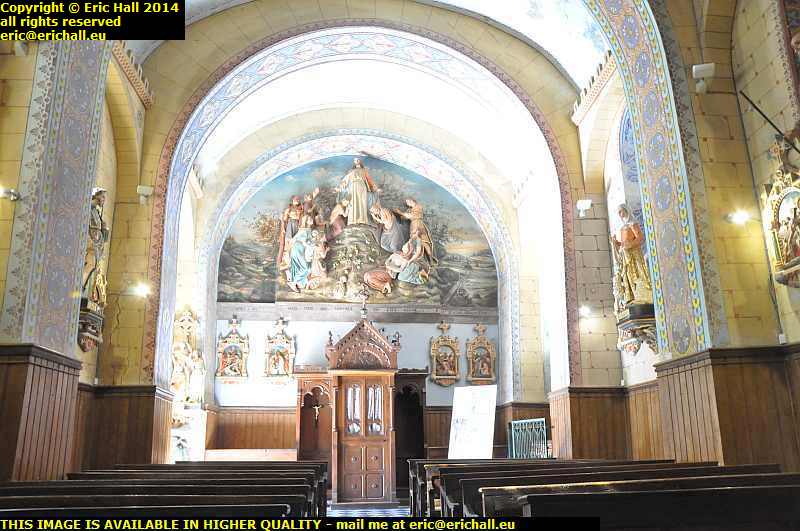 This is the interior of the church of St Mary Magdalene at Rennes-le-Chateau and although it looks quite beautiful today (which it doesn’t, as it happens – it is badly in need of attention which is totally astonishing considering how much money comes here these days), it wasn’t anything like this 130 years ago.
When a new priest, Bérenger Saunière, was appointed to the parish, he was horrified at the state of the place. It had been abandoned during the French Revolution almost 100 years earlier and although there had been a religious revival, the fervour had not reached Rennes-le-Chateau and the building was on the point of collapse.
 He borrowed a little money and made a start on some urgent renovations. But when he turned his attention to the altar, he found that one of the pillars was partly hollow and some parchments had been stuffed into it.
Hollow pillars are nothing new in churches. If you’ve been following my adventures over the last few years you will know from my frequent visits to Auvergnat churches with Marianne that it’s quite customary to have something similar in a church, and it’s where the sacred relics are kept.
And, as you know because I’ve told you this before, there was an inventory of relics carried out in all French churches in the mid-19th century. This church was no exception, and in the diocesan registers there is the report of the visit, and …
Bishop’s investigator “are there any relics in the church?”
Saunière’s predecessor “more than likely”.
It’s curious, to say the least, that Saunière’s predecessor could not give a definitive answer, especially when it’s something that falls within his responsibility.
As for the parchments, there is no dispute whatever that they were found. As to their content however, you’ll have to make up your own mind about that because every person tells a different story.
One thing that should maybe be mentioned however is that the pre-Revolutionary priest of the parish, the Abbé Bigou, was the confessor to several notable families in the area. Believing that the Revolutionaries would pillage absolutely everything that they could find, Bigou’s secret hiding place- the hollowed column used as an altar support – would make a safe cache for anything important.
And Bidou? He fled the Revolution and died in exile, never returning to Rennes-le-Chateau.
So Saunière found some parchments in a hollowed-out column. The next thing of note to happen is that some time later there’s a little enigmatic note in his diary – “ohh, by the way, I found a tomb today”. And then absolute silence.
He’s next in the graveyard attached to the church, frantically digging away to such a degree that the mayor of the commune makes a formal complaint to the Bishop. And then Saunière starts to spend money like water – tens of thousands of pounds.

He rebuilds the church and the presbytery, he refurbishes the village’s water supply, he builds a new road, and then he buys some land and builds himself a sumptious villa with outhouses and a magnificent tower that serves as a library.
He’s then investigated by his bishop – where did the money come from?
The conclusion is that he’s been selling masses. And there’s no doubt that he did. But just how many would he have to have sold in order to have amassed so much money? It’s unthinkable. He’s suspended from office but he carries on as before, taking no notice. Even though there’s a newspaper “advertisement” from the bishop advising his parishioners that he has been relieved of his functions, no-one takes any notice at all. He dies and takes his secret with him to the grave.
Only his faithful housekeeper is aware of the situation. Once she let slip that “the people around here are walking on gold but they just don’t realise it”. She sells the villa to an urbanite from the coast but remains in occupation promising the purchaser that she will make him rich beyond his wildest dreams. But she too takes her secret with her to the grave and that is that.
So where does this leave us?
I’m not going to waste anyone’s time with conjecture. There’s enough rubbish been written already about all of this.
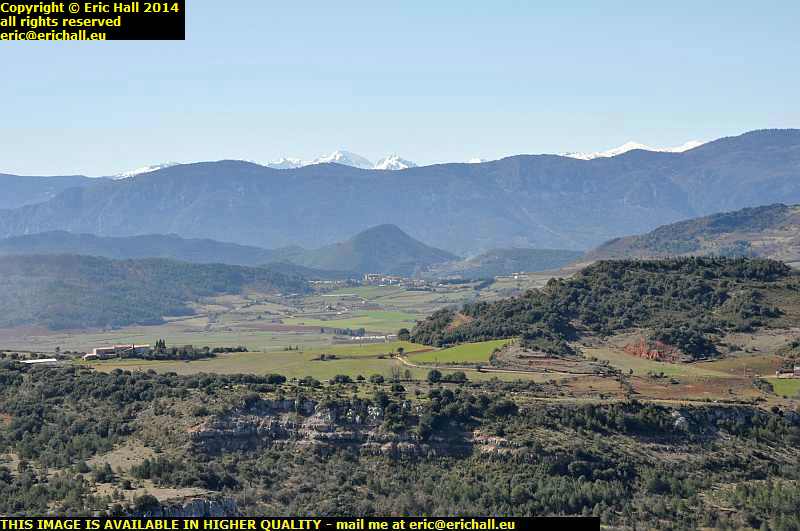
But firstly, one look at this site will tell you that this is the most magnificent defensive situation one could ever imagine, and the view from here commands absolutely everything. Nothing can move within a 20-mile radius without being observed from here.
If I were a neo-historical figure looking for a place to build a palace and a town for my followers, I would choose nowhere else but this. And there is evidence of occupation going back thousands of years – Stone Age, Iron Age, Gallo-Roman – you name it.
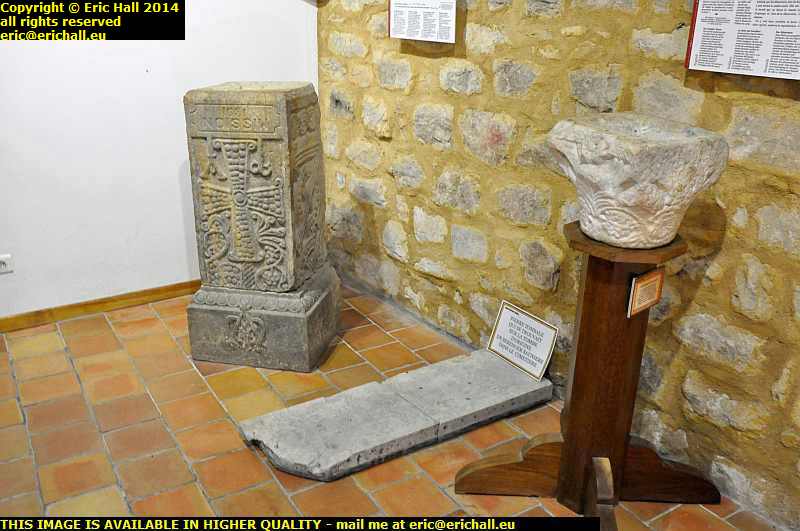
But the Visigoths came to this area in the 5th Century and set up a Kingdom. Their capital city was called Rhedae and from what we know, the site of Rennes-le-Chateau corresponds in every detail with the contemporary description of Rhedae.
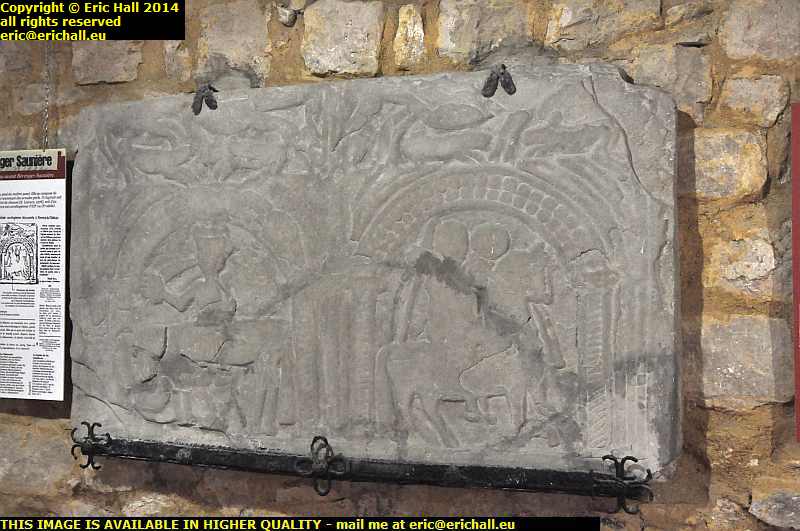 Tons of Visigoth artefacts have been discovered in the area and the church itself contains much evidence of Visigoth stonework, sculpturez and artefacts, such as this magnificent carving that Saunière discovered, face-down on the floor and being used as a flagstone.
There is therefore little doubt that the modern-day Rennes-le-Chateau is the historical Rhedae
 In fact, on my mega-ramble around the site this morning I counted three and perhaps 4 concentric rings of defences around the site, and there is no evidence to suggest that anything much of this relates to a more modern period.
So whoever was fortifying this site really meant it
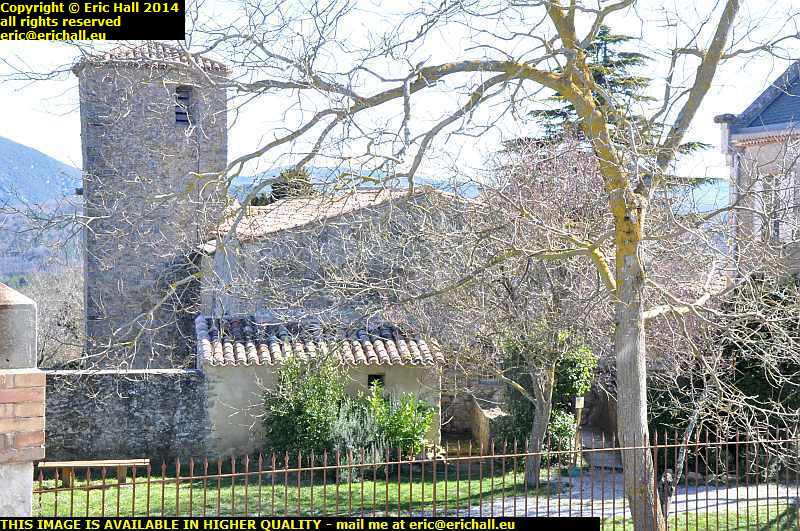
Now if you remember from our discussions a few years ago, it’s perfectly normal for there to be a small chapel included in a castle or chateau once the Lord has converted to Christianlty and, as I have said, there’s certainly a Visigoth presence in the church here.
But as Christianity gained in influence and barbarity slowly died out (not that you would ever notice it) the church would take over more of the site and the castle or chateau would be reduced in size.
 This is the current chateau, right next to the church. But from what I can see at a distant glance, there is nothing particularly Visigoth about this – although I have been told subsequently that part of the foundations is believed to be of Visigoth origin.
And in any case, this is not where I would have my chateau. Mine would be on the highest corner of the walls with the best view – right in fact where Saunière build his tower-library.
Anyway, to continue onwards. Saunière says that he found a tomb. What evidence is there that there was a tomb here? Plenty, as it happens.
In several cases, there are entries in the parish registers of people being “buried in the tomb of the Lords” – the last one being in the 1730s. And it’s only after that date that the Lords (and Ladies) were buried ordinarily in the cemetery.
There have been three inspections of the church using SONAR – a device that measures reflected echoes from the ground – and they have each given a similar result – that at a depth of 5 metres or so under the church there is a reading that corresponds with what one would expect to see if there were a cavern below.
No entrance to this cavern was found, though, and the easiest way to hide an entrance into a cavern (from the outside, anyway) would be to use it as a grave and bury a body in it, and then fill it over. And maybe this was why Saunière was digging frantically in the graveyard. Perhaps the parchments had given him a clue to whose grave it was that led into the cavern.
As an aside – following what have been described as “a few deplorable incidents” (of which we can all hazard a guess) the cemetery is locked and access is only granted to relatives of the inhabitants of the cemetery. I wish that I had known this back in May 2013
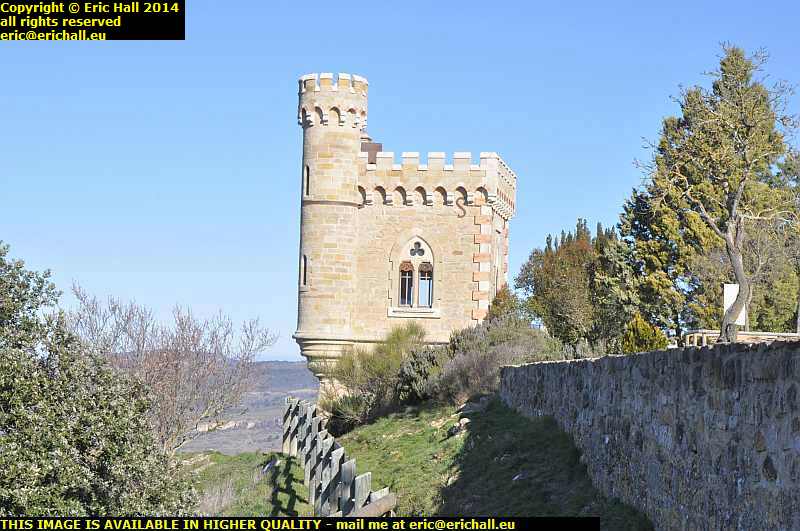
But this is no place for speculation. There’s enough of that about already. And some of the speculation would appear to be manifestly false. Saunière was not always “rolling in money” – even after having discovered whatever it was that he discovered, he had times when there was so little about that the work on his beloved Villa Bethania came to a sudden halt. If he really were blackmailing someone about a guilty secret, he would simply go back for more cash. Or if it were a regular flow of money that he was receiving, he would have planned his work more carefully.
Some say that, being an unltra-Royalist (which he certainly appeared to be), the French monarchist parties were paying him handsomely to propagate their cause. But with a parish of just a few hundred souls, their vote wouldn’t have been worth very much.
And much of the rumour and supposition that circulated following a “disclosure” by someone in Paris in the 1970s and 1980s is now considered by most authorities to be based on a forgery.
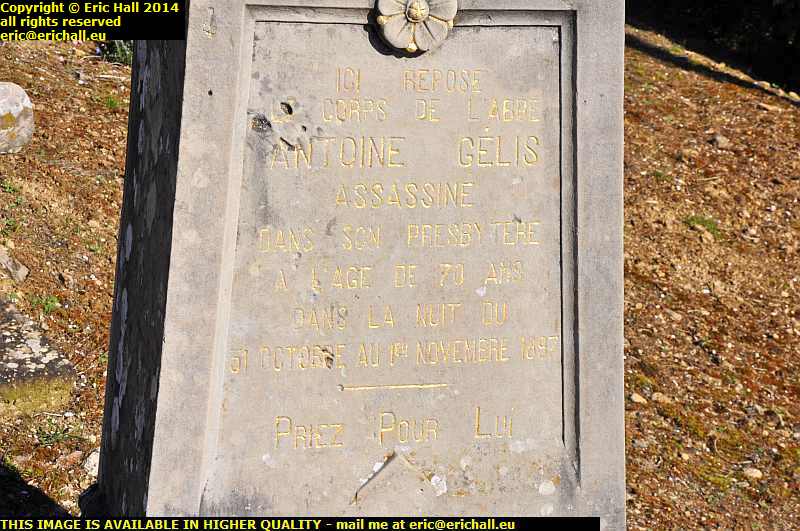
Nevertheless, he did receive money – and plenty of it – from somewhere. And one of his confidants, a priest by the name of Father Gélis from the neighbouring village of Coustaussa, was brutally murdered one night while all of this was going on.
Even today, the locals at Coustaussa (and I found some pretty vocal local yokels who told be everything I want to know) consider that Gélis’ neohew did the deed and did it for the money that Gélis was supposed to have been handling on behalf of Saunière (although the local police dismissed the nephew as a suspect and went to great pains to state that the money remained untouched.
And so you pay your money and you take your choice.
If you want to find out more about the mystery of Rennes-le-Chateau, then there are enough books written on the subject to rebuild completely every single one of the three and maybe four concentric rings of denfensive walls around the village of Rennes-le Chateau. Don’t just read one of them though otherwise you will end up with a very skewed viewpoint and – perish the thought – you might even start to believe that author’s particular slant on all of this.
There are ten thousand books, ten thousand authors, and ten thousand different opinions about the mystery of Rennes-le Chateau.

While I was in Coustaussa checking the grave of Father Antoine Gélis (and believe me, there is nothing in the world more sad than an abandoned cemetery), I went for prowl around the ruined castle.
It was built on an eminence at the foot of Rennes-le-Chateau with the aim of controlling the valley of the River Salz, which as you can see, it does in spades.
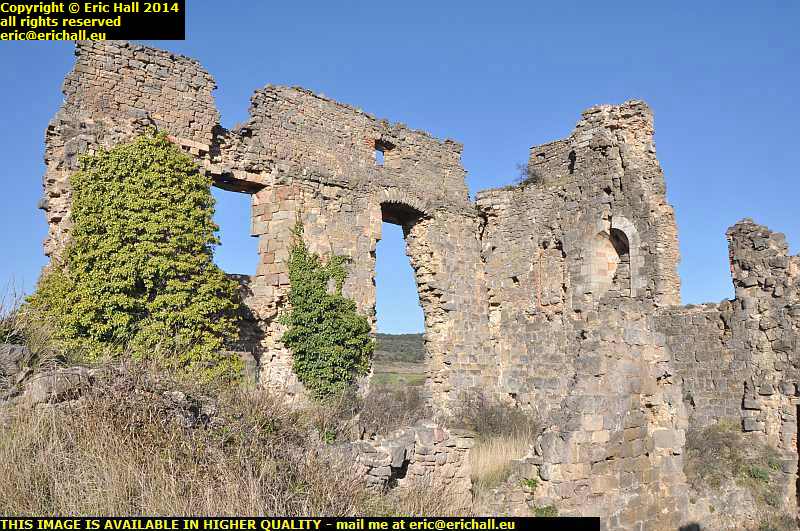
It dates from the 11th and 12th centuries, times of much turbulance in this frontier province, and fell to the Crusading forces in 1210. Nevertheless, it was the scene of a small rebellion, which didn’t last long, but the reprisals were, well, severe, as you might expect whenever Simon de Montfort was about.
This led to the first round of demolition

It was re-established as some kind of manor house in the 16th Century but the Revolution put paid to that. It was sold into private hands and the new owner treated it as a quarry, selling off all of the stones to the locals in the neighbourhood for their various building projects.
That really marked the end of the Chateau as we know it.
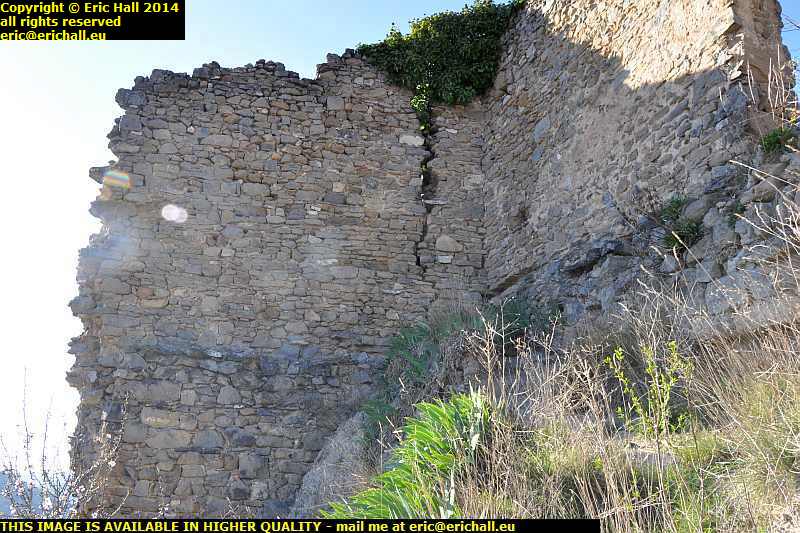
It’s still in private hads today and one is supposed to ask the owner for permission to visit the castle (which is not for the faint-hearted as it really isn’t very secure)
I duly presented myself at the relevant address, only to discover that it has been a long time since the owner has taken the trouble to visit his own premises, and so I took it upon myself to enter. I wasn’t going to let a ruin like this pass me by.
So now having given Caliburn a good wash (because, believe me, he needed it after the snows and salty roads of Andorra) I’m now in the pretty-derelict spa town of Rennes-les-Bains. A couple of things I need to do here.
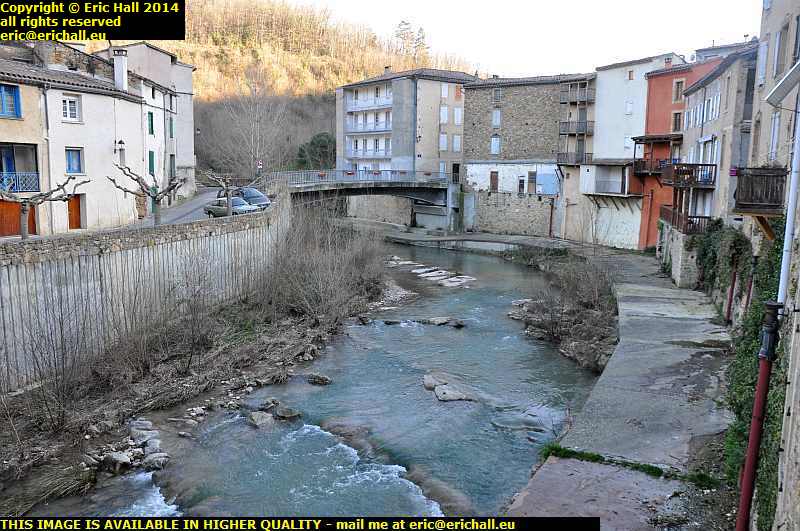 … thatI’ll be staying on in Rennes-les-Bains for a few days. And for several reasons too.
 But getting there is by no means easy. Not as exhausting as the climb up to Montségur the other day, but there is just so much of it and the path is in a terrible condition.
  The castle was the former home of Bertrand de Blanchefort. He was 4th Grand Master of the Knights Templar, whose period of office was from 1153 to 1170, and this is just about all that I could find of the remains of his castle.
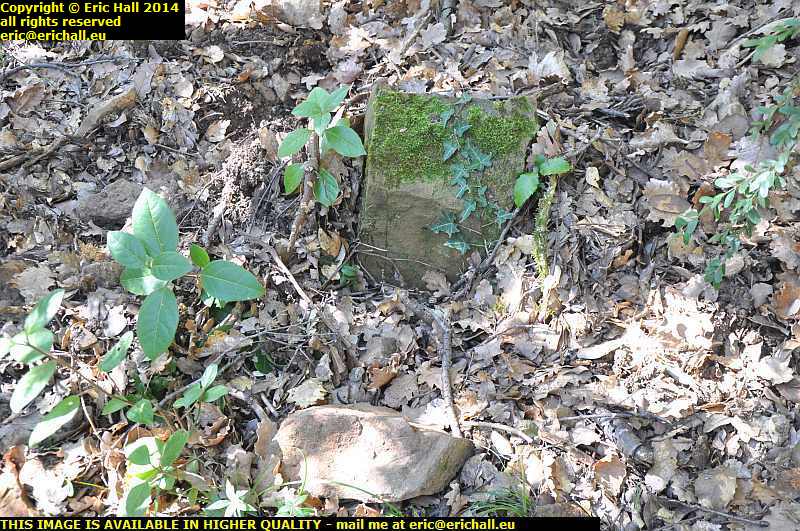 It’s not quite all that remains of the castle. I had a good rummage around and found quite a few stones, such as these examples, that have clearly been “dressed”.
 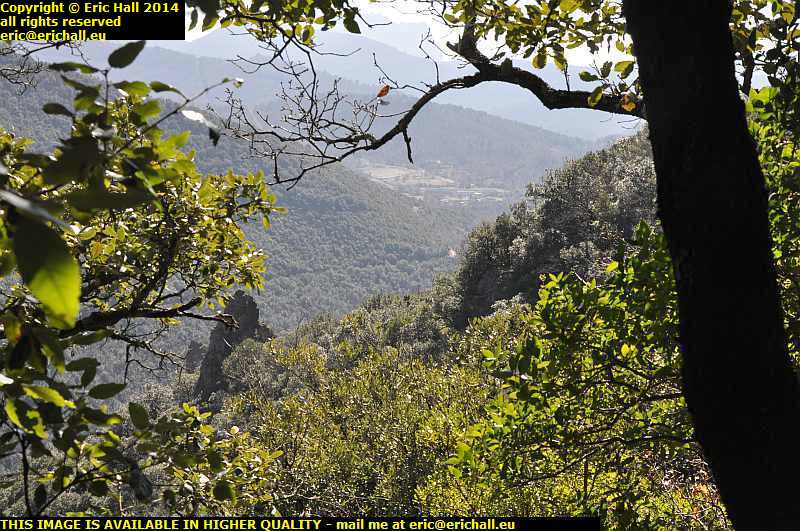 Right down there at the bottom of the valley, out of the shot unfortunately, is the River Salz and it’s from there (or thereabouts) that I’ve walked.
  This is a close-up of the famous “Cardou” mountain.
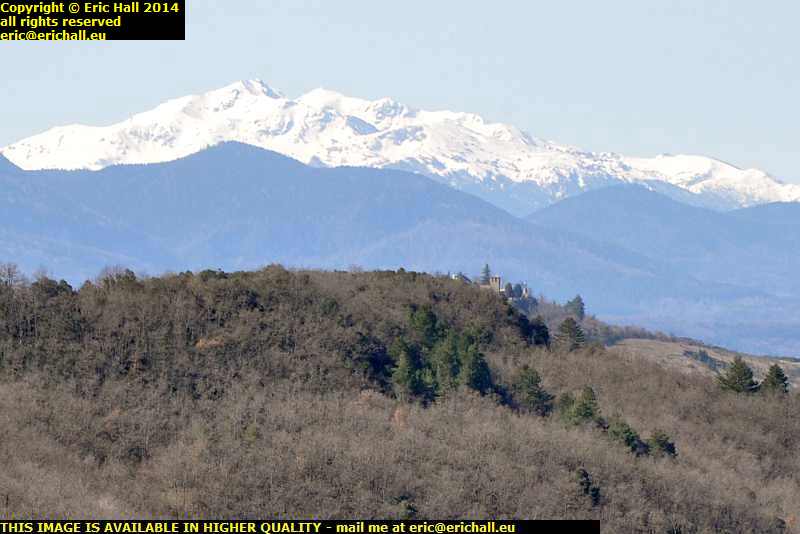 But leaving all of the conjecture aside, let’s sit for a while right at the top and admire the view.
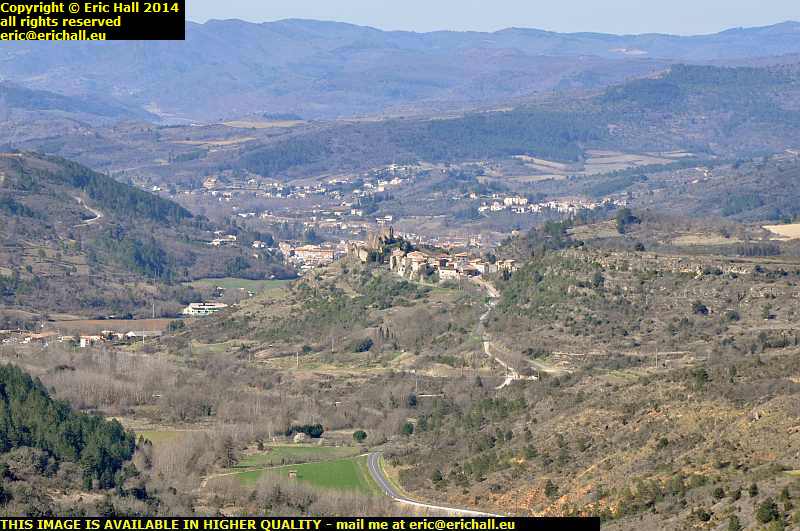 That down there is Coustaussa where we went yesterday afternoon to see the ruins of the castle and also the grave of the Abbé Antoine Gélis who was murdered at the vicarage and whose murder was never solved (no Miss Marple in France of course – she would never have missed out on a Murder at the Vicarage in the UK)