Tag Archives: coal mine

Tuesday 6th August 2019 – GUESS WHO …

… has been a busy boy today.

Started off with a reasonable night’s sleep with just a little tossing and turning here and there, but it was a struggle to leave the bed, I can tell you.

So medicine, another shower and clean-up, followed by breakfast, and then uploading all of the … gulp … 180 photos from yesterday onto the laptop.

And then uploading the dictaphone note and the dashcam stuff too. I was exhausted after that.

There should have been an early start but I ended up chatting to mine host and wife for quite some time in exchange for a coffee.

Up the road, first to Decker where I photographed a lot of the mining installations there. Much of it is open-cast but there is evidence of what is suggestive of a deep mine.

Onwards then to the site of the Battle of the Rosebud where I spent a couple of hours wandering about the part of the battlefield that is on public land (and there’s not so much of that).

But the battle itself is very interesting, if not crucial. General Crook, whose adventures we have followed in the past thanks to John Bourke’s brilliant On The Border With Crook has been discussed in these pages many times, was on his way to join up with Custer and Co when his over-stretched and over-tired column, resting on the Rosebud, was hit by a large party of native Americans.

Although Crooks troops pushed them off, they were so battered that they had to retreat to their camp at Goose Creek (near present-day Sheridan) to regroup and resupply.

And so they never joined up with Custer.

So imagine how different the battle of the Little Big Horn would have been had Custer had an extra 1100 troops at his disposal (although whether he would have welcomed them was another matter – he had turned down two regiments of infantry and a Gatling gun brigade on the grounds that they would slow him down).

From there I passed by Little Big Horn again (still wondering why the cavalry dismounted. On foot they were useless. At least mounted, they could have gone for an “arrowhead” charge to try to break out, rather than be butchered on the ground) and through to the Crow Agency where I stopped for fuel.

And that wasn’t a good idea. I ended up being stuck for about 20 minutes in a roadworks queue and then another 20 minutes at a level crossing as a mile-long coal train inched its way by.

A good run into the Big Horn mountains brought ;e to the head of the Bozeman Trail. Here after much binding in the marsh I found where the “Hayfield Fight” had been, but finding Fort CF Smith was rather different. I knew the GPS location which I knew was a private field, so from the field’s edge on both sides I tried to find anything at all.

There were some vague outlines in the field but really they could be anything. Trying to find the remains of adobe buildings that had been abandoned and burnt in 1868 was expecting too much.

There was no sign or anything acknowledging its existence so I had to go by where I would have put the fort had I been in charge.

On the way back I found a car upside-down in a ditch, and then a very long drive all the way back to the outskirts of Sheridan.

At Ranchester I found the site of the “Battle of Tongue River” where General Connor’s troops attacked a sleeping Arapaho village and killed mainly non-combatant women, children and the elderly.

Incidentally, have you always noticed that it’s a “battle” whenever the white men attacked native civilians, yet it’s a “massacre” whenever the natives returned the compliment?

I carried on then down the Bozeman Trail looking for the sites relating to Fort Phil Kearny. I found the wagon-hill fight site and the “6th December” fight, but not the site of the death of French Pete which rather annoyed me.

Buffalo is on the limit of the Sturgis Festival travel zone so finding a motel was difficult. A friendly motel owner rang a few friends and now I’m in a cabin on the edge of town.

I was rather dubious at first, as the smell of wet dog in the reception put me off and the scrap car and general air of neglect didn’t help, but it’s very deceptive as the cabins are beautiful inside.

I’ve had my soup, and I’m not going out. I shall enjoy my little cabin while I can.

Thursday 16th September 2010 – You’ve probably noticed …

… that a photo has miraculously appeared for yesterday’s image. That’s because I took it this morning first thing before I did anything else.

If you take a photo in the evening just after you have finished the cement is never dry and so you can’t really see the pointing so well.

So after that, and after breakfast, I started on my notes for the tacot. And I bet you are wondering what the tacot is. Look in any idiomatic French dictionary and you’ll see that it means “old banger”, as in some kind of disreputable car. But if you translated it to “rattletrap” or “jalopy” then you’ll understand that it refers to the Lignes Economique – the narrow-gauge light railways that littered the Allier at the turn of the 20th Century.

Marianne, the local history expert, found a book on them and has lent it to me, but she wants it back before I go to Canada at the end of the month. And so I only have 10 days or so to make notes.

It’s an exciting book – not because of its style and the way that it’s written – but more the fact that it’s written in some kind of reporter-style sensationalist account. It recounts the history of the duel between a politician and the railway manager and a few other exciting bits (life is not all boring around here, you know) but it’s strangely short on a good deal of technical information that you would have in a British book on the subject. Clearly they are more interested in the social side of events rather than the technical side.

The line at Marcillat en Combraille is featured in it, as you might expect, and it’s a monument to the shortsightedness and pigheadedness of local politicians. The line was proposed to run from the mines at Villefranche through the steelworks at Commentry, down to the limestone at Marcillat en Combraille (my guess about that was a good one) and then on to the main line into the wilderness of South-western France at Evaux-les-Bains. But when they had the quote they decided that it was too expensive and so they would shorten it. They relied upon a standard-gauge railway line frm another company to bring the coal from the mines down a branch line to where the ligne metrique would now start (involving a needless trans-shipment that would cost money and cause delays of course), and then stop the line at Marcillat en Combraille. With Evaux being in a different Departement (the Creuse) it was a case of “if they want it they can pay for it”.

Once the line was opened however, the standard gauge company closed down the branch line and ran their own line down to Commentry instead. Thus, with no through traffic to and from Commentry to the south-west of France, as provided for in the original estimations, the line quietly stagnated

But if you remember the famous bridge that I investigated several weeks ago, I’ve ruled it out as the bridge for the tacot. In the book that Marianne lent me, there’s a diary by a traveller from Paris who took his week’s annual holiday to ride all of the lines of the tacot d’Allier, all 272 kms of them.

He quite clearly describes the route from Commentry and he says that it follows a river valley well to the south (not the north, where my bridge is) of Durdat-Larequille, and makes the point that the village is “away to the north” of the station. Ahh well.

This afternoon I’ve been pointing again and harvesting veg, and tonight I’ve been cooking tea – the same as last night as it happens – and making some damson jam-type of stuff to flavour my plain soya desserts.

I’m enjoying life in the countryside like this.

Wednesday 1st September2010 – A couple of things have happened today …

… that have been well-worth recording.

Firstly, an event that happens so rarely that a note needs to be made of it so that it can silence my critics, and that is that I was up, washed and breakfasted this morning before the alarm went off. And how often does that happen? It must be my guilty conscience pricking me, or else I wet the bed or something.

Mind you, this back trouble that I have, with it sticking to the sheets, is something of a recent phenomenon. When I lived in Crewe, you know I was quite an early riser. For example, there were 37 magistrates that sat on the bench of the Crewe Petty Sessions and I was up before them on a regular basis.

home made immersion heater temperature les guis virlet puy de dome franceSecond thing that happened to day was that the home-made immersion heater that has been ticking along quite nicely, burst into frenzied activity today.

52 degrees it made, with an ambient temperature of  just 21.5. And by the time the water had finished doing its stuff it had reached 53.5. A load of insulation wrapped round that will see that fine, I reckon.

But the sun has gone down from the solar water and it struggled up to 31 degrees, even though it was bright sunshine outside. However a bucket of water out of the small boiler settled that and I had a nice shower this evening. I’d already sampled some of the hot water for a wash and shave as I was going out. I like this boiler!

There were two reasons why I had to look pretty. Firstly I’ve been appointed to this referee’s whatsit. I’ve had my letter today, so it was off to Montlucon to buy some kit. A nice shirt, shorts, socks, whistle and red and yellow cards. What else does a man need?

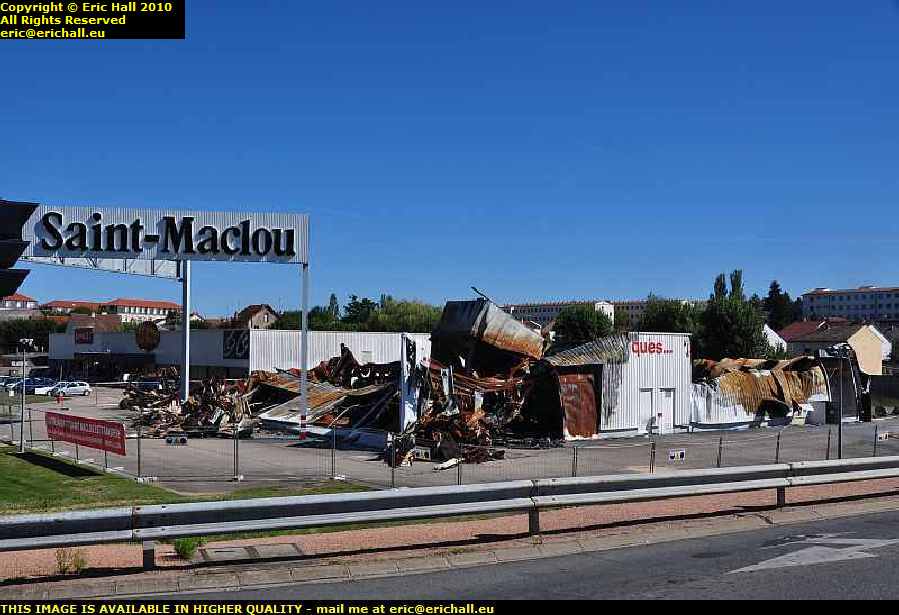
saint maclou burnt down montlucon allier franceThe sports shop where I had to go for my kit is opposite the Auchan and so I have to go past the big traffic lights at the top of the hill. And this was the site that caught my eye this morning.

The big Saint Maclou home decoration place seems to have suffered a major catastrophe since the last time that I passed this way. This is a bit of a mess, isn’t it? I wonder what happened here.

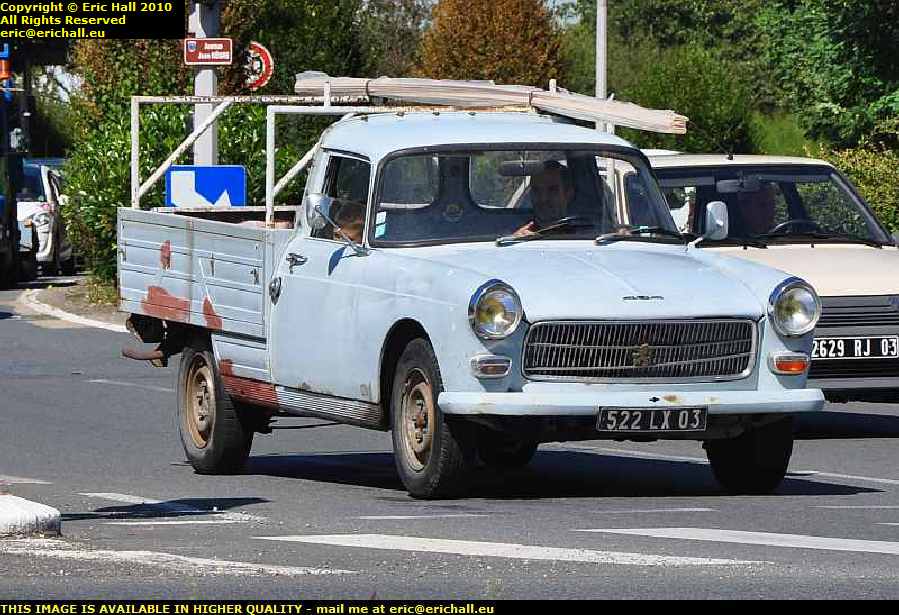
old cars peugeot 404 pickup montlucon allier franceAnd that’s not all that was interesting either. An ancient Peugeot 404 pick-up caught my eye while I was waiting at the traffic lights.

Back 20 years ago you would see thousands of these with their huge canvas tilts on French roads and they were the arch-typical French motor vehicle. Every farmer or rural dweller was the owner of one of these. However, today, you are very lucky if you actually see one. They are a dying breed and that’s so sad.

One thing that I learnt when I was talking to Franck in the Sports Shop is that have to go to Clermont Ferrand on Saturday 11th September for a referees’ induction meeting. It starts at 08:45 – heck, I can’t even normally make my kitchen for then!

But the second reason for going out was that Liz and I had been summoned to Marcillat en Combraille – the offices of Radio Tartasse, a small local radio station that broadcasts to the south of the Allier and the eastern Creuze as far as Gueret. They want to franchise “Radio Anglais” too. Yes our fame is spreading.

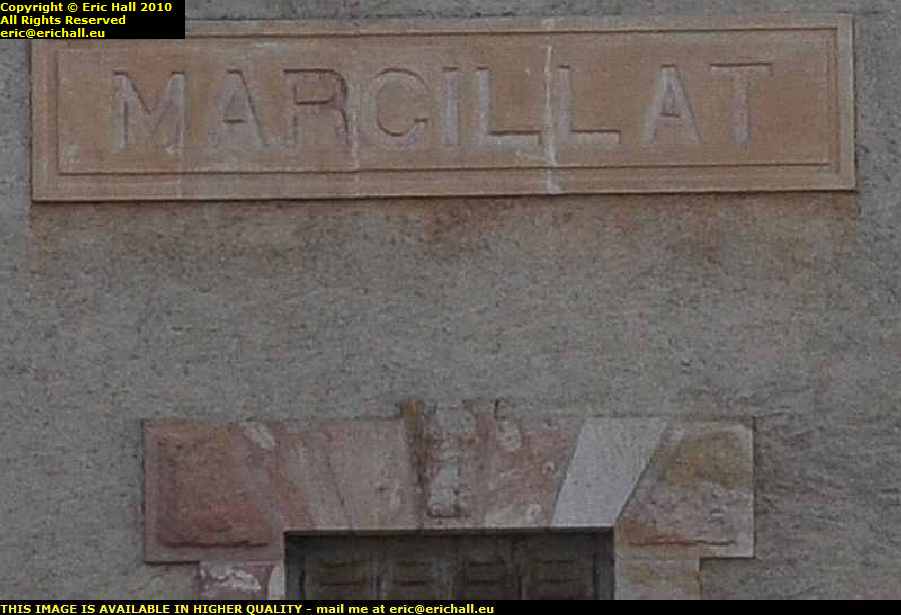
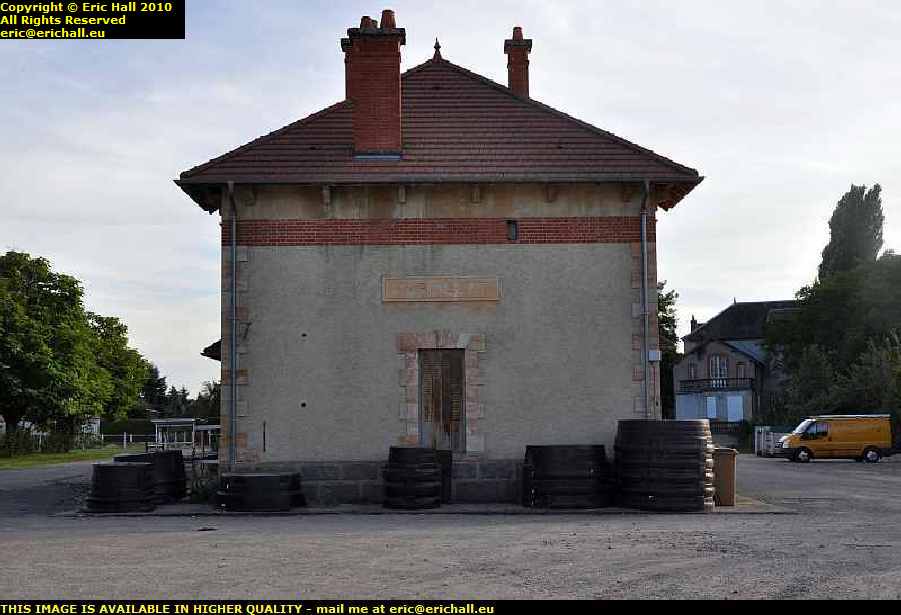
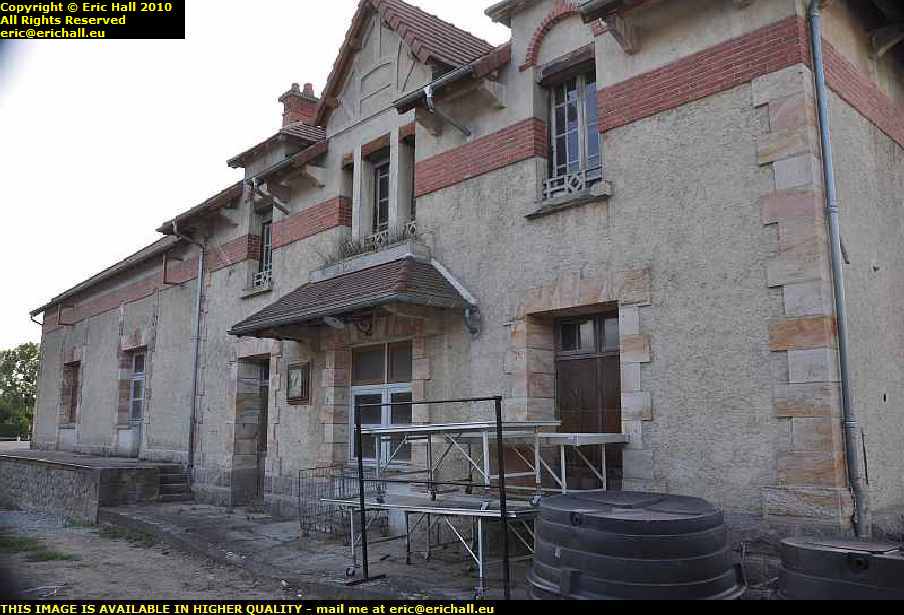
gare de marcillat en combraille railway station paris orleans montlucon gouttieres allier franceAnd after going to a cafe in Marcillat en Combraille, where the waiter forgot to bring us out coffees, Liz and I went for a nosey around the old station site there, now that I have been able to work out where it is.

This is the railway station of the very, very ephemeral railway line built by the Paris-Orleans railway company between Montlucon and Gouttieres

gare de marcillat en combraille railway station paris orleans montlucon gouttieres allier franceI say “ephemeral” because it really was. Although the line was agreed back in the 1880s to be of public utility, it was the “discovery” of coal at Gouttieres (about which we talked a good few weeks ago) at the turn of the 20th Century that provided the impetus for the building of the line to start.

1912 was when construction started and was stopped at the start of World War I, before any kind of real progress had been made.

gare de marcillat en combraille railway station paris orleans montlucon gouttieres allier franceBy the time the War was over, it had been discovered that the Gouttieres coal seam was uneconomic and its exploitation had been abandoned, so further progress on the line was very half-hearted indeed.

It wasn’t until 1932 that the line was finally opened, and the passenger service lasted just 7 years. At the outbreak of World War II it was suspended “for the duration” and was never seriously restarted – certainly this far down the line.

gare de marcillat en combraille railway station paris orleans montlucon gouttieres allier franceAlthough a goods service continued on the line as far as Pionsat until the 1960s, the last passenger train on any part of the line was a weekly service between Paris and Neris-les-Bains which ceased operation in 1957.

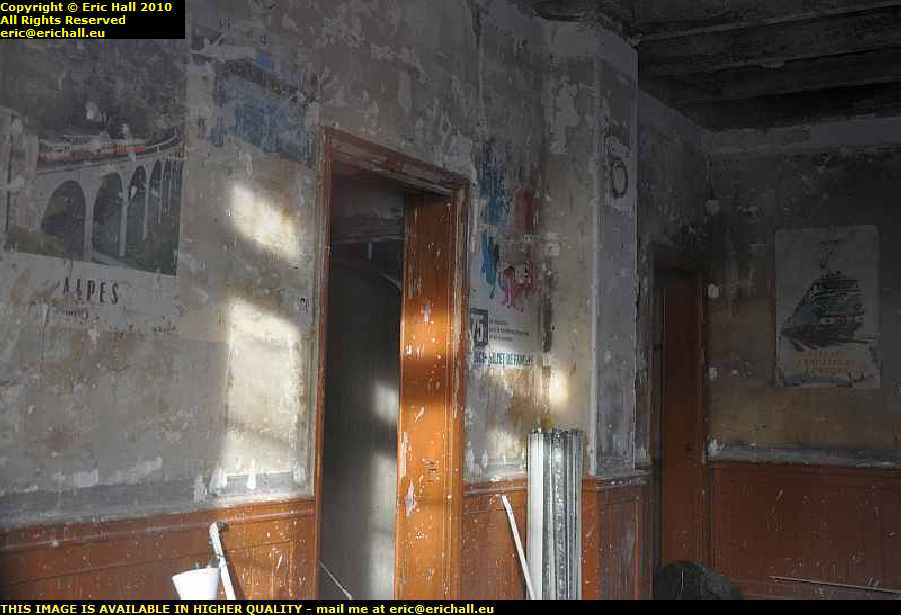
Sticking our heads to the window of the railway station though, we could see in what was the public waiting room some really wonderful railway posters from the 1930s advertising all kinds of railway excursions.

So there you are then – wasn’t that an exciting day out?

Phew!

Monday 24th May 2010 – There were about 15 of us …

… including Clotilde and Heidi from the Conversation Group, who went for this tramp in the woods today. Unfortunately the tramp got away but never mind – we’ll get him next time.

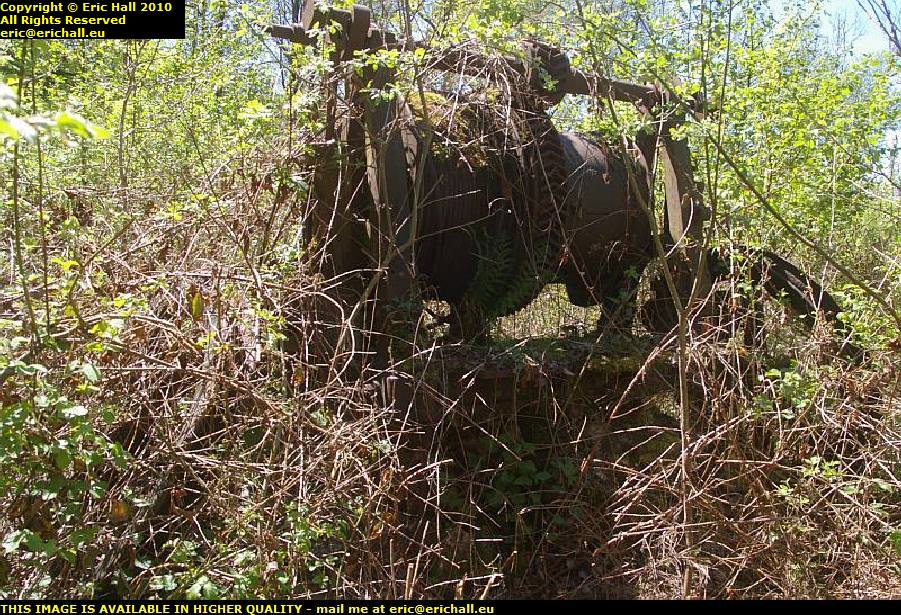
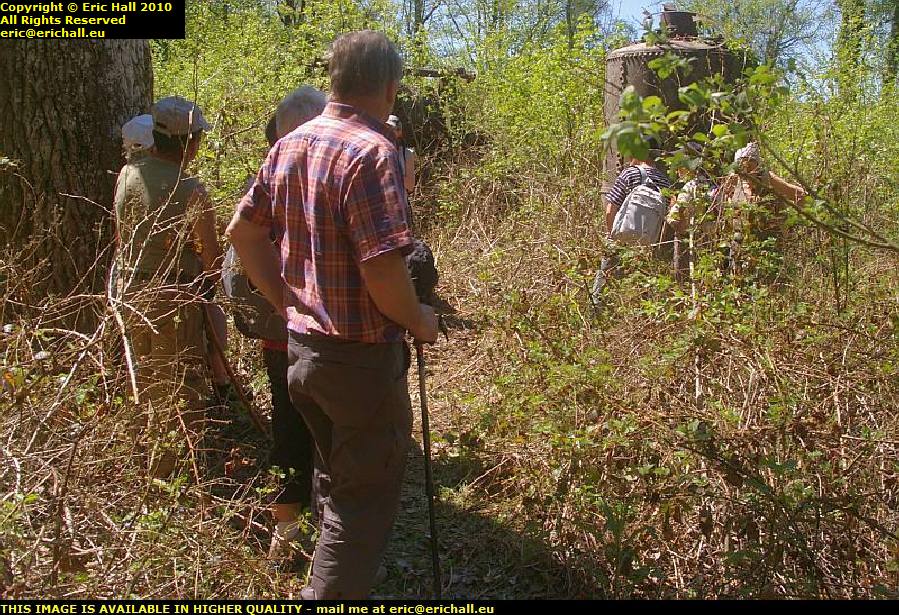
coal mine abandoned pithead winding gear gouttieres puy de dome franceFirst place we were taken to was deep in the woods at the back of Gouttieres, and here we uncovered some old machinery.

It is in fact some old pithead winding gear – a winding frame of sorts and a steam engine to power it – and dates from the turn of the 20th Century when this mine-shaft was sunk to exploit the coal seam here.

St Eloy les Mines was well-known for its coal mines, as I have said many times in the past and as the quest for fuel intensified at the end of the 19th Century they started to sink shafts at the peripheral edges of the valley.

coal mine abandoned pithead winding gear gouttieres puy de dome franceThey struck a good, profitable seam at Youx and Montjoie and so they followed it right through to the edge of the plateau where the valley opens out into the valley of the Sioule.

Early indications were promising and several mines were sunk in the area between Gouttieres and Lapeize, including this site in the forest at the back of Gouttieres. They had high hopes for the area – even going to the lengths of making a huge goods yard at the railway station at Gouttieres for the trans-shipment of the mined coal.

A great deal of investment was made in the area, not just with the mine installations themselves but even dividing up farmland into tiny plots for housing for the workers, but all hopes were dashed as the coal quite literally turned to dust.

puits michelin abandoned coal mine lapeize gouttieres puy de dome franceNot one of the pits that were sunk lasted more than a handful of years. It was quickly discovered that the reserves were nothing like as prolific as everyone was expecting and there was insufficient coal to make the proposition an economic one.

Even the massive Puits Michelin at Lapeize, the remains of which can be seen in this photograph, lasted no more than 5 years. The huge area that was set aside for a slag heap rose to no more than about 20 feet high.

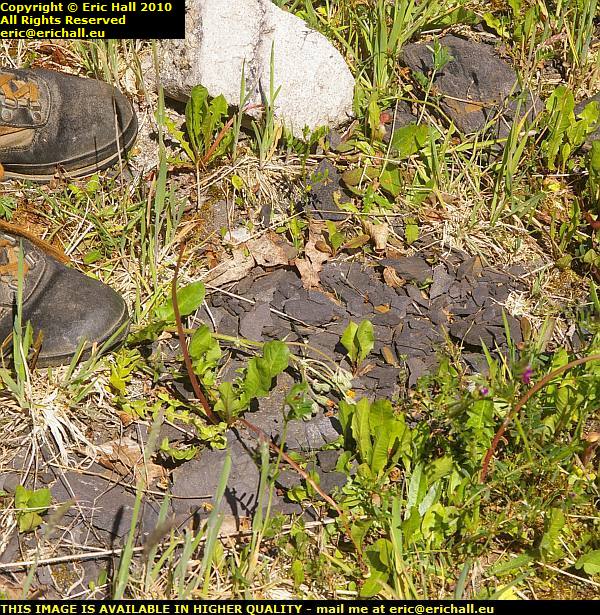
surface coal seam lapeize gouttieres puy de dome franceWe visited the site of 3 or 4 mines but the highlight of the visit, from one point of view at least, was finding the final outcrop of surface coal.

Here, we are probably no more than 300 metres from the Puits Michelin and this is where the coal seam ends. It just curves upwards to the surface and that is that. No wonder that it wasn’t possible to make an economic proposition of coal-mining in the area with the coal seam petering out like this.

A small amount of open-cast mining was carried out here but it was done in a very desultory, half-hearted fasion and never amounted to very much at all.

After a stop for iced water we went to look at the quarries at Lapeize.

gres de lapeize quarry puy de dome franceThe area is famous for the “Grès de Lapeize” – a hard silty millstone grit type of rock with a close affinity to sandstone and there are 5 major outcrops in the Lapeize area.

These have been quarried for centuries, if not millennia, and many important buildings in the area, including the Chateau de Pionsat, are made from the stone.

They closed down just prior to World War II but some kind of desultory attempt was made to restart them but it was doomed to failure. But in 1970 one of the quarries was bought (for a pittance) by a man from St Georges de Mons who was going to build a hotel there and he needed the stone.

old car american GMC world war II lorry  side valve - cylinder gres de lapeize quarry puy de dome franceNow Krys told me to look out for fossils (I suppose she meant something other than my fellow walkers)  but never mind that – the guy who bought the quarry took a wartime American GMC truck – 6-cylinder petrol sidevalve – into the quarry. And people say that it was fitted with a mechanical crane to scoop up the rock.

And one day he simply stopped coming and his truck is still there.

So I had a good nosy around it. It’s been robbed of many parts but its major components are still there. And it’s not a mechanical bucket on the back, it’s a mechanical prodder-type of ram-type of drill for breaking the stone off the wall and into manageable chunks.

Still, hottest day of the year so far – 34.5 degrees and the heat exchanger went off the scale – the first time since 6th August last year.

However it got off to a bad start. Being a Bank Holiday I was planning on a lie-in but not one but two phone calls shortly after 09:00 knackered that idea.

And it’s still warm now. It reached over 27 degrees in here even with all of the windows open and as I type – at 01:40 with all of the windows open and a pleasant breeze blowing in, it’s still 24.7 degrees. Summer has well and truly acumen in. Lude sing cucu, hey what?