Tag Archives: gallo-roman

Saturday 4th June 2016 – THAT WAS DEFINITELY THE CORRECT DECISION …

… to come here and find the quietest room in the hotel, without a doubt. Although it took me ages to drop off to sleep (I remember seeing 01:00 come up on the clock) I was absolutely, completely and utterly stark out when the alarm went off at 07:45. I didn’t feel a thing. I didn’t even have to go for a stroll on the parapet either. It was the best night’s sleep that I have had for months and my only regret was that there wasn’t more of it because I could have slept for a week.

I’d been on my travels too – to the garage at British Salt (the right way round too this time, not a mirror-image like the last time that we visited it) at Middlewich where I was repairing, of all things, a huge pile of amplifiers, speakers and the like. I’d gone into work early when there was no-one about and because of there being no-one about, I cracked on and by the time everyone came in, I’d done most of the stuff. My father came in, saw the pile of work and started to say why each appliance was difficult to do, and how each problem was insurmountable, to which my reply at each instance was “it’s fixed already”. After all, anyone can do a much better job when there are no interruptions and no negative vibrations floating around the place, as we all know.

I had a couple of cups of coffee this morning at breakfast too – the first time that I’ve had coffee for well over a week. I’ve steered clear of it because of my … errr … upset stomach but that has settled down for the last few days and so I wanted to give it a try. I would have had mint tea but there was none of that available at breakfast, so coffee it was. And it wasn’t really a good idea because I’d tell you what happened except that you are probably eating right now.
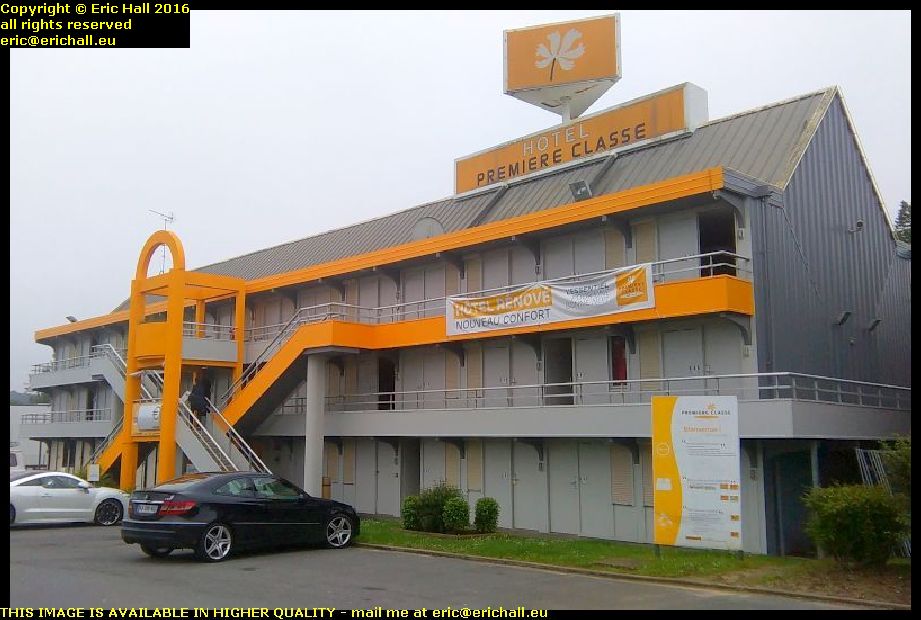
hotel premiere classe soissons aisne franceAfter I’d spent some time doing some work, I packed up and left to continue on with my journey. Now that I’ve been reunited with my telephone I can show you where I stayed the night – and the night two weeks or so ago.

My room is the one that has the open door on the top right – right at the end of the corridor at the highest part of the building. As I said, it really was quiet in there and I’ll have that room again.

By setting the SatNav to “shortest route”, I went a very merry and mazy way through some beautiful by-roads where I was suddenly decanted into the town of Guise.
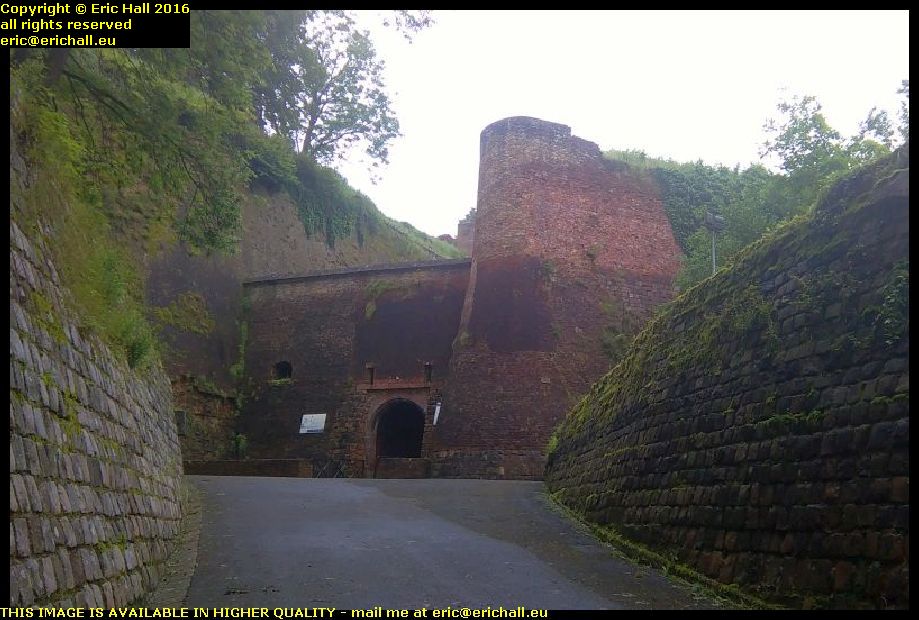
chateau fort de guise aisne franceThis is the entrance to the magnificent castle of Guise and those of you with long memories and have read reams and reams of this rubbish will know exactly why this is the only photo of the place that is appearing on these pages.

The answer is that, quite simply, as you might expect, I arrived bang on the stroke of midday, just as they were closing the place up for lunch. Everyone knows that the lunch break is sacred in France – so much so that when Marshall Petain (whose grave we visited on the Ile d’Yeu in 2013, you might remember) was appointed as Generalissimo of the Allied Armies in the middle of the desperate retreat of 1918, he is reputed to have asked for just two things to save the Allies from disaster – a free hand with the army and two hours off for lunch.

Many of you will have heard of Guise, of course. Mary of Guise was the wife of James V of Scotland and mother of Mary, Queen of Scots.
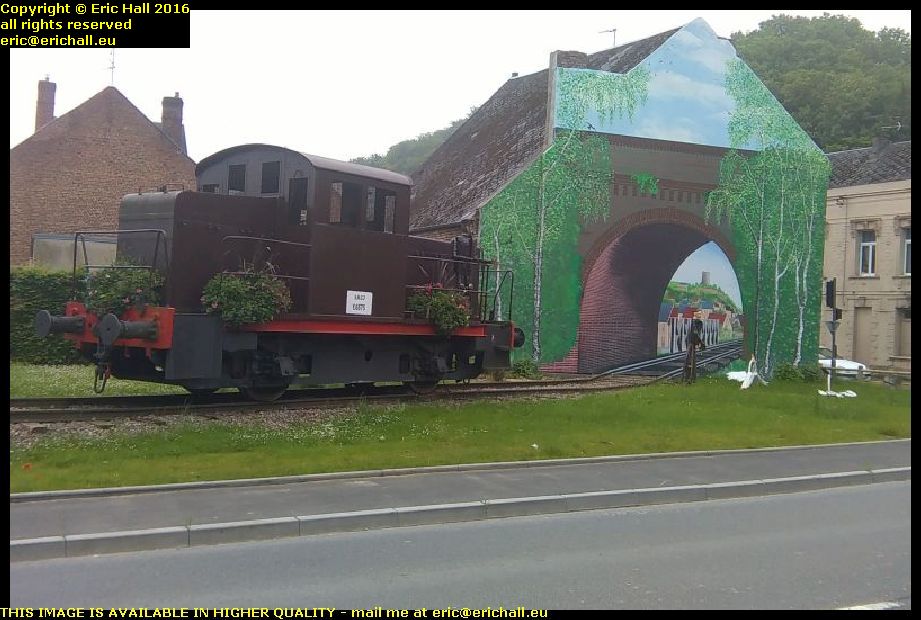
diesel shunter guise aisne franceThat wasn’t the only thing that was interesting about the town. On the by-pass on the edge of the town was this magnificent diesel locomotive – a shunter by the look of it, parked up on the site, one assumes, of a couple of demolished houses which have been fitted out to make a raiway setting.

I liked the artwork on the wall of the house in the background. It was superb.

I wish however that there had been a plaque to tell me what was the significance of the display. I hate being left in the dark.
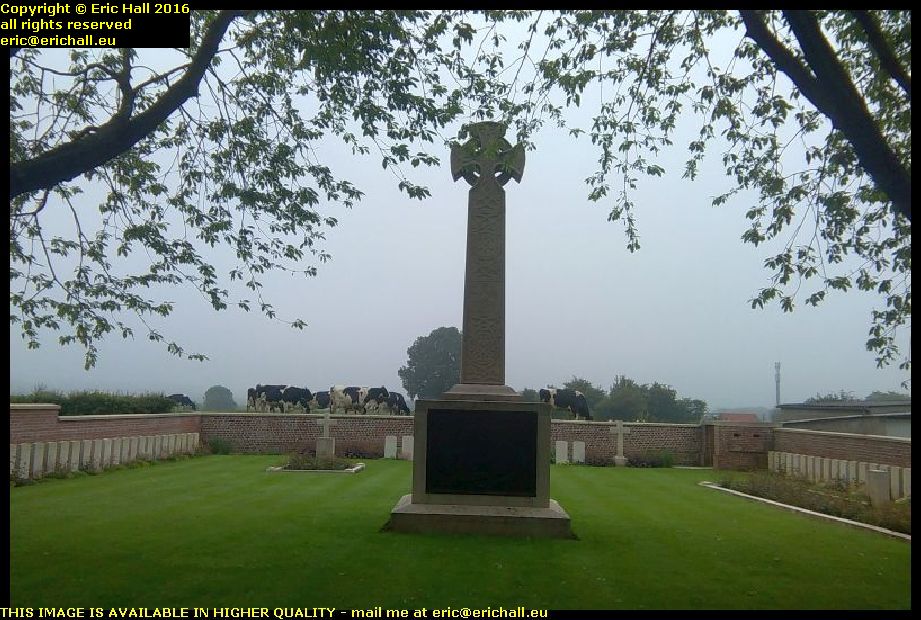
military cemetery commonwealth war grave lieutenant awdry etreux aisne franceNext stop, seeing as I’m in the vicinity, is the Commonwealth War Graves cemetery in Etreux. This is where scores of members of the Royal Munster Regiment are buried following a spirited rearguard action at the crossroads by a battalion of the regiment on 27th August 1914, to hold up the German advance while the main body of the British Army slipped away.

The claim to fame of the cemetery is that it is the burial place of Lieutenant CEV Awdry, said to be the half-brother of the Reverend W Awdry of “Thomas the Tank Engine” fame.
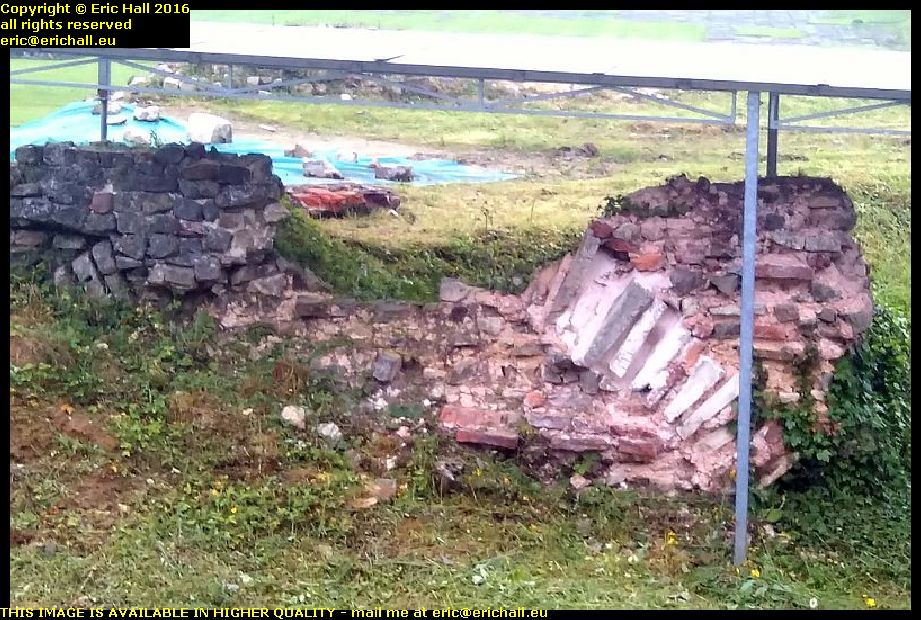
gallo roman ruins forum  bavay nord franceLeaving the Aisne behind us, we cross into the Nord and arrive at our destination, the town of Bavay, or, to be more precise, Bavay la Romaine.

And it deserves its name too because it was formerly the Gallo-Roman (you must never say “Roman” in France. The French do not accept that the Romans brought civilisation to the French, insisting that Gaul was already civilised long before the Romans arrived. It’s “Gallo-Roman” and I’ve seen some impressive uproar when people forget) city of Bagacum.
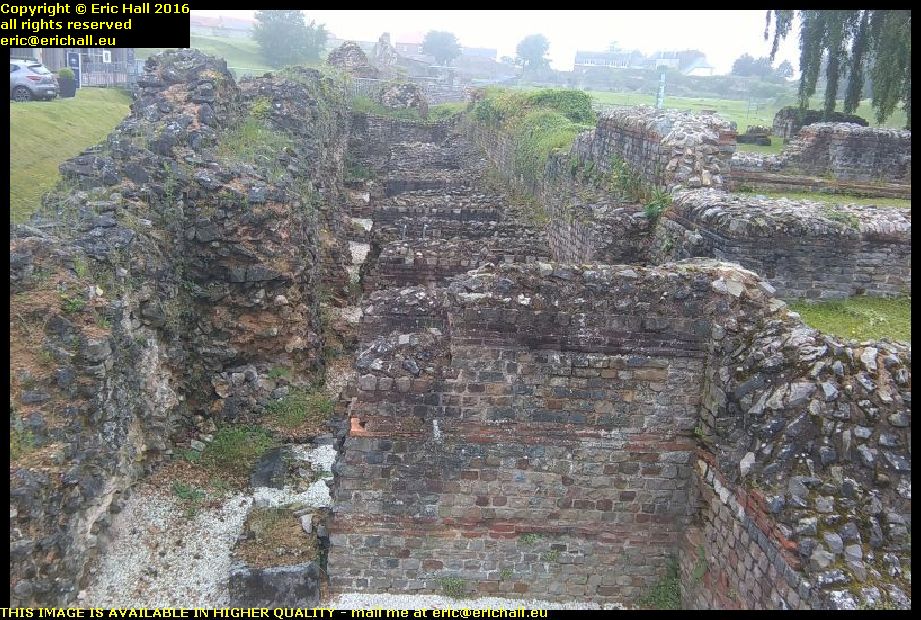
gallo roman ruins forum bavay nord franceThe city is situated at a major crossroads of routes in the northern part of the Roman road system and is home to some of the most impressive Roman … "Gallo-Roman" – ed … ruins in Gaul.

What we are looking at here is part of the Forum – the central market place of any Roman … "Gallo-Roman" – ed … city and impressive it certainly is. It’s always been known that there are Gallo-Roman remains here – stuff has been dug up for centuries – but someone digging in a cellar in the 18th Century found himself decanted into the subterranean crypt of the temple and this started everything off.
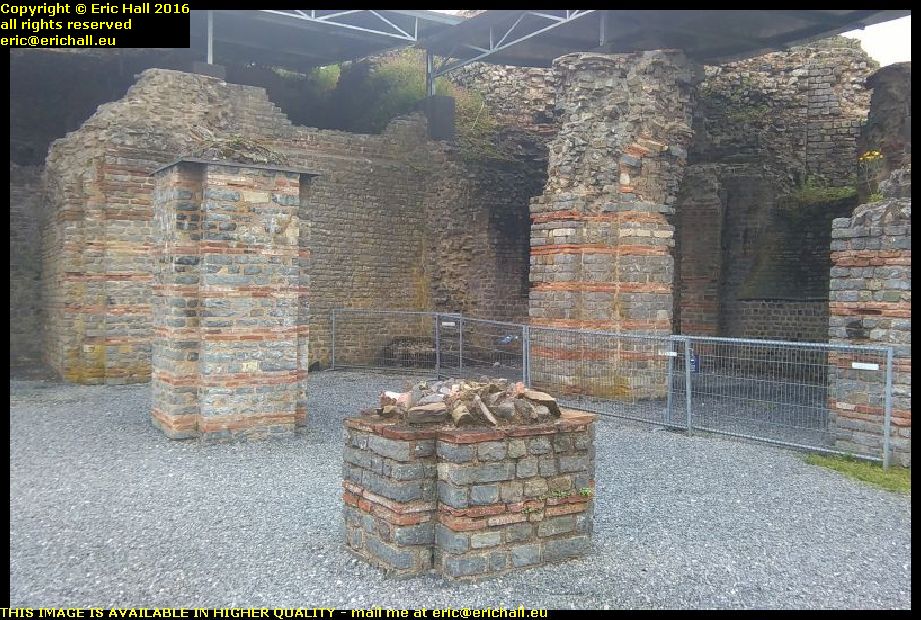
gallo roman ruins temple forum bavay nord franceGerman shelling of the town in 1940 uncovered many more remains and once the war was over, excavations started in earnest.

Our cellar-digger painted a picture of what he saw and it shows a beautiful Gallo-Roman crepi with painted designs, but all of that has long-since been washed away over 250 years of exposure to the weather, which is a shame because it really did look quite magnificent.
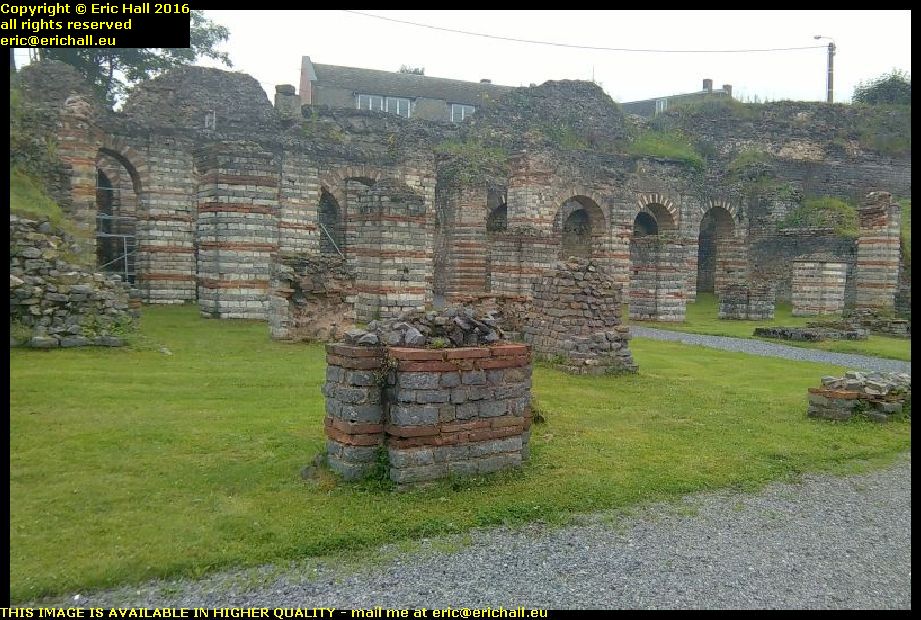
gallo roman ruins temple forum bavay nord franceI spent all afternoon here having a prowl around, totally immersed in everything that was going on all around. It really was €3:00 well-spent (yes, I’m not ashamed to claim the Senior Citizens’ discount now that I qualify for it).

No-one was more surprised than me to notice that the time had suddenly advanced to 16:30 in the blinking of an eyelid and I hadn’t even noticed. I shall have to get a wiggle on.
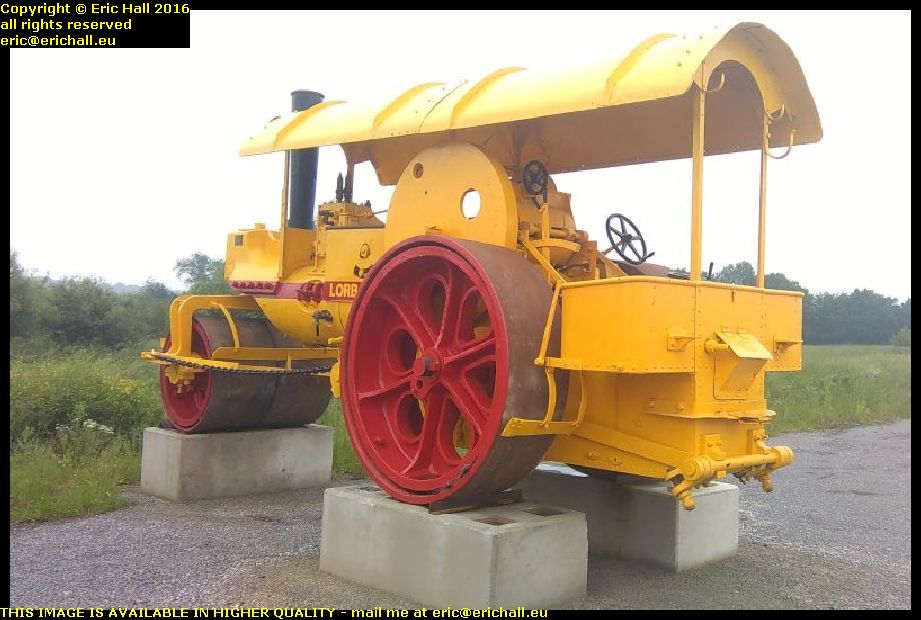
alberet steam roller compactor rouleau compressor nord franceBack on the road, I didn’t travel very far before coming to another screeching halt. Despite all self-propelled road compactors (or rouleau compressor as they are called over here) being called “steam rollers” in the vernacular, this really IS a steam roller.

It’s an Alberet, works number 1012, from the factory in Rantigny in the Oise and I don’t think that I’ve ever encountered one of this make before. It’s here parked on the edge of a haulage yard by the side of the road, inviting a photo-opportunity.

It’s not really an old car but we’ll class it as that seeing as how we don’t have a more suitable category.

So now I’m holed up in another Premiere Classe in Feignies, just outside Maubeuge. No internet (thank heavens for the mobile phone) and disinterested staff, which is a shame.

But it’s much better than a standard “Premiere Classe” that’s for sure. it has all inside rooms rather than outside rooms for a start and they are 3 times bigger than standard.

I’m having my money’s worth here tonight.

Tuesday 25th February 2014 – I’M NOT HERE

Well, not ALL here anyway. But you knew that already, didn’t you?

viaduc des rochers noirs de la roche taillende lapleau correze franceI’m not there either – although I was earlier this evening. This is the Viaduc de la Roche-Taillende, colloquially known as the Viaduc des Rochers Noirs, and it’s near the town of Lapleau in the Corrèze.

You may not think it looking at that tight curve to enter the viaduct, but I’m actually standing on the bed of a disaffected railway line. It’s another one of these metre-gauge tacots, or “rattletraps”, a narrow-gauge railway line similar to the one that we’ve seen at Marcillat-en-Combraille in the Allier, but this one ran between Ussel and Tulle in the Corrèze.

There was a speed limit of 15kph on the line which is hardly surprising given the tightness of the curve, and also the fact that we have a suspension bridge which is quite a rare type of construction for a railway bridge.

viaduc des rochers noirs de la roche taillende lapleau correze franceJust like chez Liz and Terry, the railway disappears off into a tunnel on the other side of the river, but that is all fenced off.

Until 2006 you could actually drive through there in a car but unfortunately the Conseil Départementale has put a stop to all of that.

I merely contented myself with taking a few pictures – there wasn’t anything more that I could do unfortunately.

viaduc des rochers noirs de la roche taillende lapleau correze franceI did however go for a little bit of a climb and I was glad that I did, because the view from up on a rocky outcrop towering a couple of hundred feet above the viaduct was stunning, to say the least, even if it did wear me out climbing up to here.

This photo does show you the lengths that they had to go in order to build the viaduct and it’s hard to think that this line didn’t open until 1913, by which time it had effectively already outlived its effectiveness with the coming of the motor-bus but nevertheless it struggled on until as recently as 1960, which is quite an achievement for a metre-gauge tacot.

 les gorges de la Luzège lapleau correze franceWhile I was up here I took a few photos of the stunning scenery.

The viaduct spans the Gorge de la Luzège at a height of 92 metres, or 126 metres if you count the pylons, so I’m quite high up and the view of the gorge is amazing.

It’s a shame that the weather was so dreadful though – it’s been raining non-stop and I’ve forgotten to bring a raincoat with me.

Serves me right.

plateau de Millevaches memorial 3rd Regiment SAS french resistance france 1944Coming here brought me (via the Pionsat Post Office to post Cécile’s letters) over the Plateau de Millevaches on the border between the Creuze and Corrèze.

Apart from the snow that I encountered, the plateau is famous in that it was effectively a “Free French” area during World War II. There is a great deal of resistance souvenirs in the area, including this plaque to commemorate the parachuting-in of members of the 3rd Regiment SAS who organised the French Resistance in the turbulent times after D-Day.

There are poignant souvenirs too – memorials to victims of the occasional sweeps by the Gestapo and also the town of Tulle itself just a short drive away, where the Das Reich Panzer Division of the SS strung up almost 100 locals from lamp-posts in the centre of the town as a form of reprisal for terrorist attacks.

roman ruins villa temple ruines les cars plateau de millevaches corrèze franceAnd that’s not all either.

I saw a sign that said Ruines les Cars and with Cars being French for the kind of coaches that I drove when I worked for Shearings, I went for a look to see what it was all about, but instead I found myself in the middle of a Roman villa and huge Temple from the 2nd Century AD.

Of course, you are not allowed to say “Roman Remains” here in France. Everything has to be “Gallo-Roman” because the French don’t accept (rightly or wrongly, I dunno) that the French civilisation of the turn of the Common Era was any less inferior than the Roman civilisation, and I’ve seen some healthy fights at some of these archaeological meetings that I sometimes go to.

remains of old car plateau de millevaches corrèze france Talking of ruins of cars, another thing that caught my eye was this. The remains of an old car abandoned in a forest.

No maker’s plate or anything like that on it, so no idea what it might be, but it has a wooden chassis sheathed in steel, and it’s clearly the type of car that had real wings and a lift-off body. With its steel wheels, all of that dates it to the early 1930s I reckon.

If you have any ideas what it might be, let me know. But there isn’t much to go on, I know.

From here I headed off down the hill and towards civilisation. I ended up in the town of Tulle where I planned to find a hotel but was singularly unsuccessful.

And to my own surprise, I didn’t take a single photo of the place and I ought to have done, because Tulle is one of the saddest places in French modern history.

Following the Normandy Landings, the local Resistance troops had risen up and seized control of the town from the Germans. Just as they were preparing to deal with the final German holdouts, the 2nd Waffen-SS Panzer Division Das Reich appeared on the scene on its way north.

The result was that 99 civilians, many of whom had no connection with the armed uprising, were strung up from lamp-posts in the main street and a considerable number of others were brutally tortured

So with no hotel that I could find in Tulle, I’ve moved on to Brive la Gaillard where I’ll be spending the night.. I’ve no idea where I’ll be tomorrow.

Wednesday 25th July 2012 – TODAY STARTED OFF …

… really well. Gorgeous bright blue skies with not a cloud in sight.

I was up … well, not as early as I might have been but still early enough, and while I was breakfasting, I had the fan working, so hot that it was up here.

Terry rang up and so I met him down the lane and we went off to the quarry for some melange and a pile of sand, and I ended up with about half a ton of the stuff – that will keep me out of mischief for a while, rebuilding the lean-to wall.

new potatoes les guis virlet puy de dome franceAfter computing for a while I attacked the raised bed where the early spuds were hanging about. Now was the time to dig them up.

But I have to say that I was quite disappointed. There’s not even half a bucket full here. I’ve no idea where they all went to. And after all of the effort that I – and Rosemary – had put into everything too!

But I was so engrossed with digging over the bed that I failed to notice the time – 15:24. I had to be in Pionsat meeting Marianne at 15:30 and there I was, all covered in soil and so on

But never mind. Can’t be helped. I flew into Pionsat just as I was.

That’s hardly a good advert for anything,

caliburn st maigner puy de dome franceAs well as the Sunday expositions that we have been doing, we’ve also been doing the Wednesday walks around the various communes of the Canton of Pionsat, and you’ve already been on quite a few of them with us.

Today, it’s the turn of St Maigner to receive us. That’s out on the road to Espinasse and must be the commune the furthest south in the Canton. And despite the rush that we had had to get here, we were bang on time to start the walk, which can’t be bad

st maigner puy de dome franceSt Maigner is a very exciting place and proudly announces that the population in the comunne has grown by 17.4% in the last 10 years.

Not sure about how they worked that out, though. The 1999 population was 174 and the 2011 population was 197 – that makes a 13.2% increase in my book. And, regrettably, that’s still a far cry from 1836 and the 990 people who lived here.

This population growth is typical of quite a few small villages in the Auvergne, where most of the population growth is due to all of the foreigners who have come to live here.

Rural France has not been slow in pointing out to the Brits and the Dutch living a stressed-out existence in a tiny box-like villa with a postage-stamp garden and neighbours overlooking your hedge that here are wide-open spaces with room to move about, grow your own crops and be totally stress-free.

And all at a price that you would never even imagine back home.

And the Government is grateful too.

st maigner puy de dome franceThink about it.

  • The average foreigner who sells up and comes over here brings with him – say €200,000 – from the sale of his property back home.
  • He buys a ruin (of which there are many) from a local French farmer for €30,000, saving the French farmer from bankruptcy
  • He goes to Brico Depot or Point P or the sawmill for all of his renovation material, creating jobs for the locals
  • His kids go to the local village school, keeping the schools open
  • He uses the village Post Office and the boulangerie, keeping them open for the locals
  • Many of the nouvel arrivants are pensioners – they will be having their foreign pensions paid in France and spending the money over here

Just look at all of this money coming flooding into the rural French economy. And it’s all new money too. Not from anywhere else in France, not from the French treasury, but from abroad.

The French must be laughing their heads off.

I was at one meeting many years ago when Brice Hortefeux, a French Government Minister stood up and said to the audience “you should be grateful that we have all of these foreigners here. It’s thanks to them that you still have your schools, your Post Offices, your boulangerie.”

And he’s dead right.

st maigner puy de dome franceWe saw the church in one of the photos above. It was a dependence of the Abbey of Ebreuil and although the first mention of the village isn’t until the mid 13th Century, the church would seem to be considerably older.

You can tell that by looking at the Roman-style doorway here. Despite all of the renovations that the church has undergone (and we all know what that means) this doorway cannot be anything but original.

I’ve seen many a church doorway in this style, and all available records point to them being well before the 13th Century. I would be very surprised if this doorway were much later than 11th-Century.

fontaine de st loup st maigner puy de dome franceHaving had a good explore around the bourg, we went for a nice long walk out into the countryside, as far as the Fontaine de St Loup.

This is a beautiful, well-restored spring, of which there are many here in the region as you know. But this particular one has a very well-known claim to fame in that during the 7th Century, a very well-attested miracle took place here.

So well-attested and so well known that I can’t remember what it was now. In fact, had I remembered, that would have been a miracle.

villeromain st maigner puy de dome franceRound the back of the Fontaine is the lieu-dit or hamlet of Villeromain.

And this is a very controversial place, if you are a French historian.

Wherever you see a French place-name beginning with ville, it almost certainly (although there are some exceptions in modern times) signifies the site of a Gallo-Roman villa.

I’ve told you before that one is not allowed in France to use the term “Roman” on its own. French history does not accept the principle that the Romans colonised and settled the country.

It insists that the Gauls were already civilised and that the presence of villas and other contemporary buildings were due to the combined efforts of both the Romans and the Gauls.

However, the reason for the controversy about Villeromain is because of the inclusion of the very definite Roman in the name. That would seem to suggest to some people that this settlement was entirely Roman and had no input from the Gauls.

And that opinion does not go down very well with others.

So back home, and the temperature in the solar water heater looked really inviting. This called for a nice, hot shower this evening bearing in mind how dirty I was after today’s gardening session.

And then up here to the furnace. It’s roasting up here and the fan is doing almost nothing.

Summer seems to have arrived – but for how long?

Wednesday June 29th 2011 – I didn’t post this blog entry yesterday …

.. and for three reasons too

  1. I crashed out early. Well asleep before midnight and that hasn’t happened too often
  2. I didn’t think that much had happened
  3. I lost the internet connection for a while and I couldn’t be bothered to wait until it reconnected itself.

And so I had to post it this morning.

Well, saying that nothing happened is not quite correct. It was something of a late start again – I was woken uo by someone from my ISP. Apparently my internet speed has been increased, which I can see, and to celebrate my 3 years of subscription, would I like an internet dongle for €1:50 per month extra, giving me 6 hours worth of surfing per month away from home where there is a mobile phone signal?

6 hours is nothing – hardly worth bothering with you might think, but it’s a start of a thin end of a wedge and it isn’t where we start, it’s where we finish that’s important. I’m going for this and I’ll see in due course if it can be increased to something reasonable – like “unlimited”. because this is the future of the internet. Forget your land lines and wifi hotspots. Internet via satellite on mobile phone wavelengths, that’s the way to go.

After that I had a lengthy chat with Rhys on the computer and then another phone call – from the President of Pionsat Patrimoine. Apparently in le Quartier there’s an old Roman well excavated by the Romans and used to supply water to Neris les Bains via an aquaduct, much of which is still visible. He wants to know if I could go sometime and photograph it. And as usual with him, a 5-minute chat turns into a recital of War and Peace, and that was the end of the afternoon.

I wasn’t feeling up to making tea and so I had a quiet relax and then an early night.