… really well. Gorgeous bright blue skies with not a cloud in sight.
I was up … well, not as early as I might have been but still early enough, and while I was breakfasting, I had the fan working, so hot that it was up here.
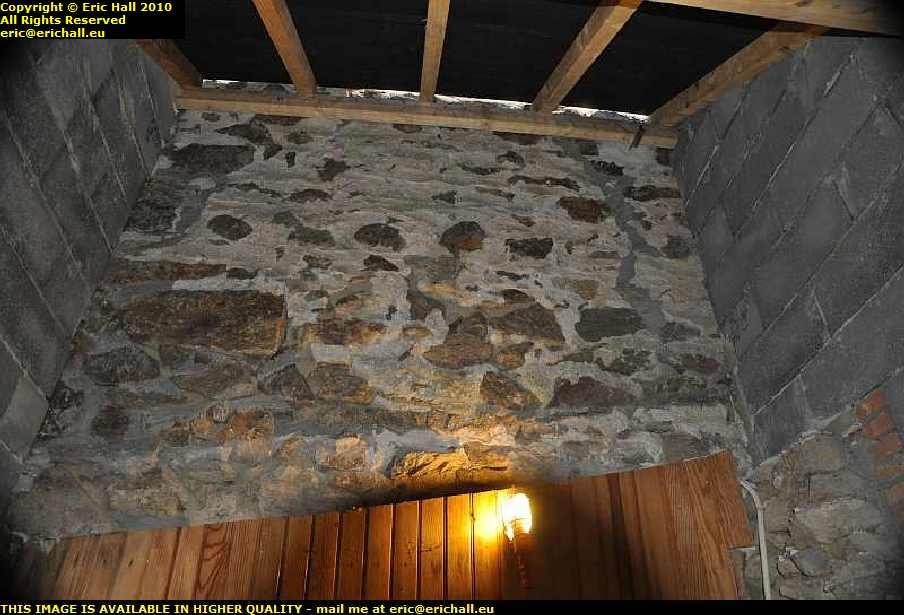
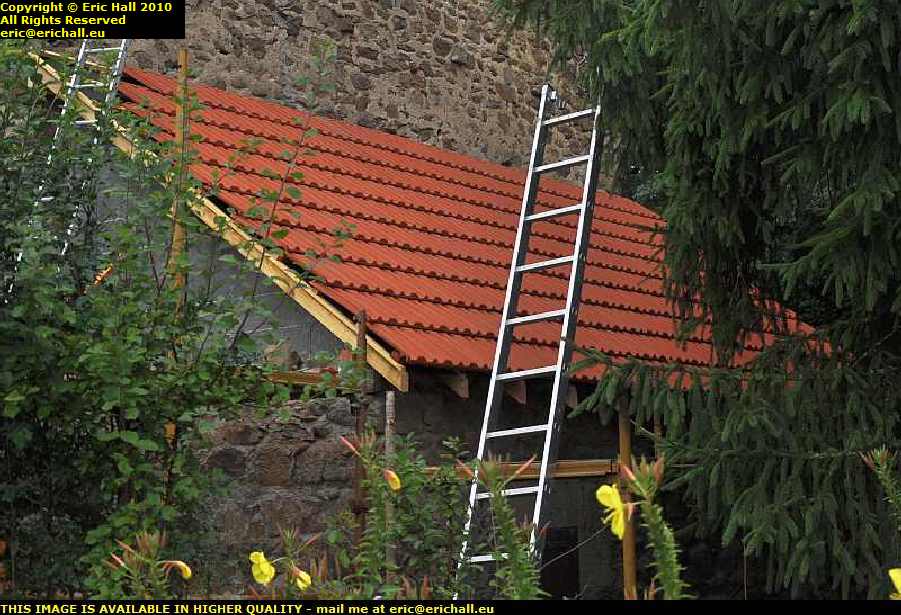
Terry rang up and so I met him down the lane and we went off to the quarry for some melange and a pile of sand, and I ended up with about half a ton of the stuff – that will keep me out of mischief for a while, rebuilding the lean-to wall.
 After computing for a while I attacked the raised bed where the early spuds were hanging about. Now was the time to dig them up.
But I have to say that I was quite disappointed. There’s not even half a bucket full here. I’ve no idea where they all went to. And after all of the effort that I – and Rosemary – had put into everything too!
But I was so engrossed with digging over the bed that I failed to notice the time – 15:24. I had to be in Pionsat meeting Marianne at 15:30 and there I was, all covered in soil and so on
But never mind. Can’t be helped. I flew into Pionsat just as I was.
That’s hardly a good advert for anything,
 As well as the Sunday expositions that we have been doing, we’ve also been doing the Wednesday walks around the various communes of the Canton of Pionsat, and you’ve already been on quite a few of them with us.
Today, it’s the turn of St Maigner to receive us. That’s out on the road to Espinasse and must be the commune the furthest south in the Canton. And despite the rush that we had had to get here, we were bang on time to start the walk, which can’t be bad
 St Maigner is a very exciting place and proudly announces that the population in the comunne has grown by 17.4% in the last 10 years.
Not sure about how they worked that out, though. The 1999 population was 174 and the 2011 population was 197 – that makes a 13.2% increase in my book. And, regrettably, that’s still a far cry from 1836 and the 990 people who lived here.
This population growth is typical of quite a few small villages in the Auvergne, where most of the population growth is due to all of the foreigners who have come to live here.
Rural France has not been slow in pointing out to the Brits and the Dutch living a stressed-out existence in a tiny box-like villa with a postage-stamp garden and neighbours overlooking your hedge that here are wide-open spaces with room to move about, grow your own crops and be totally stress-free.
And all at a price that you would never even imagine back home.
And the Government is grateful too.
 Think about it.
- The average foreigner who sells up and comes over here brings with him – say €200,000 – from the sale of his property back home.
- He buys a ruin (of which there are many) from a local French farmer for €30,000, saving the French farmer from bankruptcy
- He goes to Brico Depot or Point P or the sawmill for all of his renovation material, creating jobs for the locals
- His kids go to the local village school, keeping the schools open
- He uses the village Post Office and the boulangerie, keeping them open for the locals
- Many of the nouvel arrivants are pensioners – they will be having their foreign pensions paid in France and spending the money over here
Just look at all of this money coming flooding into the rural French economy. And it’s all new money too. Not from anywhere else in France, not from the French treasury, but from abroad.
The French must be laughing their heads off.
I was at one meeting many years ago when Brice Hortefeux, a French Government Minister stood up and said to the audience “you should be grateful that we have all of these foreigners here. It’s thanks to them that you still have your schools, your Post Offices, your boulangerie.”
And he’s dead right.
 We saw the church in one of the photos above. It was a dependence of the Abbey of Ebreuil and although the first mention of the village isn’t until the mid 13th Century, the church would seem to be considerably older.
You can tell that by looking at the Roman-style doorway here. Despite all of the renovations that the church has undergone (and we all know what that means) this doorway cannot be anything but original.
I’ve seen many a church doorway in this style, and all available records point to them being well before the 13th Century. I would be very surprised if this doorway were much later than 11th-Century.
 Having had a good explore around the bourg, we went for a nice long walk out into the countryside, as far as the Fontaine de St Loup.
This is a beautiful, well-restored spring, of which there are many here in the region as you know. But this particular one has a very well-known claim to fame in that during the 7th Century, a very well-attested miracle took place here.
So well-attested and so well known that I can’t remember what it was now. In fact, had I remembered, that would have been a miracle.
 Round the back of the Fontaine is the lieu-dit or hamlet of Villeromain.
And this is a very controversial place, if you are a French historian.
Wherever you see a French place-name beginning with ville, it almost certainly (although there are some exceptions in modern times) signifies the site of a Gallo-Roman villa.
I’ve told you before that one is not allowed in France to use the term “Roman” on its own. French history does not accept the principle that the Romans colonised and settled the country.
It insists that the Gauls were already civilised and that the presence of villas and other contemporary buildings were due to the combined efforts of both the Romans and the Gauls.
However, the reason for the controversy about Villeromain is because of the inclusion of the very definite Roman in the name. That would seem to suggest to some people that this settlement was entirely Roman and had no input from the Gauls.
And that opinion does not go down very well with others.
So back home, and the temperature in the solar water heater looked really inviting. This called for a nice, hot shower this evening bearing in mind how dirty I was after today’s gardening session.
And then up here to the furnace. It’s roasting up here and the fan is doing almost nothing.
Summer seems to have arrived – but for how long?
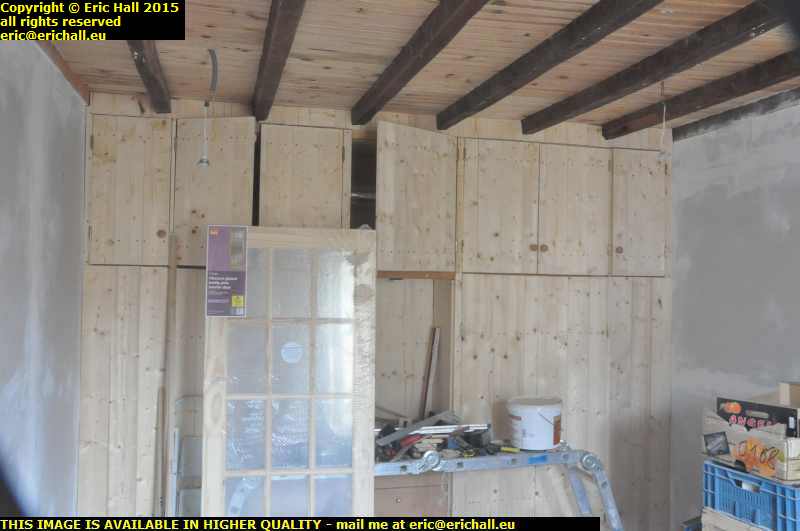 … the wardrobe.




 .
.
 .
.