Tag Archives: donald gibson

Wednesday 7th October 2020 – MEANWHILE, BACK AT …

… Castle Anthrax I had my check-up. Blood count is down to a mere 8.2, just 0.2 above the critical limit. They didn’t keep me in, but they didn’t give me a blood transfusion either. They are trying a new treatment on me again, something called Octagam.

One thing that I did was to check on the side effects and symptoms. And to my surprise, I have many of the symptoms that are flagged, a couple of which have even seen me hospitalised. But I assume that they know what they are doing.

Having said that, I’m not convinced that I do. I couldn’t sleep last night and it was long after 02:30 when I finally went to bed. Quite obviously there was no chance of my leaving the bed at the sound of the alarm. I was surprised that I managed to be out of bed by 07:20.

First job was to have a shower and a clothes wash. I need to make myself pretty. And then to make some sandwiches. I’d no idea how long this session was going to last.

And then I hit the streets.
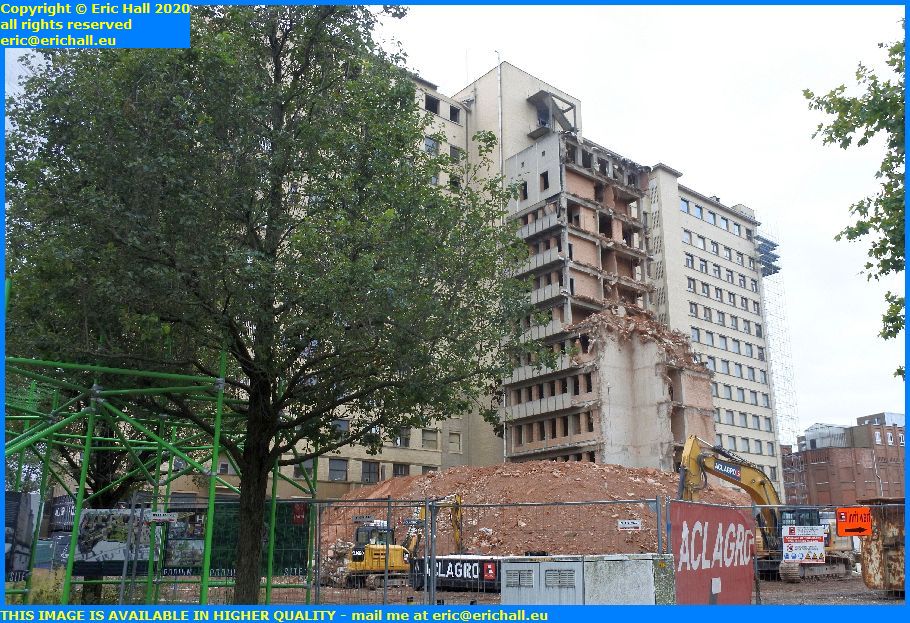
Demolition Sint Peters Hospital Brusselsestraat Leuven Belgium Eric HallWhen you have been away for a while from a place that you know, it’s very interesting to see the changes that have taken place since your last visit.

ON OUR TRAVELS AROUND LEUVEN in the past we’ve seen the start of a whole system of changes to the city, starting with the demolition on the Sint Pieter’s Hospital Building where I stayed for a week or two when I first came here in 2016. They are making a considerable advance in dealing with the matter but it looks as if it’s going to take an age.

It’s a shame that A FORMER NEIGHBOUR and customer of my taxis is no longer with us. He would have had that building down in a twinkle of an eye and at much less cost too.

Water Spray Sint Pieters Hospital Brusselsestraat Leuven Belgium Eric HallWhile I was watching some of the demolition, my interest was caught by this machine and I was wondering what it might be.

It took me a while but I think that I know now what it might be. It looks like some kind of water atomiser powered mainly by compressed air, I suppose, that’s blasting a pile of water over the heap of rubble that has been knocked down from the building. I imagine that its purpose is to keep the dust down.

You would never have had precautions like that 20 years or so ago. It seems that Health and Safety Regulations have even arrived over here.

Sint Jacobsplein Leuven Belgium Eric HallMy route continued along the Brusselsestraat to the corner of the place where I lived for 6 months, and then round the corner into the Sint Jacobsplein.

When we’d been away for a couple of months last year, we came back here to find a great big hole in the middle of the Square. It was all fenced off so we never had the opportunity to look into it, and even though it’s been at least a year since they made a start on it, they still haven’t finished.

This is turning into a really long job and I’m wondering if I’ll still be here to see the finished product. At least, I hope that they will make a better job of it than they did of that deplorable patch of asphalt in Granville.

Replacing Sewer Biezenstraat Leuven Belgium Eric Hallat the side of the Sint Jacobsplein is the Biezenstraat, and when we were last here IN JULY they were busy making a start on digging it up

Since then, they seem to have made a great deal of progress. And now that I can see the big concrete pipes down there, I can tell now that it’s all to do with replacing the sewer pipes in the street. That makes me wonder if they’ve installed something like a subterranean holding tank or something underneath the Sint Jacobsplein.

And as for the Frittourist, the fritkot on the edge of the Square to the left, the roadworks can’t be doing them much good in the way of passing trade. It’s a good fritkot too, one of the best in the City.
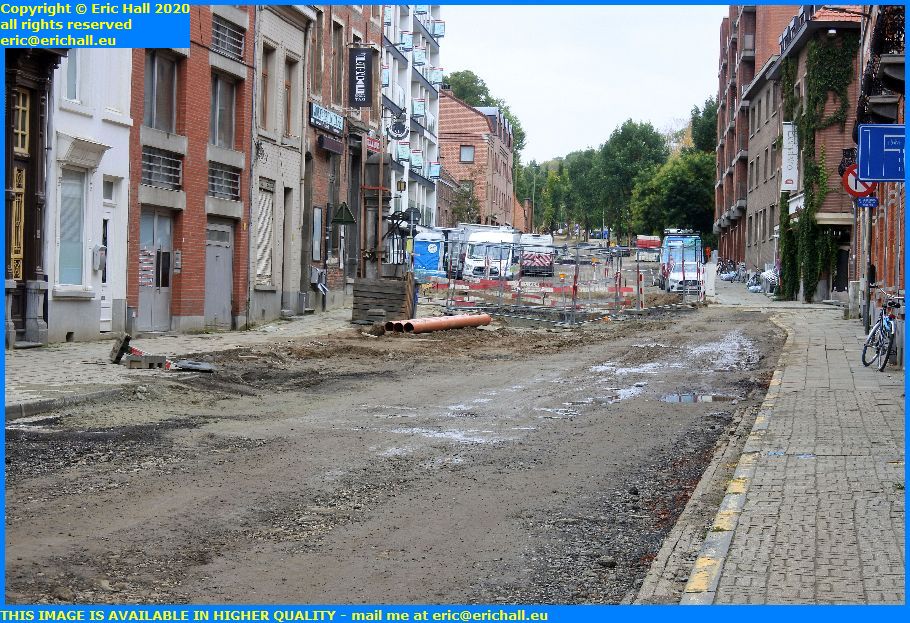
Replacing Sewer Sint Hubertusstraat Leuven Belgium Eric HallWhen I turn around to look behind me the other way to face the direction of the Hospital, I’m admiring the Sint Hubertusstraat.

When we came here last time, in early July, there was a huge hole in the middle of the crossroads and we had to walk miles around in order to proceed without falling down a great big hole in the road.

But now, it seems that they’ve filled in that part of the street now and while the surface isn’t finished, and not by a long way either, we can still walk past it on our way up the hill towards the hospital.
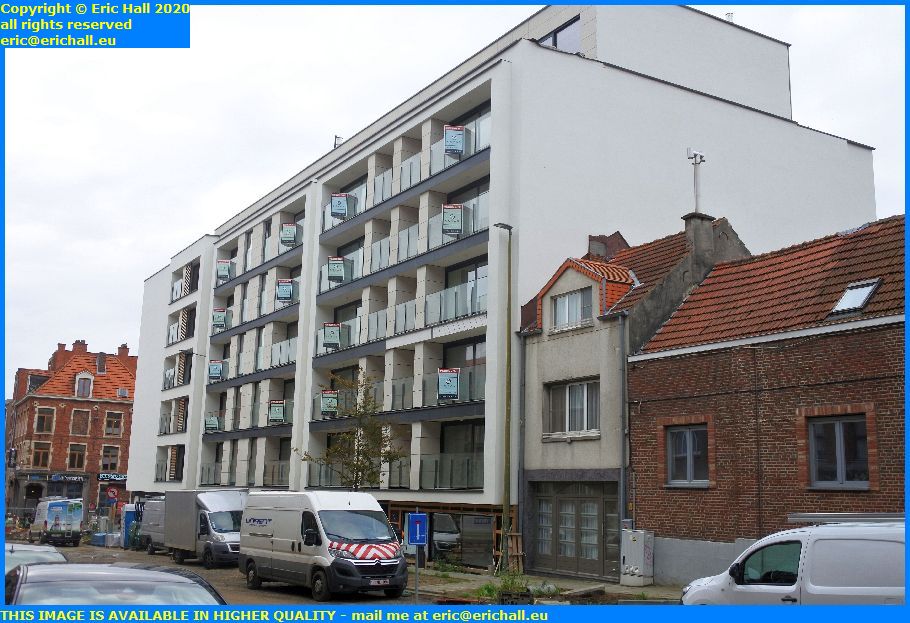
Apartment Building Block of Flats Monseigneur van Waeyenberglaan Leuven Belgium Eric HallJust after the corner there’s a big block of flats on the left that we always walk past.

Regular readers of this rubbish will recall that a while ago all of the residents were turfed out and once they had gone, the building was completely gutted right back to the framework. They have gradually been rebuilding it and it looks as if they are on the point of packing away their tools.

You can see all of the “For Sale” signs on the windows of the apartments. Most of them that I could see are “sold” and that presumably means that the new inhabitants will be moving into their homes very soon. It’s taken them long enough.
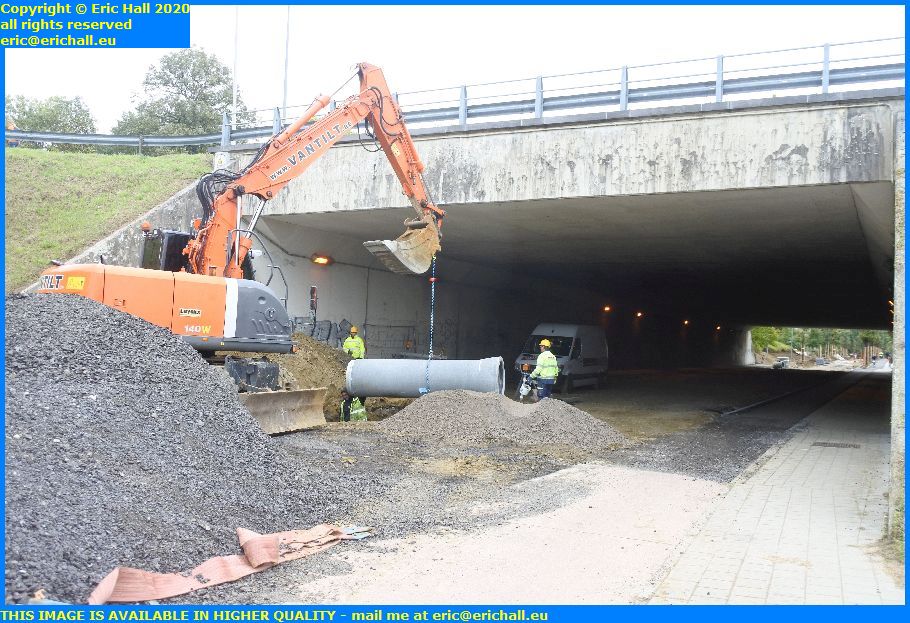
Replacing Sewer Monseigneur van Waeyenberglaan Leuven Belgium Eric HallMy struggle up the hill continued, through all of the roadworks that were there last time. The trench has been filled in and they are reworking the pavements and the cycle track right now.

The actual heavy work is now taking place on the way up between the by-pass overbridge and the roundabout at the foot of the car park. And just as I arrived, they obliged me by picking up a large concrete pipe and dropping it into the hole that they have dug.

For a change, I was early and was quickly logged in. And I found the reason why there had been such a delay in my treatment. In the waiting room there are no longer 40 seats but just 10. and in the communal treatment rooms where 20 people can sit and have their treatment, there are just two seats. There are about a dozen or so confidential treatment rooms where you go for your tests on admission, and now patients are left in these rooms throughout the whole of their treatment.

So Instead of about 50 patients at a session, there are now just maybe a dozen. Hardly a surprise given what’s going on right now.

A nice nurse took care of me and I had a nice young trainee doctor. There have to be some benefits of having this illness. Even nicer, Kaatje came to see me and we has a nice chat. She’s nominally a Social Worker but in reality she’s a psychiatrist, although they don’t let on. Every terminally-ill patient has a psychiatrist allocated to them, and Kaatje can come and administer to my needs any time she likes.

While I had her attention, I mentioned the issues – or lack of them – about not having had my compulsory 4-week treatment since January this year. Not that it will do any good but it’s something that one has to do.

While I was sitting there having my perfusion, I attacked the dictaphone. Last night I was a girl, would you believe? And I was living at home. I’d been downstairs for a meal and tried to talk to people and be interesting but no-one was listening or interested in the least with what I had to say. They were always cutting my speech, that kind of thing. In the end I threw something of a tantrum and stormed upstairs to my room. There was a record player in there and a record on and playing but the needle wasn’t advancing. It was just going round and round he edge again. Sooner or later there was a knock and the door opened. It was my father coming in. I thought that he might have come in to talk to me about things. But no. He just handed me a pair of my gloves that I’d left downstairs and said “you’ve forgotten these” and turned round and went out. I was so disappointed.
Later on there was one of these American sleuths – a Philip Marlowe type. He was renowned for helping his clients in all kinds of ways, many of which were illicit, to escape detection. This came at a price of course. One day he was being interviewed by a gangland boss who he didn’t particularly like. The gangland boss said something like “I understand that you can help people out of certain kinds of difficulties. Well I need a little help – that kind of thing. This private detective taunted him a little bit then said “yes, I’ll do that, $5,000”. To which the mafia type guy, the crook erupted into a rage. He grabbed this guy by the lapels and started to shake him like a dog. Just then, two warders came in to try and sort it all out.

Round about 14:00 my treatment was over and I could leave, having picked up next month’s supply of medication.

Statue Roundabout Gasthuisberg UZ Leuven Belgium Eric HallHere’s something that I’ve not noticed before, although that isn’t to say that it wasn’t there.

In the middle of the roundabout at the bottom of this car park is this large concrete pillar. And I’ve no idea why it’s there and what it’s supposed to represent. My opinion of modern art IS VERY WELL KNOWN so I won’t waste your time in repeating it. But seriously, I can’t see any attraction whatever in a concrete cast-off like this.

It reminds me very much of one of Albert Speer’s flak towers in Berlin, or something designed by someone from the Donald Gibson School of Wanton Vandalism, as I once mentioned IN MY UNIVERSITY THESIS
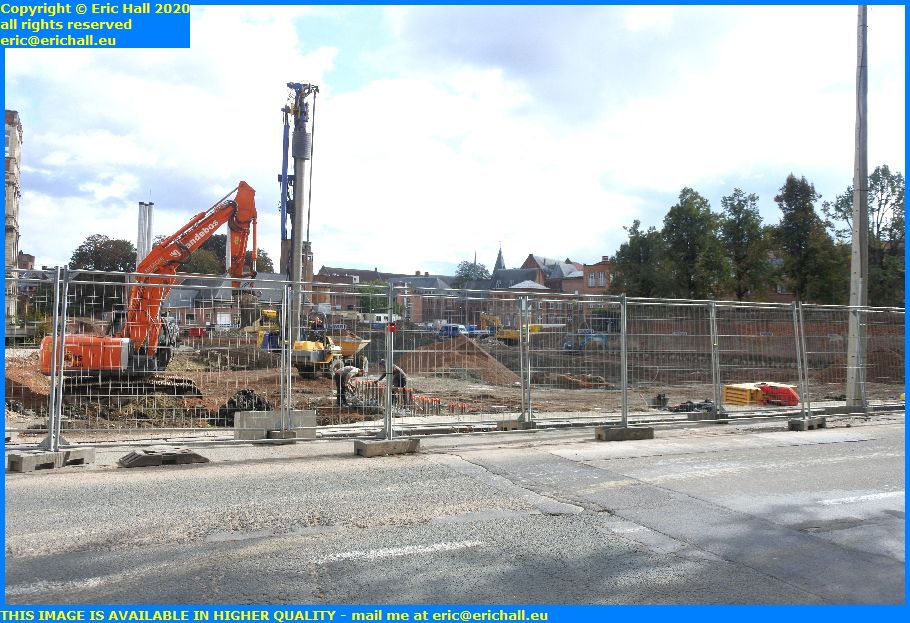
Demolition Sint Rafael Building Site Kapucijnenvoer Leuven Belgium Eric HallWhile we’re on the subject of wanton vandalism … “well, one of us is” – ed … after my hospital wisit I wandered on down the hill to see what was going on on the Kapucijnenstraat.

When we had walked past there the last time that we were here, they had started on the demolition of the annexes to the Sint Rafael. It’ always very interesting to see how they are doing and it seems to me that right now the whole lot have been swept away. They are even starting to build something on the site, but I bet it won’t be anything like as attractive.

At least the magnificent Flemish-style main building is there, but I may well go for a wander around tomorrow with the camera to record it for posterity because the cynic inside me HAS VERY LITTLE FAITH in modern developers. A suspicious fire could break out at any moment.

Interesting Old Bulding Kapucijnenvoer Leuven Belgium Eric HallThere is however a good side to all of this demolition, even if it might not seem like it.

There are loads of old houses from the glory days of the city that have been obscured by new development. There’s a little Close off the Brusselsestraat that I haven’t yet explored but with the demolition of a newer building in the Kapucijnenstraat a couple of the houses down at the bottom end of the Close have been revealed.

When I’m out and about next, I’ll have to go to have a closer look, to see whether it is an original or whether it’s a simple modern reproduction.

Repairing City Walls Handbooghof Leuven Belgium Eric HallAnother thing that regular readers of this rubbish will recall is that last time I was here I made a note about the lamentable state of the city walls in certain places.

It’s quite clear that the good Burghers of the City are keen and regular readers of the rubbish that I write because they now seem to be fenced off and there is scaffolding up in certain places. So maybe they really are going on to do something about it all.

It was round about here that I found a set of keys lying in the road. As it happens, a couple of Municipal Police were walking in the immediate vicinity so I referred the matter to them. I went on to Delhaize for a bit more shopping to take home.

Olleke Bolleke Tiensestraat Leuven Belgium Eric HallAfter Delhaize I went to Origin’O for some grated vegan cheese for my next supply of pizza and then headed for home.

In the Tiensestraat I came across my favourite sweet shop. Or at least, it was when I was allowed to eat animal products, because as far as I know, all of their products contain pork gelatine. It’s the kind of place where you put your sweets into a bag and weigh the bag to work out the price.

The first time I encountered one of these shops was when I was in Bruges getting on for 40 years ago. It’s quite a large chain of shops with branches in most of the towns. in fact, some might say that sweets in Belgium are nothing but a load of Bollekes.

Back here, I had a few things to do and that took some time to organise.
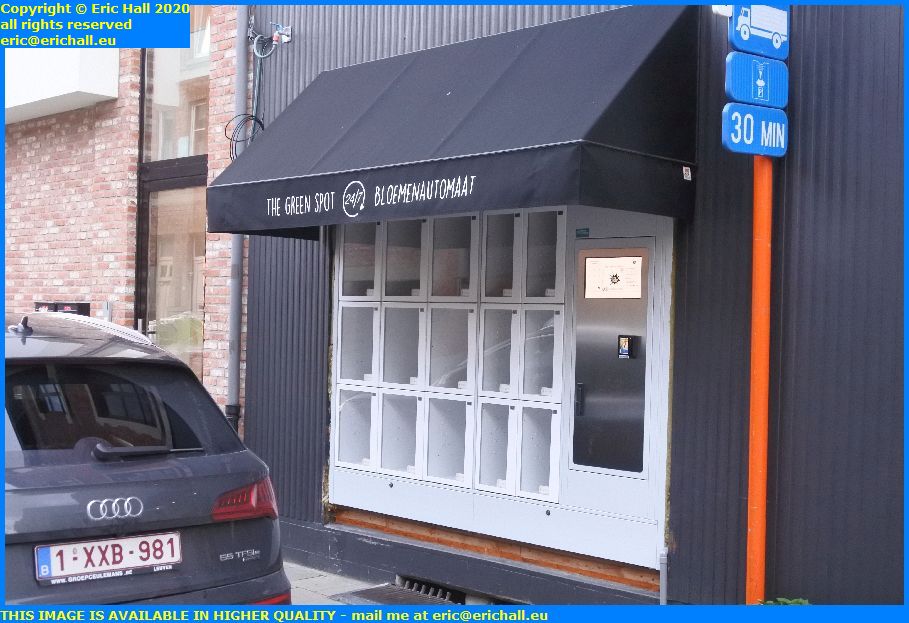
Bloemenautomat Brabanconnestrat Leuven Belgium Eric HallLater on, it was time to go out. Alison and I had arranged to meet in the town centre.

And now I have seen everything I reckon. In the past we’ve seen pizzamats, potatomats and, a few weeks ago, a soupomat. Plenty of other mats too. But today is the first time ever that I’ve seen a Bloemenomat – an automatic flower-vending machine – here at the florist’s on the corner of the Brabanconnestraat.

It makes me wonder whether or not it shouts “violet, get your luvverly violets” at passers-by. That remains to be seen.
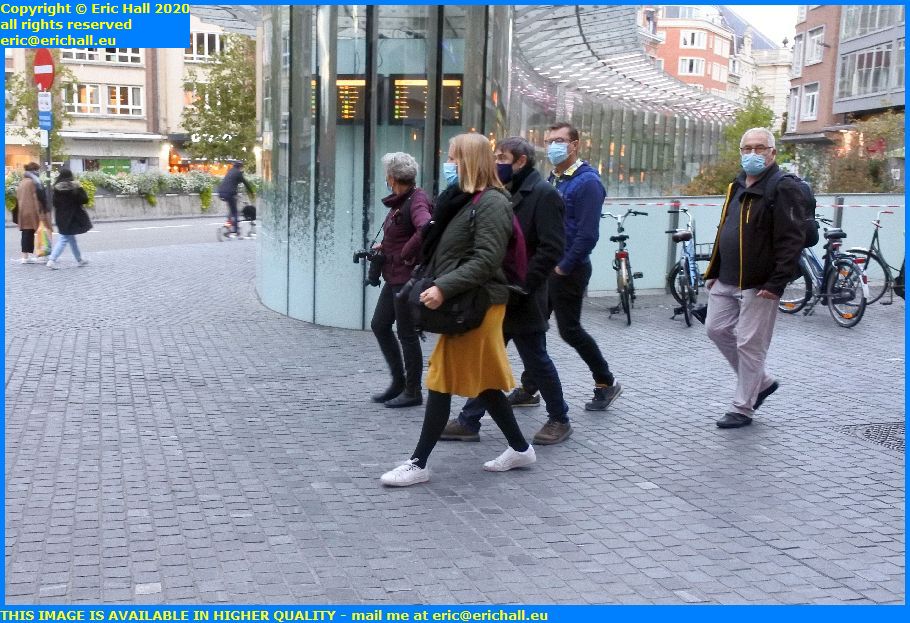
Photograph Team Rector De Somerplein Leuven Belgium Eric HallHaving inspected the Bloemenautomat, I headed off down the Tiensestraat into the town centre.

Regular readers of this rubbish will recall that one of my favourite photography subjects is to take photographs of other people taking photographs. Whilst that’s not the case in this photograph, I surprised a group of photographers marching actoss the Rector de Somerplein and it was too good an opportunity to miss.

Alison was waiting for me at our usual meeting place. It was nice to meet up again because it’s been a couple of months since we’ve last seen each other.

There seems to be a new place opened, the Wasbar in the Tiensestraat, and it was advertising vegan food. We decided to go there to see what it was like. It was certainly different and overpriced, but if you don’t go, you won’t know.

St Pieterskerk Leuven Belgium Eric HallAfter we’d eaten out meal we headed off back down into town.

At the bottom of the Tiensestraat is the magnificent St Peter’s Church – the Sint Pieterskerk. It’s least the third church on this site – the first known church being first recorded in 986. Made of wood, it was destryed by fire in 1176 and replaced by a church in the Romanesque period.

This one was in turn replaced by the present one, began round about 1425 and, surprisingly, still to be finished. Probably a British construction company was involved somewhere in the proceedings.
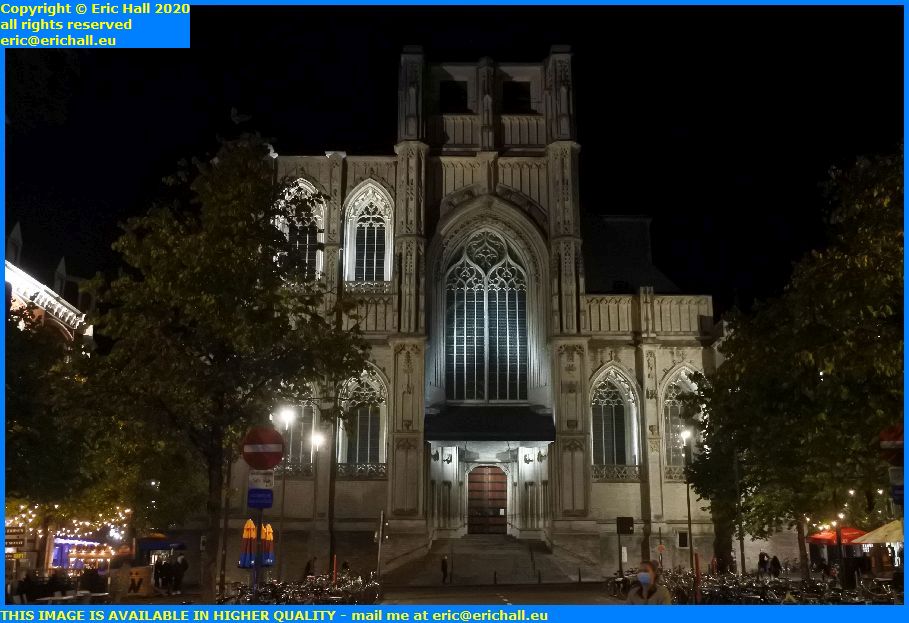
St Pieterskerk Leuven Belgium Eric HallHere at the western end, the twin towers of the Romanesque church were to remain but in 1458 they were destroyed by fire.

There was a design proposed to replace them with some really impressive towers but firstly the foundations were not solid enough, then they ran out of money, and then there were a couple of collapses of whatever of the towers had been built. Had the plans been properly completed, it would have been the tallest building in the world at the time.

During the Sack of Leuven in 1914 the church was set alight and the roof was destroyed. And then in 1944 it suffered a direct him on its northern side from a bomb
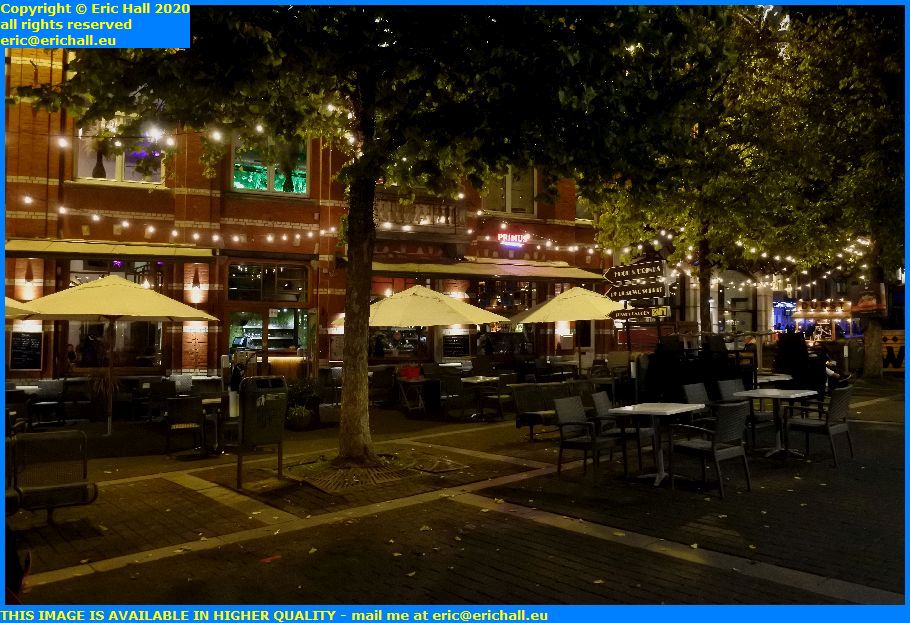
lights Mathieu de Layensplein Leuven Belgium Eric HallWhile we’d been walking around on our way to our meal we’d noticed some lights down at the end of one of the streets. On the way back we decided to go and have a look to see what as going on.

Here in the Mathieu de Layensplein where they have the brocantes at weekends, one of the bars here has decided to bring a little gaiety into the area by stringing up some very nice lights.

The whole Square looks quite nice and interesting like this and it would have been nice to see more people try this kind of thing in their neighbourhood. With everything that’s going on right now, we could do with some brightening up.

Tiensestraat Leuven Belgium Eric HallOn the way back home, someone stopped me in the Tiensestraat and asked for directions.

While I was talking, I was having a look round and having the subject of lights going round in my head, I noticed just how nice the lower end of the Tiensestraat looked with all of the lights on the buildings. It’s another subject that seems to be crying out for a photograph.

Having done all of that, I headed home and missed my short-cut, so I had to go the long way round.

And now I’ve written up my notes (and that was a labour of love) I’m off to bed. No alarm tomorrow because the medication usually takes a lot out of me and I don’t know what this new stuff will be like.

And, of course, I have a 05:30 start on Friday so I need to be at my best.

Friday 14th April 2017 – WELL, THAT’S ME …

… done in for the next few days, I reckon. I’ve really had a busy day today and I was in something of a little agony when I finally crawled myself off to bed.I couldn’t even stay awake long enough to watch a 25-minute film either!

Mind you, there’s a very good reason (or two) for this – not the least of which was that I was wide awake at some kind of silly time like 04:00 and didn’t have any idea about going back to sleep again.

However, I must have done, because I was wide awake yet again at about 06:30. And this time I managed to stay awake too, having breakfast when the alarms went off (and it’s not the first time just recently that this has happened either).

After a little bit of dillying and dallying this morning I went outside to wait for Alison who came to pick me up. She took me back to her house to see around the garden, and I took the opportunity to say “hello” to Brian, whom I hadn’t seen for a while.

Jennifer then climbed into the car with us and then we hit the highway, direction Ieper (or, for those of you with very long memories, Ypres). Neither Jenny nor Alison had been there before and it was on their list of places to visit, and so I had offered to accompany them. Regular readers of this rubbish will recall that back in the dim and distant past that for the University course that I was studying at the time, I wrote a thesis comparing the rebuilding of Ieper with the rebuilding of Coventry.

Good Friday isn’t a Bank Holiday in Belgium, and so we had the usual chaotic drive around the Brussels ring road in the usual kind of traffic that makes driving the M25 look like a stroll down a country lane, but nevertheless we made it eventually to Ieper.

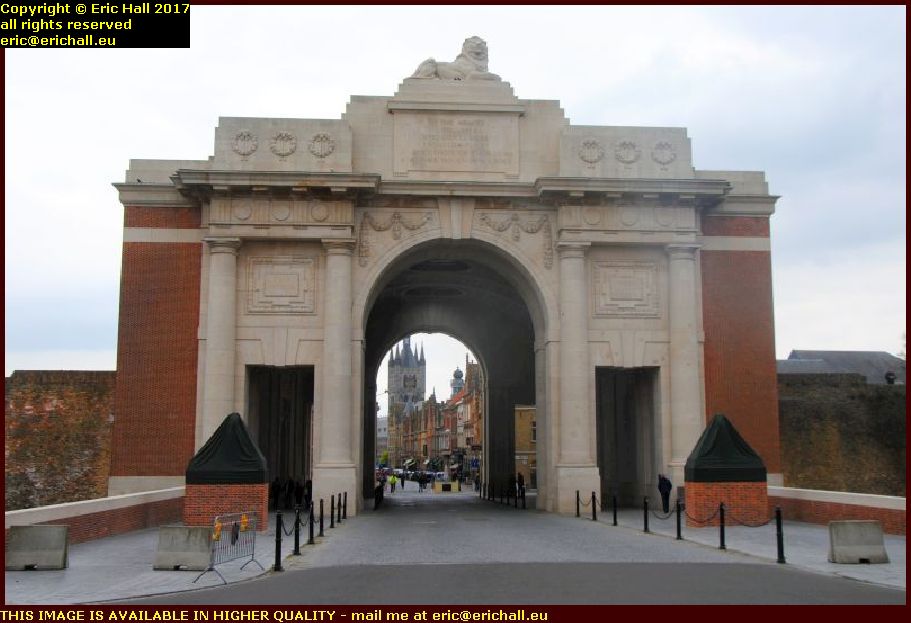
menin gate ieper ypres belgium april avril 2017As luck would have it, there was a parking space right by the side of the city walls near the Menin Gate and so Alison’s impressive driving soon had us neatly parked.

Three hours free parking outside the city walls, which is a good deal on any kind of basis and that gave us plenty of time to do a little sightseeing around the city before clearing off into the surrounding countryside.

menin gate ieper ypres belgium april avril 2017The Gate itself is fascinating. The original one had been demolished as it was considered to be a restriction to modern traffic, but a new one was built here after the war by the British as a memorial to the missing.

Of the quarter of a million or so British soldiers who died in the Battles around Ieper, probably half of them were never recovered or identified, and the idea was to write their names up on panels on the gate.

However, despite several expansions, the Gate was never ever large enough, and they abandoned the plan half-way through. Instead, they continued the work by installing panels on a wall at the cemetery.

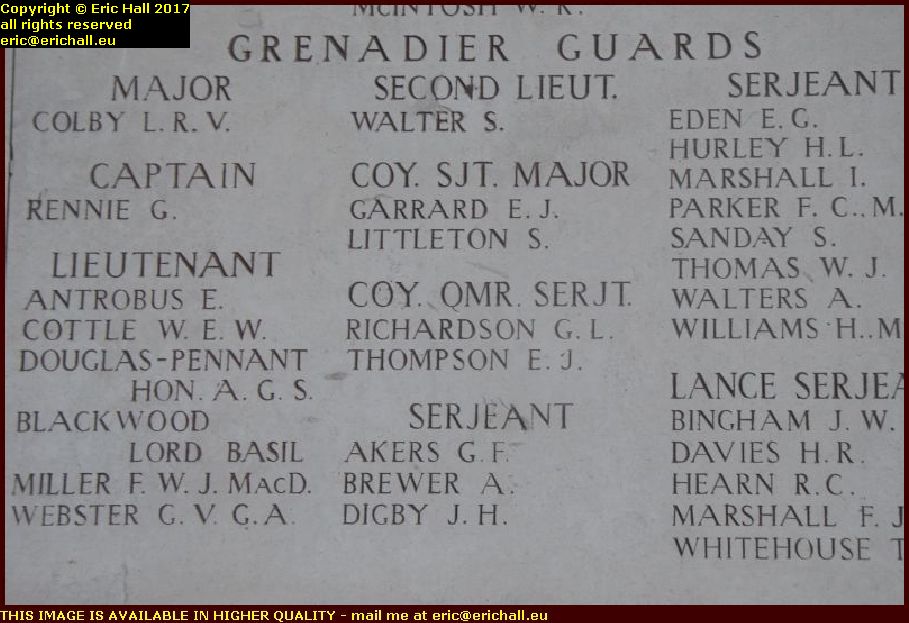
basil blackwood ieper ypres belgium april avril 2017It’s interesting to look at the panels and see if there’s anyone there whom you can identify. One name leaps to mind out of that lot on there and that is Lord Basil Blackwood.

A big friend of Maurice Baring and featuring heavily in Baring’s semi-autobiographical Flying Corps Headquarters, he was a well-known illustrator of children’s books as well as being a competent barrister.

Ironically, he actually featured in one of my nocturnal rambles a year or so ago.

Another name on there is that of the Honourable Alan George Sholto Douglas-Pennant. His claim to fame is that he was the heir apparent to the title of the Earl of Penrhyn.

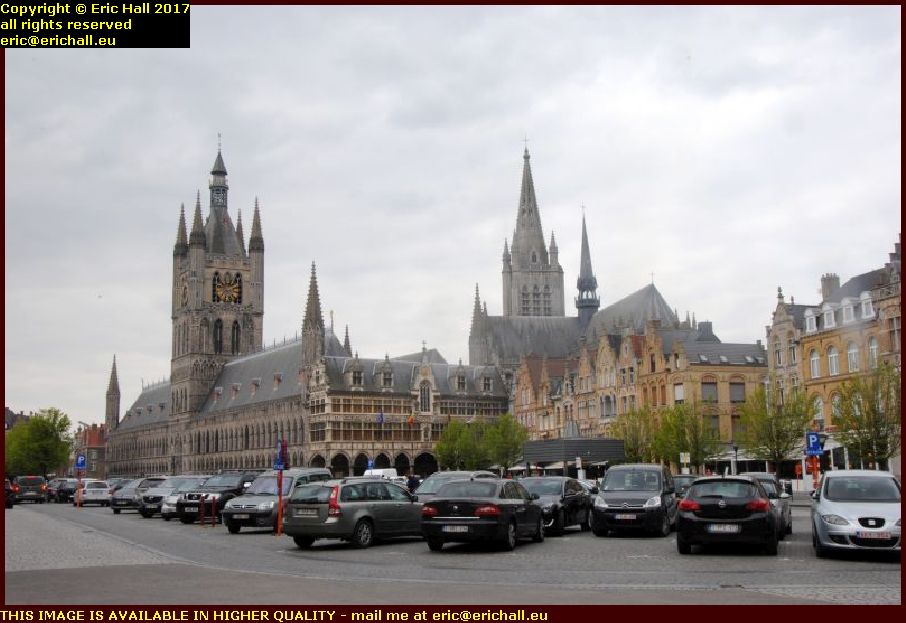
cloth hall cathedral ieper ypres belgium april avril 2017We headed off into the city centre to look at the Cloth hall and the Cathedral.

You can immediately see just how rich Ieper had been as a town simply by looking at the buildings here. The 15th and 16th Century was a time of great prosperity for the city, its fortunes being based on the woollen trade. However, by the time of the First World War, its fame and fortune had long-since passed it by.

if you had come here in 1919, all that you would have seen of the city would have been assorted piles of rubble. During the period from October 1914 until late 1917, the city was being systematically flattened by German artillery until nothing remained.

Many years ago I read the diary of the priest (or whatever ecclesiastic title he would have held) of the Cathedral in which he described day-by-day the destruction and devastation that was happening in his parish and the agonising deaths that many of his parishioners suffered.

But by chance, the original plans of the city were rediscovered after the war and this enabled much of the city, including the Cloth Hall and the Cathedral, to be rebuilt more-or-less exactly how it used to be, and it’s a testament to the skill and labour of the craftsmen that they managed it so successfully when compared to the absolutely dreadful attempts by the UK and the Donald Gibson School of Wanton Vandalism to “modernise” its cities after the Luftwaffe blitz

We found a little burger bar where not only did they have veggie burgers but gluten-free buns. We were all able to have a decent late-lunch/early-tea, and doesn’t that make a nice change?

Things are looking up!

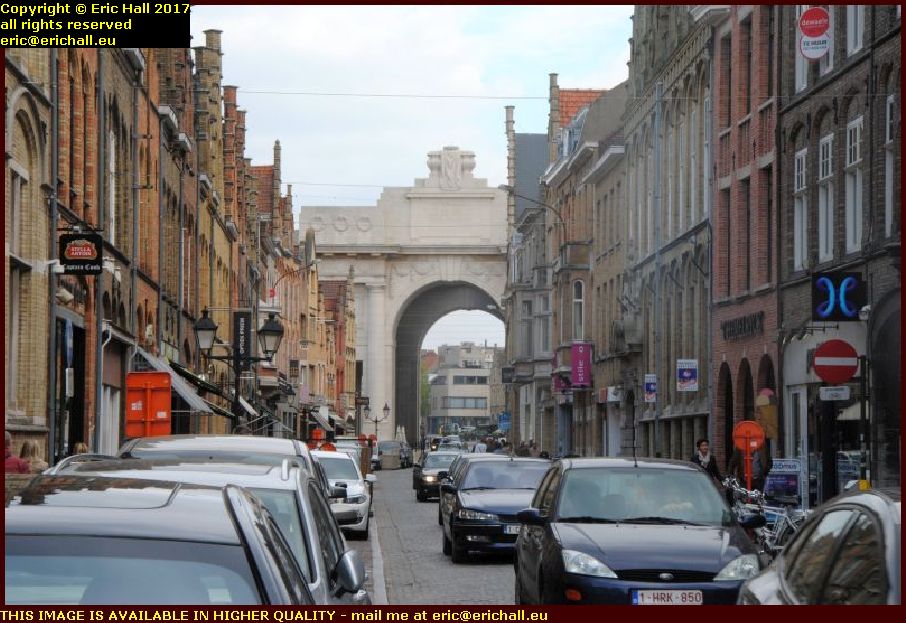
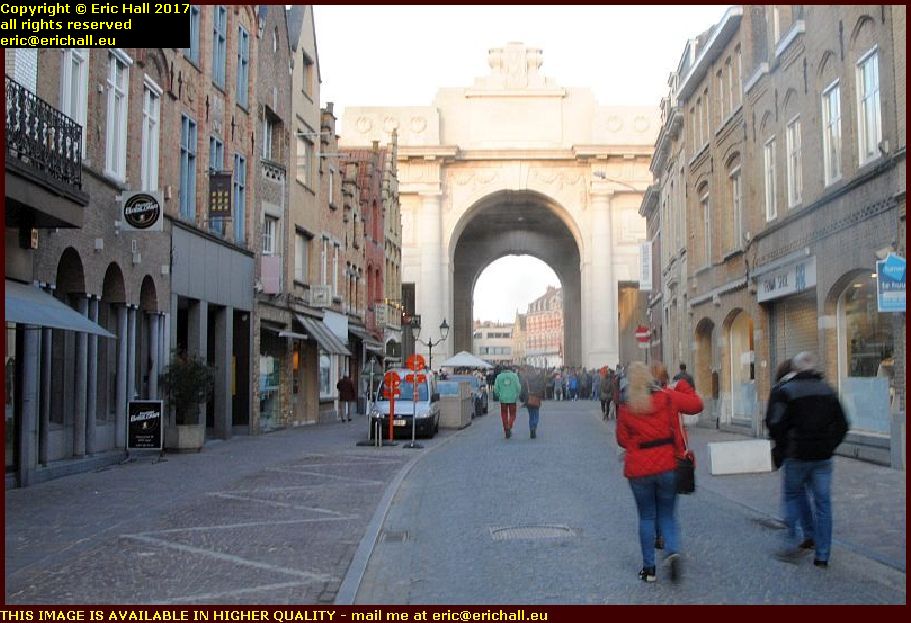
menin gate ieper ypres belgium april avril 2017Jenny had some shopping to do so we wandered back up town towards the Menin gate and the car.

This gave us an opportunity to see the Gate from this viewpoint and to admire the facades of the houses that lined the street. It’s a magnificent rebuilding job that was carried out here after the First World War.

It’s just a shame that there is so much traffic in the street. But it IS Easter Holiday in the UK of course, and that’s why Jenny is here

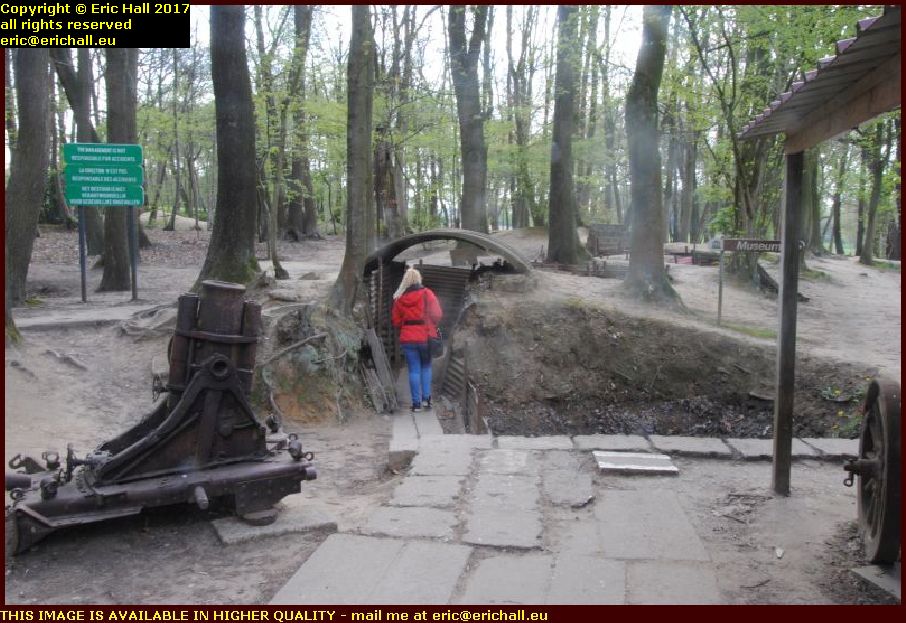
museum trench mortar ieper ypres belgium april avril 2017There’s a museum out on the edge of the city where artefacts dating from the battles here had been taken to be put on display, and this was one place that Alison and Jenny wanted to visit.

Here’s Jenny just disappearing into a trench that was being protected by an old trench mortar of the type that the British used to lob projectiles from their trenches into the German trenches which, sometimes, were no more than 20 metres away across No-Man’s Land (or No Person’s Land as I really have heard it described).

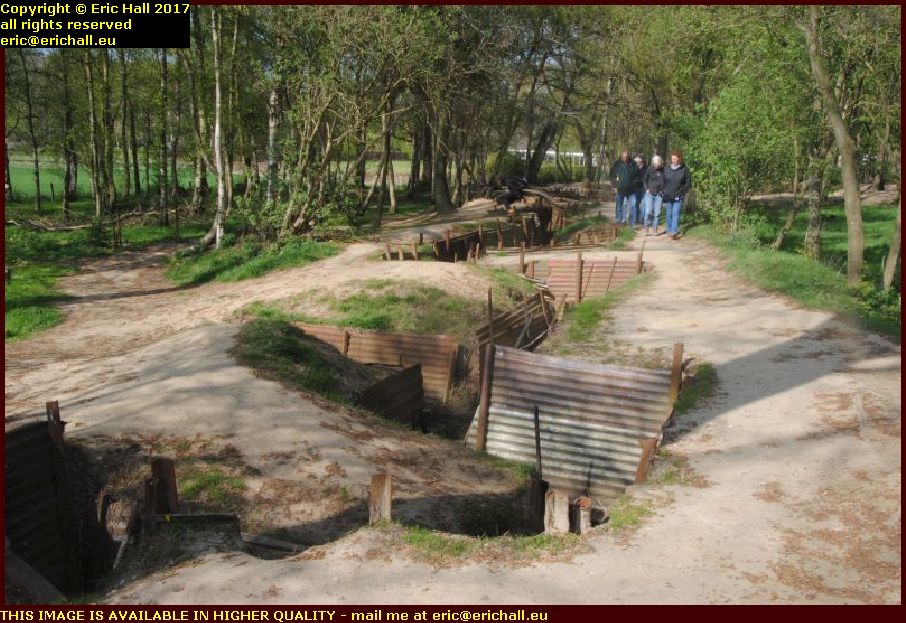
trench museum ieper ypres belgium april avril 2017The people here had bought a section of what was, I believe, the British second-line trenches during the battles here, and had kept them in some kind of state of how they might have been during the fighting.

Of course, it’s very difficult for the trenches to remain intact after 100 years, but hats off to them for having a go. It’s the nearest that you will ever come to understanding the suffering that the soldiers of the various armies had to go through during the First World War

There were all kinds of relics recovered from the battlefield and stored here to give you an idea of the items that were being used on the battlefield.

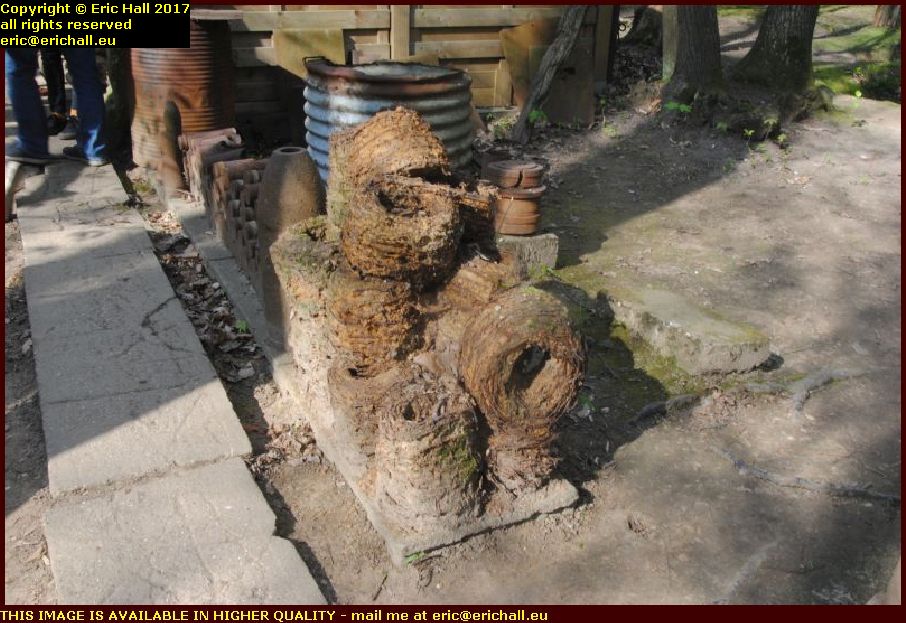
barbed wire trench museum ieper ypres belgium april avril 2017Barbed wire was probably one of the most common items to be used out here, and they had recovered several rolls of the stuff over the years. Horrible nasty stuff that can tear you to shreds and which was used to impede movement in No-Mans Land.

The Germans had a very nasty habit of whenever there was about to be a British attack, they would sneak out and carefully cut the wire in strategic places so as to channel the attacking British and French troops down predictable pathways, which were then covered by a couple of heavy machine guns.

Ludovic Kennedy reckoned that of the hundreds of thousands of Allied troops who were killed on the Somme and at the Third Battle of Ypres, most were killed by no more than a few hundred German machine-gunners.

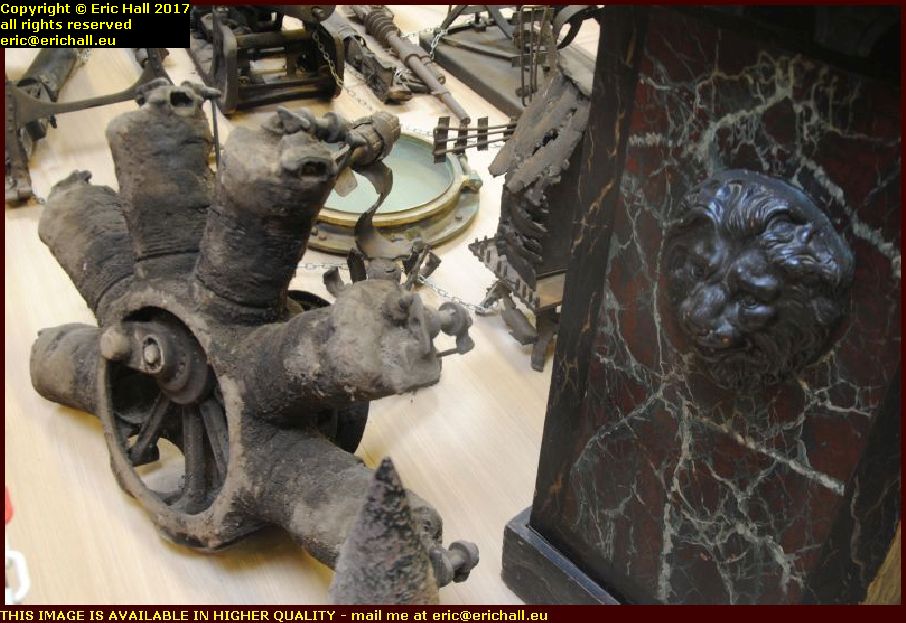
world war one radial engine hill 62 ieper ypres belgium april avril 2017I wanted to come here again because when I had been here before they had brought in a radial engine from a World War 1 aeroplane that had crashed on the battlefield.

I was hoping that they might have cleaned it up but apparently that’s not within the remit of the museum, so I couldn’t even tell if it was German or Allied, never mind what make it might have been.

They were usually either 7 or 9-cylinder engines (sometimes in two banks) and this one is a 9-cylinder.

The principle of the radial engine is that the engine rotates around the pistons, not the other way around. They produce a lot of lateral torque as you might expect and so required a great deal of concentration to fly.

However the torque could be an advantage because if you were being chased across the sky by an enemy machine, relaxing your grip would let the torque take over and the machine would shoot off at random unpredictably all over the sky and the aeroplane chasing you couldn’t follow you.

The British however generally insisted on stable machines that would fly predictably and easily, and hence they were shot down like flies.

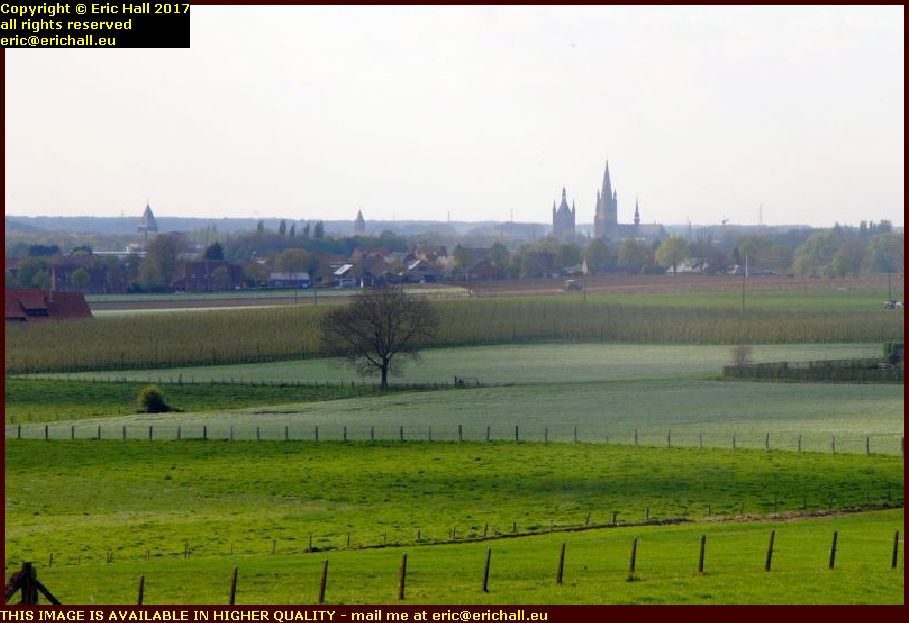
hill 62 ieper ypres zonnebek passendaele passchendaele belgium april avril 2017Outside, we went up to Hill 62 to see if we could see the Hooge Crater – the hole that had been created by the massive mining, tunnelling and explosive works of the british to demolish the German defences.

It’s not clearly visible but the city of Ieper is, and you can see why it was imperative for the British to capture the hill from the Germans, for from here they could rain down shells and bullet on the city with impunity.

People often talk about the heavy losses that were sustained by capturing positions like these, but from the top of the hill it’s very easy to imagine the casualties that would have sustained from a battery of field guns had they been allowed to remain here unopposed.

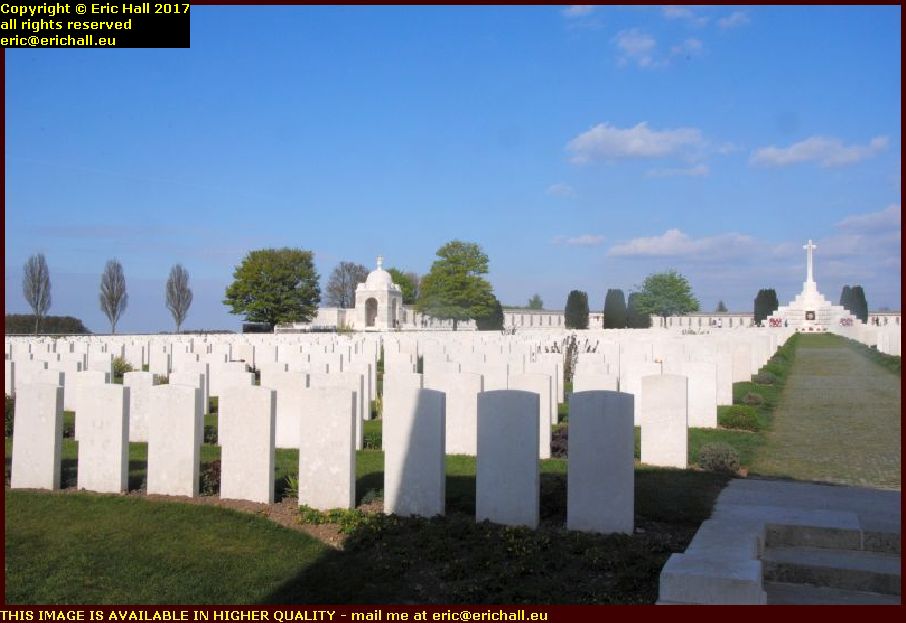
tyne cot military cemetery ieper ypres zonnebeke passendale passchendaele belgium april avril 2017From here we went on through Zonnebeke on the road to Passendale – or Passchendaele – where we stopped at the Tyne Cot military cemetery half-way up the hill.

It’s by far and away the largest British military cemetery in the World and the even sadder thing about it is that more than half of the inmates are unidentified.

What is known about them is written on the tombstone – “an unidentified soldier of the First World War” means that they don’t even know his nationality. “A unidentified Second Lieutenant of the Black Watch” is more clear.

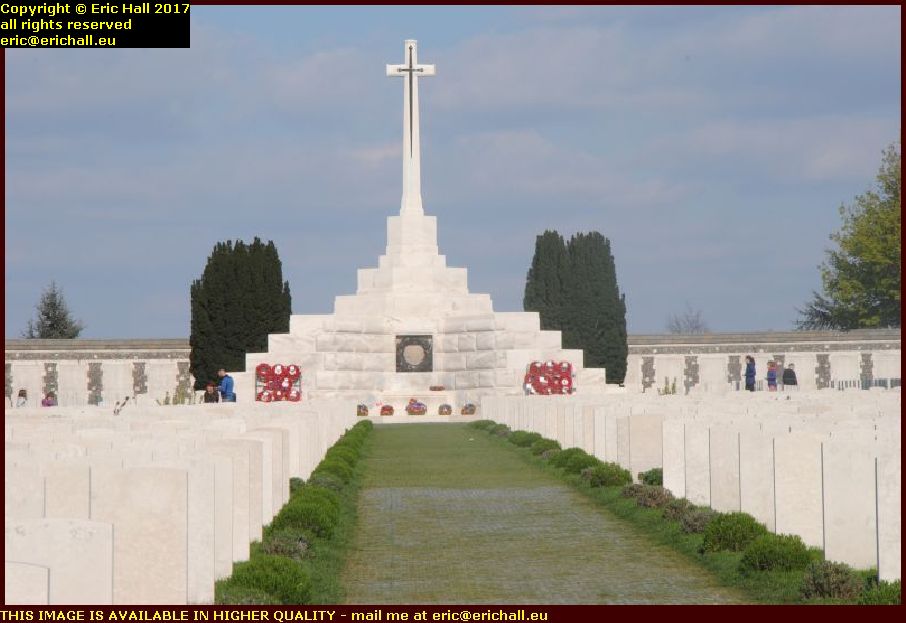
tyne cot military cemetery ieper ypres zonnebek passendaele passchendaele belgium april avril 2017I mentioned earlier that at the Menin Gate they had eventually given up the idea of expanding it to include the names of all of the missing.

It’s here at Tyne Cot that they carried on, and all along the back wall are the names of tens of thousands more soldiers who disappeared into the morass that was the Third Battle of Ypres, or Passchendaele.

And to think that there are still some people (mainly Brits of course) who are still fighting this war

tyne cot military cemetery ieper ypres zonnebek passendaele passchendaele belgium april avril 2017Douglas Haig came in for a lot of bitter criticism about his plan of attack – mainly from Captain Liddell-Hart and his acolytes in the 1950s and onwards.

But Liddell-Hart’s vitriol, due mainly to his having been passed over for promotion on many occasions evenwhen officers were also dying like flies, obscures a couple of vital points that history has (conveniently for Liddell-Hart) totally forgotten.

  1. Haig wanted to attack in the late Spring and Summer after the Vimy Ridge offensive, when the weather would have been kinder. It was the British politicians who insisted that Haig postpone his attack, and overruled him at every step. And, just like Brexit politicians, they all ran away and hid when it all went wrong.
  2. Haig had a dreadful fear, and although subsequent events were to prove him wrong, contemporary knowledge was certainly on his side and he cannot be blamed for thinking the way he did.

    After the dreadful carnage that was Verdun, the French Army was on the verge of mutiny and there was a strong call amongst left-wing politicians in France for an immediate end to hostilities.

    If the French left-wingers had had their way, and France had withdrawn, what would have become of the British Army?
    Being unable to fight in France, and being unable to resupply (as all of the ports used by the British Army were in France) the German Army would have simply waited until the British had run out of ammunition and then walked over and rounded them up.

    It was absolutely vital that the British reach the Belgian coast and capture a port at all costs if they were to continue the battle and not surrender to the Germans.

    As it happened, the left-wingers in the French Government were defeated and order was restored, but Haig wasn’t to know this at the time of the battle. And history has very unkindly erased this chapter of the story from Modern Thought.


menin gate ieper ypres belgium april avril 2017Back in town again later, we went for a coffee and encountered another Belgian businessman who preferred to shut up his shop and go home instead of catering for the hundreds of people who were milling around the Menin Gate – no wonder that there’s a recession.

At 20:00 every night the Belgian Fire Brigade have a parade here and blow the Last Post to commemorate the hundreds of thousands of British soldiers who died here to keep the city out of German hands (and as I have said before … "and on many occasions too" – ed … things must have gone dramatically wrong for the UK over the past 50 years if the Belgians prefer the Germans here these days).

The proceedings were interrupted by a British motorcyclist on a big Harley Davidson who rode the wrong way up a one-way street and revved his engine to drown out the ceremony (which explains a lot of what I have just said) but anyway, we headed back to the car afterwards for our journey back.

And now I’m exhausted. I’ve had a heavy day and it’s just as well that I’ve organised a Day of Rest tomorrow. I’ll be in no state to hit the rails after all of this.

Monday 12th May 2014 – I DIDN’T HAVE ANYTHING …

… like as good a night’s sleep last night. But that’s because the bed collapsed in the middle of the night. I thought that it was all too good to be true. I carried out a few hasty repairs and we’ll have to see what that gives. I hope I can make it home without too much trouble – much as I love Caliburn, I don’t want to sleep for the next few nights in his cab.

So after breakfast I headed off to Troyes again and lost my way again. But in the end I did manage to work out how come. Troyes is actually two centres – the old original centre and the newer Medieval centre, and they each have a ring road and so it’s like a figure 8 – and that’s what makes it so complicated.

parking place troyes franceAfter much ado, I ended up back where I had left Caliburn yesterday as parking there is free, so another motorist told me. I may just as well have stayed there last night for all the good my meaderings did me.

And what a beautiful place it would have been to stay, too. If this is the kind of thing that you see at a free car park, just imagine what it’s going to be like in the touristy bit.

quai de la prefecture troyes franceAnd if they call Chalons the “Venice of Champagne”, what on earth do they call Troyes? Because it has 10 times as many water courses flowing through it and they are all much more impressive than what you see at Chalons.

Where I parked Caliburn was right by a canal of course, and this view , the quai de la Prefecture, is only a few hundred metres away

historic troyes half timbered houses franceTroyes though is a fascinating city and it’s probably one of the prettiest places to visit if you are, like me, a fan of medieval architecture.

There’s all kinds of wooden wattle-and-daub half-timbered houses here and it’s very easy to picture Coventry as looking like this in the 1920s before the planners and the Luftwaffe started to become involved in Coventry’s development.

half timbered houses modern centre troyes franceBut as you see, the presence of old medieval architecture hasn’t interrupted the modern progress of Troyes, despite what Donald Gibson (ptah!) might have told us.

What Gibson and his planners did to Coventry in the name of “progress” was nothing short of criminal when you consider how other cities have successfully integrated their historic buildings into modern 20th-Century lifestyles.

basilique st urbain troyes franceAs well as the Cathedral, Troyes has dozens of other churches including this one, the Basilique de St Urbain.

The Urbain in question is he who went on to be Pope Urban IV. He was born here – not in the church but in a house on the site of the church. His remains were brought back here in the 1930s and interred in the choir but I couldn’t find any trace of this, and the woman who was on duty here knew nothing, and gave the impression that she didn’t really care either – much more interested in her book.

But just a word here. You’ve seen three or four photos of Troyes. I took about 60 and I could easily have taked three or four hundred. For a lover of medieval architecture and half-timbered buildings, the city of Troyes is a paradise and should not be missed for any reason at all.

site de montaigu souligny troyes  franceNot too far out of Troyes at the village of Souligny is a sign for the site de Montaigu. Montaigu is French for “steep hill” and they weren’t joking either because it was. It’s another oppidum and castle and although the earthworks are well-preserved, there’s nothing left of any building.

Even more annoying, there isn’t anything in the way of interpretive sign to tell you what it was that was here and you are left to resort to guesswork.

bulgarian lorry jump start le cheminot franceThere’s something else to add to our list of accomplishments on this journey.

Here at Le Cheminot, a Macedonian living in Italy had a flat battery on his Bulgarian lorry that was towing a Belgian trailer through France (so hooray for globalisation) and so Caliburn and I had to give him a jump start. Good old Caliburn.

But while all of this was going on, we talked about life in Macedonia. He told me that things were much better under Tito – there was work and everyone had some money and some kind of future but now, rampant capitalism has taken over, there’s an immensely rich minority in the country and everyone else is poor and there’s a pile of unemployment. Life in Macedonia is bad. He’s not the first to say this kind of thing to me, and I’ve seen much of this with my own eyes. Communism had its good points as I have said before, just as I have said that Capitalism can in many cases be evil.

And I’m having an early night tonight. The flaming gas has run out halfway through cooking tea.

Wednesday 5th March 2014 – THE VIEW FROM MY HOTEL BEDROOM …

view from balcony hotel gaspa ordino andorra… was quite impressive late this afternoon. Not quite right now though because the sun had disappeared behind the mountains but 5 minutes earlier it was warm and gorgeous and I’d been sitting out on the balcony reading a book.

You may be wondering why I’d been doing that but the truth is that I was totally whacked.


bus L6 ordino andorra la vellaI’ve been on the public transport again – something that I seem to be doing more and more as I go about my business. This time though, it’s the bus. Something that I’ve not used since I was in Montreal in August.

Just €1:80 it was from the hotel into Andorra la Vella, the capital, and that’s good value at any price, especially as parking for anything over 2:00 metres (Caliburn is 2:12 metres) costs the proverbial arm and leg. And being on the bus is much less stressful too.


andorra national sports stadiumI found the Andorran National Sports stadium too. Andorra were playing Moldova in a friendly so I was determined to go to watch the game but, as you might expect, the best-laid plans of mice and men quite often go gang awa’ when I’m involved. The stadium is undergoing a total rebuilding and the match was being played elsewhere. GRRRRR!

But what a stadium! I’ve seen better stadia than this in the Puy-de-Dôme league back home. I’m not surprised that it’s undergoing rebuilding, but a well-known phrase involving silk purses and sows’ ears springs readily to mind.


historic old town andorra la vellaStill, my journey wasn’t totally wasted. I spent most of the day wandering around to see what there was to see.

This is part of the old city and you can see how the place must have looked before the money started arriving. It’s a shame that there isn’t a great deal left. Everywhere you go, there are modern buildings and major construction work and it is a little depressing to see history being swept away. Although what seems to be being swept away are buildings from the 1950s and 60s and the first stage of reconstruction.


old parliament building casa de la vall andorra la vellaI found the old Parliament building – replaced by a modern multi-million Euro concrete-and-glass monstrosity three or four years ago. There was a free guided tour on offer too – in English I was told, but it turned out to be a fine example of classical Spanglish renowned the world over.

Apparently there were originally 24 members of the Parliament but this was enlarged to 28 some years ago. Now there is a proposal to enlarge the Parliament to 42 (cynics amongst you can well-speculate upon the reasons) and so a larger building is required.


old parliament building casa de la vall andorra la vellaI’m not quite sure why though – a good weekend’s work with three or four sledgehammers and a couple of acrows and we could soom make room for the required number of seats (if they really do need to enlarge the number of deputies) in the Casa de la Vall but of course, that wouldn’t make a nice shiny new office building though, would it?

I shall have to stop doing this – I’m becoming far too cynical for my own good. But then again, I blame my lifelong employment in the tourist industry and at the seat of European political power.


church st esteve andorra la vellaNext to the Casa de la Vall is the Church of St Esteve. Not Esteban as you might expect but Esteve, for one thing that I learnt here in Andorra la Velle is that the official language of the country is not Spanish but, since 1993, Catalan. No wonder I’ve been having difficulty making myself understood here.

The church dates from the 12th Century but fell victim to what in the UK would have been described as “Victorian Frightfulness”, which is a great shame.


thermal therapeutic baths andorra la vellaWe talked about modern buildings just now, and here’s one. What do you think that this might be?

My first thought was that it was a cathedral designed by someone from the Donald Gibson School of Wanton Vandalism in Coventry, but it is in fact a temple of the modern 21st Century religion – a fitness centre and thermal spa. I did go for a wander around inside but, quite frankly, it left me speechless and, as you know, that’s not something that happens very often.


old stone building andorra la vellaBut occasionally, on my travels I did come across the odd building that was worth photographing, but it wasn’t always possible to find a good viewpoint for a photograph without being cluttered up my modern buildings, road signs and vehicular traffic.

Hence, a photo like this is something of a rarity, which is a shame. But then, I do wonder just how long this building will be here.


tax free shop selling guns andorra la vellaEvery third shop in Andorra is a tax-free shop, so it seems. And while yesterday we had a photograph of how friendly and accommodating the country is to terrorist bombers, here is a photo of how friendly and accommodating the country is to mass murderers, school assassins and armed robbers. Every weapon you want, and ammunition too, on display in the windows.

But with these tax-free shops, it’s clearly illegal to label the products with their prices. Seeing a priced item in one of these places is a rarity. My Spanish isn’t up to much, my Catalan even less, and so I’m not likely to be able to ask the prices or even to engage the shopkeeper in meaningful conversation, so from a real tourist point of view, these shopkeepers are wasting their time.


solar panels andorra la vellaAndorra la Vella means “Andorra in the Valley” and so I couldn’t overlook the opportunity of taking a photo of the valley once I had found a suitable viewpoint.

But it wasn’t necessarily the valley that had caught my eye, but if you look at the roof in the very foreground of the photo, you’ll see that it’s equipped with some solar panels. We do occasionally have some sun here in Andorra la Vella – there was a bit today in fact – and it does clear the mountains across the valley.

So there you are.


So no wonder I’m whacked – especially as I also had a busy night too.

While I worked at Shearings in the summer season all those years ago, I had a winter job driving coaches for a local company in Crewe, with right miserable old boss in charge. Last night he had all of his coaches out, taking a huge group of passengers for a weekend to France (I’ve done this).

And all of his coaches too – even down to an early-1960s Harrington-bodied AEC that heaven alone knows where he must have dug that up from.

Anyway, it all descended into chaos. With these 8 or 10 coaches, we each had our passenger list? But we never picked up the people we were supposed to pick up – there were amendments, additions, crossings out until the passenger list was just hopeless. And why we were not setting out intil 14:00 onn Saturday afternoon for our weekend out was something that was totally beyond me.

It did recall a real adventure with this company when I, and another driver, were taking two coaches to Blackpool. We each had our passenger list but when I arrived at the pickups there were very few of my passengers but a load of other people who were waiting for a coach from the company for whom I was working. The other driver had arrived first and just picked up the first passengers that he could, and left me the rest.

“Nothing very important in the significant run of things” I hear you say, but in fact the coaches were doing different optional excursions – hence the two coaches – and this led to all kinds of confusion and recriminations, and the other driver making alternative arrangements with regard to employment opportunities.