Tag Archives: French resistance

Tuesday 25th February 2014 – I’M NOT HERE

Well, not ALL here anyway. But you knew that already, didn’t you?

viaduc des rochers noirs de la roche taillende lapleau correze franceI’m not there either – although I was earlier this evening. This is the Viaduc de la Roche-Taillende, colloquially known as the Viaduc des Rochers Noirs, and it’s near the town of Lapleau in the Corrèze.

You may not think it looking at that tight curve to enter the viaduct, but I’m actually standing on the bed of a disaffected railway line. It’s another one of these metre-gauge tacots, or “rattletraps”, a narrow-gauge railway line similar to the one that we’ve seen at Marcillat-en-Combraille in the Allier, but this one ran between Ussel and Tulle in the Corrèze.

There was a speed limit of 15kph on the line which is hardly surprising given the tightness of the curve, and also the fact that we have a suspension bridge which is quite a rare type of construction for a railway bridge.

viaduc des rochers noirs de la roche taillende lapleau correze franceJust like chez Liz and Terry, the railway disappears off into a tunnel on the other side of the river, but that is all fenced off.

Until 2006 you could actually drive through there in a car but unfortunately the Conseil Départementale has put a stop to all of that.

I merely contented myself with taking a few pictures – there wasn’t anything more that I could do unfortunately.

viaduc des rochers noirs de la roche taillende lapleau correze franceI did however go for a little bit of a climb and I was glad that I did, because the view from up on a rocky outcrop towering a couple of hundred feet above the viaduct was stunning, to say the least, even if it did wear me out climbing up to here.

This photo does show you the lengths that they had to go in order to build the viaduct and it’s hard to think that this line didn’t open until 1913, by which time it had effectively already outlived its effectiveness with the coming of the motor-bus but nevertheless it struggled on until as recently as 1960, which is quite an achievement for a metre-gauge tacot.
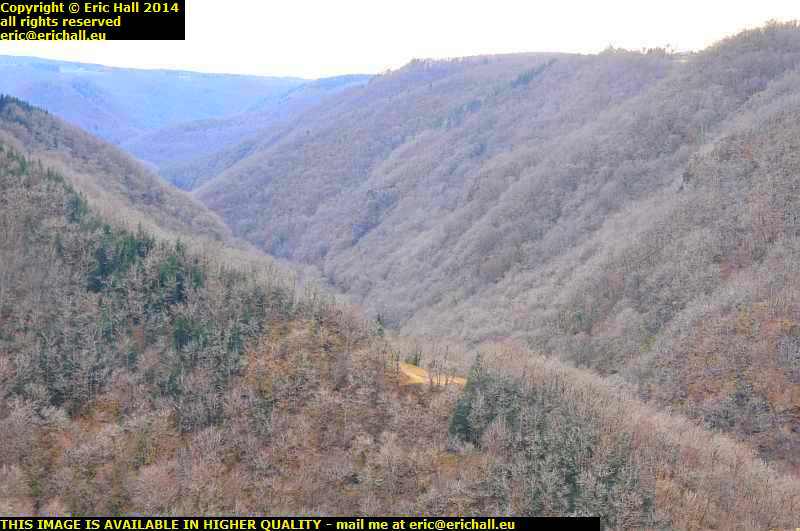
 les gorges de la Luzège lapleau correze franceWhile I was up here I took a few photos of the stunning scenery.

The viaduct spans the Gorge de la Luzège at a height of 92 metres, or 126 metres if you count the pylons, so I’m quite high up and the view of the gorge is amazing.

It’s a shame that the weather was so dreadful though – it’s been raining non-stop and I’ve forgotten to bring a raincoat with me.

Serves me right.
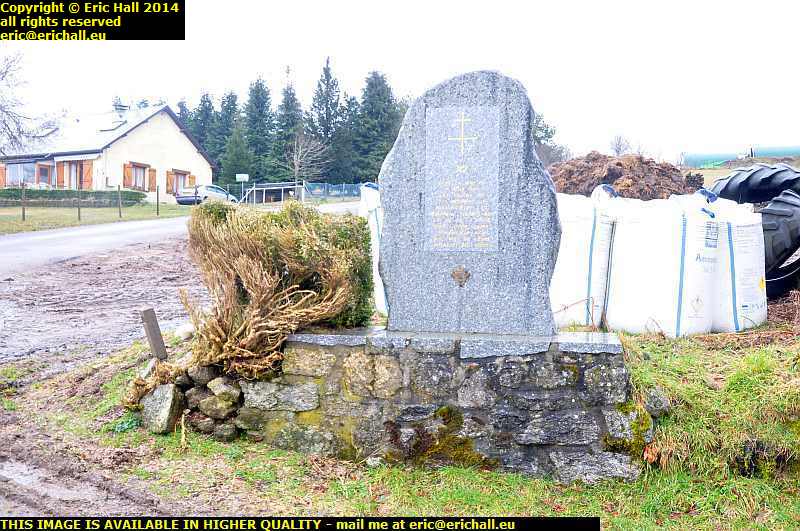
plateau de Millevaches memorial 3rd Regiment SAS french resistance france 1944Coming here brought me (via the Pionsat Post Office to post Cécile’s letters) over the Plateau de Millevaches on the border between the Creuze and Corrèze.

Apart from the snow that I encountered, the plateau is famous in that it was effectively a “Free French” area during World War II. There is a great deal of resistance souvenirs in the area, including this plaque to commemorate the parachuting-in of members of the 3rd Regiment SAS who organised the French Resistance in the turbulent times after D-Day.

There are poignant souvenirs too – memorials to victims of the occasional sweeps by the Gestapo and also the town of Tulle itself just a short drive away, where the Das Reich Panzer Division of the SS strung up almost 100 locals from lamp-posts in the centre of the town as a form of reprisal for terrorist attacks.
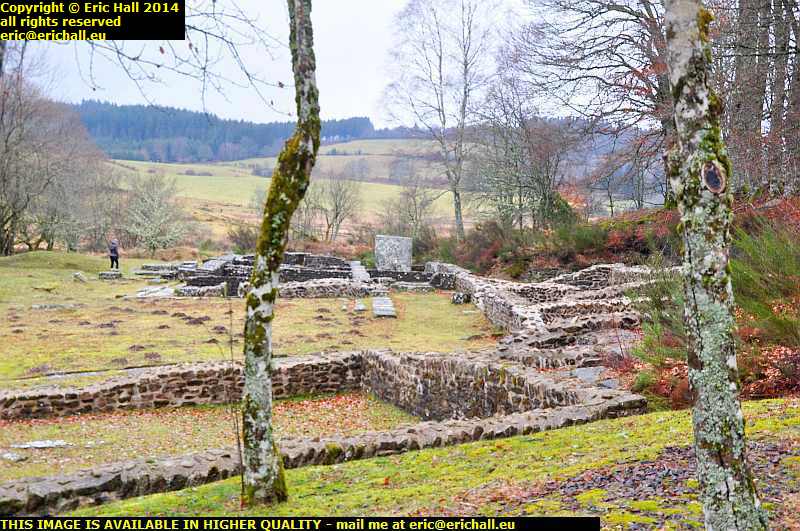
roman ruins villa temple ruines les cars plateau de millevaches corrèze franceAnd that’s not all either.

I saw a sign that said Ruines les Cars and with Cars being French for the kind of coaches that I drove when I worked for Shearings, I went for a look to see what it was all about, but instead I found myself in the middle of a Roman villa and huge Temple from the 2nd Century AD.

Of course, you are not allowed to say “Roman Remains” here in France. Everything has to be “Gallo-Roman” because the French don’t accept (rightly or wrongly, I dunno) that the French civilisation of the turn of the Common Era was any less inferior than the Roman civilisation, and I’ve seen some healthy fights at some of these archaeological meetings that I sometimes go to.

remains of old car plateau de millevaches corrèze france Talking of ruins of cars, another thing that caught my eye was this. The remains of an old car abandoned in a forest.

No maker’s plate or anything like that on it, so no idea what it might be, but it has a wooden chassis sheathed in steel, and it’s clearly the type of car that had real wings and a lift-off body. With its steel wheels, all of that dates it to the early 1930s I reckon.

If you have any ideas what it might be, let me know. But there isn’t much to go on, I know.

From here I headed off down the hill and towards civilisation. I ended up in the town of Tulle where I planned to find a hotel but was singularly unsuccessful.

And to my own surprise, I didn’t take a single photo of the place and I ought to have done, because Tulle is one of the saddest places in French modern history.

Following the Normandy Landings, the local Resistance troops had risen up and seized control of the town from the Germans. Just as they were preparing to deal with the final German holdouts, the 2nd Waffen-SS Panzer Division Das Reich appeared on the scene on its way north.

The result was that 99 civilians, many of whom had no connection with the armed uprising, were strung up from lamp-posts in the main street and a considerable number of others were brutally tortured

So with no hotel that I could find in Tulle, I’ve moved on to Brive la Gaillard where I’ll be spending the night.. I’ve no idea where I’ll be tomorrow.

Friday 20th December 2013 – DIDN’T WE HAVE A LUVVERLY TIME …

day out coach trip bus ride pionsat clermont ferrand puy de dome france… the day we went to Clermont?

Thanks, Marianne, for ringing me at 06:30 otherwise I would still be in bed now, but anyway off to a garage along the road between Pionsat and St Eloy where Marianne was to leave her car for a service, and then we headed into Pionsat to catch the bus.

33 of us, there were, on board heading for Pionsat’s annual shopping trip to Clermont. Many towns and villages in the rural Puy-de-Dome go there on the same day and the Conseil-General have a little welcoming celebration with coffee, orange juice and croissants – just as well seeing as how I didn’t have any breakfast. And we received a free tram ticket, shopping bag and little Christmas present too.

The queue for the tram was enormous and so we walked to the centre, which was quite nice seeing as we passed by the city’s cemetery. One thing about Marianne is that she’s just as interested in things like this as I am and an invitation for a stroll around the dead centre of any kind of urban settlement will not be sneezed at.

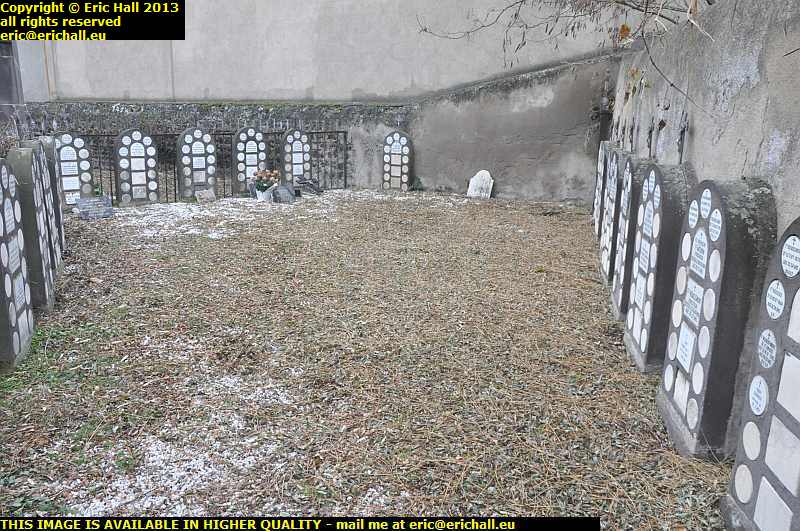
cemetery clermont ferrand monks puy de dome franceThere were formerly many religious establishments in Clermont Ferrand and we stumbled across many communal graves in which various groups of nuns had interred their departed members.

The communal graves of the monks were however much more interesting. Tucked away in a quiet little corner of the cemetery behind a few enormous tombs is their last resting place – one headstone for each establishment and a little plaque for each brother who is interred here. Things like that are quite poignant really.

And I wonder who is involved in the upkeep of this little plot because some of the communal graves of the nuns are, well, very sorry spectacles indeed.

commonwealth war graves cemetery des charmes dechaux clermont ferrand puy de dome franceThere’s also a Commonwealth War Grave here in the cemetery at Clermont Ferrand. 22 British, Canadians and New Zealanders are buried here. 21 are Air Force men and quite clearly three groups of 7. Pilot, Flight Engineer, Navigator, Wireless Operator, Bomb-Aimer and a couple of gunners.

One group died on 5th March 1944, another group on 10th March 1944 and the third group on 27th July 1944. Clearly three Lancasters shot down in the vicinity and with the proximity of the huge Michelin tyre factory – just a couple of hundred yards away from where I was standing taking this photograph, then no prizes for guessing what they were doing – or trying to do.

Or so I wrote at the time. Subsequent research revealed something rather different.

Only one of the aircraft was a Lancaster engaged in bombing the Michelin factory (with an alternative target of the marshalling yards at Aulnat).

These were the crew of Lancaster B III serial ND513 of Squadron 207 RAF, carrying identity EM-R. The crew led by Squadron Leader Dudley Pike had set off from Spilsby in Lincolnshire on 10th March at 19:42.

The aeroplane suffered a direct hit from flak and exploded in mid-air. The wreckage crashed close to the Anne-Marie-Menut roundabout between 23:00 and 23:30.

The earlier crash, on 5th March 1944, was actually a Stirling B III serial EF215 of 75 squadron RAF (although many of the crew were New Zealanders). She carried identity AA-M

She had taken off from Mepal in Cambridgeshire on 4th March 1944 at about 20:51. She had been loaned to SOE (the Special Operations Executive) and was on a training flight parachuting arms to the Resistance in the Auvergne.

Because of the foul weather (blinding, gusting snowstorms were reported) she couldn’t see the torch signals and so aborted the mission, but ran into the side of a Puy in the Le Cros – Douharesse area.

The upper middle machine-gunner luckily survived the crash and was arrested. The others perished and, according to a report issued at the time, the cause of death was as much exposure to the elements as the injuries received in the crash.

The third aeroplane Was another Lancaster B III, serial number ND527 (only 14 machines newer than that lost on 10th March). She carried identity LE-O and belonged to 630 suadron RAF, although some crew were Canadians.

She had taken off from East Kirkby in Lincolnshire at 21:17 on 26th July 1944 to bomb the marshalling yards at Givors, south of Lyon, but at 02:45 the following morning, in the middle of a violent storm, she was involved in a mid-air collision with Lancaster ND856 of 82 squadron.

The pilot of the plane attempted a crash-landing just south of St Ignat, 14kms north-east of Riom, but collided with trees. The plane burst into flames and the crew was immolated.

Incidentally, ND856 exploded in mid-air and its remains fell to earth four or five kilometres away. The crew was originally buried in the local cemetery close tot he crash site but were later exhumed and re-interred in the big military cemetery at Mazargues, near Marseille.

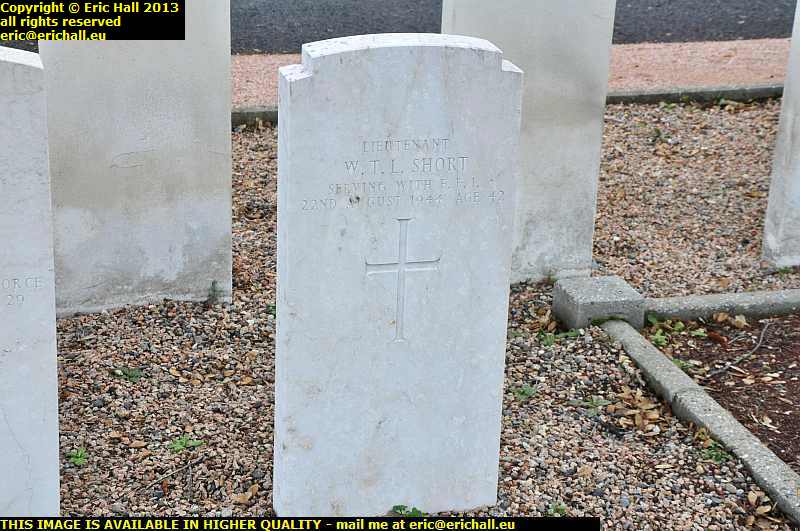
lieutenant W T L Short commonwealth war graves cemetery des charmes dechaux clermont ferrand puy de dome franceThe 22nd grave is that of Lieutenant WTL Short and his is an interesting story.

It doesn’t matter what your perception of the RAF Bomber Command is (mine is that they were a bunch of mass-murdering war criminals, but that is by the way), no-one will dispute that for the expense and effort involved and the number of casualties that they suffered, they were pretty much ineffective and much more could have been achieved at far, far less expense by quite simply parachuting into the target area a bunch of commandos armed to the teeth, with the aim of sabotaging the factories and their output on the ground. The rail campaign of Summer 1944 is a classic example of this, and who remembers the Heroes of Telemark?

But a close look at the headstone of Lieutenant Short will reveal that he was “attached to the FFI” – the Force Français de l’Interieur, which is the politically-correct way of describing the French Resistance. And I can’t help thinking that for what he cost the British Government, his efforts were probably far more cost-effective than those of his 21 neighbours. And what is even more sad about all of this is that if you go to The Commonwealth War Graves Commission website

and carry out a search for the Des Charmes Dechaux cemetery in Clermont Ferrand, you’ll find entries for the 21 airmen but no entry for Lieutenant Short.

basilica notre dame du port clermont ferrand puy de dome franceFrom there we walked on into town, stopping halfway for another coffee of course. Crossing the road we went to the Basilica of Notre Dame du Port.

This church dates from the 6th Century and was founded, so the story goes, by St Avit who, as we all know, comes from down the road here at la Cellette where he had a spring and a hermitage. The church was destroyed by the Normans during one of their invasions of the 10th Century and subsequently rebuilt. Unusually, the crypt is open to the public and so we went down there to see what we could see but the short answer to that was “nothing”. It did not escape our notice, however, that the crypt only stretched so far underneath the church.

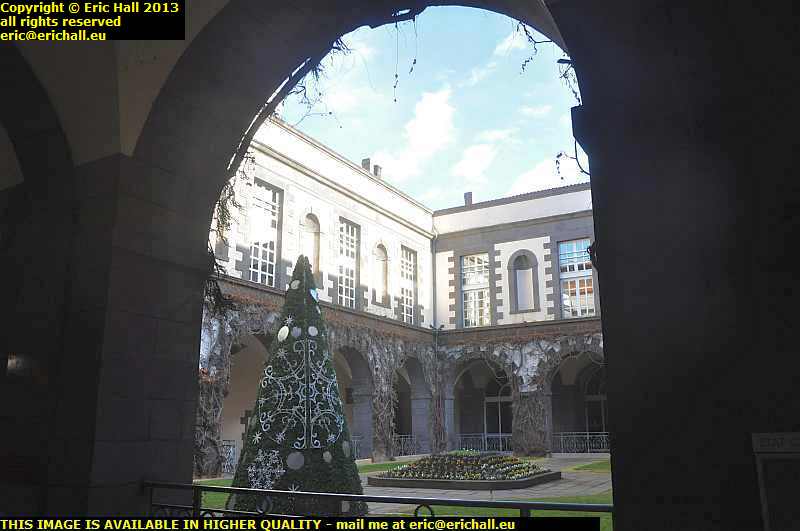
town hall clermont ferrand puy de dome franceMarianne then took me to see the Town Hall, which is just around the corner from the cathedral, the famous cathedral where Peter the Hermit summoned the First Crusade back at the end of the 11th Century.

The Town Hall was an interesting place to visit. It was formerly some kind of Abbey, as you can tell from the inner quadrangle and cloisters. But we couldn’t go inside for a nosey – it’s lunch time already.

And what do you notice here? Yes – a blue sky. It was depressing, wet and miserable this morning, just like me. But now it looks as if the sun might be coming out.

clermont ferrand puy de dome franceThe Christmas Market was next on the agenda. That was in the square at the back of the cathedral, the square that is dominated by the Puy de Dome, which you can see all bathed in snow and wun on the skyline in the background.

At the market I bought my final Christmas present, so I’m glad that I came here, and then we headed off to the Tourist Information and the Conseil General where I picked up an enormous pile of stuff for Radio Anglais. We won’t be complaining about lack of events and information now for quite a while with all of this stuff that I’ve collected, and I made a couple of useful contacts too.

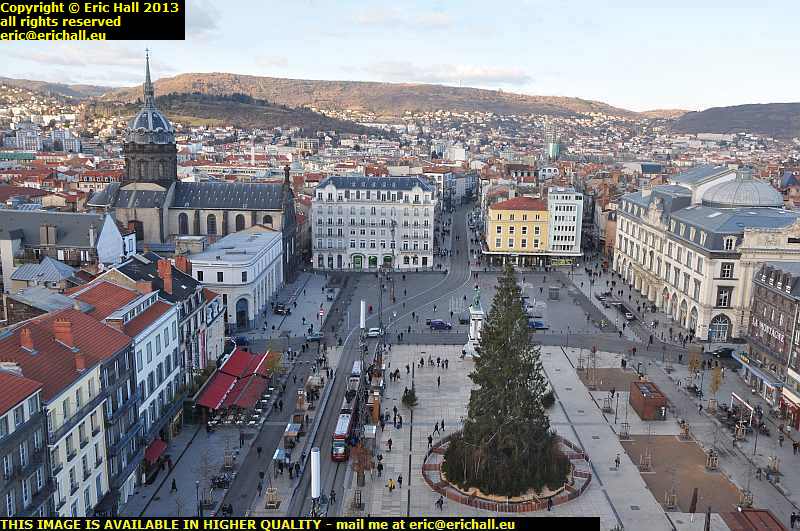
big wheel ferris place de jaude clermont ferrand puy de dome franceMy main reason for being here though is to hold Marianne’s hand on the big ferris wheel in the Place de Jaude. In her capacity as hournalist she decided that it would be quite a plan to get to the top and take some decent photos, but she’s not very good at heights. Consequently I was roped in for moral support.

The wheel is quite high as you can see, and the views from the top, such as this one looking north-west, are absolutely splendid. Mind you, I was quite disappointed as it was the smoothest ride that i’ve ever had. It gave no real sensation of movement and it certainly didn’t seem as if we were anything like this high.

cathedral clermont ferrand puy de dome franceMind you, another lifetime’s ambition has been accomplished. Taking a photo of the cathedral at Clermont Ferrand is next-to-impossible as it is hemmed in by all kinds of other buildings and there’s no really good shot.

I’ve been experimenting with extreme-length telephoto lenses from the surrounding summits of the Faille de Limagne but they haven’t really worked out. But sod that for a game of soldiers now. Up here is the nicest view of the cathedral that anyone could hope to see.

So a visit to a bookshop, a quick coffee and then back to the bus and home to 2°C.The temperature has plummetted and we might well be back into winter at last.

Wednesday 20th June 2012 – AFTER THE USUAL …

… couple of hours on the laptop I went off to Rosemary’s for the afternoon.

On the way there thought I had a couple of interesting encounters, firstly with the German guy – Heidi’s husband or partner or something – who lives over the back here, and then with Francois Carriat who lives at Barrot.

Francois was full of energy as usual – “on your way back, drop in. I could do with a hand”.

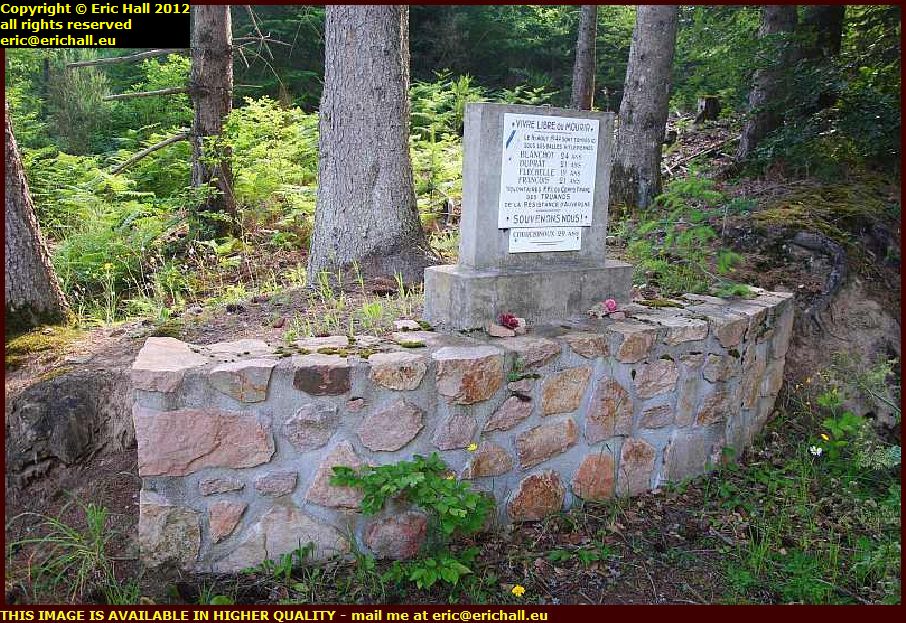
memorial to the fallen nazi puy de dome franceOn my way around to Rosemary’s, I came across this memorial. I can’t think why I hadn’t noticed it before, because I’ve been up and down this road quite a bit.

Many people criticise what the perceive as the lack of resilience of the French population to the Germans in World War II.

Leaving aside the question that I don’t recall the British civilians of the Channel Island doing too much to resist the German occupying forces – even down to the extent of sitting on their hands in starvation conditions for 9 months after the war had passed them by, the real fact is that there was quite a considerable amount of French resistance!

Regular readers of this rubbish will recall the numerous plaques that we have seen scattered around the countryside honouring people who were fusilés – shot – or decapité – decapitated – by the Germans, and we’ve seen the cemeteries at Ixelles and Evere in Belgium.

I wonder how these critics would cope if they were running the risk of being shot or decapitated every day.

Round at Rosemary’s we made some space in her barn, put my door in there and loaded up Caliburn with the rubbish, as well as a few bits and pieces that she knew that I would like.

Then we had a coffee and a chat to put the world to rights as we usually do.

I brought the rubbish back here because I have some stuff here that needs throwing away …{thud] …[thud] and I can heave that into the back of Caliburn and make just one trip down to the dechetterie at Pionsat.

Francois certainly did need a hand too. He’s had a rotavator in his small field and turned it into some kind of market garden, and a friend offered him “some” tomato plants. This “some” turned out to be about 150 and they were about 10 inches high with flowers on them.

Anyway, to cut a long story short …”hooray” – ed … Francois did the planting and I followed on behind with the watering cans and we managed to plant most of them before it went dark.

For my trouble Francois gave me a dozen for which I am grateful, and also a chili plant.

Not only that, he fed and watered me too, and we had a good chat about all kinds of things. Including the fact that tomorrow there are four groups of musicians who will be roaming the Streets of Saint Gervais d’Auvergne playing in all of the bars.

Now that sounds like a fun evening and so I might just as well go out and see what’s going on.