Tag Archives: coal mining

Thursday 7th June 2012 – YOU MAY REMEMBER …

vinegar water weedkiller les guis virlet puy de dome france… that we discussed weedkiller the other day.

Joy suggested a 50-50 mix of vinegar and water and so I tried it. And you can see the result.

A pile of burnt and scorched grass. And so there’s clearly some mileage in that idea,

Thanks, Joy, but I shudder to think about how much vinegar I’m going to need.

This morning it was work as usual on the website but I didn’t get much done due to a couple of lengthy and complicated phone calls that led to a lengthy form-filling session.

All of that made me late for my trip with Marianne and while Liz was wishing me all the best for the afternoon and me saying something like “knowing my luck it will pour down with rain” we suddenly had the most terrific thunderstorm and cloudburst.

Right on cue, you might say.

church chateau sur cher puy de dome franceAnd so I picked up Marianne and off we went for a good wander around Chateau-sur-Cher.

The village is so named because the remains of a Gallo-Roman fort were discovered on the promontory overlooking the River Cher, on the spot where the church sits today.

It’s certainly an impressive site for a defensive fortification – surrounded on three sides by a very steep climb and I can understand why the Gauls would have chosen it
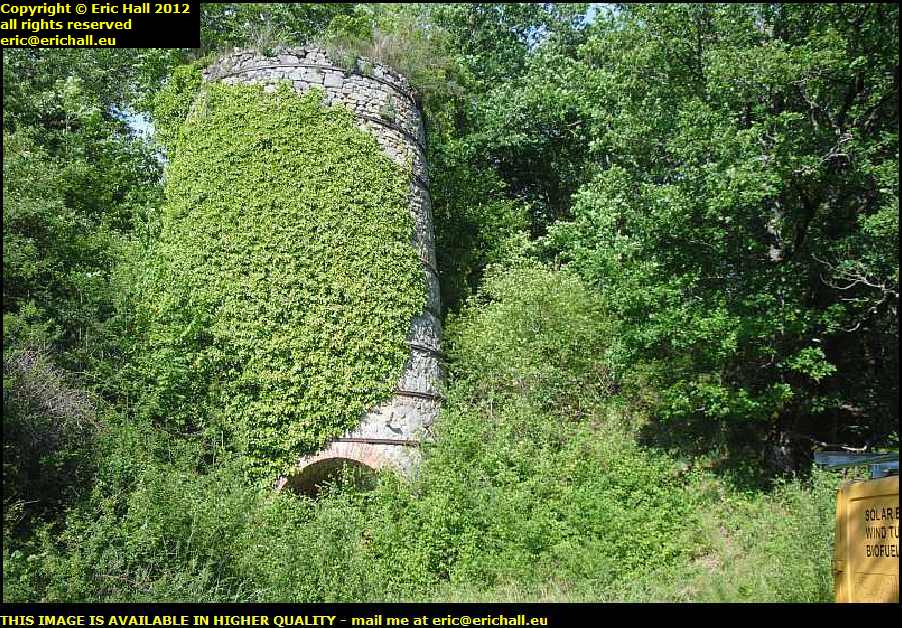
lime burner chateau sur cher puy de dome francenot only were there some interesting sights to see around the village and around the river, but that we were also directed to an intact chalk-oven and to an outcrop of a coal seam somewhere out off the beaten track on the way back to St Hilaire-près-Pionsat.

The chalk oven took some finding and that’s hardly a surprise. You can see that the chimney is all overgrown with all kinds of everything and you really did have to know where it was before you could see it properly
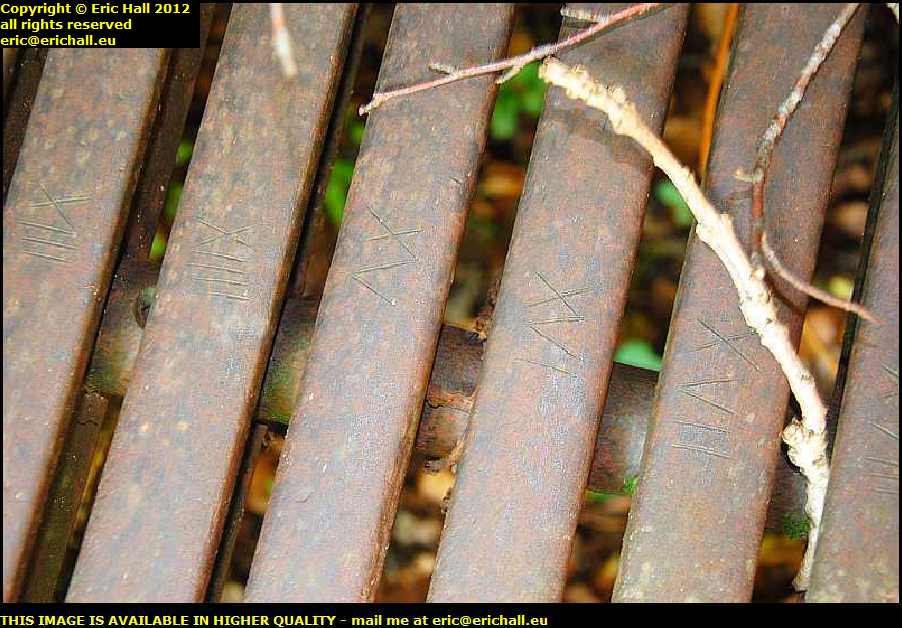
lime burner chateau sur cher puy de dome franceBut it was totally fascinating, as a good exploration confirmed once I’d been able to hack my way through the vegetation into it.

It seems to have been built from a kit or something like that, because the fire bars are noted with Roman numerals – presumably indicating the position and order in which they should be assembled.

I’ve never seen that before.

coal seam outcrop chateau sur cher puy de dome franceApparently the coal seam that we visited 2 years ago and about which I posted on here breaks out in a few other places in the Combrailles.

We had a good scratch around in the vicinity and, sure enough, we found some evidence. Not worth coming here with a mechanical shovel though – the Highways Department’s sign erectors would have been here a long time ago had it been worth the effort.

There are even some mining remains where someone had a go at trying to exploit it, but they are all overgrown apparently (as if the chimney was not) and so we need to wait for winter to hunt for those.

cadillac deville chateau sur cher puy de dome franceHighlight, for me at least, has to be this beast sitting here abandoned inthe garden of an abandoned cottage in the village.

It’s a Cadillac DeVille, one of the “fourth generation” models from the early 1970s I reckon, and what is significant about it is that according to the maker’s plate under the bonnet it’s actually a “Bienne” – a Swiss model made in that town where general Motors had an assembly plant for 40 years until 1975.

But scrambling over vehicles like this brought back some very happy memories. How poor Nerina must have suffered.

Meanwhile, in other news, I’ve run out of black ink for the printer. I’ll have to see if Terry can order some more for me.

Saturday 14th August 2010 – A good few weeks ago ….

… I went to a talk about the history and one of the items that was discussed was the local railway network. With this area being situated on a coal seam and the existence of coal mines all over the place there was at one time a railway network around here that was much more comprehensive than you would think at first.

And most people immediately think of railways as being standard-gauge – 4’8.5″ with substantial earthworks and the like, and there is a great deal of evidence for that, especially for our famous railway down the hill here that was opened to traffic in 1932 and did’t even last 25 years.

I drive regularly (or I used to when I used to go to Brussels) along a certain road that runs into Montmarault from the Montaigut direction and I’ve been convinced that I’ve seen traces that correspond to what the Ordnance Survey would call “dismantled railway” along the side of the road, although there is nothing on any map that I have ever seen that would confirm anything.

But at this talk one of the items discussed was the railway line that ran from Marcillat en Combraille to Commentry. Now Commentry was a major ironworking centre and Marcillat has the remains of a few huge limekilns and so a line bringing the lime from the fields to the blast furnaces seems like a likely proposition. But the only line here as far as I am aware is the old standard gauge line that used to pass down here and which doesn’t go directly to Commentry.

But further enquiry revealed the existence of the “lignes economiques” – a whole series of narrow-gauge lines that ran on light railway principles with the minimum of earthworks, and the border area between the Allier and the Puy-de-Dome was littered with these lines. Anyone who has seen the the Father Brown film will recall what a “ligne economique” looks like.
The relics that I have seen not too far from Montmarault are in fact part of this light railway system but my attention for the moment has been seized by a narrow-gauge line that used to run from Marcillat to Commentry – and points beyond, as I have discovered. I’ve tracked down a list of the names of stations along the route but a casual look on an Internet satellite viewing program hasn’t come up with anything. That’s a shame – long-time readers will remember that we tracked down a bridge of James Brunlees by spotting it on a satellite viewer.

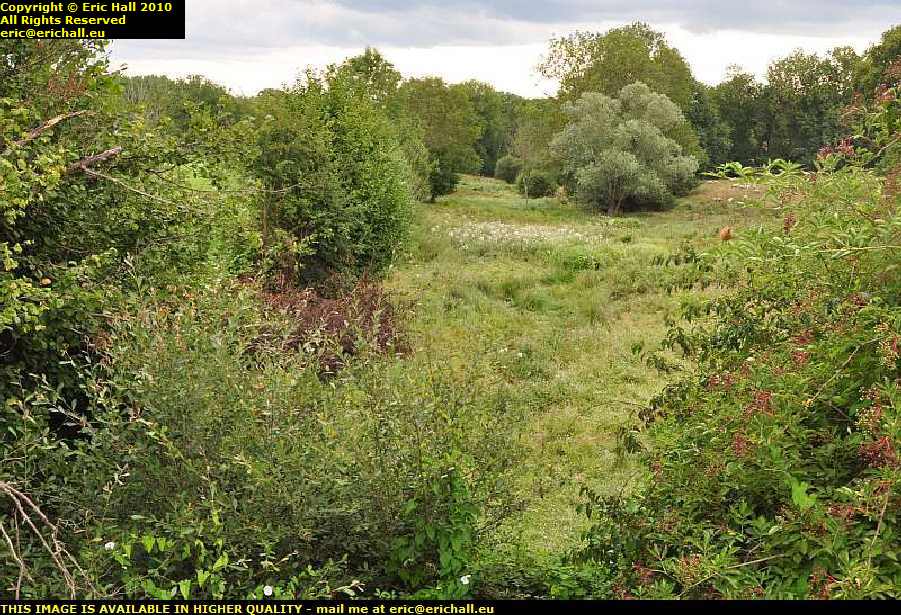
culvert underneath D2144 RN144 durdat larequille allier franceOne place however has crossed my mind as I have crossed it on many occasions. The railway passed through the village of Durdat Larequille somewhere and not too far from there is what looks like a hollow fold in the ground with what might be a bridge over it. And so on my way back from Neris les Bains I stopped for a look.

I’m right about it being an overbridge but if it’s for a narrow-gauge locomotive and train then it would have to be flaming narrow. I couldn’t stand upright in that tunnel under there

culvert underneath D2144 RN144 durdat larequille allier franceThere’s no evidence to suggest that the bridge has been infilled to any extent, suggesting that at one time it might have been of larger size, and I can’t see what might have been a track bed of a railway running to and fro underneath it.

I’m reluctantly coming to the conclusion that this may well not be a railway bridge after all, and that’s a disappointment – I had high hopes for this.

Yes – I was in Neris today. The weather is becoming colder and colder and there was no chance of a solar shower and so after shopping in Commentry (which was boring, I have to say) I went off there. 29°C in the water and only 20°C in the baths itself – but that’s because some person had for reasons best known to him-or herself decided to open up the side of the pool. It used to be an open-air pool complete with poolside cafe but it’s now covered with a balloon-type of marquee. And who on earth would want to open it up today in this weather?

But now I’m nice and clean so I’m going to change the bedding and have a good night’s sleep. And I need it too. I didn’t have the alarms on this morning and when the phone rang I crawled over to it and answered “ok Terry – see you in a bit” only to hear a French voice on the other end. Yes, I was totally out of it this morning. I’ll have to do better tomorrow.

Tuesday 8th September 2009 – IT WAS A BEAUTIFUL DAY TODAY …

… and I really took advantage of it by going on this walk.

There isn’t all that much to see in La Cellette – a hamlet that receives its name due to there having been a religious hermit living here in Merovingian times.

church la cellette pionsat puy de dome franceMany years ago they actually discovered the cell in which he lived and it is still extant but it’s incorporated into the cellar of a private house and not available to the public, which is a shame.

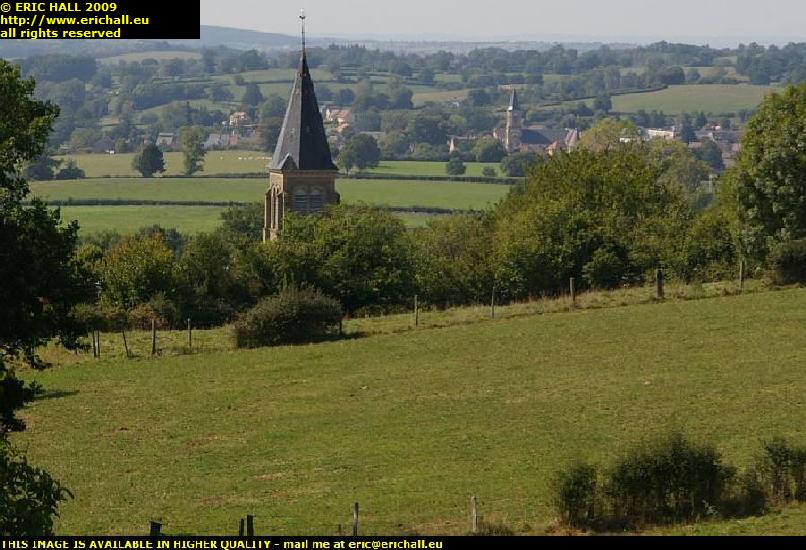
But the views from up on the top of the hills behind the village were terrific – including this impressive long-hop of the towers of the churches of La Cellette and Pionsat.

abandoned paris orleans railway track bed montlucon gouttieres la cellette puy de dome franceThe railway is much more interesting.

It ran from Montlucon via Neris-Les-Bains and Pionsat to Gouttieres and hence to Clermont Ferrand and was the last major railway line to be opened in France (TGV tracks excluded of course),

Planned in the 1880s, construction started in 1913, was held up during the First World War and the line finally opened in 1931.

abandoned paris orleans railway track bed montlucon gouttieres la cellette puy de dome franceAll of this area was a railway bottleneck. A whole series of coal seams running from Lapeyrouse to Gouttieres had been discovered and developed, and coal trucks clogged up the rail network

As a result, they kept on building a series of railway lines to by-pass the congestion. Unfortunately each time they did this, they discovered yet another coal seam that they then exploited, leading to more coal trucks, which led to more congestion, which led to more by-passes.

abandoned paris orleans railway track bed montlucon gouttieres viaduc la cellette puy de dome franceBut not long after this line was opened, the coal seams exhausted and the infrastructure collapsed. The closed during World War II, reopened after a fashion once the war was over, but passenger traffic ceased shortly after, the last passenger train being a Paris-Neris “special” in 1957

The line beyond Pionsat, where we are walking, was abandoned quite quickly, but a goods service ran to Pionsat three times per week until 1973. How about that for a short-lived railway?

Of course it goes without saying that the earlier lines had all of the best routes, and the later lines ran over more and more difficult terrain. If you read what I wrote about the Waverley Line you’ll notice that I wax lyrically about the constant 1 in 75 gradient.

abandoned paris orleans railway tunnel les bouchards montlucon gouttieres la cellette puy de dome franceThat is a mere bagatelle compared to the long slog up from Pionsat to the tunnel that passes under the Font Nanaud. That tunnel, the Tunnel des Bouchards,

is 585 metres long and there are no rumours or conspiracy theories about it. No steam trains in working order ready to return to the rails when the oil runs out – no knights of King Arthur waiting to emerge when Drake bangs on his drum – just a protected site for a colony of rare bats.

It was a good day out today and I really enjoyed it.