… and I really took advantage of it by going on this walk.
There isn’t all that much to see in La Cellette – a hamlet that receives its name due to there having been a religious hermit living here in Merovingian times.
 Many years ago they actually discovered the cell in which he lived and it is still extant but it’s incorporated into the cellar of a private house and not available to the public, which is a shame.
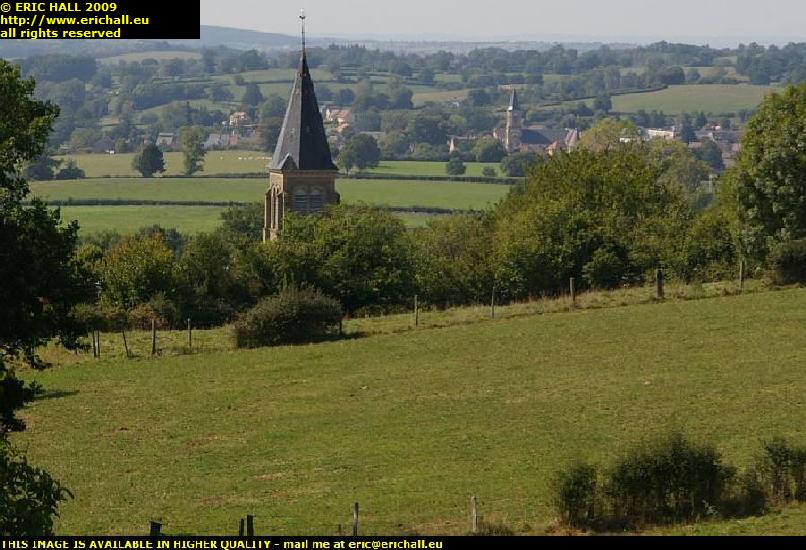
But the views from up on the top of the hills behind the village were terrific – including this impressive long-hop of the towers of the churches of La Cellette and Pionsat.
 The railway is much more interesting.
It ran from Montlucon via Neris-Les-Bains and Pionsat to Gouttieres and hence to Clermont Ferrand and was the last major railway line to be opened in France (TGV tracks excluded of course),
Planned in the 1880s, construction started in 1913, was held up during the First World War and the line finally opened in 1931.
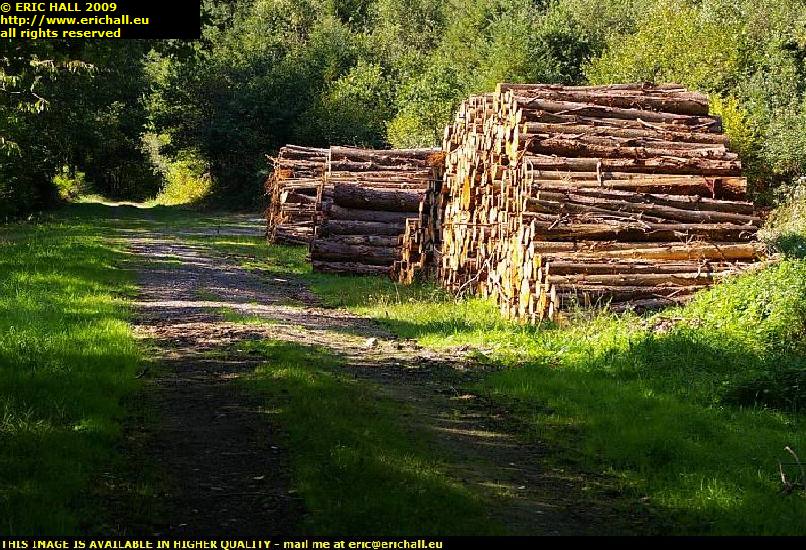 All of this area was a railway bottleneck. A whole series of coal seams running from Lapeyrouse to Gouttieres had been discovered and developed, and coal trucks clogged up the rail network
As a result, they kept on building a series of railway lines to by-pass the congestion. Unfortunately each time they did this, they discovered yet another coal seam that they then exploited, leading to more coal trucks, which led to more congestion, which led to more by-passes.
 But not long after this line was opened, the coal seams exhausted and the infrastructure collapsed. The closed during World War II, reopened after a fashion once the war was over, but passenger traffic ceased shortly after, the last passenger train being a Paris-Neris “special” in 1957
The line beyond Pionsat, where we are walking, was abandoned quite quickly, but a goods service ran to Pionsat three times per week until 1973. How about that for a short-lived railway?
Of course it goes without saying that the earlier lines had all of the best routes, and the later lines ran over more and more difficult terrain. If you read what I wrote about the Waverley Line you’ll notice that I wax lyrically about the constant 1 in 75 gradient.
 That is a mere bagatelle compared to the long slog up from Pionsat to the tunnel that passes under the Font Nanaud. That tunnel, the Tunnel des Bouchards,
is 585 metres long and there are no rumours or conspiracy theories about it. No steam trains in working order ready to return to the rails when the oil runs out – no knights of King Arthur waiting to emerge when Drake bangs on his drum – just a protected site for a colony of rare bats.
It was a good day out today and I really enjoyed it.

We’ve a hermitage here in Pontefract. It was part of a monastry complex that Henry VIII finally put paid to. They keep finding bits of it whenever they put up a new building.The hermitage is in the cliff face but is blocked by the Hospital which was built over it. It’s said to be haunted and I must say it’s a spooky little staircase that runs past it. Even before I knew about the hermitage I wouldn’t go down that way in an evening when I worked there. Some of the graves found in the monastry grounds are odd too. One chap was buried face down! Wonder what he did to deserve that?
Many hermitages sprang up under Thatcher after she started the poll tax. It was the only way of not having to pay out more in taxes than one was earning.
Maggie Thatcher wasn’t around before Henry VIII or the Merovingian Kings. It just seems like it.
But it is weird about how places and things can sometimes give off an “atmosphere”. I went to the Concentration Camp at Mathausen and the atmosphere was overwhelming.
Another place with an “atmoshpere” is the OUSA office on campus. It gets even worse in there when all of the office staff join hands and try to contact the living.
That guy buried face-down – it wasn’t Lee Potty-mouth, was it?
Maggie Thatcher is Satan and has been around since the dawn of creation.
The guy buried face down was getting ready for Tony Blair.
Ready for Peter Persondelson you mean.
I think it’s more likely to have been one of the miners who crossed arfur scabgill. No he’s not one of my favs. Not everyone in the mining communities thinks he’s a saint. He was lying just as much as the government at the time. He was trying to get power by breaking a government. He wasn’t working for the miners, just for himself, they were an excuse.
Thatcher set out to assert her supreme power by breaking the most powerful union in the country. Her legacy is over-paid, over-powered police that the country can ill-afford.
We’ll have to agree to differ. Scargill started it. How you can keep a worked-out pit going is something no one ever explained to my satisfaction, yet that was what he wanted. Thatcher finished it because she had no choice. The alternative was a government run to suit the unions, just like France where the government rolls over for the farmers and the transport unions every year. The problem here isn’t the police, it’s a judiciary that is trying to run a country by cow-towing to the bleeding hearts who blindly support the poor hard done-by criminals. Apparently putting them in prison is a breach of their human rights! It’s a mess. The current political class is as corrupt as they come and it’s business as usual for the bankers and powerful business interests because the politicians want their nice cushy consultancy jobs.
The police are overpaid fat slobs that will walk past a crime in progress because they don’t want to do the paperwork. They’ll also work hard to dissuade the public from reporting crimes and will very often refuse to give crime number. When enough people report a crime they will record it but will then persuade all the witnesses to decline to testify. The best police area in Swansea is Tesco’s cafe!
As far as the pits go, many that went private afterwards worked sucessfully for many more years. Thatcher killed coal because under EU rules she could only support one loss-making industry which she chose to be BNFL.
Hence, steel was sold to the Dutch and Britain imports all its coal despite there being vast reserves available cheaper underneath Britain.
My memory of events, such as it is, is of miners parading in the streets of Stoke on Trent carrying banners. Banners not saying “we want more pay” or “we want fewer hours” or “we want more holidays” – but “Thatcher out”, just a couple of weeks after the Tories won (quite fairly, and hansomely too) a General Election. And Arthur Scargill going on about how “the miners are the shock troops of the Socialist Revolution”.
Many people, including myself ( who has always been apolitical) saw this as a total affront to the democratic process (such as it is) and an insult to the majority of the voting electorate.
My memory is that the miners deliberately challenged the Tories to a fight. And it was a fight that they got.
The rights and wrongs of what happened during the strike are of a separate issue, but many people, myself included, had a really good laugh at the miners who, having challenged the Tories to a fight, then went around bleating about the fact that they lost. “Serve them right!” was a phrase I heard on many occsions from many different people.
I remember the battle of Orgreave where the police went in to beat the miners to a pulp.
Your memory is as good as mine Eric. I live in a mining town and am from a mining family. Scargill thought a woman PM would be an easy mark and he could do to this government what they did to Callaghan and then dictate any terms they wanted. The pits didn’t keep going, in fact many like Hatfield should have been closed 10 years before. They were already over their estimated lifespan as it was. R.J. Budge sank millions into the remaining pits and lost it too. It just wasn’t economic to keep them going when cheaper coal was available abroad. He’s the one who closed the rest down, not the government. Even the Prince of Wales pit that had plenty of coal closed because it was uneconomic. He (Budge)couldn’t sell it even with 3 big coal fired power stations on his door. Eggborough, Drax and Ferrybridge. He couldn’t get subsidies either because Scargill had ensured there was no political will to support a loss making industry that had tried to break a government.
There is very little deep drift coal left. What’s left is shallow and needs open-casting. We’ve had several open casts around here and of them all only the Ings at Fairburn was ever worthwhile land afterwards. It flooded and they went with the flow and turned it into a bird sanctuary. It’s one of the best the RSPB have now. Though just recently we’ve had some idiot wanting to buy the land, fill in the Ings and build houses on it. Not blooming likely!
There was some wicked violence committed by both sides during the dispute but as I said, that is a separate issue.
But seeing as the protagonists in the physical struggle were three groups about whom I couldn’t care less, in equal measure (three groups because besides the miners and the police, I am assured that there were also members of the military dressed in police uniforms as there are in every dispute – hence the allegations about coppers in uniforms without serial numbers – http://news.bbc.co.uk/1/low/uk/8006897.stm), then the idea that they were all beating the hell out of each other is something that I have to say that I found quite amusing.
I came from a mining area too. The colliery bus went past my house every day, before and after each shift.
Coal would have survived if Thatcher had levied the normal import taxes on it. Other countries with subsidised coal can sell it cheaply to Britain – for less than it costs to mine and transport.
Thatcher sold the country down the river. Her government paved the way for the disastrous LG plant in Newport that was built with taxpayer’s money on land reserved as a SSSI and then LG turned around and said they didn’t wnat it.
Thatcher caused everything that’s wrong in Britain today.
No, she didn’t, I don’t like the woman but fair’s fair. It had been going down the tubes for a long, long time before she got into power. Blaming it all on her is easy, but it’s sloppy thinking. What about the politicians since? Are they incapable of changing the way things are done under previous governments? The labour government that followed promised to reverse privatisation and didn’t. Who promised to stop the closure of the grammer schools and didn’t? Who is now in charged of the back door privatisation of the health service? No, I’m sorry but you won’t catch me blaming one woman for stuff that has happened, or not as the case may be, since she left. Yes a woman PM was a shocking thing for many in the UK. But that doesn’t make her better or worse than the men doing the same job.
Under Thatcher, the whole of British politics lurched to the right. Thatcher was extreme and occupied the same ground as the BNP used to occupy. The way Thatcher and Redmond went on about the unemployed (most of whom they caused to be unemployed) and single mothers being the scurge of society then went on to penalise them for being unemployed, made me wonder whether we were living in Nazi Germany.
Under Thatcher a few individuals prospered. The rest of the country suffered untold misery. John Major who replaced Thatcher was at the front of a train that had dodgy brakes. His party was ultra right wing and following Thatcher’s dogma having been brainwashed totally by Thatcher. Thus, he wasn’t in a position to stop it all and set the Conservatives back to being Conservatives.
Blair was a front-man. He was all presentation and no substance. Again, the whole political system had shifted to the right and Labour was where the Conservatives used to be. How’s an actor like Blair going to change that? As far as Brown is concerned – he’s a government accountant. He doesn’t care about anything except money!
Let’s face it. Politicians don’t care about anything but money these days and didn’t even before Thatcher. There’s are few (if any)conviction politicians anymore, though I can name a few who ought to be convicted! Most of them seem to be more interested in what they get rather than making things better. But then, that’s what happens when you don’t your eye on them, electorially speaking.
Before Thatcher, politicians did serve out of conviction. After Thatcher they served with convictions (Archer etc).
We have career politicians. Politics is not about careers – it’s about running the country. They have forgotten that.
I think we could argue this back and forward without agreeing until the cows come home… in 2100. So I’m going to exercise superhuman restraint and not continue with the answers I normally would write. Suffice to say I don’t agree and I’ve plenty of reasons why not, but they’ll keep for now.
The most democratic event in Britain will be when all the politicians are found hanging under Westminster Bridge.
Showing restraint? Not like you, Krys!
You’d be surprised. I like a good debate, but I really dislike arguments and when it’s been said once already and starting on the second time around is the time to agree to disagree. After all it’s no problem if people don’t agree. It’d be a boring old world, and not necessarily a nice one, if they did.
I have no doubt that I would be better at running Britain. There would be certain decrees I’d make straight away.
The first would be a mass execution of anybody currently in jail for more than 6 months.
The second would be a capping of all pay/bonuses/benefits above a million quid a year.
The third would be total replacement of the police with genuine police rather than the Judge Dredd types we have now.
The fourth would be a wholesale elimination of social services departments, careers advisors etc.
The fifth would be removal of all illegal immigrants.
The sixth would be to allow all newly convicted criminals to elect to serve a sentence or subject themselves as subjects for experiments by the chemical warfare, medical, nuclear or phsychological industries (they would get picked at random).
The seventh would be to ensure criminals actually did worthwhile work while in prison – building, construction, licence plates etc.
Drug smugglers and dealers would be executed on conviction.
Much to my surprise, there are one or two that even I would go along with LOL.
But I would add that if a country felt the need to go to war, all the citizens should have to vote either in favour or against. Those in favour of the war should be given a gun and a helmet and sent to the front line to fight it and those against the war should stay behind and laugh.
I think you’ve got that the wrong way around. Those that vote against should be given bunches of flowers and parachuted behind the enemy front lines.
The rest should have the guns and ammunition and attack from the front while the enemy is protecting their rear from the flower boys.
There’s one or two I might agree with too. But I’d like to amend m’learned friend’s ammendment. The politicians would get locked in a room and told to fight it out… winner gets to work as a duck on shooting range!
My suggestions are that a politician’s personal assets are assessed and frozen while he serves. If the country makes a loss then so does he, percent for percent. (If it makes a profit he can stand for another term.) He must also spend at least one month living in a council house with his entire family on no more than those on disability benefits or state old age pensions recieve and two weeks on the streets homeless in order to be eligible to stand. If he stands down at the following election his performance since the last one should be assessed by a for/ against vote of the electorate. If a 2/3rds majority think he did a good job he gets a bonus of 10% of his yearly salary, a gold star and a lollipop. Incompetent ones get nothing, but corrupt politicians should be stripped and put in the stocks and pelted with rotten tomatoes… before being carted off to jail.
Jail? What a waste of taxpayer’s money… Westminster Bridge is free and rope is dirt cheap.
Oh no, that’s too easy a way out and makes martyrs of them. No, make em work hard and pay back every single penny and more they stole with their own fair lily white hands… and if you are worried about costs you could always take their board and lodgings out of their assets.