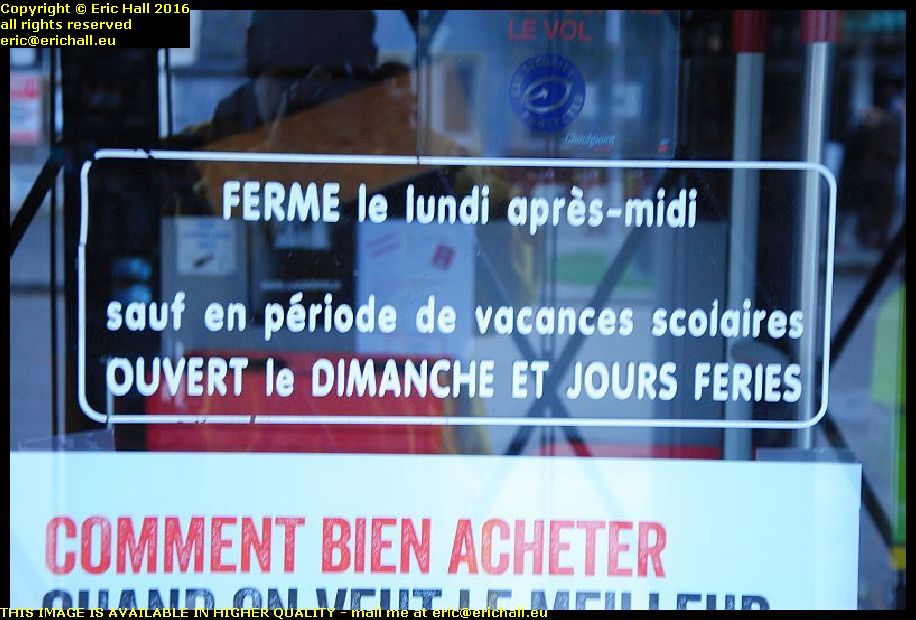
 … when I said the other day that I would probably find the Delhaize at Bohan closed if I were to come here today.
Well – I was half-right anyway. Had I come here this morning I would have found it open. But I didn’t – I didn’t arrive here until this afternoon and by then the supermarket here was well-closed.
It wasn’t much of a guess though really, was it? Knowing how things pan out when I’m involved, you should have had the mortgage on it.
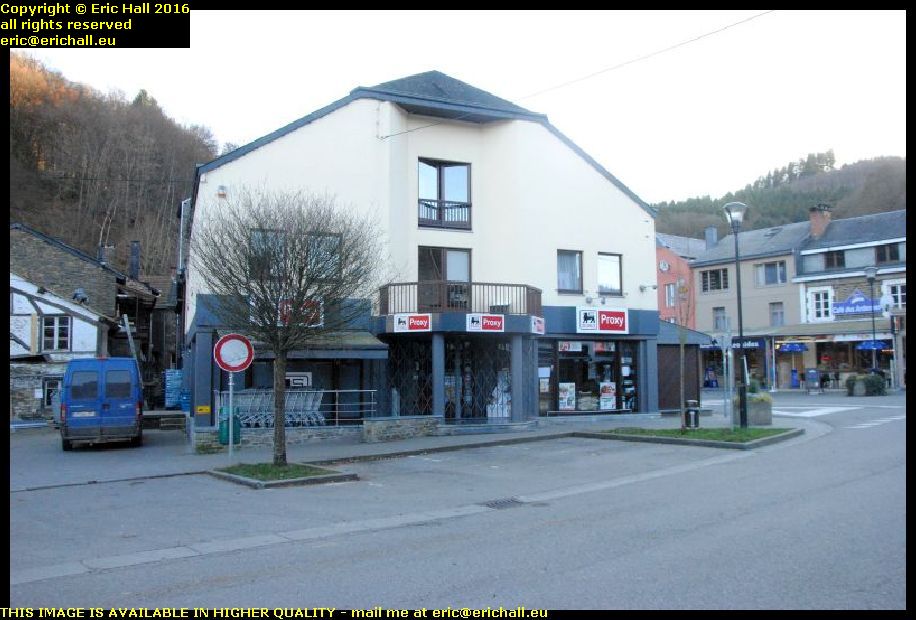 It wouldn’t be so bad if it were an out-of-town retail outlet but here it is, in pride of place right in the town centre, on a site that’s been used for retail purposes for maybe at least 90 years if an old postcard that I saw had anything to do with it.
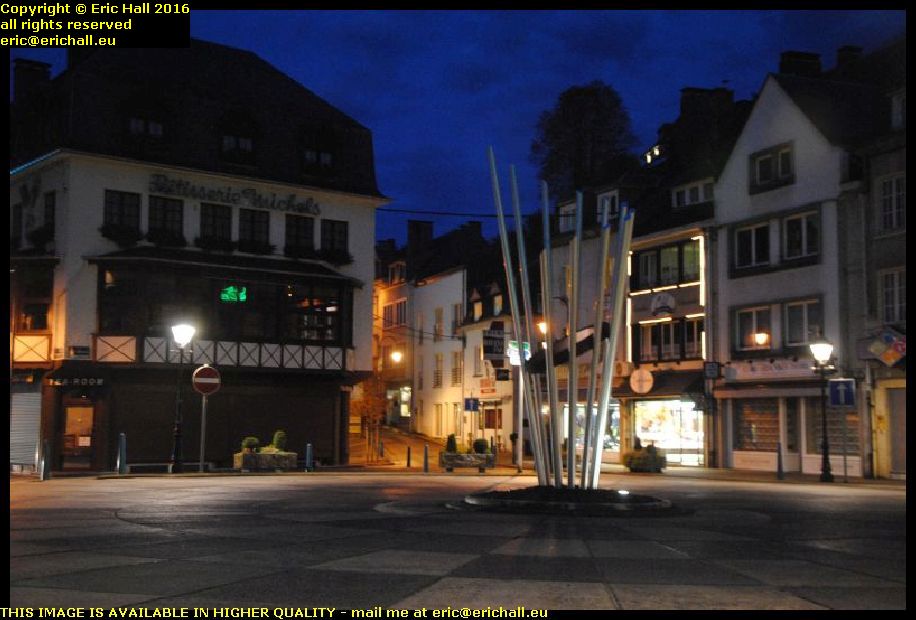
But as luck would have it, and quite surprisingly if you are a regular reader of this rubbish, there was a boulangerie open up the side street to the right,and I was able to grab a loaf of bread.
I’d had yet another bad night – this one probably the worst that I’d had so far. and I was awake long before the alarm went off. I’d been travelling too – round Labrador as it happens and I’d been promoting some complicated and difficult projects that I found very hard to explain.
First down for breakfast, even before the staff yet again, and then back to my room and carrying on with my work on Labrador and the Happy Valley-Goose Bay web pages that I’m writing. And I’m stuck. I’ve forgotten the name of a ship that I saw in the harbour and I can’t identify it from the photo. All I know is that it’s the Woodwards oil tanker that takes the fuel out to the outports and isolated islands in the Labrador Sea.
After my butties I set off to Bohan. And it was cold too – the ice warning was going off which was no surprise as the temperature had dropped well below zero during the night and there had been frost everywhere this morning. I sorted out the woolly hat to go on my woolly head.
 There was a really good reason for wanting to go to Bohan, because it’s another place that has a lot that I would find interesting.
Amongst them is what is called the Pont Cassé – the broken bridge. And if you really need to know who it was who broke it, the answer was that it was the French Army. They blew it up on 11th May 1940 in order to prevent the German Army and its tanks from using it to cross over the river
 And when they blew it up, they did a really good job of it too.
It was “repaired”, if that’s the right word, with a temporary wooden structure but during the German retreat they set it alight on 6th September 1944 and it burnt down.
And after the war, the decision was made in 1947 not to replace it.
 It’s possible to walk onto the bridge these days – it’s not fenced off – and so I did.
And you can tell from this photograph exactly what kind of bridge it is can’t you? It’s a railway bridge of course if you need to be told, and more than that, it’s another tacot or “rattletrap” – one of the
chemins de fer vicinaux or local tramway-type railways that littered Belgium just as well as they littered France and which we had near us in Marcillat en Combraille.
 And talking of my home area in the Combrailles, if you think that the railway line from Pionsat to Gouttieres with its 9 years of existence was quite ephemeral, you haven’t seen anything yet.
This railway line had a lifespan of just about 5 years. It was opened on 5th May 1935 and came to a rather sudden end on 11th May 1940 as I mentioned just now when the French army blew up the bridge.
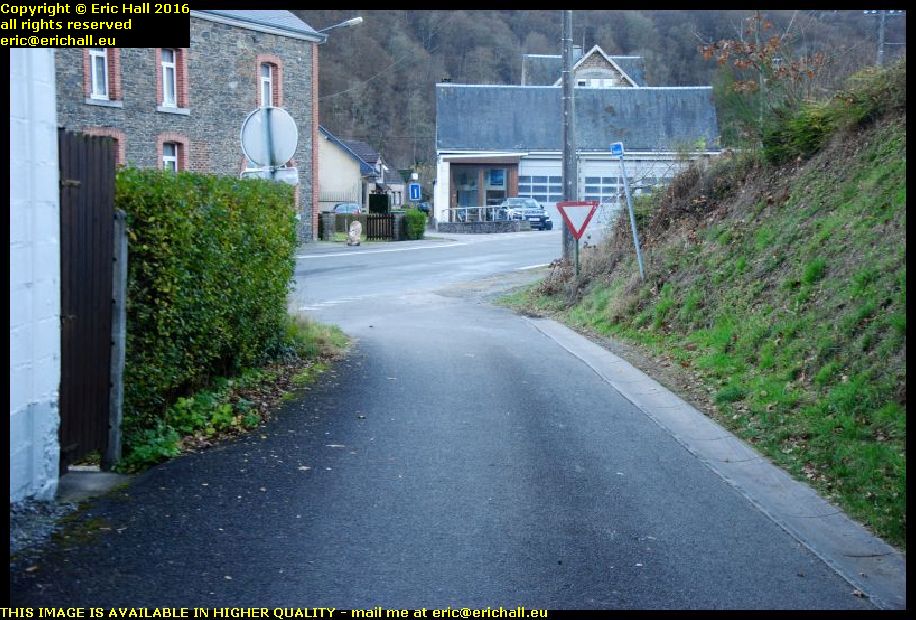 But even that pales into insignificance when we talk about the extension of the line.
Just over there is the railway station. The line came to a full stop over there in 1935 but the decision had been taken to extend the line into France. Just down beyond the railway station is the French border and beyond there is the town of Sorendal.
This was the terminus of the Ardennes tacot – the metre-gauge rural railway network of the French, and on 17th October 1938 an extension was built to join them together.
 While we admire the back of the railway station and what might be a signal cabin to control a set of points that might have worked a siding that looks as if it might have gone to the left just there, I’ll tell you an even more tragic story about the line.
And that is that despite only being opened in October 1938, the French closed the border at the outbreak of war and this part of the line didn’t even manage a whole year of working.
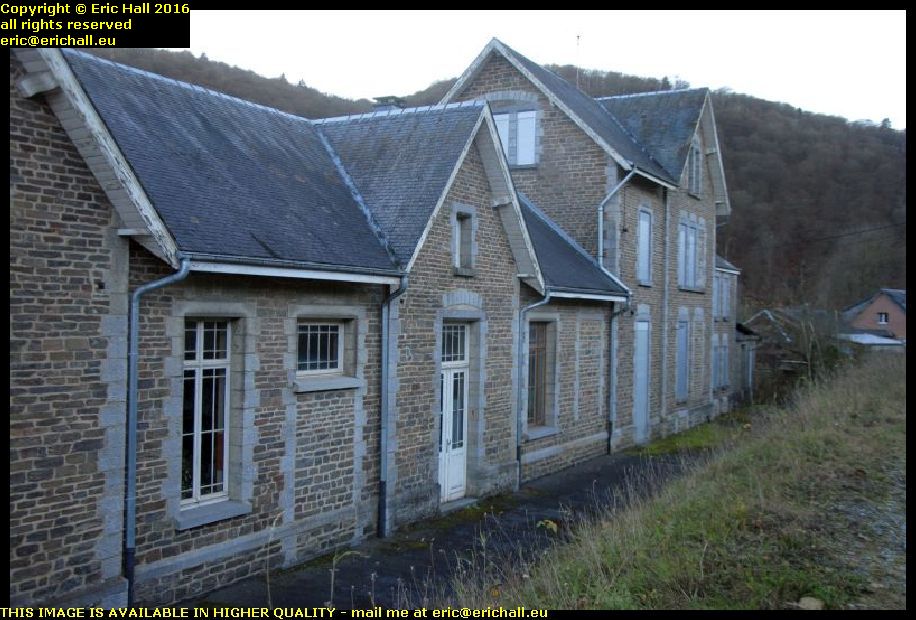 There wasn’t any doubt in my mind that this was the old railway station. There wasn’t anything carved on the stone or any old sign that might have given me a clue – it just looks exactly as anyone might expect.
Thoroughly magnificent and thoroughly over-the-top, which was a feature of these rural railway stations. No wonder that the lines didn’t last all that long with this kind of expense.
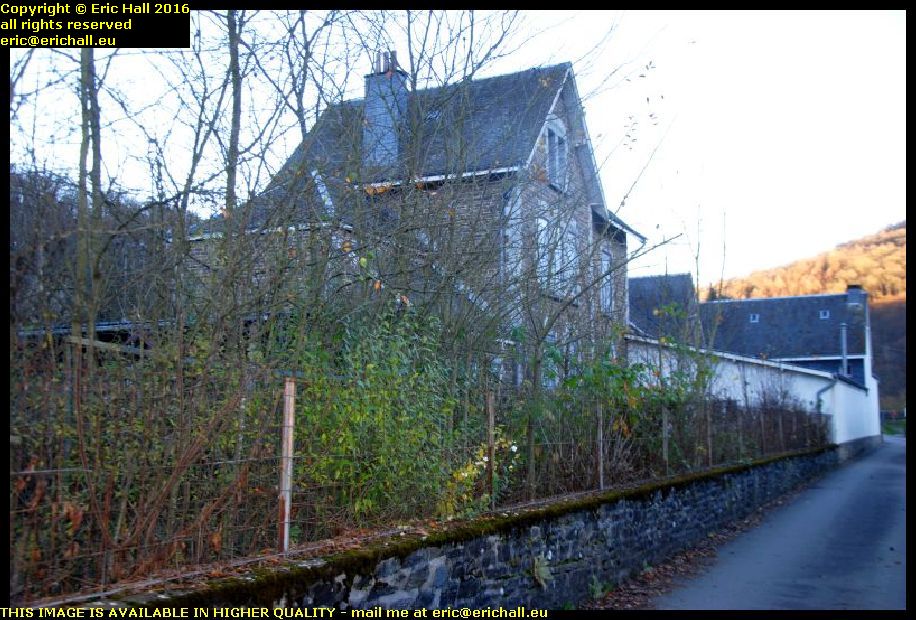 This is the line-side of the station – the roadway today is the track-bed and there is a pile of waste-land in front of the building that might easily have been the platform.
It looks as if it’s derelict now – all closed down and with damp rising up the stone walls. But it was at one time a garage and then later became a dwelling-house. But there’s no land with it unfortunately, and it’s far too big for me, as well as needing far too much work.
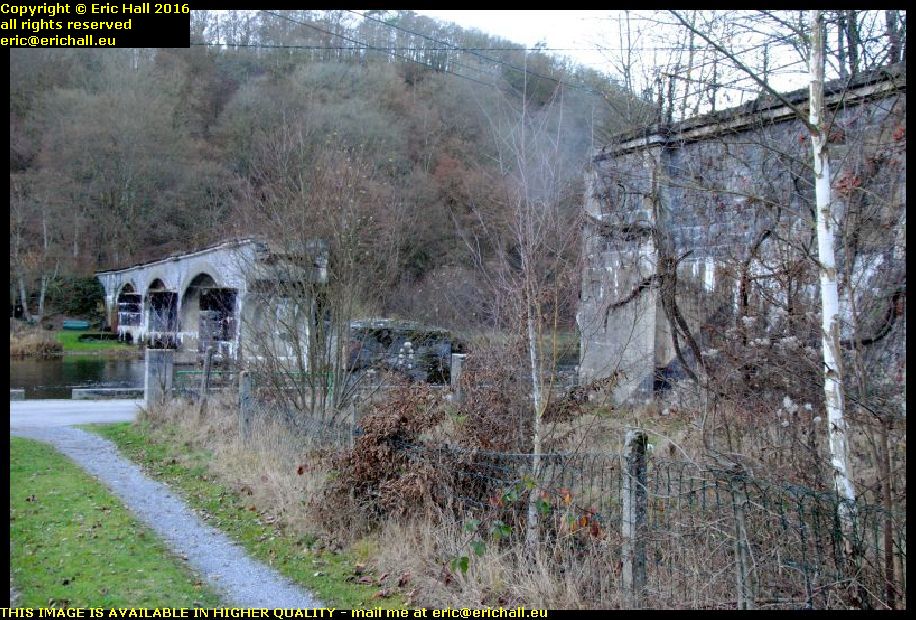 But before we leave the Pont Cassé, all 90 metres of it, let me just explain to you why it took until 1935 for the railway line to reach here.
It actually reached Membre in 1913, construction from Gedinne having begun in 1909. But then we had the war of course and afterwards, we had to wait for the Belgian economy to restart. And then we had the decision as to how actually to reach here because it’s a horrendous civil engineering problem.
In the end, they dug a tunnel through the rock, a tunnel of 22O metres in length and which was one of the marvels of Belgian engineering. Unfortunately, the portal at this end is on private property and overgrown so it’s not accessible.
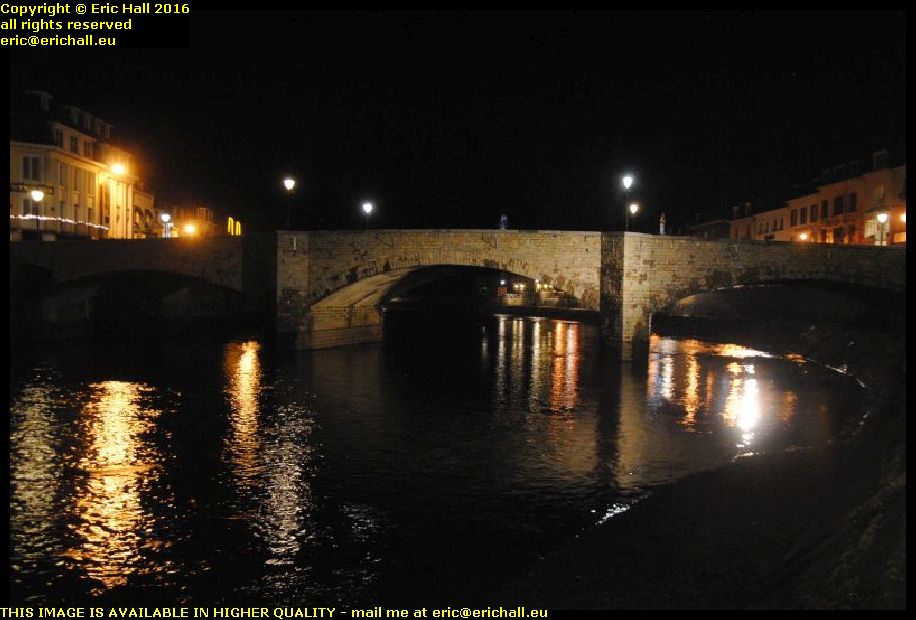
 While we are on the subject of bridges, this is the road bridge over the Semois.
Of course, it’s not the original. There’s no need for me to tell you what happened to that – and on the same day that the Pont Cassé went up too. They didn’t do things by halves.
We had another temporary type of bridge subsequently, so I was told, but this one here is built of concrete and dates from 1957
 So back in the town again, I went to have a look at one of the oldest houses in the town.
It’s called the Maison de Marichau and it’s said to be one of the very few remaining examples of traditional Ardennais architecture that’s remaining.
Although in dreadful condition, it was classed as an ancient monument in May 1973 and is currently undergoing renovation – and not before time either if you ask me.
 Not a lot seems to be known about the history of Bohan.
It first seems to be mentioned as a fief of Orchimont, where we were the other afternoon, in 1205 when the Lord Of Orchimont, Badouin passed it over to his younger brother Rigaud.
However, you only have to examine its situation here on an easy crossing of the Semois with several valleys feeding in from all points of the compass to consider that it must have been quite an important ford here, and subsequently a settlement, for hundreds of years prior to that.
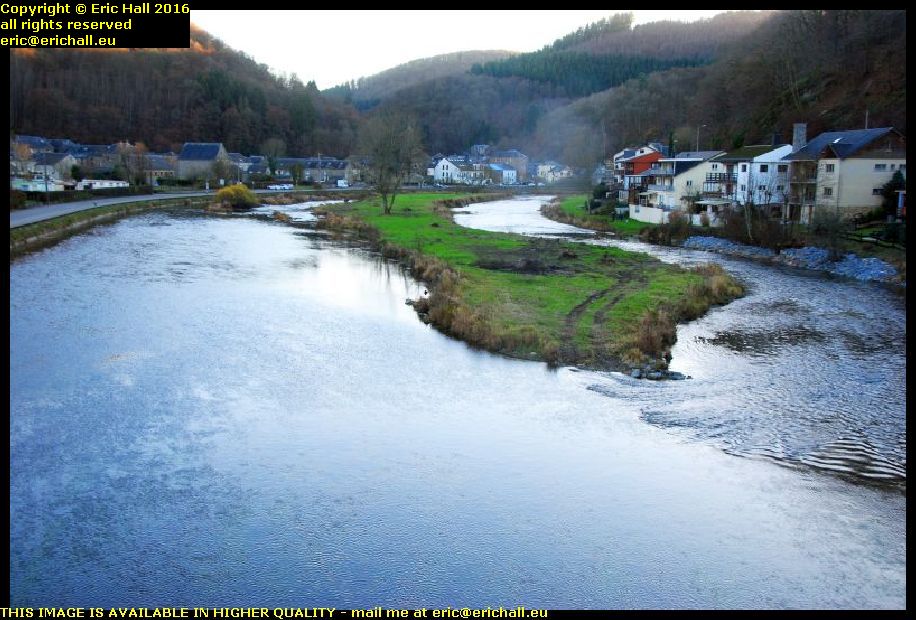
The river here by the way looks as if it has all the air of a natural border or frontier, and that was indeed the case in the early Middle Ages.
Long before the emergence of national states here in north-western Europe, it was the church, with its various bishoprics, that divided up the country amongst themselves, and when we were in Bouillon the other day we noted that the Bishops of Liège managed to hang on to their independent provinces until as late as 1795.

But the River Semois was the frontier between the Bishops of Liege and the Bishop of Reims. The southern side of the river was part of the Bishopric of Reims and in 1190 came under the control of the Abbey Church of Mézières, where it surprisingly stayed until 1802 when it passed into the hands of the Bishops of Namur.
All of this makes me so surprised to have seen nothing mentioned whatever about a fortress. Obviously the Lord of the Manor would have to live somewhere impressive and in view of the town’s strategic importance right on some kind of border I would have expected the town to have been fortified and some kind of fortress built.

In fact we are told that by 1287 it had become the seat of a feudal nobility and villages on both sides of the river depended upon it. But if there had been fortifications and a fortress here, mention of them has escaped me.
Bohan is next in the news in 1559 when the territory is willed to the two daughters of Gerlache de Bohan. And in 1605 it passes into the hands of one Jan Baptiste van den Bosch. He’s of the family “du Bois de Fiennes” and Lord of Drogenbos in the Province of Brabant, and it stays more-or-less in the hands of his family until maybe 200 or so years ago.

And this is probably the reason why it’s part of Belgium and not, as you might expect, part of France, even though the Semois would make a wonderful natural boundary.
I said “more-or-less” just now because we all know that this area is the “cockpit of Europe”, with marauding armies passing back and forth through here continually even as late as 1944.
We’ve seen how the French went on the rampage all around here in 1635, recaptured by the Spanish in 1652, the French again in 1657 and finally back to the Spanish by the Treaty of Rijswijk in 1697. And then we had the Wars of the Spanish Succession, the Wars of the Austrian Succession, the Napoleonic Wars and so on.
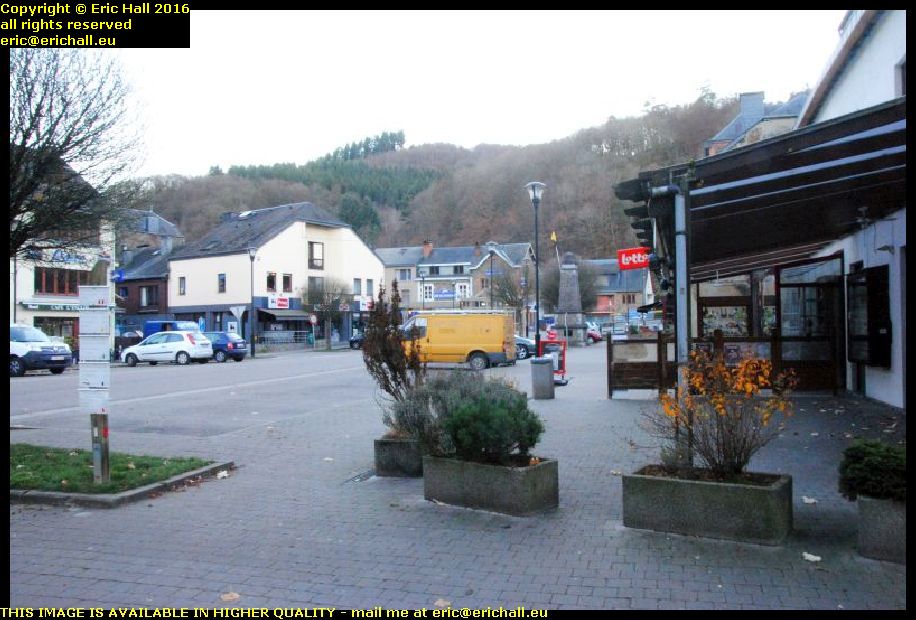
But by 1830 and Belgian independence, things had settled down and there were 130 houses counted here. Forestry products were important, as was agriculture, especially as the area seems to have a microclimate that makes it a couple of degrees warmer than one would expect here. There are excellent alluvial soils due to regular periodic flooding of the river and it’s sheltered from the winds.
There was also quite a substantial cottage industry here, making nails.
 But surprisingly, 100 or so years ago, this area was quite famous for tobacco growing and all around us are open barn-like buildings that were actually the drying sheds for the leaves.
It seems that in 1876 someone brought some tobacco plants back from Kentucky and to everyone’s surprise, they flourished here and grew like wildfire. But all of that has been abandoned now – not that I would know a tobacco plant if I were to see one.
 As for the church, this was built in 1760 and seems to be dedicated to St Leger. Its construction was financed one-third by the commune, one-third by the Lord of the Manor and one-third by the Monks of the Abbey of Laval Dieu in Monthermé.
It’s certainly not the first church on this site. There’s a reference in a will of 1235 in which a “Clarisse de Gedinne” leaves a sum of money for the “repair” of the church at Bohan, and a ducument of 1190 seems to imply a church here too. We don’t know what that one looks like, or why it was replaced.
This church is built of stone brought from a quarry at Don-le-Mesnil, near Charleville-Mézières.
Its tower is 30 metres high and formerly contained two bells. The larger one, cast in 1860, was taken away by the Germans in 1943 to be melted down. It was replaced in 1949 and a third bell was added in that year too. The second bell is apparently called Marie and was cast in 1839 and repaired in 1909.
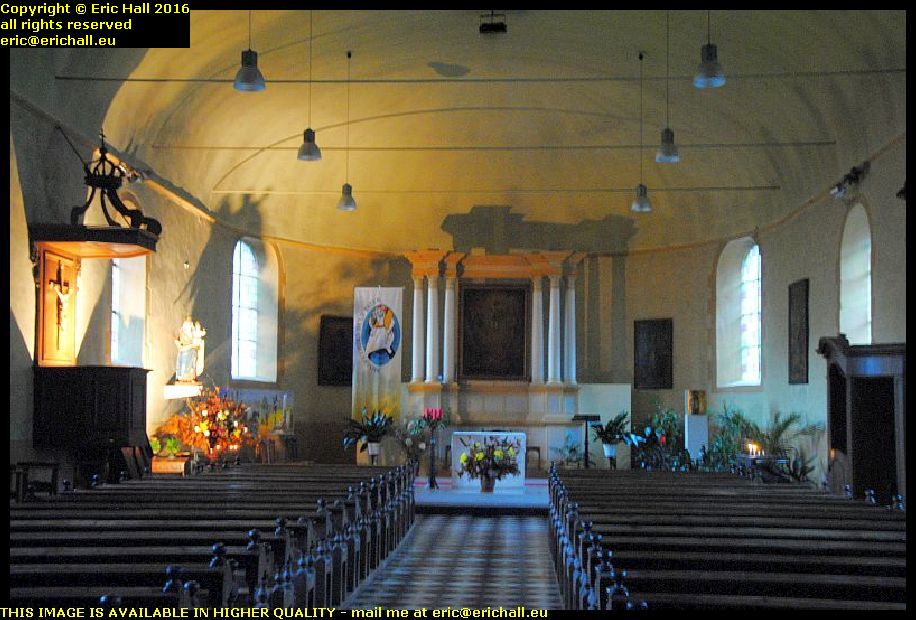 The interior is quite basic. We have the typical paintings of the “Chemin de la Croix” which date apparently from the very early 20th Century and the painter is unkown. There’s the principal altars and two side altars are also present, one dedicated to Mary and the other to Joseph.
There are several statues too, including ones of St Antony of Padua, St. Theresa and St Hubert, and several paintings that are signed “Renon Letellier de Charleville, 1827”, as well as a painting of Mary that seems to be older than that.
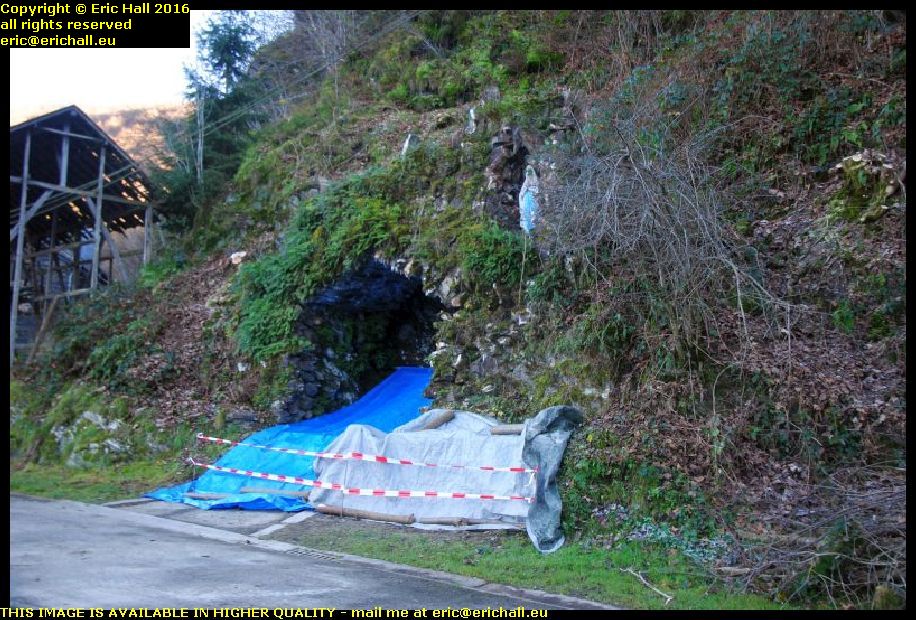 As well as the church, there are a couple of other places of religious significance in the town.
This is a calvaire, a calvary, and seems to be dedicated to Mary as far as I can tell. I think that that’s a statue of her over there in her grotto. It must be some kind of spring too because I could see water cascading out under the road opposite this spot and discharging into the river.
I wonder if that is what is covered up by the tarpaulin.
And this does remind me of the story that I heard about the Quebecois painter who was asked to paint a picture of the Calvary. He came back with a drawing of John Wayne and several United States troopers on their horses.
As for the wooden construction on the left of the photo, I wonder if that’s an old tobacco-drying shed.
 Here by the side of the river we have a very peculiar couple of stones. They are called the “Marriage Stones” because some kind of weird ritual is performed here by newly-weds after the church service.
The purpose of this ritual is apparently to symbolise the difficulties that married couples face during their life together. And I suppose that seeing as this is Belgium, the greatest difficulty that they might encounter is to deal with this ritual in the pouring rain.
 There’s a hotel over there, the white building down at the end of the road. And I missed out on an opportunity there because it advertises long stays with breakfast for just €30:00 per night, which would have done me just fine.
I decided to make a note of that for future reference, which I duly did. But would you believe that Brain of Britain forgot to make a note of the name of the place.
Ahh well! I suppose that I shall have to carry out some further research.
And now I’m done. I had a coffee and went off home for my butty and another early night.
After all, I’m off in the morning.
You can stay here and read all of this – all … errr … 2554 words of it.