… night at all.
Not for any shortcomings of the hotel, I hasten to add. This was in fact one of the better Première Classe hotels (but still not as good as the one at Maubeuge last year of course) but nevertheless it took me an age to go off to sleep and then I tossed and turned a good while during the night.
A hot shower brought me round – sort-of-ish, and a good breakfast followed. I had a rest for a while afterwards, and then edited some music tracks so that I have some custom alarm calls and ringtones on my new telephone.
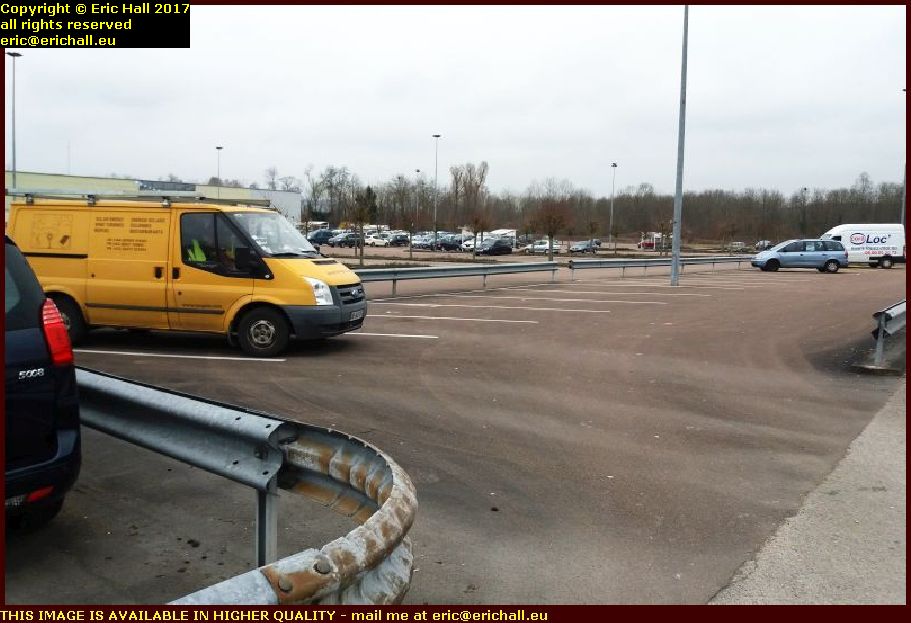 First stop was the Cora supermarket around the corner. And here was a thing.
Those of you with long memories will remember back many years ago about the Morrisons supermarket at Reading where the car park had a height barrier “to stop travellers entering the car park”, but also keeping out anyone with a high vehicle.
Here, they seem to have the same issues, but nevertheless they have managed to make a parking space for high vehicles and here’s a rather dirty Caliburn to prove it.
I’ve hit on a new plan for eating out in hotels, which I’ll explain later. It involves a visit to the shops and the purchase of certain items. But while the supermarket was good and objects at a reasonable price, the woman on the check-outs was useless. Far too busy talking to her friends in the queue to concentrate on what she was doing and as a result she was making mistake after mistake. Not a very good advertisement at all for the store.
 Having given Caliburn a really good wash, I had a slow drive through the countryside towards the south-west and into the watershed of the River Loire.
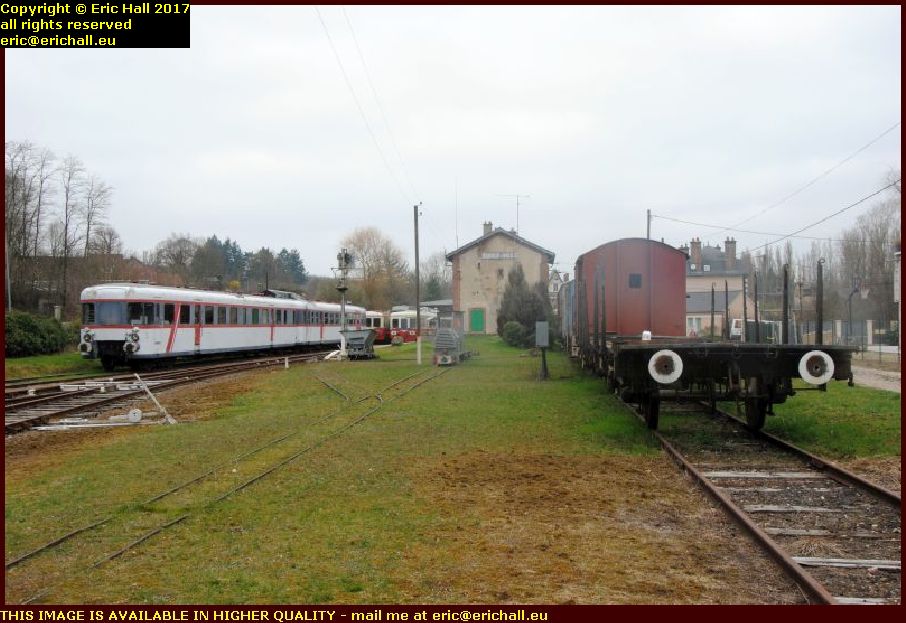
Destination was the town of Toucy, still in the département of the Yonne. I’d driven through here on several occasions 9 or 10 years ago and I’d noticed the old railway artefacts here in the town. Today was the day that I had decided to come to see what was going on
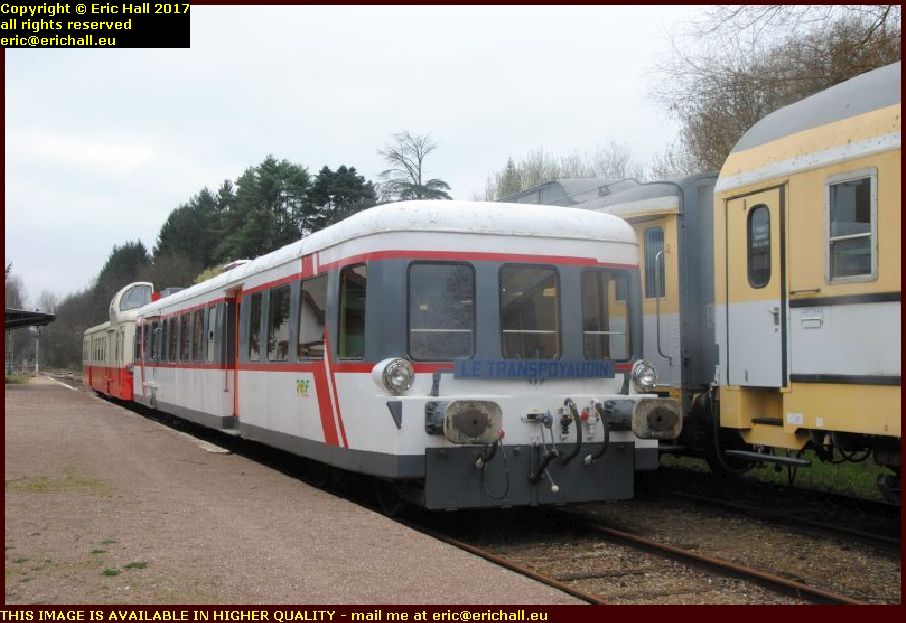
 The place was all locked up, and looked as if it had been that way for 10 years. Everything was rusting and decayed, including these beautiful diesel multiple-unit panorama cars.
The driver’s cabin is very interesting, isn’t it? But that kind of thing would never work in the UK with the restricted loading gauge on British railways.
The only British railway network with anything resembling a Continental loading gauge, the Great Central, was closed down in the 1960s.
 This was probably the most short-sighted of all of the short-sighted railway “economy” measures of the Beeching era, and replacing it today for the HS2 network is costing the UK billions and billions of Pounds.
That’s the trouble with the UK of course – it’s all down to short-term economies and there isn’t an ounce of long-term vision in anything that the country does.
And they are going to find out that for themselves once Brexit begins to bite.
 But leaving aside yet another good rant for a while, I carried on with my wandering around the railway … errr … museum.
As you can see, the exhibits, such as they are, have clearly seen better days and there doesn’t look as if there is anything going on here. There doesn’t seem to be anything in the way of restoration or renovation taking place on the … errr … exhibits here. They are just parked up and abandoned.
 This is probably one of the saddest exhibits here on the site.
I don’t know anything very much about French railway locomotives and the like, but this looks as if it’s something quite unusual and interesting – far too interesting to be just stuck here in a siding and left to rot away.
It’s all quite depressing, wandering around here and seeing all of this.
 These little locomotives were quite interesting. Yard shunters, I reckon, and made by Baudet Donon and Roussel in the early 1950s.
It’s a little-known fact that this company is actually the successor of the company founded by Gustave Eiffel, he of the tower fame. The company branched out into the construction of railway locomotives and multiple-units, and quite a lot of the company’s equipment found its way onto the French railway network during the period of modernisation after World War II.
 These little machines weigh a mere 14 tonnes, are just under 6 metres in length and flat-out, they will travel at all of 16kph.
Mind you, with a Renault 60 horse-power PETROL engine, 8-speed gearbox and chain drive, you aren’t going to get much more out of her.
They were the first locomotives to come of the new SNCF standardisation process after the War and replaced all kinds of assorted yard shunters, including horses and, in at least one case, oxen.
They were essentially a temporary measure and withdrawal of the class started in 1979.
 Railway tourism seems to be the up-and-coming thing these days, and this can be accomplished in many different ways.
You might also remember when we were in New Brunswick, Canada, back in October last year, that we saw that old railway bicycle that I admired so much. Combine the two together, and you’ll end up with something like this.
Mind you, it would be really exciting meeting another similar vehicle coming the other way on a single-track line. “Survival of the fittest” is what springs immediately to mind.
 There’s a pile of narrow-gauge railway equipment here too, and they have laid some kind of track to accommodate it.
It looks very much like mining or quarrying equipment to me, although there doesn’t seem to be much in the way of mining around here and I’ve no idea where there might be a quarry.
But like everything else around here, it’s all lying around abandoned and there’s no signage or anything to indicate what all of it might be
One thing is quite clear though.
In the past, I’ve been totally scathing of what passes for “preservation” of railway and other historical artefacts in North America. Having seen what is (or isn’t) going on here, I’m going to have to keep my mouth closed, or else start eating some rather large helpings of humble pie.
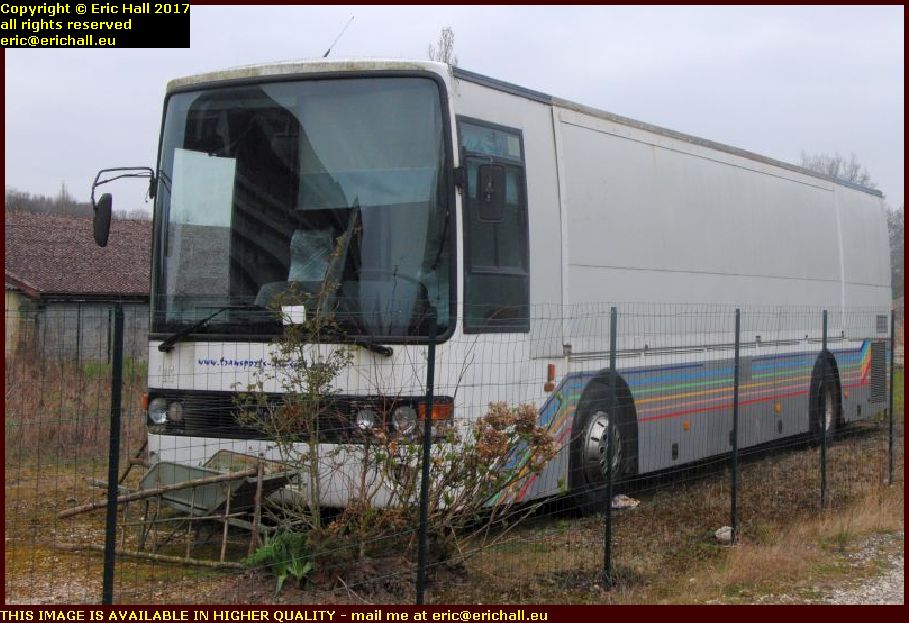 I couldn’t leave the site though without taking a photo of this sorry machine.
It’s a Van Hool Alizée of the mid-1980s, lying here abandoned in the yard, and it brings back many happy memories for me. 25-30 years ago, I was earning my living travelling around Europe in one of these with piles of tourists when I worked for Shearings Holidays.
Beautiful machines, especially when built on a Volvo chassis, but this one is rear-engined so at first I thought that it might be a Scania. However,it turns out to be a MAN and I never had the opportunity to drive one of these.
Ohhh happy days!
 As you may (or may not) know, I have a degree in Historical Technology and just down the road from Toucy is Guedelon.
Guedelon is an extremely interesting place and very high on my list of places to visit because what they are actually doing is building a Medieval castle from scratch.
Not only that, they are using nothing but construction techniques of the period, including man-powered cranes and the like.
 You can imagine therefore that this was a place that was also very high on my list of places to visit, and so I set off chaud-pied, as they might say around here, to see what I could see.
But regular readers of this rubbish will know exactly what I discovered when I arrived here.
That’s right. The place is closed “for the season” and despite all of the people wandering around the site pretending to work, it wasn’t possible for me to gain admittance, even just for the purpose of taking a few photos.
That was something that I found extremely miserable.
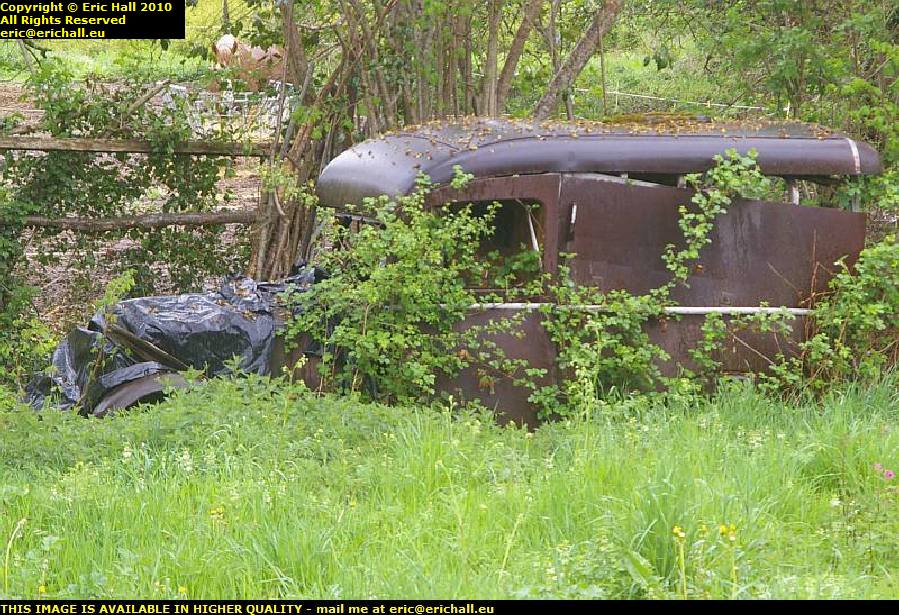
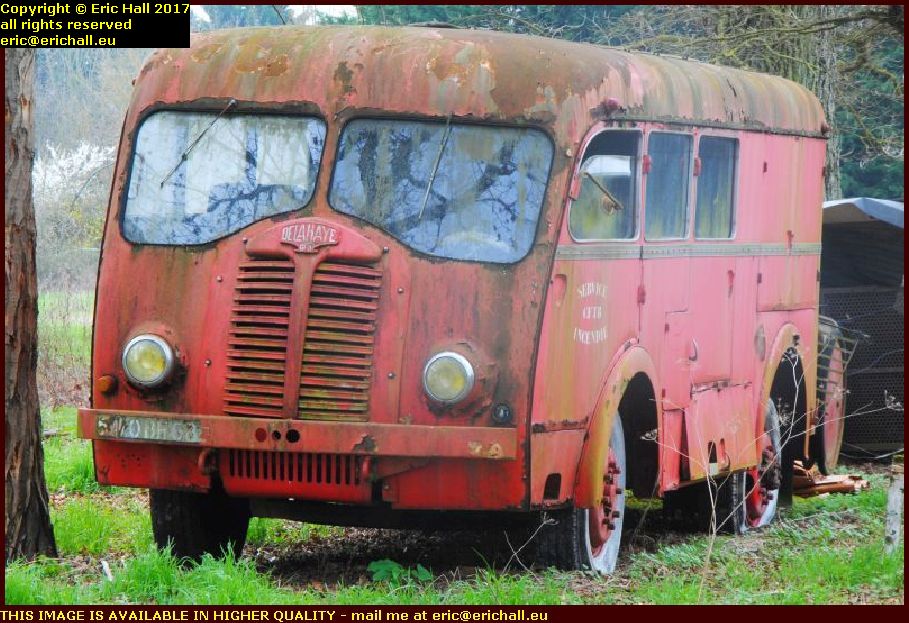 However, it’s not all doom and gloom because as I arrived at Cosne-Cours sur Loire, I encountered this magnificent beast, and it’s another sad and sorry machine having been abandoned to the elements, despite its rarity value.
It’s a Delahaye fourgonette – I reckon a type B163 – and it’s the type of chassis preferred by the French fire brigades in the early 1950s for the building of specialist vehicles.
But it’s rather a shame to see it sitting here out in the open in a field like this. As I said – I’ll have to stop criticising the North Americans.
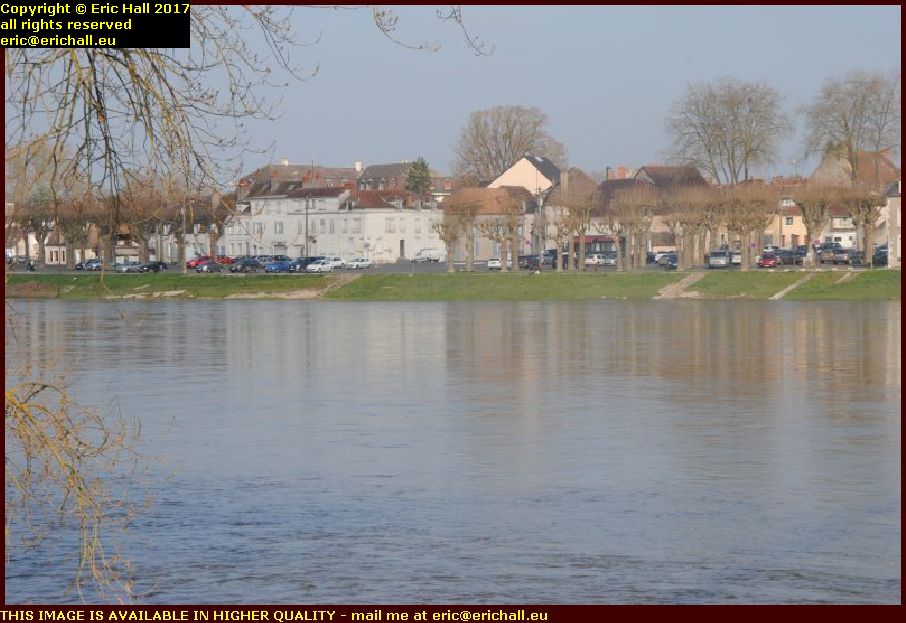 By now, it’s time for (a very late) lunch and so I head into the town. The River Loire passes by here in all its magnificence and there’s a nice park across the river from the town that’s a very suitable place to stop.
And, as you have probably noticed, the clouds have gone, the sun is out and there’s a beautiful blue sky to sit and watch me as I eat. It’s a marvellous afternoon and I intend to make the most of it.
 The town itself is another one of these beautiful, cramped Medieval cities that has unfortunately seen better days.
There seems to have been a settlement here in Prehistoric times and there was certainly a … errr .. Gallo-Roman settlement called Condate here.
With its comparatively easy crossing of the Loire here, it was the centre of several confrontations throughout history. As far as the British are concerned, its claim to fame was that during the Hundred Years War, Henry V was marching here to meet the Burgundian Army in 1422 when he caught dysentery and died.
His premature death effectively marked the end of any serious hopes that the English might have had of making a permanent conquest of France.
By the 17th Century there was a thriving metallurgical industry here and this was the basis of the wealth of the town. It manufactured fittings for the French naval industry and these were shipped out down the Loire to the naval shipyards downriver.
 However the French railway network caused a decline in navigation on the Loire and the metallurgical industry closed down in the 1870s. Some vestiges of the industry lingered on for a while but it all eventually petered out and led to the slow decline of the town.
Today though, it’s the second-largest town in the département of the Nievre after Nevers and as a result it’s become something of an important regional administrative centre.
 There’s a beautiful suspension bridge here across the river and this is what had attracted me to the town. I’d never had the time to stop here before.
Unfortunately it’s not the original bridge here. That dated from 1833 but unfortunately that was destroyed during the Second World War. The bridge that’s here today dates from the 1950s but nevertheless, it’s still a magnificent structure and the setting here is tremendous.
 Having had a nice walk and a good relax to read my book, I headed off to my hotel. It’s a little place right out of the way in the countryside about 2 miles from the river.
But I’m not alone here- not at all. There’s a 1944 Dodge Lorry – a veteran of the US Army parked here in the barn by the side of my room. It’s certainly the right hotel for me, isn’t it?
And my room is nice and cosy too. This was a good choice.
Tea tonight was something so simple that I’m really surprised that I have never ever considered it before. It’s so easy too, especially in a hotel bedroom and I shall be doing this kind of thing more often.
Half a tin of potatoes, half a tin of mixed vegetables, half a tin of mushrooms and some lettuce all mixed up in salad dressing. Followed by a soya dessert and a chocolate soya drink, with one of these packets of fruit-and-nut mix.
Simple, effective and healthy. You can’t say fairer than that.
And I’ve had a shower, washed my undies and now I’m settling down for the night. See you in the morning.

 .
.