Tag Archives: battle of france

Sunday 11th December 2016 – SEE IF YOU CAN GUESS …

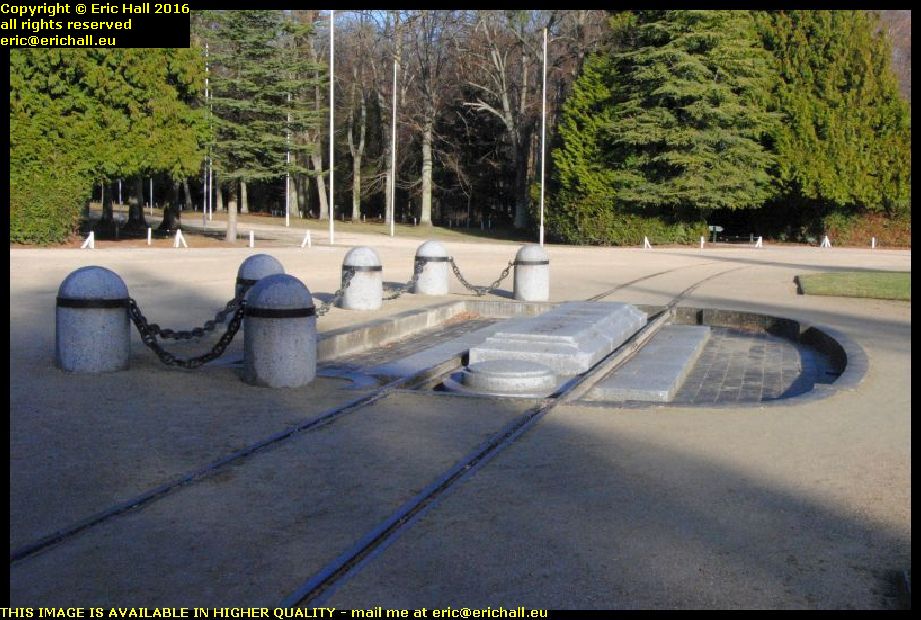
11 november 1918 21 22 june 1940 site of armistice germany france compiegne… where I am right now.

In fact, if I walked forward a dozen or so spaces and stood on that slab just there in between the rails, I’d be on the very spot where the Armistice was signed between the Allied powers and Germany on 11th November 1918.

And it’s also the place where the armistice was signed between France and the German Reich on 22nd June 1940 and which brought to an end the Battle of France.
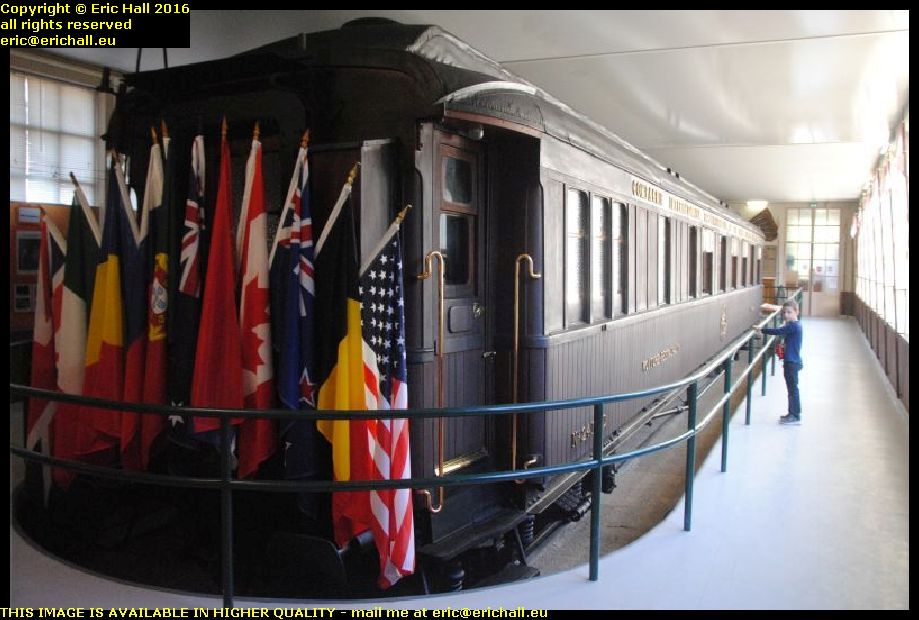
armistice carriage wagon 11 november 1918 21 22 june 1940 site of armistice germany france compiegneAnd despite what you might hear, this is not the railway carriage in which the armistice was signed, even though it dies carry the same fleet number.

After the signing of the 1940 Armistice, the original carriage was taken to Germany where it was displayed for a while in Berlin. But as the noose closed in around the city, the carriage was one of the artefacts evacuated.

It was taken to relative safety to near Ohrdruf in Thuringia, but was burnt by the Germans in late April 1945 to stop it falling back into Allied hands.

This carriage here is one of the original carriage’s younger sisters, but is fitted with many of the fittings and accessories of the original carriage, which were discovered in Berlin after the end of the War.
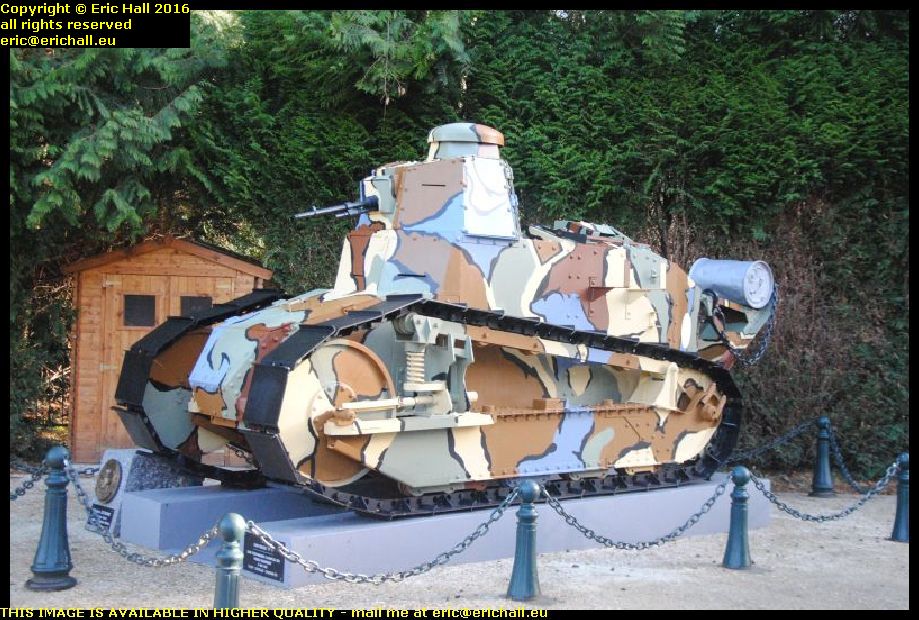
renault FT 17 tank 11 november 1918 21 22 june 1940 site of armistice germany france compiegneThere are quite a few other bits and pieces on display here too.

This is a Renault FT light tank of 1918, and despite being built less than 2 years after the first appearance of the tank on the battlefield, it really is a modern vehicle, well in advance of anything else that any army had to offer at the time and is the basis of almost every subsequent tank built even today.

In fact the design was so advanced that dozens of them went to war in World War II with several different armies. The one here actually did see action in the latter stages of World War I.
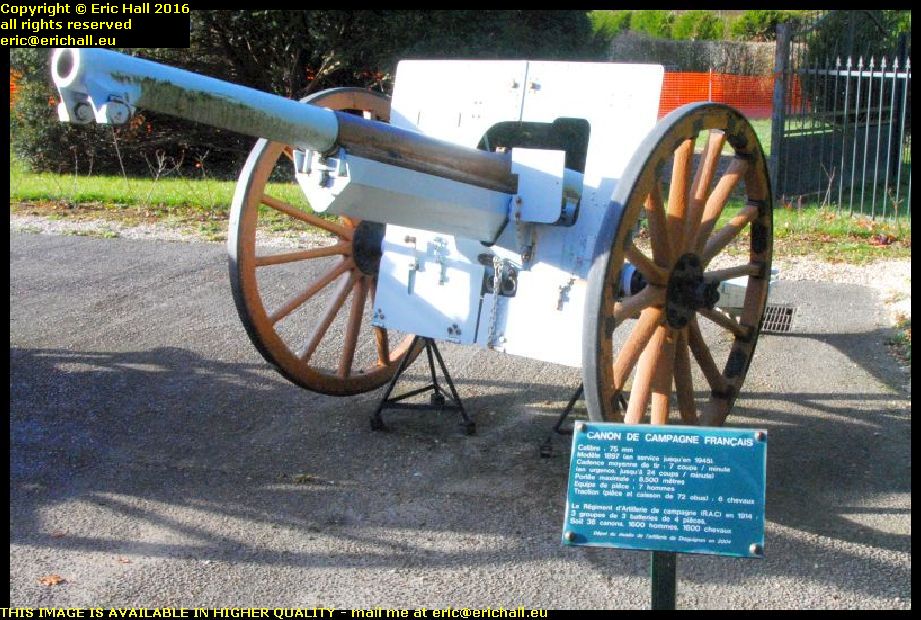
75mm cannon soixante quinze 11 november 1918 21 22 june 1940 site of armistice germany france compiegneBut pride of place from my point of view in the absence of any contemporary aeroplane, has to be this piece of artillery

This is the French Army’s 75mm rapid-fire cannon, much better known as the soixante-quinze. And when I say “rapid fire”, I really do mean “rapid fire”. The official firing rate of one of these is 7 shells per minute, but fully-trained crews have been times as firing 24 and even more rounds per minute under pressure.

This was certainly the most astonishing piece of artillery of World War I and its rapid rate of fire with a trained crew saved many a battle.

You could always tell when they were at the front because instead of going off with a dull thud or a bang like most artillery pieces, they had a very distinctive whine that anyone who has ever seen a World War I film featuring the French Army will immediately recognise. It sends a similar shiver up my spine as does the hooter of a North American diesel engine.

Apart from that, the one trouble with going to bed early is that you awaken early. And after a long while of tossing and turning, I finally rose up from my (very comfortable) stinking pit to find that it was … errr … 04:26

But never mind. That gave me an opportunity to back up all of the files on the laptop and to do a few other things too.

And have a shower. And a shave. And not just clean clothes but brand spanking new socks and undies. I bought a pile of those last year just before I was taken ill, and I hadn’t even unwrapped them. Anyway, I’ve brought them with me.

Breakfast could have been a little better, but apart from that, I enjoyed my stay at the Akena Hotel here at Claye-Souilly and I’ll remember this place for again, that’s for sure. Add it to the list if I can’t make one of my other two stops. It was a good find.

By 11:00 I was back on the road and after fuelling up with diesel on the N2, headed off for the clearing at Compiègne. This was another one of the places on my list that I can now cross off.

The rest of the journey was pretty uneventful and even after my sight-seeing, I was back here in my little room by 17:00 with a couple of bags full of stuff.

I had a good rest, a pizza from round the corner, and now I’m off to bed. I’ve had a busy last few days and I need to catch up with my beauty sleep.

Sunday 16th June 2013 – A FUNNY THING HAPPENED …

… this morning.

Lying in bed on my palliasse this morning, I heard someone shout “Eric” quite loudly and so I stuck my head out of the door and said “what?”.

I was greeted by a pile of blank stares from a group of people on the other side of the wall.

I didnt know it then, but I do now, that the name of the guy whose house backs onto this one is also called Eric.

So that was my Sunday morning lie-in ruined anyway, but it was at least gorgeous and sunny. And when everyone else finally surfaced and we all had breakfast, we prettied ourselves up for a special occasion.

Cécile’s mother is rather partial to mussels – the typical moules et frites – and on our travels Cécile and I had seen a flyer to the effect that a local restaurant – the Loup Blanc – was offering a special Sunday lunch of just that.

So Cécile’s mum had a party and we had home-made falafel and chips. Quite expensive but then again this is a tourist resort so you stick €5:00 on each dish before you start.

loup blanc golf course ile d'yeu beauty spots franceInterestingly though, the restaurant also has a mini-golf course.

As you know, with the sun in our faces we couldn’t get a good view of the fortress yesterday but there were no problems here today.

The mini-golf course is designed around the local beauty spots – chateau-fort included. It was quite interesting.

fort de Pierre-Levée ile d'yeu franceAfter lunch, Cécile’s mother had a music concert at the Senior Citizens’ Club and having dropped her off, Cecile and I went off to look at another venue on my list of places to visit.

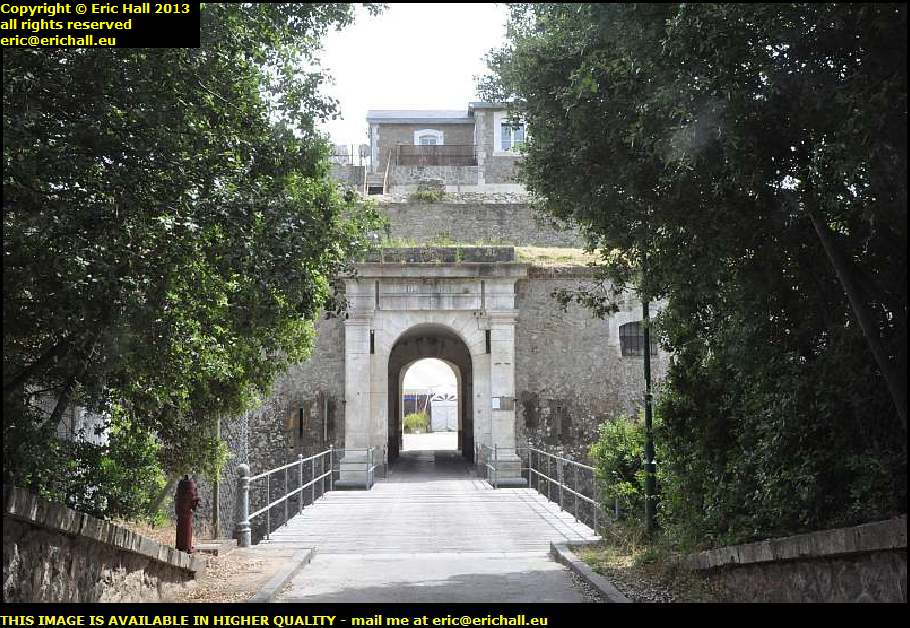
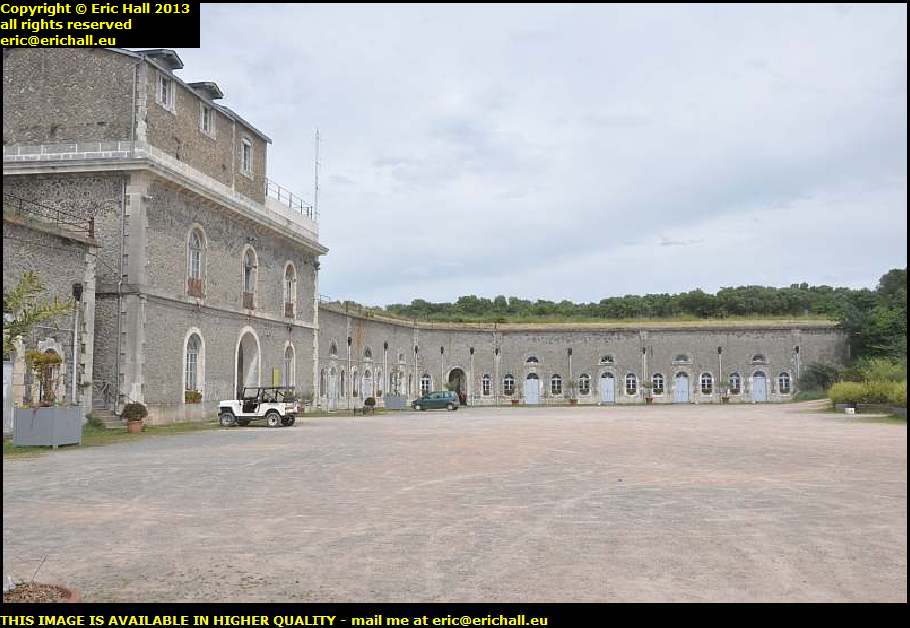
This is the fort de Pierre-Levée situated somewhat centrally on the island.

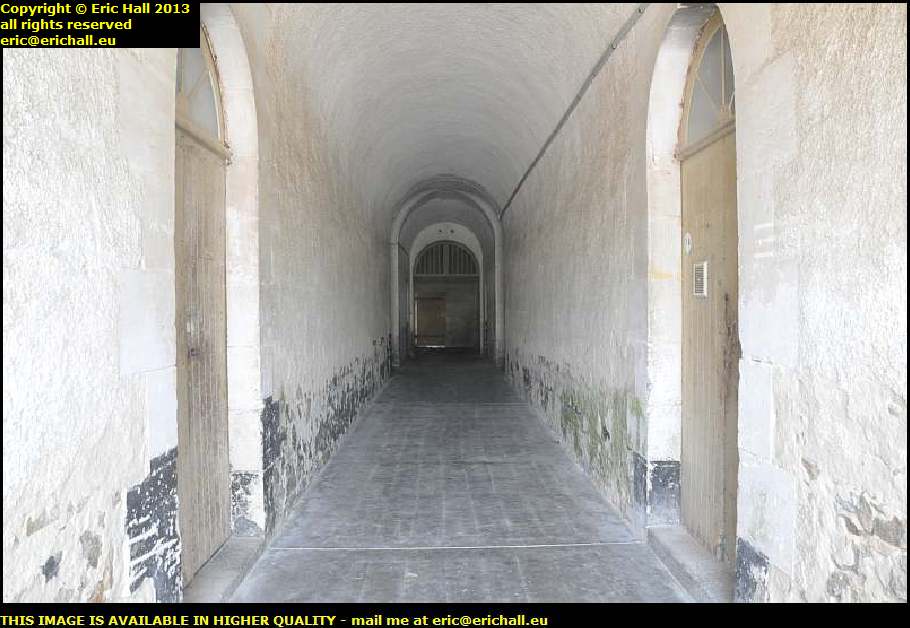
It was built during the period 1856-66 on the site of a much older fort. It is much, much greater in size though, so much so that a small hill had to be flattened to accommodate it.

fort de Pierre-Levée ile d'yeu franceOn top of this hill was a menhir … "PERSONShir" – ed … the pierre levée or “raised stone”, hence the name of the fortress.

This was taken down into Port Joinville where it was smashed to pieces by the locals who used the pieces for housebuilding.

Originally a barracks, it later became a prison and its most famous prisoner was Philippe Pétain.

fort de Pierre-Levée ile d'yeu franceIf you know your French history, when France was divided into two by the conquering Germans, they stuck as a figurehead-President the 84 year old French hero of World War I, Marshall Pétain (the oldest Head of State that France has ever had) to give the Government some kind of legitimacy.

Some say that he was shamefully manipulated due to his loss of his faculties in his old age, although you will find just as many people who will insist that he was far from being non compos mentis at the time.

fort de Pierre-Levée ile d'yeu franceNevertheless, at the end of the war he was tried as a collaborator (at all of 90 years of age) and condemned to life imprisonment. In November 1945 he ended up here in the fort de Pierre-Levée where his condition rapidly deteriorated.

As a coincidence, you’ll recall that I don’t live too far away from the Chateau de Chazeron where Pétain’s government incarcerated his political opponents during the dark days of Vichy.

Regular readers of this rubbish in one of its previous reincarnations will recall that Liz and I had been there a few years ago to look at the place, so I was quite keen to come here to see the other side of the coin.

Having been released from confinement due to ill-health on 8th June 1951, Petain died on the island 7 weeks later on 23rd July.

I wanted to add his grave to my list of war leaders, such as Churchill, whose tomb I had seen when I went for a wander around with Sue, and of the French General whose name I have momentarily forgotten and whose tomb I had stumbled across quite by accident in a small village graveyard in Finisterre in the mid 1970s, long before these pages ever began to see the light of day.

And of course the memorial to Marechal Desaix, right-hand man of Napoleon during some of his early campaigns, down the road from me in Ayat-sur-Sioule.

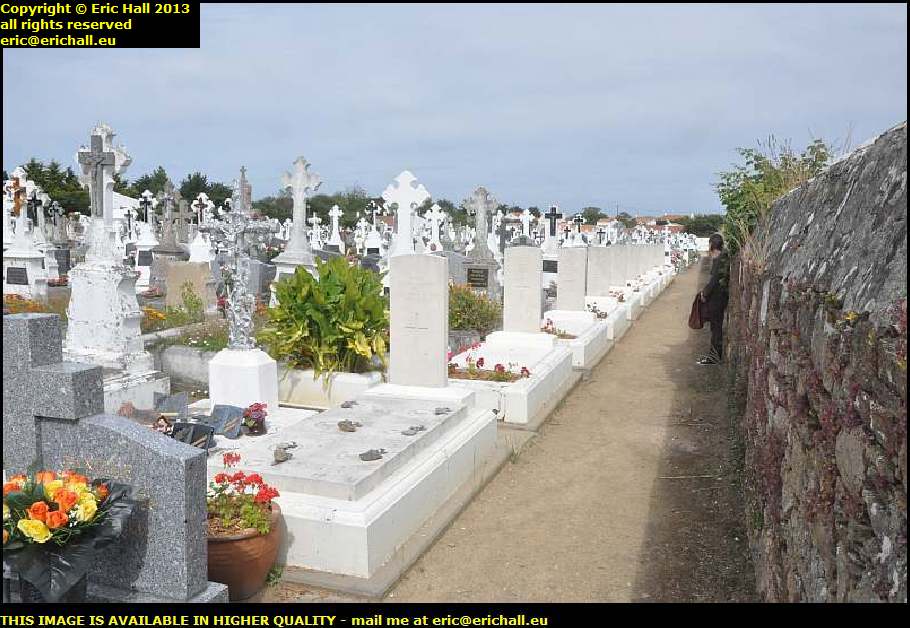
grave marshall philippe petain Cimetière Communal de Port-Joinville franceWe went off the the Cimetière Communal de Port-Joinville to see his grave and it was actually there.

That might sound a surprising thing to say, but it wasn’t always there. In February 1973 his body was stolen by Far-Right activists who wanted his body in the grave that had been prepared for him at Verdun.

The authorities recovered it and reburied him here, but as a concession they gave him a Funeral of Honour.

commonwealth war graves Cimetière Communal de Port-Joinville ile d'yeu franceThere are several other graves in here that are quite important. They are of 16 British and Commonwealth servicemen, one of whom is unidentified.

Seven graves relate to airmen from 149 Squadron RAF.They had taken off from Lakenheath in a Stirling Mk1 BF 392 OJ-D at 18:30 on 16th October 1942 on a “gardening” mission, sowing mines in the Gironde estuary and were shot down by a night fighter.

Most of the other graves however are dated May and June 1940 and are from a variety of services and regiments.

I do recall that in a well-hushed-up incident of World War II a British transport ship – the Lancastria if I remember correctly – evacuating troops from mainland Europe during the final days of the Battle of France was sunk off the coast of St Nazaire on 17th June 1940.

There was a massive loss of life, somewhat similar to the Wilhelm Gustlof off the coast of Danzig in the latter days of the war.

I wonder therefore if the later casualties buried here might be bodies of soldiers from the Lancastria who were washed ashore here at a subsequent date.

I shall have to check up on this.

And that reminds me – whenever you are on board a ship or other maritime transport, always carry a bar of soap in your pocket. That way, if you fall overboard or are shipwrecked, you can get washed ashore.

Don’t be like one of the survivors of another maritime disaster, the sinking of the Caribou, to whom I talked a good while ago.

He was telling me that he spent 16 hours in the freezing Gulf of St Lawrence, clinging to an upturned lifeboat.
“Didn’t you manage to drag yourself up?” I asked him
“Ohh dear no!” he replied. “I didn’t even have time to put on my lipstick”.

street of the flying dutchman ile d'yeu franceBut I had to laugh at this sign – and so should you too.

And not because it’s incorrect – it should be “rue du Ne’erlandais Volant” these days

It is of course anyway the Street of the Flying Dutchman and that conjures up all kinds of ideas in my head … "well, there’s plenty of room" – ed … but possibly relates to the famous ghost ship.

However, I always thought that it was called in French the Voltigeur hollandais, so who knows?

But now its clouding over again and I think that summer is over for another year.