Tag Archives: springhill mining disaster

Saturday 21st February 2026 – IT’S BEEN ANOTHER …

… day when I seem to have accomplished quite a lot, without really realising it.

Mind you, I did have something of a head start this morning, and that can quite often make a great difference.

It wasn’t like that last night, though. Once more, everything that I needed to do seemed to take so long to do it that it was 23:30 once more when I finally crawled into bed and threw the covers over my head, as I usually do.

And there I lay, fast asleep, until all of … errr … 03:25 when I awoke. And from that moment on, try as I might, I simply could not go back to sleep.

So for about two hours or so, I lay there tossing and turning to no effect whatsoever and in the end, round about 05:30, I arose from the Dead.

Regular readers of this rubbish will recall that this week, I’ve prepared two radio programmes. The notes had yet to be dictated, and so I made the most of the early start by dictating both of them before we started having people strolling around outside and making a noise.

Once I’d finished, I went into the bathroom to sort myself out, change my clothes and have a clothes-washing session. As I have said before … "and on many occasions too" – ed … having lived out of a suitcase for several years, I always try to keep on top of the washing of the undies so that I’m not overwhelmed or, even worse, run out of clothes. Handwashing my undies is no big deal.

In the kitchen, I made my hot lemon, honey and ginger drink with which to take my medication, and then came back in here to listen to the dictaphone to find out what I’d been up to during the night.

And I was surprised that I’d been up to so much, given how little sleep I’d had during the night.

There was a big group of us sitting around on the chairs and settees and the floor of a living room somewhere. We were discussing various things that had happened, various illnesses, and someone began to talk about a mining disaster up in the Cumbria region where people had been killed. They were discussing how it happened, and someone turned round to me and said “I suppose that if you’d been in charge, Eric, you’d have pleaded ‘Not Guilty'” to which I replied “not at all”. Someone said “yes, but you don’t want to say that at the top of your voice, do you?”. I replied “no, but you review the evidence first before you decide on what you are going to say”. The chap then turned round from that same subject towards the medical and said … “that’s why” I said “I have this illness but no-one is going to say that I die of it because I might die of something else in the meantime”. People usually hedge their bets as to when I’m going to die etc and no-one will give me a date because they are all making sure that they don’t pre-empt anything.

Yesterday, I was writing the biography for a musician who came from Aspatria in Cumbria. And as well as that, it was the anniversary today of one of the SPRINGHILL MINING DISASTERS, the one that took place in 1891.

Later on, we were singing a song called “Rebecca”. It’s a song in French and concerned a girl who was walking around Maiden Castle reviewing all of the changes etc that had taken place there. The song was in homage of what she saw. Of course, it was much more complicated than this and included a dream as well, but it was the song that stuck in my mind mostly, even though I’ve forgotten it now.

This is one of those dreams that I have mentioned before, where I remember nothing at all about it.

As I have said before … "and on many occasions too" – ed … I am actually asleep when I dictate my notes during the night but even so, I usually have a recall of something or other when I’m transcribing them. However, this is one of those where I didn’t and I’ve no idea to what it relates.

It certainly sounds interesting, though, and I wish that I could remember it.

We were back right at the end of the American Civil War and the siege of Richmond or Fredericksburg. The Union Army was of course on top, and there was one Union soldier who was quite famous for a lot of things. He was running agents behind Confederate lines, doing all kinds of things that had made him something of a hero. The Confederates learned that he was in the front line in their sector, so one of their private soldiers made a kind of search amongst the Union soldiers as best as he could from his own trench, and thought that he was able to recognise the soldier by the accolades that he was having from his friends. One evening, the soldier went and constructed a kind of tent in the front line, a shelter using a tent half and installed himself in it. The Confederate soldier took a rifle from the rack and inserted a bullet in it. He took careful aim but of course the rifle was extremely heavy and he was unable to control it properly when he was standing up. Nevertheless, when he thought that he was correct, he fired. It hit the Union soldier in the leg and rebounded into his chest and there had to be all kinds of immediate, urgent reactions to try to save him, otherwise he’d die. So in the pause that was taking place, a couple of Confederate officers and their wives decided that they would try to cross the lines into the Union Army area and go to do their shopping. When the general heard about this, he was appalled and sent the strongest instructions around. A couple of days later, the Confederate Army surrendered and it made no difference. One thing about this rifle while I think about it was that it wasn’t a muzzle-loader with a paper cartridge and a Minié ball but a breech loader with a proper bullet. In the American Civil War armies, it was extremely rare to find that.

This dream actually concerned the siege of Petersburg, and regular readers of this rubbish in a previous existence will recall that WE WENT TO VISIT PETERSBURG on one of our trips around the USA back in the past.

And I do have to say that I’m so impressed that I can remember from my reading in the past, so much that is relevant to this dream. The Spencer Repeating Rifle that this Confederate private seems to be using was a very rare issue, only issued to Union cavalry and sharpshooter infantry regiments. It had a chamber that could hold seven bullets of the type that we know today

The ordinary “footslogger” used a Springfield rifled musket. These were long-barrelled and had to be loaded at the muzzle. A paper cartridge of gunpowder would be rammed down the barrel and then a Minié bullet, a lump of lead about six tenths of an inch in diameter, would be rammed down afterwards.

The discharge of a Minié ball from a Springfield was of a very low velocity, so rather than the bullet passing through clothes, flesh and everything, the Minié ball would push clothing deep into the body and the weight of the ball would shatter the bone. Consequently, there were many, many cases where gangrene developed, because of the dirty and stained clothing that the victim would be wearing. A surgical amputation of the limb in what passed for a casualty clearing station was a very common result of being hit by a Minié ball.

The survival rate of amputation after being hit by a Minié ball was not very optimistic. I’ve seen figures to suggest that over twenty-five per cent of such amputations resulted in death.

As for the tent, every Union soldier carried as part of his kit a “shelter half” which was half a tent. And when the troops stopped for the night, they would form pairs and make one tent from their two “shelter halves”.

And as I said just now, I’m impressed that I could remember all that in a dream.

Isabelle the nurse turned up as usual and told me that somehow, she’d been locked out of her health card-reading machine. That’s going to cause a few complications if she can’t unlock herself.

After she left, I made breakfast and read some more of MAIDEN CASTLE EXCAVATIONS AND FIELD SURVEY 1985-6 by Niall Sharples.

He has now moved on to discuss pottery. And it’s going to be a very long discussion too because his team found a total of 10,432 grammes of pottery from the Neolithic Age alone, never mind the Bronze Age, the Iron Age and the proto-Roman occupation.

At the moment, he’s trying to categorise it into rim formation and shape. I have a feeling that we’ll be here for a rather long time.

After breakfast, I had things to do. Up on the top of my shelf unit were some boxes from the move back in August. I can’t reach them so while my cleaner had the ladder here yesterday, I asked her to bring them down.

And you’ll be amazed at the stuff that I found in them when I was sorting through the contents. It really is quite impressive. Loads of stuff that I’d either mislaid, couldn’t find or didn’t even realise that I’d brought with me from the farm.

The problem now is to find a place to put the things because it’s no use putting them back on the top shelf where I can’t reach them. A lot of it is stuff that I ought to need.

After a disgusting drink break at lunchtime, I came in here and began to edit the notes that I’d dictated a couple of weeks ago for another radio programme. And by the time that I’d knocked off, I’d edited them all, assembled the two halves of the programme, chosen the joining track and written the notes for it ready for dictation on the next early morning.

Then we had the football. And at last, after several weeks, we finally had a match where both the teams were interested in the game and wanted to play it.

Llansawel, fourth from bottom, were entertaining Y Bala, second from bottom. Y Bala were desperate for points to haul themselves out of the relegation places and Llansawel had hopes of catching up the teams ahead of them and pulling further out of danger.

Consequently, they were at it hammer and tongs right from the kick-off and there was no respite.

The result, 2-1 to Llansawel, was probably about fair, but if Y Bala can play like that all the time, they might give Y Fflint, third bottom, a few things to think about.

After the final whistle, I went into the kitchen and sorted out the pastry to make my croissants. I tried my new technique and it seems to work, but we’ll have to wait until I bake them tomorrow morning to see;

By then it was teatime and I made baked potato, a vegan salad and some of those vegan nuggets that I like, followed by apricot with vegan sorbet

Right now though, I’m going to bed ready for my lie-in, I hope. I have to say that I deserve it. Tomorrow, I’m going to try to find a recipe for a ginger cake so that I can make a ginger layer cake, with some vegan ginger cream filling in between the layers, if I can find a recipe for that too.

But before I go, seeing as we have been talking about Neolithic pottery … "well, one of us has" – ed … Niall Sharples was asked about all the pottery that he had collected.
"The problem is" he said "that it’s all broken into small pieces. To all intents and purposes, it’s effectively dead."
"So why are you collecting it all?"
"We’re going to have to try to return it to its next-of-kiln."

Tuesday 26th October 2010 – NOW LIZ, WHO READS THIS BLOG …

rainstorm pictou nova scotia canada… saw my photo of Pictou last night and asked me what the place was like and how it looked in broad daylight.

And the answer to that is “no idea”.

I came here the first time in 2003 and it was absolutely p155ing down so I didn’t stay long. And today, as if in keeping with some kind of tradition, it was likewise p155ing it down. And how.

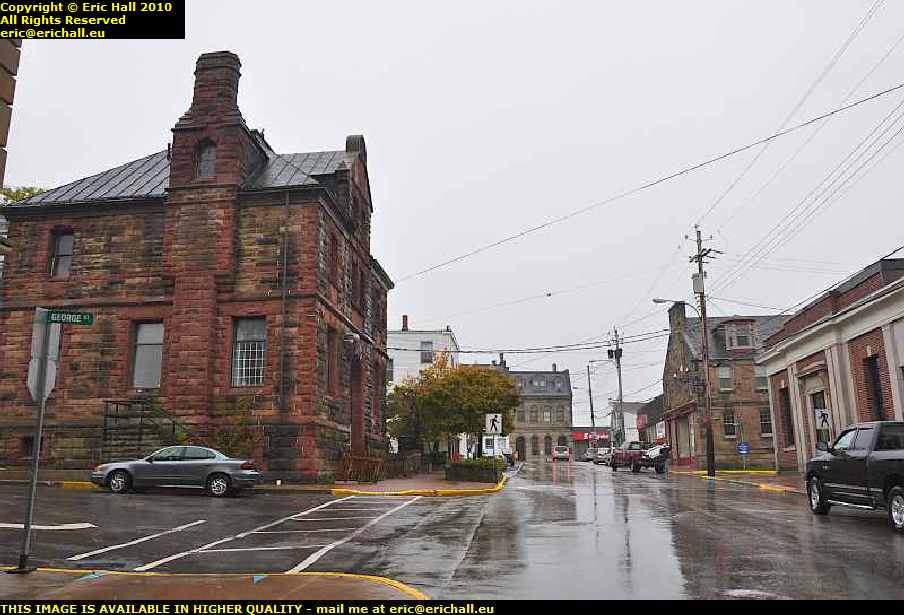
main street pictou nova scotia canadaBut this time I’m made of more sterner stuff and went for a nosey, getting thoroughly drenched in the process.

We’re lucky in that many of the buildings are quite substantial – made of stone, not your usual timber framed stuff. North American urban settlement is famous – or infamous – for being ravaged by fire and these stone buildings will have resisted that quite well.

However, escaping from the ravages caused by human modernism and “progress” is another thing, and Pictou has suffered some from that.

Now for those of you familiar with North American history, you will know that Plymouth Rock in Massachusetts is significant as it was there that the Pilgrim Fathers landed in late 1620 in the Mayflower.

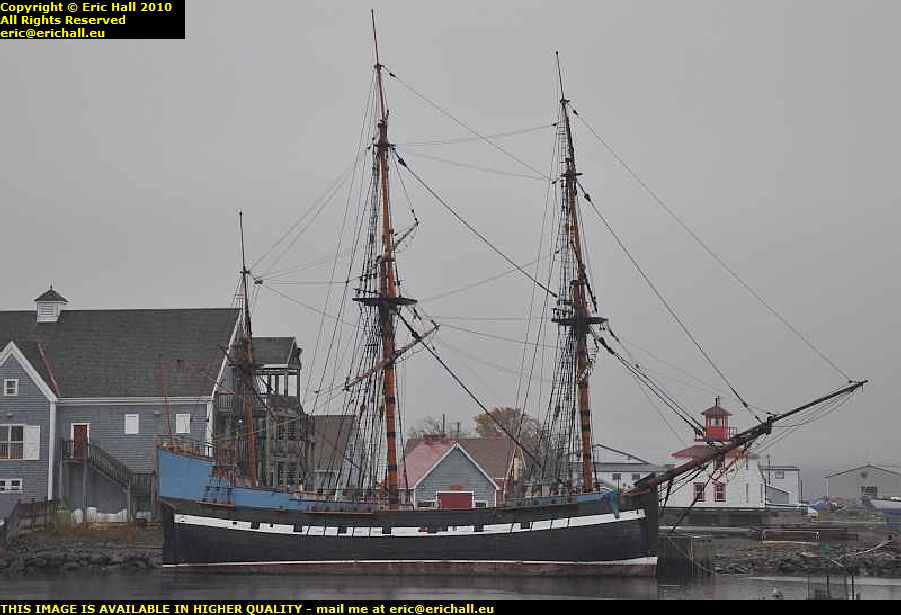
replica hector pictou nova scotia canadaAnd Pictou has a similar kind of significance for Canada as it was here in 1773 that a group of Scots landed in the Hector – a replica of which is on display here – and laid the foundations for Nova Scotia – or New Scotland.

Look at any of the graves of people who were born in this area during the following few years – there are dozens of people called Hector interred there.

And after that it was a drive to Springhill to do something else that I … errrr … overlooked when I was here before.

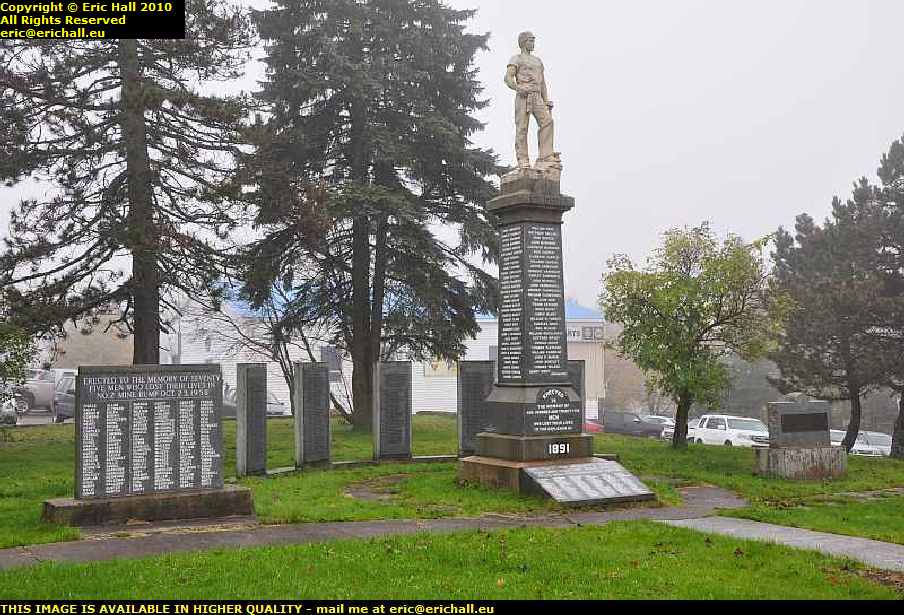
memorial springhill mining disaster nova scotia canadaI didn’t visit the Anne Murray Museum this time (so I didn’t meet Anne Murray this time like I did the last time) and I didn’t have time to visit the mining museum even though it was open today.

Instead I tracked down the monument to the hundreds of miners who died in the dozens of mining explosions and collapses in the shameful situation that passed for coal-mining here from about 1820 until just a few years ago.

If you know Peggy Seeger’s song Springhill Mining Disaster – made famous by U2 – then that is about one of the explosions here.
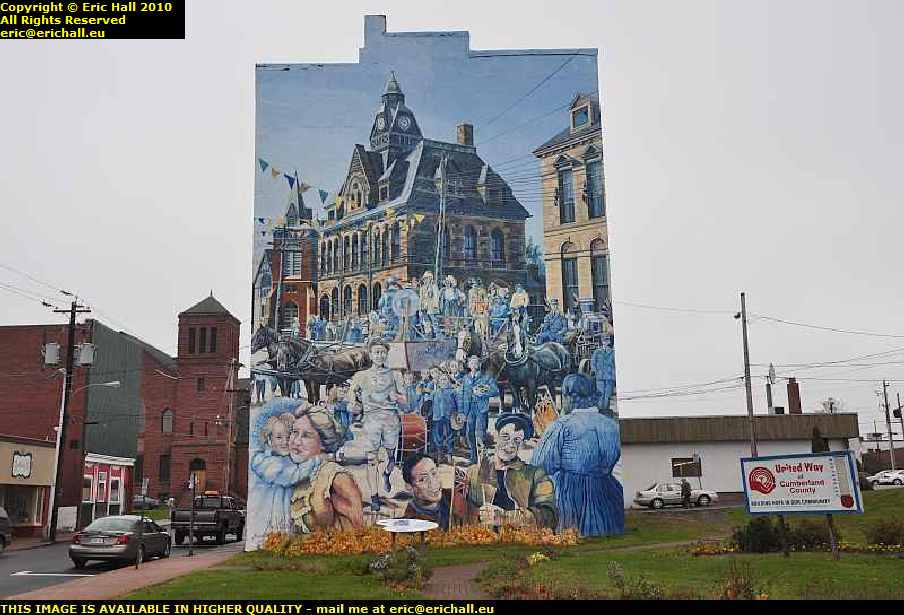
mural wall amherst nova scotia canadaNext stop was Amherst to look for something interesting and really I must have been asleep the two times I’ve passed through here and not noticed anything worth photographing.

Apart from the fact that it’s a beautiful sandstone-built town, there’s tons of other stuff that’s well-worth seeing.

I was having health issues both of the times I came here and that’s my excuse anyway.

fort beausejour amherst nova scotia canadaWhen I was here in 2003 I went to visit Fort Beausejour – the second-last bastion of the French army in Canada, not the last one (despite what most history books tell you – that dubious honour belongs to Fort Gaspereaux across the isthmus).

Here they hung on grimly to a toehold at the head of the Bay of Fundy as the French possessions all around them crumbled away into nothing, and eventually they too were swept away with the tide.

fort lawrence amherst nova scotia canadaThe British built a fort – Fort Lawrence – about 5 miles away from Fort Beausejour in order to blockade the latter and so I went in search of that.

It appears that this is in fact the site of the Nova Scotia Tourist Board offices and once I had realised that, it wasn’t all that difficult to track down. It’s not easy to miss all of those flags fluttering away up there.

acadian dyke tantramarre marshes chignecto isthmus nova scotia canadaFrom up on the heights I noticed what looked like early Acadian dykes across the Tantramarre marshes. The Acadians had done their best to drain the marshes and ended up with, what one commentator called “the largest hayfield in the world”.

So I had a wander out across the flats and, lo and behold, indeed they were, complete with a handpainted sign, displaying the Acadian flag. That’s the “Stella Maris” there on the pale blue background.

In the 19th Century, technology began to catch up with human ambition. And one of the ambitions was to make a short-cut across the Chignecto isthmus between the Strait of Northumberland and the Bay of Fundy so that ships would save days of sailing time and all the risks of circumnavigating the Canso Strait.

Someone had the idea of building a ship railway, where ships would sail into a canal and then be loaded onto railway trucks in order to be transported to the other side of the isthmus.

chignecto ship railway canal nova scotia canadaBut just as technology made this a feasible proposition, making larger ships became more feasible too and the ship railway was overwhelmed by events.

Work had actually begun but was soon abandoned. Nevertheless there still remains considerable evidence of the earthworks and I managed to track them down too. This would have been quite an impressive achievement had it been completed, judging by what remains.

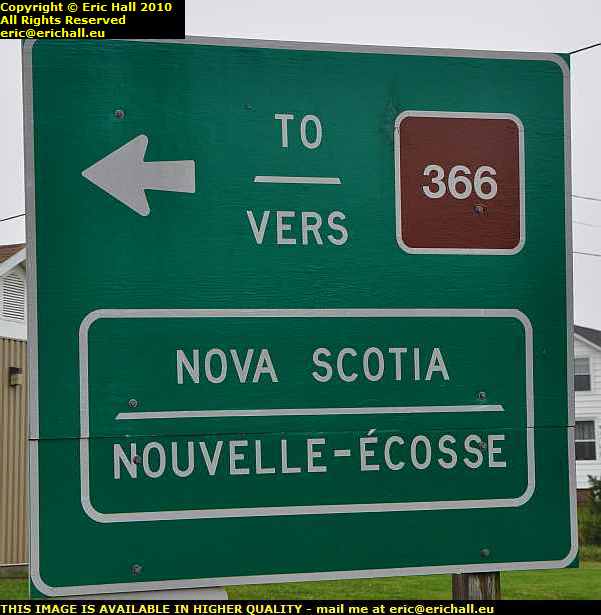
nova scotia nouvelle ecosse canadaWhenever I see this sign, I always end up laughing, even though I know that I shouldn’t. Coming from an oppressed minority myself, I can understand the feelings that minorities have about defending themselves and their cultures. But this sign is the kind of thing that brings this policy into disrepute.

I often ask about this sign – what’s the purpose of the “Nouvelle Ecosse”?. I’m always told that Canada has a policy of bilingualism (except in Quebec where their Anglophone minority is oppressed much more than the French minority ever was, but that’s another issue) and so every public sign in English has to be translated into French.

And I always wish that I had a camera handy to photograph their faces when I explain to them that “Nova Scotia” is Latin, not English, and so under the terms of the bilingual policy, there needs to be an English translation.

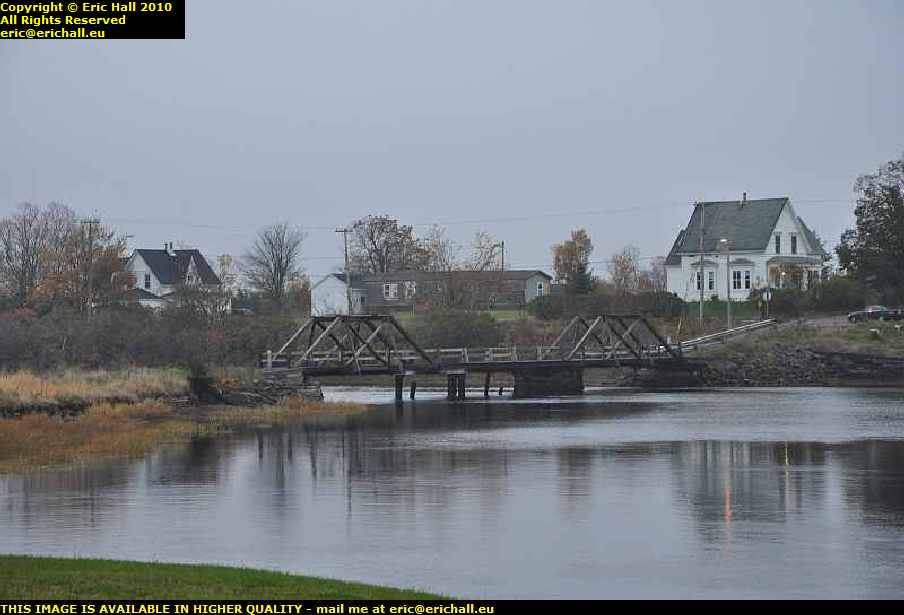
railway port elgin pivoting bridge new brunswick canadaI’m now in Port Elgin just down the road.

Port Elgin is famous for its hand-cranked (so much for modern technology in the 1890s) pivoting railway bridge that moved so that ships could enter the harbour here.

Just on the edge of the town is not darkness but a motel, and next to the motel are the remains of Fort Gaspereaux. This is where i’ll be staying the night (the motel, not the remains of the fort).

There’s also the Confederation Bridge, the world’s longest bridge across iced-up waters. I saw that in 2003 but taking a photo of that with a compact digital was … errr … interesting so I’m going to do it again.

I hope that it’s still standing – I don’t seem to have much luck with bridges over iced-up waters – and that will be effectively my tourism over. It’s all downhill from here.