… that I would be talking much more … "much, much more" – ed … about the man from the Tunisian Tourist Board and his optional extras.
So here I am at 07:00 sitting in the hotel foyer waiting for a bus to come by.
And needing to heave myself out of my pit at some silly hour this morning, I was tucked up in bed with a film on the laptop at some silly hour last night.
But nevertheless, as seems to be the usual procedure these days, I didn’t make it to the end of the film. In fact, far from it.
And it was rather a disturbed night too with me being unable to settle down into a deep sleep, what with the pressure of having to be up early in the morning. But that still didn’t prevent me from being on my travels.
So during the night we had to wait for the convoy to come and pick us up, and here it was arriving at some time earlier than the 07:15 promised. The convoy consisted of a couple of armoured cars with one of these armoured personnel carriers, painted orange, in between. And we waited (and waited, and waited) to be called. It was then that I realised that I didn’t have an important item of clothing with me and I needed to go home for it. It was a good 5-10 minutes up the hill to Virlet and then I had to find what I needed and come back again of course, and it was already 07:19 and I was nowhere near arriving at my house yet so I doubted very much if I would be back in time. I didn’t think that they would wait that long for me.
But the question didn’t arise because the alarm went off at 05:55 and again at 06:00 and I was awake and out of bed more-or-less promptly. By 06:30 I was downstairs with my rucksack all nicely packed and trying to track down some food. There’s a bar by the swimming pool that opens at, would you believe, 03:00 and he rustled up some toast and coffee, as well as a bottle of water for the journey.
The bus was due at 07:00 so at 07:30 I asked the receptionist if it was normal that he would be this late.
“Ohh yes” he reassured me. “Quite normal”. I could have had a normal breakfast had I known
When he finally arrived and picked me up we headed off
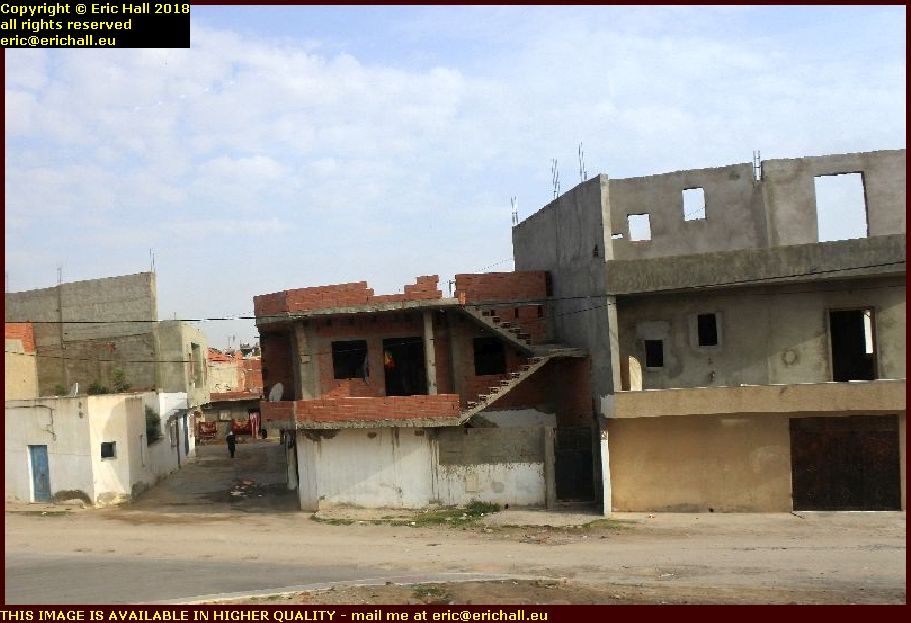 We had to go via a couple of other hotels and pick up a few more people, and then we threaded our way through the streets of the outskirts of Sousse and into the interior of the country.
Once we were out of the tourist zones and the city centre, we noticed a marked decline in the standard of living of the general public.
Despite what people tell you, not all of the wealth cascades down to the bottom of the pile and there are some who are less-fortunate than others.
 That’s not to say that there is no sign of economic progress in the region.
There’s still a good deal of house-building going on around here. The “flight to the towns” that was a symbol of the dissolution of rural life in Western Europe in the 1950s and 1960s is happening here too,
Especially as the desert continues its relentless march onwards and overwhelms little by little many of the more-isolated rural communities.
Regular readers of this rubbish will recall that I’ve mentioned … "many, many times" – ed … the fact that the climate today is much different than it was in antiquity.
 North Africa was much wetter than it is today and there wasn’t as much desert.
Agriculture was much more prominent and the region was the major source of supply of many of the agricultural products of the Roman Empire – the “Bread Basket of Rome”.
Even today there’s a considerable agricultural output from the region as you can see, and I’m not just talking about olives, dates and figs.
So just imagine what this region must have looked like 2000 years ago when agriculture was at its height.
 We came to the town of Kairouan where we needed to change to another bus that was going to take us on the rest of our journey.
The plan was that we should have had enough time to visit the Great Mosque there but with running so late the bus that was going to meet us was already there and the driver was keen to depart.
And I can’t say that I blamed him either. It’s a long way to where we are going.
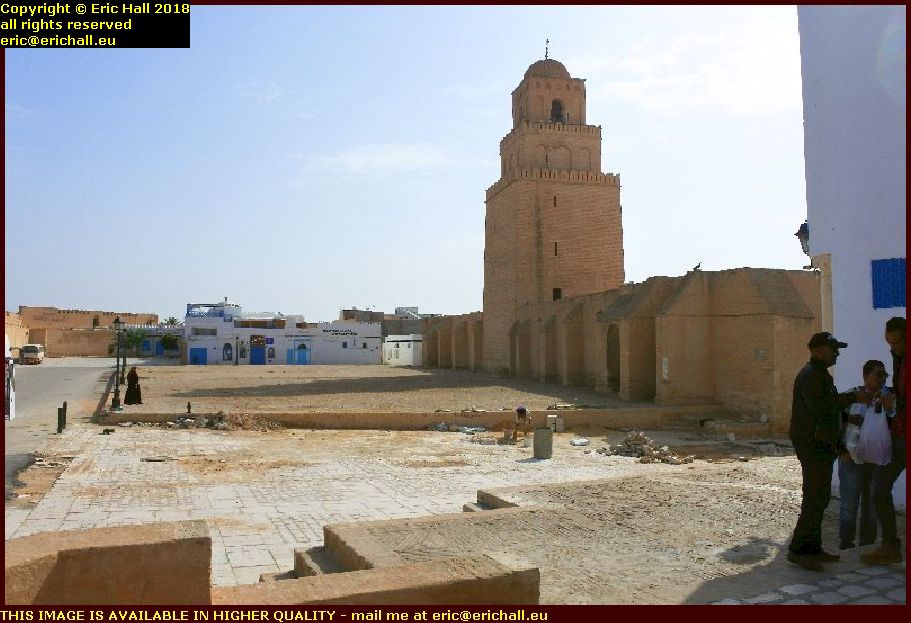 But I haven’t come all this way to be thwarted, I’ll tell you that. I’ll get to have a look at the mosque, even if it’s only from the outside.
It’s an absolutely magnificent edifice and so I have to look for a decent vantage point to take a photo because the most obvious one has the sun streaming into the lens.
So around the corner using another building as a sun blind I can at least manage to do something.
It was however a huge disappointment not to be able to visit the interior of the mosque because it is one of the most important and one of the oldest religious edifices in the whole of the Islamic world.
Tunisia was invaded by the Arabs in the latter years of the 7th Century and by 670AD – which is Year 50 in Muslim dating – they were firmly established here in Kairouan which they used as their main base of operations.
And it was in this year that the construction of the Great Mosque began. And it doesn’t have the sobriquet “Great” for nothing because it covers an area of over 9,000 square metres and a perimeter of over 400 metres. The minaret is about 31 metres high.
It became the inpsiration and the basis of the design of almost every other mosque in North Africa and is said to use earliest know example of a “horseshoe arch.
As well as being the centre of religious teaching in Western North Africa (the Maghreb) it also had a reputation of being a great centre of secular learning and in the 10th and 11th Century was said to have one of the most impressive libraries in the world.
One book that was held here was the legendary “Blue Koran”, described by the Brooklyn Museum as being “one of the most extraordinary luxury manuscripts ever created.”. But like the rest of the contents, it was pillaged and dispersed by the Ottomans when they overran the area in 1534.
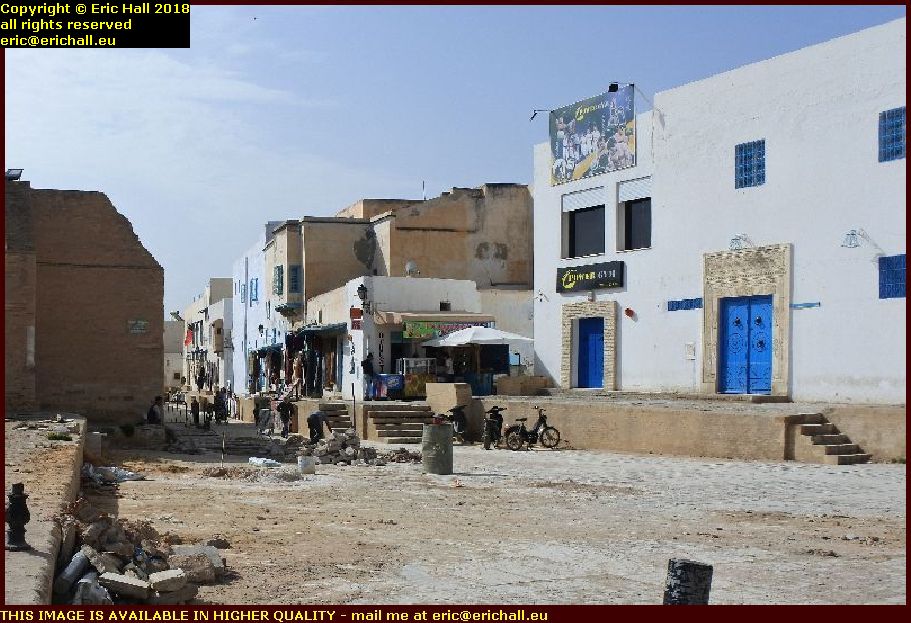 As for the town itself, there was very little here before the Arabs arrived, and it was they who built the city.
The inland site was chosen because the Mediterranean coast was still subject to surprise raids by the Byzantine fleet, and it also controlled the exit of a couple of mountain passes to the west that were stil lin the hands of the Berbers, so it could stem any counter-invasion from that direction.
It still retains much that is of great historical value and became a UNESCO World Heritage site in 1988. in 2009 it was proclaimed the “Capital of Islamic Culture”.
 And I suppose that you are wondering why the mosque isn’t situated in the centre of the Medina, as you might expect.
The answer is that it was when construction started, but as the fame of the city grew, it expanded rapidly and by the 9th Century the town is said to have had over 100,000 inhabitants. However, the topography to the north (riddled with wadis) limited expansion in that direction.
The rapid expansion of the city exhausted the nearby drinking water supplies and a whole system of artificial aquaducts and reservoirs was constructed, the remains of which are still clearly visible today (if we had time to go to visit them), to bring water from the mountains.
 The place is also littered with souvenirs and artefacts of warfare.
Being one of the principal cities in the Maghreb it was a target of many an invading army.I’ve mentioned the Ottoman Turks invading here, and the city was also a fanatical centre of resistance to the French “liberators” in 1881.
In fact the resistance was to such an extent that the French never really quite felt in full control of the region in all the time that they were here.
Eventually we all leap aboard the bus, which is almost full to capacity, and head off out of town.
 It’s market day today, as usual, and everyone has set out his or her stall in the marketplace.
And it’s not just the typical meat and veg either. Kairouan has a couple of claims to fame, firstly for its patisseries and secondly, with the town being surrounded by sheep, for its woollen products, especially woven wool carpets.
And talking of wool, it reminds me of when Lux, the washing soap people, launched a new product with the advert “if it’s safe in water, it’s safe in Lux”.
I wrote back to them “I’d like to talk to you about my goldfish …”
 This roundabout is very close to the dead centre of Kairouan, which you can see in the background.
As for the vehicles though, you will probably have guessed that the yellow vehicles are taxis, but the white minibuses with the red stripe are something of a cross between taxis and buses. They are called louages.
They sort-of follow a fixed route (although deviations are quite the normal thing, especially if a passenger starts to wave about some of the folding stuff).
They don’t follow a fixed timetable either. They set off when the driver thinks that he has enough people aboard, and stop and wait when he hasn’t.
 At this roundabout we pick up the ring road around the town.
There’s a sign here for Sousse but we aren’t going back to there. We’re taking the road to Gafsa, and I suppose I’d better tell you why.
Regular readers of this rubbish will recall that we have had a miserable winter. It’s been wet like a wetness that I have never seen – only 4 dry days between the end of October and the end of March, floods everywhere, and I’m thoroughly fed up.
So much so that I said to quite a few people that I’m going to find a way of getting to the desert and then I’m going to sit in it.
Seeing the advert for this week away in Tunisia was one thing, but that’s not enough to satisfy me. It’s a shame to come all of this way and not take the final step.
So when the Tourist guide came to the hotel yesterday I asked him how I could go to the desert.
At first he refused to give me any details. “Your Government won’t allow your citizens to travel to the interior”
“Why’s that?” I asked.
“They are nervous about the situation down there.”
“That’s strange”
“Yes, but the Belgian Government is very protective of its citizens”
“Belgian? I’m not Belgian”.
“But you came with a party of Belgians that booked with a Belgian Travel Agent in a hotel that is primarily for Belgian clients”
“That’s as maybe, but that’s because I happened to be in Belgium when I saw the advert”
“So what nationality are you?”
“British” I replied, brandishing my passport.
“British? They you’re lucky. You are one of the few countries who are allowed to travel”.
There was a revolution in Tunisia 7 or so years ago, and this seemed to reinforce the Arab control over the country, which means that the Berbers, the Bedouins, the Touaregs and a few other minorites down south are not too impressed.
Furthermore, the south of Tunisia is like a finger that points in between Algeria and Libya. In both those countries there are some anti-Government forces and when the pressure is too hot for them they step over the border into Tunisia for a little peace and quiet.
Although this might sound like a tense situation, everyone involved in any kind of discontent knows that the only money that comes into the south of the country these days comes from the tourists.
Frighten away the tourists and you stop the flow of money and everyone suffers. So apart from the odd madman which you find in every walk of life in every country in the world, there’s no real issue for the tourists.
Statistics go to show that you stand much more chance of being killed by a madman with a legally-held firearm in a school in the USA or on a beach in Florida than you do here.
And as if that would stop me anyway.
“There’s a bus going from Hammamet into the desert tomorrow for two days but as there are a few people from the hotels in Sousse and Monastir who are allowed to go, we’ve arranged a feeder bus. We’ll arrange for it to come for you too”.
So here I am, with, as far as I can gather, a pile of Brits, a few French, a couple of Pakistanis and a Hungarian. And Uncle Tom Cobbleigh and all, for all I know.
 Now this is an exciting sign.
The name of Kasserine certainly rings a bell. There’s a mountain pass behind it that leads through the mountains into Algeria that you won’t ever find an American mentioning.
In November 1942 during World War II the US Army had landed on the coast of Morocco and Algeria in what was known as Operation Torch.
With the British 8th Army pushing along the coast westwards from Libya, the idea was to catch the German Army in a pincer movement here in Tunisia between the mountains and the sea.
So this involved the Americans making a dash for the Kasserine Pass before the Germans could reach there and fortify it.
But, typically for the Americans, they wouldn’t make a movement before all of their supplies and home comforts had arrived. And when they finally set off, they were lulled by their inexperience, naivité and overconfidence into a false sense of security.
They arrived at the Kasserine Pass with a kind of innocence that was quite touching, totally unaware of the fact that the Germans had arrived there first, and when they marched through the Pass quite nonchalantly the Germans set upon them and devastated them.
General Omar Bradley called the battle “a disaster” and said “It was probably the worst performance of U.S. Army troops in their whole proud history” – which presumably includes the abject surrender of Detroit on 16th August 1812 which a Vermont Newspaper, the “Green Mountain Farmer” described at the time as “disaster, defeat, disgrace, and ruin and death” and for which General Hull, the officer in charge of the post, was tried by court-martial and sentenced to death, and also the flight of the US Army from Washington DC and its total abandonment to the British who burnt it to the ground on 24th August 1814.
General Ernest Harmon wrote “It was the first—and only—time I had ever seen an American army in rout”
However we didn’t head to Kasserine, which was a pity. We continued on in the direction of Gafsa.
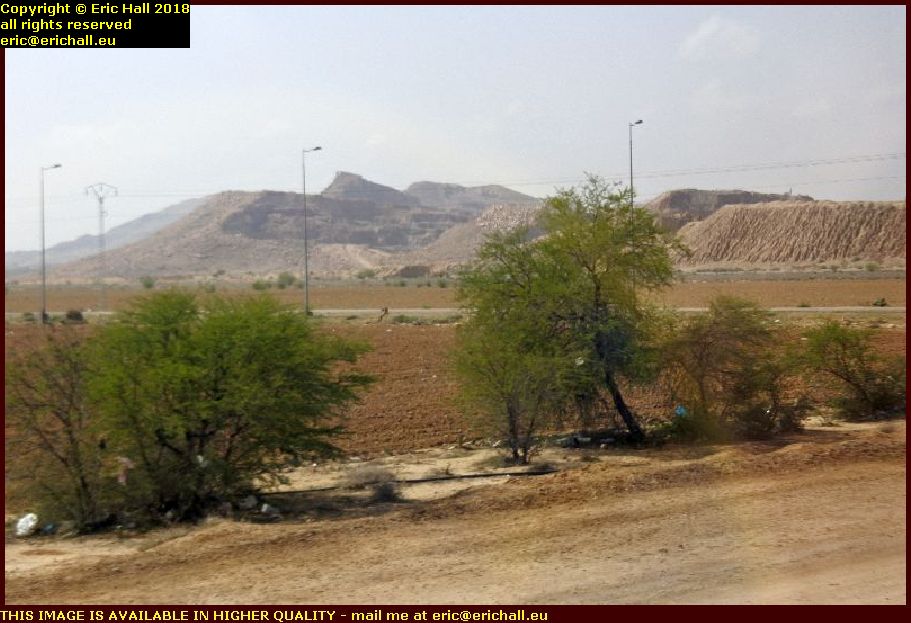 But we were still heading towards the mountains nevertheless. Our route was planning to take us into the foothills of the Atlas Mountains at the very least.
And you’ll notice the change in vegetation too. The climate is becoming much more arid and even the olive trees were starting to have a hard time of it.
And you’re probably thinking that these don’t look like olive trees. And neither did I, so I enquired. Our guide told us that there are gommier – gum trees – imported from Australia. I wonder if he means “eucalyptus”?
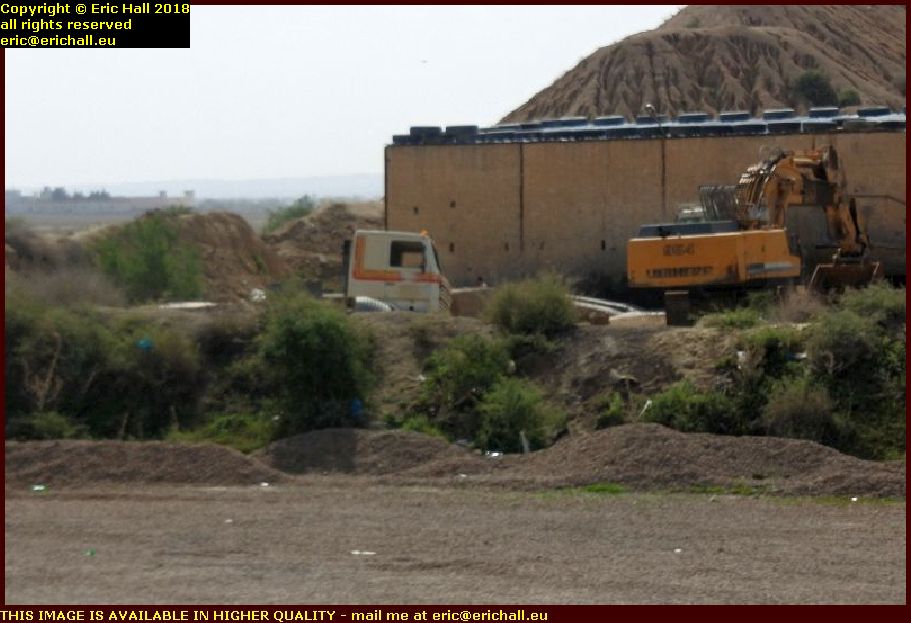 One thing that you’ll find out here on the edge of the desert is a large assortment of mines and quarries, although you might not notice it in this photo (taking photos inside a bouncing bus isn’t very easy)..
Tunisia has enormous resources of phosphates, some of the richest in the world, and we are, apparently, driving along the phosphate belt of the country.
To give you some idea of the amount of the stuff, of 11,000,000 tonnes of freight carried by Tunisian railways in 2007, 8,000,000 tonnes of that was phosphates. One company alone (admittedly, with several mines and quarries) accounted for 10% of the country’s exports and 4% of its GDP.
 Shortly after this we reached the town of Jelma, and here on the outskirts of the town was a roadside café, the “Oasis Parc”.
This looked a little out of place here. The baked adobe finish looked more like something that you might see in Mexico or the US border states.
But no matter. We’ve been on the road for hours so I can’t say that I was sorry to stop here for a coffee etc. We certainly needed it, some more than others.
 But one thing that I had noticed was that the café was situated within the walls of its own little compound, and not long after we had pulled in, the gate was closed behind us.
There was however time for me to go for a peep to the outside, and sure, enough we were not alone.
A police van thing had pulled up outside and two evidently military men with automatic weapons were on patrol outside. “A taste of things to come” I mused to myself. Evidently the farces of law and order have less faith in the locals than I do.
Back on the road once more and we continued on our merry, mazy way into the foothills of the Atlas.
And I must have dozed off at some point (which is hardly a surprise given the early start) because I didn’t make much of a note of things that were going on.
 But I must have been shocked into life at one moment or other in order to see some more abandoned vehicles by the roadside.
The red van at the back is a Berlingo-type of vehicle but the rest seem to be either Kias or Hyundais and they look as if they have been there for a considerable amount of time.
There’s quite a few of them as you can see, so I wonder what the story is behind them.
 It must have been a good while that I was away with the fairies because the next thing that I knew was that it was lunchtime.
We’re on the edge of the town of Gafsa, at a place called the Restaurant Orbata.
And I was in luck here because when I explained to the manager about my meal, he had the chef rustle me up a plate of couscous and vegetables cooked in oil with an extra helping of bread.
I’m not going to complain about that.
 Back outside afterwards, there were a few minutes left for me to go for an exploration.
The restaurant is part of some kind of complex related to the Gafsa Palace Hotel, and splendid pile this one looked too, just like something out of the Arabian Nights.
And you’ll notice the big, heavy gates here too, although there were none at our restaurant.
 But never mind all of that right now. I was much more intrigued by this vehicle.
You con’t have seen one of these in Western Europe because despite the success of the legendary 403, 404 and 505 pick-ups, Peugeot seems to have abandoned the pick-up market there.
Not so in North Africa though, where a new generation or Peugeot pick-ups is available. And not so in China where the Peugeot pick-up platform is shared with a Dongfeng offering, and surprisingly, neither in North America where it’s marketed as the Nissan Navara (albeit with a few styling changes).
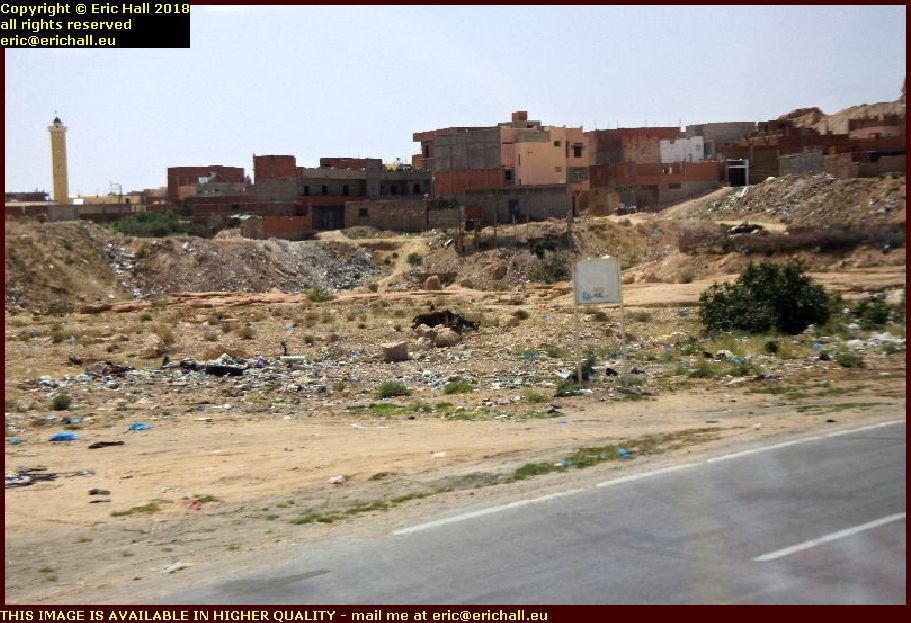 Once more unto the breach, dear friends. And here at Gafsa we headed off around the ring road and into the Atlas Mountains.
At least driving around the ring road gave us an opportunity to study the city of Gafsa. Not that there’s much to study from this viewpoint unfortunately, even though there’s a great deal of history attached to the place.
No-one knows the origins of the settlement here. It was certainly occupied during far antiquity, and the remains of some kind of very primitive leather workings that have been discovered have been dated to at least 8500 years ago.
It was an important crossroads (a role that it still carries on today) for the Romans, where the road from what is today Algeria bursts out of the mountains on its way to Libya crosses with the road down which we have just travelled from the coast to the oases of the interior.
And it is believed by some to have been the site of the Phoenician city of Utica, although this is hotly disputed by many others
Such was its status in Roman times that it was granted the position of a colonia, and called Capsa.
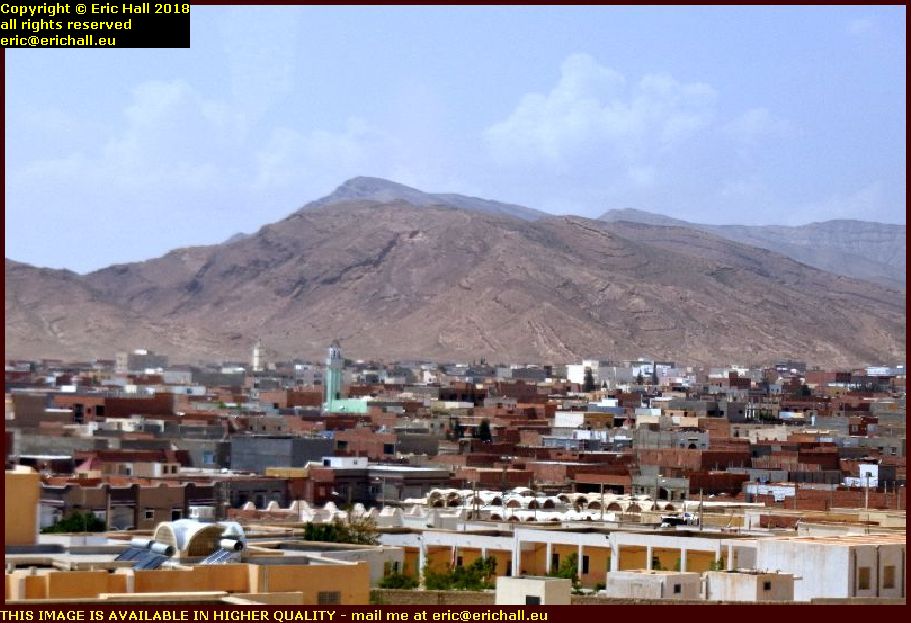 You won’t find any Roman remains here though. When the city was occupied by the Byzantines, who gave it the name of Justiniana, they totally razed the Roman city and used the stones to build a defensive wall.
But despite the absence of any Roman remains, the extent of the city can be gauged by the fact that is recorded in contemporary texts that various important spectacles took place here.
So there must have been at least a large theatre, if not an amphitheatre.
Despite the Byzantine walls, the city fell to the Arabs in 688. But not without what was recorded in Arab texts as a “fanatical defence” (we seem to be meeting a lot of “fanatical defence” in this region).
And even after its fall the inhabitants refused to integrate with their new masters and it is said that even as late as the 11th Century many of the inhabitants had still not converted to Islam and were still speaking Latin.
 It has several rather sinister claims to fame too.
- In 1907 a French regiment refused to obey orders to suppress a series of demonstrations against the French Government in the Languedoc region of France, having been shocked by the brutal manner in which another French regiment had fired on the unarmed demonstrators and killed several. As a punishment, they were transferred here to Gafsa to sweat it out in the desert.
- On 27th January 1980, a Libyan Army brigade, including a good number of Tunisian dissidents, having entered the country clandestinely, seized control of the city and invited the inhabitants to rise up against the Government, while the Libyan Army took up a threatening position on the border to distract the Tunisian Army. The population refused to rise up and eventually the Government regained control of the city, but not without a good deal of sabre-rattling from the Libyans and the Algerians who objected to the presence of French military advisers helping out the Tunisians.
- In 2008 there was a general strike here that was put down by the Government with great brutality, and the subsequent discontent simmering away is said to have been one of the factors that led to the Revolution of 2011.
- In 2014, at the height of Ramadan, it was discovered that an abandoned quarry had transformed itself into an oasis following the eruption of an underground spring. Even though the Catholic Church informs us that miracles only happen in Catholicism and never in Islam, the fact that this was observed at Ramadan calls into question the claims by the Catholic Churchof their monopoly of miracles.
Just beyond Gafsa we had our first encounter with a serious military presence.
We’d seen the odd military patrol here and there on our travels to date, but this was a proper road block and checkpoint. We had no issues, being allowed straight through, but from what I saw, almost every other vehicle on the road was being pulled over and searched.
And this is how it continued for the rest of our journey. Had I been in a private car and not an official Tunisian Government Tourist Board coach, I would have been well-fed up by the end of the day.
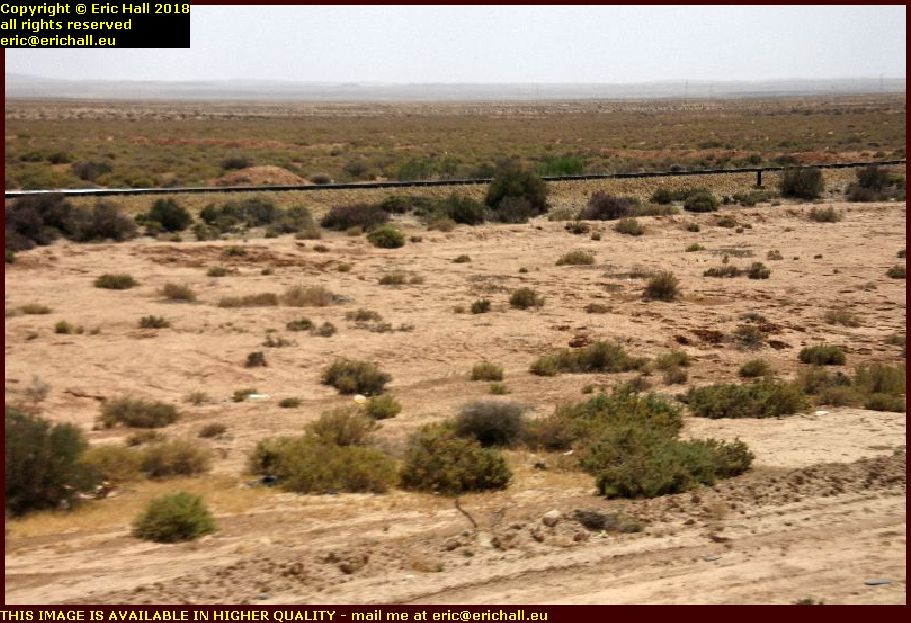 I mentioned a short while ago the phosphate mines and the Tunisian railway network – the SNCFT, or Société National des Chemins de Fer de Tunisie.
This whole area is honeycombed with phosphate deposits and the output is taken to the ports on this metre-gauge railway line that runs all the way to the oasis of Tozeur.
There’s a passenger railway service too that runs through the night from Sousse to the oasis, and that was my Plan B if I could find no other way of going to the interior.
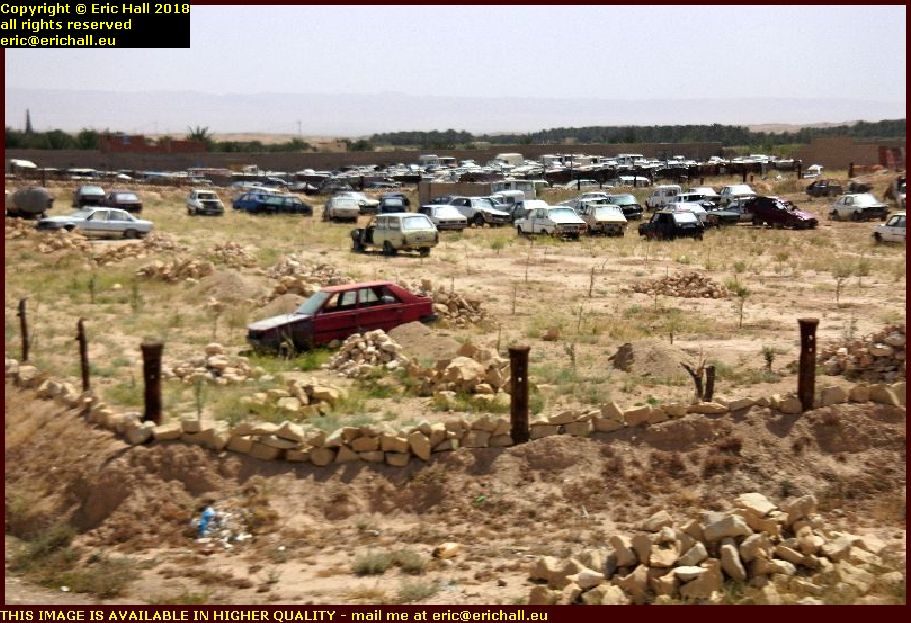 But never mind the desert and the scenery and the railway line for the moment – this is much more like my idea of scenery isn’t it?
Even in North Africa they can’t make cars go on for ever and I bet that there’s some really good stuff down at the far end of that scrapyard.
This is the kind of place that would have attracted my attention for some considerable time, as poor Nerina would have testified. She always had something of a difficult time on our many journeys around Europe.
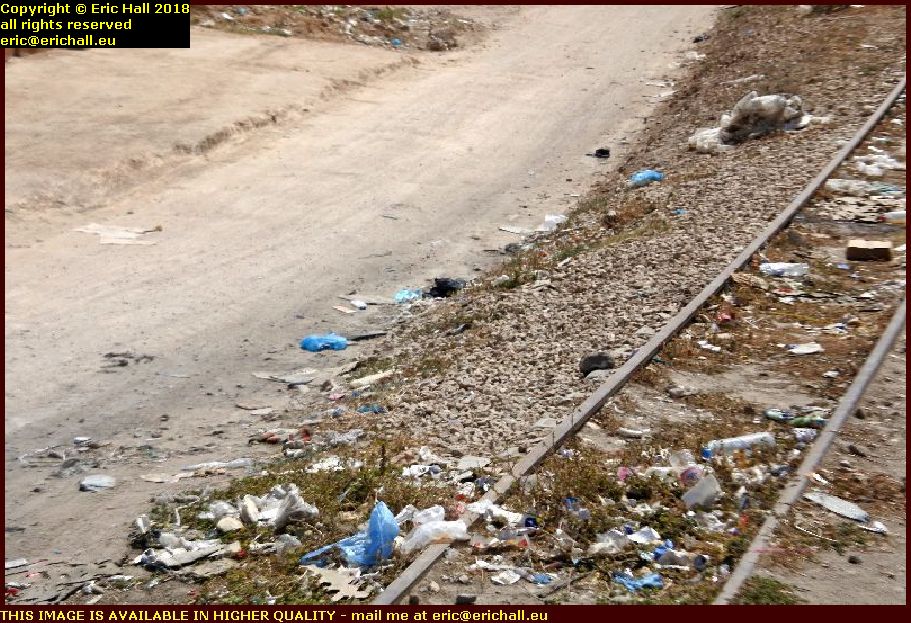 Here and there around the town of Metlaoui are some very rich deposits of phosphates, but many of the extraction sites have been closed and the railway branches abandoned
In fact, it was the closure of some of these sites and the subsequent job losses in 2007 and 2008 that led to the civil discontent in Gafsa which I mentioned earlier.
The continued uncertainty around here coupled with issues across the border are what have led to the more visible presence of the farces of law and order beyond Gafsa
But this is why there isn’t any great issue with the tourists. With the winding-down of the phosphate economy, the tourists are playing a more vital role in the economy of the area and no-one wants to chase them and their money away.
 Now this is the kind of thing that really gives you the hump, isn’t it?
You can tell just how deep in the desert we are even here when you start to notice the herds of camels.
Beasts of burden have long-since given way to motorised transport wherever it is possible to do so, but there’s still a place for a camel train once you go deep into the desert and it won’t be far now before the road peters out.
 I said that Tozeur was a small town situated at an oasis in the desert, didn’t I?
Now just look at all those trees over there in the distance. The town, and the end of the road, is down there somewhere in amongst those trees and that’s our destination for today.
At one time there were 200 different water sources and as many as 400,000 trees but with the change in climate, both the sources and the trees are slowly starting to dry out and use of the water is now controlled.
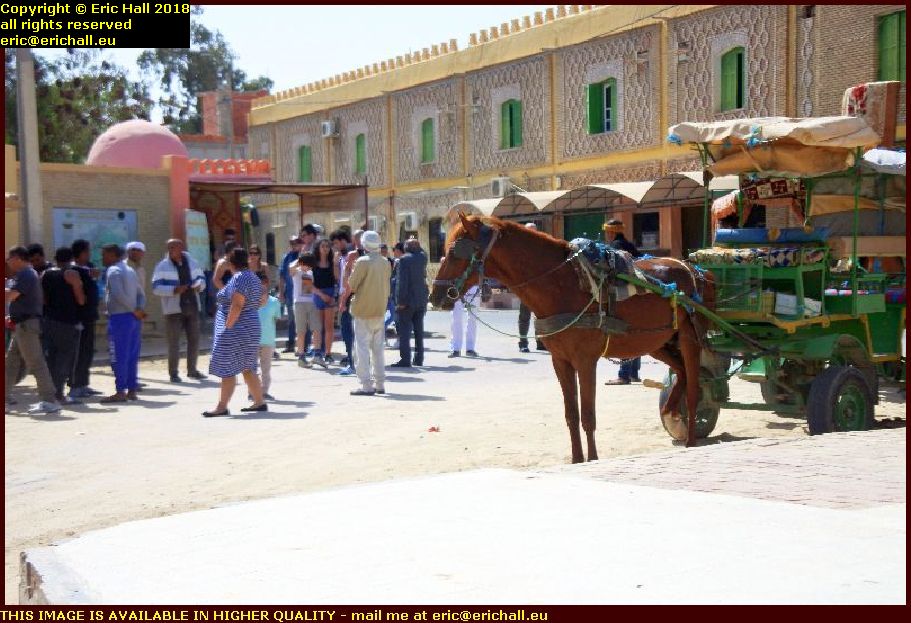 On arrival in the city we were dropped off at what passes for a kind of taxi rank. We were going to visit one of the groves in the oasis, but by horse and carriage.
All of this is included in the price, so I was informed, so who am I to refuse?
We poured out of the tour bus an into a carriage. I ended up sharing with a couple from Paris and their little daughter.
 I say “carriage”, but I do use the term rather loosely. These are what might have passed for carriages 100 years ago.
And an enormous amount of hilarity ensued when the wheel bearing of one of them collapsed and the wheel, passengers and guide were decanted into the street. And we hadn’t gone more than five yards either.
A few other wheel bearings also looked rather shaky too, including ours. I hoped that it would last out until we got back.
And the same applied to the horse. I’ve seen healthier-looking beasts hanging up on a hook in a butcher’s shop.
 So while we are trotting off down an alleyway and past one of the 200 water sources on our way to the oasis, let me tell you a little about the town.
It goes without saying that with it being one of the largest oases in the whole of North Africa, it’s been inhabited for thousands of years. There is certainly evidence to suggest that the Capsienne civilisation, which expired around 6000 BC was present at the oasis.
The town was a Carthaginian outpost called Tisourous and when the Romans ovethrew the Carthaginian Empire it became the fortified Roman city of Thusuros. And there’s plenty of evidence of Roman remains here too, There was even an early Christian church, the remains of which have been incorporated into the mosque..
It fell to the Arabs during their invasion of the late 7th Century and subsequently became another great intellectual centre where even poets thrived.
Tourism has long been known in this area too and one of the earliest of the modern genre of travel writers, Thomas Shaw, wrote about his visit here in 1730.
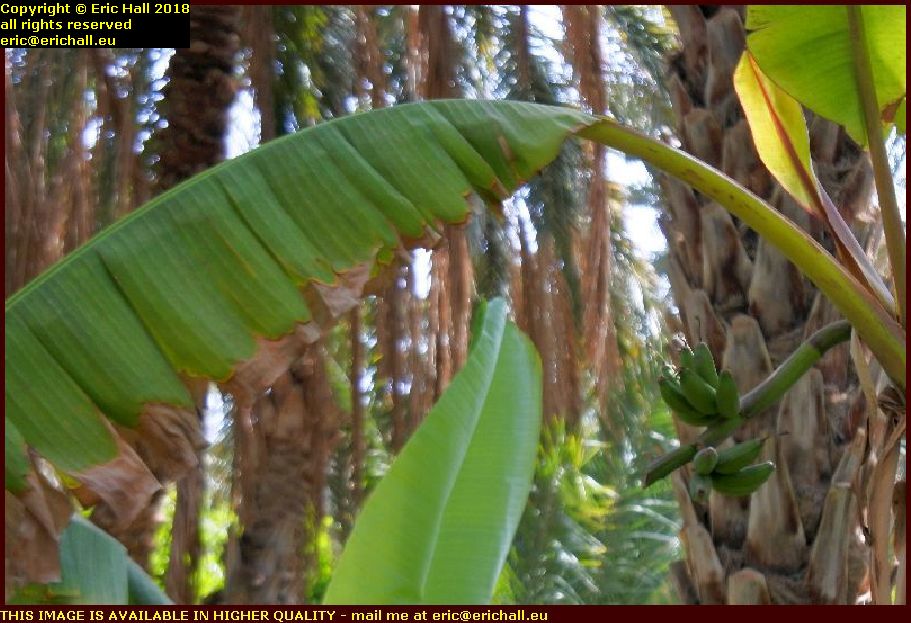 Today, the economy revolves around agriculture, with the region famous for its date crop,
And not only that, if you look very carefully at the lower right quadrant of this image you’ll see a bunch of bananas. They can even make those grow here, but it’s not a particularly profitable crop by any means.
However, whatever you do, don’t make jokes about bananas within the hearing of the Tunisian police. It’s a sensitive subject.
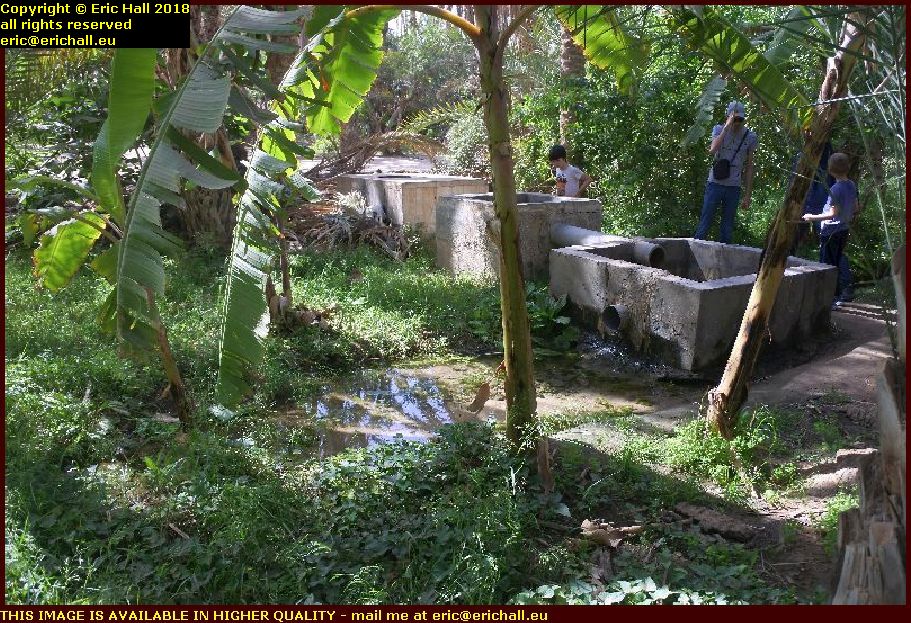 And while you admire one of the water sources here in the grove that we visited, I’ll tell you that another commercial enterprise for which Tozeur is well-known is its brick factory.
It still makes bricks of the traditional style, and in the traditional manner too. At the last count, there were 20 families earning their living at the brickworks.
There is also of course tourism, although most of the tourists are merely passing through, just as we are. This causes some dismay amongst the locals who with that the Tourist Board would do something about attracting long-stay tourists to the area isntead of the overnighters.
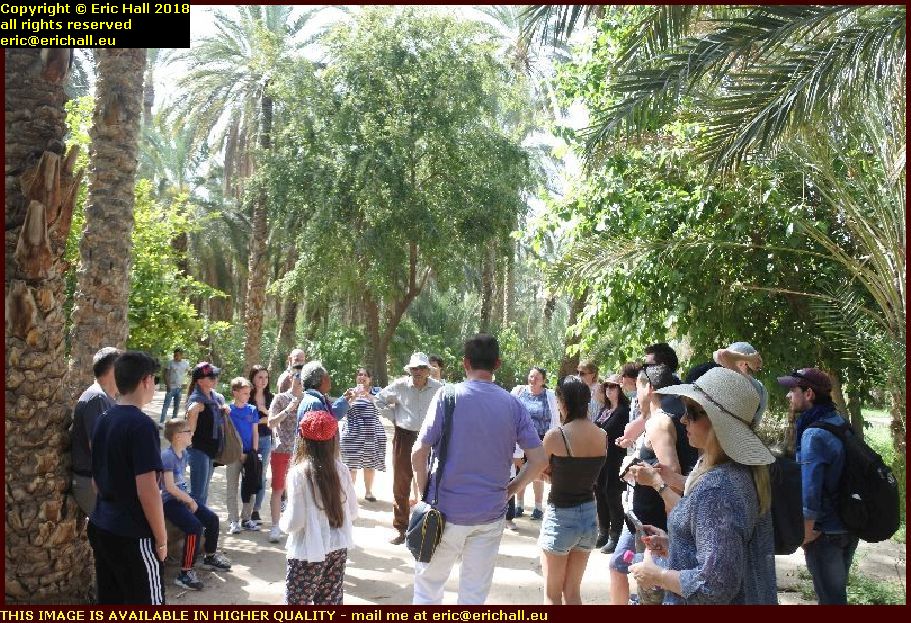 Returning to our moutons as they might say in Francophonia, this grove really was a fantastic place to be.
It’s difficult to imagine that we were deep in the desert just here with all of the trees growing around us. It was relatively cool in the shade
But even so, there were several signs of decayed and fallen trees around here. It did make me wonder how long the water supply would last out.
 On the way back to town, we were overtaken by another historic vehicle of the type that you won’t see these days in Europe.
This is an old OM – Officine Meccaniche – lorry and the fact that it’s badged as a FIAT indicates that it most likely dates from the period 1968 – 1975.
And if that’s a plastic grille it indicates that it’s a “later” rather than an “earlier” model.
I asked about the Islamic script in the centre of the windscreen as I’d seen many vehicles displaying it, and was told that it’s an exhortation to Allah.
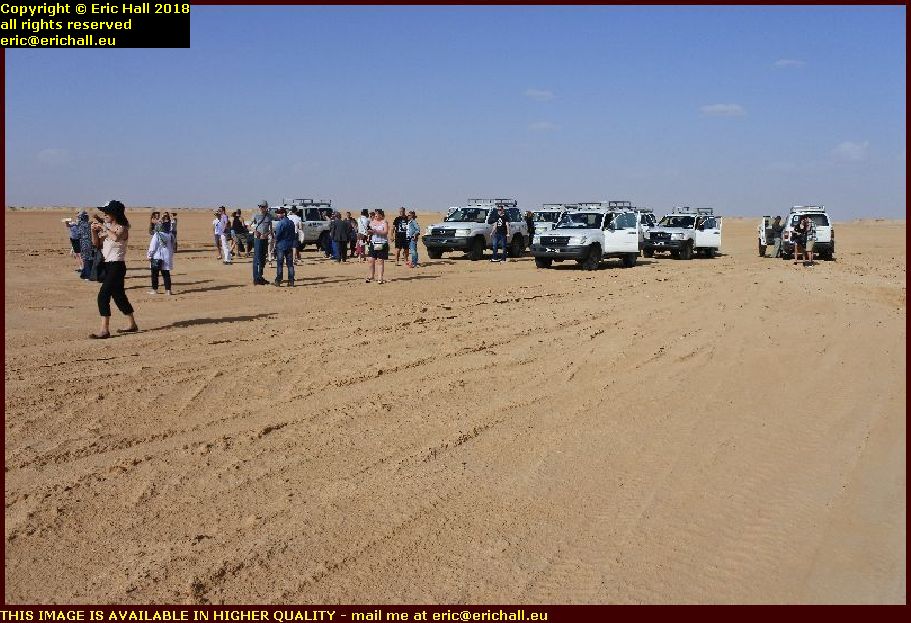 Our horses and carts dropped as all off at yet another taxi rank, this time where there was a queue of some rather elderly 4×4 Land Cruisers.
The second part of our early evening, because it was now rather late in the day, adventure, likewise included in the price of our excursion, was a trip out into the desert
And this pleased me greatly. After the winter that we had had, I promised myself the desert, and here I am.
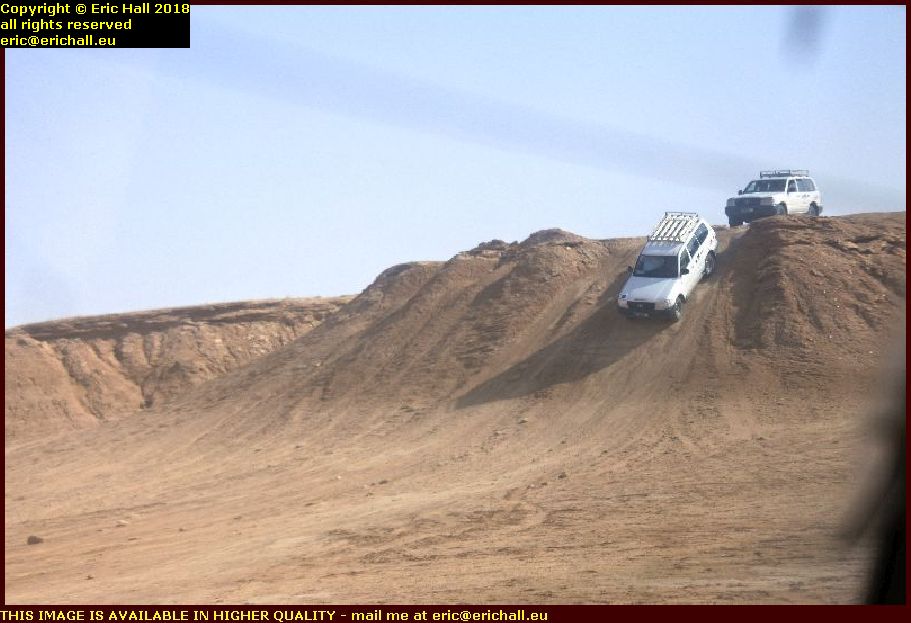 And the road that we took was not an easy one either, although I suspect that we came this way more for effect rather than for necessity
Nevertheless, it certainly made for an exciting trip and it did produce some wonderfully photogenic moments as we swerved up and down some really difficult desert terrain.
It was certainly not for the faint-hearted but I hoped that we were going to come back this way so that I could retrieve my stomach.
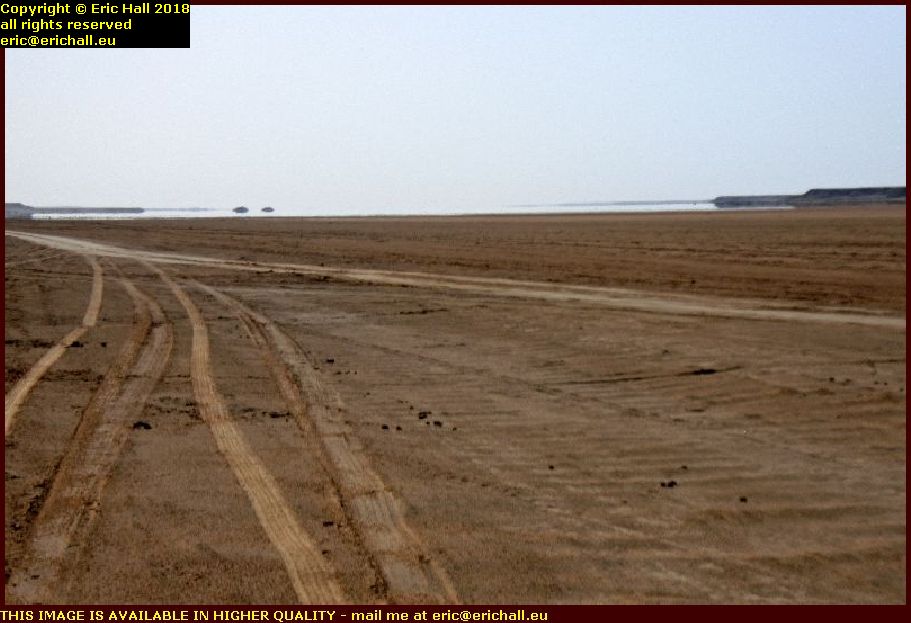 Everyone has heard of the phenomenon of the mirage in the desert, and one of the best in the whole of North Africa is said to be found here on the outskirts of Tozeur.
That’s not a lake of course, as became apparent when we went to drive down that valley. It really is a mirage.
And if you enlarge the image by clicking on it, you’ll see just how realistic it looked.
 A little further on we had the fisrt glimpse of our destination.
And I imagine that even though you didn’t know where it was, you’ll all recognise what it is.
And all of the tracks that lead down there into the wadi will show you that it’s a very popular destination, especially with tourists who travel hundreds of miles to come here.
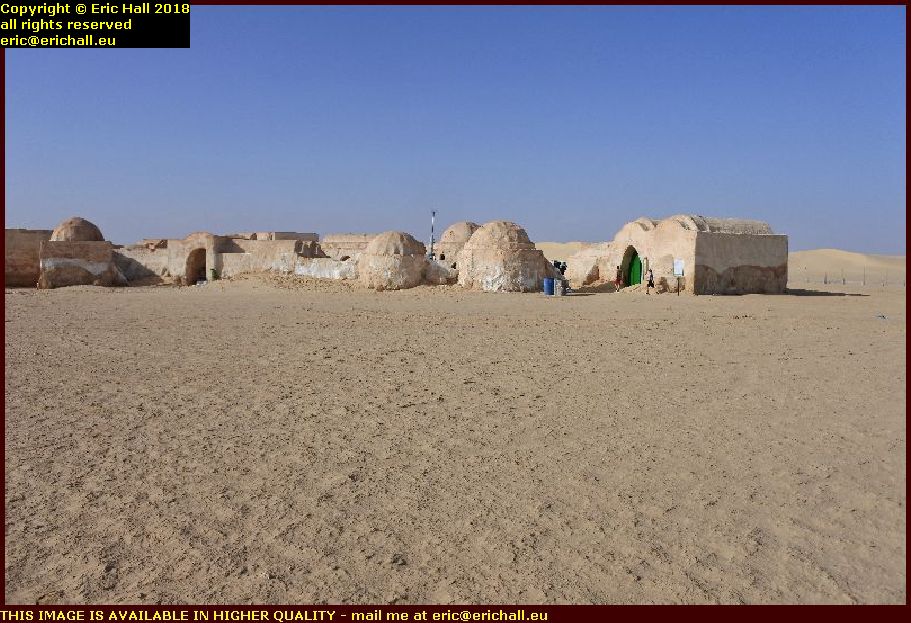 Where we are is about 20 miles from the Algerian border near a village called Nefta.
Right out here miles from anywhere (except the Algerian border) is the mythical Huttite city of Mos Espa, the film set from the later series of George Lucas’s “Star Wars” films.
We’ve picked the wrong day to be here though. We should have been here on May the Fourth.
 There are no Jedi here today though. And no Pizza the Hut either for that matter.
Just an enormous numbers of souvenir sellers and the like trying to take advantage of the gullible tourists. Even I could see that the desert amethysts and other precious stones were fakes.
You can have your photograph taken with a whole variety of misshapen flea-infested animals too, but at a price of course.
 It’s interesting to see how the village was constructed.
The buildings have a wooden framwork and are then built up with fibreglass, then given a rough finish to resemble clay or adobe.
Having been engulfed in numerous sandstorms, including one during filming, the buildings are in a very poor state of repair and I don’t imagine that they will be lasting all that much longer.
We drove back to Tozeur from here.
And I was right about the route into the desert. Just around the corner was the main, metalled road to the Algerian border and coming back was nothing like as exciting as the way out.
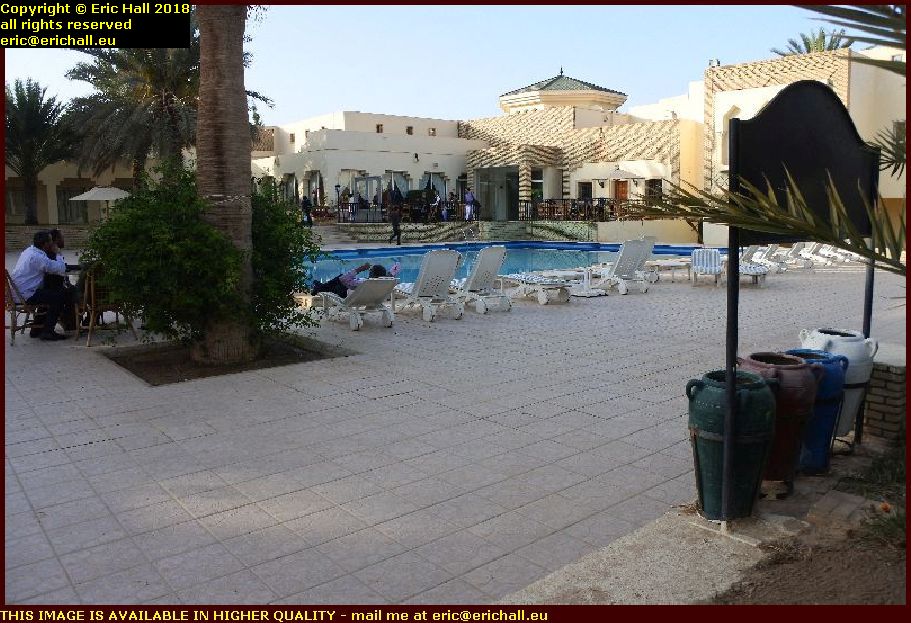 We had been booked in to stay at the Ras El Ain hotel, which looked as if it was one of the ones that had been built for the luxury tourism boom that was anticipated in the early 1990s
If you thought that the one in Sqanes is luxury you should see the Hotel Ras El Ain here. I can honestly say that I have never ever in my life had such luxury. This really is the Last Word in holiday accommodation.
But I’m not going to have the time to enjoy it. We’re getting up at … errr … 04:00 and we’ll be on the road at 05:00.
And while I’m asleep, you can sit quietly and read today’s blog entry. A marathon, mammoth world record of 5875 words.
 Our first port of call was about 30 kms down the road in Welkenraedt.
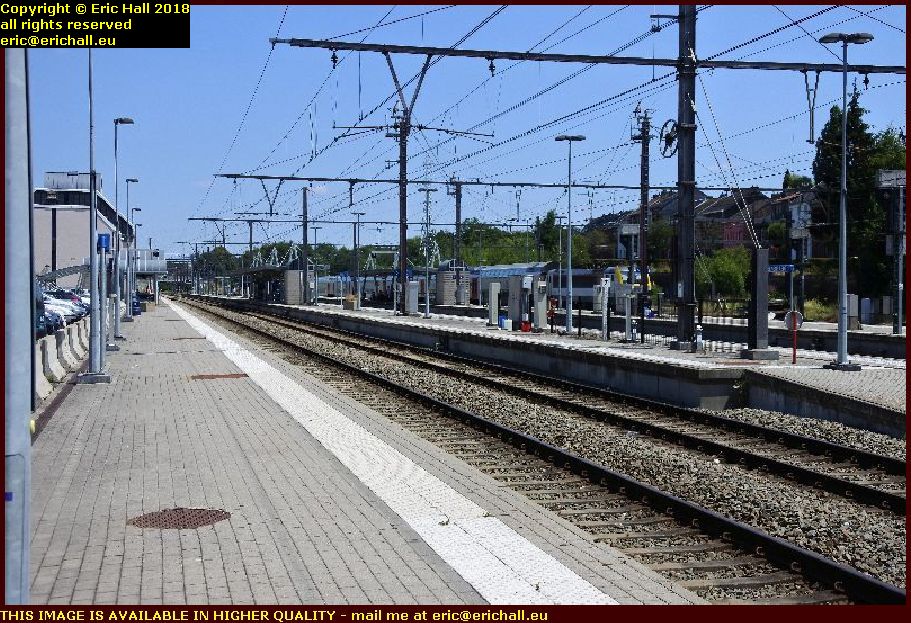 And when you look at the station, it’s a big, modern station that has plenty of facilities and it is all out of proportion to the size of the town
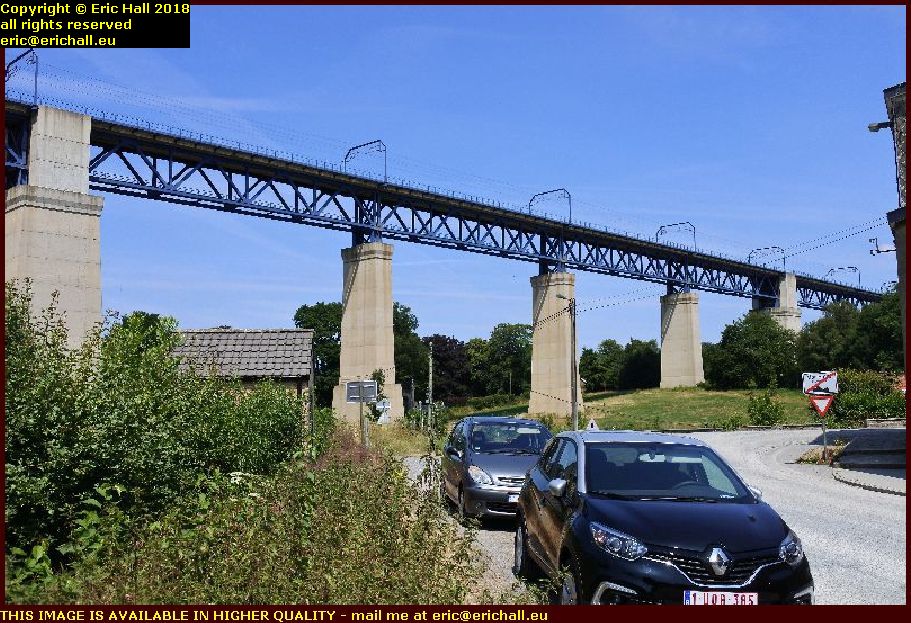 But you can’t cometo this region without going down the road to Moresnet.
 According to the information that I have found, it was built during the period 1915-1916. The pillars are fine examples of reinforced concrete of that period.
 Knowing my usual luck, we would ordinarily have had to wait for about three weeks to see a train pass over the viaduct, and then we would have missed it because we had gone for a coffee.
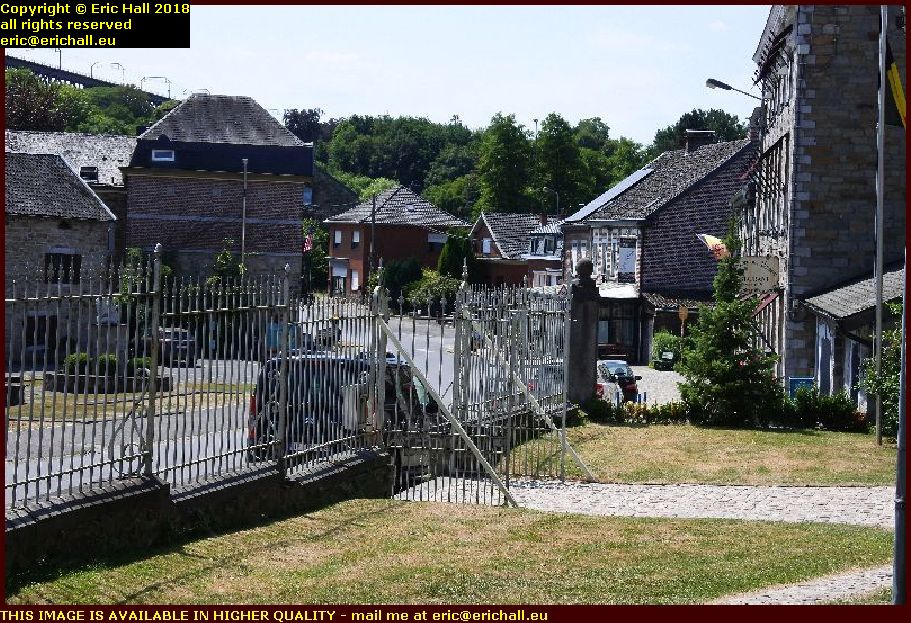 So while you admire the village of Moresnet and Alison and I have gone for a coffee with the friendly young girl who runs the village café, let me tell you a little story.
 Unfortunately, any logical dividing line ran right through a very important and valuable quarry and they couldn’t agree where the line should go so that each country would have half the value.
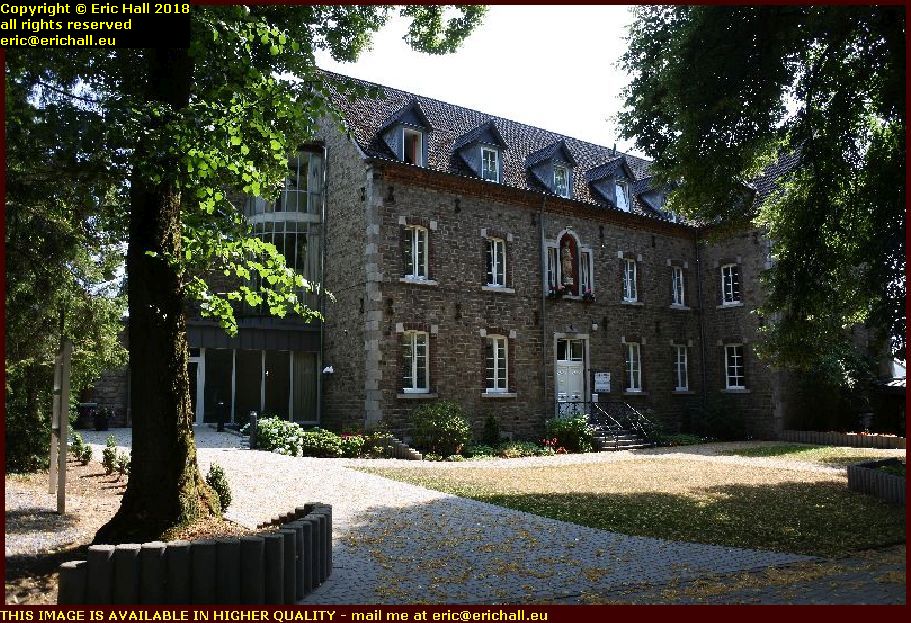 Pilgrims came to visit the site so a small chapel was built, followed by all of the usual facilities for the visitors, and the village of Moresnet-Chapelle developed.
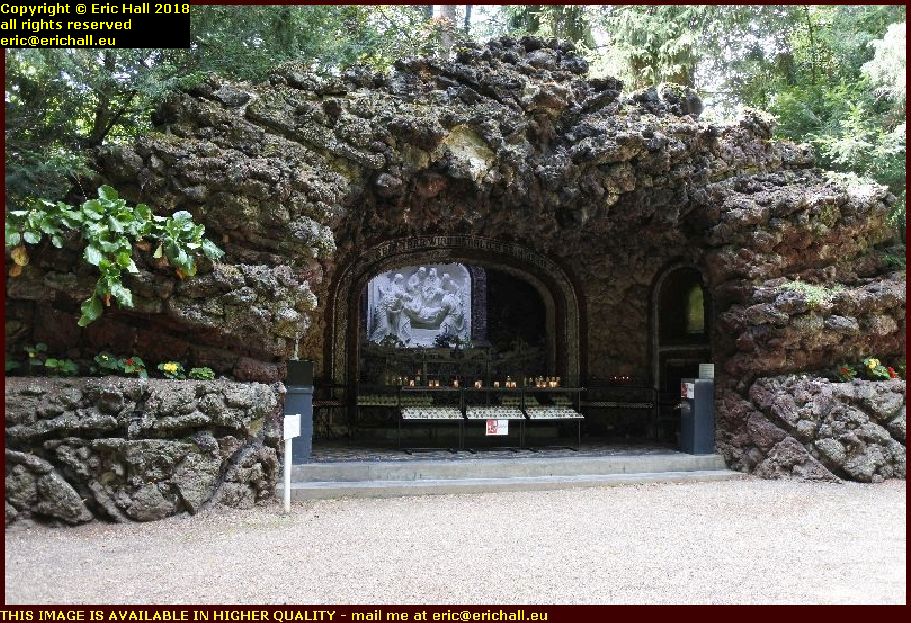 Regular readers of this rubbish will recall that we’ve talked on several occasions about the Chemin de la Croix – 14 stages of Jesus on his way to his crucifixion, death and subsequent resurrection.
 In 1895 German benefactor provided some cash to purchase the land around the chapel and they set to work.
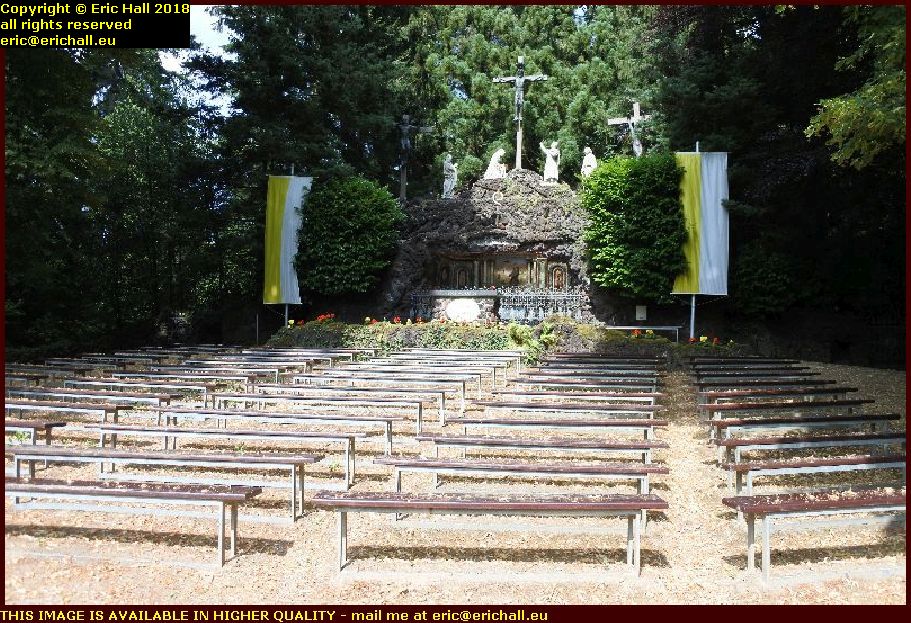 The twelfth station, the Calvaire or Calvary, featuring the crucifiction, is always a good ‘un and there’s no exception here.
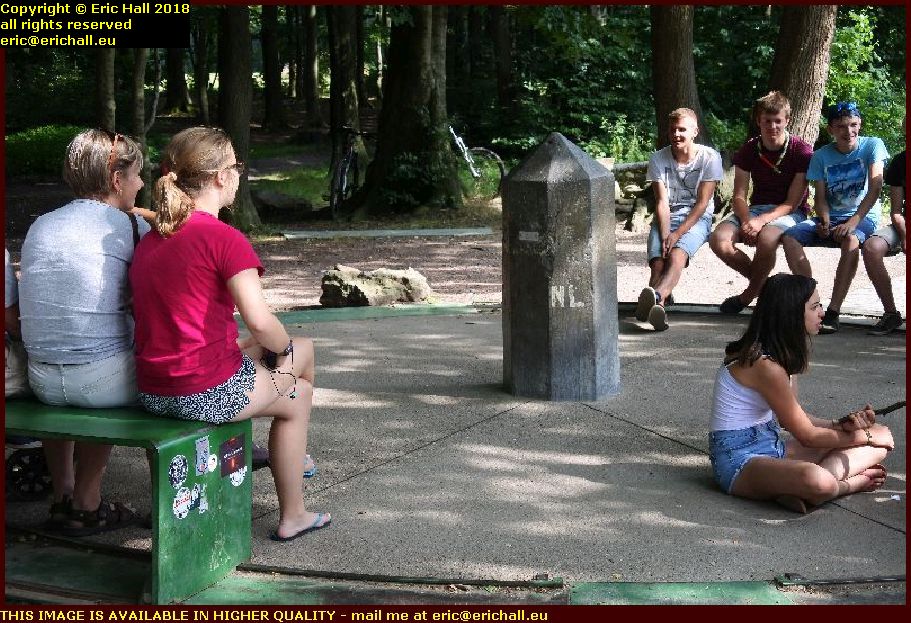 Here we have the Driehoek – or “Three Corners” – where the countries of the Netherlands, Belgium and Germany meet.
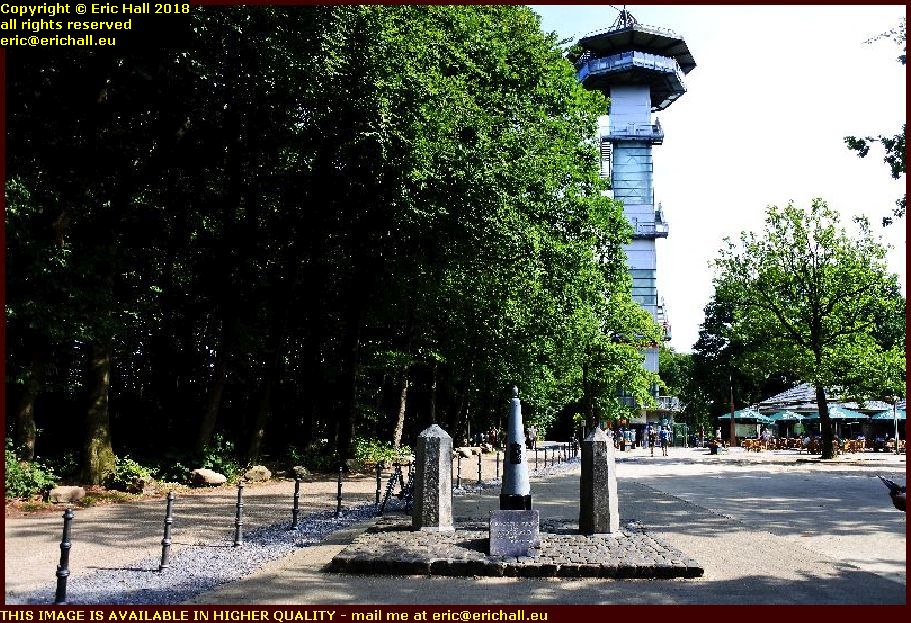 Not only that, the highest point in the Netherlands – the Vaalserberg – is only 100 metres or so from the border and so we had to pay that a visit too.