Monthly Archives: August 2020

Sunday 16th August 2020 – JUST IN CASE …

… you’re wondering, I’m back home.

But there’s a slight problem, as Alison will understand because we talked about it. In all honesty for the last couple of weeks I’ve not been feeling myself … “quite right too – disgusting habit” – ed … and the feeling has slowly been getting worse until today when it finally erupted.

Today therefore I was up early and I pushed on home.

Not before I had a listen to the dictaphone though.

There was some kind of police incident last night with all of these really violent criminals and we were caught in the crossfire. These criminals had 12-bore shotguns sticking them inside our vehicle and pulling the trigger, everything like that. I couldn’t see how anyone could have survived in it. It was the most violent thing I’ve ever seen or been involved with. Eventually we were set free. it seemed that the police had overwhelmed these criminals which was the most surprising thing, and when we got out and checked ourselves over we found that we were totally unhurt. I couldn’t believe that for a minute. I was the last to be released from the car. I had a little chat with them. They were telling me all kinds of security precautions that I knew mainly vaguely. Then they took me off to a room. There was a bed in 1 little room, annexe type of place and there was someone in there. I asked him where all the others were. he said that they were in the next room so I went in there. One of the people was a boy whom I knew from school – what the hell is he doing? He was just finishing some tea and saying that he’s on the 16:00 bus the same as me. We started to have a little chat and I remember sayng that apparently I’m unharmed which really surprised me. We had a little chat about something or other involving this.

Later on there was something to do with nurses last night. One of them was talking to some people discussing a strike that had taken place. She said that there was only her and one or two other people and a patient from France who were still working at this particular local hospital. Somewhere in this I had a kind of plastic knife thing like a scraper that was used for cutting rope. I’d used it on a piece of rope but somehow the blade had come dislodged and I had to work out how I was going to get the blade back in because it had taken ages for it to be assembled and I wasn’t quite sure about it.

There was another thing about some kind of lorry. I thought that it was a Ford D-series artic tractor but it was in fact a very short wheelbase kind of lorry with high sides at the back for gravel, that kind of thing parked up at the side of the road. I had to park my van somewhere and work out where was the best way to take a photograph of it. I tried all kinds of places to get a good photograph but the person in this van was getting a bit fed up about it. I managed to get one photograph but it wasn’t very good. It turned out to be a Mercedes too. Then I walked to try to get a photo and ended up at a place where there were loads of people standing as if they were waiting to be picked up by people coming in cars. I had to walk back and clamber over the side of this verge to get a good photo but while I was doing it this lorry just drove away which annoyed me.

hotel st daniel Rue Bataille 16, 7600 Péruwelz, Belgium eric hallFirst thing to do was to go and rescue Caliburn. I wasn’t leaving him out in the street but there was a locked compound opposite (for an extra charge, of course) where he would be perfectly safe.

This gave me an opportunity to take a photograph of my extremely expensive hotel, with the sun streaming into the lens. And expensive it was too – with the receptionist going to check the contents of the fridge in the room before he would chack me out.

We also had something of an argument about a missing bottle of Schweppes until the housemaid butted in to confirm that she didn’t put one in.

The experience put me right off this hotel.

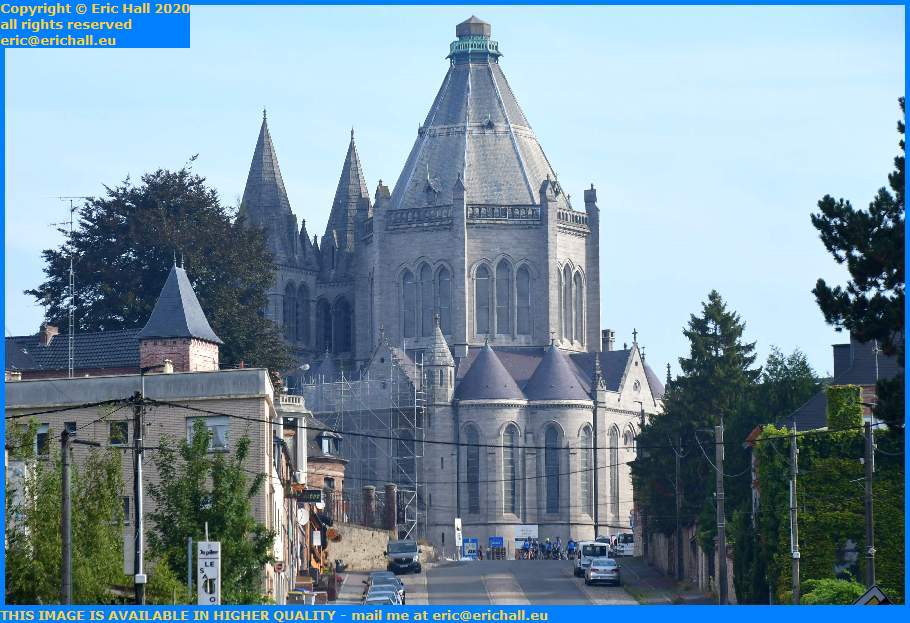
cyclists basilique notre dame de bon secours Place Absil B 7603 Bon Secours Belgium eric hallFinding my way out of town was quite an experience too, with a railway line blocking me at every turn.

However in the end I found what I was looking for. This is the Basilique Notre-Dame de Bon-Secours.

It started life as an oak tree, would you believe, in the Middle Ages. When it died they made a statue of Mary from the wood and it became a centre of pilgrimage for some unknown reason.

In 1637 a chapel was constructed to shelter the statue and then, like Topsy, “it just growed”, The current building dates from 1885-1892, and was awarded the title of “Basilica” by Pope Pius X in 1910.

Incidentally, where I am when I’m taking this photo is in France. Peruwelz is that close to the French border.

Leaving Peruwelz and entering France, there was something that I needed to do so I set course for Albert.

In the past I’d read countless books about the Battle of the Somme and I’d been interested in stories about how the top of the church spire was used as a watch tower by the British and how the Germans could clearly see its gilded top from their lines.

Basilique Notre-Dame de Brebières 20 Rue Anicet Godin, 80300 Albert France viewed from behind German lines eric hallThat was what I wanted to see for myself and due to a variety of different circumstances I didn’t have the opportunity to do that when I was here 18 months ago

So here I am, standing roughly where the Second Line of German trenches would have been prior to the British offensive of 1916 and you can indeed see the church spire quite clearly from here – and probably even clearer still when there is no early-morning mist about.

One of the locals was clearly upset by my stopping outside his house to take the photo. He came out to his front gate to have a look at me so I gave him a cheery toot and a wave as I departed.

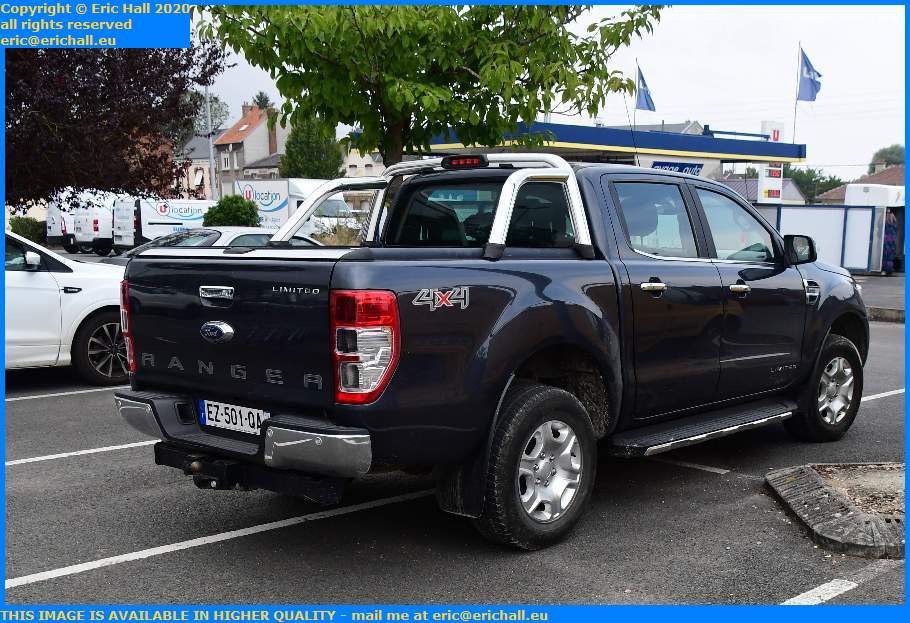
ford ranger taking up four parking places super U 82 Avenue du Général Faidherbe, 80300 Albert france eric hallJust down the road is the town of Albert and there’s a supermarket there. That’s where I stopped to buy food for lunch as I don’t have very much in the van.

And regular readers of this rubbish will recall that pathetic parking takes up a lot of space on my pages, and here’s another one that is probably more pathetic than most.

Here on the car park at the Super U in Albert, this rather sad and sorry person has chosen to take up no fewer than four car parking spaces with his Ford Ranger. It surely isn’t possible to be any more selfish than this.

caliburn 200,000 kilometres france eric hallOn the way home, we reached a very important milestone in Caliburn’s life was reached.

Somewhere between Amiens and Neufchatel-en-Bray Caliburn’s tripmeter clocked up to 200,000 kilometres. Not bad for a boy who’s just celebrated his 13th birthday. He’s in line for a reward when we return home, whenever that might be.

As I mentioned earlier, for the last week or so I’ve not been feeling too good and I’ve gradually become worse and worse. The farther along the road I drove, the worse I became and I began to worry about reaching home.

It was my intention to call in on Liz and Terry and drop off Terry’s brushcutter but I was in no fit state to do that. I pushed on homewards thinking that the sooner I reach home the better

And just as well, for back here, it was a struggle for me to even climb up the stairs.

First thing that I did when I was up here was to call the boys on the great white telephone, after which I could peruse the finest details of what I’d eaten for the last few days.

Now I’m off to bed, with a handy bucket by my side, and normal service will be resumed as soon as the crisis passes.

Saturday 15th August 2020 – I’VE DONE SOMETHING …

… today that I haven’t done since 2005. And this time even more so because while back then it cost me nothing, this time it’s cost me a lot of money.

But ask me if I care.

What I’ve done is to walk away from a hotel that I had booked for tonight and went somewhere else (far more expensive).

But more of this later. Last night I had a strange sleep – waking up at about 00:45 to find that the radio was playing. And then sleeping through until about 05:45 without moving. Not a single nocturnal voyage anyqhere to be seen

Plenty of time to do a load of paperwork and then I went down to breakfast. Unfortunately I wasn’t feeling too well so I didn’t eat much which was a shame because there was tons of stuff there. It could have been an outstanding breakfast.

Unfortunately Jackie wasn’t available but Alison was free today as well as tomorrow so we agreed to meet up this afternoon.

Dodging the roadworks and the heavy showers, I set off for Leuven.

Friterie Marsupilami Route de Marche, 6600 Bastogne, Belgium eric hallThe Lady Who Lives In The SatNav brought me all the way through Luxembourg, where I fuelled up before crossing the Belgian border (fuel at €0:97/litre) and the Ardennes, passing through the town of Bastogne where I stopped to take a photo of another abandoned bus

It’s an old “bendy bus”, one of the articulated buses and judging by its number plate it comes from the town of Rotenburg in Lower Saxony but it’s now the Friterie Marsupilami, the FritKot on the Edge of Town.

There’s a fritkot on almost every corner in Belgium and this is certainly one of the more interesting ones. It’s closed though so I couldn’t find out what it was like.

It took me a good while to find Alison’s house – The Lady Who Lives In The SatNav having brought me into town in entirely the wrong direction. It was a nice afternon so we went to the English shop for a supplies such as vegan ice cream.

herons Kasteel van Leefdaal belgium eric hallLater on we went for a walk. We discovered a new footpath that eventually took us past the Kasteel van Leefdaal.

Here we could admire the wildlife swimming on one of the many ponds – mostly man-made ponds – around there

Not that I would want to go swimming on a pond like that. There’s that much algae floating aound on top that you could probably walk on it – or, at least, someone lighter than me could. I must keep on with the battle to keep my weight down.

swans Kasteel van Leefdaal belgium eric hallThe Chateau isn’t open to the public unfortunately and it’s hidden behind a rather large wall so you can’t actually see very much of it.

Currently owned by the Counts of Liedekerke it dates from the Renaissance period and replaced a previous building. There is known to have been a building on the site since at least the 12th Century.

Armed with our vegan ice cream, we then went back to Alison’s house for a chat. We must be both getting old because we ended up crashing out in the garden in the sun, something that we found quite amusing, although in fact it was a rather sad indictment of our states of health these days.

Alison had to go out later so I set off through one of the most wicked rainstorms that I have ever encountered. All of the road round by Braine l’Alleud was flooded and the traffic lights at a road junction had failed. That led to certain complications until we all managed to sort ourselves out.

strawberry moose silly belgium eric hallAs well as having A FAVOURITE TOWN IN AUSTRIA Strawberry Moose also has a favourite town in Belgium.

It goes without saying that as we were passing within a mile or two of the place, we had to go there. His Nibs is never one to pass up on a photo opportunity whenever he gets the chance, as regular readers of this rubbish will recall.

Having done that, we headed off down to peruwelz on the Belgian – French border and my hotel. But one look at it convinced me that this was not where I wanted to stay. Crowds of single men loitering outside, sitting on the steps or leaning against the wall. Crowds of them.

It’s the kind pf place that gave me a most uneasy, eerie feeling that I can’t explain. But always having been one to rely on my own intuition, I decided that it wasn’t the place for me so I went elsewhere.

Tea tonight was a plate of chips and a salad, and watching the people coming into the fritkot, I can see immediately why the infection rate in Belgium is so high. Despite all of the precautions that are supposed to be taken, the wearing of masks is, shall we say, rather casual.

And the roads in Belgium are appalling. They are much worse that I ever remembered them. They are just like in a third-world country and for one of the richest countries in the world, it’s an embarrassment.

Tomorrow I won’t have far to go on Belgian roads because I’m close to the frontier here. About a kilometre away, I reckon.

With any luck I’ll be over the border early tomorrow and then a leisurely drive home. It might take a couple of days to make it but I’ll be back by the middle of the week. It’s been a long time

Friday 14th August 2020 – THAT WAS A …

… nice break on my journey today.

My route brought me through the city of Luxembourg so I telephoned my friend Malou. We met in the city centre and went for a drink and a chat for an hour or two. It’s a long time since we’ve seen each other so it was good to meet up and have a chat for a while.

And I do have to say that I needed a break because it had been a long, hard day. It all went wrong before I went to bed because having had a little doze during the afternoon, I wasn’t tired at all and it was almost 02:00 before I went to bed.

Nevertheless I staggered out of bed as the alarms went off, tired as I might have been, and did some of the outstanding paperwork.

There was something on the dictaphone too. For some unknown reason we had been discussing tanks during the night. We were in a big one, the idea being to spray several other tanks with machine gun fire to find out how flammable they were and to see what the chances were of setting other tanks ablaze with just simply machine gun fire reaching vital parts or breaking fuel lines kind of thing

Breakfast was interesting because the landlady insisted on talking to me. We had a delightful conversation in a mixture of German and English that went on for almost an hour.

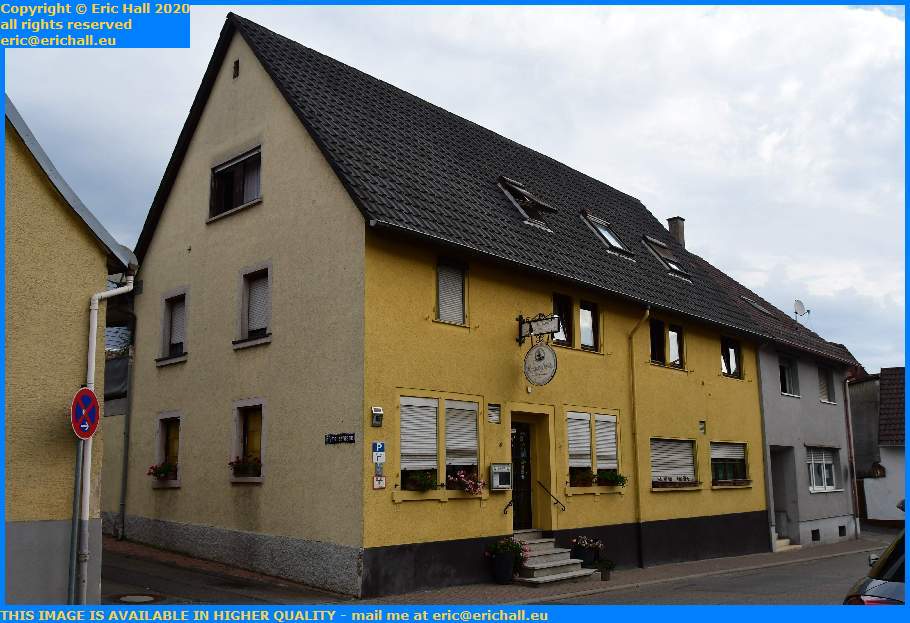
hotel kraichgauidylle 69254 malsch germany eric hallThinking on, I’m not too sure if I’ve mentioned my hotel.

It’s the hotel Kraichgauidylle in Malsch, the correct Malsch of course, and is one of these typical Germanic small village hotels that you encounter all over Central Europe. Somewhat tired, dingy and dark as if it was a throwback to the 1930s but while the price wasn’t a 1930s price, it was pretty good value for the money that I paid.

In fact, being on the Budget Economy plan that I am, the proof of the issue is “whether I would stay here again at the same price” and that emits a rather positive response.

The only issue was the lack of on-site parking. But arriving late and leaving early meant that I could use the parking space of the bank across the road without any problems.

On the road, the lack of sleep caught up with me before I’d gone too far and I ended up asleep in a car park for a couple of hours. It’s a long time that I’ve done that, isn’t it? Just like old times in Canada.

The bridge that I was intending to take across the Rhine was closed and I was obliged to take a detour to another bridge.

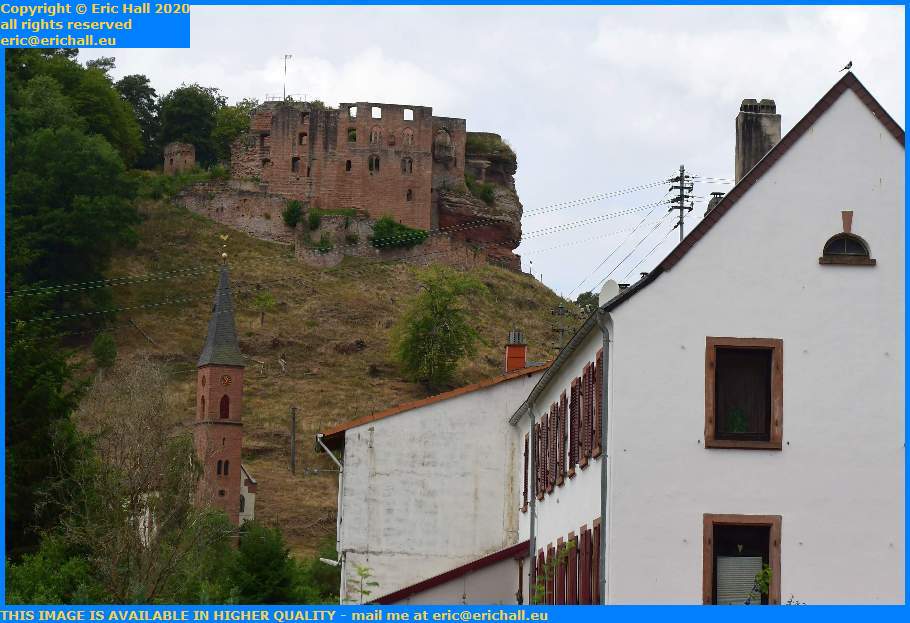
castle frankenstein  eric hallFrom there, through yet more roadworks and traffic jams, especially in the town of Kaiserlautern, I pushed on into the Eifel Mountains past the Castle Frankenstein.

One of those places where you have to stop and take a photo, even if you do have to drive around for ages and perform several U-turns in order to find a place to park where there’s a good vies

It’s not unfortunately the castle of Mary Shelley’s Frankenstein – that’s out near Darmstadt – but its etymology is the same, to wit, the stone (building) of the Franks, the tribe that occupied western Germany and eastern France in the early Middle Ages

The existence of this particular castle is first recorded in 1146 and is believed to date from some 50 years earlier according to some contemporary reports. Its purpose was to guard the road between Speyer, Dürkheim and Worms, presumably for the security of pilgrims and religious officials, and was owned by Limburg Abbey.

Severely damaged during the various wars of the 15th and 16th Century, it was finished off during the German Peasants War, a revolt that led Martin Luther to state that the peasants “… must be sliced, choked, stabbed, secretly and publicly, by those who can, like one must kill a rabid dog.”.

By 1560 it was reported as being destroyed.

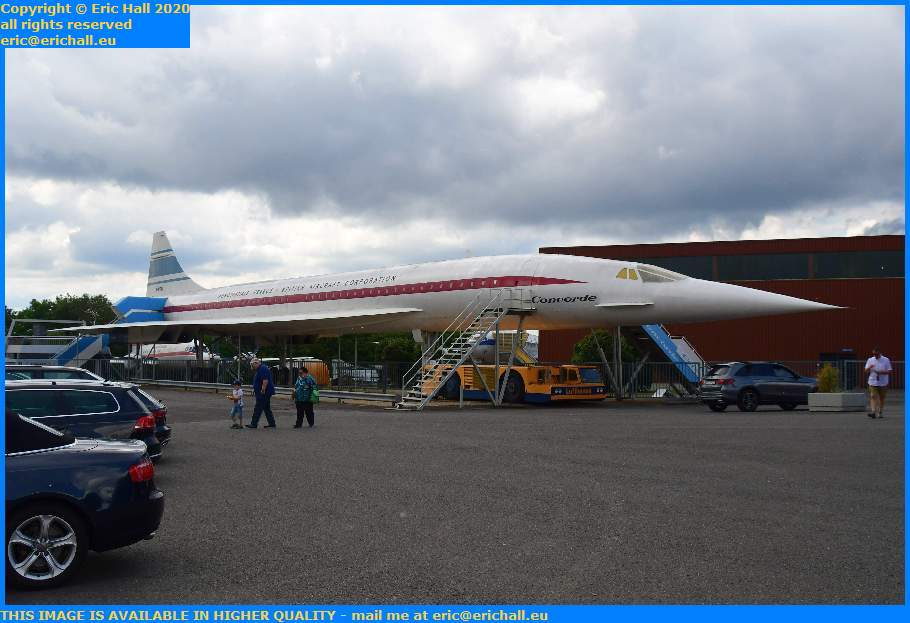
concorde Flugausstellung Peter Junior Hermeskeil Habersberg germany eric hallContinuing onwards deep into the mountains, I came across an air museum with 20 or so aeroplanes on display outside, somewhere near the towns of Hermeskeil and Habersberg.

What actually caught my eye was the Concorde here so I had to do a U-turn and go back for another look. However I didn’t stop for more than a second or two because right at that moment we were having a torrential downpour outside – something akin to what we had on the previous day and I wasn’t getting out of Caliburn in that. A quick photo would have to do.

But it’s another one of these places to which I’ll have to return, even if the Concorde here is only a replica, as I was to find out later. Never mind 20 or so areoplanes, there are in fact well over 100 and not only that, there’s a railway museum nearby with a shed full of steam locomotives.

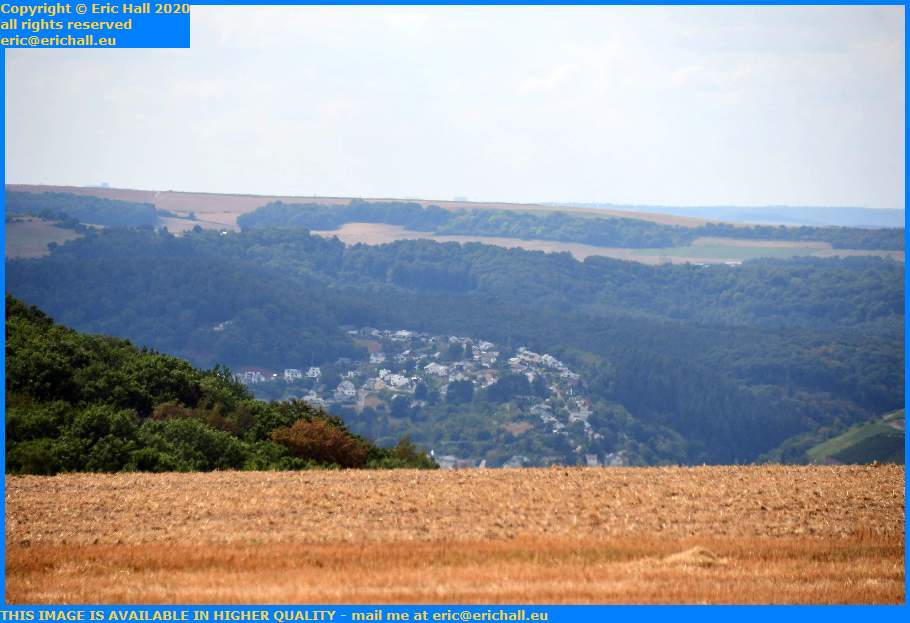
view river saar valley germany eric hallThe weather started to brighten up very slowly as I pressed on further into the mountains. And as I crested a rise at the back of the town of Vierherrenborn, I stopped in my tracks to admire the beautiful view.

Where I actually am is at the top of a range of hills that form the eastern shore of the Saar River, one of the tributaries of the Moselle which it joins a few miles further north near Trier.

246 kilometres long, it was a vital industrial route of Germany in the late 19th and early 20th Century when this region was one of Europe’s leading iron*producing areas, bringing raw materials in and taking the finished product out.

This was a region that was considered to be so vital to Germany’s industrial progress that for 15 years after World War I and 10 years after World War II it was adminsitered separately from Germany by various occupying powers.

radio mast near vierherrenborn germany eric hallBehind where I’m standing is what at first glance appeared to be similar to the Loran C masts of which we saw more than a few ON OUR TRAVELS AROUND NORTH-EAST CANADA.

However this one probably isn’t. It’s probably nothing more than an ordinary radio antenna – if “ordinary” can be used to describe an object quite like this one. I was rather hoping that it might have been the “Eifel Tower” – in actual fact the Sender Eifel – the tallest structure in the Rhineland-Palatinate at 302 metres, but that’s about 60 miles further north at Kirchweiler

So whatever it is, I shall have to continue to make enquiries

wind turbines saar valley germany eric hallThese objects are much easier to identify, because we have seen plenty of them on our travels around here and there.

Across the river over there – brcause the river is just down there in that velley in the middle distance – is one of the highest points in this particular region, a mere cockstride from the border with Luuxembourg, right in the path of the westerly winds.

Consequently it’s obviously going to be a prime candidate for a wind farm, and quite right too. Regular readers of this rubbish will recall that I’m all in favour of windfarms, having lived for many years with three wind turbines.

river moselle rehlingen nittel germany eric hallTalking of westward, I’m going west, aren’t I? Continuing along the road towards the border with Luxembourg myself.

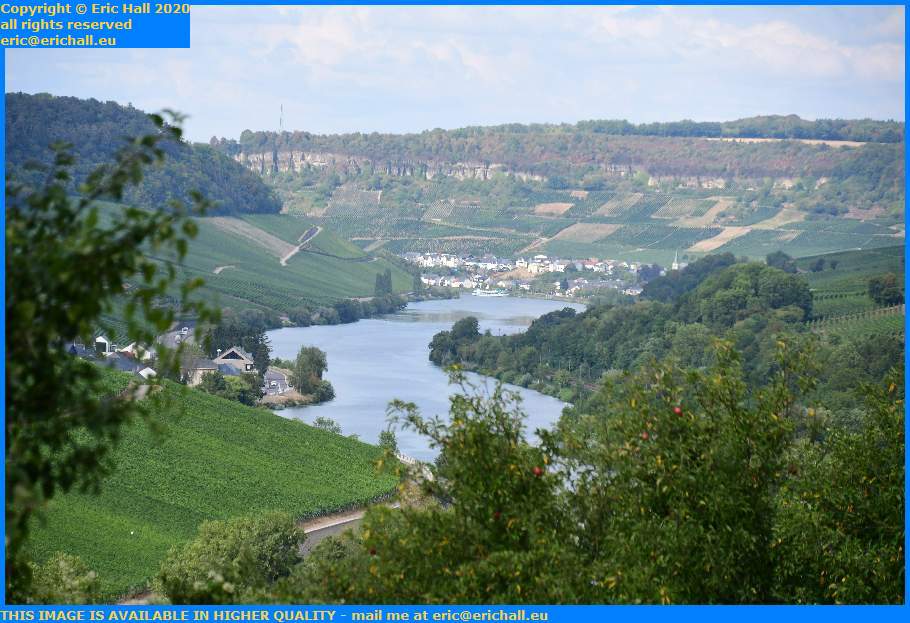
It’s a really beautiful drive through this part of the Eifel so I wasn’t in any great rush, but soon enough I arrived at the River Moselle, the “little Meuse”. To the left of this image is Luxembourg and to the right is Germany, for the river forms the boundary between the two.

The town down there is called Rehlingen, a town first recorded some time in the middle of the 12th Century but lost its autonomy in 1974 when its administration was absorbed into that of neighbouring Nittel.

wormeldange luxembourg eric hallOver there is the town of Wormeldange, in Luxembourg and it’sdown by there that we will be crossing over the river into Luxembourg by means of the bridge that links it with the German community of Wincheringen, where I am at this moment.

Lovers of wine would love to come to visit Wormeldange because it’s one of the more important centres of production of Reisling and there are 360 hectares of grapes to have a go at.

But not for me though. Apart from a beer, which was all that there was to drink when we were stranded in a snowdrift half way up a mountain while skiing in Romania one year, I haven’t drunk alcohol for 30 years or so. And in any case, I have an appointment to keep and can’t spare the time to stop.

Into Luxembourg City to find a parking space, and Strawberry Moose received a wave from a friendly pedestrian.

Having found a place to park, I met up with my friend Malou. We had studied together at University all those years ago and still keep in touch. We’ve met up a few times while I’ve been on my travels but not in Luxembourg since about 2001. We went off to have a coffee and a good chat.

Having spent a pleasant hour or so with Malou I headed out of the city northwards in the vague direction of the Belgian border.

hotel kinnen Route d'Echternach, 6550 Berdorf, Luxembourg eric hallDeep in the mountains of the northern part of the country in the town of Berdorf, I ended up at my hotel, the Hotel Kinnen, in keeping up my tradition of spending a night in every country that i’ve visited.

This hotel is another place that has seen much better days in the past when Berdorf was the place to be. And it still has quite a few signs of its former grandeur. In fact, for value for money, it’s one of the best places in which I’ve stayed in Western Europe for quite some considerable time.

Walking around the town later that night, I stumbled upon a pizza place and prevailed upon the chef to make me a special pizza seeing as I hadn’t had one for a few weeks. Now I need some more vegan cheese.

Tomorrow I’m heading to Germany and Belgium. Well on my way home now. Looking at my notes I can see that I’ve already been out for three weeks and it’ll be four weeks by the time that I return home. I wonder if I can remember where it is.

Thursday 13th August 2020 – WHAT A HORRIBLE …

… day it was today.

It all started off during the night, seeing as it was something of a turbulent sleep and so it’s hardly surprising that there were tons of stuff on the dictaphone.

There was some kind of big incident going on, a murder or something like that and everyone was having to be questioned. Castor and Pollux were there and it became a case about their grandparents. It was so that their grandparents whatever they must do they must not go on the next leg of this trip because the stress would do them a lot of harm. I had to remind people of what had been said about this and they had a look. Yes, they were going on the next leg of this trip. I was wondering how I could catch up with Castor and rekindle our friendship. So I really don’t know.

Later on there were half a dozen or so of us, one of whom was another girl whom I particularly fancied. She ended up playing golf with another guy, getting right down to the end. Totally ignoring me and the rest of our little group. You’ve no idea just how hard or difficult it was to be there last night watching her there with this other guy. I was really, really down on my luck as far as that was concerned. Whether or not she had any kind of feeling for him, all she was interested in was playing golf and they seemed to be really having a good time enjoying themselves. I awoke absolutely full of grief, would you believe and drenched in sweat. All kinds of emotions about this. It was really strange. I just felt so bitterly, bitterly disappointed.

Later yet we continued our tramp through this countryside towards the sea, a group of four or five of us. We met the girl again. She was being taught how to walk on high heels by a couple of people. She was totally ignoring us so we just carried on walking in this dry countryside towards the sea and we suddenly seemed to take a different way. Whoever was leading the party branched off down this dirt track instead of along the main road. It brought us out somewhere at a T junction. I asked “how long is it going to be before we get there” but no-one replied, basically as if no-one really knew but didn’t actually want to say so which was a bit strange seeing as we were being guided by some kind of fitbit or GPS or something like that.

There was much more to it than this but as you are probably eating your lunch or something like that, I’ll spare you the gory details. What was interesting was that a couple of times, after awakening, I went straight back into a nocturnal voyage exactly where I had left it. And that’s happening more and more frequently these days.

But at least it was a very welcome return for Castor who put in an appearance, although it wasn’t under any sort of circumstances that I would have welcomed.

The upshot of all of this was that I was awake long before the alarm went off and so I had plenty of time to catch up with some paperwork before Hans surfaced.

After a coffee, we went out to breakfast at the cafe across the road and then we went to REWE so that he could do his shopping. And I was impressed by the amount of vegan products – even vegan cheese – available in there now.

Having packed Caliburn I headed off into the sunset – definitely going west.

And all the way this afternoon we had one hiccup after another. Roadworks, diversions – you name it we had it.

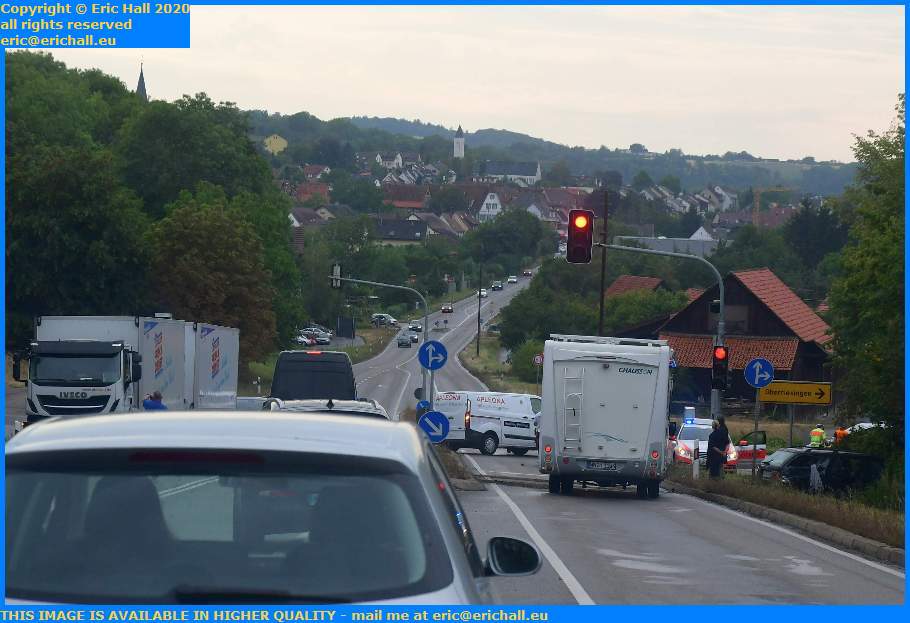
road accident traffic lights schwieberdingerstrasse Enzweihingen germany eric hallThe road out of Stuttgart was gridlocked and it took hours to clear, only for us then to run into a serious accident in the Schwieberdingerstrasse Enzweihingen.

And I’ve really no idea what was going on here. We had a motorhome that had ground to a halt in the middle of the traffic lights and a lorry on the other side of the road parked blocking the traffic looking as if it’s had bits knocked off it.

There were crowds of peopel around watching the events and a couple of policemen taking details but no one, and I do mean no one at all, controlling the traffic and it was all total mayhem. We were sitting in this queue for ages trying to make some kind of headway.

road accident traffic lights schwieberdingerstrasse Enzweihingen germany eric hallAs we approached the junction, inching bit by bit over a period of about an hour we could see that there was another actor in our drama.

If you look closely to the right, you’ll see that there’s a car in the hedge too and it’s difficult to see how it’s come to be there in that position.

Eventually, after a great deal of trouble fighting our way through the chaos we managed to reach the open road. And if that wasn’t enough to be going on with, round by Donauworth the heavens opened and we had one of the most astonishing rainstorms that I have ever seen. The temperature plummeted by 13°C in a matter of a couple of minutes and the rain continued for a good few hours.

What made my bad day worse was that I didn’t realise that there are two towns with the same name in Germany and of course I had booked a hotel there. Consequently, when I arrived in the town after a drive off my route of 60 kms, I couldn’t find the hotel. As a result I had to drive 80kms in the other direction past where I started to find the correct Malsch.

By now it was 20:30 and there was no restaurant open anywhere (it was too late to start up the slow cooker) so that was that.

The hotel is a little dated but then again so is the price so I’m not complaining. I’m hoping to have a decent night’s sleep as I want to have a good day on the road tomorrow.

Wednesday 12th August 2020 – ANOTHER SWELTERING DAY …

… in the middle of this heatwave in Southern Germany. And I have surrendered to it all by buying a desktop fan to go with the USB fan that I bought for Caliburn yesterday (did I mention that?).

This morning, it was again 28°C early on and the news that there had been a cloudburst and that my home town back in the UK was 12 inches under water and they were all complaining now about too much rain didn’t really abate my humour all that much.

But anyway, I digress.

This morning I was awake quite early yet again and spent some time bringing the paperwork up to date and listening to the dictaphone.

Back in England everyone was worried that the amount of viruses was rising and yet people still weren’t taking things seriously, still not taking their masks seriously. We were walking between a couple of towns on a nice shady road near a river. We could see people disobeying the mask instructions all that kind of thing. We were convinced that they won’t last very long at all if they kep on going like this. There was a lot more to it than this but I don’t remember it now.

Later, it was time to disembark from the ship which was in fact an aeroplane so we all have to get ourselves ready and we all walked off down the gangplank a few of us together laughing and joking a little bit. One of the guys with whom I worked at the EU, he was coming on behind us and about to get into this queue with us. A couple of us said “we really don’t want to be in the queue with him”. Castor and Pollux were there too, and it’s nice to see them back with me again on my travels. They had changed into some nice clothes – I remember Pollux in a nice little top and a dark blue skirt. They just walked through Customs and walked away and didn’t look back, which left me feeling extremely disappointed.

When Hans came in we had a coffee and a good chat and organised a pile of stuff that needed organising.

Going to the bank to pay in his shop takings was next and then we went for breakfast at the bakery across the road. it was crowded with people and we had to sit inside for a change.

natural primeval forest eching germany eric hallGathering up the camera (but forgetting a bottle of water) we walked off out of town towards Garching in the sweltering heat.

A couple of kilometres outside the town on the left-hand side across the motorway is a nature reserve, the Echinger Lohe. It’s actually a piece of primeval woodland that was set aside in 1978 totally unmanaged as a natural forest reserve – some kind of experiment to see how a natural wood would have behaved before human intervention.

And what with all of the urban expansion in the vicinity of Munich that’s a feat in itself

natural primeval forest eching germany eric hallScrambling through the wire fence via a suitable opening we went inside.

It’s totally fascinating to see how it’s turned out. Nature is certainly doing a fine job here in this magnificent example of a climax forest. And all of the rotting tree trunks and branches that are passing through the “interesting shape” stage and disintegrating into powder and slowly regenerating the soil.

This is just as nature would have done several thousand years ago. Ashes to ashes, dust to dust.

natural primeval forest eching germany eric hallWe pushed our way deeper into the forest. It seemed to be the sensible thing to do in view of the heat.

One thing that impressed me about the place was how silent everywhere was. It was very broody and mysterious in there. Had a pile of Hurons leapt out from behind the trees, bow in hand, to overwhelm us I wouldn’t have been in the least surprised.

And although we didn’t see any large mammals, there is PLENTY OF EVIDENCE OF THEIR PRESENCE.

natural primeval forest eching germany eric hallWhen I say that the forest is totally unmanaged, that’s not to say that there hasn’t been any human intervention.

These stranee, crude constructions are apparently hides for cameras. Some University or something is carrying out some kind of survey on activity that takes place in the forest.

Of course they aren’t going to park themselves up in full view of the wildlife, but all the same I can’t say that I’m very impressed with disturbing nature like this. Surely they couls have brought in some artificial hides that would have done the trick and which they could have taken away later on, leaving very little trace.

tui aeroplane eching munich airport flightpath germany eric hallThere is plenty to see in this particular corner of Eching and so we left the cover and shade of the forest to go to see it.

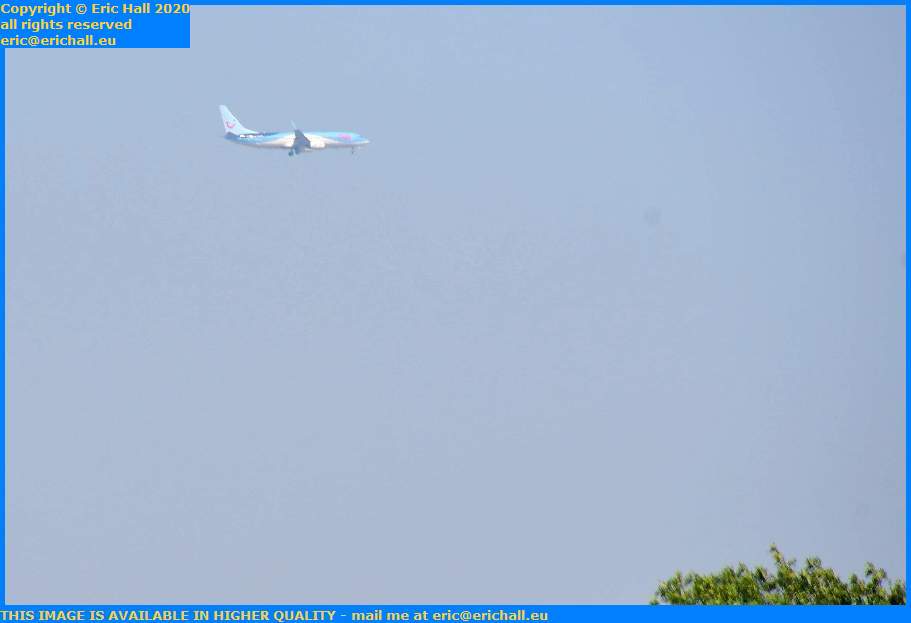
One of the things to see, which might not appeal to everyone, is what is going on in the air. We are right in the flight path for the descent to Munich Airport which is about 5 or so miles and even with the grounding of many flights due to the effects of the pandemic, there is still the odd one passing overhead.

At first I didn’t recognise the livery of this plane, but having photographed and enlarged it, I can see that it’s one of the planes that fly for the big holiday company TUI.

open natural heathland eching germany eric hallOut here beyond the forest there’s a huge natural, unspoilt heathland, the Garchinger Heide too.

It’s a haven of wildlife that you wouldn’t usually find so close to a major city and large transportation hub. The wooden thing that you can see that looks like the handle of a spade is actually a perch for the various birds of prey and the like that are around here.

218 different varieties of natural plants have been recorded here, of which about 50 are on Germany’s “red list” of plants subject to Conservation rules, type that would be difficult to find anywhere. This is good news because the flowers attract butterflies, of which a couple of visitors are quite rare types, and also bees.

monument to creator of open natural heathland eching germany eric hallAnd we are very lucky to have it too because in the late 19th Century during the grand expansion of Germany’s economy there were proposals to transform the heath into farmland.

However due to the energetic efforts of Franz Vollmann, the “Saviour of the Garchinger Heide“, 23 hectares of unspoilt land were bought by the Bavarian Botanical Society between 1907 and 1904 and in 1942 it became an official nature reserve. A monument was erected on the site in honour of Vollman.

Unfortunately much of the heath was badly damaged in early 1945 when prisoners from the Dachau Concentration were instructed to turn it into an emergency airstrip. Some work was begun and you can still see some of the damage that they did.

celtic burial ground eching germany eric hallEching is apparently an ancient Celtic town and there’s what is, I suppose, a Celtic cemetery here – a part of the heathland where there were plenty of small barrows. We went over there to have a look at them

Some other work that was undertaken here was the excavation of the barrows, so I was told, apparently in the search for various artefacts and grave goods. The excavations were carried out all that well and now there isn’t very much left now, but the outlines of the barrows are still visible.

There are several pools here that were formerly the site of gravel extraction and now abandoned to nature and the surroundings overgrown by vegetation.

Our route to the cemetery took us past a small one that was very quiet and secluded, and here we surprised a bunch of nudists. However I do have to say that if I had a body like any of those, I wouldn’t be exhibiting it anywhere in public like they were.

On our way back home we stopped for a drink at the football ground, and then we picked up Caliburn and went to track down a battery for Hans’s jeep. No-one had one in stock so we ended up having to order one.

But at one place that we visited I bought my desktop fan. this heat really is killing me right now.

mittlerergrabenopen mittlerergraben freising germany eric hallWhile we were in the van we decided to push on for an afternoon out in the nearby town of Freising, the region’s capital.

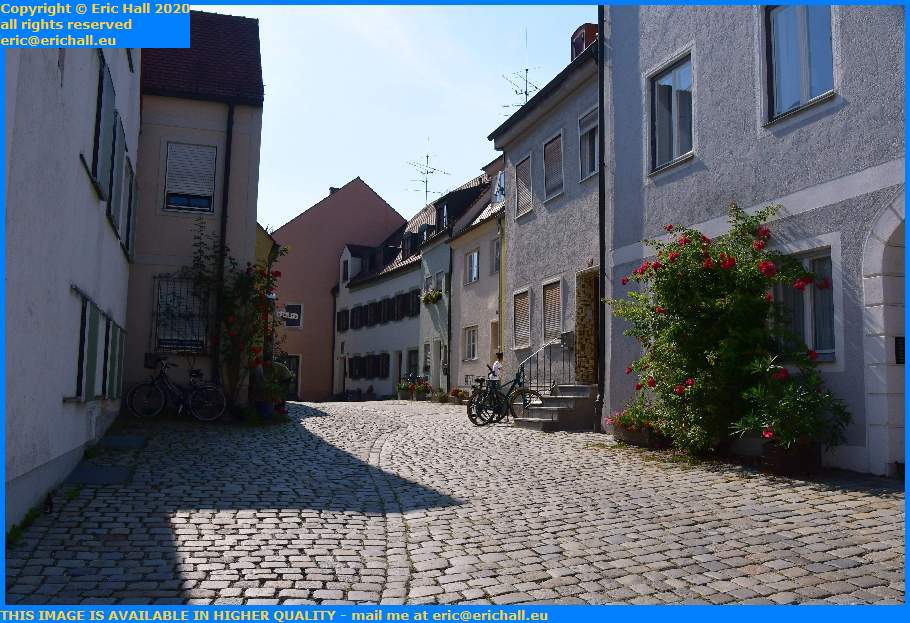
We found a car park just outside the city centre and Hans led me through a maze of alleyways and narrow streets. This one is called the Mittlerergraben and it’s a typical example of the little streets around the northern part of the town.

In fact, much of Germany looks like this, and while some property is quite clearly modern, it’s very difficult to tell with others which is contemporary and which is new to replace war-damaged property.

, so we went for a walk around while Hans pointed out a few of the local sights. The cathedral was up the top of a huge set of steps so in this heat we ruled that out. We went for a cold drink instead.

sporrergasse cathedral mittlerergraben freising germany eric hallFrom where I was standing to take the previous photo there’s a little Gasse, an alley that leads down into the main shopping street. These alleys are another feature of medieval German cities – in fact most medieval cities. As you know, Granville, where I live is littered with them.

In the background are the towers of the cathedral and to the left just down there is the Bayerische Hof, an upmarket hotel that has rooms at prices that the likes of you and I can only dream about.

That column is actually at the entrance to the hotel car park and I bet that more than just a couple of people have had fun trying to put their car into there.

hummelgasse medieval street freising germany eric hallWe walked down the alleyway into the main shopping street and the first thing that I did was to disappear up another Gasse

The town is littered with these little alleys and this one is certainly one of the prettiest. It’s called the Hummelgasse and leads on down to the river at the bottom of the hill.

We weren’t going that way though. We were heading down the main street and so I had to come back. But not before I became all nostagic about the yellow walls on this house here. It reminds me too much of MY HOME BACK IN THE AUVERGNE.

sparkasse unterer hauptstrasse freising germany eric hallSo back in the centre of Freising, in the Unterer Hauptstrasse.

It’s not very often that a town site changes position throughout history so it’s very likely that where we are walking now is the same street that people were walking down 1500 or so years ago. The first recorded mention of the village of Freising was as long ago as 555AD – it was certainly in existence before that date

And it may well be even much older than that because it’s known that there was a Roman Road in the immediate vicinity along the banks of the River Isar and this would have been a likely situation for some kind of regional settlement.

heiliggeiststrasse freising germany eric hallYou can see what I mean from this photo just here taken in the Heilinggeiststrasse – The Street of the Holy Ghost.

Where that tower is in the background is on an eminence overlooking the river and that would be the ideal situation for some kind of fortified site keeping an eye on the traffic passing up and down the river valley either by the road or the river.

The building on the left is the Church of the Holy Ghost with its associated Hospital complex. The hospital dates back to 1374 when a local dignitary left in his Will his entire estate to the benefit of building some accommodation for the poor, the sick and the needy.

fischergasse freising germany eric hallWe eschewed the possibility of climbing up to the cathedral and the other official buildings on the eminence. I’m not too good, hans has a bad leg and it was far too hot for a scramble.

Instead we threaded our way through the maze of back streets into the Fischergasse. There’s a little stream here that runs eventually into the Isar. The stream has been canalised and the banks reinforced and it makes quite a pleasant walkway back to town.

There was a café down here too and so we took the opportunity to sit down and have a nice cold drink. We needed it in this weather.

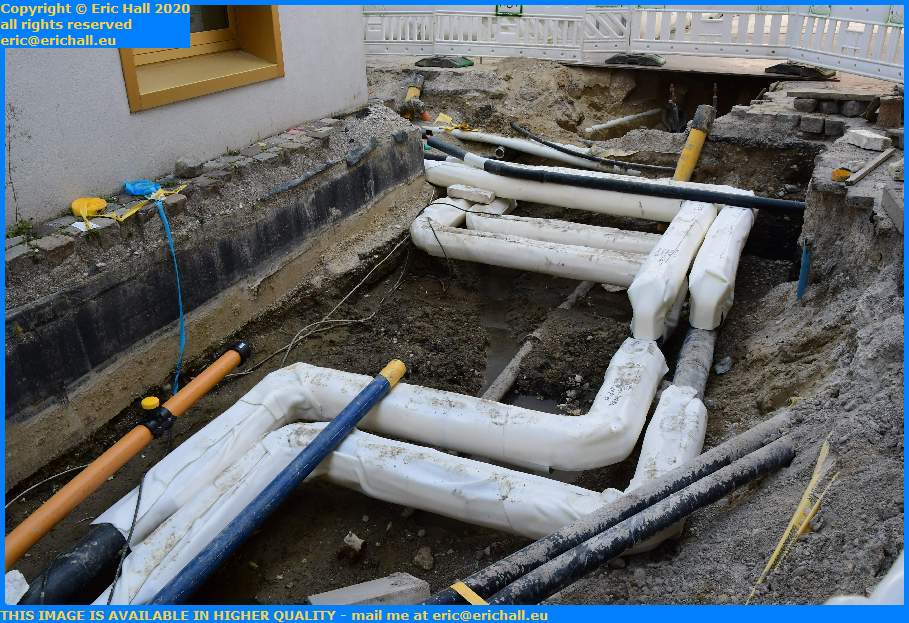
replacing underground heating pipes fischergasse freising germany eric hallHeading back into the centre of town we came across some road works that caught our eye.

According to Hans, there’s “District Heating” in the town – a communal heating system of hot water that’s pumped around the town. it looks as if the system is receiving some attention. Here are some of the water pipes, covered in insulation.

It’s interesting to speculate as to why they have put that big U-bend in the pipework I can’t see any logical explanation for that

medieval vaults brennergasse freising germany eric hallOne thing about these early medieval cities is that it doesn’t matter how old a building is, it’s likely that the underground works are even older.

Consequently, when I saw some renovation being undertaken in the groundwork of a building in the main street I dived in there with the camera. Unfortunately this cellar is the exception that proves the rule. It’s nothing like as old as I was expecting.

We walked on through the town for a while and Hans showed me a bar that he had at one stage been thinking about taking on, but city parking regulations scuppered that.

And so we walked back to the car park and Caliburn

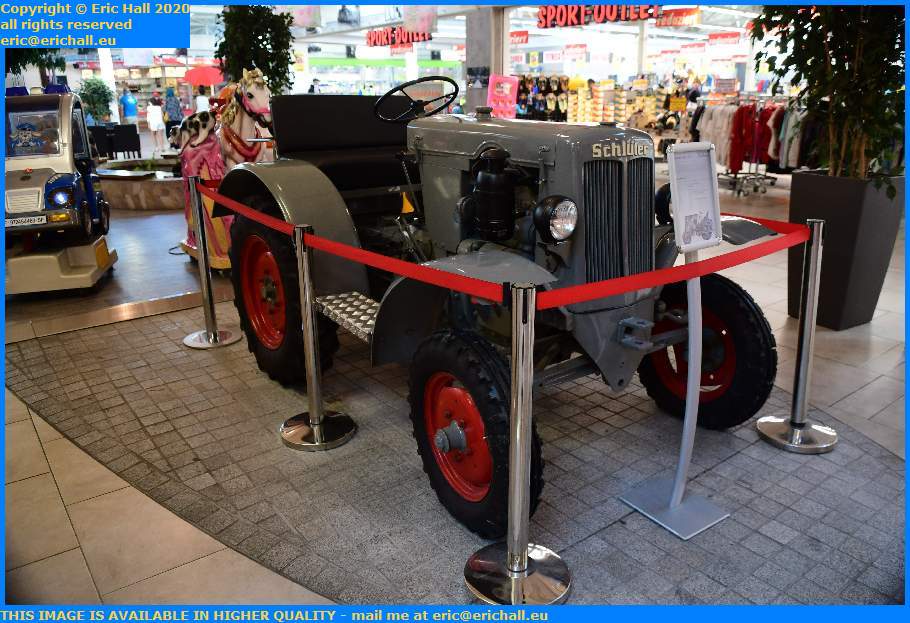
schluter tractor freising germany eric hallOut on the edge of the town is the site of a factory, the Schluter Tractor Company, where they made tractors until 1993.

The factory has now been transformed into a shopping centre where there is a display of photos of all of the products that the company manufactured. We went for a look around to see them, and discovered that there was even a restored tractor on display here as a centre-piece.

While we were here we went for a look around at the rest of the shops on the factory site but there was nothing of any interest so we went back to Caliburn and made our way back to Eching.

Back here, we parked up Caliburn and walked back to the football club where I had a delicious Thai curry with rice. And then back to the Bier Keller for a drink and a chat and to listen to some music.

Now I have my fan, and I feel so much better. I’m not going to say that it’s nice and cool of course, but it’s a lot better than it has been and i’m hoping for a comfortable sleep tonight. Tomorrow, I’ll be hitting the road.

Tuesday 11th August 2020 – I’VE BEEN SPENDING …

… my money yet again.

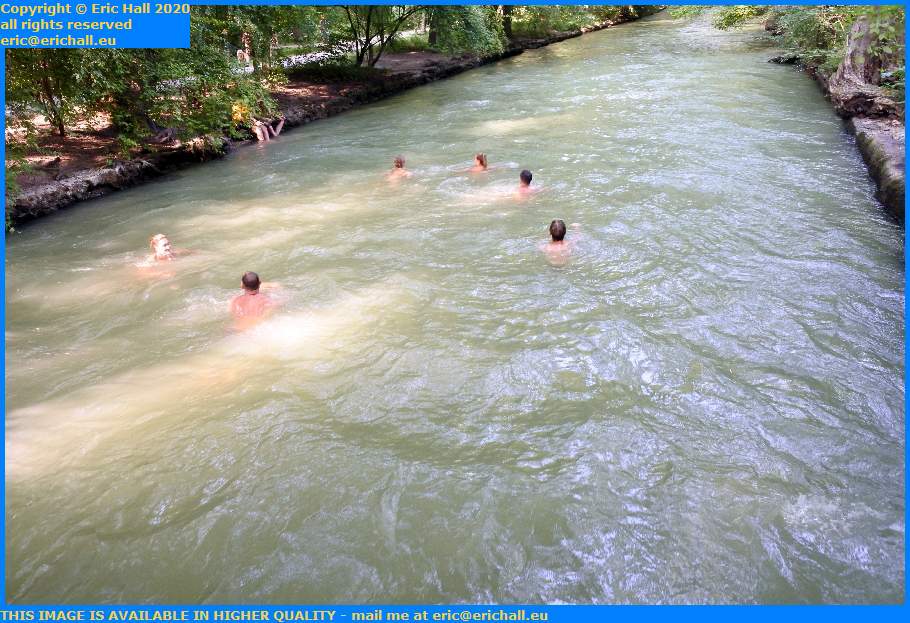
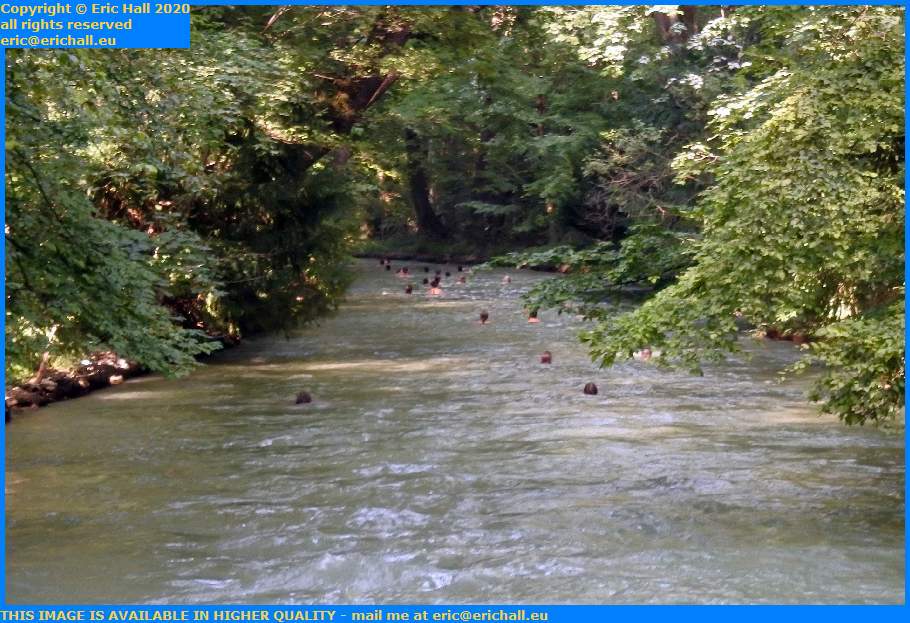
swimmers in the schwabinger bach english garden munich germany eric hallWhile you lot admire some photos of people having fun in the water in the Englischer Tur, regular readers of this rubbish will recall that I have been on the lookout for a new acoustic guitar.

My current one was a £25:00 special of no quality or finish or anything, and rather disappointing all round, and so one of my reasons for being in Germany was to visit the large music shops to see whether there was anything that was more suitable.

Thomann’s had been very disappointing so I was hoping for better luk back in Munich. That was the plan for today.

surfers schwabinger bach english garden munich germany eric hallAnyway, this morning I was wide-awake quite early (Hans’s sofa really is comfortable) and attacked the paperwork.

Heidinnguaq, my Greenland Inuit friend appeared on one of my voyages last night and we’d met as she was doing something as a kind of student so I’d recruited her for my travel company as receptionist, called Heidi, we changed her name to Heidi and she was working there. No matter how I tried I couldn’t make our work relationship into a personal relationship unfortunately. On one occasion we were walking towards the canteen to go and have a meal and she said “I’ll see you back at the office at 13:30 (it was now 12:50)”. I said “yes OK, or you can come and have lunch with me”. “Oh no” she said “you can go and have your lunch in here” she said, pointing to one of the dining rooms. “It’s a smoking one and you can make a mess if you like”, something like that to do with smoking and so on. Definitely doing everything she could to keep me at arms’ length, and I can’t say that I blame her. I would keep a good distance away from myself if only I could.

surfers schwabinger bach english garden munich germany eric hallLater on there was a murder case involving some Chinese people. All of the papers and all of the evidence had been stuffed in an old blue minibus. People had broken into this minibus and started to search through the contents. This was clearly not right and I was wondering why they hadn’t sent the boxes to something like Iron Mountain, something like that. I was wandering around back at my office, getting in arrears again at work and doing some stuff that I didn’t really like. Someone was doing a survey on food and found that we only had something like 81% of food that we needed to survive. I was trying to think of ways to cut down on different things and how to make the food go further which involved taking more care about it but every time I mentioned cheese there was some cheese about someone would say “well so-and-so hasn’t had his cheese yet. Do you want some cheese?” Of course that wasn’t my plan at all because I didn’t want to give it away gratuitously like that. I wanted to keep it. There was some pie left over and I thought that I’d put it in a safe in the spare room but when I went to pick it up this guy there said “oh so-and-so hasn’t had any pie yet” and started to ask around who wanted more pie, whereas I was going to put it in a room and serve it up at tea later that night. I was thinking that there will have to be some really drastic economies of food if we were all going to survive. We can’t afford to waste it all and give it away like this.

Hans appeared at some point and made coffee, and we had a good chat.

Later, we headed out across the road to the cafe where they do very reasonable breakfasts. I had a couple of delicious German bread rolls with jam.

deutsche bahn class 423 743 4 electric multiple unit eching eric hallOff into town now. Caliburn took us to the main-line railway station in town and to catch a train for Munich.

The train that pulled up to take us was one of the lightweight Class 423 units buolt by a consortium including ABB, Adtranz, Alstom and Bombardier specifically for the suburban networks of many German cities during the early years of this century, the first ones actually entering service in 1998.

Clean, tidy, comfortable and quiet, it whizzed us into the city and at the rather appropriately-named Moosach station we alighted and took the Metro down to the Olympic Park. At the big shopping complex near there is A place called Just Music, one of the largest music shops in Germany.

Here, they did EXACTLY what Thomann’s should have done the other week. A salesman listened to what I was telling him about my requirements, sorted out half a dozen guitars, put them in a little room with me, and then left me to it.

After about half an hour I’d whittled the choice down to two and following a lengthy discussion with Hans and the salesman I finally made my choice. So I paid up and left the guitar there for later collection.

We then headed off back to the underground for a train (and a bus) back to the city centre.

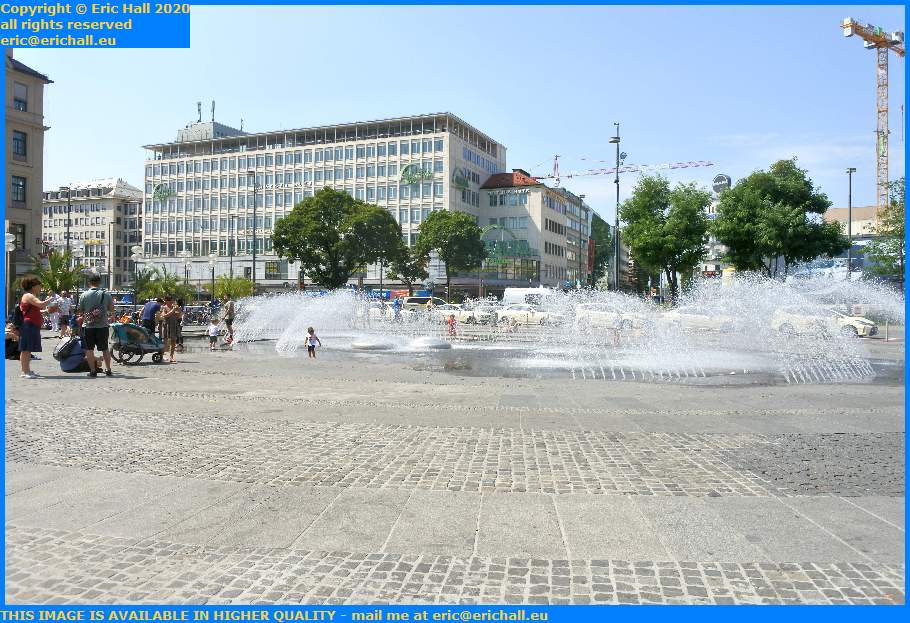
karlsplatz munich germany eric hallWe were planning for a mega-ramble around Munich today to see some of the sights and we started today at the Karlsplatz.

Mind you, it’s not everyone who knows it as the Karlsplatz, not even on some occasions the announces on the Underground system. Charles Theodore, the Elector of Bavaria after whom it was named was not very popular with the locals and the story goes that when he died in 1799, the locals held a party that went on for several days.

The locals call it the Stachus, which apparently was the name of a bar that once stood on ths site.

In winter, by the way, the fountain is switched off and it becomes a skating rink.

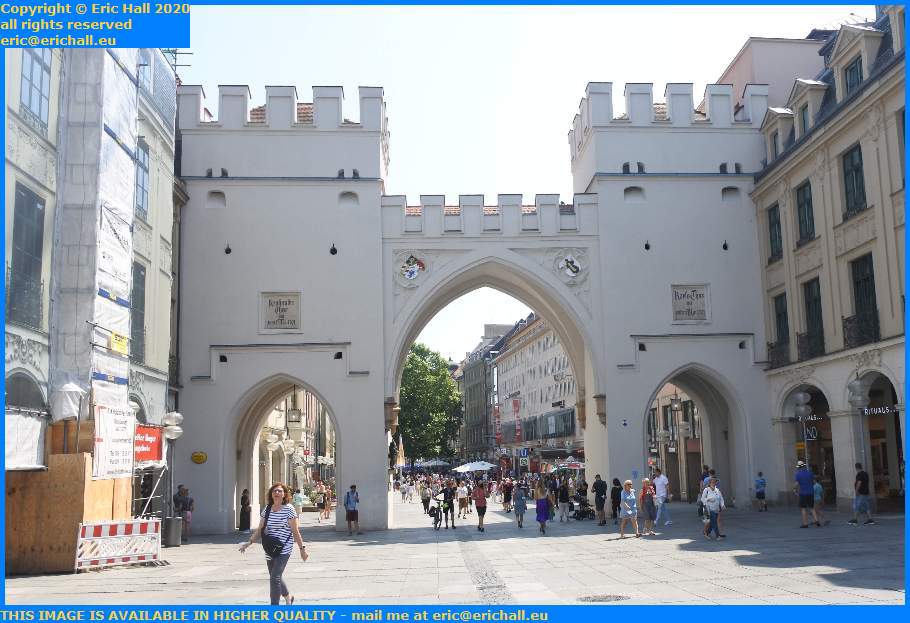
karlstor munich germany eric hallProbably the most impressive building in the Square and one of the most impressive throughout the city is the Karlstor, or Charles’s Gate.

It goes without saying that being an important city in medieval times, there were fortifications here that included a city wall – or maybe I should say “walls” because like most cities back in those days, rapid growth led to several concentric rings of walls to protect the expanding town.

The Karlstor, originally known as the Neuhauser Tor, is one of the very few surviving structures from the sesond generation of city walls erected in the latter part of the 13th Century and was certainly in existence in 1302.

But what we see today isn’t the original. The original was used as a munitions store and in 1857 the munitions exploded, destroying the gate. In the 1860s the gate was built and it’s quite different now from how it used to be.

Bürgersaalkirche Marianische Männerkongregation Mariä Verkündigung am Bürgersaal zu München Kapellenstrasse Munich eric hallWe walked on into town down the Neuhauserstrasse, stopping for a cold drink on a terrace where we could admire the Burgersaalkirche on the corner of the Kapellenstrasse.

To give it its full name, which is a bit of a mouthful, it’s the Bürgersaalkirche Marianische Männerkongregation Mariä Verkündigung am Bürgersaal, or “Citizens’ Hall Church of the Men’s Congregation of the Annunciation of Mary at the Citizens’ Hall. It’s a Catholic Church then, which is quite evident as Southern Germany and Bavaria in particular is a Catholic region.

It seems to have been at first a Civic Hall when it was built round about 1710 and became a church in 1778. Within it is the grave of Father Rupert Mayer, a Jesuit priest who was a firm and outspoken opponent of the Nazi regime but was spared execution by virtue of his popularity and also by the fact that he had won the iron Cross for bravery as a regimental chaplain in World War I during which he lost a leg while administering the last rites to soldiers in the Front Line in December 1916.

Isartor munich germany eric hallA little earlier we were at the karlstor at the west end of the city. We have now walked all the way through the centre and are now at the Isartor, the gate near the River Isar.

When the second circle of city walls was built between 1285 and 1337, this gate was added to control entrance to the city. The tower was built first and the two flanking towers later when the moat was created.

Unlike the Karlstor, the Isartor is pretty much as it would have been when completed. It is said that the restoration taken place in the 1830s followed the original plans, as were the repairs after the end of World War II during which it was heavily damaged.

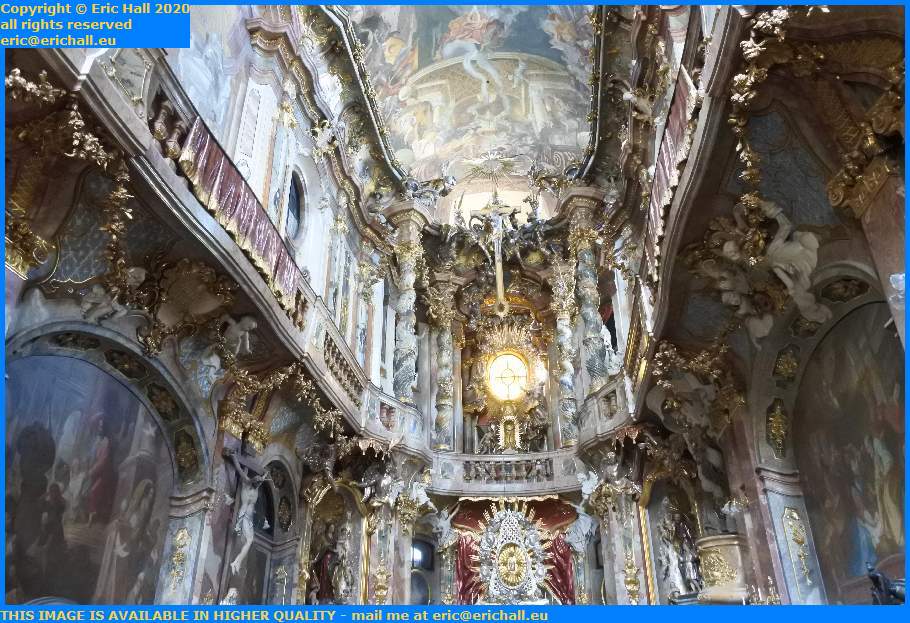
interior Asamkirche church sedlingerstrasse munich germany eric hall
Hans had saved the best until last. It took quite a lot of finding but in the end Hans led me to the Asamkirche.

For this we have to turn the clock back once more to our favourite period of Munich Architecture and head for the years 1733-1746 and the Baroque period.

A couple of brothers, a sculptor named Egim Asam and his painter brother Cosmas wanted their own private church and so they bought four houses in the Sendlingerstrasse. Having done that, they set to work to create a veritable masterpiece to showcase their individual talents.

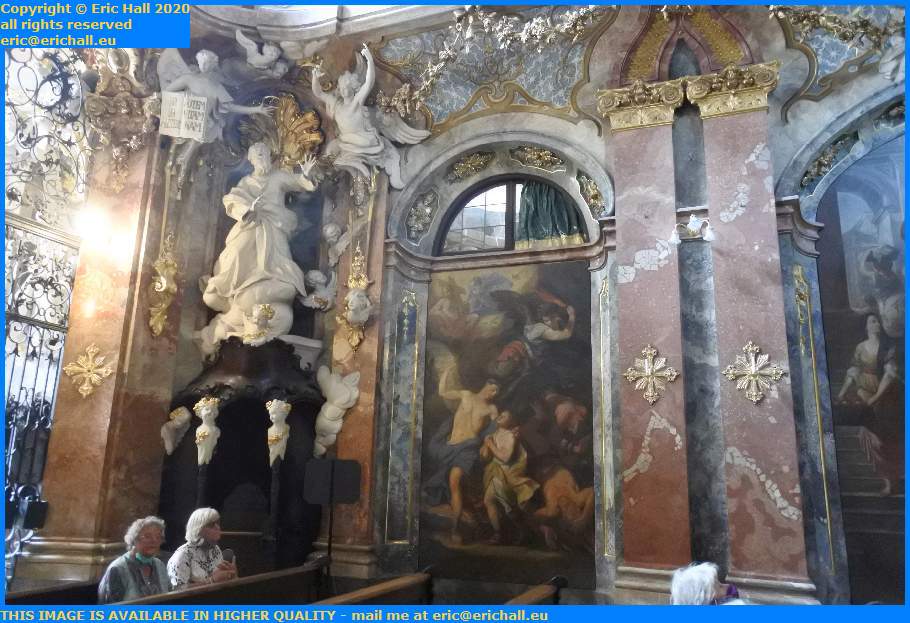
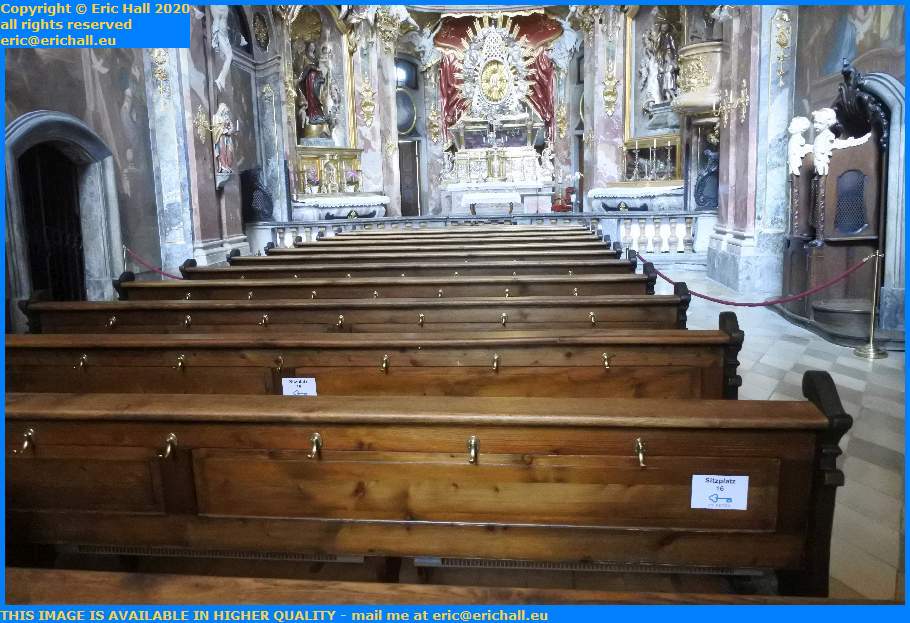
interior Asamkirche church sedlingerstrasse munich germany eric hallAlthough it’s known by the locals as the Asam Church, Its official title is the Church of St Johann Nepumuk.

Because it’s a private church, they didn’t have to conform to any established design and so could pretty much as they pleased. And for that it has some delightful little quirks. You’ll notice (or maybe you won’t) that the altar in the church is to the west, not to the east and Jerusalem which is traditional.

It’s said (and I have to say that I didn’t check) that the altar was so positioned that Egim could see it through the window of his house.

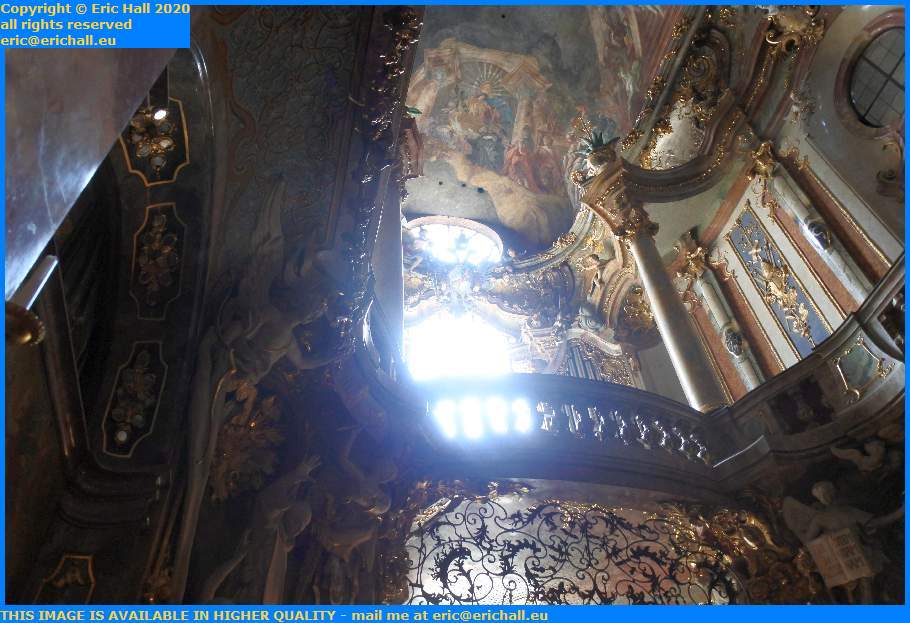
interior Asamkirche church sedlingerstrasse munich germany eric hallAnother little quirk is that it’s symbolically on three levels.

The lower third is for the congegation and is dark and sombre to represent the suffering of the world. The second section is in blue and white and is reserved for the Royal Family of Bavaria and whoever might be the Holy Roman Emperor.

The third part, right up in the roof with all of the wonderful illuminated paintings is reserved specifically for God. The fresco up there is called “the Life of Saint Nepomuk” and is said to be an example of the apogee of the talent of Cosmas Asam.

interior Asamkirche church sedlingerstrasse munich germany eric hallThe story goes that despite it being a private church and built to please the Brothers Asam rather than the church authorities, the neighbours were not very co-operative and insisted that it become a public place of worship and it’s for that reason that we are allowed in today.

And we are lucky to see it too because although damaged during the blitz of Munich in 1944, it survived without suffering very serious damage. Imagine a group of modern-day artists and sculptors trying to reproduce all of this?

In conclusion, I have seen some very opulent churches in my time – many that hardly correspond to the idea of “give all thou hast to the poor”, but this one outdoes them all

Munich Stadtmuseum Sankt-Jakobs-Platz München, Germany eric hallWhile we’d ben on our walk to find the Asam Kirche, we’d seen and interesting building away in the distance so we went to see what it was.

It turns out that it’s the Munich City Museum, in the Sankt Jakobs Platz. Ordinarily we would have gone for a wander around inside but with it being so hot, we’d sat for 15 minutes or so by the fountain just outside to cool down, and by the time we realised what time it was, we had to clear off.

Also in the square was a hideous concrete Brutalist structure that I didn’t photograph, considering that it was of no architectural merit whatever. I found out later that it was the Bavarian Jewish Museum.

Anyway we hurried across town to the Munchener Freiheit where we had arranged to meet Ulli on the way and stopping for a drink and a chat. I like Ulli.

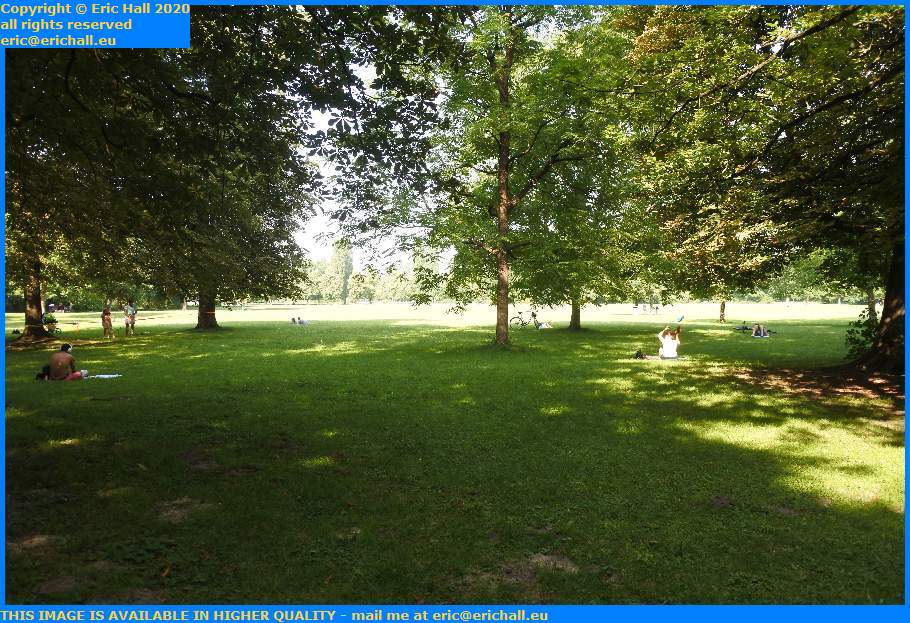
English garden munich germany eric hallHaving done the socialising bit (after all the time that it took to find Ulli too) Hans and I threaded our way through the back streets to the English garden to see the swimmer and the surfers (and I am not making this up, as you have already seen).

We’re back in the days of the unpopular Elector Charles Theodore again. In an attempt to win back some popularity amongst the people after his failed attempt to sell them and their lands to the Emperor of Austria, he decided upon a series of civic imrorvements.

In 1784 he engaged the services of Sir Benjamin Thompson, a Loyalist American who had fled after the American Revolution, to undertake a modernisation of his army, and one of Thompson’s suggestions was a garden.

Although one of the aims was to make a public open space, its real purpose was to train the military in agricultural practices so that they could be loaned out to perform civilian work during times when the Army wasn’t fighting

monopteros english garden munich germany eric hallGradually, the military importance faded and the civilian leisure use of the park increased and under the direction of Friedrich Ludwig von Sckell who assumed responsibility of the Gardens in 1804, the Gardens adopted their current form

This building here is the Monopteros, built on top of an artificial hill that was created using leftover rubble from the renovations of the Royal Palace. There had been a wooden temple nearby but this had weathered away and so in 1836 they erected the hill and this stone temple of 10 columns, designed by Leo von Klenze.

The dome is actually made of copper, although you wouldn’t think so from here.

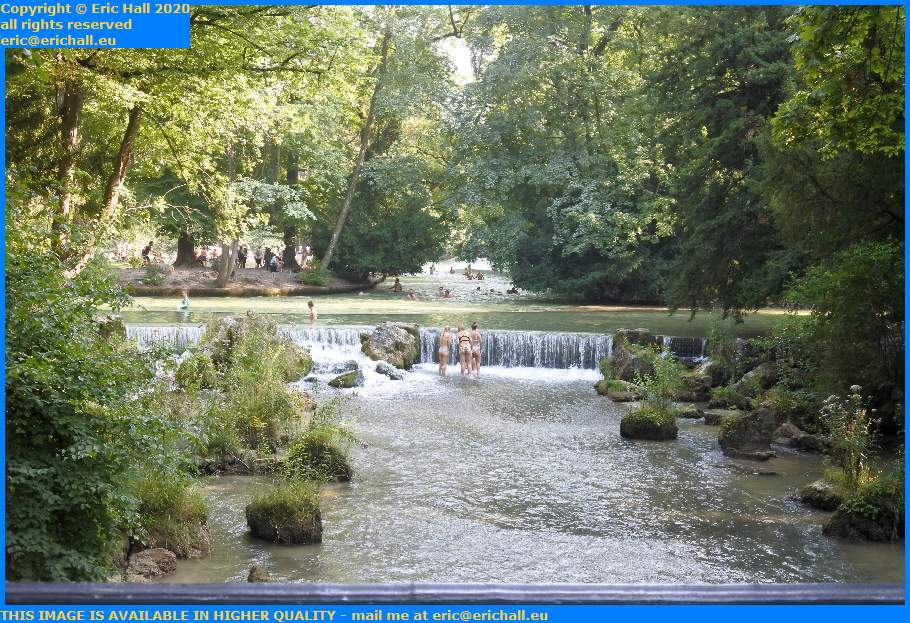
beauties in the schwabinger bach english garden munich germany eric hallIt’s not just the mound that’s artificial in the park. The river that runs through here and the waterfall are too.

The river is called the Eisbach, which means “Ice Stream and runs for about 2 kilometres through the Gardens, and the waterfall was created here in 1815. It’s an ideal spot to come and soak up the shade on a stifling hot day and to admire many of the wonderful sights that nature can create.

Hans and I remained here for quite a while resting out of the sun and contemplating the scenery.

swimmers in the schwabinger bach english garden munich germany eric hallThe Eisbach lives up to its name because it really is cold. I’m told that the temperature doesn’t exceed 15°C although of course I have no intention of finding out for myself.

Officially, swimming isn’t allowed but as the river is about the fastest that I’ve ever witnessed and the police would stand no chance whatever of catching the people who are flouting the law. They might just fish out a few of the bodies because there have been a number off atalities in there, people succumbing to the cold or to the speed of the river.

It’s not for me, of course. If the water isn’t at 37°C I’m not interested at all in it.

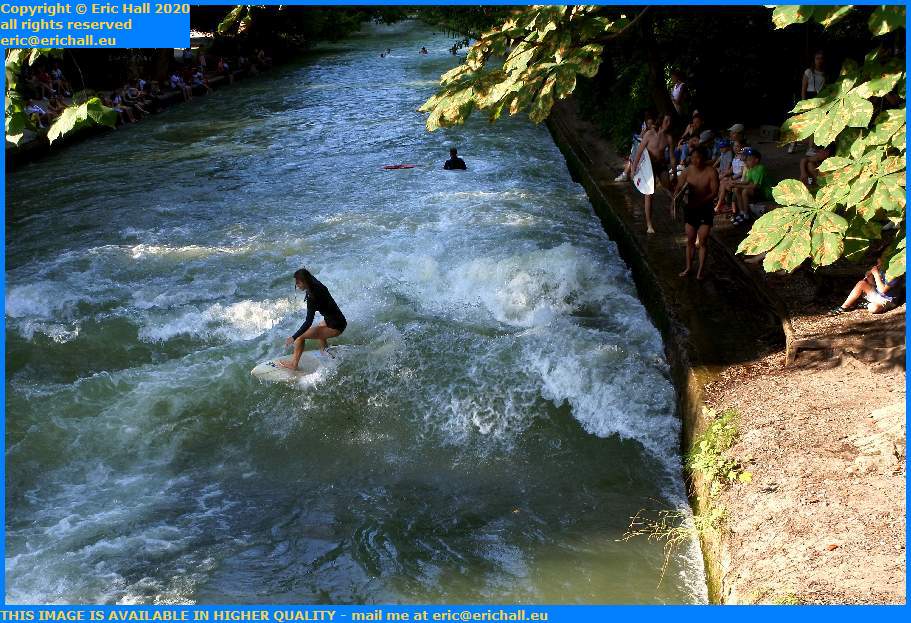
surfers schwabinger bach english garden munich germany eric hallSo we went off to watch the surfers, who you saw earlier.

Surfing first started here in the early 1970s, much to the dismay of the local authorities who tried to stop it. However, various forms of action by interested parties succeeded in reversing the Council’s decision and in 2010 it was afficially permitted and since then, surfers have enhanced the waves by using artificial devices.

We watched them for a while and noticed that they didn’t seem particularly proficient in what they were doing. I suppose that you can’t expect too much in an inland site like this.

Kayakers sometimes have a go at the waves too although they are not made welcome by the surfers and there have been confrontations between the two groups.

Later on, we went back to the music shop to pick up the guitar, and our walk concluded with a trip to the Munchener Freiheit and the Indian café there where I had another bowl of their delicious curry. And then it was time to come home. And hardly surprising – I’d walked 14kms today in the heat.

The guitar is beautiful. It’s an Ibanez softwood acoustic with a beautiful tone and sound, a nice deep bass and a good low action. I’m really pleased with this one. We had a play on it for an hour or so and then one of Hans’s friends phoned us up. Our evening concluded with a session in the beer garden.

Tonight is another night on the really comfortable sofa. And I’m going to make the most of it because there are apparently some Celtic remains in the vicinity that have recently been discovered. Tomorrow’s plan includes a little visit of the site to see what we can see.

And with my interest in that kind of thing, it should be good. My career has been in ruins for quite some considerable time.

Monday 10th August 2020 – IT’S NOT EVERY …

… day that I have the chance to ride in a rickshaw is it? but today I really did. A 1928 machine made by the Bombay Bicycle Company, as it happens.

Yes, I’m back in Eching in Germany and this is one of the many pieces of unusual equipment that my friend Hans happens to own.

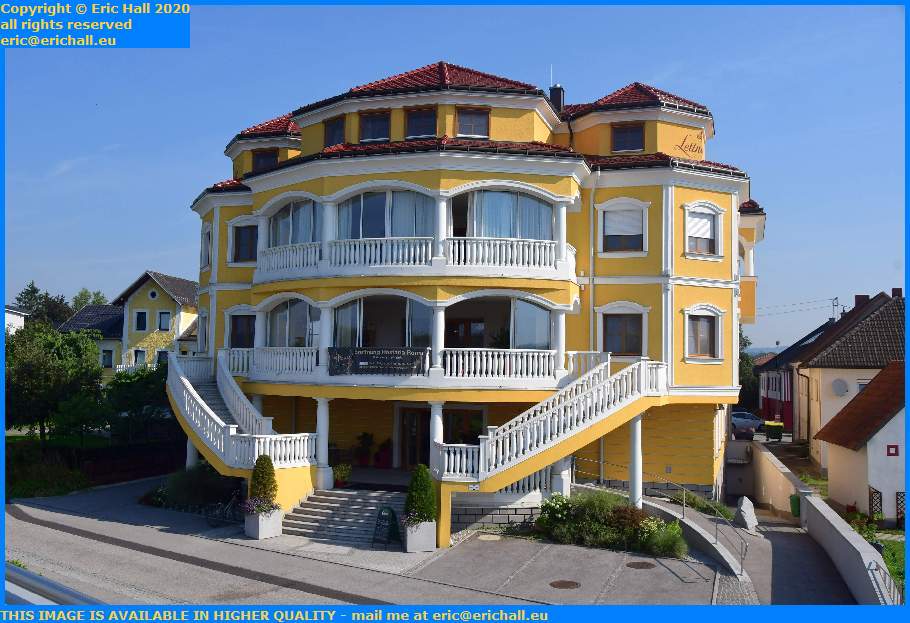
Donauhotel Lettnerhof Au An der Donau austria eric hallLast night’s sleep in my luxury hotel was one of the best that I have had for quite some time – and that’s saying something because there have been some good ones just recently. I was up and about quite early too and had plenty of things to do before I left.

Like listen to the dictaphone

I was with a group of people last night and we were in the old Chemistry building in school, the H block and there was a football match taking place on the playing field. We all trooped off to one of the rooms to watch it. There was probably half a dozen of us – Zero, who has been with me on several nocturnal rambles over the years was there and a few others but we couldn’t see very much at all. The end room was the best one so we picked up all of our stuff, all our cables and leads and walked down to the end room. Surprisingly all these cables actually reached so we could get to the big picture window there and watch the game. The game was down the bottom field, people in green against people in blue and black and a similar team playing on a steep slope on a 5-a-side pitch. There was another couple of games going on and we couldn’t work out which was which. We came to the conclusion or decided that this wasn’t a very good place to be all. Something happened and we were like catapulted out of this room, two of us, me and a guy, and we ended up back down at the bottom so we walked along. By this time the people were sitting there and playing cards. This guy grabbed a seat as if to play cards and I stood there taking to everyone. There was a girl there who was dealing and she had a very heavy indented cleft palate with teeth growing up through the skin of her lips, like outside her lips. People were talking but it wasn’t about this game of football. This game of football had somehow disappeared so I don’t know what has happening about that now.

Later on, I’d had a schoolfriend and someone else in my car during the night and they’d left a pile of shopping behind so I went round to see them. My friend was very pleased to see me and I got loads of stuff out, bags of food that he had left behind. He didn’t really want it, thinking that I needed it but he didn’t want the coconut slices because they had been in contact with the inside of my holdall thing. Then he started to sit down to tell me that his sister had disappeared and how he would give all he owned to know that she was safe and brought back, and this was something that I could help him with.

And too right too. I was a big fan of his sister when we were at school and later, when she was at College in Manchester we had a few dates together. I should be so lucky!

Ironically, when I was musing over people who had been to accompany me on my nocturnal rambles, I’d mentioned this girl and I wondered why she had never come along with me. So here’s your answer. She’s disappeared off that particular ethereal plane.

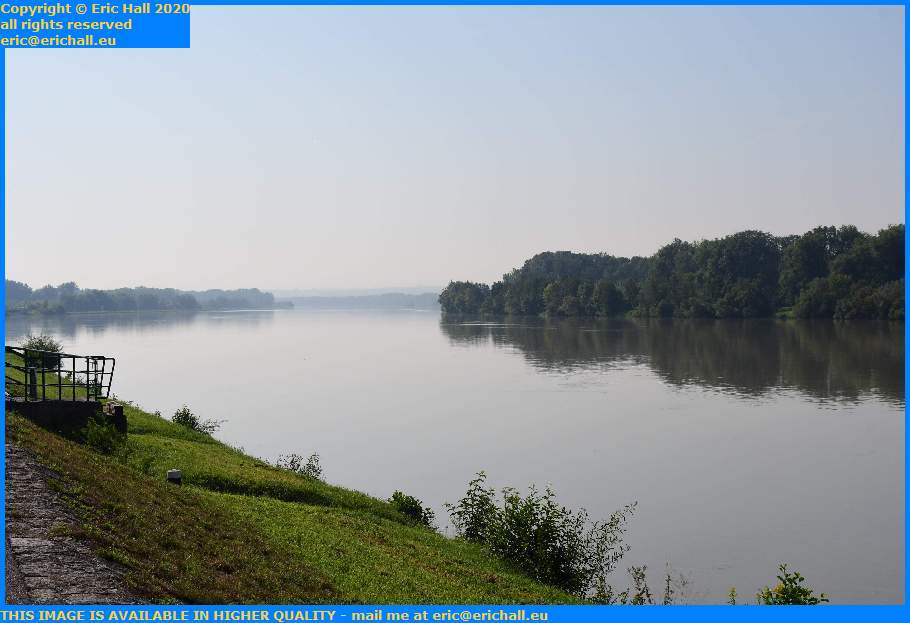
river danube au an der donau austria eric hall No breakfast though today. I wasn’t hungry.

To start the day I went for a walk along the river bank to stretch my legs before I hit the road and despite it being so warm, there was a lovely early-morning mist rising up off the river but I didn’t think that it would last very long.

My ice cream stall was closed, as you might expect. Not that I was hungry of course, but it would have been nice to have had another one of those banana sorbets

river danube au an der donau austria eric hallThe previous photo was looking east, or downstream, the way that I had come. This way is looking upstream to the west, the way that I was going.

As you can see, the River Danube is nice and wide, free-flowing and not too fast. It goes without saying that there’s a marina close by because it’s just the kind of place where your average weekend sailor can don his navy blue cap and blazer and have a little potter about on whatever passes for ocean waves around here.

But I bet that it’s not always this calm. The levées here would tell you everything about that, looking at the height and width of them. There must be some incredible floods around here in late spring when the snow is melting.

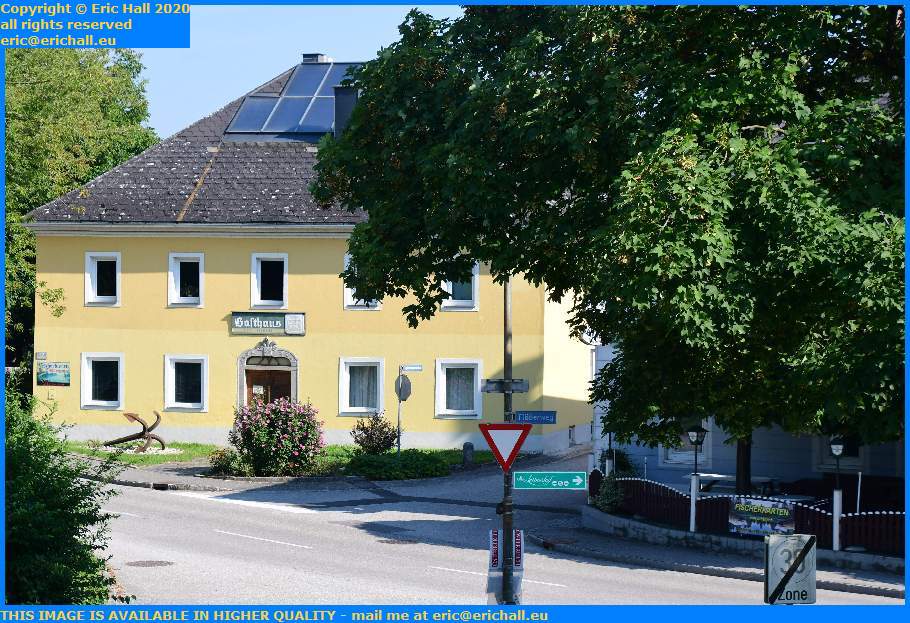
gasthaus marktstrasse au an der dnu austria  eric hallCarefully dodging the squadrons of cyclists out for an early-morning ride I walked some way along the path on top of the levée to see what I could see.

As you might expect with it being a kind of resort town on the river there are quite a few amenities for tourists such as inns, taverns, guest houses and the like. But I was eminently happy with where I stayed last night

For example, the price. I was right about that. I certainly hadn’t imagined it. It was indeed €63:20 for a room that would cost three times that in a hotel in the UK or the USA. I’ll be back here again, that’s for sure.

And then I hit the road. 09:30 and it was already approaching 30°C. This was going to be another long, hot day.

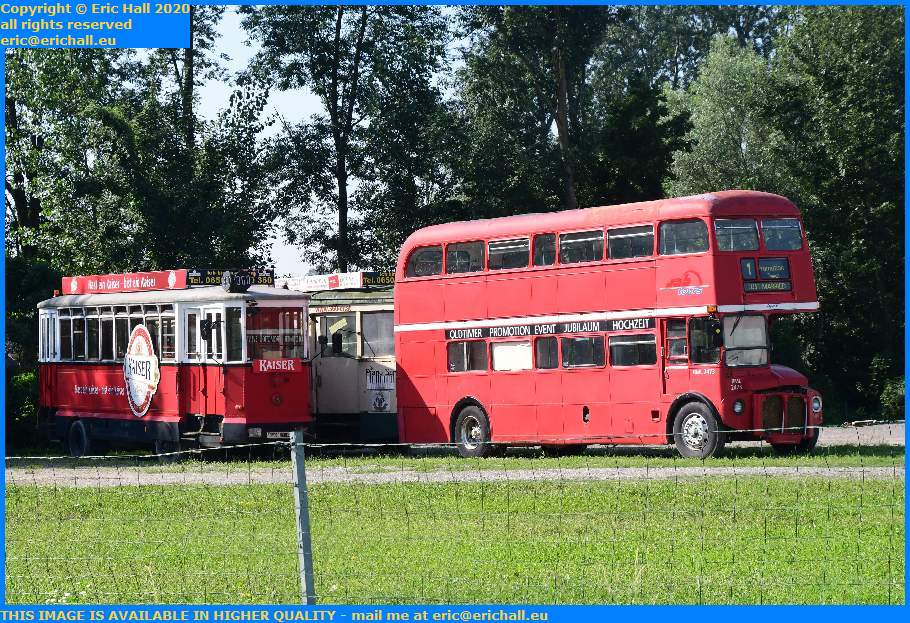
old London Transport Routemaster naderers au an der donau austria eric hallHowever I didn’t get very far at first. There’s a travel company called Naderers here and as I threaded my way through the maze of streets I came across their transport yard. And parked up at the back of it was this interesting old London Transport Routemaster, whatever that was doing here.

Having made subsequent enquiries, I’m told that it’s RML2473 owned by Sabtours apparently and, rarely, it’s fitted with a Cummins engine instead of an AEC or a Leyland engine.

And behind it were some even more interesting items that look as if they might have been old tramcars from some ancient urban network.

And that wasn’t all of the excitement either.

There was quite a traffic queue for ages, cause by a couple of slow-moving vehicles that took ages to pass, but that was because, as I discovered later, we were stuck in roadworks. I missed my turning and had to do a U-turn, go back and do it all again.

abandoned steyr bus gusen austria eric hallEventually we were routed off into a diversion and here I came to another halt because parked up on an industrial estate was another old bus.

An Austrian Steyr this time a stage carriage vehicle I reckon and about which I know nothing at all, except to say that it was appropriate to the place, seeing as Steyr had a small factory here in World War II making rifle barrels.

Doing a U-turn in traffic to go back to see it was not easy either. While I was there looking at it I took a photo, but none of my “usual suspects” were able to identify the bus at all.

Eventually we left the diversion and rejoined the main road. My route followed the Danube for a while and then headed off into the hills.

And up there I found a service station selling diesel at just €0:91 – the cheapest that I’ve seen for years – so I fuelled up, only to find one even cheaper a short distance further on, as regular readers of this rubbish will probably have come to expect by now.

But in the main tt was a really depressing drive today in the heat, with roadworks, more diversions, farm vehicles and, at one stage two heavy lorries for about 35 kilometres and nowhere to pass all conspiring to slow me down.

I’d managed to find some bread for lunch, almost coming to grief at a roundabout, but finding a spot in the shade to park up to eat it was something else.

lunch stop near velden germany eric hallIt seemed to me that I must have driven for hours trying to find a quiet shady spot and I was very quickly becoming fed up of all of this. My humour does not improve in the heat.

In the end I found a little clump of trees with a forester’s path going up between them. The path was very tight but I reversed up there all the same as far as I could go until I was totally surrounded by trees and shade.

And here I sat with my butties and a good book and a closing of my eyes for half an hour while the sun moved slowly away and I could resume my drive in something more like comfortable weather.

My way to Eching came through the Airport at Munich – at least I now know where that is – so I parked up and went to find Hans in his shop. I stayed there until closing time and then had my rickshaw ride to the Beer Garden. Salad and chips and alcohol-free beer for tea. After all, this is the suburbs of Munich.

We had an interesting chat with a couple of people about motor bikes and the girl fell in love with Strawberry Moose. But now it’s late and I’m off to bed. It’s a busy day tomorrow.

Sunday 9th August 2020 – HOW LONG IS IT …

river danube cruiser bolero marbach an der donau austria eric hall… since we’ve had a ship of the day on here?

This time of year we are usually posting one or two every day as we stroll up and down the St Lawrence in Canada. This unfortunately is not the St Lawrence but it’s the best that I can do right now. Right outside the window of tonight’s hotel the River Danube is flowing by and it’s making me quite homesick for the mighty Canadian river.

When I download all of the photos from the camera, edit them and upload them again, you’ll see an enormous cruise ship – a kind of luxury barge – sailing past. Not a 100,000 tonne container ship but it will have to do.

Hotel Minerva Mosonmagyarovar Hungary eric hallIn my really comfortable hotel, the Hotel Minerva in Mosonmagyarovar I had a really good sleep and even though it was Sunday with no alarm, I still awoke at about 05:50.

There was tons of stuff on the dictaphone again. It had been a really busy night

At one point during the night I was somewhere in Eastern Europe in a car, a Sunbeam Alpine convertible. I was driving through the mountains at a really rapid rate of knots but the headlights were set far too high and on main beam you could only see clouds. Dipped beam was set too high as well. I’d been driving around like this doing my best to avoid an accident at night. I suddenly realised that the windscreen was wrong. It was too far sloping back and I was sitting in the wrong position. I organised myself sitting properly and carried on driving. I eventually ended up somewhere where there was a girl. My brother was chatting her up obviously. I had a bit of pastry left so I started making some pastry for a pie and it gradually evolved into a crumble when I added sugar to it although I didn’t actually add any oats. This girl was very interested and came over to talk to me about it. She said “if you have any more interesting recipes let me have them”. I told her that I had dozens, and we had a huge intellectual discussion about my pastry and apple crumble and so on.

Later on, I was away on another voyage but i’ve forgotten half of it. We were .. I’d been out somewhere taxi driving. I had my old Ford Anglia and I dropped some people off in the mountains. I was coming back but I couldn’t get round one of the bends. I had to get out and push the car round. Three guys came to help me so I offered them a lift. They were going all the way to Shavington so I took them there and they booked a taxi for a couple of days time going from Wybunbury to Shavington. I went home and all of the papers were everywhere. My brother and Nerina were going through trying to sort out some kind of system with the paperwork, looking for vehicle records. They had a really good sort through it. I was thinking “I ought to be doing some sorting out while they were doing all of this but I decided in the end that I would start to look at my clothes. I had 2 chests of drawers but I only found 1 drawer with my clothes in it so I wondered where the rest of my things are. I had 2 more chests of drawers somewhere so I went off to have a look through those. While I was doing that there was a young girl, obviously nothing to do with our family having a play around and there were some people admiring some clothes belonging to this girl that were hanging up. I half-expected them to engage me in some kind of conversation but they didn’t. In the end I got on the bus and went to Chester, and walked from Chester towards Wrexham and came to a housing estate of modern terraced houses with a garage on the groud floor, then a first floor and then a second floor. For some unknown reason I thought that this was Brickfield. I was wandering around this estate looking at things and thinking that it would be nice for me to come and live here. Then I heard people talking about how they lived here and the winds and how cold it was so I decided maybe I won’t. I carried on walking a little further but lost all the signposts and I was on a modern 1930s semi-detached type of estate place. I saw a sign for Flint but I thought that i don’t want to go there – i want to head back towards Wrexham so I tried another road. I heard people talking about the Nobel Prize for Literature and how all the people who had entered for this year, and they were saying that if they don’t enter for next year we’ll know that they were just one-hit wonders and not really significant. There was a primus stove and it had been a long time since I’d seen one so I got it and pumped up the pressure and went to try to light it but I couldn’t get the nozzle to work. A guy saw me and came running over the road. It turned out to be his and he was one of these authors. We talked about his live stove thing and he said yes, that he uses it for heat mostly rather than lighting. We had a talk about it aand he went to pump it up, found that it was pumped up and went to light it as well but he couldn’t. he had a kind of Piazzo lighting arrangement where he clicked on the button to light it. I chided him about that. “You really ought to do it with a match”. Someone came along. He had something else and said “you light it with that” but I can’t remember what it was. It turned out that it was all kinds of things like cabbage leaves and so on. I knew exactly what it was and I told him but I can’t remember now. They lit it and started to smoke it and said “yes! This is really good. We had a good chat about that as well.

Going back to sleep, I found myself back in the same dream. So where was I? All the time that this was going on I was thinking that I’d caught the bus to Chester and now I was walking down the road to Wrexham and I’d missed the last bus back by a long time. The only way home for me now was to carry on walking towards Wrexham and then back to Crewe that way. That was going to take me all night at the very least to do all that but I hadn’t even given it any thought about what I was going to do about getting home.

But when I really do get home I’m really going to be having a lot of fun editing all of these photos and transcribing all of the dictaphone notes.

Unfortunately I’m afraid that the days when I could do that during the evening when I arrived at a place of repose are long-since over. Usually now, when I arrive at somewhere for the evening I simply crash out on the bed for an hour or two.

But I digress.

Breakfast was quite nice – not as nice as I had in Lech but nevertheless it was something to be going on with. I didn’t like the coffee but that’s probably more to do with the fact that I couldn’t understand the Hungarian instructions on the coffee machine.

typical traditional hungarian house hegyshalom hungary eric hallLater on, I headed off for the border in the heat. 09:30 and it was already 31°C. I shudder to think how hot it’s going to be later in the day.

The scenery around this part of Hungary is very flat and monotonous and there wasn’t all that much to see. There were some delightful little Osterreich rural cottages along the way and In the village of Hegyshalom, not far from the Austrian border, there were some splendid examples in the shade of the trees.

The big BMW lets the show down unfortunately. It seems that even in Central Europe the price of a rural cottage is way beyond the means of the average rural-dweller and now the province of the big city-slicker.

But I was surprised at the border. There was all new security fencing with razor wire, a full and complete border patrol and interrogation, and a Romanian lorry being slowly dismantled over on one side.

It reminded me just like the old times pre-1992. Although, interestingly, the old Hungarian border installations from the Cold War days, including the watchtower, were all still there but abandoned, empty and closed up. All of the excitement was on the Austrian side.

This just goes to show you just how much the world has turned round on itself over the last 30 years – something about which I have commented ON SEVERAL OCCASIONS in the past.

Photography is of course not allowed at border crossings but rather unfortunately, I seemed to have forgotten to switch off the dashcam in Caliburn. So when I finally get round to editing the video recordings, we can see my border crossing.

war memorial zurndorf austria eric hallA mere cockstride from the border in Austria I came to the village of Zurndorf, where my attention was drawn to this rather impressive war memorial.

Regular readers of this rubbish will recall that I have a great interest in war memorials in Central and Eastern Europe. The political situation here has varied greatly over the centuries as the Austrian Empire dealt with waves of Muslim invaders, grew to its greatest extent with the annexation of Bosnia in 1908 and then disappeared completely in 1938 with the Anschluss.

Consequently, different regions found themselves fighting different wars as well as quite often being on different sides in the same war, so it’s interesting to see all of this reflected on some of the memorials.

war memorial zurndorf austria eric hallThis one unfortunately is quite banal – with just a mention of the two World Wars and nothing about the Austro-Prussian War of 1866 or any other conflict in which Austrian troops were involved.

But these monuments in Axis countries are quite different from the monuments in Western countries in a very significant way. In the West, the number of casualties in World War I vastly exceeded the casualties of World War II. But here in Austria, this War memorial shows something quite different as we have seen in many Axis countries.

The upper photo shows the casualties from World War I, and it’s known that the casualty figures of the Central Powers were in a similar region to those of the UK and France. But in World War II when Allied casualties were much less than in the previous war, the caualties of the Axis powers were enormous. The bottom photo shows the casualties from that war, so just compare the two and see what I mean.

There are no dates of death unfortunately, but we have seen on many others that the greater part occurred in the final couple of years of the war. It just goes to show the horrors that were taking place on the Eastern Front in the second half of World War II when the Axis Powers were on the run from the Soviets.

Anyone who denies the overwhelming efforts of the Soviet Union in defeating the Axis Powers unfortunately somewhat misinformed.

gaz m21 volga baleen autoexpert recaio bruckerstrasse parndorf austria eric hallIn the heat I carried on across Northern Austria. But not too far. Only to the town of Parndorf.

If someone were to ask me whar car I would really like, from anywhere in the world, then if I couldn’t lay my hands on one of Erich Ubelacker’s Tatra 77s, i’d have to go for something like a GAZ M21.

And sure enough, to my surprise, here parked up by the side of the road in Parndorf is a rather sorry-looking M21. Where’s my trailer just when I need it?

gaz m21 volga baleen autoexpert recaio bruckerstrasse parndorf austria eric hallGAZ stands, of course for the Gorki Avto Zavod, the Gorki Auto Factory in the Soviet Union, and they were the cars to own if you were anyone in the Soviet Union in the 1960s

Many people have suggested that this was because they were the only car available in the Soviet Union, but that’s doing them a great disservice because they really were a much better car than anyone ever gave them credit with a great many modern features and, unlike cars from the West, were built to last for ever.

One very happy owner of an M21 was the astronaut Yuri Gagarin who often spoke kindly about his car

gaz m21 volga baleen autoexpert recaio bruckerstrasse parndorf austria eric hallThis particular one is a Series III GAZ M21 Volga – known as the baleen or “whale”. You can tell that by the radiator grille.

They were nominally made from 1962 to 1970 but that’s only half a story. So popular were they with taxi drivers and the like that there was an outcry when the model was withdrawn and a flourishing aftermarket set up where “new” vehicles were assembled from factory spare parts combined with other bits salvaged from scrap yards. I once met someone who had a “new” one that was first registered as late as 1988.

For a short while they were on sale in Belgium, where a diesel conversion was quite popular, but I never found one for sale when I lived there.

So yes, I would bring this one home with me in a heartbeat.

vienna austria eric hallHaving satiated my interest for the moment I continued on my way westward.

Not being a fan of big cities when I’m in a hurry, I gave the centre of Vienna a wide berth, even if it is one of my most favourite cities in Europe. But away in the distance I could see it from a suitable vantage point on a low hill to the south so I took a photograph.

It’s a shame though that the photo showed nothing of the city’s magnificence from here. Nothing of the really classical buildings – just more banal late 20th Century high-rise architecture. One of these days whenever its possible to do so, I’m going to catch the overnight train to Vienna and spend a week here.

Through the southern suburbs of Vienna I pushed, and onto St Polten.

For lunch I found a nice shady spot on the edge of a forest and settled down in my comfortable chair in the shade to eat my butties.

I stayed there for a couple of hours too as the heat passed me by. A good book was quite a help, although I ended up drifting away with the fairies at one point.

Benedictine Abbey Melk austria eric hallA little later I picked up the Danube and followed it for a while. And here I ended up in the town of Melk, another place where I would have been happy to spend several hours wandering about had I had the time.

Although the Benedictine Abbey dates from the early years of the 18th Century, it replaced one from the latter part of the 11th Century which in turn replaced a castle owned by Leopold II of Austria. The family of Leopold, the Babenburgs, ruled Austria for another 150 years or so until 1246 and several of the rulers are buried in the Abbey, as is the Irish Saint Colman.

It became a great centre of learning in the Middle Ages and had a magnificent library, although several fires throughout its history have caused irreparable damage to some of the collection. Because of its academic stature, it survived several attempts at dissolution, including the persecution by the Nazis after the Anschluss.

citroen traction avant pochlarn austria eric hallRegular readers of this rubbish will know what this is because you have seen one often enough. There’s ONE SITTING IN THE BACK OF MY WORKSHOP in the Auvergne.

Taking photos of a moving vehicle from another moving vehicle is always a challenge , and I seem to have managed to catch a road sign right in the middle of the photo that obscures half of the car. But what I reckon is that it’s a Traction Avant Lght 7, and with the curly bumpers rather than the straight ones.

And that’s confirmed by the design of the boot lid. Although you can’t see it in this photo, it did indeed have the shape of the spare wheel on the boot lid, being an early model.

Kath. Pfarr und Wallfahrtskirche Schmerzhafte Mutter Gottes, Maria Taferl austria eric hallFor a few miles I followed the Citroen until we crossed over the Danube where he turned right and I turned left.

Having seen the barge on the river – the one that I showed you earlier, I pulled up in a small town further along the river. Behind me up on a hill is the Basilica of Maria Taferl, one of the most important pilgrimage sites in Austria where it is said that a couple of local people made a miraculous recovery from serious illness and injury by praying to Mary.

The current church was built in the second half of the 17th Century to replace an earlier one, and It’s said to contain all kinds of important relics and souvenirs left by pilgrims who have come to visit the site over the centuries

Further along the road I stopped off at one point to put some fuel in Caliburn and shortly afterwards my journey brought me into the small town of Au An der Donau where there’s a luxury hotel, the Donauhotel Lettnerhof, on the banks of the Danube. There are some cheaper rooms down in the basement and one of those was available.

No air-conditioning down there but they supplied a portable fan for me and that works fine. There’s also an ice-cream stall on the river bank with a fine selection of vegan sorbets. Banana and coffee went down really well.

So far I’ve had a shower and washed my clothes, which are currently drying on the fan here. I’m off for an early night and hopefully a good sleep. I’m slowly heading homewards, which is a shame. But I have to go home sometime, I suppose. I can’t drift around for ever.

But interestingly, leaving Eastern Europe filled me full of depression. It always used to do that back in the old days and once again when I WENT TO ZATEC a few years ago.

I’m surprised that it still does make me feel like that. It’s the kind of thing that makes me think that I didn’t make the most of my Freedom of Movement and Freedom to Live Anywhere when I had the chance.

It’s too late now.

Saturday 8th August 2020 – IT’S FAR TOO HOT …

… to do anything right now. This afternoon, the temperature on the thermometer on the van showed 41°C at one point and that was confirmed by one of these roadside thermometers so I’m sure that it was correct.

hotel senica slovakia eric hallLast night was a really good sleep, and I slept right up to 05:47 when something awoke me – but I’m not sure what.

Nevertheless, I didn’t actually leave the bed at that time but … errr … somewhat later.

According to the dictaphone, I’d been on my travels too during the night. I had been going somewhere, driving and I was in Caliburn, I think. I was being followed by an old Morgan 3-wheeler with a couple in it, driven by a guy with a red handlebar moustache. They were piled up with luggage and seemed to be following me throughout all of my route across Central Europe and it was very interesting although I didn’t exchange a single word with them or anything like that and it was very intriguing to try to work out exactly what they were doing

And later on it was Welsh Cup day and there were 12 matches being played. 2 were postponed and some were being played later. We were going to go to Aberystwyth to watch the game. They were talking about this on the TV and radio which was nice. I was in Nantwich somewhere so I set off to walk. I got to round about Gresty, somewhere like that and there was a football stadium and there was quite a big queue outside. I climbed over the fence to get in, about 12′ high and I’m not quite sure why I would do that. I was hoping to meet the others, including my father apparently and we’d all go into the ground together. For some unknown reason it was half an hour to kick-off and I couldn’t find them at all. I wondered what had happened to them.

Having organised myself and packed my stuff, I said goodbye to my nice hotel and set off.

First port of call was the Billa Supermarket down the road where i bought some food for the journey – including some grapes. And bread was cheap too here in Slovakia, as I discovered.

Another thing was that I was impressed with the range of vegan food on offer – much better than anything that France could come up with in a mainstream village supermarket.

It’s a shame that I’m leaving the country today. I’ve always liked Slovakia. I spent several weeks here in the North-East of the country on the Polish border when I worked with Shearings and one of these days I’ll try to find the time to spend much more time here.

Having done the shopping for the next couple of days (I can’t buy too much and expect it to survive long in this heat) I set off and drove all the way south-eastwards through the mountains.

Driving through the town of Boleraz I had to do a U-turn and go back to check on something that I’d seen in someone’s garden here.

One thing that’s disappointed me is the absence of real Eastern European cars around here. No Gaz or ZIL vehicles, only one Skoda and not even any Moskvitches either come to that. I can’t believe that a whole lifetime of interesting vehicles has been wiped out of existence.

skoda 1203 van boleraz slovakia eric hallAnd so when I saw this old Skoda 1203 I breathed a sigh of relief.

This was Eastern Europe’s equivalent of the Ford Transit. Every businessman or tradesman owned one and they were the local ambulances and police vans too. You used to find them everywhere 30 years ago, but so far on my travels I’ve only seen one of them prior to this and that was on the road heading the other way.

Not that I would swap Caliburn of course, but I would love to take something like this back home with me to have some fun. It’s a real relic of the past, that’s for sure, and quite a curio too.

odos FOR 742 525 9 velky meder slovakia eric hallBy-passing Bratislava, I ended up in the town of Velky Meder on the border with Hungary.

A railway like runs through the town and there’s a railway station here so I reckoned that I would go along and see what was happening her. And my luck was in because there was a goods train here in the siding.

The locomotive pulling it is an FOR type 742 – a heavy shunter built for Czech Railways and now used all over the Czech Republic and Slovakia for hauling small freight trains and on occasion even passenger trains. It’s painted in the livery of the Ostravská Dopravní Spolecnost – a freight logisitics company from Ostrava in the Czech Republic.

The railway station and the surrounding area have a very sinister reputation, something that is quite ironic seeing as currently back at home I’m reading a book about the Serbian nation in World War I.

After the collapse of the Serbian Army in 1915 the Serbian soldiers, as well as a great many civilians, who didn’t manage to escape to Greece were arrested and subjected to a most appalling savagery by the Austrian troops. A Prisoner-of-War camp or, to be more precise, a death camp was set up here and there are mass graves all over the area that contain the remains of the Dead.

No-one knows how many Serbians and Montenegrin troops lost their lives here but a monument nearby records the names of over 5,000e known to have died here. I wasn’t able to find the monument or any of the graves while I was here. My Slovak isn’t up to anything much – certainly not for asking about this.

But on another note, if you come this way, don’t go looking for a town called Velky Meder because you probably won’t see a sign for it. You’re more likely to see a sign for Nagymegyer.

That’s because although we are north of the Danube, the frontier between Slovakia and Hungary, this whole area for a considerable number of miles around is ethnically Hungarian but was occupied by Czech Nationalist forces at the end of World War I.

During the Nazi occupation of Czechoslovakia it was awarded to Hungary but recovered in 1945. Even despite the forced relocation of many ethnic minorities in the late 1940s the population is almost entirely ethnically Hungarian and almost everything is written in Hungarian.

So even had I been able to ask for the monument or the graves in Slovak, it probably wouldn’t have done me any good.

There was a LIDL in the vicinity so I stopped for a look around, and then crossed over into Hungary near the town at Gyor

Unfortunately there was nowhere suitable to park to take a photo of the border crossing so in due course I’ll pinch a still from the dashcam and post it. Even so, it’s more new territory for Caliburn and Strawberry Moose to visit.

Gyor was a nice place to drive around but there was nowhere to park and take a photo of the town. And in any case it was far too hot to go for a walk. I was melting.

Caliburn lunch stop Mákosdulo utca Gyor 9025 Hungary eric hall. In the end I found a nice sheltered spot by a small lake on the edge of town.

Here, wedged up in the shade between Caliburn and a hedge I ate my butty and afterwards did a little tidying up. And while I was here, I had a little snooze in the sun. I was at one point thinking about going for a walk in the sun but not in this temperature.

As an aside, I didn’t find out anything about this lake except that it’s one of about three or four in the immediate vicinity. And they all look very artificial to me although of course I wouldn’t know about that.

austin maestro Autós Motoros Oktatópálya gyor hungary eric hallOn the way to my parking place I’d seen a dirt road that crossed a railway line and then seemed to follow the river so I decided to go for a drive.

But I ended up stopping at the side of the road by an area that looked as if it might be a car park or something like that. For in there, parked and partially dismantled with no engine by the looks of things is an old Austin Maestro.

There are many vehicles that I would never expect to see in Eastern Europe, for sure, but the possibility of finding an Austin Maestro is something that I wouldn’t have ever considered. It’s certainly living up to its model name as a “Special” and I notice that it comes with factory-standard body rot.

caliburn dirt road river raba rabapatona hungary eric hallFurther along the road I turned off, crossed the railway line and drove down as far as I could go until I reached the river, when I turned right to follow it for a while.

The river is the River Raba, a 300 kilometre long tributary of the Danube, and the part that I am following seems to be a canalised deviation of it. Where I’m driving looks as if it might be a service track on top of a levee and the amount of dust and gravel that I’m kicking up reminds me all too much of driving along THE TRANS LABRADOR HIGHWAY.

The road went for miles and I was reaching the stage where I was wondering whether I would have to turn around and go back the way that I came. However eventually I came to a house at the side of the track and wheeltracks of a couple of vehicles heading my way convinced me to carry on.

war memorial rabapatona hungary eric hallEventually, having passed underneath a couple of other main roads that crossed the river on bridges, I came to an exit that brought me into the little town of Rabapatona.

The road into the centre of the village brought me past the church and there, in the churchyard, was a war memorial so I went to have a look at it.

It lists the dead of the village for the two World Wars, so there’s nothing special about that. It might have been interesting to see the dead from other conflicts too.

But what really caught my eye was what wasn’t on the memorial. If you look closely at the base of the memorial there’s a patch of a different colour. It made me wonder if there had been something affixed there that is deemed today to be inappropriate. All kinds of shenanigans occurred with Hungary and its political partners between 1848 and 1990.

moskvitch 2141 aleko pickup rabapatona hungary eric hallHaving moaned on earlier in the day about the lack of old Eastern Bloc cars to be found these days, I struck it lucky in Rabapatona.

This exciting looking vehicle is a Moskvitch 2141 Aleko, built during the period 1986-1997. Based somewhat on the old French Simca 1307, the early models were said to have been some of the best cars ever to have come out of the Soviet Union although after the end of Communism, anarchy at the car plant led to a rapid deterioration of quality of the later ones.

Although the saloon cars were quite popular, I can say without fear of contradiction that this is the first ever Aleko pick-up that I’ve ever seen. I didn’t even realise that they were made.

Fighting off the heat (in mid-afternoon it reached 41°C according to two different thermometers) I found my way out of the town and into the countryside, disturbing a wedding as I drove through another small town.

And eventually I managed to track down a hotel – the Hotel Minerva in Mosonmagyarovar. Another lovely 3-star hotel at a bargain price and the first time that I’ve spent a night in Hungary since 1988.

First thing was to have a shower and wash of my clothes, and then I crashed out on the bed for a couple of hours. Rosemary awoke me with a phone call so we had a chat for a while, but I was too late to make any tea.

If the heat lets me, I’ll have a good sleep and then I’ll be ready to move on tomorrow.

Time to think about going home, I reckon.

Friday 7th August 2020 – STRAWBERRY MOOSE AND CALIBURN …

strawberry moose border crossing okres skalika river dubrava cezch republic slovakia eric hall… are breaking new ground today. And here is the obligatory photo of Strawberry Moose and Caliburn, to prove that they were here. We mustn’t go forgetting that.

As for me, it’s 28 years and more since I last set foot in Slovakia – one of the very last coach trips that I did for Shearings back in 1992 before I left and I’m glad to be back because I happen to like Slovakia very much, despite the reputation that it has in certain quarters.

This morning I was awake at something resembling a normal working day. I’d heard all of the alarms go off and I managed to haul myself out of bed by about 06:30 – the first time for ages.

There was plenty of work to be done, such as listening to where I’d been during the night. I was going somewhere, driving and I was in Caliburn, I think. I was being followed by an old Morgan 3-wheeler with a couple in it, driven by a guy with a red handlebar moustache. They were piled up with luggage and seemed to be following me throughout all of my route across Central Europe and it was very interesting although I didn’t exchange a single word with them or anything like that and it was very intriguing to try to work out exactly what they were doing

Not just that but everything else delayed me to such an extent that I was rather late going down to breakfast. But afterwards, I came back here to pack and headed down to pay for my stay. It’s refreshing, the politeness in Eastern Europe. The guy at reception called me “sir” even AFTER I’d paid the bill.

Back outside I headed off south-east. 414 kms in the sweltering heat, roadworks and diversions everywhere.

old cars skoda estelle coupe Nezvestice czech republic eric hallBut after I’d been driving for an hour or so I suddenly found my self tagged on behind an old Czech car, a Skoda Estelle coupé. The “Estelle” was the name given in the Uk to a whole range of Skoda rear-engined cars produced from the mid-60s up until about 1990

In Czechoslovakia, they were identified by their model names, starting with the Skoda 1000MB in 1964 and then passing through the Skoda 100 all the way up to the last 136. As far as I can tell from the rear lights, this one may well be a Skoda 110 from the early 1970s.

Seeing it on the road somehow restores my faith a little in Eastern Europe. One thing that I’ve noticed on my travels so far has been a total lack of Eastern Bloc vehicles and that has been causing me some not inconsiderable dismay.

zdakov bridge river vltava czech republic eric hallAfter seeing the Skoda there wasn’t very much of note or of interest until I saw this magnificent structure right in front of me. This has to be something worth a good look.

It’s called the Zdakov Bridge, built between 1957 and 1967 and has a claim to fame in that at the time of its completion the span of its arch at just marginally under 380 metres made it the longest single-arch span in the World. However it’s subsequently been surpassed by many other bridges, particularly in China

The total length of the bridge is an impressive 543 metres and it’s just under 50 metres above the water underneath it.

river vltava czech republic eric hallThe river over which it passes is the River Vltava, the longest river in the Czech Republic at 430 kilometres long.

This is a tributary of the Elbe and so the general flow of water is northwards-ish from its source near the southern border of the country. It’s navigable by ships of up to 1,000 tonnes as far as Prague and then by ships of 300 tonnes as far as Ceske Budejovice.

Further on, progress is impeded by the existence of various hydro-electric barrages and only very small boats can pass up and downriver beyond there.

river vltava czech republic eric hallIn fact, that’s one of the reasons for the bridge here because the river has been dammed here by the Orlik Dam to create the largest hydro-electric dam in the country, with power of about 360mW. You can see some of the power lines in this photo.

The bridge is named for the village of Zdakov which is somewhere underneath us, flooded by the lake that was created and which we can see just up there. The lake is the largest along the river by volume but not by surface area and contains 720 million cubic metres of water for a surface area of 26km².

Built between 1954 and 1961, the barrage is 91.5 metres high and 450 metres wide.

river vltava czech republic eric hallSeeing as I needed to make a call of nature I decided to go for a walk along the river to see what might be happening here , and to stretch my legs as well.

The scenery was quite stunning and I really envied the people down there on the river cruiser that runs some kind of shuttle service along a navigable section of the river.

However, much as I would like to, I can’t spend all day sunbathing and admiring the scenery. I am running to some kind of timetable, although you may not believe it, and I have a long way to go today. The Czech republic is bigger than you think and I need to be making tracks.

And so I climbed back into Caliburn and continued on my way south-eastwards for a couple of hours.

For lunch I simply pulled up at the side of the road in the shade, had a nibble on some stuff and a little snooze for half an hour. I’m not as young as I was

Nuclear power plant Dukovany czech republic eric hallOhhh loook what i’ve found now. Had I known that I was going to pass by here I’d have brought a potato with me and had fission chips for lunch.

This is the Dukovany Nuclear Power Plant, which will be instantly recognisable to anyone who has ever played “Ton Clancy’s End War” (not that I ever have). The second Czechoslovak (and first Czech Republic) nuclear plant, built using Russian technology in the late 1970s and came on stream in the mid-80s.

There are four nuclear power units in here, all of which are in operation and three of them have been modernised in the first decade of this Century. It produces in total about 1.4TW of electricity, some of which is exported to Austria.

It’s due to be decommissioned in the mid-30s and approval in principle has been given for a replacement unit on the site

mikulov castle czech republic eric hallSo pushing on along my route, I eventually come to the town of Mikulov with its beautiful Romanesque Chateau.

Just a cock-stride away to my right is Austria but I’m not going that way. i’m going past one of the most important historical places in the whole of the Cezch Republic. The first written mention of the place was in 1149 and 100 years later it was in the possession of the Dukes of Liechtenstein, passing to the Hapsburg dynasty in 1560, by which time it was known as Nikolsburg.

There was a medieval stone castle situated here built before the Dukes of Liechtenstein arrived here, although the one here dates from 1719 and completed in 1730 following a fire that damaged the original. This one was burnt out by the Germans retreating from here at the end of World War II and rebuilt in the 1950s.

It’s now a museum an is said to contain one of the largest wine barrels in Europe – a mere 22,300 gallons.

Being so close to the Austrian border there was a very great Germanic influence here in the town but after the end of World War II the ethnic Germans, who made up the bulk of the population, were “removed”. The large Jewish community here had been “removed” during the War and very few survived.

st sebastian chapel holy hill mikulov czech republic eric hallBut despite being one of the major centres of Jewish life in Moravia there’s a significant Christian pilgrimage chapel here too, the Chapel of Saint Sebastian on Holy Hill at the back of town.

The hill itself at 1100 feet is quite significant and is a nature reserve with a load of Protected flora and fauna but the Chapel is the main attraction.

Following a plague here in 1622 the Bishop of Olomouc authorised the construction of a chapel here that would resemble St Peter’s Church in Rome. However it underwent several alterations over the years to obtain its present shape.

There were many rumours about miraculous healings associated with the site and it became a centre of pilgrimage, with accommodation being created in the town and the nearby monastery to cater for the number that arrived.

The Chapel was abandoned in 1786 under the Emperor Jospeh II’s attempts to bring the Hapsburg Empire into the modern World following the death of his traditionalist mother, but having fallen into decay, a restoration programme began in 1861.

Every year since then, except in World War II, there has been a procession of pilgrims on 8th September. They come to walk the famous “Way Of The Cross” and to see the copy of the “Black Madonna of Loreto” that is kept here.

strawberry moose border crossing okres skalika river dubrava cezch republic slovakia eric hallontinuing on my way, dodging more and more roadworks and diversions, I crossed over into Slovakia round about 18:00.

It’s the Euro in Slovakia, much to my surprise, and so with what remained of my Czech Kronor I fuelled up Caliburn at a local petrol station near the border. This brings back many memories of travelling around Europe back in the 1970s and 80s.

And then I went looking for a hotel.

hotel senica slovakia eric hallHere I am in the Hotel Senica, in the town of Senica in between the border and Bratislava.

It’s a modern hotel on the edge of the city, very clean and tidy and, like most places in the former Eastern Europe, very good value.

First task once I’d installed myself was to set tea on the go, and then clothes-washing and a shower. It was so hot in here that after tea I crashed out again, but having worked out how the air-conditioning works, it’s a much-more reasonable temperature now.

And so I’m hoping to have a good sleep tonight and hit the road tomorrow. I’m not going to be travelling very far but nevertheless there is plenty to do.

But something else will turn up to distract me – it usually does.

Thursday 6th August 2020 – I TOOK IT …

… easy today. I didn’t leave my room until midday, despite the chambermaid’s insistence.

Last night I was in bed fairly early but it was a restless night and I didn’t really have a deep sleep. And despite the three alarms going off on time, I didn’t leave my bed until about 08:00.

Plenty of stuff on the dictaphone too. For part of the night I was at work and just across from there was a school. It got to the type where I was well over 65 and thought that I was going to retire. After all, I should after all that time. I was really worried because Castor was there (I wondered when she would put in an appearance) and how was she going to cope without seeing me there but how was I going to cope without seeing her and I was trying to sleep for 10 minutes thinking about that.

Later on we were prisoners of war and were all in a hut. The drain had blocked and there was a really foul smell coming from the middle. We all had to go back in but somehow keep clear of this central drain that was overflowing and smelling. Someone else had taken hold of my seat and wouldn’t move. That became an extremely complicated situation. There was a situation in Ireland where they weren’t used to handling prisoners and there for example you couls see where the hut had actually been on the ground because the ground was marked. There was like a string vest type of thing – I’ve no idea what it was about – but it had a huge wine stain in it from where some wine had been spilt by the prisoners.

Even later I was a passenger in a bus last night and we were driving somewhere. It was from Bluestones traffic lights towards Nantwich down the old by-pass. From the traffic lights a boy of about 10 or 11 on a pushbike tried to race us away. We soon overtook hime but going over the canal bridge something happened and we had to stop. There were two or three lorries behind us. They had to swerve out into the middle of the road to try to pass us and almost collided with vehicles coming the other way. It was all very dangerous, that sort of thing as they were out there in the middle of the road trying to go past us just over this blind hill. Eventually we got under way again and set off. There was loads of traffic coming the other way and I’m not surprised with it being so busy that it had been so dangerous like that.

There was also something else that stuck in my mind – a breakdown of the lorry of one of the contractors at my father’s old factory – one of the old 8-wheeler S36 Fodens.

But there was a lot more too but seeing as you are probably eating your meal right now I’ll spare you the gory details.

Having finally awoken, I headed off unsteadily to breakfast. You’ve no idea just how much that walk yesterday took out of me. I wasn’t all that hungry so I didn’t have much and I was soon back in my room.

Much of the time was spent sorting out my things and tidying up my affairs, as well as having a little relax. The chambermaid was quite insistent so I let her in to empty the bins and do a few little things.

Round about midday I reckoned that despite everything I ought to make a move and head into town. And even though most of the way was downhill I still regretted having set out because I wasn’t feeling at all like it.

quotes plaques on wall Goethova stezka Karlovy Vary Czech republic eric hallWhen I arrived in town I took a different route into the centre – down the footpath, the Goethova Stezka, on the left-hand side of the river.

My Czech isn’t up to very much at all so i’m not able to tell you too much about what is happening down here but it seels that the walk is lined by plaques carrying quotes of various famous authors and philosophers and the like who may have visited the town.

The reference to the Arhimandrit Mitrofor may refer to a senior religious official of the Eastern Orthodox Church who has earned respect or performed service for which the Church is grateful. There is a Monastery in the town of Sinaia but it’s led by aHegumen, a Grade or two below that of Arhimandrit.

Jungmann could be anyone really, but is more than likely to refer to Josef Jungmann, the man considered to be responsible for the revival of the modern Czech language, although he was long-dead by 1895.

Kaiserbad Spa karlovy vary czech republic eric hallWhen I came into town yesterday I’d taken a photo of this building but it wasn’t much good so one of the reasons that I came down this way was to take a photo from a better perspective.

As I said yesterday, it’s the Kaiserbad Spa built in the late 19th Century on the site of a brewery to cater for the increasing flow of people who “came to take the waters”.

But its glorious heyday is long passed. Closed in 1994 it was allowed to become derelict but was ceded to the city in 2008 sice when it’s ben undergoing a programme of major restoration. And not before time, I have to say

river tepla Zahradní Karlovy Vary Czech republic eric hallHaving passed everywhere that I photographed yesterday, I headed straight for the more modern part of town.

This took me along the banks of the River Tepla and by the delightful Zahradni Terrace. This was really the elite end of town for most of the visitors who came here back at the end of the 19th Century and even today there are plenty of hotels and upmarket shops here.

As we’ve said quite often as we’ve admired buildings here, it goes to show just how glorious this city must have been at the end of the 19th Century

In the town centre my Czech pronunciation brought out a few smiles and laughs as I tried to order some chips for lunch. And I did have another Italian chat with the guy with the Italian food stall in the centre. But actually I didn’t do much. I just had a little walk around and then spent a lot of time sitting around in the sun.

It made me wish that I’d brought a book with me to pass the time, although at one stage I did manage to have a little doze.

Thermal Velky Sal conference centre thermal spa hotel Ivana Petrovice Pavlova Karlovy Vary Czech republic eric hallThis is one building that didn’t impress me very much. I mean – for a modern concrete Brutalist building I suppose that it’s quite attractive but it’s totally out of place here.

It’s the Thermal Velky Sal (“Great Hall”) Conference Centre and Spa Hotel, designed by architects Vera and Vladimír Machonin. Construction began in 1968 and took 9 years, basically because they had difficulty with the infiltration of groundwater into the foundations and basement area which led to the cash running out and a need to refinance the project.

The sad thing about this though is that in order to build the place, they had to demolish about 30 houses, mostly from the 19th Century, and so imagine how this place would have looked back then prior to the demolition

After my good rest I set off back for home. It took quite a while too a I didn’t push on too much. Just a little 30-minutes of walk followed by a 15-minute rest. And at one of my stops I actually found someone selling vegan strawberry sorbet. It wasn’t cheap but it really was delicious and I enjoyed it.

hoonigan microcar MC Brezová Czech republic eric hallThere’s a petrol station at the roadside halfway home from the town centre, and as I walked byn this little car pulled in to fuel up.

Not seeing a badge on it, I couldn’t see what kind of car it was and of course my Czech isn’t good enough to ask. But the “MC” that I noticed on the back might seem to suggest that it’s a Microcar MC from France, so it’s a long way from home over here.

Back here at my hotel I had a look at how far I’d gone today. And what a disappointment it was. I’ve only done a mere 169% of my daily activity today – almost 14kms.

Finally making it up to my room, I lay on the bed and crashed out until 19:00. Out like a light and that was no surprise. I had a shower but had a little “incident” with the washing. I took down the nice clean and dry undies that I’d washed yesterday – and washed them again. I’m not doing too well am I?

Too late to make any tea, I decided to pass on that and make up for it with a good breakfast in the morning. I’m hitting the road tomorrow so I need to be on form. That means a nice early night and hopefully a decent sleep.

But we’ll see all about that in the morning.

Wednesday 5th August 2020 – LATER THIS EVENING …

… I’ll regret having walked into town today.

According to the booking agency, the hotel is just 3700 feet (about 2/3 of a mile) from town. But that’s clearly in a straight line. When you are following a meandering river through the mountains, it’s nothing like a straight line at all.

And when the town is a long, narrow strip of buildings all the way along the valley, by the time that you have reached the end, had a really good look around and then walked all the way back, it’s no surprise to anyone that your fitbit shows 16.8 kilometres – 211% of my daily total.

Last night was rather strange. I went to bed early and crashed out again, waking up to hear the radio still playing at round about 01:00. And so I switched it off and went back to sleep.

All of the three alarms went off of course, but I wasn’t in any rush. 07:30 was when I finally arose.

Breakfast was interesting. Nothing like the one at Lech but that was really something special. This one here, although a long way short of it, was still more than satisfactory. I’m not too keen on powdered orange juice but then again, this is the east.

Sliced banana too, still in its skin. First time that I’ve seen that. But then, 30 years ago, there wouldn’t have been any bananas at all. People have very short memories yet I can tell you hordes of tales about travelling in Eastern Europe back in the 80s.

Last night I was with someone who might even have been a girl whom I used to know of all people. We were certainly on the verge of becoming a couple, holding hands, all that kind of thing, being extremely close to each other. A group of us had gone off somewhere and she was there as well so she came. I had extremely high hopes about this but the more into this trip we got and the more things started to become evident that the kind of life I was living at the time was not the kind of life that other people were living, that my family was living she became more and more distant. By the time I got somewhere to stop for a coffee she just disappeared. We’d seen some really interesting fountains and of course I didn’t have my camera with me so I went to get the one off the phone to take these photos but it turned out hat I had the dashcam. By the time that I’d put that away and got the phone out ready to work everyone was all coming back and we had to go back. She wasn’t there and I wondered where she had gone. I was with my family by this time and we ended up in a hospital. All my family was being treated for cancer and I had to go to have my treatment too. One of my sisters was there being treated and my grandmother was there being treated. My sister having a perfusion had lost an arm or a thumb along the way. They were all talking about they’ll be out by March and I thought “God! March – I’ll just be beginning”. I had to look for them and I ended up going to the wrong house or wrong hut where they were staying but someone put me right. I was talking about a message that we were all going to receive from the Government. Someone called me forward , it was one of these “pat on the back of the head” type of things and I couldn’t wait to read it and have a good laugh. I tracked my family down and they were living in some miserable hovel or wooden hut. As I said, my sister had lost an arm and was there with a perfusion and my grandmother was there with a perfusion and it was all one hell of an untidy mess. I was thinking that if the girl whom I mentioned shows up now if I made it up with her this is going to be the absolute end. She’ll never speak to me again, not that she was speaking to me at that particular moment. As usual it was my family of course who were causing all these problems with me as I tried to get on in life. All that time as this was going on I was singing that Brian Eno song “we are the 801” and that’s stuck in my head now.

There was a baseball match of some description. There was a little boy playing in it and he’d scored some kind of record number of runs in a match. he was very lucky because he’d nearly been out first ball, where the ball had actually hit an obstruction before it had been caught by a fielder. And somewhere in this was a girl to whom I used to be engaged when I was much younger. There was something going on with the coaches and I can’t remember now. She was there and I’d been with her and ended up talking to the woman who owned the coaches in the end. She was asking me about the girl and how well I’d known her. I replied that I’d known her since she was about 13 when she came from Arbroath and we’d gone out with each other at school, all that kind of thing. We’d separated and got back together again, and separated and got back together again. She was pointing out some kind of erratic behaviour of my girl and was under the impression that she was spying on the coach company for some reason or other, which I found very hard to believe. I thought that she was waiting for me while we were having this discussion. All kinds of weird little things like that and I can’t remember them now which is a shame. There was certainly something where I was with someone in a car and she was going to visit someone for work. We were having a quick kiss and cuddle in the car and all her clothes were creased and she had to walk to this house straightening all her clothes as she went. I’ve a vague feeling that TOTGA put in an appearance too at some time during the night although again I don’t remember anything about it particularly

I can’t remember who I was with now but we were driving around and came across what was Tatler’s Garage or what should have been Tatler’s garage. It had “Tatler’s Garage New For 94” and we were wondering what was new. We had a look but it was all deserted and derelict, the doors had been left open and the building was decaying and there were people down there. We were wondering whether we should go down there and have a look and find out what was going to be so new about 94 with the range of Peugeot vehicles that they were selling
old chimney Zahradnictví Mudroch garden centre Mariánsko-Lázenská silnice 897, 360 01 Brezová, Czech republic eric hallRound about 10:30 I set off on my marathon hike into town.

However I didn’t go very far before I was side-tracked. I ended up having a good walk around the little town where I was first – mainly because I noticed this old chimney.

By the looks of things, over there, there’s a huge greenhouse complex over there across the river and so what that chimney might be doing – pure speculation here – is that it might be for a furnace for heating the greenhouses in order to give everything a head start in spring.

Regular readers of this rubbish will recall that back in days gone by I used to cover my ground with thick black plastic for the same reason.

river tepla  360 01 Brezová, Czech republic eric hallDid someone say “river” just now?

Right across from the hotel behind a row of houses is the River Tepla. If I walk on about 200 yards there are no houses and so I can see the river quite clearly.

I’m told that its name, Tepla, means “warm” in old Slavonic which of course makes perfect sense because Karlovy Vary near to where we are is one of the most important Spa towns of Central Europe with warm springs just about everywhere.
headless statue of soldier 360 01 Brezová, Czech republic eric hallThis was something that I found quite interesting, and if only my Czech were good enough to ask someone about it.

It is of course a soldier and the clothing puts it at about the end of the 19th Century and maybe just about into World War I. But for what particular reason would anyone want to decapitate it?

It’s probably necessary to mention that here, we are in one of the most turbulent regions of Central Europe. This was a part of mainstream German-speaking Bohemia of the Austrian Empire that found itself against its own wishes transferred to an “enemy” country (the Czech Legion fought with the Russians in World War I and continued the fight against the Austrians after the October Revolution) in 1919.

After years of agitation it was absorbed by Germany in 1938 (the Sudeten Crisis) but in 1945 the Czechs recovered the area and all of the Germans were forcibly expelled.

And so this symbolic act of decapitation (if it really is a symbolic act and not something that has been done by accident) could refer to almost anything.

renault thalia 360 01 Brezová, Czech republic eric hallIt’s a very long walk into Karlovy Vary as I mentioned earlier. But there was plenty to see on the way.

Lioke this car, for example. A Renault of course, but not one that you would expect to see on the roads in France. And although it’s described as a Renault Thalia, regular readers of this rubbish will recall HAVING SEEN ONE BEFORE when it was called a Renault Symbol.

It’s basically a Renault Clio destined for markets where hatchbacks aren’t very popular, and they are made in Turkey.

hotel imperial karlovy vary czech republic eric hallIt’s quite a slog into town from Bresova where my hotel is, although it’s a beautiful walk, I have to say, and although it was sunny, it wasn’t too hot.

But sooner or later we eventually begin to see the signs of things to come, like this magnificent building that can only be a hotel situated on top of a ridge.

It is in fact the Hotel Imperial, dating from 1912 and I was proudly told that it was the first building in what is now the Czech Republic to have been built with poured concrete. There’s a road that goes up there of course, but there’s also a cable car, so I was informed.

Just about anyone who is anybody has stayed here in this hotel and I can well understand it because I have seen the prices.

park hotel richmond karlovy vary czech republic eric hallBut before I can reach where the Hotel Imperial might be situated, I start to encounter a few more hotels. I must be reaching the town now, or at least, something connected with it.

This is the Park Hotel Richmond. Although its history goes back to the middle of the 19th Century the present building dates from 1925. And there’s much more of it than you can see in this photo because altogether there are 5 floors and 117 guest rooms, as well as a whole host of other features.

It’s well hidden inside its own little park and you wouldn’t ever know that there’s so much of it here.

statue of beethoven karlovy vary czech republic eric hallOne thing about Karlovy vary with it being the haunt of the rich and famous, is that there have been all kids of people who have come here.

Amongst the visitors here was Ludwig Van Beethoven, who came here on two occasions in 1812.

And if you think that his monument is rather grand, it’s rather a cheat, because it’s not really “his” monument. There used to be a statue of the Emperor Franz Josef I of the Austrian Empire on this spot but once Czechoslovakia was created, then it was only natural that the Emperor received his marching orders.

Beethoven has in fact only been here since 1929
statue freidrich schiller karlovy vary czech republic eric hallSomeone else who had a famous stay in Karlovy Vary was the German playwright and poet Freidrich Schiller.

He came here in 1791 and during his stay he began to write his “Wallenstein Trilogy”, the story of the Bohemian General von Wallenstein who despite being born a Protestant, led Catholic forces against the Protestants in the 30 Years War, just one of the many, many reasons why he was such an unpopular character.

During a programme of Embellishment of the town during the early years of the 20th Century the committee in charge of the programme engaged architects Freidrich Ohmann and Max Hiller to design this memorial to celebrate the 150 years of Schiller’s birth in 1759.

And when I saw it, I couldn’t help but think of a couple of lines of the poem written by Conrad Meyer about the funeral of Schiller –


A waving pall. A vulgar coffin made of pine
With not a wreath, not e’en the poorest, and no train

I wonder what Meyer would have to say about this memorial.
river tepla Art Gallery Karlovy Vary czech republic eric hallIf anyone thinks that I’ve arrived at the town now, they would be mistaken. There’s still a long way to go yet before I reach the end.

Here, I find myself in another gorge and I need to push on from here. I’ll be following the River Tepla again, nicely canalised with proper stone.

On my left is the Art Gallery. I meant to take a photograph of it from a better angle on my way back and to my bitter regret I forgot. But it’s a beautiful building that also dates from the Embellishment programme of the early 20th Century. Prior to this, it is said that this was an important shopping area, although the clients must have had something of a walk to reach here.

strange bicycle karlovy vary czech republic eric hallBut I’m not going that way quite yet. I’ve been side-tracked by this strange machine.

It’s obviously a bicycle of some kind and this little boy is having a whale of a time riding up and down in front of the Art Gallery.

Had my Czech been up to anything I would have asked him about it and even maybe cadged a lift into town. But unfortunately the Czech Republic wasn’t a member of the EU when I working was there so I never had the opportunity to learn much of the language.
hot water manhole cover karlovy vary czech republicç  eric hallBut before I move away from here there is one thing that I ought to be photographing.

Karlovy Vary is, as I have said, famous for its hot springs and there is thus a considerable volume of hot water that is being discharged throughout the town. So even some of the manhole covers have a warning written on them to inform whoever might want to lift off the cover that there’s hot water flowing by underneath.

This kind of place looks like the kind of place where I would like to sit in the middle of a local Czech winter, and I bet that it’s popular with the local animals too.

Kaiserbad Spa karlovy vary czech republic eric hallThis is a rather depressing thing to see, especially for lovers of James Bond.

This is the famous Kaiserbad Spa, designed by Hermann Hellmer and Ferdinand Fellner and built on the sire of a former brewery. It was opened in 1895 and was full of the latest state-of-the-art equipment of its day, even down to the very first electric exercise machines designed by Gustav Zander who exhibited at the Philadelphia Centennial Exhibition in 1870.

It was also the venue for a whole series of international chess championships in the early years of the 20th Century.

With the decline in visitors after World War II it lost a great deal of its splendour and in the 1980s became a casino and then a luxury hotel, both projects which failed spectacularly.

Most people will know it from the James Bond film CASINO ROYALE, filmed in Karlovy Vary, where its exterior was featured on several occasions during the various “entry into the Casino” scenes.

But having been left to ruin for the last 30 or so years it’s slowly being restored. And about time too because by all accounts it’s supposed to be magnificent inside with loads of frescoes and the like.

terrace of houses Marianskolazenska Karlovy Vary Czech republic eric hallJust opposite the Kaiserbad Spa are rows of magnificent terraced houses that must have been where the cream of society came to stay in the heyday of Karlovy Vary in the late 19th Century.

The name Karlovy Vary might not be very familiar to you but if I were to mention that until about 1945 the place was known as Karlsbad or Carlsbad, then a few bells might start ringing

It was a town considered by many important dignitaries to be the Jewel in the Crown of the Austro-Hungarian Empire, with its 13 major springs and, in total, well over 300 sources of water bubbling away out of the rocks all over the town. Anyone who was anybody wanted to come here to take the waters”.

horse drawn carriage terrace of houses Marianskolazenska Karlovy Vary Czech republic eric hallIt is said that the city was founded by, and it was certainly named for Charles IV, King of Bohemia after he had bathed in a hot spring that he had found in the forest here while hunting, although there were plenty of settlements here already.

A charter was granted to the town by the Emperor Charles in 1370 but it wasn’t until the arrival of the railway in 1870 that things began to take off. And the rise in visitors was spectacular. By the time of the outbreak of World War I there were well over 70,000 visitors coming each year.

With the incorporation of Bohemia into the Austrian Empire in 1526 a great number of ethnic Germans moved to settle in the area, and political turmoil and unrest amongst the mainly German population of the town after the region was incorporated into Czechoslovakia reduced the flow of visitors, and numbers fell again under Communist rule.

It’s only now that the tourists are returning to the area, now that the facilities are being restored.

grand hotel pupp river tepla karlovy vary karlovy vary czech republic eric hallWe talked about the Jales Bond film CASINO ROYALE just now. This is the Grand Hotel Pupp – one of the buildings that featured considerably in the film.

It’s not the only film to have been made here either. There have been about a dozen that I could trace, mainly Czech films, but the Jackie Chan film SHANGHAI KNIGHTS and the Gerald Dépardieu film LAST HOLIDAY are two others that many people might know.

The original building on this site was called “The Saxon Hall”, so-called because the construction in 1701 was partly financed by Friedrich August, Elector of Saxony and King of Poland, and the staff who manned the building came mainly from Leipzig
grand hotel pupp casino Mírove nam Karlovy Vary Czech republic club eric hallIn 1708 the mayor of Karlovy Vary built a competing Hall on an adjacent plot and this became known as the “Czech Hall”. And gradually over the next 70 years or so, various constructions and enlargements continued down the street.

In 1778 the Pupp family, confectioners, bought the Czech Hall and put a lot of effort transforming it into one of the most popular places in the town, which resulted in the owners of the Saxon Hall endeavouring to find ways to out-compete their neighbours and for 100 years a fierce rivalry ensued

This came to an end in 1890 when the Pupp family finally managed to acquire the Saxon Hall and in 1892 the whole site was cleared away and construction of the present building began.

grand hotel pupp river tepla karlovy vary czech republic eric hallSince then it’s been through several stages of reconstruction.

The facade was improved in 1907 thanks to a design by Hermann Hellmer and Ferdinand Fellner whom we met at the Kaiserbad Spa down the road, and in 1923 every room was converted with en-suite facilities. In 1934 the house next door was bought and the hotel expanded. It ended up with a total of 1080 beds at its maximum

Although World War II didn’t affect the town particularly, the hotel became a hospital for wounded German officers. The story goes that a hoard of supplies of coffee and other scarce goods was discovered and was expropriated by the Luftwaffe and the Submarine service.
grand hotel pupp fountain river tepla karlovy vary czech republic  eric hallAfter the War the hotel was nationalised as the Grand Hotel Moskva and became a reward centre for Communist Party officials and exemplary peasants and factory workers. However it was during this period that the hotel became quite run-down.

Several attempts were made to try to restore it but various political upheavals such as the 1968 invasion disrupted everything. The luxury clientele who had begun to be lured back melted away again in all of the turmoil and it wasn’t until after the end of Communism that things began to change for the better.

In 1992 it was privatised. Its original name was reinstated and the Pupp family returned to the helm, and in 1994 the International Film Festival which had taken place here intermittently in the past now became a regular feature, and led to its appearance in a whole variety of films.
river tepla quisisana palace hotel Marianskolazenska Karlovy Vary Czech republic eric hallAcross the road from the Grand Hotel Pupp is the Quisisana Palace Hotel, one of a chain of hotels apparently.

It’s a building that was constructed between 1887 and 1888 in a mixture of the neo-Renaissance, neo-Gothic and neo-Baroque styles.

It has 19 luxury rooms and suites and although I wasn’t able to stick my nose in to see what it was like, looking at the photos of the rooms tells me that I wouldn’t be able to afford anythng there. With its spa and massage parlours and all of that, it will be way out of my budget.

The bridge over the River Tepla is very interesting too with its lovely wrought-iron scrollwork.

fountains river tepla karlovy vary czech republic eric hallJust a little further on from the Grand Hotel Pupp is the corner where the River Tepla turns the corner and heads down into the town.

The fountains here are quite nice but they don’t spring up much higher than that.

There was some nice shade just there under the trees. I went along and sat there for a few minutes to take advantage of it. The heat was really oppressive right now.

And it wasn’t until I returned to my hotel and looked closely at the photograph that I saw the statue of Jesus up there on the rock behind the houses. I’ve no idea what it’s for but it’s something to do with the “Forest Devotion”, whatever that might be.

river tepla karlovy vary czech republic eric hallHaving restored myself in the shade for a few minutes I could wander off now towards the town centre.

Going around the bend … “quite” – ed … in the river I come out towards the most beautiful riverside promenade, as you can see. It follows the river all the way into the town centre.

And I really do mean “all the way to the town centre” because there was still a long way to go. The town of Karlovy Vary is nestled in a very steep valley so the town is very long and thin as it follows the river valley.
fountain river tepla sparkasse karlovy vary czech republic eric hallWe’ve already seen a couple of fountains bursting up out of the river, and here’s another one a little further along. It seems that fountains are the “in” thing around here.

More interesting that the fountains though is the yellowish building in the background. Looking closely at it I could see the word “Sparkasse” on the facade just above the clock.

Why that is interesting is because it’s “Savings bank” in German. As I have probably said before, until 1918 this was part of the Austro-Hungarian Empire where German was the main language, and this area was quite Germanic.

After the end of the Second World War the German-speaking population was expelled and the Czech population took over the town. Looking for signs of the pre-1945 Germanic population in these areas is something that I like to do, and here we are with quite a good example.
market colonnade karlovy vary czech republic eric hallFurther along there was a choice of following the river or taking a short cut to cut off a corner by following the Tržište.

This street took me past the Market Colonnade. This was built at the height of the period of glory of the town, between 1882 and 1883. It’s a wooden colonnade and is said to be “in the Swiss Style”. The architects were Ferdinand Fellner and Hermann Hellmer.

The reason for its construction was to cover three natural springs, the Charles IV Spring, the Lower Castle Spring and the Market Spring. After 1945 it fell into decay like most things here but was restored during the early 1990s.

mill colonnade karlovy vary czech republic eric hallFurther along the street I rejoin the river and continue my trek along the promenade and end up at the Mill Colonnade.

This is another construction from the belle epoque of Karlovy Vary, designed in the Pseudo-Renaissance style by the Bohemian architect Josef Zítek and built during the period 1871-1881 and officially opened on 5th June 1881. Zitek by the way was Professor of Civil Engineering at Czech Institute of Technology in Prague.

It’s the largest of the colonnades in Karlovy Vary.

On top of the central part are twelve statues. These are allegorical in that they represent the months of the year, although the significance of the statues beats me.

charles 4 Mill Spring spa karlovy vary czech republic eric hallThere are five springs within the building, the Mill Spring, the Rusalka Spring, the Prince Wenceslas Spring, the Libuše Spring and the Rock Spring.

On the way out of time I called at the Mill Spring for a drink but it wasn’t exactly cooling. This one here is the Mill Spring and the water that comes out of it is at 57.8°C. That’s not exactly cooling in this weather.

It’s one of the oldest captured springs in the town, dating back to the 16th Century. Back in 1705 it was one of the first to be recommended for drinking and since then its water has been bottled and sold all around the world. I’m not sure why though because having had a mouthful of it I can say that it tastes disgusting. I wouldn’t want to try a bottle full.
river tepla Vrídelní Karlovy Vary, Czech republic eric hallWhere I was standing to take the photo of the colonnade was on some kind of plaza built right over the river.

Looking behind me, I can see all the way down the Vrídelní , the street on the right bank of the River Tepla. That’s quite a busy little street with lots of shops, restaurants and hotels all along it and looking at the roofs over there, there’s some kind of street market going on down there too.

On the other side of the river, we’re looking at the back of a block of flats. It’s quite splendid for flats, I have to say, and it’s easy to imagine the people who might have stayed there during the belle epoque at the end of the 19th and the beginning of the 20th Century.
park colonnade windsor spa karlovy vary czech republic eric hallThis building here is the Park Colonnade.

It’s built of cast iron and is actually all that remains of a restaurant and concert hall that was called the Blanenský Pavilion. This was designed by the architects Ferdinand Fellner and Hermann Helmer who we met a little earlier when we were at the Market Colonnade.

This was built prior to the Market Colonnade – between 1880 and 1881 in fact – and assembled from parts that had been cast at the Blansko Iron Works and was opened on 5th June 1881.

After the end of the Belle Epoque the building suffered badly and by 1965 it was in such a poor condition that it was demolished. Just the colonnade remains today.
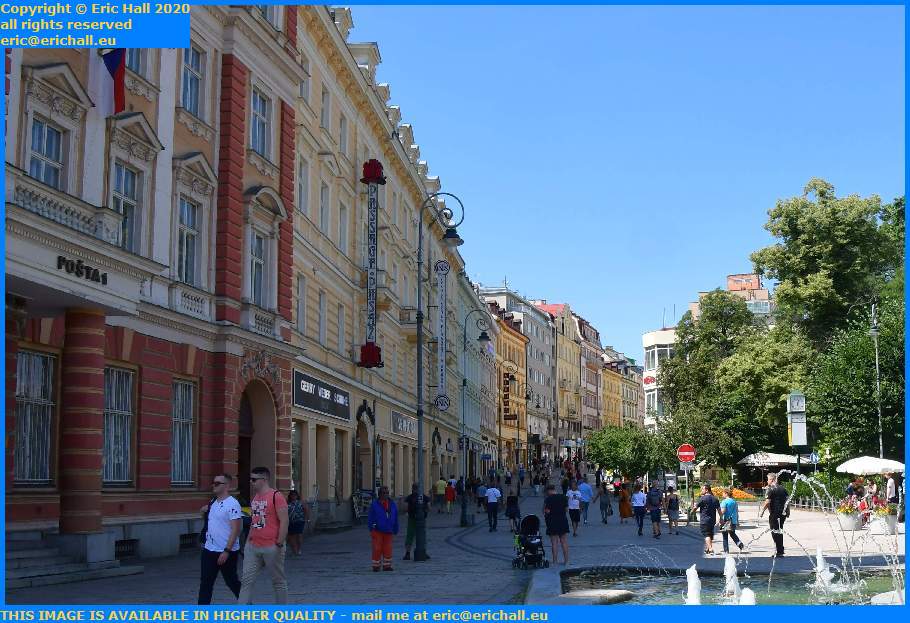
T. G. Masaryka Karlovy Vary Czech republic eric hallA brisk walk along the river from the Park Colonnade brought me into the modern centre of the town.

This is the T.G. Masaryka and it’s around here where you might find all of the modern shops. And if you are wondering to whom the T.G. Masaryka refers, It refers actually to Tomaš Garrigue Masaryk who was a Bohemian politician born in 1850.

Prior to World War I he was working hard to try to convince people to accept the transformation into a Federal State. At the start of World War I he fled into exile and organised the Czech Legion to fight on the side of the Allied Powers with the aim of liberating the Czechs and Slovaks from Austrian rule.

At the end of the war, with the Czechs and Slovaks freed from Austrian domination and was voted President of Czechoslovakia, a position he held until 1935. He was the father of Jan Masaryk, President of Czechslovakia from 1945 until his mysterious death in 1948 on the eve of the Communist takeover.

There was an interesting encounter in this street with regard to money.

The Czech Republic isn’t a member of the Eurozone and still uses Kronor the local currency. At the bank in the cash machine, I was offered 22:13 Kronor to the Euro.

But in one of these exchange booths scattered about the city I was offered 1290Kronor for 50 Euros, an exchange rate of 25.8 Kronor with no commission. And seeing as neither of us had any small change, I ended up with 1300 Kronor.

Someone asked me what I would do if I ended up with money left over after my travels here are over.

The answer is the same that we used to do back in the 70s and 80s when travelling by road in obscure regions of the world. You simply fuel up the vehicle with what local currency you have left.

But returning to the street in front of us, its pedestrianisation was awarded the title of Construction of the Year 2004.
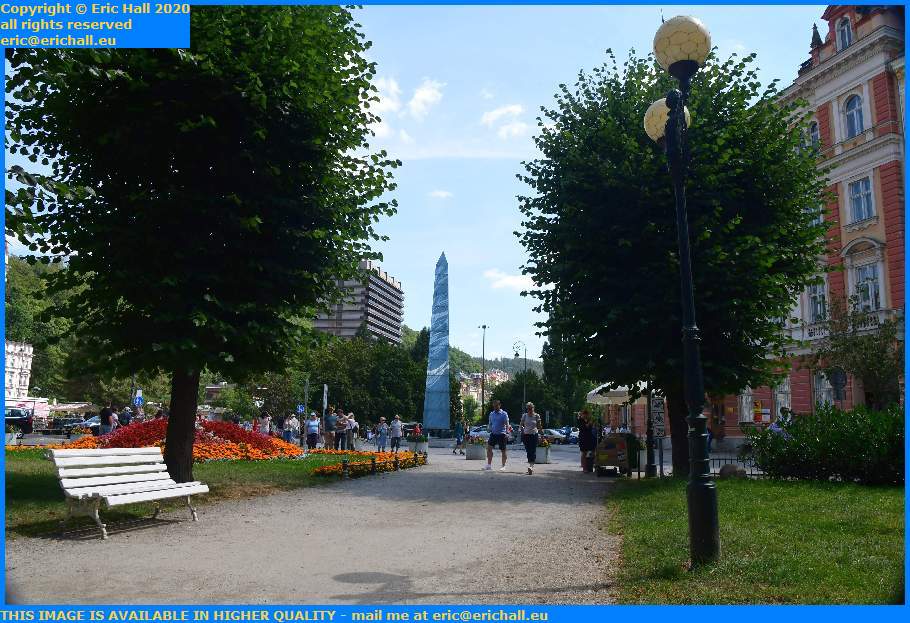
samec kubicek obelisk fountain Alzbetiny Lazne Smetanovy sady Smetana orchards karlovy vary czech republic eric hallJust to my right in the previous photo is the obelisk that you can see in this photo, the Samec Kubicek Obelisk.

It’s a symbolic feature, so we are told, and it’s supposed to represent the boundary between “the peaceful spa area and the excited rhythm of the business zone”.

And if you think that this is pretentions prose, then how about “The pregnant stern silhouette of the obelisk was permeated and visually softened by the bluish light energy from the translucent glass fields with sandblasted drawing and the rounded lines of water splashes”? I don’t want anyone ever criticising any pretentious prose that I might have written when they have this kind of prose to contend with.

The obelisk is situated in the middle of a fountain, a fountain that I didn’t think was all that impressive.

market stall varsavska karlovy vary czech republic eric hallThrough the shopping area I went, and came out the other side into the Varsavska where there was a street market stall selling fruit.

The fruit looked quite delicious and I was tempted, until I saw the swarms of wasps around them. I didn’t want the wasps transferring their attention to me and so I declined the opportunity.

It was interesting to see the “Slovensko” on the edge of the awning over the fruit. That of course is “Slovakia” in the Czech and Slovak language.

The big building behind it with the nice cupola is the former Municipal Market Building. In a sign of the time these days, it’s a supermarket and pharmacy.
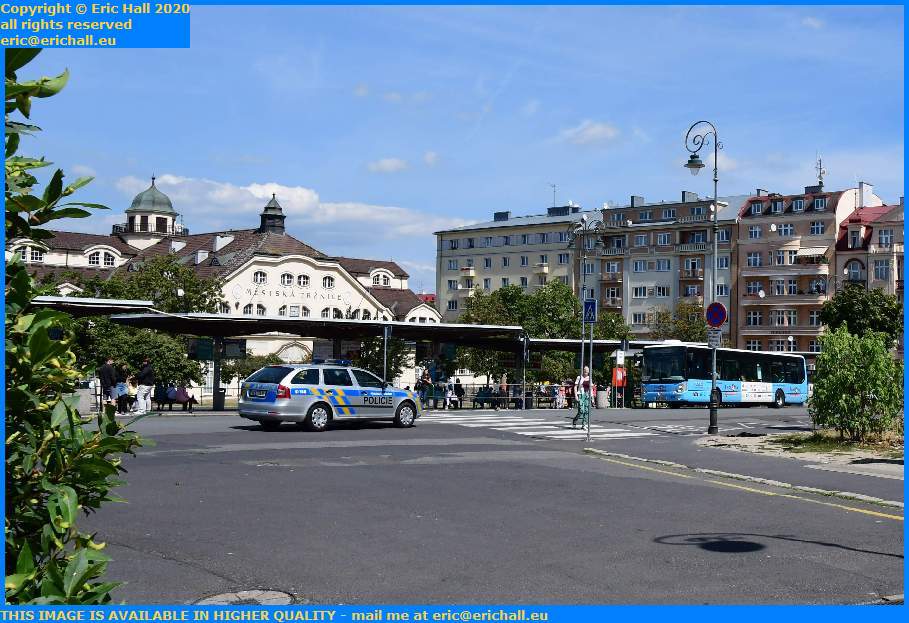
bus station varsavska karlovy vary czech republic eric hallIn front of the Municipal Market Building is the local bus station.

The bus service around the town was something that impressed me considerably. There were quite a few stands at the bus station with a regular stream of vehicles, and also a large crowd of passengers waiting to board them. It seems that public transport is quite a big thing around here.

It seemed to be quite a friendly town for pedestrians. Plenty of streets are closed to motor traffic as we have already seen. I headed off up one of them back towards the quieter part of the town where all of the tourists hang out.
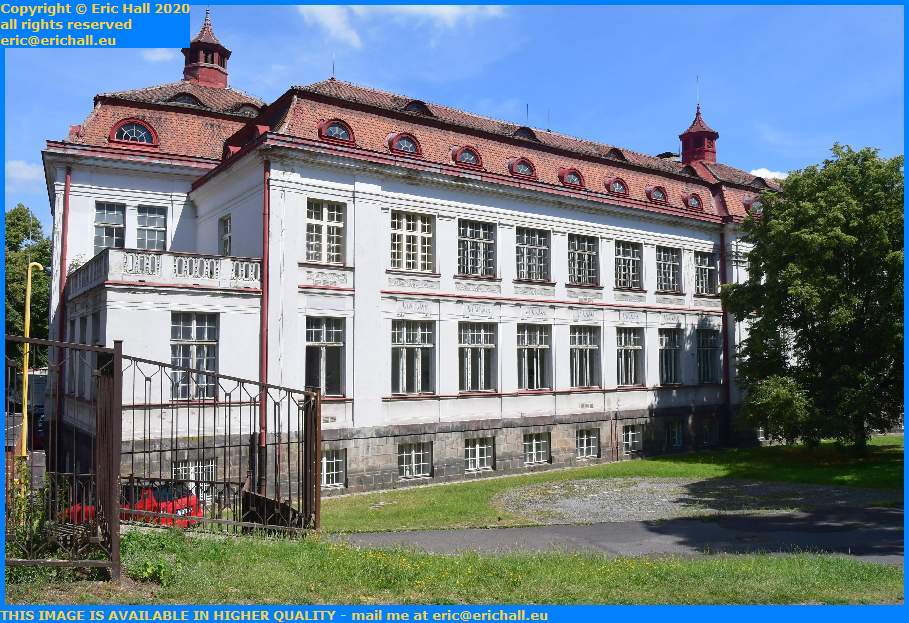
Alzbetiny Lazne Smetanovy sady Karlovy Vary Czech republic eric hallOn the way back from the commercial end of town I passed by this rather gorgeous but very shabby building.

It’s actually a building called the Alžbetiny Lázne, otherwise known as the Elizabeth Spa. And just in case you are wondering who the Elizabeth might be, she was the Empress Elizabeth, more widely known by her nickname “Sissi”.

Born of the Wittelsbach family in Bavaria where we were the other day, she married the Emperor Franz Joseph, seven years her superior, when she was just 16 and was immediately thrown into the limelight to which she was totally unaccustomed. she struggled against her mother in law in an attempt to influence her husband but was particularly unsuccessful.

In the end she fell victim to the Anarchy movement, being assassinated by an Italian anarchist in 1898.
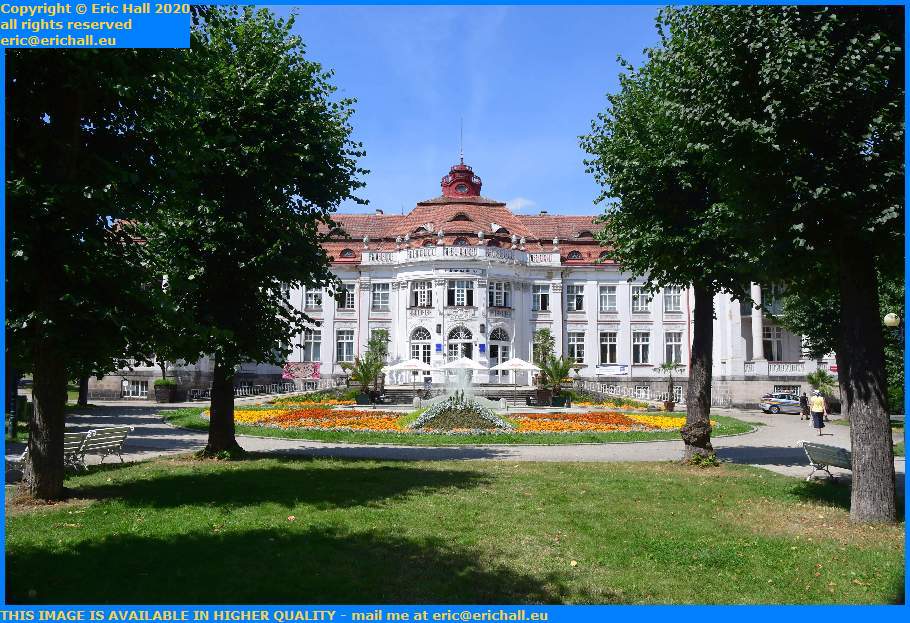
Alzbetiny Lazne Smetanovy sady Karlovy Vary Czech republic eric hallThe building and its Spa were designed in the pseudo-baroque style by the Municipal Architect Franz Drobny. It was built between 1905 and 1906 and formally opened on 18th June 1906.

After the creation of Czechoslovakia, the Spa was renamed as the much more banal “Spa Five”. It was renovated between 1969 and 1973 and again about 20 years ago. While the interior might be the State of the Art, I wish that they had spent some time on the outside because it’s not as good-looking close to as it does from a distance.

In front of it is a fountain featuring the statue of a nude girl, designed in 1963 by Bretislav Benda.

There’s also a very smart little park in front of the building that you might have seen earlier in the photo of the pyramid thing. It’s called the Smetana Park, named after the Bohemian composer Bedrich Smetana.

Having brought a book and a bottle of water with me, I sat down and rested for an hour or so. I can’t say that I didn’t need it.

Now that I was rested, I went off and found something to eat for lunch. There was an Italian guy selling pasta and pizza from a stall and we ended up having quite a little chat in Italian. And then I headed off in the general direction of home, on the other side of the river to which I came.
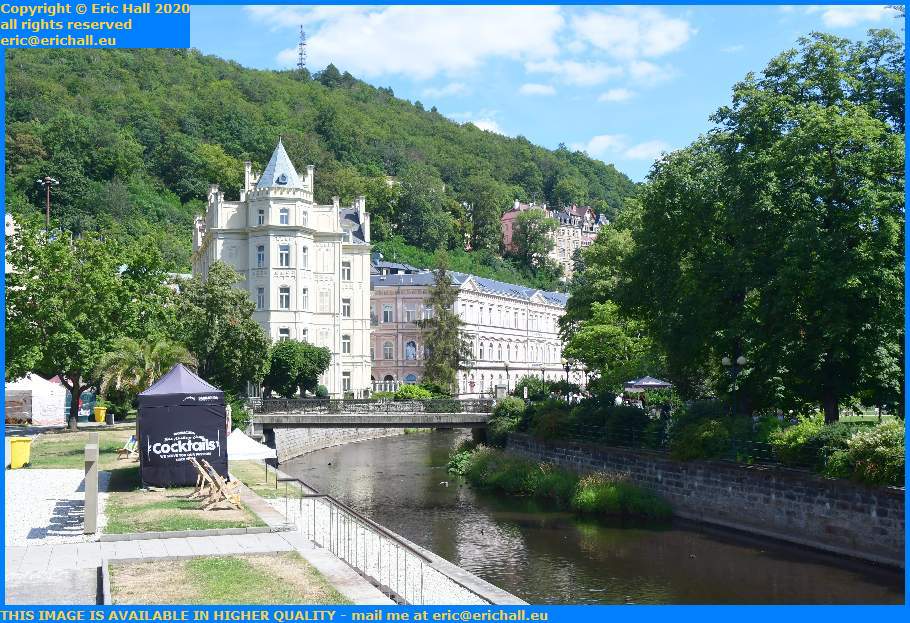
river tepla Hotel Pavlov Ivana Petrovice Pavlova Karlovy Vary Czech republic eric hallThis buiding over there in the Ivana Petrovice Pavlova is the Hotel Pavlov.

What’s exciting about this building as far as I am concerned is its shape. And when you look at it and compare it to the famous “flat iron” on the corner of Broadway and Fifth Avenue in New York, it just goes to show what you can do with a little imagination, something of which is desperately lacking in almost every single piece of architecture in the USA.

The building behind it to the right in the photograph is interesting too. It was probably an old hotel or something similar at one time but now it’s a kind of shopping centre now with quite a few little boutiques in there. I went in there for a good look around but there was nothing in there that was of any interest to me.
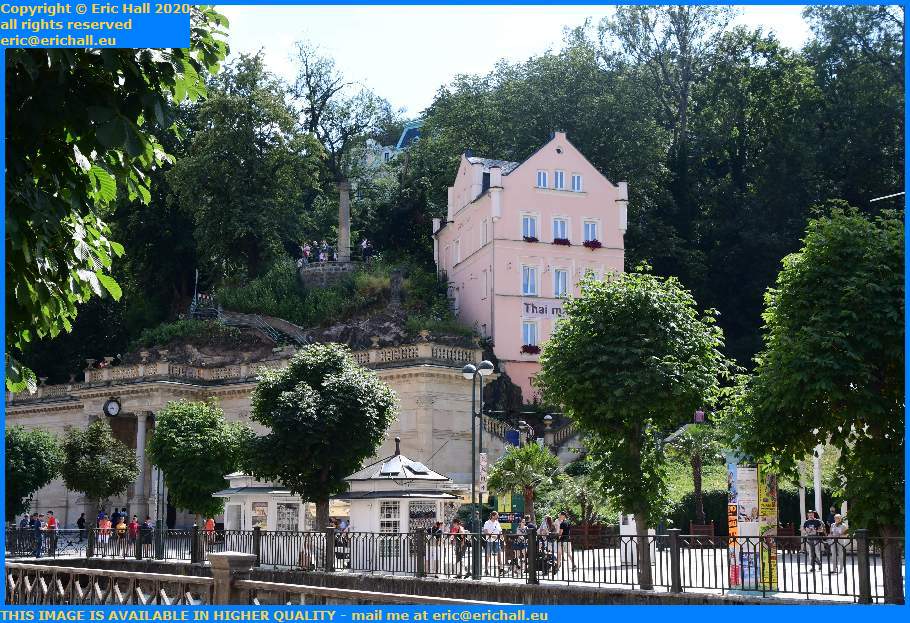
Vyhlídka nad Mlýnskou kolonádou Tawan Nikolina Thai Spa House Mlýnské nábr  Karlovy Vary, Czech republic eric hallComing out of the little shopping centre I had a look across the river to see what I could see.

Over there is some kind of obelisk over there reached by several flights of stairs. Where it’s situated is called the Vyhlídka nad Mlýnskou Kolonádou which, crudely translated by Yours Truly, means “The Viewpoint Above The Mill Colonnade”. I’ve no idea if the colonnade has any significance because I didn’t go up to look.

The building to the right is the Tawan Nikolina, the Villa Nikolina. That’s now a Thai spa and massage centre and right now I could do with paying it a little visit myself after all of my exertions just now.

By now it was time for me to make a start on my walk back home so I began to retrace my steps back to my hotel.
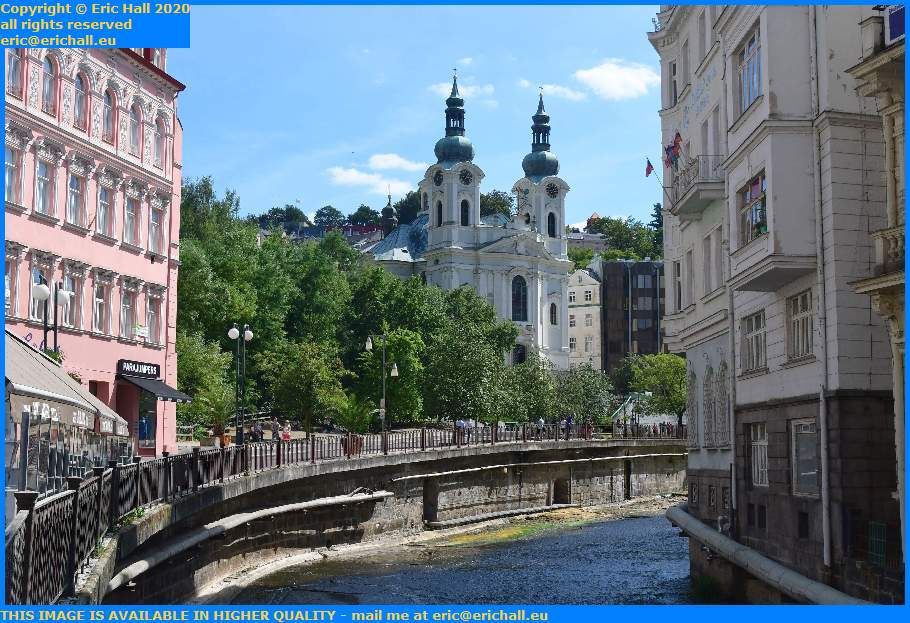
river tepla St Mary Magdalene's Church karlovy vary czech republic eric hallThis is the Church of St Mary Magdalene that I missed on my way into town.

Designed by the Bohemian architect Kilián Ignác Dientzenhofer, it was built in the High Baroque style between 1733 and 1736 to replace a previous church that dated back to the 14th Century but which was in poor condition following a couple of fires.

It’s actually built on top of the crypt of the previous church and you can go down there to have a look at the remains of several people who were interred there during the life of the previous church. Unfortunately it was closed when I went there so I missed out on that and also in seeing the magnificent altar.

Incidentally, in 2010 the church was added to the list of National Historical Monuments.

fountain Stara Louka Karlovy Vary Czech republic eric hallAfter the Church of St Mary Magdalene I found myself back at the Vrídlo – pramen c1, otherwise known as “Hot Spring Number One”.

Because of the pressure of the water in this spring and the amount of carbon dioxide in it, the jet can in some circumstances reach up to 12 metres in height and a temperature of 73°C. Whenever it reaches those extremes, you won’t find all these people loitering around in the vicinity.

On the hill in the background up on the hill is the Diana Observation Tower. That’s probably the place where the view of the town and the surrounding area is the most interesting. It’s been a favourite place with walkers.

They built a funicular lift up to the top of the hill in 1909 and in 1912, to accommodate the increase in visitors, local architect Anton Breinl designed the tower that is now up there. That was opened to the public on 27th May 1914, just in time for the conflict that folllowed.
river tepla Stara Louka Karlovy Vary Czech republic eric hallA few steps further on I can stand on a bridge overlooking the river and admire the fountains that I saw on the way in.

And the esplanade there on the right alongside the river is all terraced out with seats and tables from the cafés in the immediate vicinity. It’s an ideal place to relax even if the shade is rather limited – or, at least it would have been until I saw the prices that they were charging for a coffee. I only wanted a drink – I didn’t want to buy the table and chair.

Instead, I strode off on my way down the street looking for something at a more democratic price. The spring water was out of the question of course. It’s much too warm in this kind of weather, but I was confident that I would find something as I travelled along on my way back to my hotel.
Karlovy Vary City Theatre Divadelní nám Karlovy Vary Czech republis eric hallOne of the most exciting buildings in Karmlovy Vary is the City Theatre.

This was designed by the architechts Fellner and Helmer who designed several other buildings in the town, including the Market Colonnade and the Blanenský Pavilion, of which the Park Colonnade is all that remains. Building began in 1884 and it opened in 15th May 1886 with a performance of “The Marriage of Figaro”.

And that reminds me of the story of the time that someone asled me if I knew about “The Marriage of Figaro” and “Madame Butterfly”. I replied that I didn’t even know that they were engaged.

The interior is just as magnificent as the exterior, with chandeliers, paintings and sculptures designed by a whole host of local painters and sculptors and that’s another building that I would have loved to have visited had it been open to the public at the time when I went past.
river tepla Interhotel Central Divadelní nám Karlovy Vary Czech republic eric hallAcross the river from where I’m walking on my way home is the Interhotel Central, very proud of its “hundred-year history”, something that features prominently in everything that you ever read about the place, although they never seem to go into any details about it.

It’s actually a sanatorium and deals with gastric diseases, and is also a rehabilitiation centre for post-cancer issues. I made a note of the latter for my own purposes, as well as a note of the former if my cooking doesn’t improve.

And I wish that I’d found out more about the building that we can see in the rear to the left in the Lubusina. That’s probably one of the most exciting and interesting buildings that I’ve seen in the town and I could quite happily settle down in a place like that.

As I wandered along the side of the River Tepla on my way back, I came across an Ice-cream stall selling vegan ice cream. In the heat, and having been defied in my attempts to buy a coffee, I stopped and bought one of the aforementioned and took myself off to a quiet place in the shade to eat it.
fountain river tepla karlovy vary czech republic  eric hallSo while I sit here and eat it, I can reflect on my visit to Karlovy Vary before I leave the town.

It’s a beautiful town. Some of it is very much decayed but other parts are well maintained and there is quite a bit of renovation. Plenty of new build too, but unfortunately it doesn’t blend in with the late 19th Century splendour.

And splendour there is a-plenty. It looks really nice today – a fine example of a Bohemian city – but imagine what it must have looked like at the height of its fame in 1913 before World War I destroyed the Austro-Hungarian Empire and we had all of the Sudeten nonsense. It must have been magnificent.

Back home was uphill of course and that wasn’t as easy as going down to town. However using the old British Army marching order of 50 minutes march with 10 minutes rest for every hour I made it back home safe enough.
bridge support river tepla Brezová Czech republic eric hallNot before I’d had a good look at this though – something that caught my eye on my way back to my hotel.

The bridge over the River Tepla here is a reasonably new one but on the right here are some vestiges of a previous construction that might possibly have been of z girder bridge that might have been previously on the site.

It’s interesting, if not amusing, to think about the bridge that might previously have been here and to wonder about its fate. Was it blown up by the Czechs in 1938 during the German invasion? Or was it blown up by the Germans as they retreated north-westwards from the invading Americans?

Or was it simply dismantled when the new bridge was built here? Or is it nothing to do with the bridge at all?

Finally back in my hotel room I crashed out for a while . And waking up, I set tea on route while I had a good shower, shave and clothes wash. And I needed it all too.

Even though it’s early, I’m now off to bed. It’s been a long, tiring day and I’m going to be doing the same tomorrow too. It’s been years since I’ve being this way and I intend to make the most of it.

Tuesday 4th August 2020 – STRAWBERRY MOOSE …

strawberry moose caliburn kyjov 348 15 Zadní Chodov czech republic eric hall… has Czeched in to his latest accommodation.

It’s not the first tile that Strawberry Moose and Caliburn have visited the Czech Republic. We were here IN MAY 2015 when we took the short cut from East Germany and Colditz Castle to Munich.

This time, we’re going to spend a few days exploring the town of Karlovy Vary, or Carlsbad as it was called in its days as a city of the Austro-Hungarian Empire.

We’re installed in our hotel already but we haven’t had a chance to visit the town yet because after the horrible night that I had had last night, I crashed out as soon as I sat down on my bed.

But returning to the beginning, having crashed out earlier yesterday evening, I awoke at about 23:00 and then I couldn’t go back to sleep again for hours. I remember seeing 02:30 come round, and probably a few other times as well.

Nevertheless, I was up at something reasonable, like 06:30, feeling like death again.

There was a pile of paperwork to do, such as transcribe the notes off the dictaphone

There was something going on like an exhibition or a fete or something. I was wandering around somewhere and i’d come across some old shoes of children and I’d stacked them somewhere to hide while I attended this fete. On the way back it was dark and I had awful difficulty finding them. In the end I found them and walked on home. It was a really steep slope and I walked up with someone else. A third person said something like “this is the right place to be to give yourself an alibi. They hadn’t known that I had only just got there. I said “no” and something about how I know people here so I could get down the front. I walked up this really steep slope with this woman. In the dark I had to grope around and eventually found the pile of shoes that I’d hidden. I walked on through this village and this guy accosted me and said “where are your shoes? Why haven’t you your shoes on?” I though to myself “God, is that the only thing he’s noticed?” I felt like giving him a right mouthful then I suddenly realised that I’d dropped some of this pile of shoes so I had to go back and get them. I walked back and retraced my steps and eventually found them. Then I put on some trousers and started to walk back thinking that I’d put on my trousers but I’m not putting on my shoes just for him. If he asks anything I’ll show him these shoes that I have in my hand that I’d now found all of. I also had a box and it was a matching mother and daughter swimsuit that I was going to give to someone. When I got to where I was supposed to be going with all these things they looked at this box and said “God I hope that they can get that in their luggage”. I was thinking that they could always undo the box and take the things out, can’t they?

Next task was to download the files off the dashcam. For some unknown reason the data cable wouldn’t work and I had to dismantle the machine to take out the SD card and insert it in the laptop. It took so long that I ended up with the hotel cleaner banging on the door.

Eventually I found myself back on the road again, heading north.

My first port of call was at Thomann’s at Burgebrach. As regular readers of this rubbish will recall, my acoustic guitar is a cheap and nasty £25:00 cheap thing and after trying to play it at home more regularly than ever I used to, I’ve decided that I want a new, decent one.

Thomann’s is usually said to be the place to go but actually it was something of a disappointment. They didn’t have available what I wanted and the labelling and pricing system of the guitars on display is such that you need to be a contortionist with a magnifying glass to read the prices.

Furthermore, the stock isn’t labelled to tell you what kind of guitar it is.

As for the staff, they seem to be another lot of minimum-wage shelf fillers rather than assistants and have no idea how to engage with the customers. No-one seemed to be interested in talking to me and when I finally grabbed hold of a sales person, he didn’t seem in the least bit interested in my story.

In the end, having driven all the way there, I drove away empty handed, full of disappointment.

At Burgebrach I’m only about 180 kms or so from the Czech border. At the moment the borders are still open but they won’t be for long, so Strawberry and I went for a drive. It’s been five years since we’ve been there.

And despite the short distance, it took an age to get there. The roads are narrow, steep and winding and full of lorries and tractors trying to negotiate them. At one stage we passed a speed indicator that showed that we were travelling at all of 12 kph.

When we arrived at the border we found it unmanned so we just drove straight through. Unfortunately there was nowhere to stop to take a photo of the border sign. We had to drive on to the first village before we could stop.

kyjov 348 15 Zadní Chodov, czech republic eric hallThe village where I stopped was called Kyjov.

It’s not to be confused with the town of the same name that’s to be found in the centre of the country. This is a small village about 6 or 7 kilometres from the frontier with Germany, not too far from Planá in the region that used to be the Sudetenland.

The contrast between the rich West and the poor East is very apparent as soon as we cross over. It brings back all kinds of memories of times past when I used to come over what was the Iron Curtain 30 and 40 years ago. The modernisation of Eastern Europe is a very slow process.

The fuel in Caliburn started to run low so I took a deviation into the town of Marienbad, nowadays called Mariánské Lázne, and fuelled up there, seeing as fuel was cheaper here than in the West.

tatra lorry Becov nad Teplou czech republic eric hallFrom Marienbad I pushed on to the north-east and ended up in the town of Becov nad Teplou.

This was a very interesting place to stop, and for several reasons too, one of which was this gorgeous Tatra lorry. Eastern European vehicles have always held a fascination for me but unfortunately these days it’s very rare to see one running around. Everyone seems to prefer Western vehicles.

Eastern vehicles were heavy, primitive and rather difficult to drive but they were built to last for ever and easy to maintain. There would still be swarms of them on the road today had they not become unfashionable after the fall of the Iron Curtain.

ruined abandoned house hotel central Becov nad Teplou czech republic eric hallit wasn’t just the Tatra lorry that caused me to stop here at Becov nad Teplou. This magnificent building is enough to stop anyone in their tracks.

This is the Hotel Central and looking at it, it’s very hard to believe that at one time it was a luxury hotel. It was built for someone called Georg Rohm in 1876 and sold to a Maria Schmidt in 1892. She sold it on to someone called Franz Bachmann in 1901.

At the end of World War II Bachmann and his family, being of German origin, were expelled from Czechoslovakia and it was used as barracks by Red Army soldiers. After they left it was used as a barracks for miners and they stayed here until the mid-50s.

After being empty for a while it was restored by volunteers and became a Post Office and cafe but the economic situation in the country after the end of Communism meant that there was no money to maintain the buiding and it deteriorated rapidly until it reached the state in which it currently is.

And that’s a tragedy because it’s a beautiful Art Nouveau building with some wonderful features.

Over the road from the hotel is the local railway station. It’s on the line between Karlovy Vary and Mariánské Lázne (the old Marienbad) and I was lucky to find a pile of railway equipment hanging around there.

CSD Class M 152.0 multiple unit train Becov nad Teplou czech republic eric hallOver on the far side of the station were these two diesel multiple units with notices that they will be travelling to Mariánské Lázne.

Not knowing all that much about Czech trains, I reckon that these are two CSD class M 152.0 units coupled together. And if so, although they don’t look like it, these are quite elderly, having been built between 1976 and 1982 by Vagonka Studénka, a company which these days is part of Skoda.

They have undergone two series of modernisations, the latest being 2018, so it looks as if Czech railways is planning to have another 15 years of use at least out of these.

CSD Class M 152.0 multiple unit train Becov nad Teplou czech republic eric hallAnd this is another one of the CSD Class M 152.0 multiple units, all on its own this time.

This one is in the livery of Czech Railways rather than in the livery of a private operator and carries the logo “Regio Mouse” which is a marketing name given to these little trains running on the small local lines of the Czech Republic.

It’s a shame that I wasn’t able to go over and look inside them to see the interior. However I have seen a photograph of the inside of an unmodernised unit and they are quite primitive and basic, very 1970s in fact. I wouldn’t fancy the idea of going on a long-distance journey on one of these. They remind me of Crosville buses from the 1960s.

It made me wonder what the interior of a modernised unit would be like.

siemens dueweg regio sprinter AŽD 654 multiple unit Becov nad Teplou czech republic eric hallThis multiple unit is a much more modern unit.

It’s a Siemens Dueweg Regio Sprinter of the type that was built in Germany between 1995 and 1998. They are quite lightweight and were designed to replace trams and city buses on longer tram routes, and are a great favourite in Europe to run on reopened railway lines.

And it’s for that reason that the Czech Railways have bought some, and called them the AŽD 654 . A large number of railway routes were closed to passengers due to the financial crisis of the early 1990s and a few of them have been subsequently reopened, some being worked by these train sets.

Back in Caliburn I set off from here into the mountains for my destination, Karlovy Vary. A town better known to travellers of 130 years ago as Carlsbad, it was the place to be back in those days, the principal spa town of the Austro-Hungarian Empire where all of the rich and famous “came to take the waters”.

My hotel is a few miles outside the town in the small town of Brezova.

And don’t be fooled that it’s only shown in the advertisements as a short distance away from Karlovy Vary. That distance is measured in a straight line. But in actual fact to reach Karlovy Vary from here you have to go in a tortuous winding direction following the path that the River Tepla has carved through the mountains.

hotel st michael Hamerská 27, 360 01 Brezová, Czech republic eric hallAnd here’s my hotel – the Hotel St Michael here in Brezova.

It’s quite a beautiful hotel but it’s seen better days, that’s for sure. It would have been splendid back in the days of glory of the Austro-Hungarian Empire but like everywhere else, it’s rather tired these days, just like me in fact.

After my rather busy day I’m quite exhausted and tired. I’ve smuggled my food and slow cooker into the hotel and made myself some tea, and then crashed out for a while. Now that I’m awake, I’m off to bed for a really good sleep, I hope. Tomorrow morning I shall go for an explore of Karlovy Vary.

Monday 3rd August 2020 – I’M NOT SURE …

… what it was that went past here at 05:49 but whatever it was, it made enough of a racket to awaken me.

I was in the middle of a nocturnal voyage too – something about an Austin 1300GT that was dismantled. It was bright yellow, the same colour as my taxis were, and we were discussing its paint job. I remember saying that it would come out of the factory with the underneath of the wings already painted like that and so there would only be one or two panels that you would need to pay for the painting.

Anyway, little chance of going back to sleep at that point so I did some work on the laptop instead.

Hans went out to the shop and came back with fresh bread rolls so we had a good breakfast and then went out to IKEA. And there I struck lucky – in the reduced section was a small folding camp bed for just €20:00. That is now in Caliburn ready for another adventure.

For lunch Hans made burgers and chips and then we went for a walk. Because of Brexit issues, he’s had to go back to work and so runs a small whisky shop in the town. He took me to see it and to show me around. And I think that I went on all of these walks today and I forgot to take my camera with me each time.

On the way back we stopped at the ice cream parlour for dessert and then it was time for me to hit the road.

hotel primavera parco furth germany eric hallA leisurely drive through the German countryside has brought me as far as Furth where I’m staying for the night.

This is a nice hotel too. There are several buildings here around a central courtyard so it’s fairly quiet and that suits me fine. I can smuggle the slow cooker into my room without any problems at all and so I’ve had another nice tea of all kind of tinned bits and pieces.

And having done the washing up, I’m going to have an early night. I’ve not done very much today but I’m totally exhausted having done it.

Sunday 2nd August 2020 – TONIGHT, I’M IN …

… Munich in Germany.

It’s Sunday today but even so, I set an alarm. Only for 08:00 though as I need to be up and about, breakfasted and gone by 10:00 today.

And despite the later alarm time and the fact that it’s Sunday, I still awoke bolt upright at 06:03. No chance of gtting up at that stupid time. I turned over and went back to sleep until a more reasonable and respectable time.

All of this meant that there was plenty of time for me to go off on my travels again last night and I started off at Rosemary’s. We were discussing kitchen arrangements, cooking, that kind of thing. I ended up swapping slow cookers and letting her have mine in exchange for one of hers because one was a bigger size than the other and I can’t remember now which way round was which. But it suited me to have the one she had and it suited her to have the one that I had so I proposed a swap

Later on I was with Nerina and we were on our travels. We came to a freighter that was going to take us on to somewhere but we suddenly realised that we didn’t have any insurance and there was no security patrol or anything on board this ship so I had to set off leaving Nerina with the car in this queue to run down the road and came to some kind of insurance place. I went in and it really was a dive. The people there were dirty and certainly weren’t clerical types at all but I explained what i wanted. They went away and came back with a green form. I gave them a £20 note and they gave me £12-something back and a box of chocolates. I had to run back to the car because they would be loading by this time. I’d told them in the insurance what was happening about this and what I wanted. So I ran back and came to these steps and had to run all the way up these steps, stone narrow steps and i was counting them as I went up. I got to 60 but I was still running up these steps and still going and I came round the corner and a couple of kids were playing right by the edge of this cliff drop which I thought was a bit strange. There were still more steps and I had to keep on running up here to try to get back to where Nerina was with the car, carrying the change in my hand, this green card, this box of chocolates

Finally, I was a bit loaded up last night. I had all of my holiday gear with me including the camera. I ended up with a guitar and I had a long way to walk. I was hoping that I would find somewhere where I could leave the guitar and come back for it later. My first idea was the church so I went there but it was all locked up. I was wondering what to do and someone else told me that there was another church further on downtown. I walked down there and came across some kind of building and the church was built on the back of that. I went round the back there just as the policeman was locking up the door ready to go away. I thought “forget that” and continued walking. I suddenly had this thought “what have I done wiht my camera?” I had a search among the stuff that I was carrying and in the end found that the camerz was slung around my neck but for some unknown reason it was underneath my jumper. At least I had it. I had to carry on walking towards where I was going to go and that was where this voyage broke off.

After breakfast it didn’t take too long to pack and tidy everything up, and by 10:00 I was on the road heading northwards.

The weather had started off as a gloomy morning and that didn’t help my mood. And neither did all of the grockles driving around at about 20mph admiring the scenery. They might have had nothing better to do, but I did.

There were several roadworks and diversions too. Because of the winter weather there’s only a short timescale in which to do road-mending so of course it has to be in summer.

The closer I came to Munich the greyer the weather became and by the time I came out of a tunnel on the Munich ring road I was in the middle of a torrential downpour.

One thing that I have noticed is that this Satnav is not using the same program as the previous one. Despite setting the preferences to exactly the same as the previous one, it brought me into Eching in a completely different way and I drove past Hans’s apartment building before I had realised where I was.

It’s nice to see Hans again. We had a coffee and then despite the showery weather we climbed into Hans’s jeep and headed off to the nearest metro station to catch a train into Munich.

Hans knew of a little vegan restaurant so we headed there for a drink and some banana cakeand then wandered off in search of excitement.

Wittelsbacher Brunnen Maxvorstadt, Munich, Bavaria, Germany.eric hallOur first port of call was the Wittelsbacher Brunnen, or fountains.

The Wittelsbachs were the royal family of the Kingdom of Bavaria until the political upheaval at the end of World War I. Munich was their capital and the eplendour that survived the bombing of World War II gives some kind of indication of their wealth.

The fountain was designed by Adolf von Hildebrand, a famous German designer of fountains, and sculptor Erwin Kunz and was built between 1893 and 1895.

Wittelsbacher Brunnen Maxvorstadt, Munich, Bavaria, Germany eric hallIts purpose, bizzarely enough, was to celebrate the arrival in the city of the new high-pressure water pipeline from the Mangfall, a river in Upper Bavaria that is a tributary of the river Inn.

A site was chosen at the junction of the Karlsplatz and Lenbachplatz where the old city walls had been, and it was unveiled on 12th June 1895. We are told that the design consists of all kinds of allegories connected to the power of water

The fountain suffered damage during the bombing raids but was restored by one of Hildebrand’s pupils and reopened on 3rd October 1952.

From there we pushed off down the road to continue our little exploration of the north-west corner of the inner city.

karolinenplatz munich bavaria germany eric hallOur little stoll brought us to the Karolinenplatz. This is named for Princess Caroline of Baden who married Maximilian Joseph, Duke of Palatine-Zweibrucken and became Queen Caroline II of Bavaria when her husband became King in 1806.

When Napoleon set off for his disastrous invasion of Russia in 1812, he took 36,000 Bavarian troops with him, but only 6,000 returned home. The column, designed by Leo von Klenze, is a monument to those 30,000 Bavarian soldiers who disappeared.

The Square was designed by Karl von Fischer (who died in 1820) who based his design upon that of the Place de l’Etoile, where the Arc de Triomphe is, in Paris.

The big building to the left of the column is the Palace of Prince George and you might have expected it to have been easy for me to tell you all about Prince George, but instead I’ll merely mention that so far I’ve been able to trace about a dozen Prince Georges so you can take your pick.

Our next stop is going to be the the Konigsplatz so we walked down the Briennerstrasse, another part of von Fisher’s great design.

On the corner of the Arcisstrasse are two very large and heavy plinths that I didn’t photograph, because there are the bases of a couple of temples erected to the memory of thse supporters of Hitler who were killed in the Munich Putsch of 1923.

konigsplatz munich bavaria germany eric hallThere was no summer festival in Munich this year because of the virus, which was a shame although it was quite understandable, but what we had instead were little festival sites scattered around the city, like the one here at the Konigsplatz.

This is another part of Karl von Fischer’s masterpiece. He had been charged with organising an orderly expansion of the city beyond the old city walls at this point.

The Propylaea Gate that we can see in this image though isn’t by him but by Leo von Klienze and dates from 1862. It was originally intended to be a commemoration of the accession of King Ludwig’s son Otto to the throne of Greece in 1832 but it took so long to build that in effect it became a monument to the overthrow of King Otto from his throne by the Greek people after 30 years of rule.

roundabout summer in the city konigsplatz munich bavaria germany eric hallThe whole area is bedecked with “Summerin the City” banners as people make the most of whatever entertainments there are in the area.

Everyone seemed to be enjoying the fun, even if there wasn’t all that much of it. It’s a far cry from the traditional Munich summer festivals but we are living right now in extraordinary times.

Having wandered around loking at the sites and being unable to go to either of the two museums here, we went off for a wander around to look for a metro station because we were going to be heading from here into the town centre. We eventually found something in the Louisenstrasse and from there we ended up in the Marienplatz.

One thing that I like about the German language is the name that is given to the local town hall and civic administration offices in the towns – the Rathaus. I can’t think of anything more appropriate.

old town hall Altes Rathaus Spielzeugmuseum marienplatz munich bavaria germany eric hall
This is the Altes Rathaus, or Old Town Hall. The building was known to be in existence in 1310 and underwent a reconstruction, the first recorded of very many, between 1392 and 1394.

The spire beside it is actually the old Talburgtor gate in the eary city walls. As you can see, the gate is quite narrow and so in the 1870s they actually tunneled through the ground floor, with a second tunnel being put through in 1935. And in 1938 in the Great Hall Josef Goebbels made the speech that launched the Kristallnacht – the destruction of Jewish property in Germany in 1938.

It was badly damaged by bombing in World War II and not restored until the early 1970s. Somewhere in my ancient collection of photos I have a photo taken of it in 1988 when I was here with Nerina and when I get back to the farm, whenever that might be, I’ll dig it out.

town hall rathaus marienplatz munich bavaria germany eric hallThis building here looks absolutely magnificent so it’s very easy t lose sight of the fact that this is a much more modern “Gothic Revival” building.

In the second half of the 19th Century it became apparent that the old town hall was becoming too small for modern needs so in 1867 construction of a new building, designed by Georg Hauberrisser, began.

The Town Council offices moved here in 1874 but as the building was still too small, further enlargements took place. The building was not finally finished until 1906. It has 400 rooms and covers an area of over 9,000m²

Somewhat surprisingly, it escaped severe destruction during the bombing attacks of World War II and was very quickly, if simply, restored

musicians marienplatz munich bavaria germany eric hallOne thing that was nice to see here was a group of musiciens entertaining the crowd of people.

Although masks are not compulsory in the open air, it’s pretty much a waste of tie to just wear one over your mouth and not over your nose. And I would have loved to have seen the flautist play the flute wearing a mask. That would have been interesting.

Having finished our wandering around we ended up in the Munchener Freiheit at a little Indian café that I know, rather like the one in Montreal. A bowl of curry was delicious – it’s been a long time since I’ve had a decent one of those.

By now the heavens had really opened and we were being pasted in a torrential downpour. Walking from the metro to the car, we were drenched.
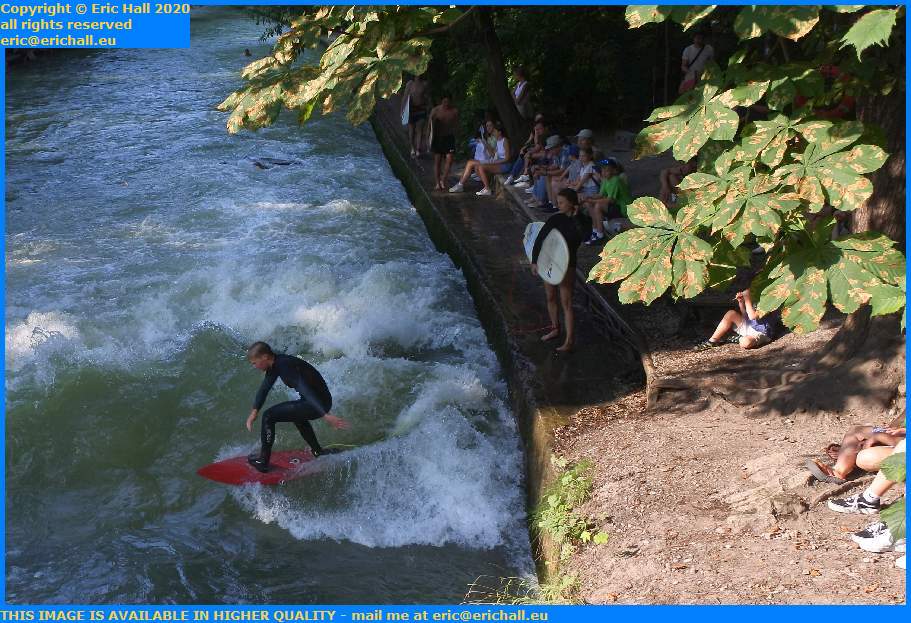
A couple of films and a good chat finished off the evening and then we all went our separate ways.
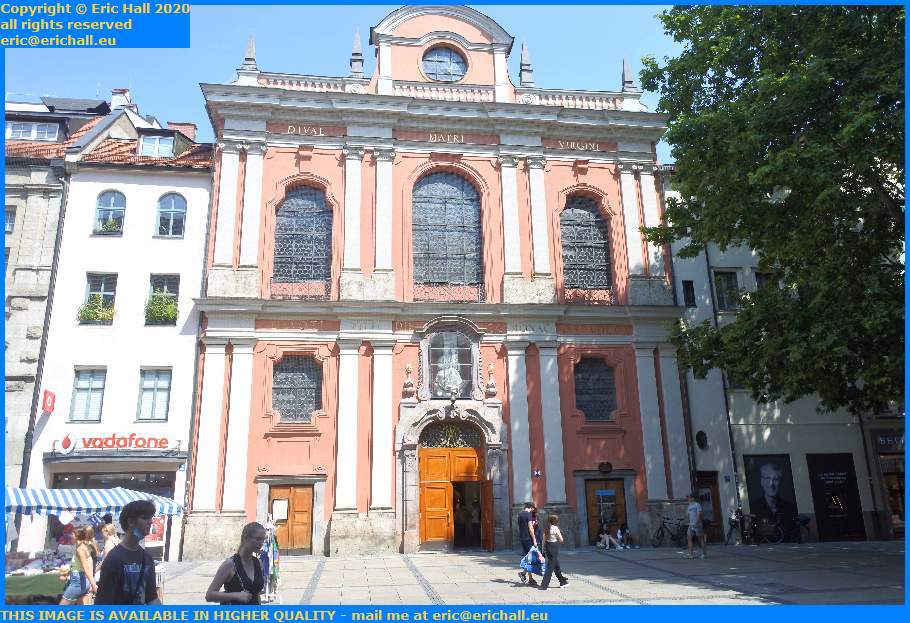
The sofa here is really comfortable so I’m settled down for the night. We’ll see what tomorrow will bring me.