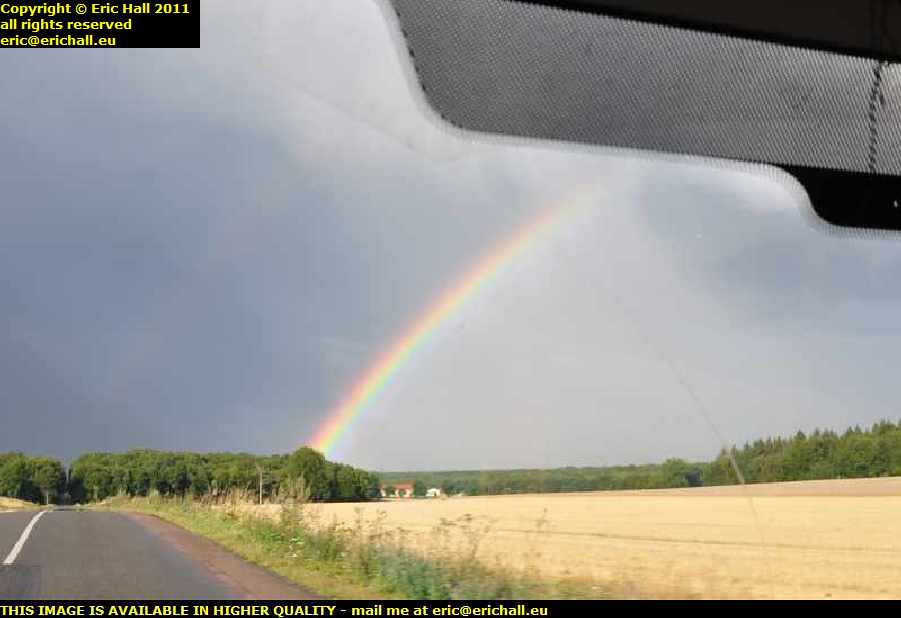
 … here at Blanc Mont and I woke up bright-eyed and bushy-tailed.
I wasn’t alone here either despite what it looks like in the photo. Discreetly hidden in the bushes is a French Army radio post and they were most surprised when I stumbled upon them last night when I went for a walk. I had a feeling that they wanted me to clear off but not much chance of that.
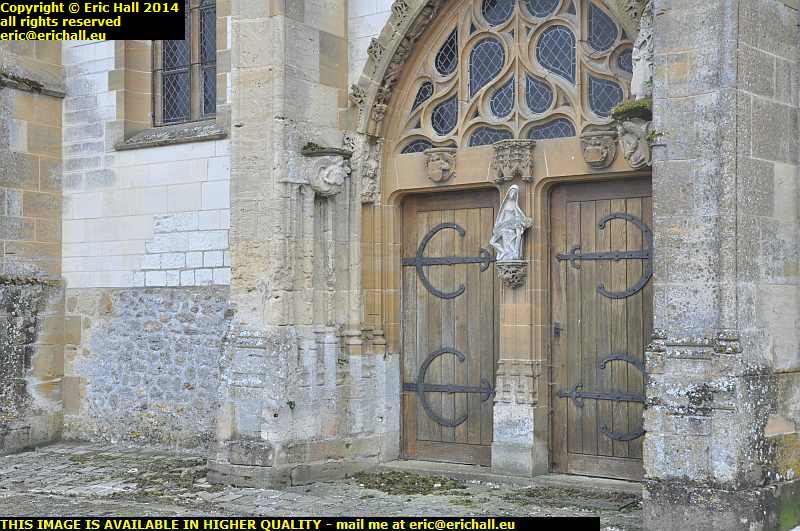 Of all of the villages around here, there’s not much to see. Not for me anyway as there is nothing much of historical importance. Well, not for me anyway as everything was obliterated during the fighting of 1914-18. You can see in the odd church some kind of vestige of original stonework, badly damaged by the shelling, but rebuilt with modern techniques and modern materials.
Still, the emphasis here in 1919 was on time, not on aesthetics, and you can’t blame them for that.
 This is Navarin Farm on another high point of a Marne ridge. This is a monument raised by public subscription to remember the dead of the Battles of the Marne and is an ossuary where the bones of unknown soldiers recovered from the battlefield in modern times are laid to rest. Even 100 years on, they are still recovering soldiers from the fields.
It’s possible to go in for a visit, but not for me because, with my usual luck, it’s closed.
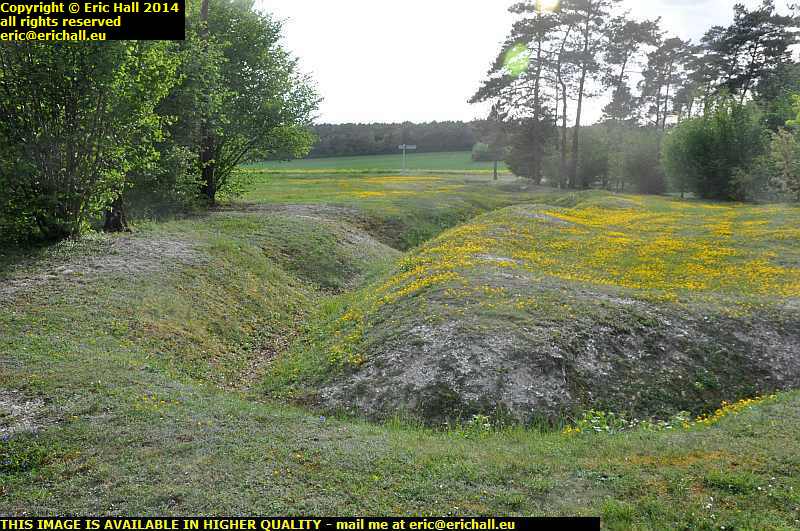
 Outside the ossuary, the ground, in public ownership, has been left exactly as it was at the end of the war. You can see a couple of trench systems here, a concrete pillbox, and thousands of shell holes littering the site.
Just add to this a few feet of water – not hard to do as it was pouring down on an off all through the day, and you can imagine what a nightmare it must have been to have lived in these trenches for 4 years.
 Suippes has not much to celebrate as it’s another largely-reconstructed town. Its claim to fame is that during World War II it suffered something of a massacre of its civilian population as you can see from this commemmorative plaque.
It’s quite easy for many people to criticise the French civilians in respect of what some see as a lack of resolution towards the German occupying forces but as I have said before, the critics have never had to run the risk of four years of bombing and four years of Gestapo activity, and never had to stare arbitrary death in the face.
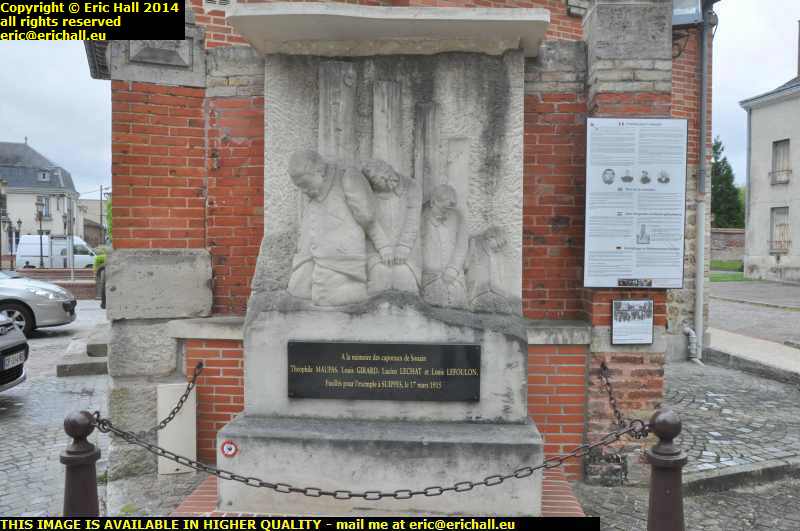 Another dark claim to fame, or maybe infamy, is an event that took place here in 1915. A Division of French soldiers was ordered “over the top” to attack the enemy but having been shelled all through the night by their own artillery which had incorrectly calculated the range, the survivors were reluctant to leave their trenches once the barrage had moved on.
The French military authorities were not impressed and picked at random 25 soldiers and tried them for cowardice. All were found guilty in a summary drum-head court martial and the 4 NCOs were stood up against a wall and shot. It was the inspiration for the Kirk Douglas film Paths Of Glory
There’s also a museum here and I had a little argument with them about their notices and descriptions – everywhere they talk about Angleterre and the Anglais. I had to remind them, most insistently, that the country is called Royaume-Uni and its inhabitants are called Britanniques.
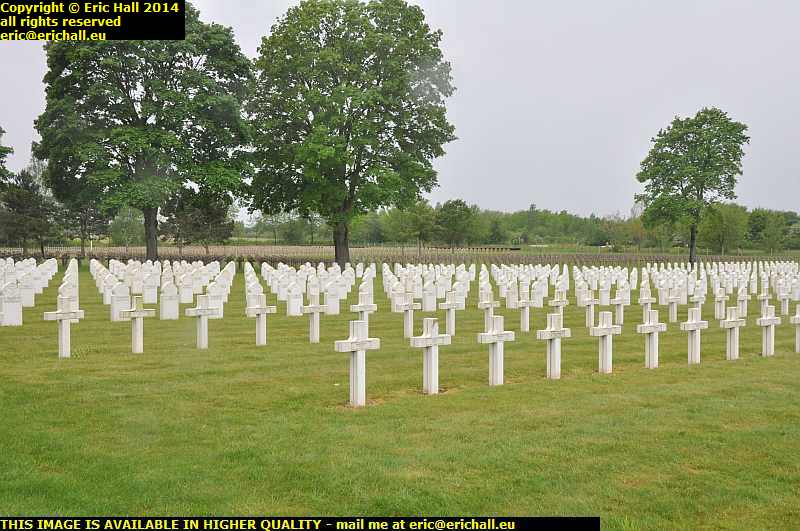 In the driving rainstorm I paid a brief – but only a brief – visit to a French military cemetery – the Suippes Farm cemetery.
It’s interesting here to notice that many of the headstones are not crosses but a more traditional design with Arabic writing. It’s quite often forgotten that the Arabic colonies of France supplied a huge proportion of soldiers to the French Army and they died for France in the same way that the soldiers of Metropolitan France did. And as soldiers from West Africa did too.
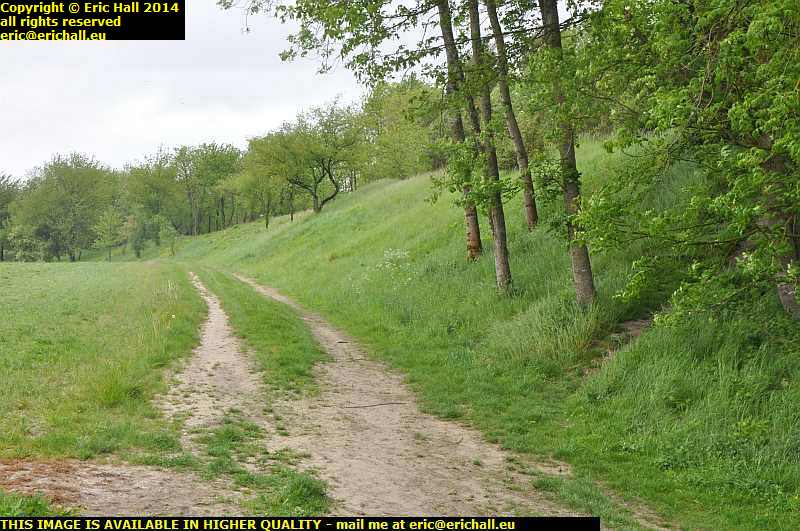 A short drive down the road at La Cheppe, there’s the Camp d’Attila. That’s a Gaulish oppidum of, would you believe, 22 hectares surrounded by twin earthen banks and this is surprisingly complete too. It’s very impressive to go for a wander around the ramparts in the rain – I was certainly having no luck at all with the weather. There’s even a Roman road that passes right by the camp. It’s the kind of place that has everything.
So now I’m off to spend the night on the edge of Chalons. I don’t care what they call it today, or what they will call it in the future. To me, it always has been and always will be Chalons-sur-Marne.