Tag Archives: roman concrete

Friday 11th October 2013 – I’VE BEEN ALL AT SEA TODAY.

Something that will come as no surprise to anyone who knows me. Most people have been saying that for years.

makaira II speedboat rosy's holiday village agkistri greeceBut actually, what I have been doing is to do with work. Here on the Island of Anxios, in the Sporadic Islands, Rosy (who owns the little hotel complex where we are staying) and her husband Nondas have bought a speedboat thing, and they will be offering it as an attraction for their clients next year.

Consequently they needed a few photos for their next-year’s holiday brochure and so Yours Truly was enrolled to do the honours.

makaira II speedboat rosy's holiday village agkistri greeceConsequently everyone piled into the Makaira II and off it went like a ferret up a trouser leg.

The driver of the little power boat thing in which we were travelling had loads of fun doing some synchronised sailing to get into some really good positions, but we managed in the end to shoot off about 30 photos of which 4 or 5 made the cut.

makaira II speedboat rosy's holiday village south shore of agkistri greeceAnxios is quite similar to parts of Québec and Labrador in the sense that the road to the south side of the island has only been made quite recently. Prior to that, all communication was by water, and you can understand why the locals would want to keep it all to themselves, because it really is something out of a photography album.

I’ve never seen a sea as clear as this round here and even though the water might be several metres deep, you can clearly see the bottom of the sea and the fish that are swimming around in it – something that you could never do in the north of Europe.

roman concrete agkistri greeceThis afternoon I went for a wander around to that bay where I thought that I had recognised some Roman concrete. I managed to find the pathway down and went for a closer look.

The conclusion is that it’s not volcanic, and it’s not sand that is binding the stones together. Whatever it is has certainly set quite solid and doesn’t look as if it was ever intended to move. Of course, I’m no authority on anything but this is so different from anything else in the immediate vicinity and bears no relation whatever to the natural geology, and given its strategic position I could easily imagine this as having been constructed deliberately by a human agency.

momument memorial to 1821 Agkistri greeceON the way back, I passed this monument in the church grounds. I can’t read what is written on it as my Greek isn’t good enough, but there is a date of “1821” clearly engraved.

Back in the early 19th Century Greece was part of the Turkish Empire, but all through that century, parts of “The Sick Man of Europe” were amputated and many historic nations in South-Eastern Europe came back into existence, Greece being one of them. It’s said that in 1821 the movement for Independent Greece used the island of Agkistri as its headquarters and so it wouldn’t surprise me to learn that this is to commemorate those islanders who achieved independence for their country.

Wednesday 9th October 2013 – TODAY I TOOK THE PLUNGE …

… and ended up in the sea. Not for long because it isn’t all that warm in October, but I was in the sea all the same. I was out for a walk in the early afternoon and came across Trixi, Glynis and Helen having a swim from the beach.

By the time that I came back with my cozzy they were ready for a coffee and so we tottered off to a café, and when they left to go back up to Rosy’s, I took the plunge.

Apart from being freezing cold and the sea bed being all pebbly, it’s quite a curious sensation being surrounded by an enormous shoal of little fish. I was wondering whether they might be piranhas or something equally devastating. Knowing my luck so far, nothing would surprise me.

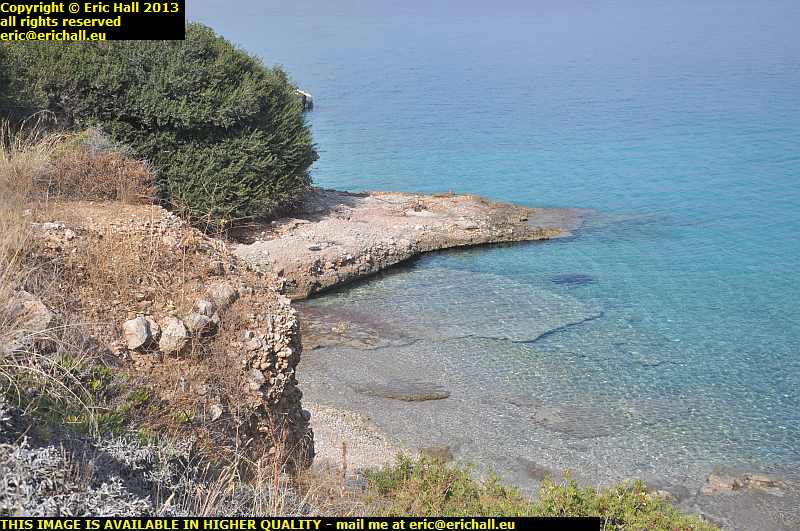
roman harbour ruins agkistri saronic gulf greeceYou can see in this photo just how clear and clean the water is, but that’s not why I took this photo.

Looking at the cylindrical wall just in the foreground, and in the rock shelf behind it stretching out into the sea, they have all of the appearance of Roman maritime concrete, if you ask me. And of course, that would not be surprising for during a couple of hundred years the Romans were the masters in this part of the world and building a harbour on the island would not be an unexpected piece of construction.

And apart from that, I’m yoga-ing, singing, and eating and sleeping well. I can’t fault the food that I’m receiving and whilst the room might be small, it’s one of the most comfortable beds I’ve ever slept on.

Tuesday 13th July 2010 – Some people have all the luck

rosemary gorges de la sioule pouzol puy de dome franceTerry had a job to do this morning and he needed a hand, so seeing as I owe him God knows how many days’ work I went along to help.

And where we ended up was at a house right on the edge of the Gorges de la Sioule – the cleft in the Combrailles that runs from South-West to North-East.

The view is certainly spectacular from here, that’s for sure and I wouldn’t mind a little field right up there at the back to build my log cabin.

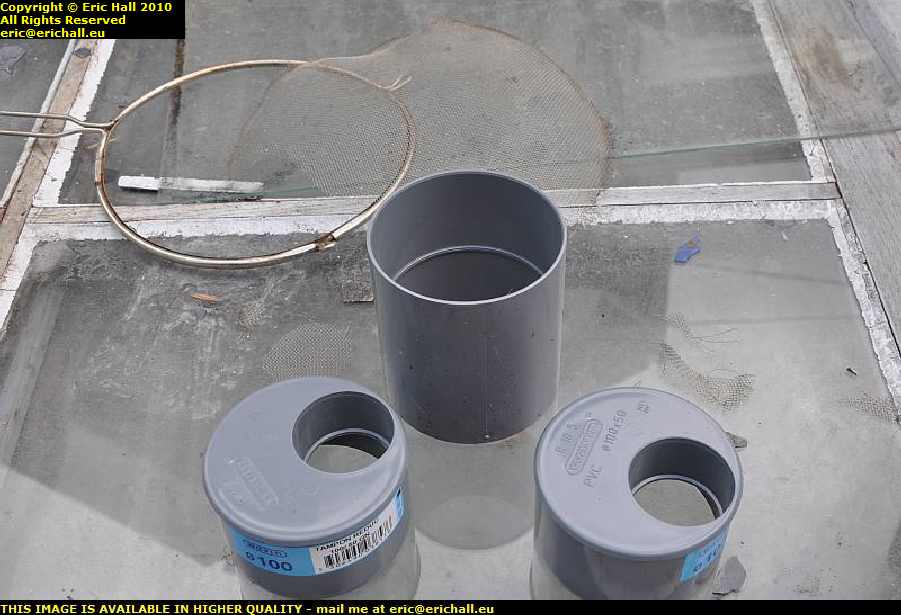
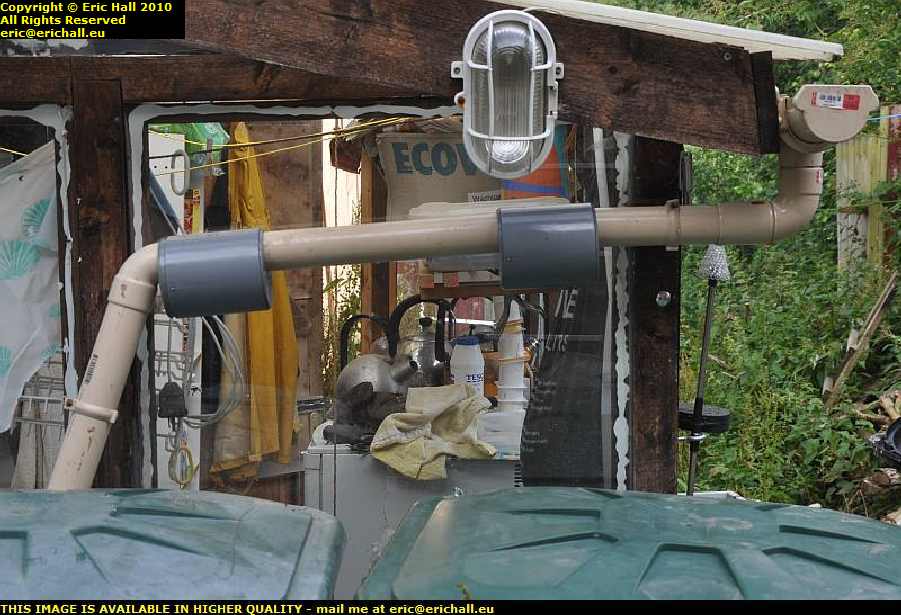
rainwater harvesting home made rainwater filter les guis virlet puy de dome franceAnd back home I started work on part one of the patent water filter system (and I would have done part two too but Terry forgot the puzzolane). Part one consists of a length of 40mm downspout, a reduction plate from 40mm to 100mm, a length of 100mm pipe, another reduction plate back to 40mm, a section from an old stainless steel mesh kitchen strainer and another length of 40mm pipe into the water butts. This first filter takes the place of the sump (the stones and the like sink to the bottom of the 100mm pipe) and the mesh filter inside the water butt.

verandah lean to rainwater harvesting home made rainwater filter les guis virlet puy de dome franceYou can see what I mean in the photo just here. Filter n°1 is the one on the right-hand side. The mesh is to the left of the filter so anything that I don’t want to drop into the tank will stay in the section of 100mm pipe – the grey stuff.

To the left of filter n°1 is another grey section of 100mm pipe. That will be filter n°2. It’s constructed in the same way as filter n°1 except that it will be filled with puzzolane and there will be stainless steel mesh at either end. The purpose of that will be to to keep the puzzolane in the section of 100mm pipe and that will be the water filter.

I’m eventually going to make up two sections of these so that I can change them and clean them. Cleaning by the way will be quite easy – you just put a pressure hose to blow backwards and that will move all of the debris out.

Of course the idea of using puzzolane is not new. The Romans were the first recorded users of puzzolane for filtration purposes (they also used it as a base for Roman concrete) but nature makes quite good use of it too – Volvic water from just down the road from here uses natural puzzolane seams to naturally filter the water that rises up from the water table. That’s ground water of course – and I’m using rain water so I bet mine will be cleaner than theirs.

Tonight I went into Pionsat for the annual fireworks display. And that was nothing much to write home about although it is nice to go out. But it did remind me of Guy Fawkes’ Night 1980 when I was a taxi driver in Crewe. There was a company in Crewe at that time called “Dial A Car” and they had two vehicles, a Vauxhall Victor Transcontinental Estate that was driven by one driver, and he had only one speed and that was “flat out everywhere”. The other car was an absolutely ancient and derelict Ford Zephyr. That night around Crewe these two cars became affectionately known as “Dial A Rocket” and “Dial A Banger”.