… good time last night and covered a lot of ground, and being to cold to sleep for too long, I was up and about today in plenty of time.
 Of course, it goes without saying that I’m open to all kinds of sightseeing opportunities when I’m on my travels, so when I saw a sign for “St Valéry-en-Caux”, I was off.
St Valéry-en-Caux has something of a reputation dating from World War II and the Fall of France.
The town was the site of the “last stand” of the British Army on Mainland Europe in June 1940
 The British Army’s 51st Highland Division had been detached from the rest of the British Expeditionary Force in order to go to assist the French at the Maginot Line.
They had thus escaped being encircled and trapped in Dunkirk, and they retreated to the west.
The plan was to evacuate them from St Valéry-en-Caux – not the ideal place but the only place possible that had not been overwhelmed or threatened by the Germans’ rapid advance.
The navy duly arrived on 10th June, but the troops had not yet arrived. And having suffered an aerial attack, they pulled back offshore.
The soldiers arrived shortly afterwards and hastily threw together a defensive perimeter around the town to protect the evacuation, but the Germans were too quick.
The arrived hot on the heels of the Highlanders and overwhelmed the perimeter quite quickly.
By the time the ships returned next day, it was already too late. The fighting was all over and practically the entire 51st Highlander Division had been led off into captivity.
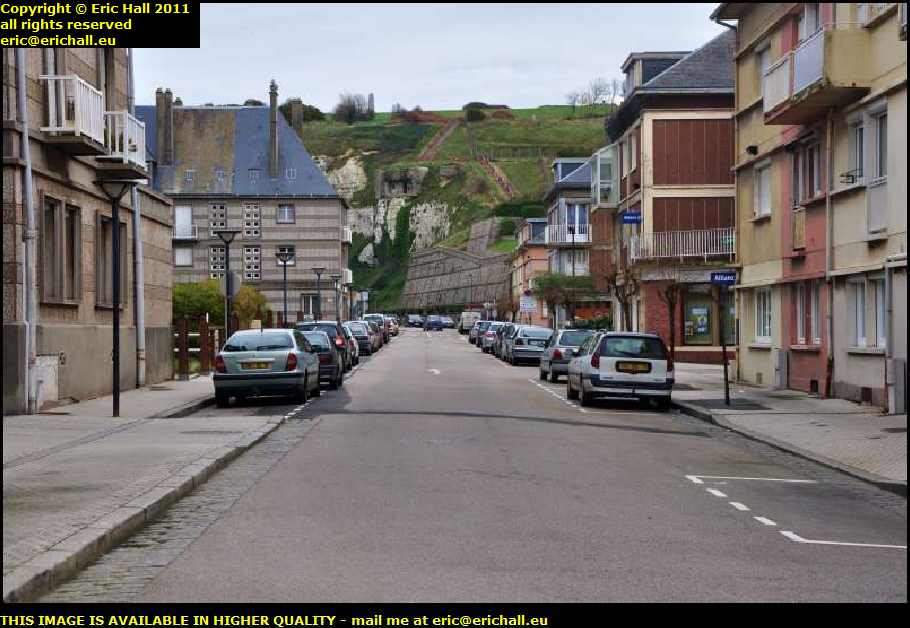 In 1950 a memorial stone to the 51st Highland Division was erected on the cliffs on an eminence that dominated the town.
That’s it up there on the skyline in the centre of the photograph.
The erection was, apparently, something of a ceremony, with the pipers of the Black Watch playing “The Last Post”.
 I actually saw a photograph of the town on that occasion, and it didn’t half look a mess – even 5 years after the end of the War.
The town was fortified quite heavily by the Germans as part of “The Atlantic Wall” so it’s no surprise that heavy fighting took place around here later in the War.
The amount of destruction in the town, and the fact that the fortifications escaped so lightly, is some kind of testament to German thoroughness.
 That is of course one reason for visiting the town. There are plenty of others too.
It’s quite a historic place, being first mentioned in a Charter of 990, although legend has it that the town actually dates from the 7th Century when a religious institution was founded here as part of the plans to evangelise the coast.
Nothing has been seen to confirm this, and no trace of a likely building has ever been discovered.
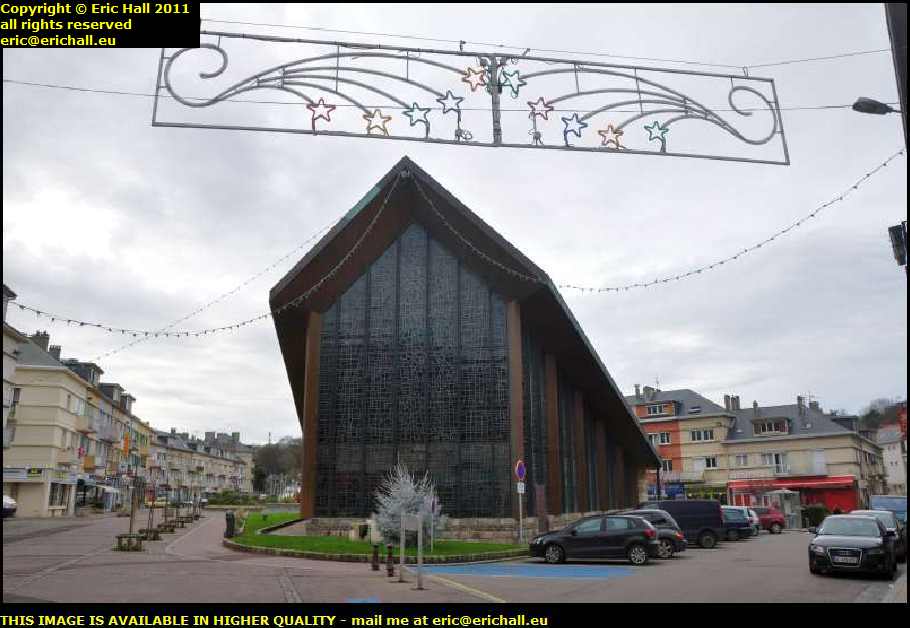
 First port … if you pardon the expression … of call in St Valery-en-Caux has to be the Chapelle Notre Dame du Bon Port – the Chapel of Our Lady of Bon Port – the “Good Port”.
This magnificent wooden structure, designed by Raymond Jules Lopez, and situated in the … errr … Place de la Chapelle.
It dates from 1963 and replaces a much older chapel that was destroyed during the war.
 And in an irony that seems to have gone right over everyone’s head, the stones from the original chapel – about which nothing much seems to be said – were used for a very secular purpose – to build the casino in Veulettes sur Mer.
Its stained-glass windows, designed by André-Louis Pierre, are said to be magnificent and are best viewed from inside, something which I was very keen to do.
And so in a situation that somehow only I seem to be able to manage to conjure up, the church is closed today and the doors are locked.
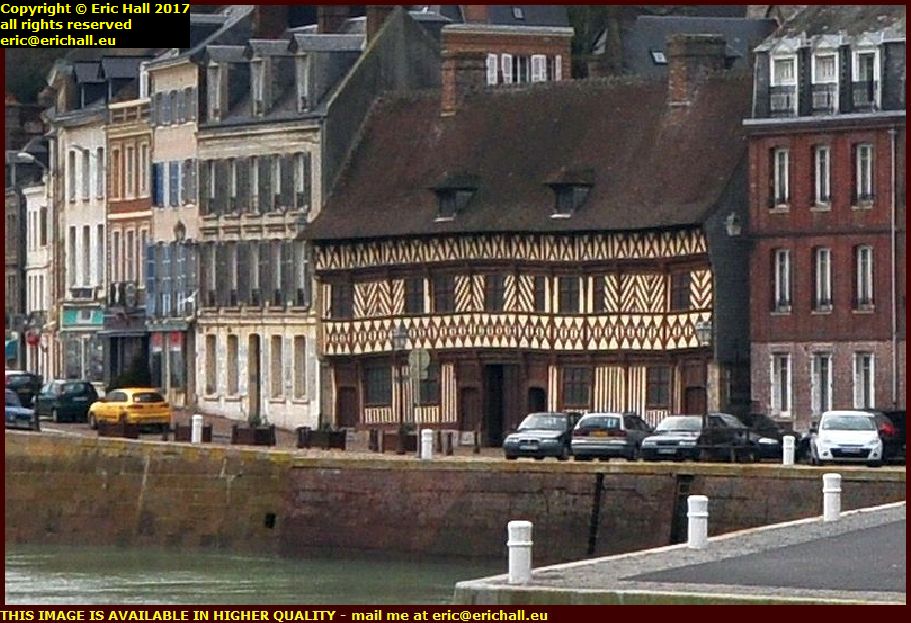 The most magnificent building in the town is what it known as the “Maison Henri IV”.
Built in 1540 by the wealthy Guillaume Ladiré, it earns its name from a story that suggests that the French King Henri IV spent a night here in 1593.
It’s said by many to be the finest “Normandy-style” half-timbered house in the region and who am I to disagree?
Yet another claim to fame possessed by the town, and about which people are quite reticent, is the fact that a major rail crash took place here on 17th January 1945.
The fact that it happened in wartime and involved armed forces means that it never received the publicity that it might otherwise have done had a news blackout not been in force.
A train loaded with American soldiers was coming into town when a brake failure cause it to overrun the buffers at the station. 89 American soldiers were killed and 152 injured.
Finally, and most importantly, there’s a transatlantic telephone cable – the TAT 14 – between North America and Europe that runs out to sea here. According to the American Secret Service, this is a vital communications link and so the area is considered by the US military to be a “strategic point”.
We all know what that means. Iraq and Afghanistan were considered by the US military to be “strategic points” too.
Blimey! Is that the time?
My ferry leaves in 90 minutes and I have about 50 kms to travel. And to check in, and to board. And I’ve never been to le Havre so I don’t know where the port is!
I shall have to put my skates on!
 Made it to the port and on the ship with half an hour to spare (good old Caliburn) and I’m glad that I did because just look at my travelling companion!
It’s one of these Nissan Pike-style retro cars made in Japan in the late 80s and early 90s. This one is the Pao – the estate-car version.
Rare as they come, I’ve never seen one before and I probably won’t ever see one again because these had a very limited production run – and that was for Asia only.
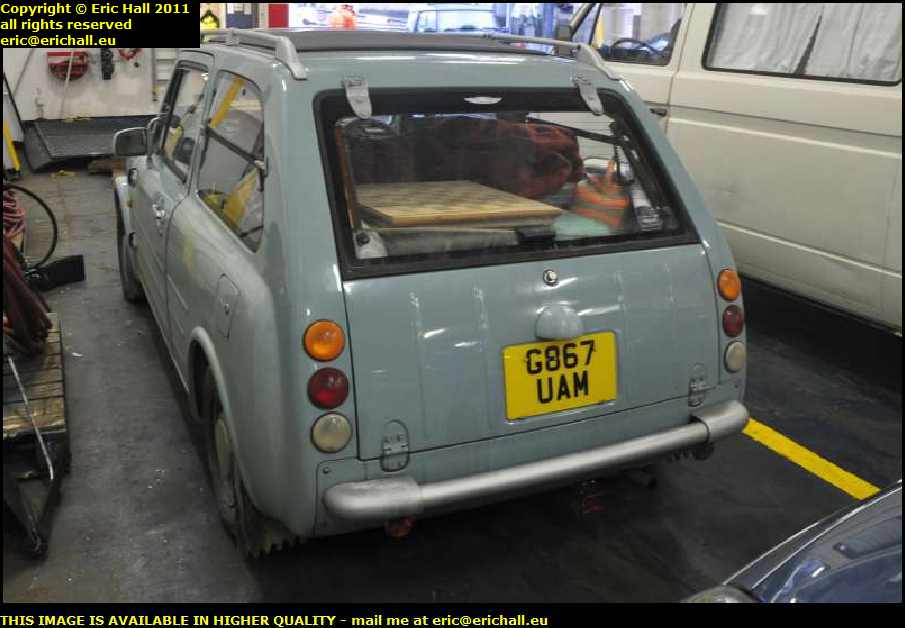 They don’t have a class type approval and so were never officially imported into the UK.
Only individual cars can be brought in – the so-called “grey imports” – and they need modifications before they can be used on British roads.
You’ll notice the add-on rear foglights underneath the rear bumper, for example. That’s a real give-away if you want to see if a car is an official mainstream import or a grey import like this.
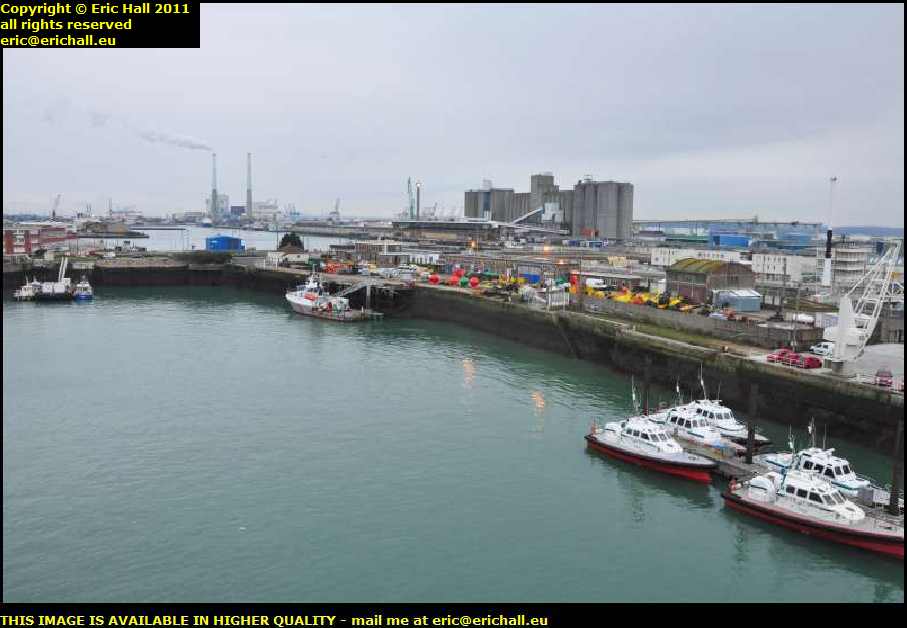 As for me, having parked up Caliburn and photographed the Pao I went hot-foot, or chaud pied as they say around here, up to the deck to see what I could see.
Having spent my early afternoon in St Valery-en-Caux rather than Le Havre, I hadn’t seen too much of the city, so I needed to see what I could see from on top.
First thing to see of course is the River Seine – the town is situated right at the mouth of the river.
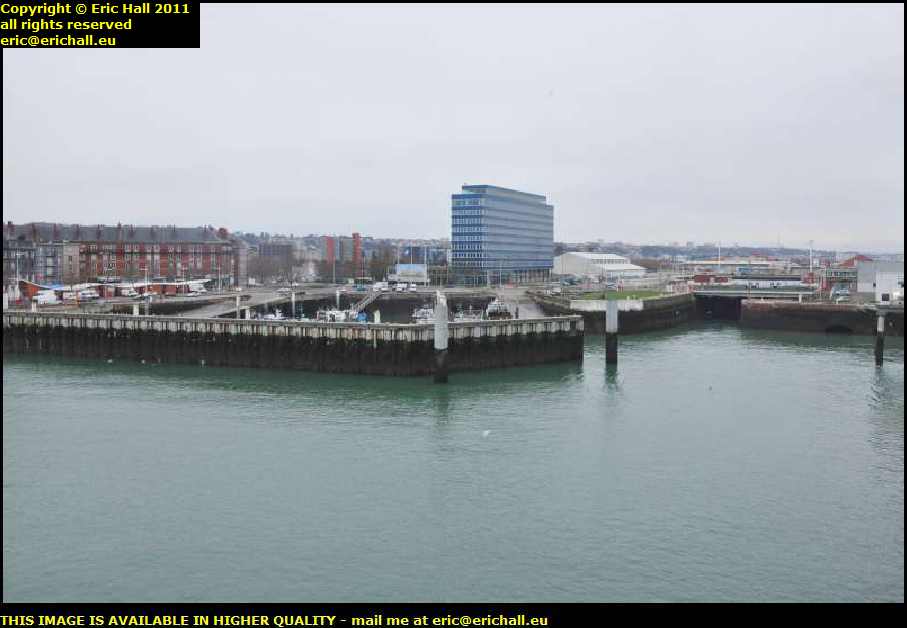 It’s not really a historic place as such, like many French towns and cities. It’s effectively a “planned town” built on the orders of King Francois 1st in 1517.
With the expansion of France’s maritime power in the 15th and 17th Century, the town was intended to take advantage of its ideal situation here.
As more and more ships were sailing, and the ships themselves grew in size, the port of Rouen was overwhelmed. Goods could be unloaded here and trans-shipped by barge up the Seine to Paris
 Mind you, that’s not to say that there was never a setttlement here. Evidence has been uncovered suggesting settlement from the dawn of European humanity.
More-or-less continual occupation from Neolithic times is suggested.
There was an Abbey here in the immediate vicinity at the time of WIlliam the Conqueror and there were certainly a couple of small fishing villages here when Francois I became interested in the site.
 But like most things, it was the era of the Industrial Revolution that saw the spectacular growth of the port.
Continual development has been taking place over the last 180 years, and it’s now one of the major ports of the country.
There’s a considerable amount of heavy industry as you might expect. Oil refineries, cement works and all of that, all based on the raw materials that are brought in.
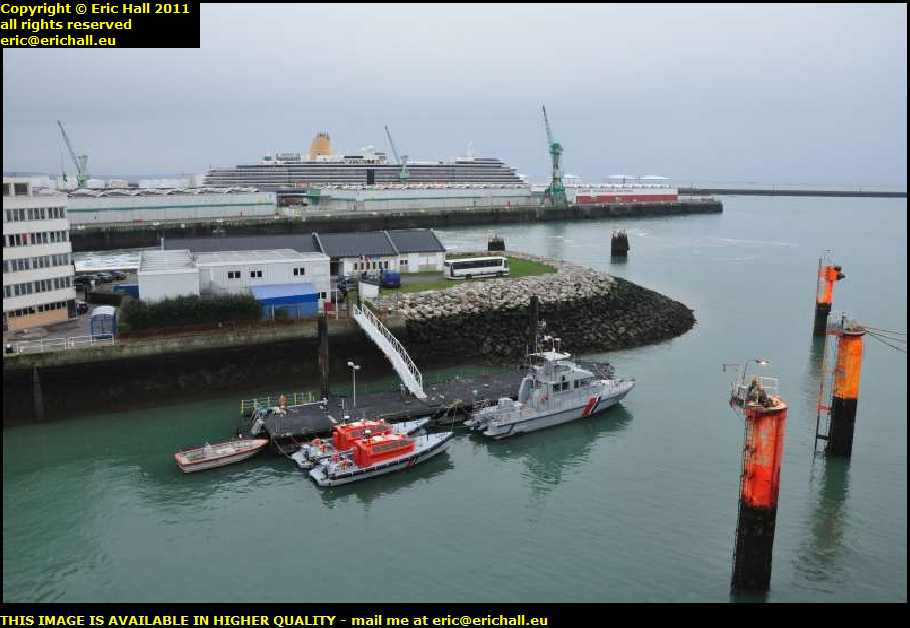 Mammoth cruise ships call here today as you can see.
But that’s just a sad reminder of the days when the great French transatlantic liners of the Compagnie Générale Transatlantique sailed from here.
And the huge ship-building works – the Ateliers et Chantiers du Havre – closed down in 1999. That was a major blow for the town.
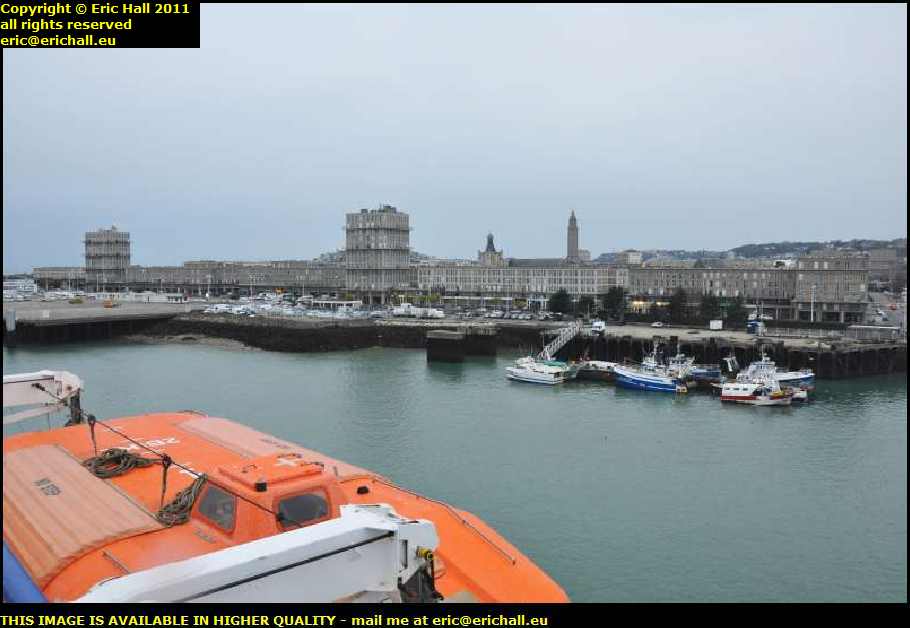 The city was totally destroyed by the Allied air forces during the war – and the rebuilding has not been kind, as you can see.
The worst of the air raids took place on 5 an 6 September 1944 by the RAF Bomber Command.
They dropped a total of 10,000 tonnes of bombs on the city, destroyed 12,500 buildings and killed over 3,000 civilians. 350 boats and ships were sunk.
And all to no purpose either because the port had already been badly damaged and the German defenders were camped well outside the town.
The reason of this destruction has always for the French been a total mystery. Many conspiracy theories, such as the wish to damage French post-war maritime commerce, have abounded ever since.
In the lounge of the ship for five and a half hours of one of the most comfortable crossings of the English Channel, I was in Pompey – or Portsmouth to the uninitiated.
Out of the docks and round the back streets is one of the best chippies in the whole of the UK and I felt so much better once I’d wolfed down a helping of beans and chips liberally doused in malt vinegar.
The M27 and the M3 to Winchester took me to the A34 to Oxford, and then the A43 as far as the edge of Towcester where there’s a quiet lay-by for the night.
And guess who forgot to plug his heated seat in so that he could warm up his bed?