Tag Archives: transatlantic flight

Wednesday 6th September 2017 – THAT WAS SOMETHING …

… of a disturbed night last night. And I’ll tell you why in due course.

And it took the alarm to rouse me from my slumbers – and I was still there when Billy Cotton wailed out his reminder 15 minutes later.

Furthermore, I wasn’t in much of a state to do much when I awoke. Something of a difficult morning in fact.

Eventually I made it in for the inclusive breakfast. It wasn’t much of a breakfast either. It might have helped had I taken my soya milk in but I wasn’t thinking too much about that.

A little later I did manage to attack the blog and bring it up to date, as well as tidying up the room and making it look presentable. By 10:30 I was on my way.

Last night I’d made a little miscalculation. Grand Falls where I ended up was about 50 kms beyond where I wanted to me so I had to go all the way back.

botwood newfoundland canada septembre september 2017I ended up back at Botwood – one of the towns that had been very high on my list of places in this part of the world, because it’s another place steeped in history of the kind that I appreciate.

The area was first officially visited in 1810 by an exploration party led by David Buchan

An early claim to fame is that it is the place of death of that last two known Beothuk natives.

botwood newfoundland canada septembre september 2017had you come here even 50 years ago, the bay here would have been a hive of activity.

There were quays here and the railway brought wagon-loads of paper from the pulp mills at Grand Falls-Windsor and ore from the mines at Buchans.

But all of that has long-gone – the ore in 1984 and the paper in 2009. Nowadays they don’t have one ship per month in here.
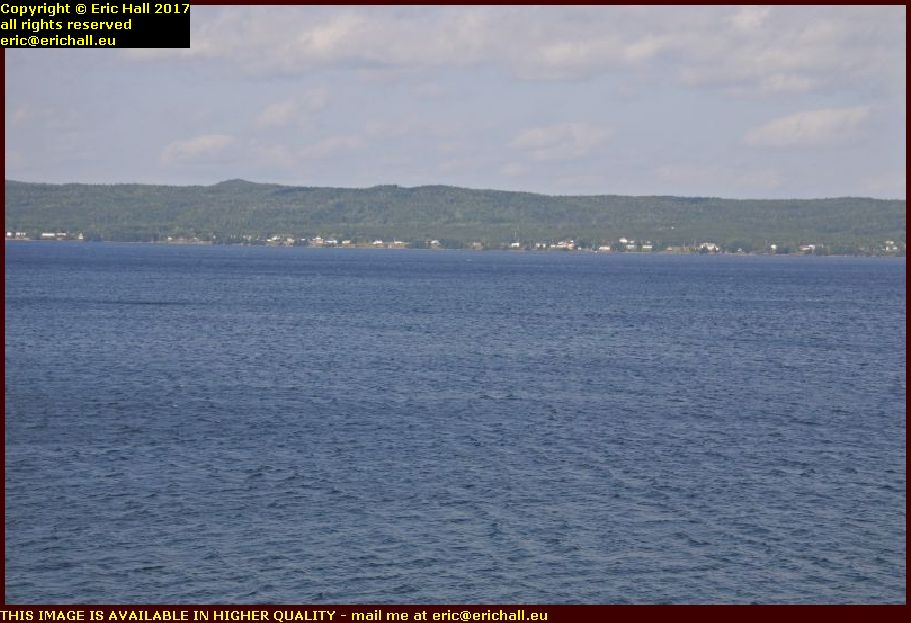
flying boat base botwood newfoundland canada septembre september 2017And had you been here between 1937 and 1945 you wouldn’t have been able to move out there either.

For this was the raison d’etre of the town during this period.

It’s another one of these places that played a leading role in the development of Transatlantic flight, because the first commercial transatlantic passenger flights came into land right there.

botwood newfoundland canada septembre september 2017The town, originally called Ship Cove and renamed Botwood after an early Minister, was originally tied to the sea as you might expect.

It developed a lumber business at the turn of the 20th Century and then, once the railway arrived, became a throving port.

But just after the First World War, the legendary airman Sidney Cotton – pioneer of modern aerial photography – chose Botwood as a base for his seaplane that he used for surveying and seal-spotting around the Newfoundland and Labrador coasts.
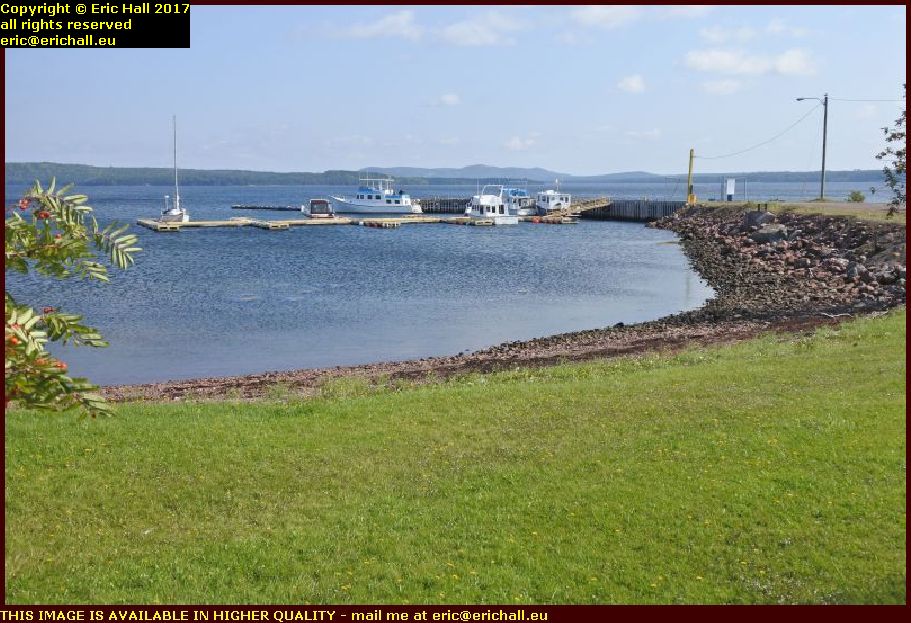
botwood newfoundland canada septembre september 2017Charles Lindbergh, the “flying fool” was employed by Pan-American Airways to locate sites for the airline’s fledgling fleet of flying boats.

He and his wife flew into Botwood in 1933 having heard of Cotton’s base here. They surveyed the bay and approved its use as a base for flying boats.

As a result, Pan Am issued a contract with Boeing to develop a huge flying boat capable of flying the Atlantic, and the Boeing 314 “Clipper” was born.

In the meantime, BOAC had been doing research of its own into long-distance flight to link up the major cities of the Commonwealth. This led to the development of the “Short Empire” flying boat.

The two airlines co-operated in research for transatlantic flight, and in July 1937 the first several Transatlantic survey flights were made with the co-operation of both companies.

And in June 1939, the first regular commercial transatlantic passenger flights began. The route was Southampton – Foynes – Botwood and then either Montreal or New York.

During the Second World War, the “Empires” were requisitioned by the British military authorities and it was left to the “Clippers” and a few older Sikorsky S42 flying boats to continue the service.

In fact, somewhere out there in the area shown in one of the earlier photos, there’s a Sikorsky flying boat – a more modern VS44 named “Excalibur”.

On 3rd October 1942 she “bounced” on take-off and went under. 11 of the people on board were killed and, strange as it might be to mention it, the US military authorities are still even today searching for the bodies of the four people who are missing.

pby flying boat botwood newfoundland canada septembre september 2017The area really came into its own during world War II.

This was when the concrete slipway was built (the big flying boats were loaded and unloaded by boat).

The British – and later the Canadian – government based a squadron of flying boats here that were used for anti-submarine defence around the north of the island.
pby flying boat botwood newfoundland canada septembre september 2017That’s because the slow “Sydney Cape” or “SC” convoys used to assemble off Sydney and then sail up the Strait of Belle Isle and out around the north of the island.

German submarines were quite active in the area as you know from our previous discussions.

The port itself was protected by a couple of batteries of heavy artillery, of which the gunners passed what could only be a very boring war.

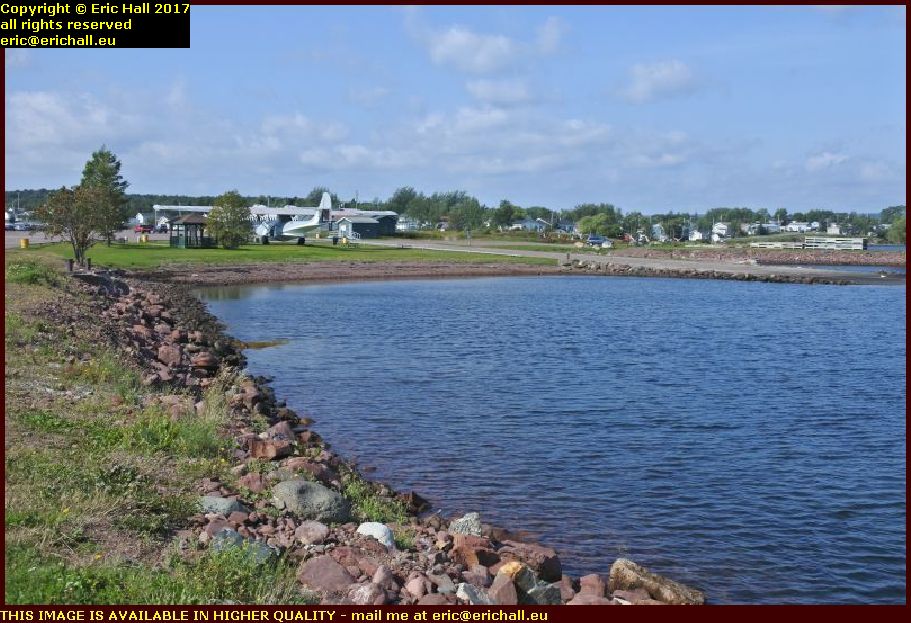
newfoundland canada septembre september 2017We actually have on display here a PBY flying boat – one of one of the types that was based here during the war.

This machine was taken out of service in the late 1980s and was donated by the Canadian Government to the town.

It’s official recognition as some kind of reminder or memorial to the role that the town played during the war in the fight against the submarines.
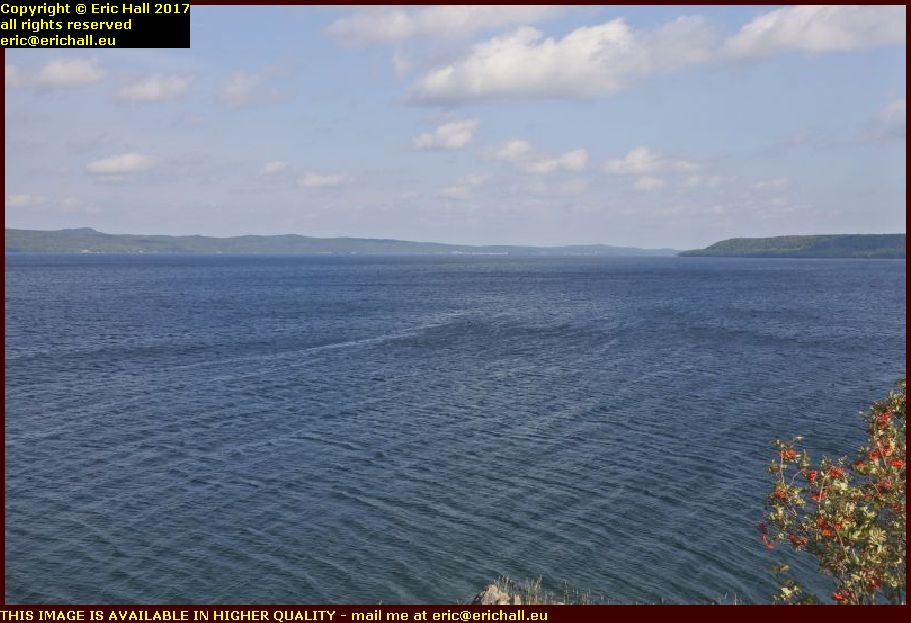
botwood newfoundland canada septembre september 2017We talked about Excalibur a short while ago. Somewhere out there in the bay are twomore aircraft.

One of the military flying boats, a PBY Canso, crashed on landing in the bay on November 8, 1943 and seven people were killed.

A Hurricane, flying to Gander, ran out of fuel and attempted a landing on the ice. Unfortunately it broke throuh and sank, but the pilot was saved.
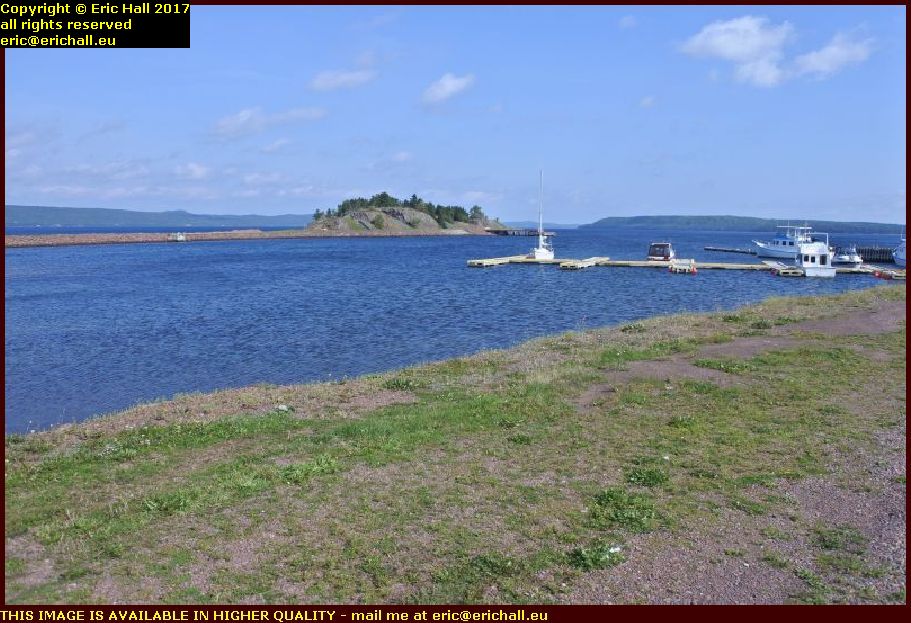
botwood newfoundland canada septembre september 2017That out there was formerly an island. The “causeway” that links it to the mainland is an artificial causeway and dates from the Second World War.

The island itself is hollowed out and was used as a bunker or store for munitions and the like and there’s a whole series of entrances over there in the rock.

You might think that that’s enough wartime excitement for a small town like Botwood, but that’s far from the case

Probably the very first Act of War in North America took place here.

A German ore carrier, the Christoph V. Doornum was in dock here on the very day that War was declared, loading ore from Buchans to take back to Germany.

She was immediately seized by the local police, her crew arrested, and she was impressed into the British merchant fleet.

She didn’t last long though, being damaged beyond repair by a mine off Margate on 9th June 1940.

And so having “done” Botwood I drove back to Grand Falls for a look around. And there’s nothing that’s really any reminder of the importance of the town.

I did the final load of shopping (having to go into three shops before I could find a lettuce), fuelled up, and then hit the highway to drive non-stop to Deer Lake.

strider 200,000 kilometres newfoundland canada septembre september 2017On my arrival I negotiated for myself another over-priced accommodation in a cabin – Lush’s cabins – in the mountains at Cormack, but not before I’d noticed another significant milestone.

Just down the road from my cabin, Strider passed over the 200,000 kilometres. So happy 200,000 kilometres, Strider.

The cabin that I’m in sleeps four and although it’s tired around the edges, it’s not too bad. Four people would have a really good time here I suppose.

All of the cooking gear is here and there’s a microwave too, so it’s potatoes, beans and bangers for tea tonight.

And then an early night because I’m whacked. In fact, I fell asleep speaking to someone on the internet.

At the start of tonight’s rubbish, I mentioned that I had had a disturbed night and that I would tell you why.

I went on a ramble last night – a ramble that lasted most of the night and I was out and about all over the place.

I started out in some kind of town – an old run-down type of place falling to pieces and I was looking for some documents for a driving test. Id been told where to go but I couldn’t remember so I accosted a local. He pointed out a few places but one was closed a few days ago and the other one had closed a few months ago. Everything was in such a derelict mess – just in fact rather like Calveley Airfield.
And then I came across a boy whom I knew who was trying to burn a load of papers – it was very important that all of these papers would be burnt. He’d put them in some kind of incinerator and closed the door but the conveyor belt wasn’t working. He was kicking a football against the door and all of a sudden there was a bang from inside the door – something like a paper bag bursting. We opened the door to see and saw the big box disappearing – the conveyor belt was now working – but there was still a load of paper, some bubble wrap and a few bits and pieces lying around. I told him that all of these needed to be removed as they had people’s addresses on them and they were visible, so he took some of the stuff and left the rest behind. The first thing that I noticed was a big file of mine about an insurance claim with my name and address clearly marked on it. I made him move it but he just took it out and dumped it on the side, which resulted in me having a huge “go” at him about this.
Round the corner was a public bar and I went in, and on the TV was England playing Norway at football. England conceded a goal after just 30 seconds. The goalkeeper for England was Viv Anderson – a full-back from the 1980s. Apparently the England goalkeeper had been injured in a previous match. This made me wonder why they didn’t have a reserve or anyone better than him because he was dreadful – running away from his goal after balls that he would never ever win. At the start of the second half Norway scored again straight away but for some reason it was disallowed. The Norway players were extremely unhappy about this. And by this time Anderson was playing like the full-back he was, rushing around over the pitch and leaving the goal empty and on a couple of occasions the other defenders had to dash back and kick balls off the line. Roy Hodgson was the England manager and he was giving vent to his feelings, but actually doing nothing about it.
By this time I was looking for somewhere to go for the toilet, but there was no toilet in this house where I was staying – just a bath and a sink. So I went out and about looking for one and couldn’t find one anywhere in the vicinity. I thought about nipping down a suitable dark alleyway but there people down there. There was a small park down the hill at the end of this football ground that might have done, but there were a couple of cars and people all around – so I just couldn’t get to go.
At this point, I awoke. and no surprises for guessing what I needed to do.

Back to bed – and who should appear in last night’s voyage but a girl whom I haven’t thought about in a long time and who is making her debut in my nocturnal rambles. Even when she was a young kid we all knew that she was going to be “something” and I can tell you a couple of stories about how we met up quite a few years later.

But going on from here, something came up that meant that I had to go to visit this house, and it was the home of her parents. I was rather embarrassed because it had been a good few years since I’d seen this girl and I was expecting her mother to make a few comments to me. But it seemed that she was suffering from dementia and was making quite a few comments to everyone. There were loads of people there, including her brother who was giving me the cold shoulder, and several people had bought their guitars with them. I was saying that it was a shame that I hadn’t come in my van because I would have had my bass with me. Then the girl appeared – blonde hair and thick-rimmed black glasses, nothing at all like she used to be and I had a hard time convincing myself that it was she (which it wasn’t of course).
From there I was back doing something with a guy I knew from Wandsworth who was now running a taxi company. He’d left a piece of paper on his desk about an old taxi run that he had done, giving the address of the street and which road to take to enter it – and “take a trailer”. A little later I was outside discussing this thing on the phone with someone else when he came on the tannoy that I was wasting my time as the job had been done last week (which I knew anyway and which wasn’t the point) and they had charged £54. I went off there to find out why the specific street to use had been mentioned, and found that the rest of the street was blocked off by a street party. I was in a bus and hordes of people climbed aboard just to chill out. When it was time o go I had to usher them all off – and do it two or three times too. And then we gathered up the waste into two large oil drums and started to burn it. They took off really well but one flared up and was in danger of setting alight some overhanging branches (we’d not been to careful) so we had to move it, flames and all. Another person tried to light a fire but was completely unsuccessful so we sent people off to look for more rubbish to add to his pile.

Sunday 3rd September 2017 – THE HOLY GRAIL …

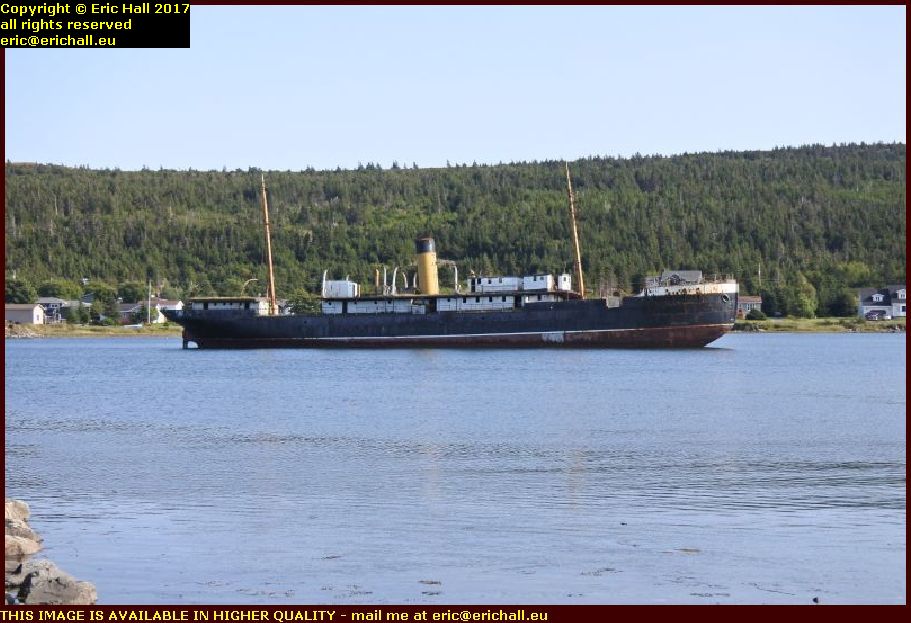
kyle reid alphabet fleet harbour grace newfoundland canada septembre september 2017… of ship spotters everywhere, and here she is, in all that remains of her sad glory.

This is the Kyle and she is probably the most famous ship in the whole of North America.

As Labrador and the coasts of Newfoundland opened up at the turn of the 20th Century, someone by the name of Reid started a regular shuttle service along the coasts serving most of the isolated habitations.

You need to remember that the network of roads in Newfoundland and Labrador is a comparatively recent phenomenon.

kyle reid alphabet fleet harbour grace newfoundland canada septembre september 2017He had a series of ships built in Scotland and on the Tyne and named them after places there, in alphabetic order, and these ships became known as the “Alphabet Fleet”.

The most famous of all of these ships was the Kyle. Built in 1913, she was not the biggest, but she was certainly one of the fastest. And she was certainly the strongest, being specially reinforced for fighting her way through the ice up the Labrador coast.

She was the longest-lasting too.

With modern shipping regulations, the abandonment (voluntary or otherwise) of many isolated communities, the start of the modern road network and marine disasters in the treacherous waters, the Alphabet Fleet diminished quite quickly, although Kyle survived and passed on to the whaling trade

kyle reid alphabet fleet harbour grace newfoundland canada septembre september 2017At the end of her working life in the late 1960s she was moored up as discussions were taking place as to her future.

But one night in 1967 she broke free of her moorings and ran aground here at the head of the bay at Harbour Grace.

And here she sadly remains, and will remain here until the end of time, I imagine. It’s impossible to refloat her, as she’ll break her back and attempts to sell her for scrap have been met with the most vehement opposition by the inhabitants of Harbour Grace who see her as the symbol of a bygone age.

But The Kyle is not the only famous symbol of Harbour Grace – it’s quite a famous little place.

And its main claim to fame is the role that it played in Transatlantic air history.

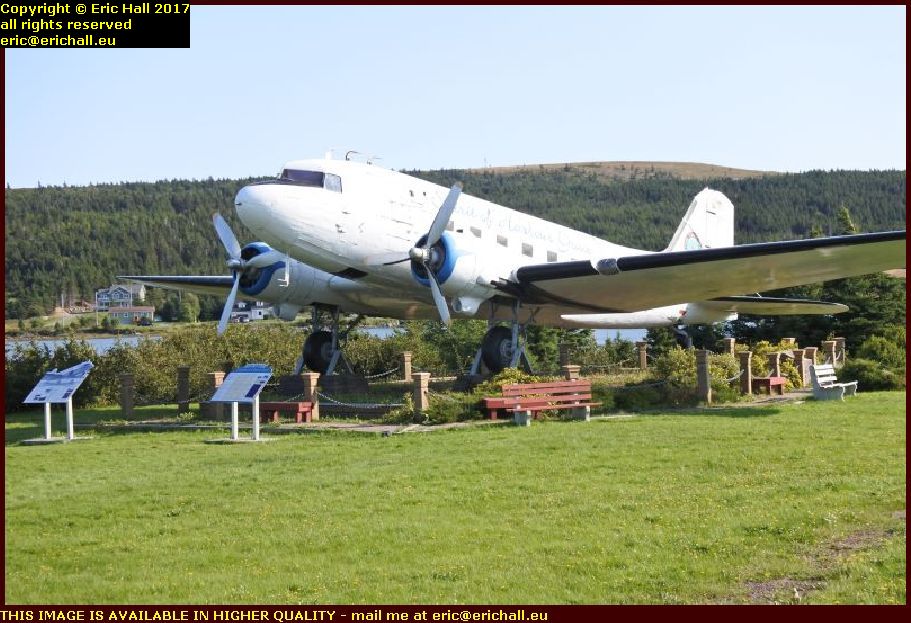
newfoundland canada septembre september 2017You are reminded about that by the presence here of a Douglas C47 Skytrain, the freight version of the DC3 Dakota.

This is CF-QBI “Spirit of Harbour Grace”, built in 1943 and had an eventful 50 year working life firstly with the US Air Force in North Africa and then with a variety of small businesses, spending many hours in the air around Newfoundland and Labrador.

When she was finally laid up in 1993 she was donated to the town as a static memorial to the aeroplane heritage of the town.

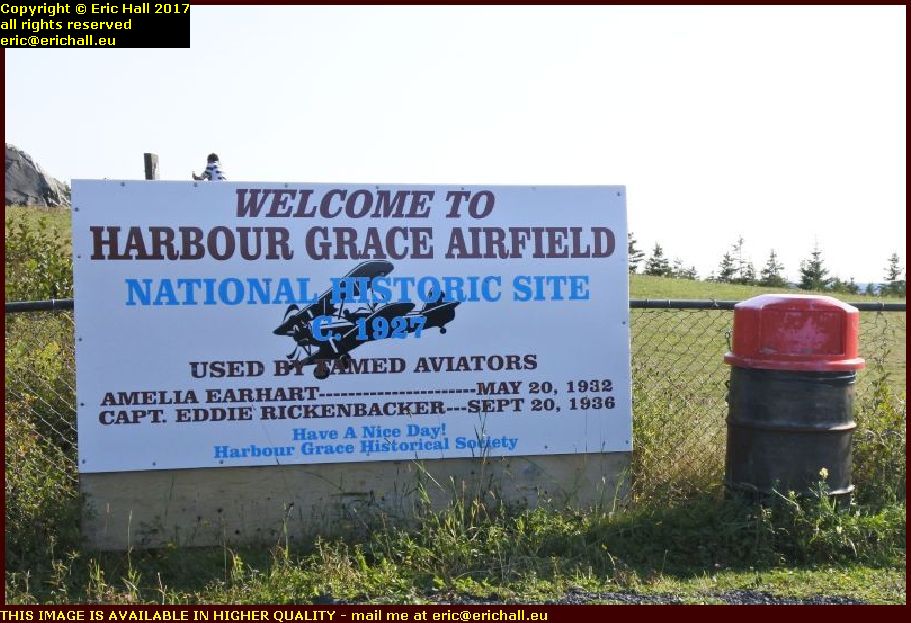
harbour grace airfield newfoundland canada septembre september 2017And this is the reason for the claim to fame of Harbour Grace’s footprint in the history of Transatlantic Air History.

There were a great many attempts to fly the Atlantic in the period 1919 to 1939 – some of which succeeded and many of which didn’t.

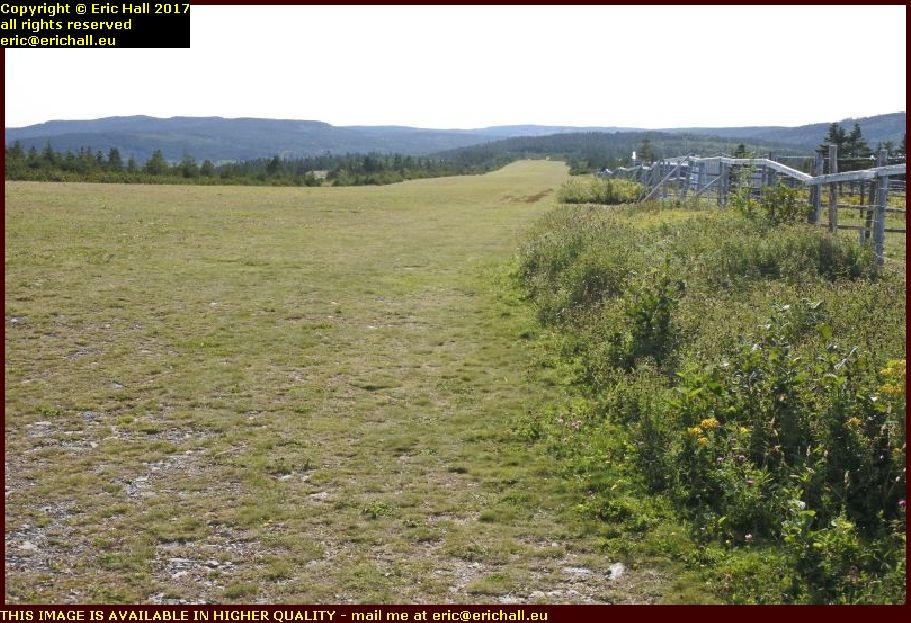
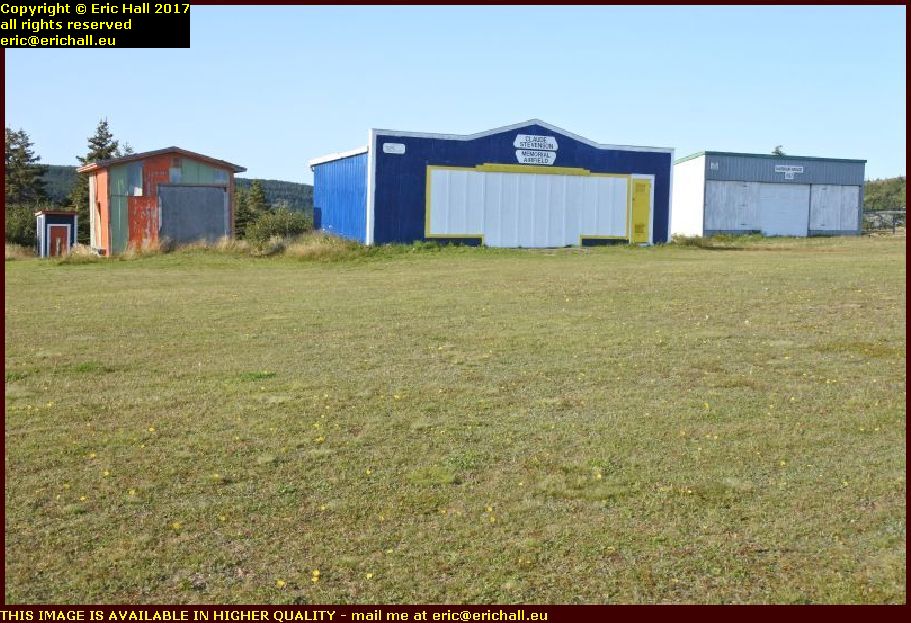
And many of those attempts took place from the improvised, hastily constructed air strip here.

newfoundland canada septembre september 2017The sad thing about it all is that, as regular readers of this rubbish will recall, we’ve visited many sites from where these early flights left, and there is nothing much left today

Here at harbour Grace though, it’s probably the best-preserved of all of the early Transatlantic airstrips and it was somehow very pleasant and satisfying to be walking in the footsteps of people like Amelia Earhart and Wiley Post.

harbour grace airfield newfoundland canada septembre september 2017But we were lucky though.

It’s clearly not an airfield up to modern standards, and a radio listening post was stuck on here during World War II.

After that, it was left to decay and would have been completely overwhelmed by nature had not a spirited campaign by local people not led to its recovery and restoration.

Last night I’d had a good night’s sleep at Donald’s – his sofa really is comfortable – and after breakfast we had another really length chat.

So comfortable had I been that I was even able to go off on another ramble, although it wasn’t a very pleasant one. I was in something of a panic. I’d arrived in Portsmouth (and Southampton) and I needed to be at the airport – presumably in London or somewhere like that. It was early morning and my flight wasn’t until about 13:30 but even though it seemed as if I had plenty of time, there just wasn’t the transport to take me there. For example, a train leaving at 06:45 didn’t arrive until 12:40 which was far too late. it was just totally bizarre for London (or Birmingham, or even Manchester) wasn’t anything like that far away.

While I was there I took advantage of Donald’s shower (which was beautiful) and he bunged my clothes in the washing machine which was really nice of him.

It goes without saying that I appreciated the hospitality.

tow bar tray st johns newfoundland canada septembre september 2017Stocking up on fruit, veg and breadat the Dominion Superstore later, I noticed this handy device.

That’s the kind of thing that I need if ever I change Strider for a smaller car. It can sit in the rear of the car until I go off on my travels and everything can be dumped on there and chained down.

And so I made a mental note.

Having done the shopping, I left St John’s on the Trans-Canada Highway and headed off in the direction of Harbour Grace, the Kyle and the airfield, stopping to make myself a butty on the way

And having done what I needed to do, and booked a room at a motel in Carbonear, I set off through the town.

belle carnell clam harvester harbour grace newfoundland canada septembre september 2017There’s a big port here – which used to be one of the bases for the Alphabet Fleet of course, but now it’s mainly fishing boats that tie up.

And that includes the massive 3600-tonne clam harvester Belle Carnell, based out of Halifax.

Built in 2004 she was previously the Norwegian Siddis Skipper.

peter eastons fort customs house harbour grace newfoundland canada septembre september 2017he most famous of all of the Harbour Grace inhabitants must surely be the pirate Peter Easton.

That’s the Customs House from the 1870s there, but it’s said to be built on the site of Easton’t fortress.

he would think nothing of sailing out with his men to capture a Spanish treasure fleet, and his men became the richest pirates on the North American seaboard.

He himself retired in luxury to the south of France and ended up as Marquis of Savoy.

church of the immaculate conception harbour grace newfoundland canada septembre september 2017This however was not so pleasant.

It’s the Church of the Immaculate Conception and despite being a place of worship (and it’s a Sunday too) it was all closed up, the gates were chained and there was a “Private – No Trespassing” sign on the gate.

I shan’t go in to all of this because I’ve said it so many times before. You all know that it’s an attitude that totally dismays me.

memorial to transatlantic flyers harbour grace newfoundland canada septembre september 2017Instead, we can admire the scenery.

The museum with the flight log of the airfield was, as you might expect, closed. But in the grounds was this sculpture to commemorate the Transatlantic flyers, particularly those who lost their lives in the attempt.

Europe, the destination of most of them, is right out there, 2000 miles away to Ireland with nothing in between.

harbour grace newfoundland canada septembre september 2017But yesterday I mentioned just how beautiful Newfoundand was, and showed you a photo to prove it.

Today’s photo, looking right across Conception Bay here, merely underlines it.

I was lucky with the weather too because despite the wind it had turned out to be a beautiful day.

And so I shot off down the road to Carbonear and my motel for the night.

Tea was pasta, tinned vegetables and tinned soup all mixed up in the slow cooker – and delicious it was too. I’ll do that again.

And despite having so much to do, I’m so tired that I’m off for an early night.

See you in the morning.

Tuesday 19th October 2010 – THE BIG ISSUE …

… with fulfilling your lifetime’s ambition is “what do you do next?”

st john's harbour newfoundland canadaI reached St John’s today and had a good wander around. But I found hardly anything much to hold my interest,apart from a couple of things below.

The view of the harbour from up on the hill at the entrance to the harbour is impressive though and it showed you why this was such a key harbour during all of the events that took place on the north-eastern seaboard.

Last night I stayed in a little B&B that was excellent. The brother of the woman who ran it came round – he’s a teacher and we had a good chat about the aviation history of the area.

Now in a book that I once read, it stated that there was a little aviation museum that kept the bits of- the 5 attempts to cross the Atlantic in May 1919 – the undercarriage that fell off Hawker’s plane for example. But try as we might we could find nothing anywhere that looked like it might be anything.

But then this guy told me that a good while back a new museum had been built and all of the relics from a load of small museums were collected there, and there had also been a Transport Museum created.

And as my book was dated 1970 or something, long before the consolidation, he suggested I try those places.

transport museum newfoundland railway station st johns canadaAt the Transport Museum, one of my major assumptions was verified. Up in Central Newfoundland I’d seen traces of what looked like railway track bed – I would have staked my mortgage on it – and sure enough there had been a railway in Newfoundland and one of its tracks did go where I saw it.

So that was that. And a fascinating museum it was too – I spent ages there and learnt a lot but they had no trace of these aviation exhibits.

At the new museum, “unhelpful” is a word that I thought that I would never ever have to use in the English-speaking Maritimes, but unfortunately, here we are. The … errr …. young people on the reception desk knew nothing at all and wouldn’t be bothered to ring up to ask any elderly colleague to see what he or she might know.

But they did encourage me to visit the exhibition of a sculpture depicting the car-bombing of a street in Iraq – to see the “senseless destruction”.
“How appalling” I commented. “It’s a disgrace. It clearly made sense to the Freedom Fighter who detonated the bomb so I find your comments juvenile, offensive and patronising. When might there be an exhibition of some of the senseless American bombing of streets in Iraq?”

Yes, I was in a bad mood. I suppose these early aviation exhibits have been long swept into the obscurity of the distant past and probably won’t ever see the light of day again, which is a shame.

raynham morgan transatlantic flight attempt take off may 1919 pleasantville quidi vidi lake st johns newfoundland canadaI did however manage to track down what I reckon is the crash site of the “Raymor” – the aeroplane piloted by Raynham and Morgan. They took off from some land at Pleasantville, near Quidi Vidi Lake, and crashed at the end of the runway, heavily overloaded with fuel.

I once saw some photos of the aeroplane on the runway and I could identify the hills in the background, and I also saw a photo of the crash site, and I was also able to identify the hills in that location too – so I’m pretty sure that I’ve got it right.

It’s really the only place that it could be because everywhere else is either totally uneven terrain or the hills are too close.

But it was still a hell of a place to try to take off with a new and untried aeroplane with an enormous load of fuel. Alcock and Brown, who had drawn to take off next from that field, immediately went around to look for another field rather than to try from there and in the end they used a field that had been allocated to another competitor but who had withdrawn. That, unfortunately, is now a big housing estate.

There were still a few other sites that I needed to track down, Hawker’s being the most important, but the light went and I needed to leave. I’ll have to come back again to Newfoundland, but I won’t be sorry. it really is a beautiful place even if the east coast does average something like … errr … 216 rainy days per year

strawberry moose cape spear newfoundland canadaSo now I’ve turned back and sad as it is to say it, I’m on my way home. I’ve reached the apogee of my voyage.

But I did see at St John’s, a sign that said “3940 kms to Paris”. And when I fuelled up just outside the city I noticed that since leaving Toronto not quite 3 weeks ago, I’ve driven far enough to have gone to Paris and come back, and still had mileage to spare.

Monday 18th October 2010 – "KEEP OUT! I AM WORKING CAPE RACE!"

marconi radio station cape race lighthouse newfoundland canadaIf ever 7 words changed the fate of so many people, it was “Keep Out, I am Working Cape Race”.

At the turn of the 20th Century Marconi perfected his radio  transmission system and it had the potential to overwhelm the cable line that had been laid across the Atlantic many years before.

Although he had managed to transmit directly across the Atlantic from shore to shore, it wasn’t as yet a practical proposition to do it consistently and so he set up a station at Cape Race – the nearest to Europe – and another one at Valentia in Ireland – the nearest to North America.

He then put his operators, whose wages his company paid for, on board ships, with the promise to the shipping lines that they would receive and transmit important navigation information between ships with the aim of making the oceans a safer place. And it is a fact that losses and deaths in the important shipping lanes declined significantly.

However, the sinking of the Titanic stunned the world and at the subsequent public enquiry Marconi gave his evidence that seemed to confirm the instructions that had been issued to his employees concerning the priority that “navigational” messages were to receive

But as the enquiry unfolded, it became clear that Marconi had been … errrr… economical with the truth. What was really happening was that Marconi was using the ships to bounce messages across the Atlantic by radio. And when the Titanic came into the range of the radio station at Cape Race the radio operator started to transmit a battery of Marconi’s commercial messages that lasted for three hours.

During this period, the Californian had become embedded in the ice and as the radio operator of the Californian knew that the Titanic was on the same track as his ship but an hour or so behind, he tried to send an urgent message to the Titanic to give it a warning.

It was then that the operator on the Titanic cut him off with his curt message, and the ice warning never made it to the Titanic‘s captain. The fate of the Titanic was thereby sealed.

At the subsequent public enquiry the Chairman asked the radio operator of the Californian “I’m sure you didn’t mean to listen but could you say what character of messages the Titanic was transmitting?”
The operator replied “I’m sure that these messages were of a private nature”.

trepassey bay newfoundland canadaNow this is Trepassey Bay, with the town of Trepassey in the background. Trepassey Bay is only an hour or so from Cape Race and the town played an important part in the history of aviation.

If you ask most Americans who was the first to fly the Atlantic they would reply “Charles Lindbergh”. But in fact much to their surprise and to the surprise of many others, at least 91 people (maybe 92 if a mysterious stowaway is included, and maybe even 94 if the mysterious fate of a pair of Portuguese aviators is ever unravelled. They disappeared on a flight across the South Atlantic and were never found, but a raft made from parts of their aircraft was discovered washed up on a remote part of the coast of Brazil) crossed the Atlantic before the Flying Fool.

Most British people would reply “Alcock and Brown” – but to the surprise of many people, that’s not correct either. What Alcock and Brown actually achieved was the TOP flight across the Atlantic.

There was an earlier trans-Atlantic flight by a US Navy Pilot by the name of Albert Read. However his flight was a little different. It was in a seaplane along a route marked by a line of US Navy ships, he made several stops on the way, had a break in the Azores before starting again for Lisbon, and the two other seaplanes that accompanied him failed to make the journey.

Nevertheless it is the first trans-Atlantic crossing no matter by what standards you measure his flight, and it has never ever received the credit that it deserves. And of course he set off from Trepassey Bay in Newfoundland.

commander read memorial plaque trepassey bay newfoundland canadaIf you hunt around the town you might, if you are lucky, eventually find a little plaque to commemorate Read’s efforts.

As for Amelia Earhart, the first woman to cross the Atlantic by air and who set off from here (and she did not pilot the aeroplane, no matter who insists that she did. In her memoirs she states that “Schultz did all the flying … I was just baggage, like a sack of potatoes”), and the Marquis of Pinedo, who was first to fly the Atlantic in both directions and who set off from here on the return trip, there’s nothing at all.

marconi radio station cape race lighthouse newfoundland canadaSo from Trepassey I went off to see Cape Race, seeing as I was here.

And I was lucky too. Although the place was closed up, someone had come by to collect the post and she allowed me to visit the museum. There are quite a few artefacts there from the time of the Titanic, and they were recovered on site.

When the Marconi station closed down, it was simply bulldozed into the earth with everything still inside. When the museum was proposed, the volunteers scavenged in the debris for the artefacts to exhibit.

seal bay bulls newfoundland canadaThis gentleman set the seal on my little trip, and gave me his seal of approval. Sitting there on his rock giving me a round of applause as I drove past him.

What with porcupines, moose and bear, and now seals coming along to mark my progezss, I’m having more than my fair share of wildlife. I’m disappointed that I haven’t seen Godzilla however.

merkur sierra xr4i tor cove bay bulls newfoundland canadaAnd despite what you might be thinking, this is NOT a Ford Sierra.

This is actually a Merkur Sierra – for the Sierra and the Scorpio were exported to North America under the Merkur trade name. The experiment didn’t last very long at all and you will be very lucky to be able to find one these days. I couldn’t believe my luck.

So now I’ve found a little Bed and Breakfast on the edge of St John’s, and I am immensely happy that I bought that cheap little GPS in Windsor a few weeks ago – it’s more-than paid for itself just with tracking down these obscure places.