Tag Archives: museum

Monday 20th August 2018 – SLEEPING ON THE SOFA …

… is quite comfortable, which is why I chose this sofa anyway, but for some reason last night I couldn’t drop off to sleep. And when I eventually did, I was awake quite early and couldn’t go back to sleep.

So I had my medication and then set out everything for breakfast. The muesli that I make myself went down very well, as did the bread from LIDL. Good stuff that, I have to say.

When we were ready and organised, I made some sandwiches and then we set off on our travels.

utah beach normandy franceOur destination for today was Utah Beach.

On the north-eastern shore of Normandy, it was the most westerly of the landing beaches on D-Dau. Despite many problems and issues regarding the arrival of troops, many of whom were offloaded at the wrong place, the beach was quickly captured.

Of the 21,000 soldiers who landed here, just 197 of them were lost. It was one of the more successful landings.

utah beach normandy franceThe aim of the landing here was to seal off the Cotentin Peninsula from German reinforcements and to move on quickly to capture Cherbourg and all of its port installations.

Unfortunately, the American soldiers were so over-trained that they were very devoid of individual initiative. So when they were held up, they just waited for someone else to come up with a new plan instead of finding another way around.

As a result, it took three weeks rather than three days to capture the port, and the Germans had used the time profitably to destroy the port installations.

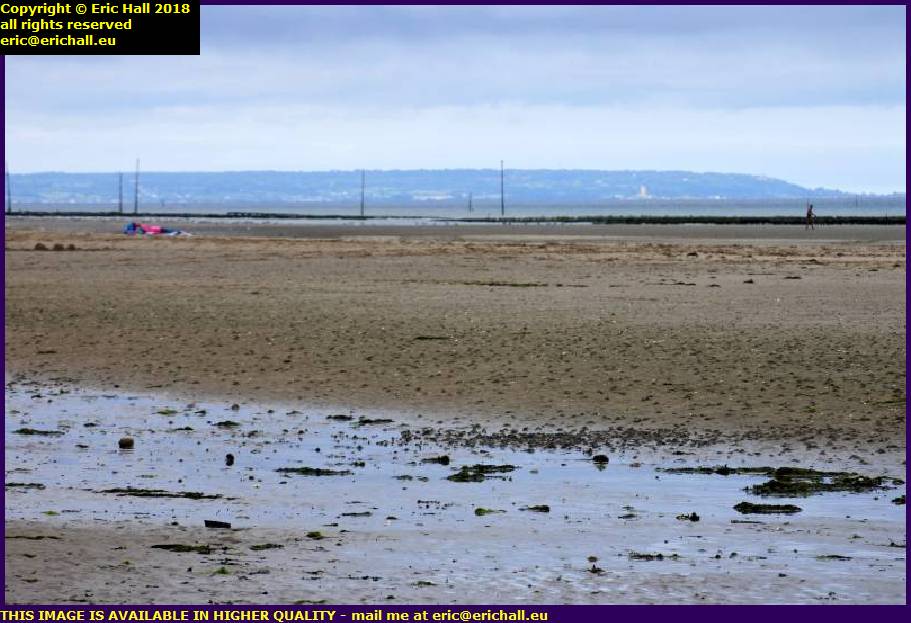
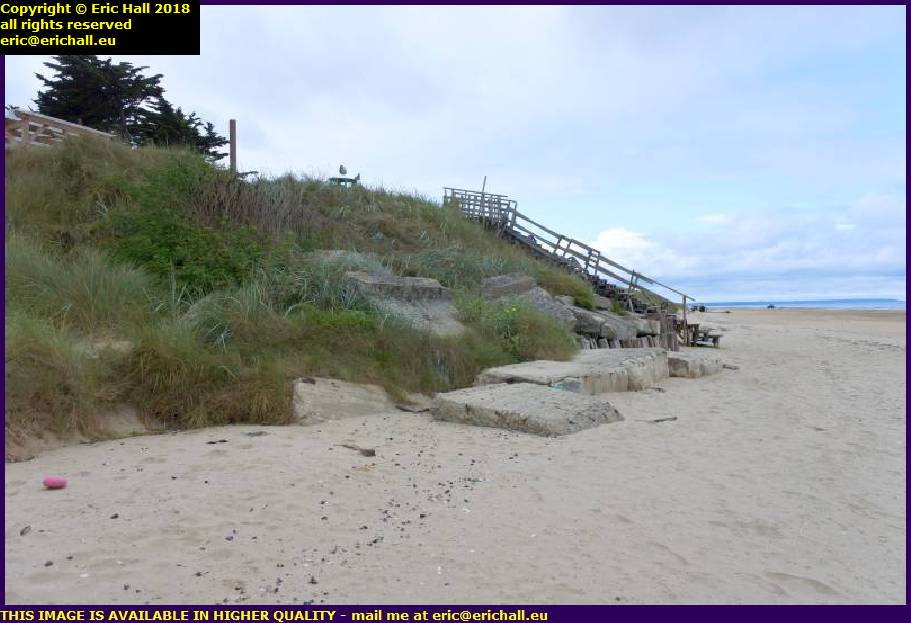
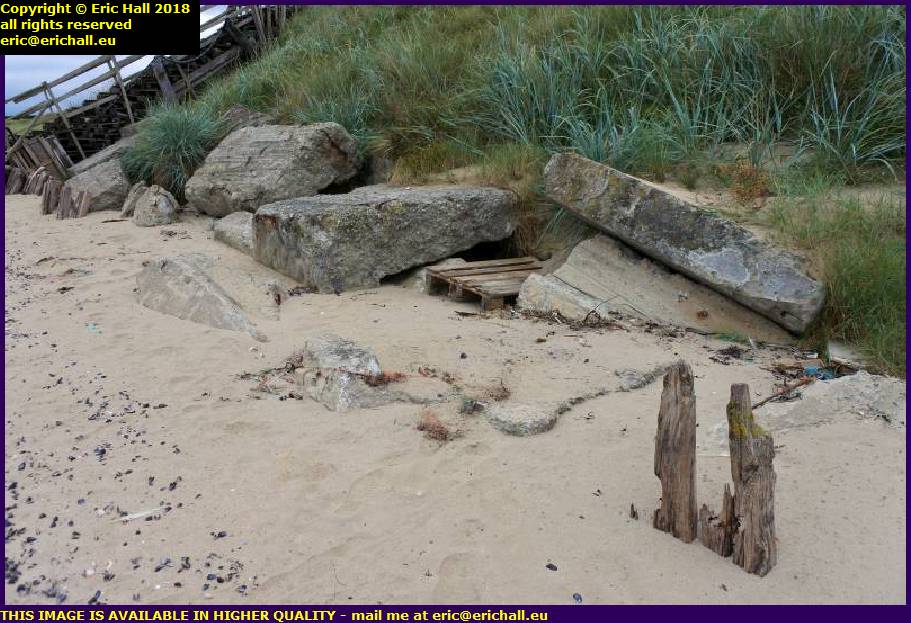
utah beach normandy franceAt a certain prominent point on the shore there were a few heavy concrete defensive strongpoints. A combination of air strikes, assault troops and naval gunfire saw them off.

This point here is one of the most prominent points on the coastline, and the shattered reinforced concrete scattered around here makes me wonder whether or not this was the site of one of these strongpoints.

Whatever it is, it’s been well-and-truly seen off.

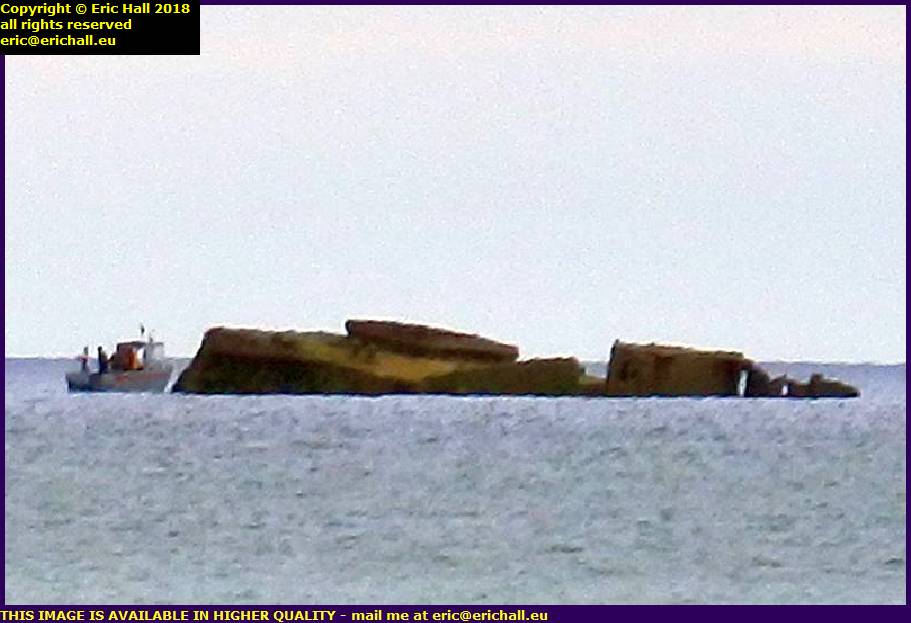
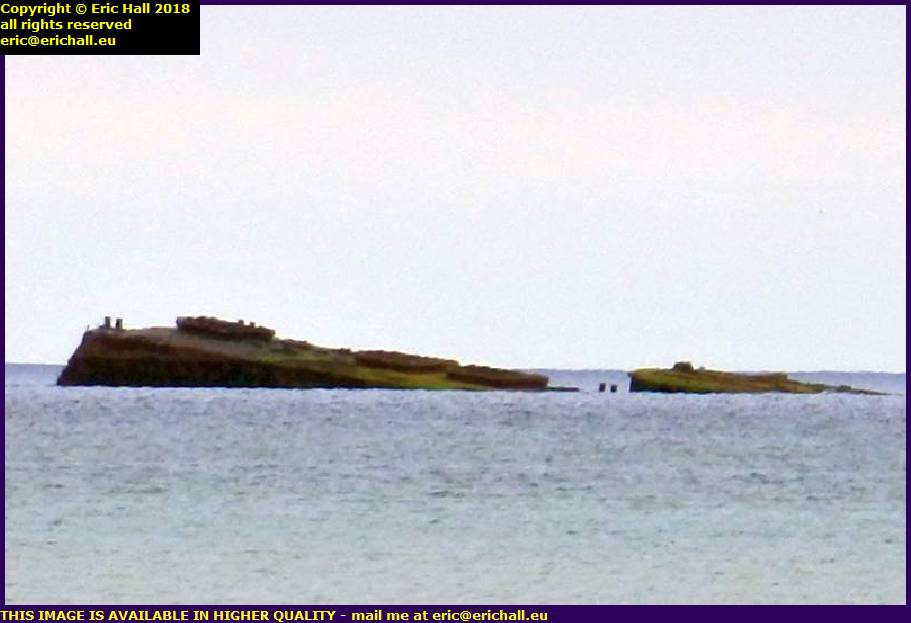
granville manche normandy franceA good way offshore were a couple of objects that looked quite interesting. I couldn’t make out what they were so I took a photo with the telephoto lens and enlarged it.

It’s still not very clear as to what it might be, but it looks suspiciously like the wreckage of some kind of ship. And the boat around it might indicate the presence of divers.

Of course, it could equally well be a bizarre rock formation. I shall have to wait until I can find a kayak so that I can go out there for a proper look.

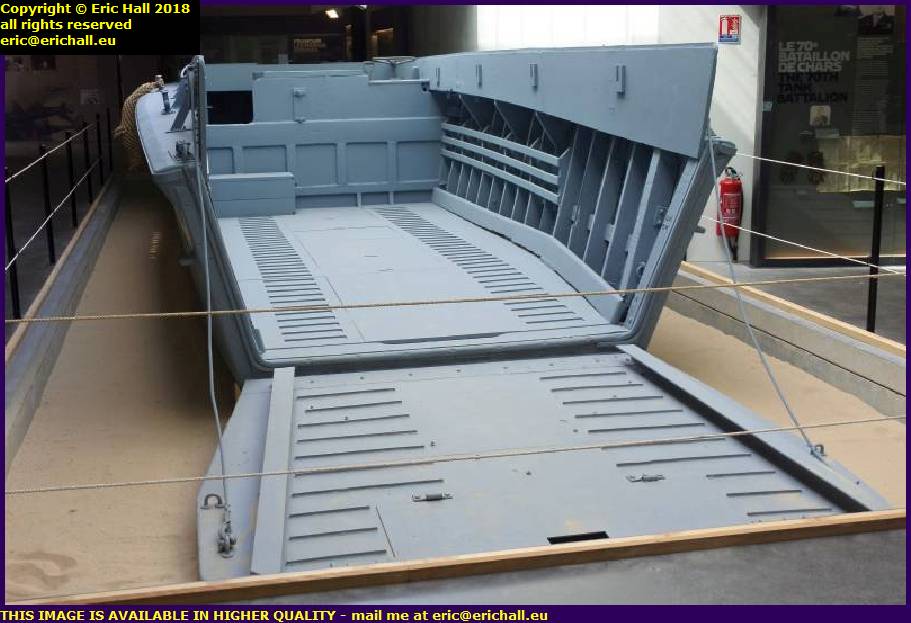
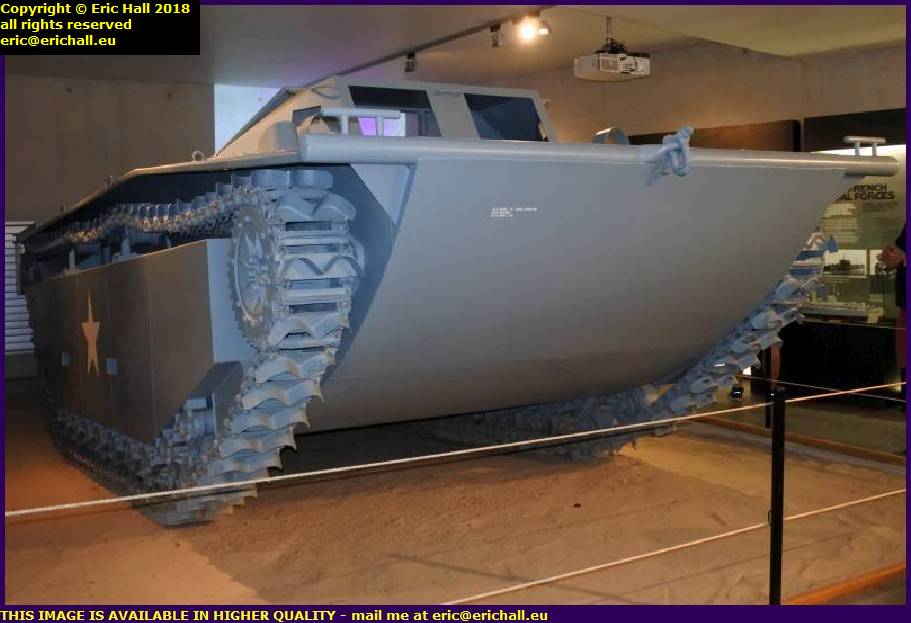
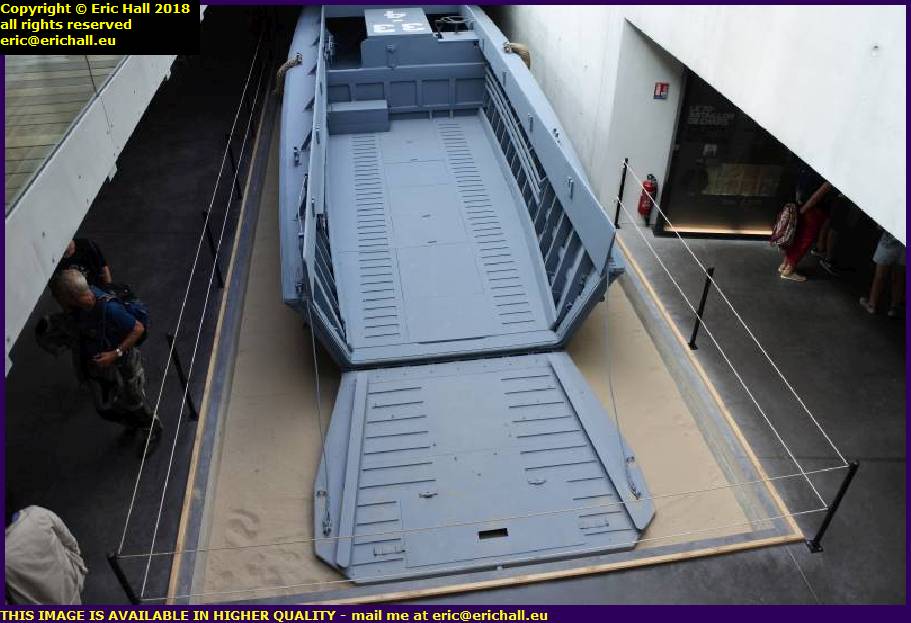
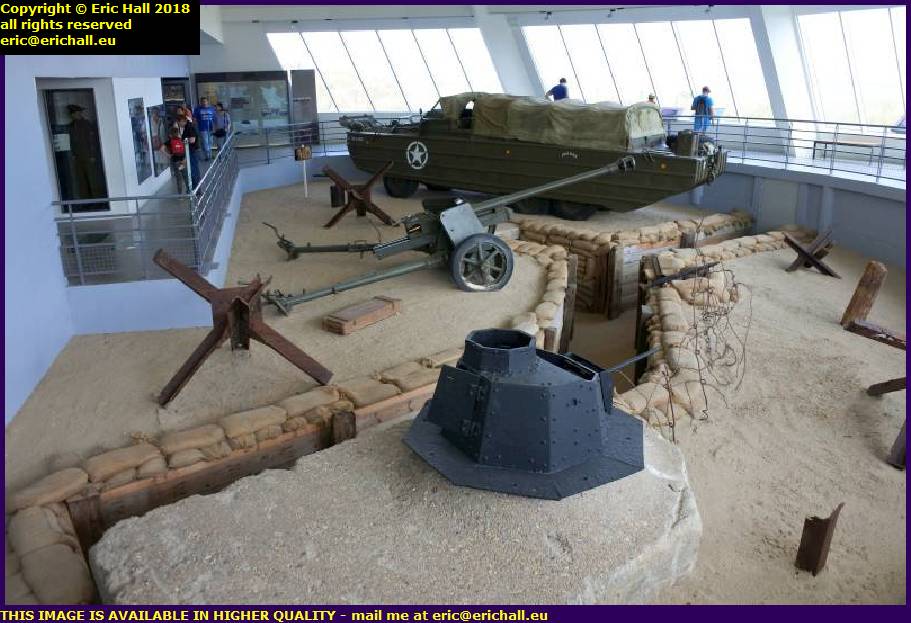
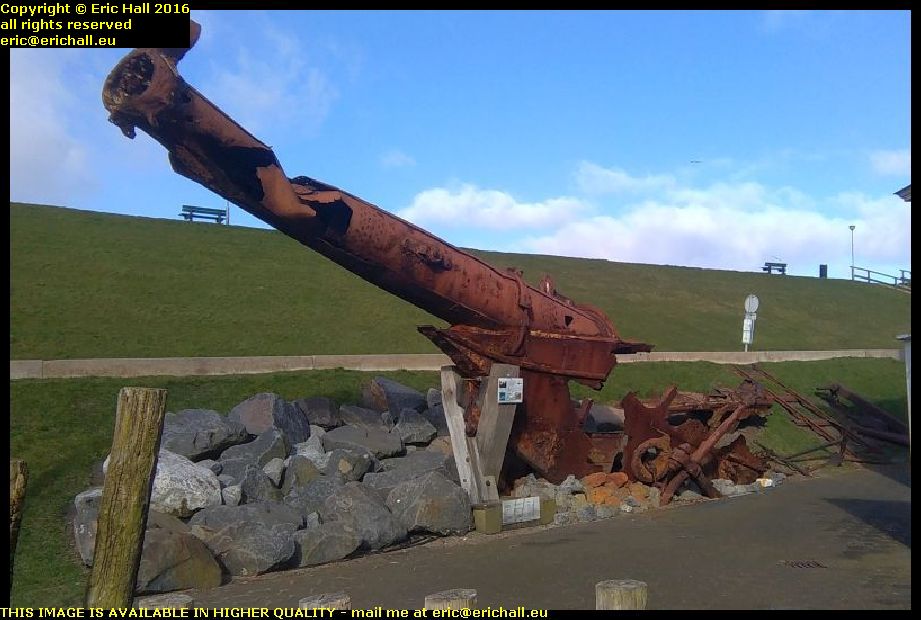
museum utah beach normandy franceThere’s a museum here too. This contains all kinds of relics uncovered from the battlefield, discovered by local residents or donated by former soldiers who served here.

But this is more like the kind of thing that I would find interesting. If ever I buy my own island I would need something like this.

Caliburn would fit quite nicely on it and I could quite easily go across to the mainland and the shops in it. It would make life easy.

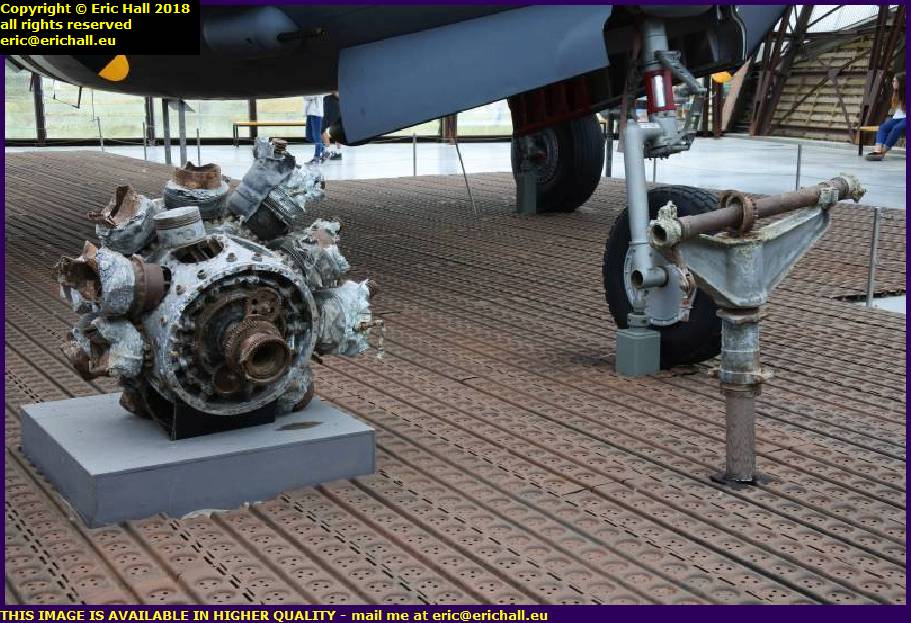
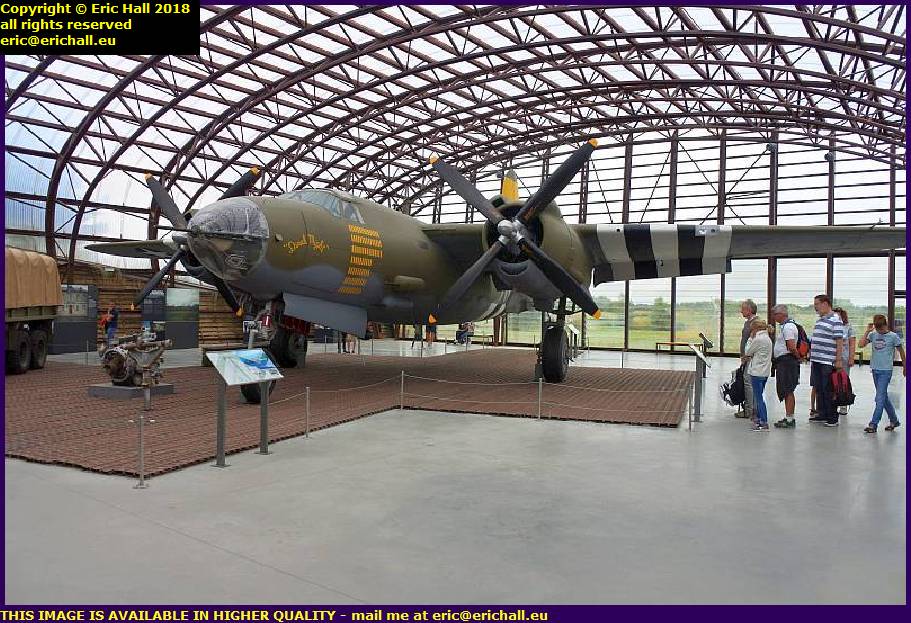
mitchell marauder b-26 engine undercarriage museum utah beach normandy franceMitchell Marauder B-26 bombers were used by the United Nations to bomb the German defences.

One of these planes and its captain was quite famous due to his exploits but was shot down a short while later. Parts of his aeroplane were recovered subsequently and are displayed here

I could have an enormous amount of fun with this 18-cylinder twin-row radial engine.

While we were wandering around I ate my butties, and then we set off again.

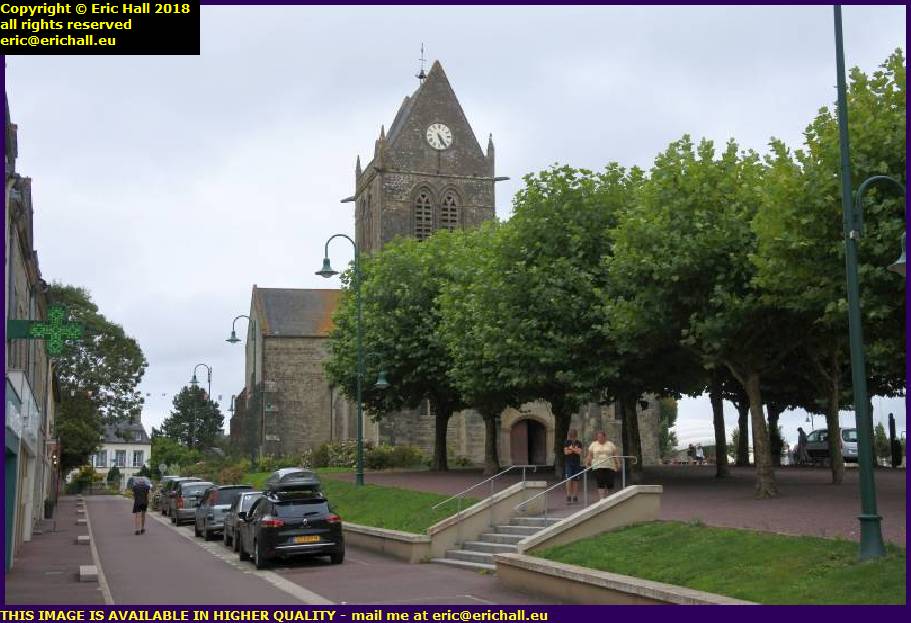
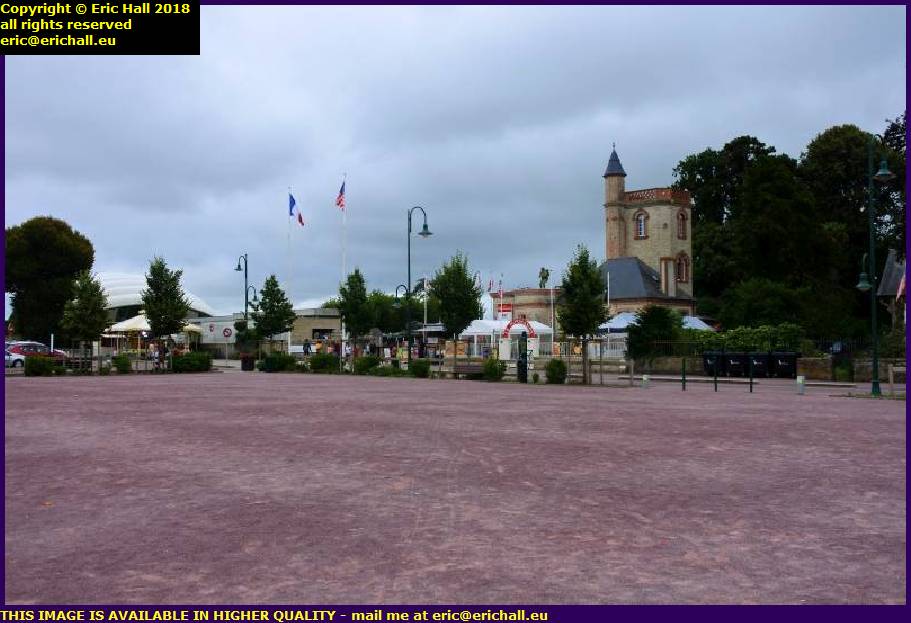
st mere eglise normandy franceThe key to the assualt on Cherbourg was the town of St Mere-Eglise.

With the land behind the beach being low-lying, the Germans had flooded everywhere to inhibit any invasion. The roads however are raised up on causeways and these all radiate out from the town, so the capture of the town was quite important.

A squadron of paratroopers were parachuted into the area early in the morning to seize the town.

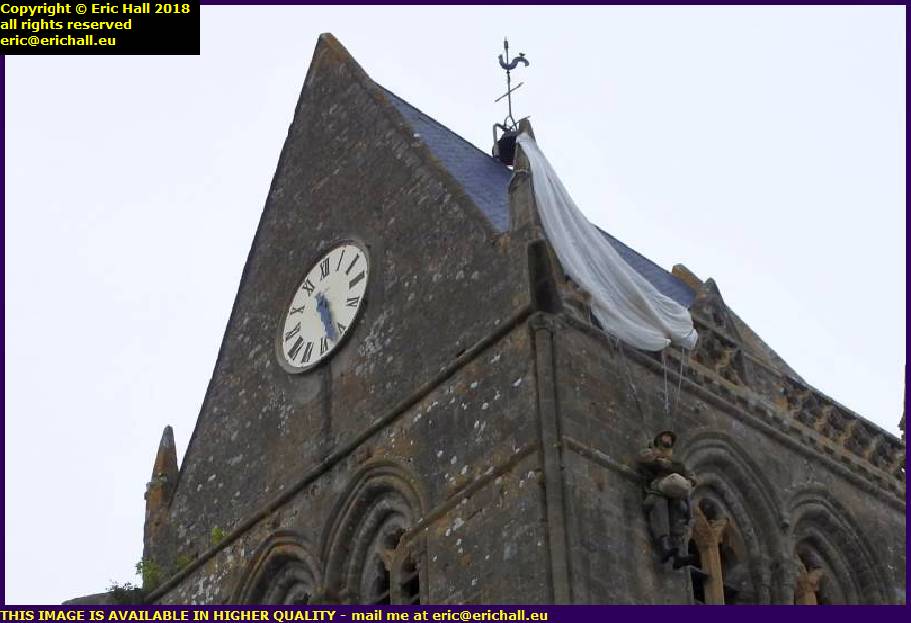
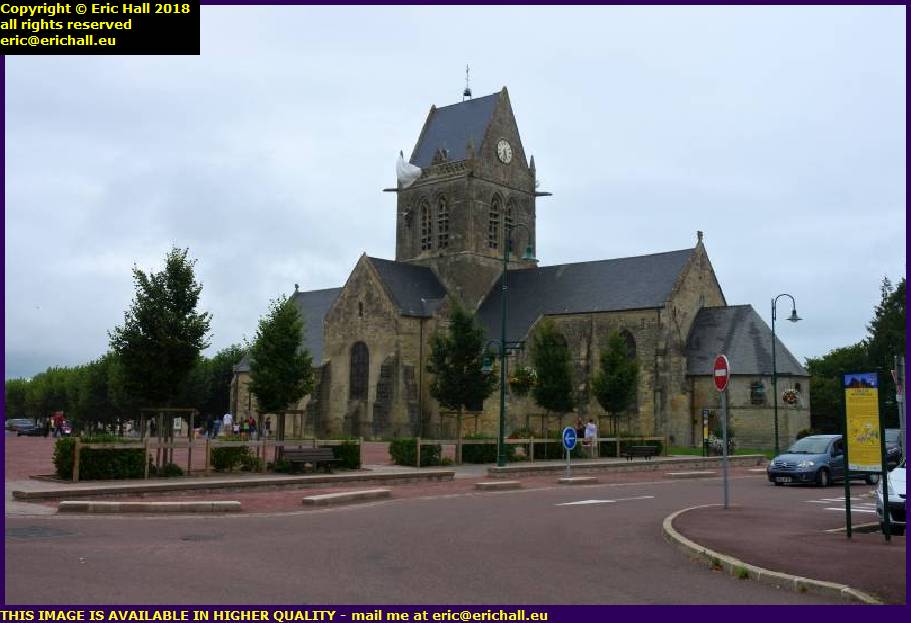
parachutist church st mere eglise normandy franceOf course, the parachute drop went wrong and the soldiers ended up being scattered all over the countryside.

One unfortunate soldier landed on the roof of the church and as he slid down, his parachute was caught on one of the gargoyles.

And here he dangled while a battle was ranging right below him. Eventually the Germans spotted him and rescued him, but he subsequently escaped when the town was captured.

We had a coffee and then we set off back home for tea.

Regular readers of this rubbish will recall that Liz and I had made some vegan burgers a while ago. And so for tea we had burgers in baps with potatoes and vegetables. And they were delicious too.

Hans is as much a film buff as I am, and so we sat down and watched one of the Inspector Hornleigh films. I still think that these films are really well ahead of their time considering that they date from the late 1930s.

And so, being thoroughly exhausted, I settled down on the sofa. I hope that I have a better night tonight.

landing craft utah beach museum normandy france

landing craft utah beach museum normandy france

artefacts utah beach museum normandy france

martin b26 marauder utah beach museum normandy france

sunken remains utah beach normandy france

demolished fortifications utah beach normandy france

museum st mere eglise normandy france

church parachutist st mere eglise normandy france

Friday 14th April 2017 – WELL, THAT’S ME …

… done in for the next few days, I reckon. I’ve really had a busy day today and I was in something of a little agony when I finally crawled myself off to bed.I couldn’t even stay awake long enough to watch a 25-minute film either!

Mind you, there’s a very good reason (or two) for this – not the least of which was that I was wide awake at some kind of silly time like 04:00 and didn’t have any idea about going back to sleep again.

However, I must have done, because I was wide awake yet again at about 06:30. And this time I managed to stay awake too, having breakfast when the alarms went off (and it’s not the first time just recently that this has happened either).

After a little bit of dillying and dallying this morning I went outside to wait for Alison who came to pick me up. She took me back to her house to see around the garden, and I took the opportunity to say “hello” to Brian, whom I hadn’t seen for a while.

Jennifer then climbed into the car with us and then we hit the highway, direction Ieper (or, for those of you with very long memories, Ypres). Neither Jenny nor Alison had been there before and it was on their list of places to visit, and so I had offered to accompany them. Regular readers of this rubbish will recall that back in the dim and distant past that for the University course that I was studying at the time, I wrote a thesis comparing the rebuilding of Ieper with the rebuilding of Coventry.

Good Friday isn’t a Bank Holiday in Belgium, and so we had the usual chaotic drive around the Brussels ring road in the usual kind of traffic that makes driving the M25 look like a stroll down a country lane, but nevertheless we made it eventually to Ieper.
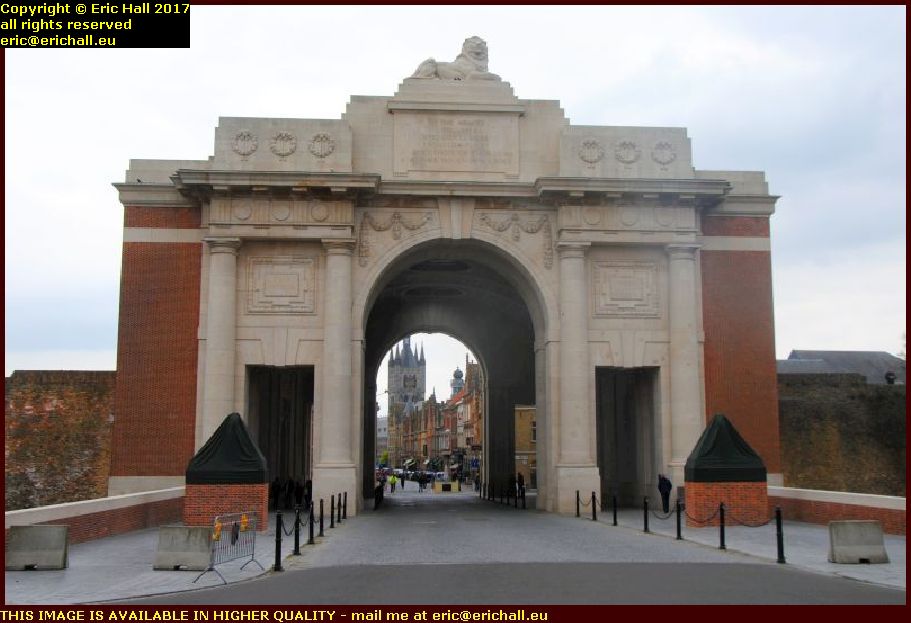
menin gate ieper ypres belgium april avril 2017As luck would have it, there was a parking space right by the side of the city walls near the Menin Gate and so Alison’s impressive driving soon had us neatly parked.

Three hours free parking outside the city walls, which is a good deal on any kind of basis and that gave us plenty of time to do a little sightseeing around the city before clearing off into the surrounding countryside.

menin gate ieper ypres belgium april avril 2017The Gate itself is fascinating. The original one had been demolished as it was considered to be a restriction to modern traffic, but a new one was built here after the war by the British as a memorial to the missing.

Of the quarter of a million or so British soldiers who died in the Battles around Ieper, probably half of them were never recovered or identified, and the idea was to write their names up on panels on the gate.

However, despite several expansions, the Gate was never ever large enough, and they abandoned the plan half-way through. Instead, they continued the work by installing panels on a wall at the cemetery.
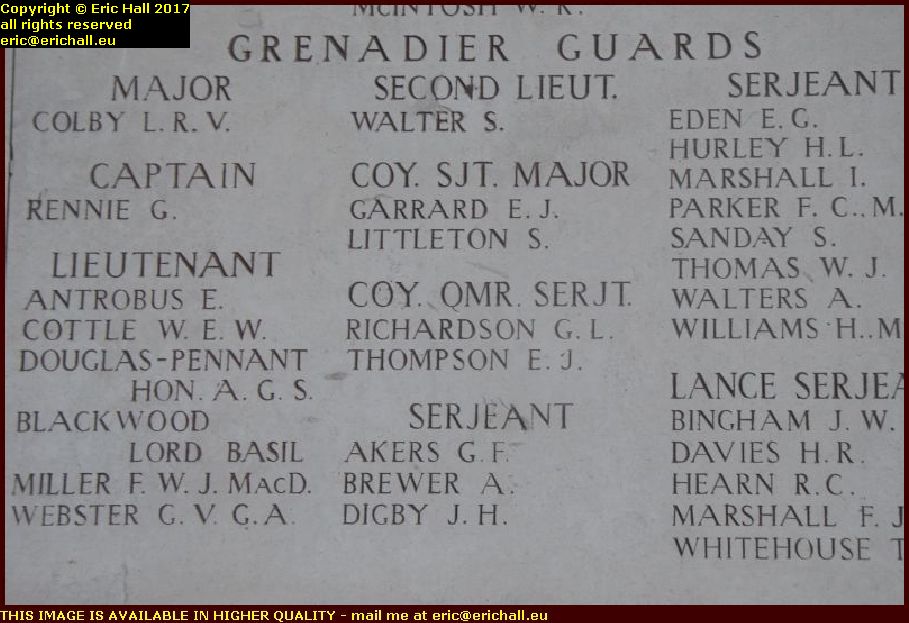
basil blackwood ieper ypres belgium april avril 2017It’s interesting to look at the panels and see if there’s anyone there whom you can identify. One name leaps to mind out of that lot on there and that is Lord Basil Blackwood.

A big friend of Maurice Baring and featuring heavily in Baring’s semi-autobiographical Flying Corps Headquarters, he was a well-known illustrator of children’s books as well as being a competent barrister.

Ironically, he actually featured in one of my nocturnal rambles a year or so ago.

Another name on there is that of the Honourable Alan George Sholto Douglas-Pennant. His claim to fame is that he was the heir apparent to the title of the Earl of Penrhyn.
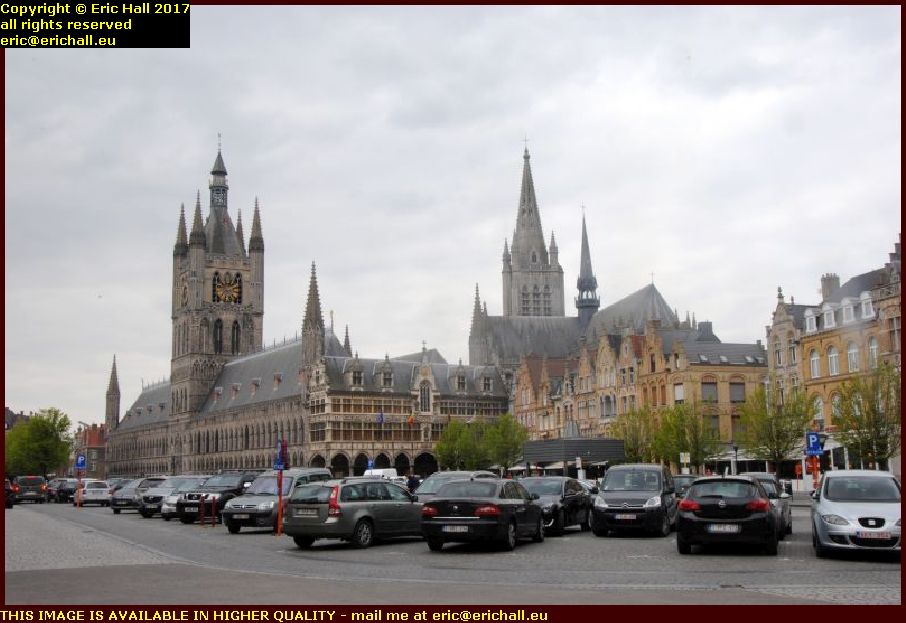
cloth hall cathedral ieper ypres belgium april avril 2017We headed off into the city centre to look at the Cloth hall and the Cathedral.

You can immediately see just how rich Ieper had been as a town simply by looking at the buildings here. The 15th and 16th Century was a time of great prosperity for the city, its fortunes being based on the woollen trade. However, by the time of the First World War, its fame and fortune had long-since passed it by.

if you had come here in 1919, all that you would have seen of the city would have been assorted piles of rubble. During the period from October 1914 until late 1917, the city was being systematically flattened by German artillery until nothing remained.

Many years ago I read the diary of the priest (or whatever ecclesiastic title he would have held) of the Cathedral in which he described day-by-day the destruction and devastation that was happening in his parish and the agonising deaths that many of his parishioners suffered.

But by chance, the original plans of the city were rediscovered after the war and this enabled much of the city, including the Cloth Hall and the Cathedral, to be rebuilt more-or-less exactly how it used to be, and it’s a testament to the skill and labour of the craftsmen that they managed it so successfully when compared to the absolutely dreadful attempts by the UK and the Donald Gibson School of Wanton Vandalism to “modernise” its cities after the Luftwaffe blitz

We found a little burger bar where not only did they have veggie burgers but gluten-free buns. We were all able to have a decent late-lunch/early-tea, and doesn’t that make a nice change?

Things are looking up!
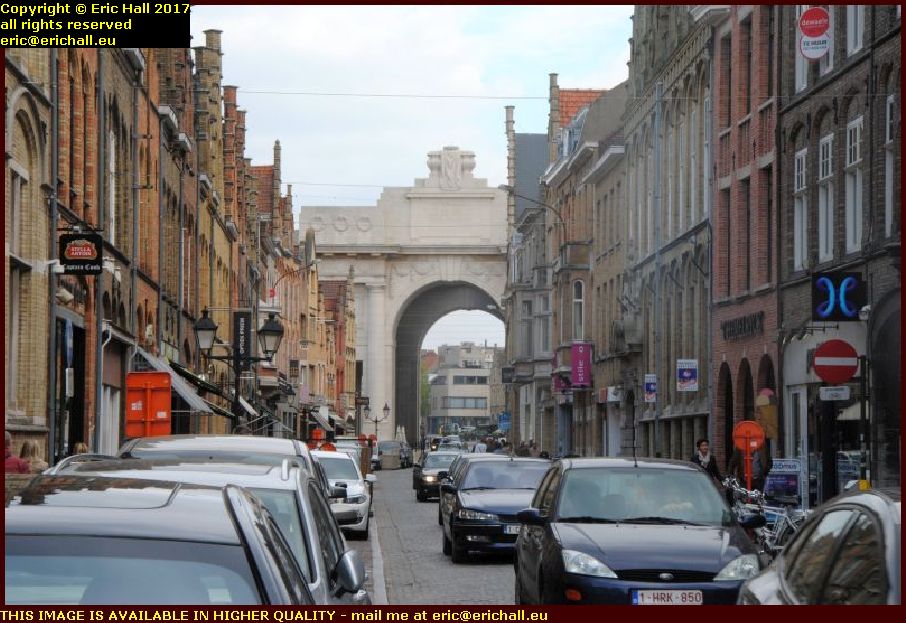
menin gate ieper ypres belgium april avril 2017Jenny had some shopping to do so we wandered back up town towards the Menin gate and the car.

This gave us an opportunity to see the Gate from this viewpoint and to admire the facades of the houses that lined the street. It’s a magnificent rebuilding job that was carried out here after the First World War.

It’s just a shame that there is so much traffic in the street. But it IS Easter Holiday in the UK of course, and that’s why Jenny is here
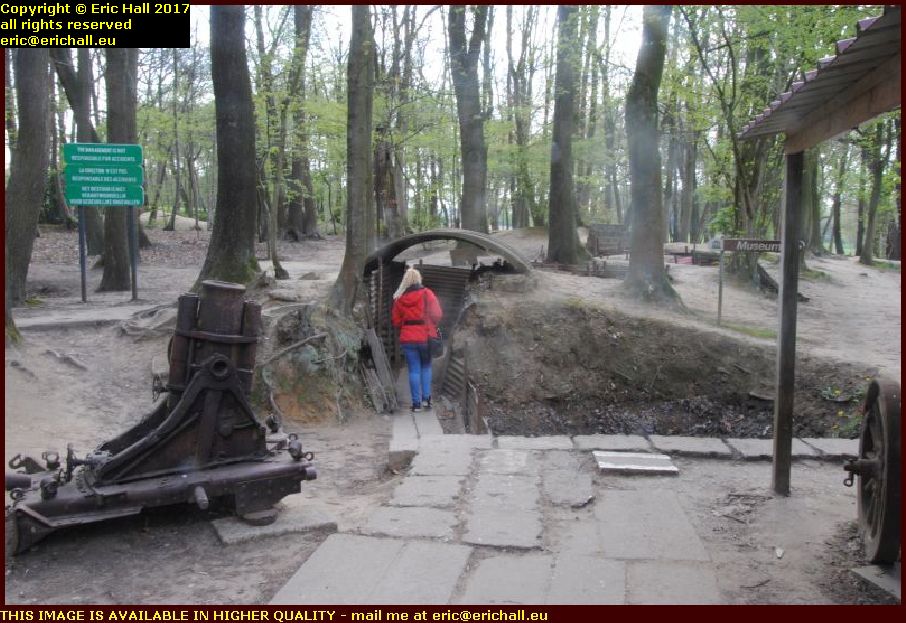
museum trench mortar ieper ypres belgium april avril 2017There’s a museum out on the edge of the city where artefacts dating from the battles here had been taken to be put on display, and this was one place that Alison and Jenny wanted to visit.

Here’s Jenny just disappearing into a trench that was being protected by an old trench mortar of the type that the British used to lob projectiles from their trenches into the German trenches which, sometimes, were no more than 20 metres away across No-Man’s Land (or No Person’s Land as I really have heard it described).
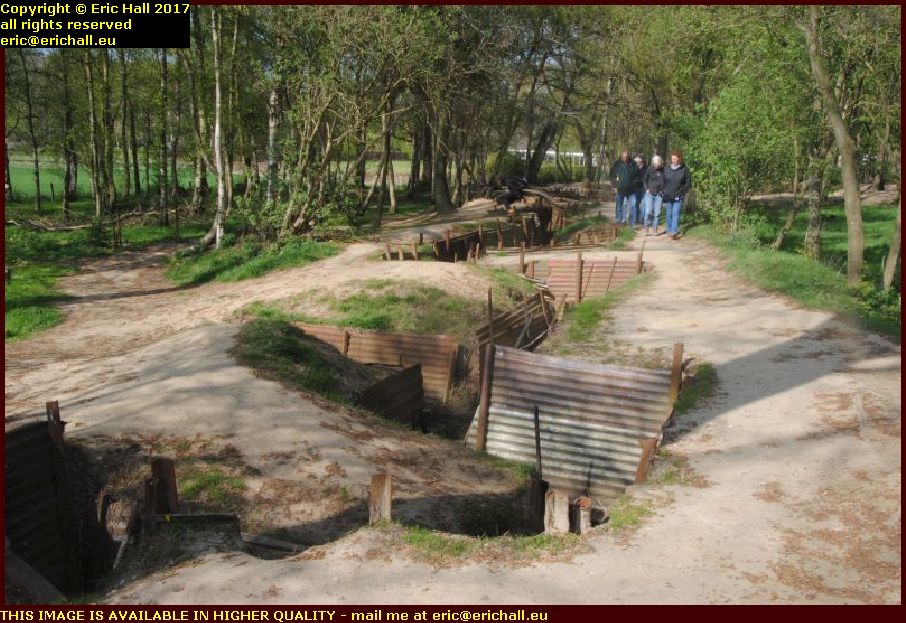
trench museum ieper ypres belgium april avril 2017The people here had bought a section of what was, I believe, the British second-line trenches during the battles here, and had kept them in some kind of state of how they might have been during the fighting.

Of course, it’s very difficult for the trenches to remain intact after 100 years, but hats off to them for having a go. It’s the nearest that you will ever come to understanding the suffering that the soldiers of the various armies had to go through during the First World War

There were all kinds of relics recovered from the battlefield and stored here to give you an idea of the items that were being used on the battlefield.
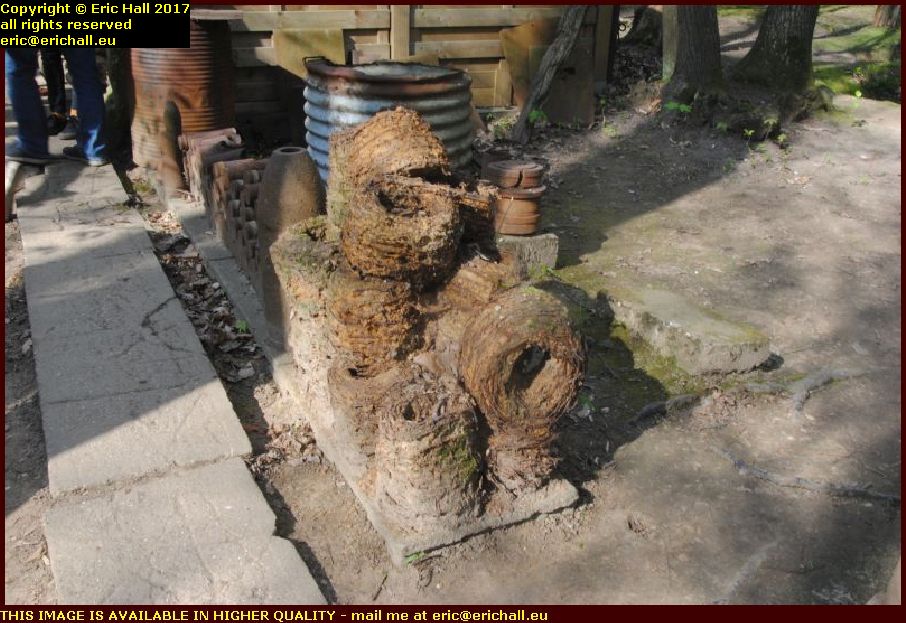
barbed wire trench museum ieper ypres belgium april avril 2017Barbed wire was probably one of the most common items to be used out here, and they had recovered several rolls of the stuff over the years. Horrible nasty stuff that can tear you to shreds and which was used to impede movement in No-Mans Land.

The Germans had a very nasty habit of whenever there was about to be a British attack, they would sneak out and carefully cut the wire in strategic places so as to channel the attacking British and French troops down predictable pathways, which were then covered by a couple of heavy machine guns.

Ludovic Kennedy reckoned that of the hundreds of thousands of Allied troops who were killed on the Somme and at the Third Battle of Ypres, most were killed by no more than a few hundred German machine-gunners.
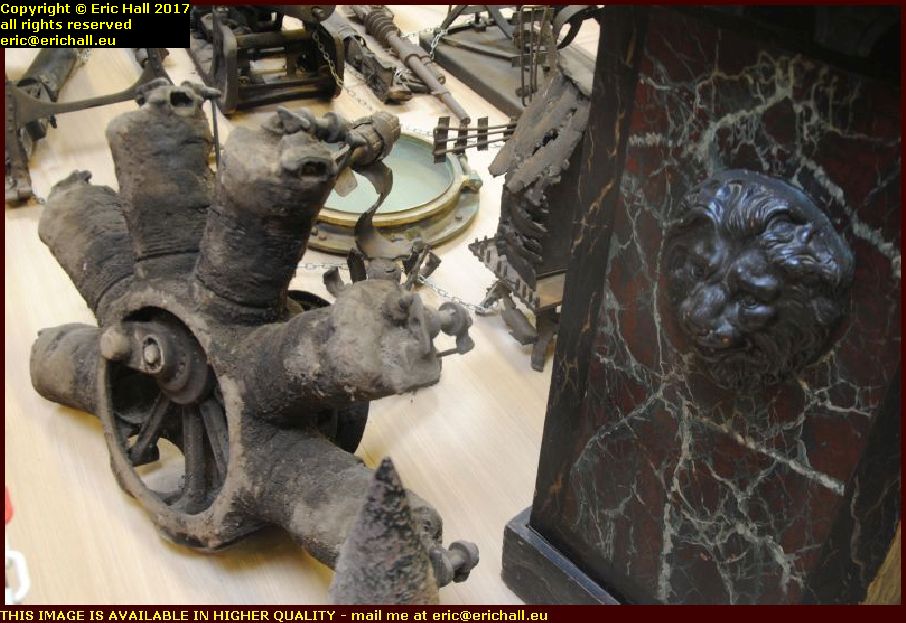
world war one radial engine hill 62 ieper ypres belgium april avril 2017I wanted to come here again because when I had been here before they had brought in a radial engine from a World War 1 aeroplane that had crashed on the battlefield.

I was hoping that they might have cleaned it up but apparently that’s not within the remit of the museum, so I couldn’t even tell if it was German or Allied, never mind what make it might have been.

They were usually either 7 or 9-cylinder engines (sometimes in two banks) and this one is a 9-cylinder.

The principle of the radial engine is that the engine rotates around the pistons, not the other way around. They produce a lot of lateral torque as you might expect and so required a great deal of concentration to fly.

However the torque could be an advantage because if you were being chased across the sky by an enemy machine, relaxing your grip would let the torque take over and the machine would shoot off at random unpredictably all over the sky and the aeroplane chasing you couldn’t follow you.

The British however generally insisted on stable machines that would fly predictably and easily, and hence they were shot down like flies.
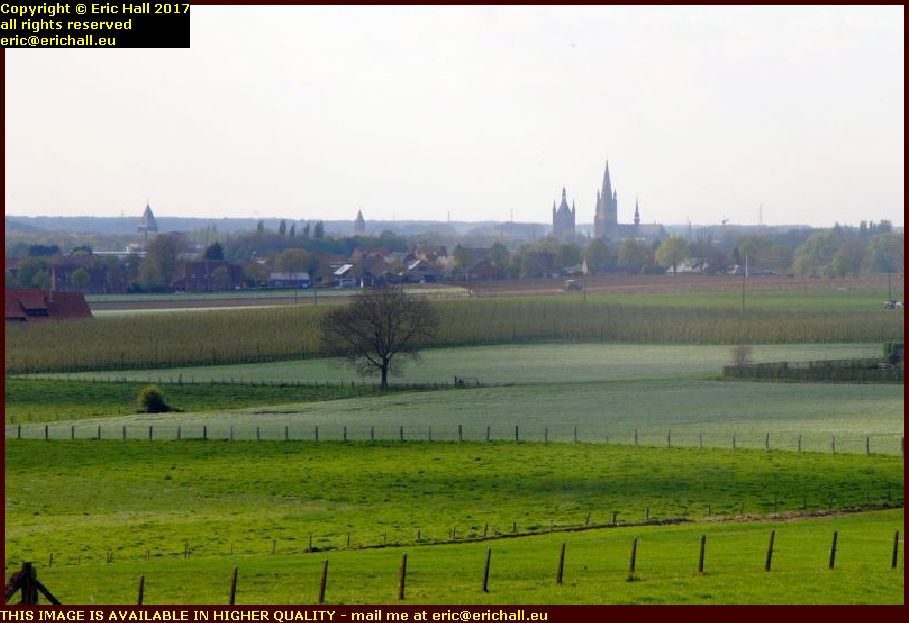
hill 62 ieper ypres zonnebek passendaele passchendaele belgium april avril 2017Outside, we went up to Hill 62 to see if we could see the Hooge Crater – the hole that had been created by the massive mining, tunnelling and explosive works of the british to demolish the German defences.

It’s not clearly visible but the city of Ieper is, and you can see why it was imperative for the British to capture the hill from the Germans, for from here they could rain down shells and bullet on the city with impunity.

People often talk about the heavy losses that were sustained by capturing positions like these, but from the top of the hill it’s very easy to imagine the casualties that would have sustained from a battery of field guns had they been allowed to remain here unopposed.

tyne cot military cemetery ieper ypres zonnebeke passendale passchendaele belgium april avril 2017From here we went on through Zonnebeke on the road to Passendale – or Passchendaele – where we stopped at the Tyne Cot military cemetery half-way up the hill.

It’s by far and away the largest British military cemetery in the World and the even sadder thing about it is that more than half of the inmates are unidentified.

What is known about them is written on the tombstone – “an unidentified soldier of the First World War” means that they don’t even know his nationality. “A unidentified Second Lieutenant of the Black Watch” is more clear.
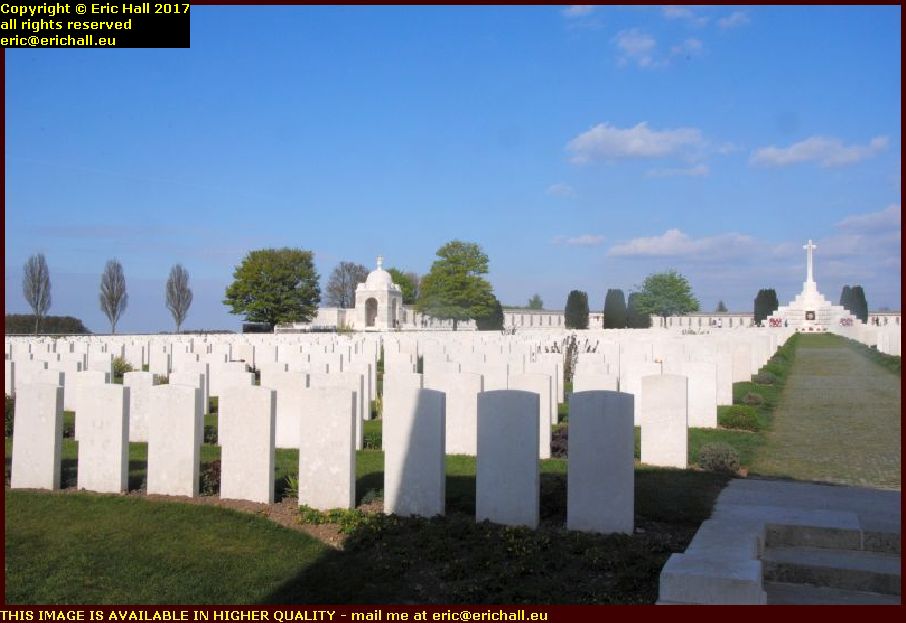
tyne cot military cemetery ieper ypres zonnebek passendaele passchendaele belgium april avril 2017I mentioned earlier that at the Menin Gate they had eventually given up the idea of expanding it to include the names of all of the missing.

It’s here at Tyne Cot that they carried on, and all along the back wall are the names of tens of thousands more soldiers who disappeared into the morass that was the Third Battle of Ypres, or Passchendaele.

And to think that there are still some people (mainly Brits of course) who are still fighting this war
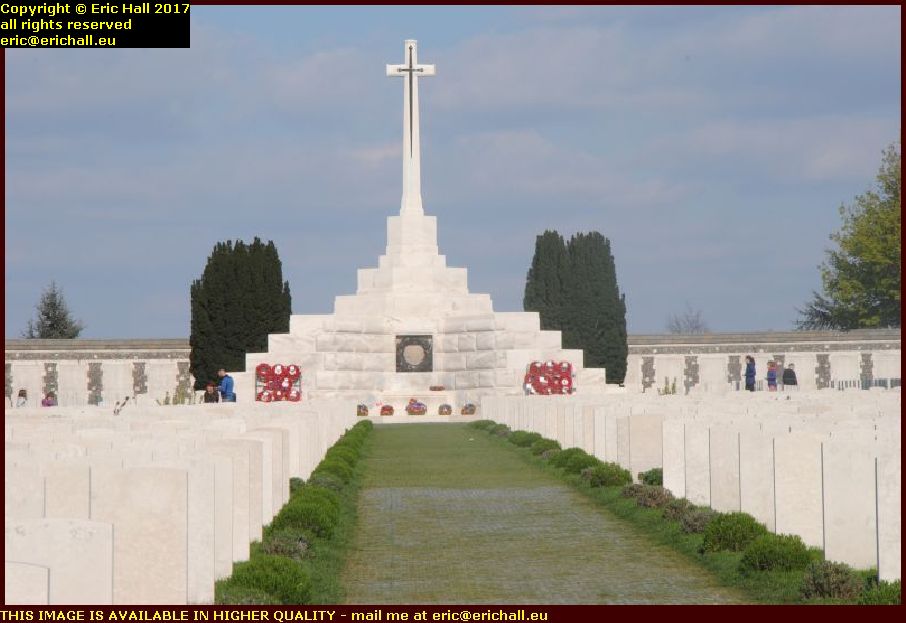
tyne cot military cemetery ieper ypres zonnebek passendaele passchendaele belgium april avril 2017Douglas Haig came in for a lot of bitter criticism about his plan of attack – mainly from Captain Liddell-Hart and his acolytes in the 1950s and onwards.

But Liddell-Hart’s vitriol, due mainly to his having been passed over for promotion on many occasions evenwhen officers were also dying like flies, obscures a couple of vital points that history has (conveniently for Liddell-Hart) totally forgotten.

  1. Haig wanted to attack in the late Spring and Summer after the Vimy Ridge offensive, when the weather would have been kinder. It was the British politicians who insisted that Haig postpone his attack, and overruled him at every step. And, just like Brexit politicians, they all ran away and hid when it all went wrong.
  2. Haig had a dreadful fear, and although subsequent events were to prove him wrong, contemporary knowledge was certainly on his side and he cannot be blamed for thinking the way he did.

    After the dreadful carnage that was Verdun, the French Army was on the verge of mutiny and there was a strong call amongst left-wing politicians in France for an immediate end to hostilities.

    If the French left-wingers had had their way, and France had withdrawn, what would have become of the British Army?
    Being unable to fight in France, and being unable to resupply (as all of the ports used by the British Army were in France) the German Army would have simply waited until the British had run out of ammunition and then walked over and rounded them up.

    It was absolutely vital that the British reach the Belgian coast and capture a port at all costs if they were to continue the battle and not surrender to the Germans.

    As it happened, the left-wingers in the French Government were defeated and order was restored, but Haig wasn’t to know this at the time of the battle. And history has very unkindly erased this chapter of the story from Modern Thought.
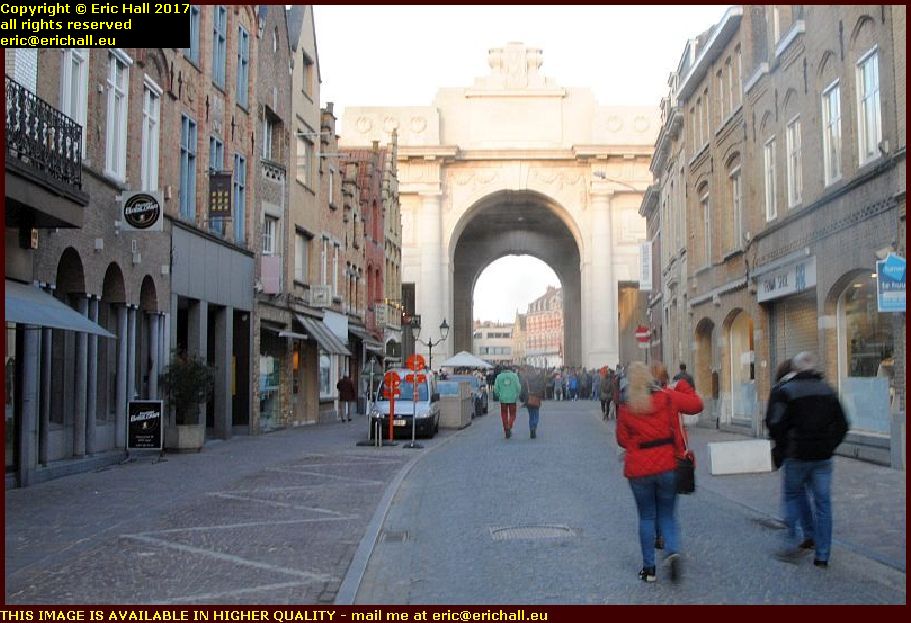

menin gate ieper ypres belgium april avril 2017Back in town again later, we went for a coffee and encountered another Belgian businessman who preferred to shut up his shop and go home instead of catering for the hundreds of people who were milling around the Menin Gate – no wonder that there’s a recession.

At 20:00 every night the Belgian Fire Brigade have a parade here and blow the Last Post to commemorate the hundreds of thousands of British soldiers who died here to keep the city out of German hands (and as I have said before … "and on many occasions too" – ed … things must have gone dramatically wrong for the UK over the past 50 years if the Belgians prefer the Germans here these days).

The proceedings were interrupted by a British motorcyclist on a big Harley Davidson who rode the wrong way up a one-way street and revved his engine to drown out the ceremony (which explains a lot of what I have just said) but anyway, we headed back to the car afterwards for our journey back.

And now I’m exhausted. I’ve had a heavy day and it’s just as well that I’ve organised a Day of Rest tomorrow. I’ll be in no state to hit the rails after all of this.
Tuesday 29th March 2016 – THERE ARE JUST SO MANY …

… job opportunities these days.

basterd suiker emte supermarket zoutelande netherlandsYes, I’ll be back in the Netherlands at some point giving them lessons in English spelling because somewhere along the line, they seem to have lost their way.

But the existence of this product explains quite a lot and answers many questions.It must have been on sale in the UK at one time or another, because I’ve overheard loads of people wandering around Tesco’s or Asda going “where’s the basterd sugar?”. And now I know why.

After my dreadful evening last night, I was first up and first into the breakfast room yet again, and I was in and out by 08:30. It didn’t take me too long to pack and arrange my affairs, and by 09:10 I was on my way.

But something very surprising happened as I was leaving. I’d handed my key to the chambermaid and as I was walking away from the hotel, the landlady came chasing after me. Not, as you might think, to accuse me of taking the towels away, but to shake my hand and wish me all the best in my forthcoming trials and tribulations. I thought that that was very poignant indeed.

Off to the supermarket and stocking up with Raak Campagne Pils and gelatine-free licorice-and-banana flavoured sweets, and then I went off for a drive along the coast.

sherman tank westkapelle netherlands museumJust down the road in the town of Westkapelle I stumbled upon a museum. This features exhibits relating to the polders and dykes around here and contains a few exhibits from the battles around here that liberated the islands in the Scheldt estuary in late 1944.

That up there on the top of the dyke is a Sherman tank of course. From the USA and the most popular of the USA light tanks in World War II

remains of shipwreck westkapelle netherlands museum“Exhibits relating to the polders and dykes”, I just said. And this area of the coast is littered with shipwrecks, which is hardly surprising when you remember just how close to the shore the main shipping lane is.

It’s bad enough in a motor-powered ship but it must have been a nightmare in a sailing ship. There’s hardly any room at all in which to manoeuvre. This pile of metalwork has been gathered from off the shore over time and is part of the exhibits.

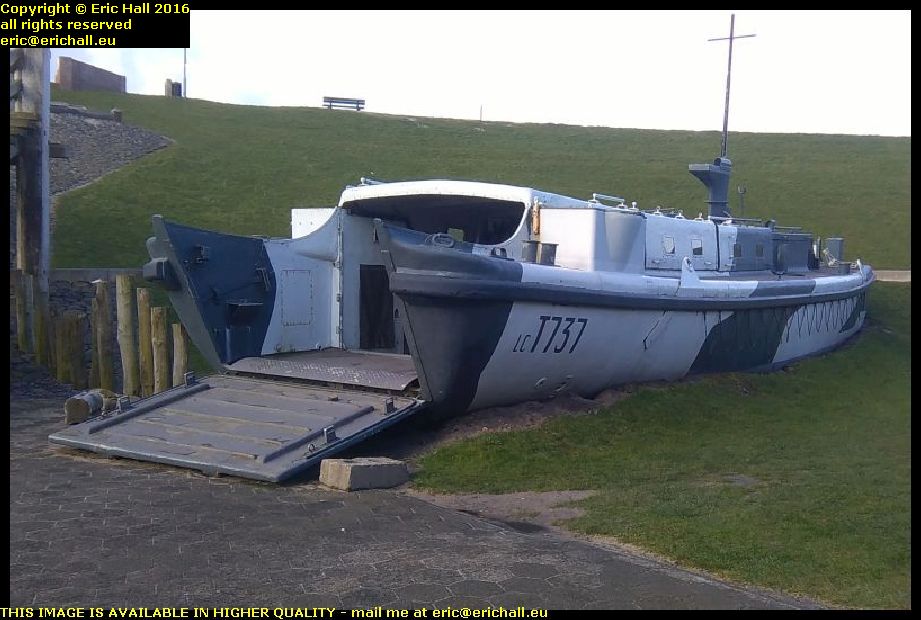
landing craft tank LCT737 westkapelle netherlands museumThat’s not all either. This is a Landing Craft – Tank and was one of the key elements in amphibious warfare.

It’s the kind of thing that I would buy in a heartbeat if I were to live on my own island somewhere off the coast. Caliburn would fit in there quite nicely with a little modification (to the LCT) and t would be just the thing to keep us all mobile.

I would gladly have told you so much more about the exhibits but as you might expect, the museum is closed. No surprise here.

So I travelled on up the road for a while and found a lovely spec by the seashore where I could watch the ships sailing along the coast, and also have a little snooze for a couple of hours. You’ve no idea right now how much I’m feeling the exertions of my travels.

I stopped for a coffee on the way home, at a motorway service area just before the International Border, and then hit all of the traffic around Antwerp. And that’s just how it was, all the way back to Alison’s.

I didn’t hang around for long though. I have a long day ahead in Brussels and so I crawled upstairs for an early night.

There’s just about enough time for me to tell you about my travels though. Some British person had bought a piece of land in France, but it was more like on Barony Park in Nantwich, at the top end of the street where Helena and Ann used to live. He was laying down some huge amount of concrete hardstanding there in order to erect a block of flats. Someone had been working for him but had left the job half-way through and an arrangement had been made for me to go and pick up his wages. I had to be there at 17:00 but when I arrived at 17:01, everyone had already gone – in that minute that I was late. I had to find a place to park there, annoying all of the traffic whilst I was trying to squeeze into a parking place – access was really difficult. I had a good look around but I couldn’t find anyone, and ended up by talking to a man who had been interested in buying the small plot next to this large one. He had thought that with this first man ordering to much concrete, he could add whatever he wanted onto the neighbour’s order and pay pro-rata. They could lay his concrete together and he would return the labour on this person’s site. However, the first guy was not at all in favour. he told him to bring his tonne of aggregate, his tonne of sand and of cement and we’ll do it in five days. This made the second guy have second thoughts about buying this plot of land for if this was how it was going to be like in the beginning, how was it going to end up in the future when they were living next door to each other? From here, I had to go back to my bus (for I was driving a bus) and pick up Roxanne’s grand-parents on her father’s side. We had to go and pick up our mail which was delivered to the garage of a block of apartments somewhere that looked like a street I know in Evere and was put in galvanised metal buckets. There was nowhere to park, as usual, so I had to park in the street while they nipped out to pick up their buckets and pick up mine too. Of course, at this moment a great big bus pulled up behind me and of course he wasn’t very happy so I had to move. I had to drive about 50 yards down the road to where I had seen a parking place. But it was tight down there and I had knocked the mirror on the passenger side of my bus so I couldn’t see properly and had to inch my way down there and inch my way into this parking space and shunt myself in so that I was close enough to the kerb. But this bus wasn’t helping because every time I went forward, so did he, which meant that I couldn’t reverse back in, especially with no mirror on the passenger side (it was a RHD bus by the way), and I was on the point of getting out and giving him a piece of my mind.
I was with Liz and Terry somewhere around the Pinware River in Labrador. It was where they have built the new diversion but we were actually on the old road but this was all now industrialised and a big city environment with a railway line that ran up there and a yard where containers were loaded and stacked. The first thing that we noticed was a shipping container that had not detached from its trailer, so the crane had picked up the container and the trailer – and then dropped the lot! The whole right-hand side of the road had been devastated by fire and I wanted to photograph this, so I had to drive around to find a suitable place to park (I was in Strider, but a RHD Strider, by the way). There was nowhere really to park and I lost Liz and Terry while I was doing this. I’d gone higher up the hill, but on turning round and coming back, I noticed that there was a road that turned off to the right so I turned off to travel along it, but it was a one-way street and I ended up going the wrong way along it. People were flashing their lights at me and some youngish guy tried to get into my car with me and give me a lecture, something about “all of these tourists coming into our country and thinking that they know their way around when they really know absolutely nothing. They ought to be given proper qualified guides to accompany them”. My reply was that I was interested in seeing things that I was interested in, and seeing them through my own eyes, not anyone else’s. This led to quite a heated debate. He started speaking to me in a language that I didn’t recognise but, remembering where I was, I guessed that it was Innu, which he confirmed. It was all very unpleasant.
We were out walking by the river somewhere round by Farndon, that area. There was a girl, rather like Pamela Hayes or that girl whom I met on that ship out in the Gulf of St Lawrence who looked quite tall (although she was wearing high heels) and she was intending to throw herself in the river. We had a big discussion about it and I explained that this wasn’t the solution – there were people far worse off than she was, and all of this sort of thing. There were people up to their necks in water struggling to get out and so on. I introduced myself and told her that I was out looking for an apartment somewhere as I lived at home with my five siblings and my parents in a little two-bedroomed house. My mother was swimming in the river at this time (although it wasn’t my mother, it was the mother of Helen – a girlfriend from my school days). All of our family was into things to do with painting – my mother was a painter and my brother was a house painter. I was actually on my way to Halfords to buy a box of assorted tap washers to do some plumbing. I knew a girl who worked there, but she was in the department that sold tapestries. My mother then came out of the water and we all had a big chat and then went off to buy these washers; However, there was nothing really suitable – they had a multi-pack of washers there but these were just bits and pieces. At this moment, the Police turned up. There had apparently been some other kind of incident going on there and they had come in response to that, but we were all held and interviewed about what we knew.
This next bit is nothing like complete because after I woke up, I fell asleep again almost immediately and so didn’t dictate it “at the moment” as I would normally like to do. From what I remember, though, I was on a train that had left France and was heading down to the south of Europe. I’d boarded it at the departure point, Paris, and it was crammed with people like most wartime trains were. We’d boarded it right behind the engine and had to work our way backwards to find a seat. We must have travelled for miles and there was still no seat to be found. We kept bumping into the guard and he was telling us all kinds of stories about wartime travel and so on. I don’t remember too much more about it, although we did end up somewhere down by Yugoslavia and we were still standing. But on the subject of wartime, I was explaining to someone that French railways were liberated “all at once”. They were surprised by that but I pointed out that the railway staff was actually civilian in most cases and would just take orders from whoever was giving them. It made no difference whether they were French, German or whatever, whether they were giving the orders or receiving them. They would not, in by far the most cases, be considered as combatants. So once the head of the pyramid of command had been liberated, so would all of the rest of it.

Monday 5th October 2015 – AND THAT WAS ANOTHER NIGHT TOO

We started off with the smoke alarm. The battery was going flat and so after about an hour or so of crashing out, the alarm gave its warning beep.

And then an hour later, after I’d managed to go back to sleep, it bleeped again.

Eventually, once I realised what was going on, I ended up taking out the battery.

And then, after I’d gone back to sleep, Rhys texted me to tell me that all of South Carolina had been washed away in a biblical flood.

And not only that, I had forgotten once again to check the surrounding area for railway lines. And so we had the inevitable.

he net result of all of this was that by midnight I was totally wide awake and it took hours for me to go back to sleep. By the time 06:00 came round and the alarm went off, I was thoroughly wasted,

A coffee and a shower helped me on my way, but here’s a remarkable fact – I’ve driven over 250 kilometres today along Highway 132, one of the principal routes along southern Quebec and through several holiday resorts along the north shore of the Baie des Chaleurs, and in all of that distance along all of that highway through all of these places I’ve not encountered a single Tim Horton’s.

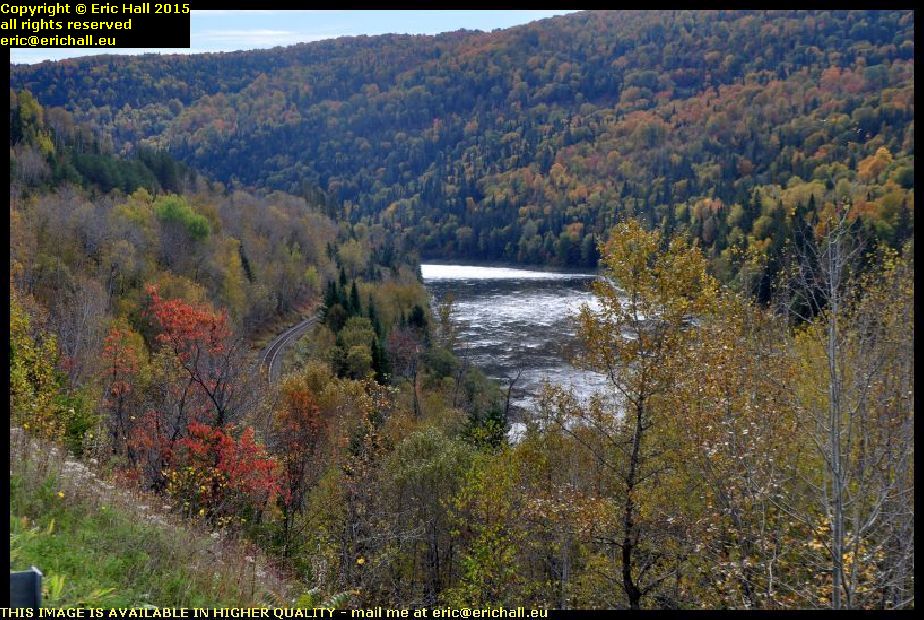
matapedia river highway 132 quebec canadaWe’re in the gorge of the Matapedia River now, on the southern slopes of the Appalachian Mountains and this is another really beautiful place to be. Once more, I could take a thousand photos of the area around here and I would never be able to do it justice.

And you can see down there the railway line that runs past the motel where I stayed last night. It’s the Canadian National railway line that links Halifax and Montreal and runs along the New Brunswick coast. The VIARAIL passenger expresses run along there, at least it did when I encountered one of them in 2010. Who knows what happens now.

matapedia river highway 132 quebec canadaFurther on southwards, we pass the town of Matapedia and round about here the land starts to flatten out as it approaches the Baie des Chaleurs.

There are some interesting hills along here and depending upon the viewpoint that you adopt, you can conjure up some bizarre shapes. And not only that, the light is much better for photography too so the photos come out much better.

And despite the important road junctions around here for the roads that bifurcate off to New Brunswick across the river, still no Tim Horton’s.

The Baie des Chaleurs is famous for being the site of a naval battle that effectively sealed the fate of the French in North America. Once the city of Quebec had fallen to the British, two fleets set out from Europe. One was British, to deliver arms and supplies, and the other was French, with supplies and soldiers to reinforce the French forces.

The British fleet arrived first at the city of Quebec and so the French fleet, following closely behind, put into the bay here to regroup and to think of a Plan B. But here, they were cornered by the British and the French fleet was destroyed. And that was that for the French.

museum battle of restigouche st lawrence river highway 132 quebec canadaA few years ago, an archaeological expedition in the bay had uncovered many relics of the naval battle, including the remains of some of the sunken ships, and a museum has been created to display the artefacts. This was my port of call for today.

However, you don’t need me to tell you what has happened, do you? The museum is “closed for the season” as you might expect and for once, I’m not able to blag my way in.

I just don’t understand why they have such a short tourist season in Canada. There’s a 10-week spell and that’s that. But nowadays with these huge mobile homes that they have, with all mod cons and central heating, and a rapidly-increasing population or early-retired people with a huge disposable income, they could run the tourist season 12 months of the year. It would bring much more income into the area spread out over a longer period, and so create much more permanent employment, but Governments and Civil Servants can’t think beyond the ends of their fingers. They have no long-term vision.

old ferry dalhousie highway 132 baie des chaleurs quebec canadaThere’s a huge bridge across the river here into New Brunswick but we’ve been on that before, and my old map indicates that there’s a ferry further up the river.

But the ferry is a disappointment as you can see. According to the guy working here with his tractor, the ferry has been closed down for 10 years and the only way across to New Brunswick now is the bridge. But we spent a good half hour putting the world to rights too. Canada is just like everywhere else in the world where people are fed up with the Government, big business, and the whole of modern society.

dalhousie highway 132 baie des chaleurs quebec canadaAnd so I went off to find a place to eat my butties.

Here I am on the shore of the Baie des Chaleurs overlooking the town of Dalhousie in New Brunswick. In the peace and quiet I enjoyed my butties, and the next thing that I remember was that it was about 15:35. I’d crashed out good and proper yet again due to my difficulties during the last couple of nights and this at least is one way of catching up with my missed sleep.

la grande hermine highway 132 baie des chaleurs quebec canadaNow how about this?

This is La Grande Hermine – or, at least, a half-size replica of it. She – the original at least – was the ship in which Jacques Cartier sailed to Canada on his 1534 expedition, and a guy who runs a holiday chalet complex had traced the plans, sent off to France for a copy and then built this half-size replica.

It took about 7 months work over a period of a year and a half to build it, and he’s made a magnificent job of it too.

la grande hermine highway 132 baie des chaleurs quebec canadaIt’s now a two-bedroomed holiday chalet and I was lucky enough to be given a guided tour of it. And it really is magnificent.

I asked the owner if he had much trouble having the plans passed by the local authority and he said none at all because they haven’t even seen them, never mind passed them.

And so how has he managed it? The answer is that someone from the maritime department has inspected it because it is officially classed as a boat. And it does indeed float too, so he’s okay for whenever global warming overwhelms the bay – provided that he manages to find a pair of every known species of animal to go with him.

timber trestle viaduct highway 132 baie des chaleurs quebec canadaAnd how about this too?

At one time in North America there used to be timber trestle viaducts everywhere but you’ll be hard-pushed today to find one. We did discover one a couple of years ago but that was on an abandoned line, but here is a timber trestle viaduct on a railway line that is still(as far as I am aware) functioning. It’s a thoroughly magnificent beast as you can see and I wouldn’t mind taking this home with me.

bombardier snowplough highway 132 baie des chaleurs quebec canadaSomething else that I wouldn’t mind taking home with me is this tracked snowplough. It’s a Bombardier, of course, like the snow cat that we saw in Goose Bay a few years ago, and this would be fun for me to play with on the fatm back home.

It’s for sale too and the price is not unreasonable, but I’d have no idea how I could go about getting it to fit in my hand luggage on the aeroplane and the airline would probably have a fit.

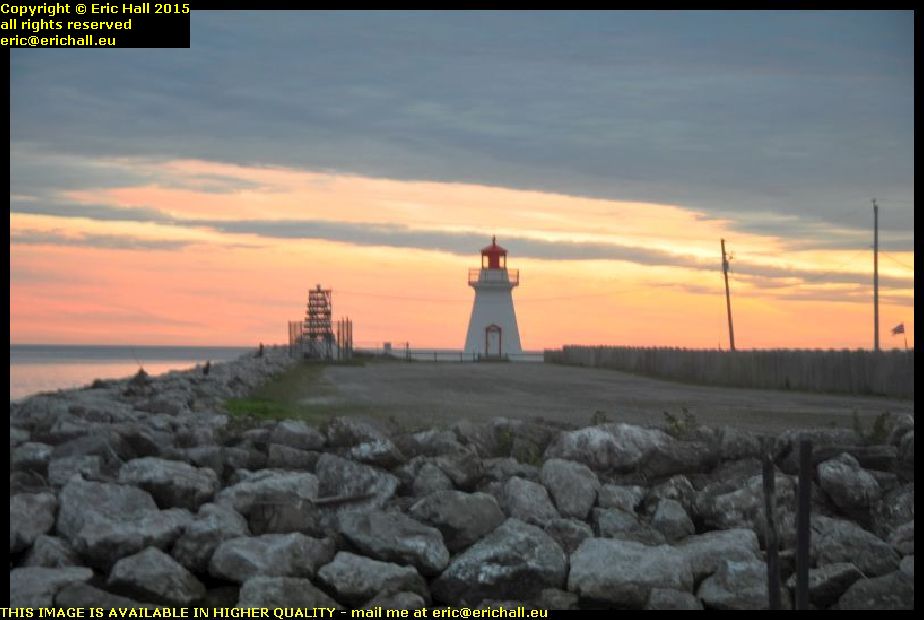
river bonaventure highway 132 baie des chaleurs quebec canadaAnd so here I am tonight on my spec at the old quayside on the River Bonaventure at the town of the same name, watching the sun set over the old lighthouse.

I’ve cooked myself a meal and now I’m going to be settling down for a nice night in Strider to see if I wan catchup on some of my beauty sleep.

Having seen my face in a mirror this morning, I reckon that I need it.

Saturday 3rd October 2015 – START AS YOU MEAN TO GO ON.

I decided this morning that I would have a proper breakfast (of sorts) and so I called into the local Tim Hortons for coffee and bagels. And then promptly dropped the whole lot on the floor, followed by the laptop.

Still, at least it amused the patrons of the establishment.

I was up early after my rather late night last night and did a pile of paperwork in something of a vain attempt to catch up and then hit the road for Rimouski and breakfast. At least they gave me some more bagels and coffee. And someone with whom I was chatting confirmed that the serving wench there asked me 7 times if I really didn’t want butter on them.

I’d never had a proper look at Rimouski before and so I had a little drive around. It’s a typical seaside town with beaches, plenty of motels and amusements – just the place to come for a fortnight if only the river were warmer, because the St Lawrence is a really cold river.

onondaga submarine maritime museum rimouski st lawrence river quebec canadaBut I was here at Rimouski for other reasons. As Austin Powers once famously said to Basil Exposition, “what’s long, hard and full of seamen?”.

There’s a small maritime museum here at Rimouski and the pride of place goes to the old Canadian submarine Onondaga. I’ve always said that you would never ever get me into a submarine, and at the price that they wanted for a visit, nothing was ever likely to change.

maritime museum rimouski st lawrence river quebec canadaThere’s quite a little complex of buildings here and the old port facilities when this area was a major port for all of the coast-hopper ferries that started from here.

Much of this traffic has been replaced by road now and what is left departs from the quayside in the town and so this area is redundant. But there are quite a few maritime souvenirs left to visit and it’s a nice place to walk around and to eat your butties

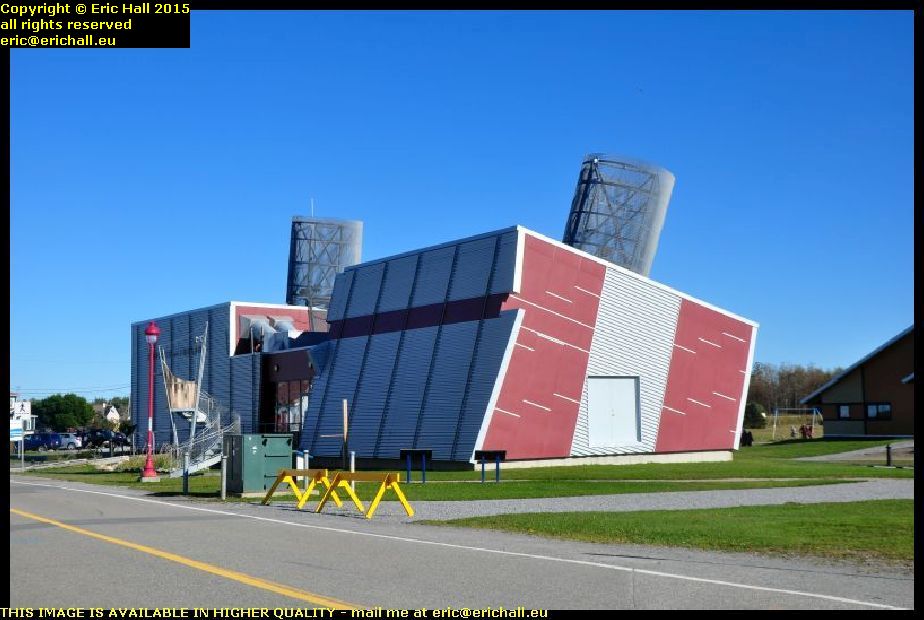
empress of ireland pavilion maritime museum rimouski st lawrence river quebec canadaBut it was the new pavilion that I had come here to see – or, rather, it was the contents of the new pavilion.

On the evening of 28th May 1914 the Canadian Pacific transatlantic liner Empress of Ireland set out from Quebec on her way to Liverpool. She stopped off at Rimouski to drop off her river pilot and then set off full ahead for Liverpool.

buoy sinking empress of ireland st luce st lawrence river quebec canadaJust a couple of kilometres out of Rimouski she sighted the collier Storstad and then each ship became enveloped in a fog bank.

What happened after that has never been adequately explained, but it’s suspected that some of the portholes were open and the collision rolled the ship so that the water poured in.

The net result was that the liner took the Storstad full-on in the beam and sank within 14 minutes, taking 1012 passengers with her. And they all lie right underneath where that white buoy lies.

It’s the greatest marine tragedy every to hit Canada and one of the largest losses of life of any marine accident in peacetime. Remember that the Titanic lost 1507 passengers, but she was 4 times as big, and this disaster took place right within sight of shore.

Quite a lot of the ship has been salvaged since her wreck was rediscovered in the early 1960s. Some of it is displayed in the museum (and this was what I came to see). Very much more of it is held in private hands, which is a shame.

But what is even more disgraceful in my opinion, even though I know for a fact that many others, including the museum staff, disagree with me, is that much of it, including one of the massive brass propeller screws, has been sold for scrap. $5,300 the salvors were paid for the propeller and that just goes to show that some people have absolutely no sense of history.

In fact the looting of the wreck became so blatant (there was talk that one team was planning to use dynamite on the hull to make an easier entry into the bowels of the ship) that the authorities “nationalised” the wreck and placed it out of bounds to salvors, although private divers can visit it.

And hence the buoy – to moor your ship and to display the “statutory notice” about looting.

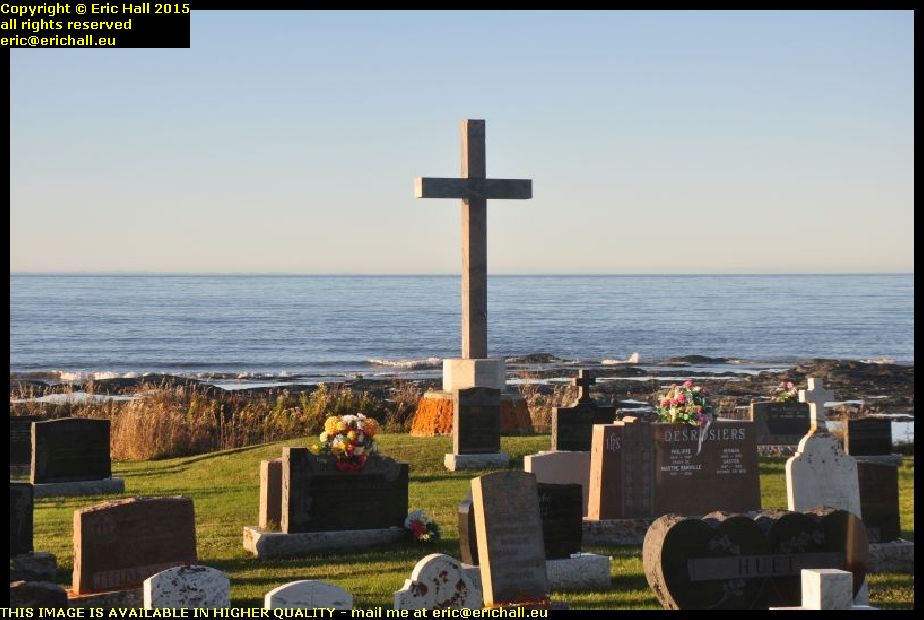
empress of ireland memorial cross st luce st lawrence river quebec canadaThe disaster took place just off the headland of St Luce and there’s a modern Celtic cross on the headland there that clearly relates to the disaster.

In the cemetery however is a concrete and stone cross dated 1920 looking out over the headland to the sea. There’s no plaque to say to what it relates but the date and its position would seem to be significant as being an early memorial to the disaster.

It’s hard to understand how it was that the notion of the earth being flat persisted as long as it did amongst the powerful classes.

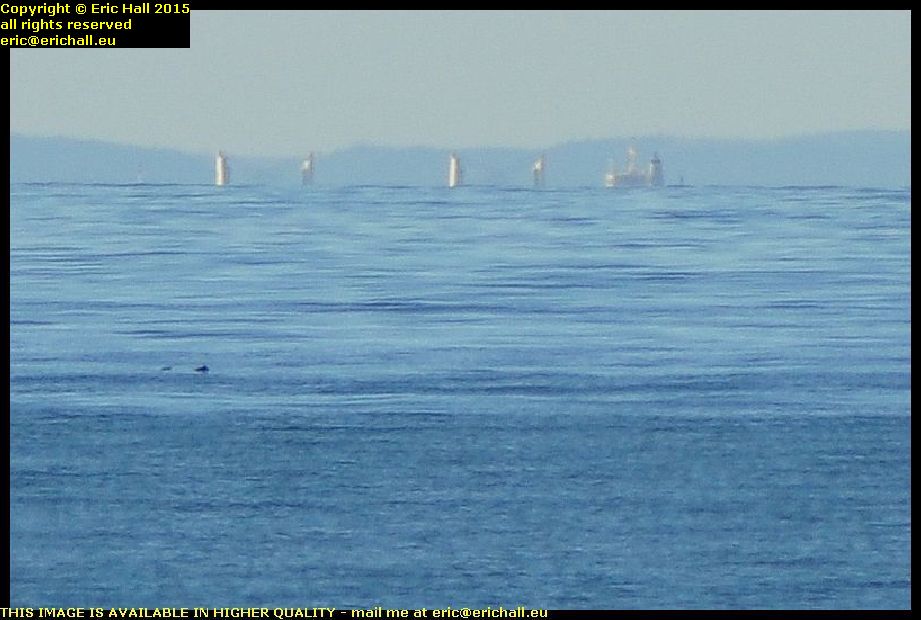
superstructure of ship st lawrence river quebec canadaWhile I was sweeping the horizon looking to see what I could see, I noticed a few peculiar shapes and so I photographed them with the telephoto lens at its fullest extent and enlarged the image to see what I could see.

It turns out that it’s the superstructure of a ship, way across the other side of the St Lawrence. The ship is at such a long distance away that the hull has been lost due to the curvature of the earth.

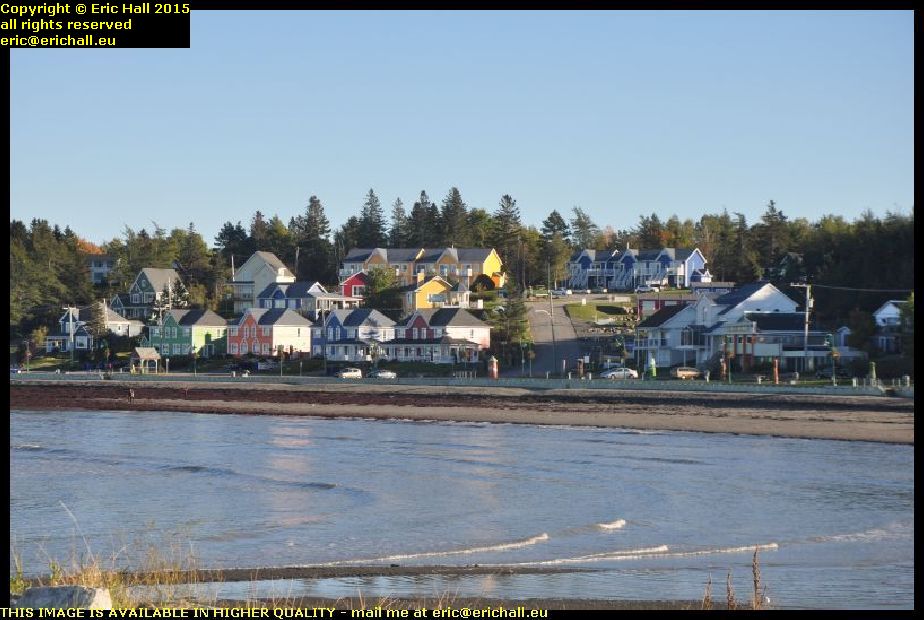
st luce st lawrence river quebec canadaAs for the town of St Luce, it’s another seaside resort but much smaller than Rimouski. It’s quite a quaint little place, another small town where I would be quite happy to pass a week or two relaxing in the peace and quiet.

But the shore of the St Lawrence is really beautiful around here with all of the beaches. It’s a shame though that it’s on the south shore and so it doesn’t catch the sun as much as the north shore. And the north shore is a good 5° colder so it’s not as pleasant for sunbathing.

sunset st lawrence river ste flavie quebec canadaI’ve had a couple of really exciting and involved chats with a couple of people today and we’ve really put the world to rights.

However, it’s made the time pass really quickly and as a result the sun is disappearing rapidly. We’re having a glorious sunset but none of this is helping me find a place to stay.

And while I’m dithering, the temperature has dropped rapidly too and it’s freezing. But I’ve found a type of chalet motel place with cooking facilities and while it’s a little more than I would be happy paying, it’s got absolutely everything and I can cook myself a really hot meal. And so I’m saving there too.

And talking to the proprietor’s wife, she’s a vegan too and gives me a huge bowl of home-made vegan vegetable soup. And that’s the most delicious thing that I’ve eaten for ages.

Sunday 27th September 2015 – I’M LOOKING FORWARD TO THIS.

Tonight, I’ll be sleeping in a real bed, in a real room, with full central heating too.

And what’s more, I’ve just stood for half an hour under a nice hot shower and I’ve changed my clothes and had a shave too. I even look human now, and you know how difficult that can be.

So how did all of this arise? The answer is that it’s a very long story.

overnight camping place eagle plateau labrador coastal drive canadaThis morning, I awoke to a torrential downpour of rain and the black sacks with the insulation in were sopping wet (although the insulation itself was dry).

And we had a small amount of condensation inside the truck cap, but considering how wet it was outside and the fact that I’d been cooking inside last night, I’m not surprised by this. The small amount of condensation was quite acceptable.

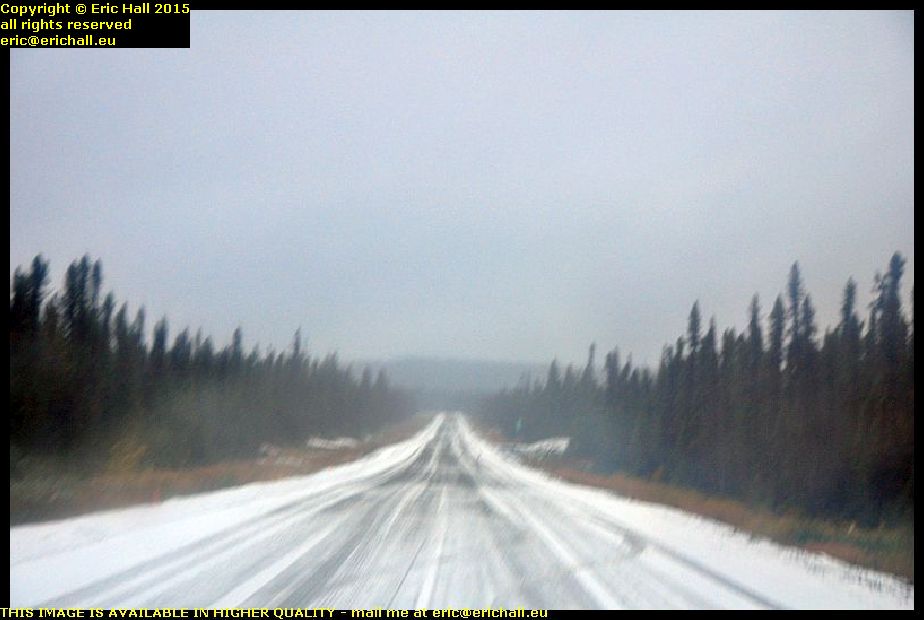
snowstorm eagle plateau labrador coastal drive canadaI hadn’t gone 5 kilometres when the metalled road ended. And while I was on the dirt road, the heavens opened and we were drenched in snow. It had been warmer in my little bolt-hole, but it wasn’t like that just here. This looked quite ominous for the rest of the journey. I wasn’t very optimistic.

Anyway, the dirt road only lasted for 15 kms or so and then we were back on the metalled road again. And I do have to say that in the dirt bit, there were men and machines, including an asphalt layer, all lined up. It looked as if today’s task (had the weather been better) would be to finish the gap.

And hats off to Strider too. I’ve been moaning about his excessive fuel consumption too (and to be fair, it is excessive) and I’d loaded up with 40 litres of extra fuel just in case I needed it. But we pulled in to the Ultramar petrol station in Happy Valley with the gauge just going into the final quarter. Not even the orange warning light, never mind having to refuel.

But I do have to say that the benefits of the new road are readily apparent. Whereas in 2010 when I was here, the difference between a litre of fuel here and a litre of fuel in a more-populated area was $0:34. Today, the difference is just $0:06. That says a lot.

old car happy valley goose bay labrador canadaAfter a coffee and an internet session at Tim Horton’s, I went for a good wander around.

First stop was to see what was happening with my old car – the one that I saw last year. It’s still here, looking definitely the worse for wear and it doesn’t look as if it is going to last for too long if no-one gives it any attention.

It really is sad

happy valley goose bay labrador canadaI went as far eastward as it was possible to go by road, and then went off for a wander into the bush to see what I could see in there.

This is the bay of Goose Bay, at the head of the Hamilton Inlet, and there’s a lovely sand bar just here in the bay. The beaches really are nice in Labrador. And in the background are the mountains over which I’ve driven this last couple of days.

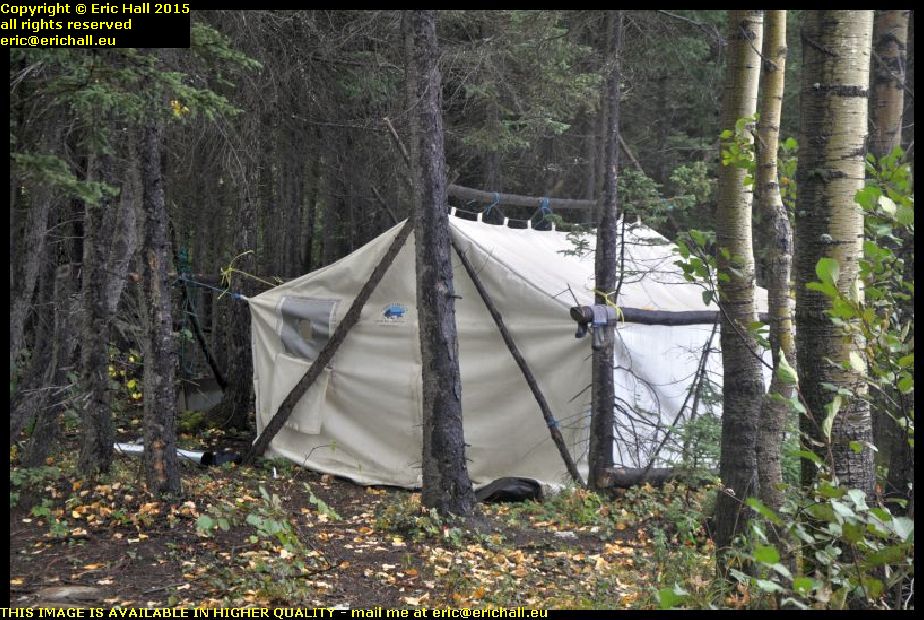
first nation encampment happy valley goose bay labrador canadaThis wasn’t all that there was to see either. There’s also a tent here in the woods.

There’s a really big Innu community around here and there are casual encampments all over the place. Although the First Nation people have adopted more modern building materials (I saw a hut made of OSB draped with a tarpaulin) the traditional itinerant lifestyle is quite important – and quite right too.

There was nothing doing at the quayside at Goose Bay and so I went on to North West River for a good look around. North West River is the farthest north town in Labrador that is possible to reach by road.

I was here late one evening last year and so this time I intended to have a better look around, even though the weather was dreadful.

And this is where our story begins.

I found a museum – the Labrador Interpretation Centre – and much to my surprise, it was open. That doesn’t happen very often.

I spent hours there chatting to the very friendly woman in charge, and we talked quite a lot about the interaction between the First Nation people and the Europeans.

“It’s a shame that the other museum in the town has closed for the season” she said. That has everything that you would like to see, including all of the papers from Mina and Leonidas Hubbard” … "he set out from here to explore the interior of Labrador 100 years ago and died of starvation – his wife set out 2 years later and completed his work" – ed
“I’d love to see that” I said. “What a tragedy that it’s closed”.
And so after another long chat, I wandered off to look at the museum, and she came hurrying after me “I’ve spoken to the curator on the phone. If you can be there at 09:00 he’ll let you in for a private showing”.
Well, badger me!
“I don’t suppose that you know anywhere where I can stay for the night?” I said rather optimistically. My last night around here had cost me a King’s ransom, and that was 5 years ago.
She wandered off and came back again 5 minutes later.
“The B&B is full unfortunately, you won’t want to pay $115 at the motel here, but there’s a room free, with communal facilities including washing machine, in the old Grenfell Building. That’s $45 a night”.
Do bears have picnics in the wood?

north west river hamilton inlet sunday hill north west river labrador canadaShe said that the best views around here were from the top of Sunday Hill, and so Strider and I went off-roading up the mountain.

It was worth the effort because the view from here was stunning as you can see. And it would have been even better had the weather been kinder to me. It was a really excellent place to eat my butties.

And hats off once more to Strider because he made short work of our little excursion up the mountain, even in just 2-wheel drive. If only I could seriously improve his fuel consumption!

So here I am. In Wood Cottage, or Woods Cottage as I’ve seen it sometimes described. Built in the 1920s, it was first the boarding house for schoolkids at the High School who had come from the outlying settlements, and was later an Old People’s Home. I’m warm and comfortable, I’ve had a hot shower, a nice mug of coffee and all of my washing is now in the tumble drier. I’m going to make some food in a minute and then I’ll be off to a nice comfortable bed.

You just watch the house burn down!

Wednesday 13th May 2015 – IT’S USUALLY FRIDAY …

… the 13th that is the day for things going wrong. So Wednesday 13th must be the day reserve for disasters because, believe me, we’ve had one of those today – and a major one at that too.

view of tittmoning germany from castle schloss  may 2015In fact it started off as we meant to go along. I had climbed most of the way up to the Schloss here at Tittmoning and it was on stopping to take my first photo that I realised that I had forgotten to put the memory card back in the camera last night.

Consequently I had to walk all the way back down to Caliburn, recover the memory card from the laptop, fit it into the camera, and climb back up the hill.

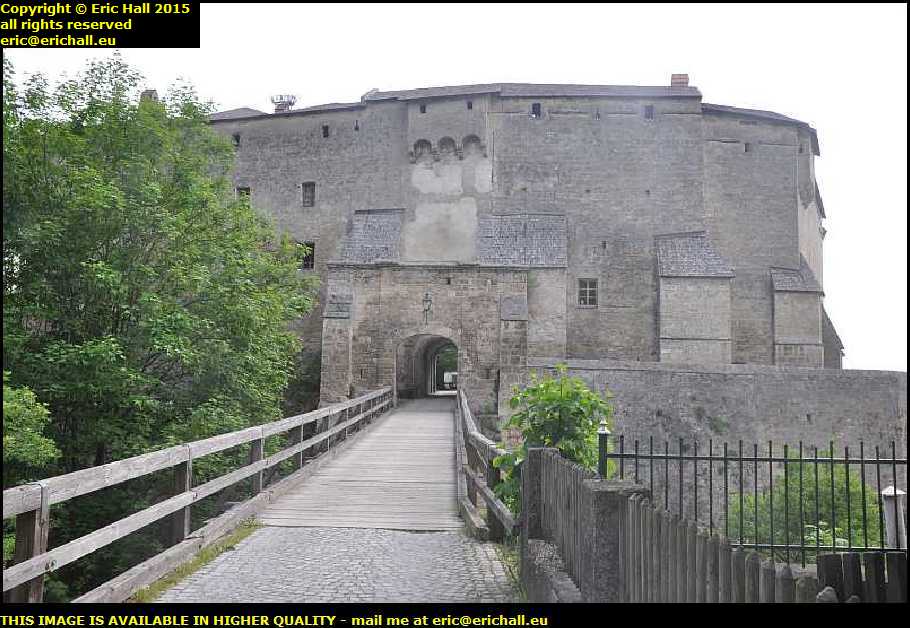
schloss tittmoning prisoner of war camp germany may 2015Finally I made it into the Schloss and had a good wander around.

I did mention last night that it had something of a sinister reputation. This was where British civilian internees, including many people deported by the Germans from the Channel Islands, ended up if they had been naughty, and if they were naughty here, the next (and final) stop was inevitably Buchenwald.

And that does remind me – something I said a few days ago – while many people criticise what they perceive as a lack of resolution by French and other occupied nations, I’ve yet to see one of these critics say anything about a similar stance taken by the vast majority of the (British) inhabitants of the Channel Islands.

schloss tittmoning prisoner of war camp germany may 2015But I digress.

I continue my walk around the Schloss and I’m impressed by the silence here. I seem to be the only person up here admiring the beautiful buildings.

I end up at the museum, because there is a museum on site and, as you might expect, theres a sign “Closed until 13:00”. That was rather odds-on, wasn’t it?

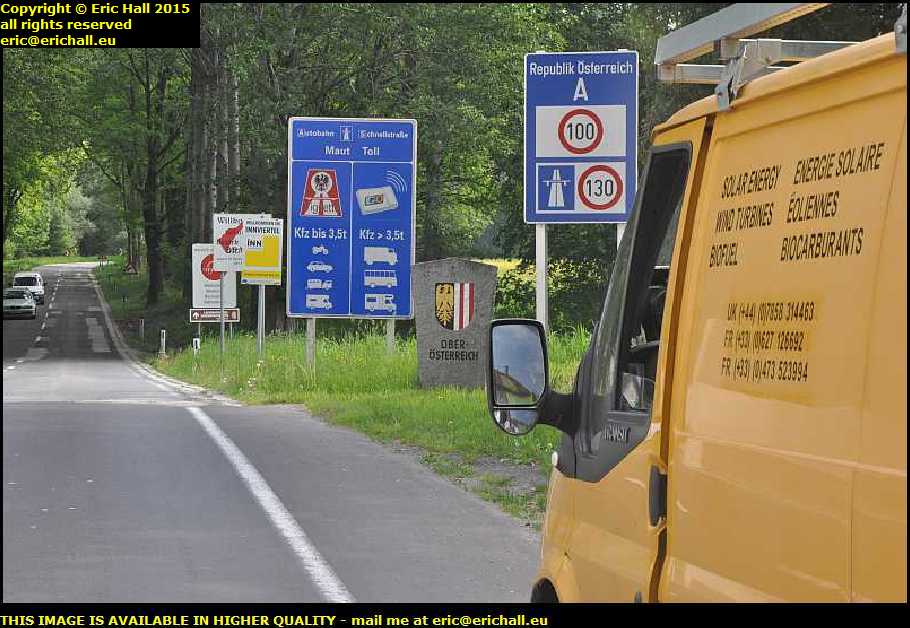
caliburn ford transit crossing into austria may 2015I also mentioned last night that Tittmoning was only about 400 metres from the Austrian border. So with the aim of visiting as many countries as possible, Caliburn and I cross what is a totally unguarded frontier. Hooray for the Schengen Agreement.

And despite the protests from the Lady Who Lives In The Satnav, we continue in Austria for a little while in order to see what is happening, nearly crushing a party of little kiddy learner-cyclists on our way around.

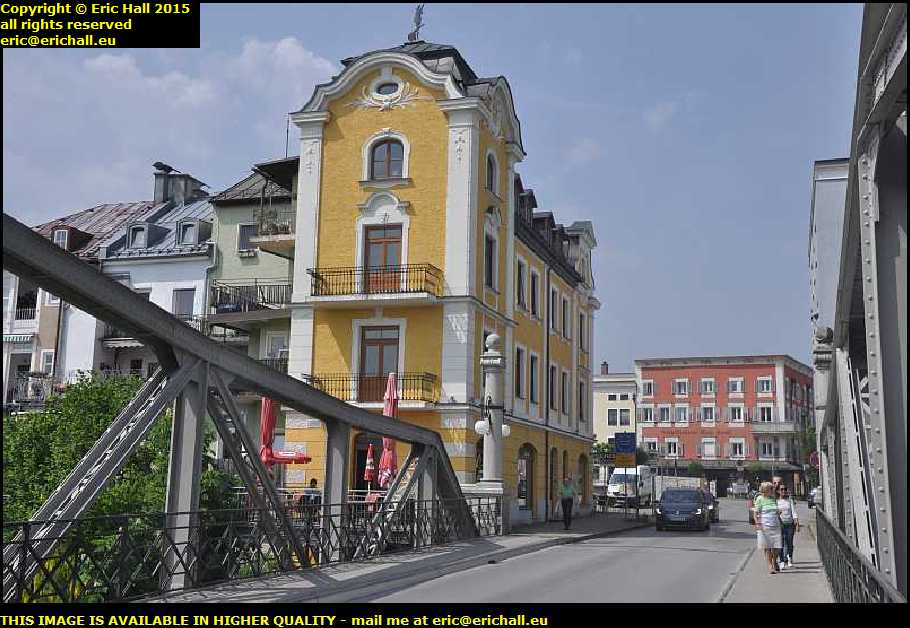
laufen crossing the border into germany may 2015After a drive of about 20 kms we cross back into Germany at the town of Laufen.

This is quite a beautiful little town, right on the border between Austria and Germany, and the two countries are linked by a gorgeous girder bridge. It was built at the turn of the 20th Century and refurbished a couple of years ago.

And if you want to know why I’m being so vague about everything, read on.

walls of laufen germany may 2015Laufen, a beautiful gated medieval city was also the site of a Prisoner-of-War camp somewhere in the vicinity. Oflag VII-C was quite a famous one from which a couple high-profile escapes were made, and which later became a civilian internment camp.

The President of the ruling council of Guernsey was one of the civilian detainees here at Laufen, and Patrick Reid, a Colditz escapee and writer of several books about P-O-W life, including the book on which the film and TV series “The Colditz story” was based, was probably the most famous military prisoner.

historic buildings laufen germany may 2015Not knowing exactly where Oflag VII-C had been situated, I wandered off to the Town Hall to make enquiries. Thats always the first port of call on any occasion such as this.

However, as anyone who has followed my adventures for any length of time might expect, The Town Hall is “closed exceptionally” today and there was no-one there.

No surprise here then.

So that was the end of that then. Back on the road once more, Caliburn and I headed to Eching, in the suburbs of Munich (and only a couple of kilometres from Dachau)

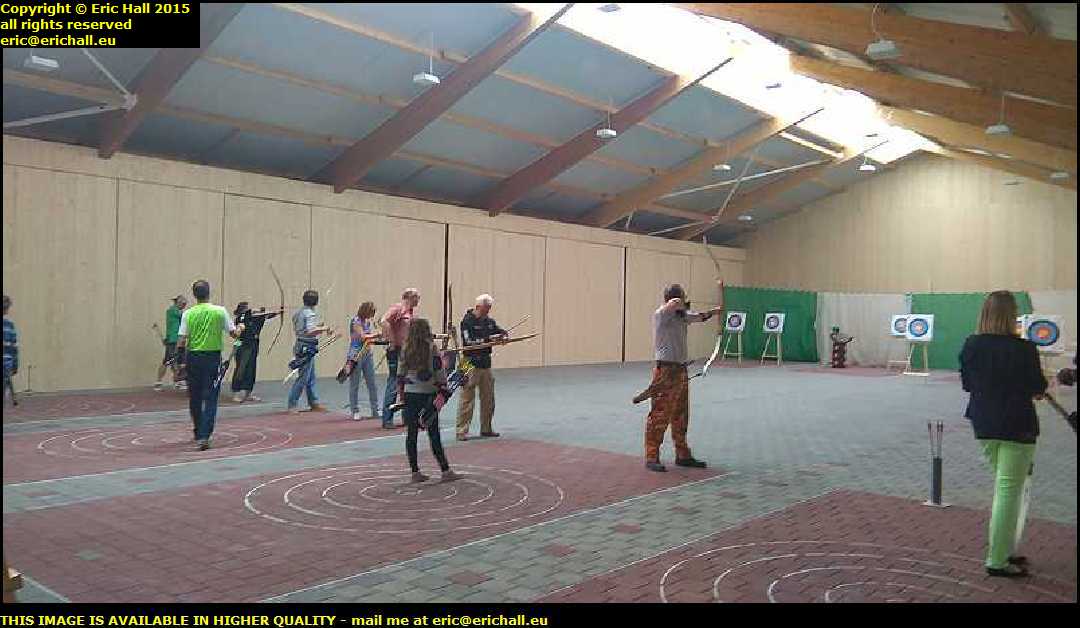
sherwood forest eching germany may 2015My old school-friend Hans runs an archery club, called Sherwood Forest, here and they have recently moved into larger premises.

It was club-night tonight so he took me along to see the activity there and I was quite impressed with the set-up. I was invited to have a go but I declined, not out of fear of showing everyone up by my prowess, but the fact that with a bow and arrow in my hand I’m a danger to everyone around me, except of course the enemy.

Now right at the very beginning, I talked about disasters. And quite right too. because on booting up the laptop to load up todays work, the laptop failed. The thing is only booting up part-way through the notmal opening cycle and then flashing up an error message “Your computer has encountered a problem and must close down. We are collecting details of the error and then your computer will restart”. And then it restarts and at exactly the same point in the boot-up process, it all starts again.

In fact, this is more than a disaster. Its a calamity. And I wish that I knew where all of my old notes were from T223, the Open University’s computer course that I followed, where we learnt (and I have since forgotten) how to hack our way into failed disks and extract all of the information.

All help on this subject will be gratefully received.

Thursday 15th September 2011 – I HAD …

… an absolutely excellent nights sleep last night. Out like a light although I did have to get up to go for a gypsy’s in the middle of the night

This morning however it’s not as gorgeous as all that as far as the weather goes because there’s a low hanging cloud or mist all over the place. Its all grey and overcast and misty damp and clammy not very nice at all.

Nevertheless I managed to make my way to Home Depot where I managed to purchase my weed control blanket, but not a brush-cutter. There was nothing suitable so I’m going to have to see about getting a second hand one. I managed to organise a few other exciting bits and pieces while I was there, including some cheap metal shelving clips that will make nice and ideal straps for holding solar panels on the roof of the car.

I had an interesting chat with one of the sales staff there. He’s called Danny and comes from Croatia. And so we had a good chat about Slovenia, Hungary and Croatia and places like that, reliving old journeys that we had made.

And then down to the University of New Brunswick where to find my way around campus I stopped a girl but she didn’t understand any English. So when I asked in French she didn’t understand any of that either so I asked her what language she did exactly speak thinking that I might summon up something and she said Persian. So how she is going to study in New Brunswick at the English-and-French-speaking University is anyone’s guess.

Its Doctor Chang with whom I need to speak about my wind turbines and he’s not in, as you might expect and so I’m going to have to come back here again. I hope that he will talk to me because judging by the leaflets that I saw about what he has been doing he could be an extremely useful person to know.

And I heard that lorry that sounds like an old Foden 2-stroke diesel when it’s slowing down so I dashed out to see, and it’s a Western Star. Thats not too much of a surprise as at one time Western Star had a major interest in Foden junior’s ERF lorry manufacturing business down the road in Sandbach.

But what has just come around this corner here at these traffic lights is something that I haven’t seen for I haven’t a clue how many years and that is a Honda 6 When was the last time I saw a 6-cylinder Honda. Of course we are talking motor cycles here, in case you are wondering.

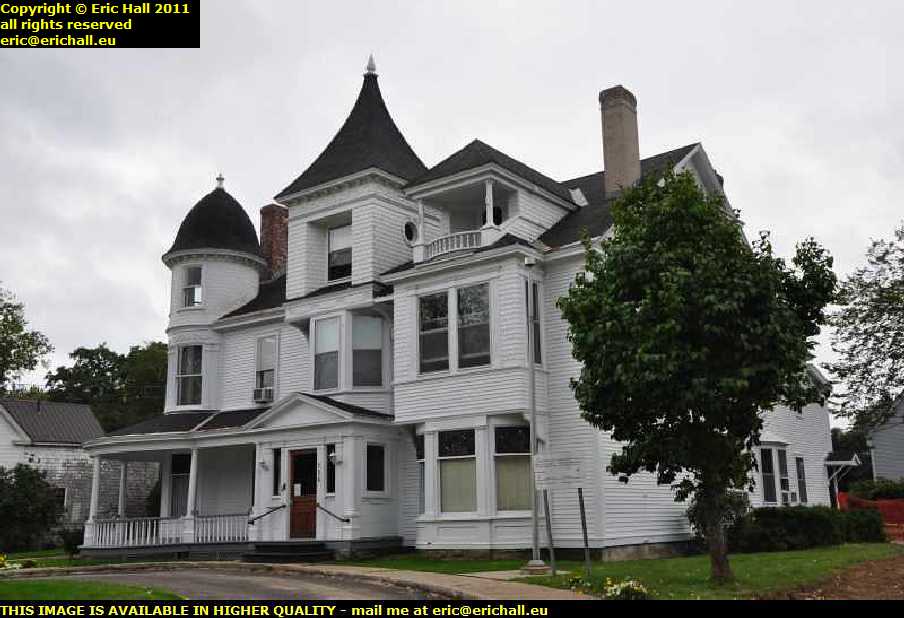
legislative Office of Conflicts of Interest Commissioner fredericton new brunswick canadaSo with a couple of hours to kill, I can go for a wander around Fredericton.

This white building is the legislative Office of Conflicts of Interest Commissioner, and that’s an enigmatic organisation if ever I heard of one. I wonder what he does and what cases he’s considered during his tenure of office.
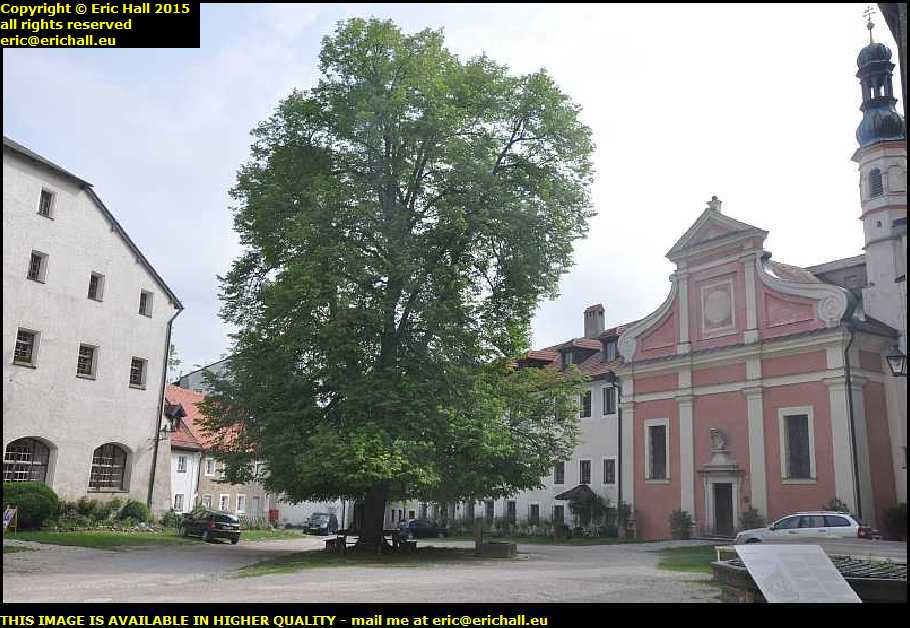
But it is a nice building, isn’t it? I could live in a place like this with its nice round turret

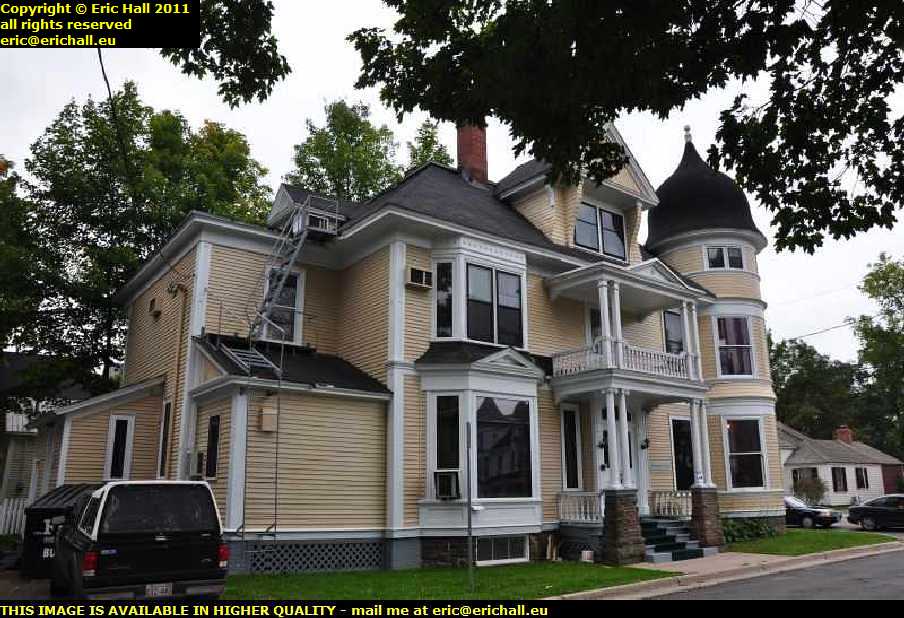
maison jewett house fredericton new brunswick canadaHere’s another nice building almost next door on the corner of King Street and Secretary Lane. And it also has a nice round turret of the type that would appeal to me.

It’s the Maison Jewett House, whoever Jewett was when he was at home if he ever was. Ahhh – yes, he was a local doctor and, strangely enough, he wasn’t the first owner of the house. It’s now being used as government offices

war memorial fredericton new brunswick canadaI always like to have a look at war memorials and Canadian ones are quite surprising to a European such as myself.

In Europe, there are usually at least 5 times more victims recorded for World War I than there are for World War II but here in Canada, the numbers are about equal. However, that’s rather misleading. The population in Canada was much smaller in 1914 than it was in 1939

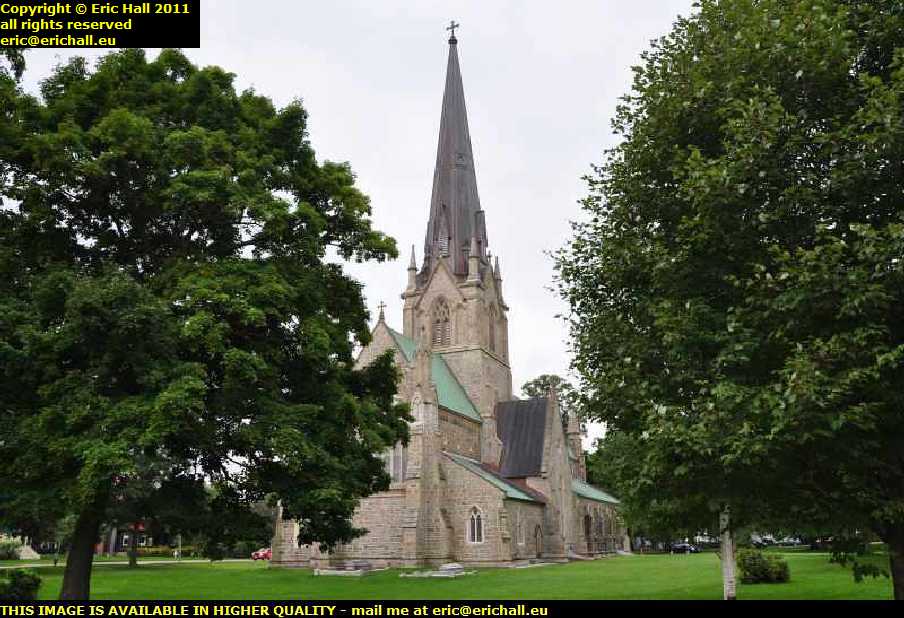
anglican christ church cathedral fredericton new brunswick canadaThis is the Christ Church Cathedral and while I’ve seen many bigger cathedrals than this, I’ve also seen one or two smaller ones.

If you think that it’s small and that you might have seen it before, it’s said to be a copy of St Mary’s church in Snettisham, Norfolk and having seen the church when I visited my friend Lorna who lived nearby, I can see the resemblance.

The cathedral was built between 1845 and 1853, and its claim to fame was that it was struck by lightning on 3rd July 1911. it did make me wonder what they had done in the cathedral to have incurred this sort of divine wrath.

railway bridge across saint john river fredericton new brunswick canadaThere used to be a railway line or two here in Fredericton but today it’s one of two provincial capitals (the other one being Charlottetown on Prince Edward Isle) to have had its railway lines ripped away.

The track bed is now a riverside walk and the bridge across the Saint John River is a walkway and cycle path.

It was on here that someone wished me a “good evening young fellow” so there’s clearly a vacancy for a good optician in the city.

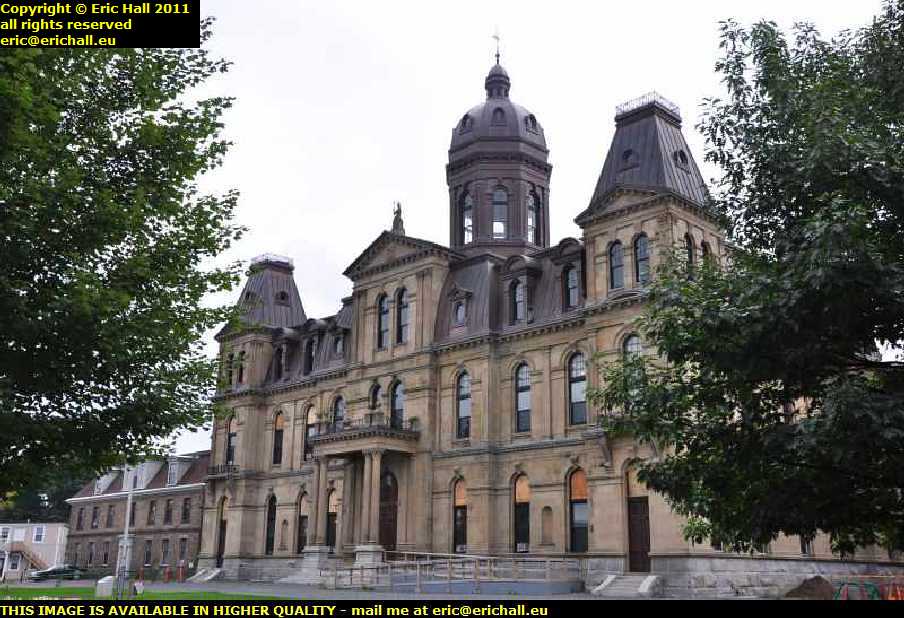
legislative assembly building fredericton new brunswick canadaDown along Queen Street is the Legislative Assembly Building for the Government of New Brunswick.

It dates from 1882 and replaced a previous building which, for the benefit of those of you who have not yet come to terms with life in Eastern Canada, was destroyed in a fire in 1877. The dome, by the way, is over 40 metres high.

To the left is the old Education Building dating from 1816.

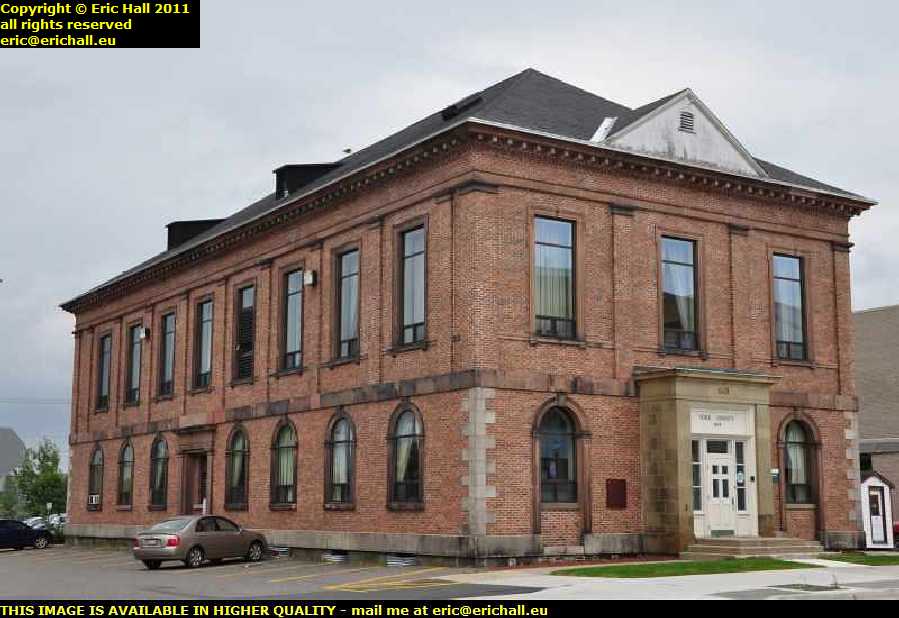
york county building fredericton new brunswick canadaFredericton is actually situated in York County, New Brunswick, and over there is the old York County Building of 1855

It also served as the County Court back in the old days, and what was unusual about it was that back in the early days it had a market underneath with the Court buildings on top. I suppose that if they set up the stocks outside, the spectators wouldn’t have too far to go to find the rotten fruit and vegetables.

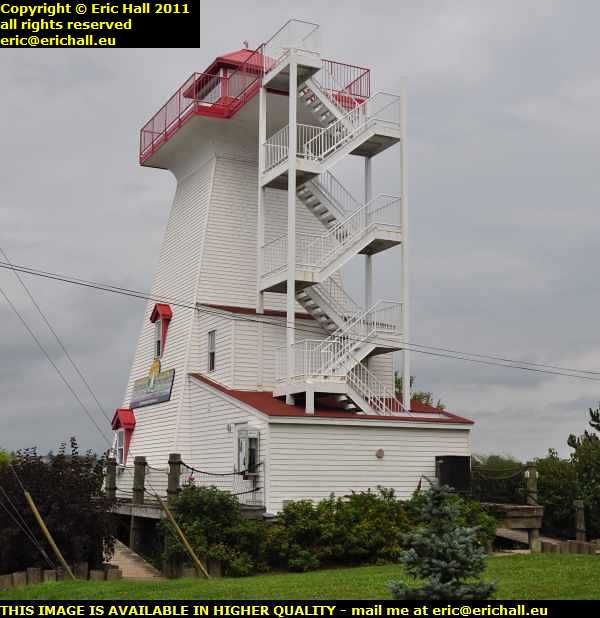
fredericton new brunswick canadaDespite what you might think, this really is a lighthouse. The Saint John River used to be navigable to paddle-wheelers as far upriver as Perth-Andover. There were 21 lighthouses along the river, and this one at Fredericton was the farthest north.

12 of them remain today, of which 7 still serve their original purpose, such is the volume of pleasure traffic that might be found on the river

st dunstans church tow away zone fredericton new brunswick canadaThis is something that really gets on my wick.I always understood that Christians were supposed to turn the other cheek, forgive people their sins, and pardon the wrong-doer. I read nothing in the Bible that states that sinners and wrong-doers would be towed away.

It’s this kind of hypocrisy that brings the church, Christians and Christianity into disrepute. Didn’t St Paul say something about “be not afraid to entertain strangers, for thereby, some have entertained angels unawares”?

museum officers square fredericton new brunswick canadaThis is Officers Square where there is a museum that preserves relics of life in the area in bygone days.

It has a considerable military significance and every day tourists can witness the Changing of the Guard, followed by, at the Royal Canadian Bank down the road, the Guarding of the Change.

There’s also going to be a stage here for the Festival tomorrow.

As far as the festival went, I was at the Hoodoo House tonight.

First on stage tonight was a guitarist called Morgan Davis, and he started off by giving a pro-active demonstration of playing on a cigar box guitar.

Next up was Geoff Bartley, who plays like an early T S McPhee when he lets go and ups the tempo, which is unfortunately something that he didn’t do all that often. But he did let rip with a superb version of Chuck Berry’s “Nadine is that you”.

Rambling Dan Stevens certainly lived up to his name. He a real rambling blues singer who sings just like an old blues singer should. His version of “My Baby Don’t Need No Loving” was excellent and the jam that he did at the end with Geoff Bartley was magnificent.

The main group tonight is Joe Murphy, Garrett Mason and the Water Street band, with a keyboard player who looks just like Mini-Me
. Murphy did a lead-guitar type of thing with bottle neck slider and his guitar fell to bits in the middle of it.

They are pretty good and they really rock when the mouth organ player pi … errr … leaves the stage. He spoils it after a while. You can have far too much of a mouth organ. If he’s not there they are really tight and they really rock. I quite enjoyed them.

And now we have torrential rain storming down outside and one of the venues has been flooded out. I won’t be going for a late-night photography walk-around tonight I’ll tell you that.

And thanks to Dave and his wife from Nottingham and now New Brunswick who looked after me so well here this evening. They have given me quite a few hints to follow up.

Thursday 11th August 2011 – It smells lovely in my room just now.

Seriously – and for several reasons. Not the least being that I cut down all of the herbs that were running riot – 5 different types of herb – and they are all hanging up in here starting to dry off.

And not only that, we have a clean me too seeing as we had a scorching day today and the water in the solar shower heated up quite nicely. And as well as a clean me we have clean clothes and clean bedding too because I did a huge load of washing. Well, seeing as the water in the home-made immersion heater reached 48°C it was rather appropiate.

So apart from that I’ve been working on the website this morning. I’m just about to go into the New Glasgow Industrial Museum at Stellarton. That’s where you will find the oldest steam locomotive in North America, built by Timothy Hackworth in 1839. Hackworth’s main claim to fame was that he designed the Sans Pareil, one of the rivals to Stephenson’s Rocket at the Rainhill Trials.

This afternoon in between the washing I carried on with some tidying up and now that I have space to put things since I’ve put the shelving up in that room over the bread oven. Slowly but surely I’m making a little progress. In another 20 years I might get somewhere. But what I did find was the missing data head for the new anemometer that I fixed on the barn ages ago. However did that find its way onto the floor underneath the Whitworth toolbox? I haven’t moved that for ages.

Talking of the Rainhill Trials by the way, I can’t remember how many locomotives took part but I do know that they were all found guilty.

OK – I’ll get my coat.

Wednesday 10th August 2011 – I had an earlier night last night.

Yes, I was in bed by 01:00, just for a change. And so I was up at a reasonable time, fighting fit.

I’ve now reached the other side of Truro on my web site, heading for the industrial museum at Stellartown. I might even arrive there tomorrow if I’m lucky. But this radio web page is giving me a headache. It’s taking ages to upload the programmes to my website and I’ve absolutely no idea why it should be so. It won’t be finished any time soon.

I’ve also finished (for now, at least) the guttering on the barn roof outside here. That’s all re-positioned so I hope that it works better from now on.

solar panels anemometer les guis virlet puy de dome franceNow this is what I’ve been doing for another part of this afternoon. I’ve fitted the cheap anemometer to the roof of the house. It wasn’t giving me an accurate-enough reading from down on ground level in the garden and I still can’t find the data head for the new one.

Now I bet you will all be wondering how I will be changing the batteries in the unit, seeing as they are up there about 40cms above the roof line. Well, that’s easy. The unit is fitted to a 38mm pole that’s 2.5 metres tall, and that’s fastened into a key clamp on the side of the house. I’ve deliberately set it just outside the window at the top of the stairs outside the door into the attic. To change the batteries, you just slacken off the clamp and the pole slides down the kep clamp, and you lean out of the window to change it.

guttering house les guis virlet puy de dome franceAnd while we’re on the subject of the guttering and the subject of the house roof, then seeing that I had the ladder out for the anemometer, I propped it up against the front of the house and re-positioned the guttering there a little too so that it looks prettier and is (hopefully) more effective.

And so having done all of that with the guttering, I’m intrigued now to see what will happen now when it rains. But it wasn’t going to work today though – for the first time for ages we have had a glorious summer day.

I hope that it stays like this as well.